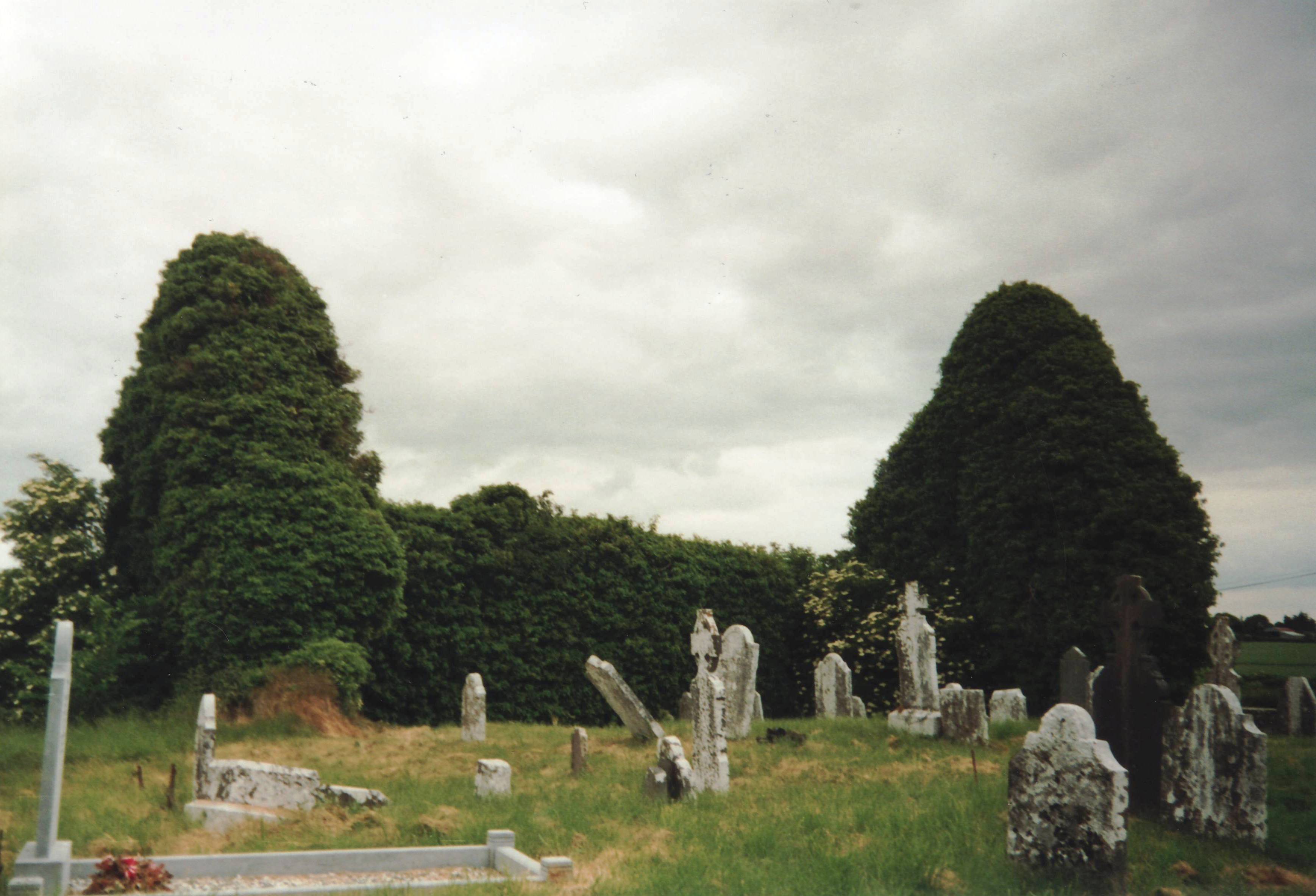
Medieval Pilgrimage at Lemanaghan, Co Offaly

The ecclesiastical settlement of Lemanaghan is one of Co. Offaly’s hidden treasures. There  is so much to say about the architectural remains and the history of the site  and of course its founding saint, Manchan.   I am going to  focus on the evidence for medieval pilgrimage at the site .

In early medieval times  Lemanaghan was  located  in the territory of the Delhna Ehtra tribe close to the border of the territory of the Delbna Ethra  and the Ferceall.   For the modern traveler it is located along the R436   to the east of the town of Ferbane.
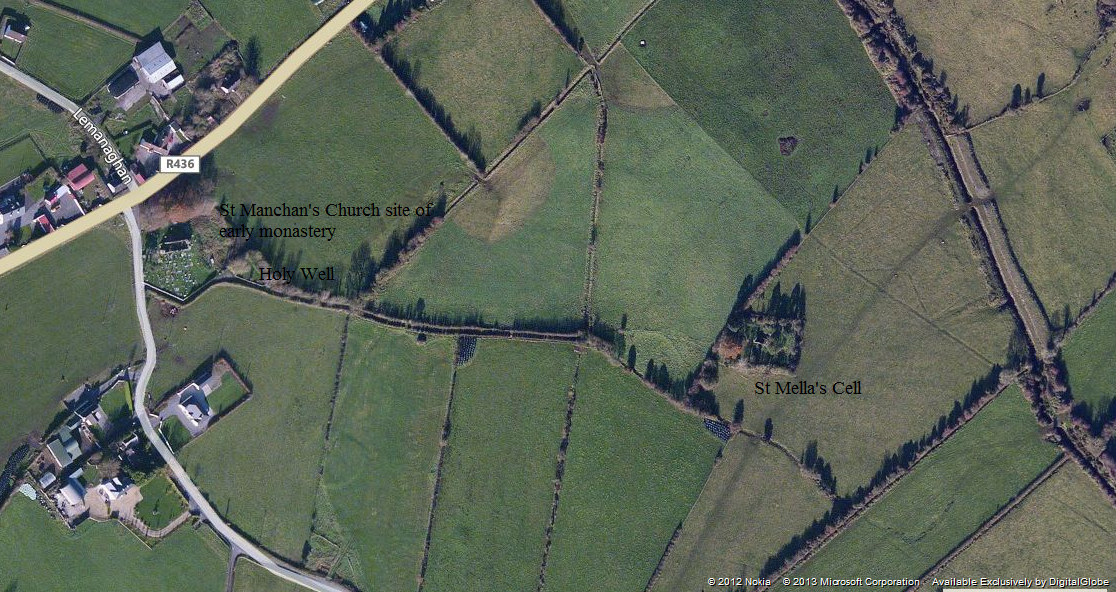
Map of Lemanghan showing  the monastic remains from Bing maps

Map of the ecclesiastical remains a t Lemanghan from Bing maps (http://www.bing.com/maps/)

Lemanaghan was founded in the 7th century after King Diarmaid   son of Aedh Sláine, granted the land of the territory of Tuaim-nEirc (Doimerc) to Clonmacnoise following his victory at the battle against Guaire King of Connaught in 645/646.  It appears  that Manchan a monk of Clonmacnoise, founded a sister monastery  here  at Liath-Manchain  ” the grey place of Manchan” (Lemanaghan is the anglicized version ). There are a number of traditions  concerning the geneology St Manchan.  One tradition  suggests he was a member of the Ulaidh of Ulster while another suggest he a was a member of the Eoghanachta of Munster and another that he  was from Wales.  The saint was credited with writing many poems during his lifetime .  Manchan is also associated with the Mohill in Co Leitrim where local tradition holds he  founded a monastery here before heading to Lemanaghan. Manchan died in 664/665  having caught the yellow plague that raged through the country. This is the same plague which killed St Féichín of Fore.
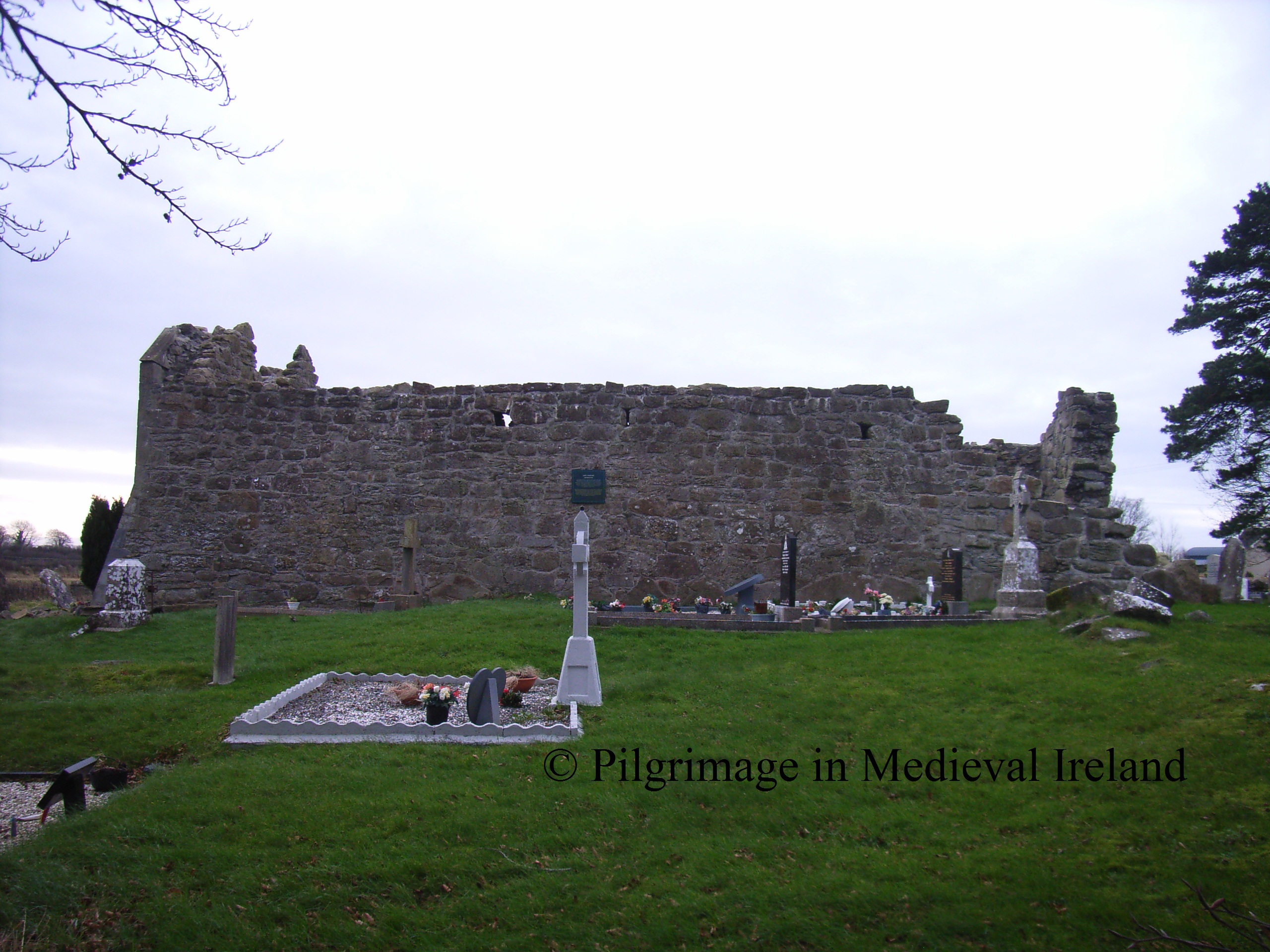
RIMG1613

St Manchan’s church at Lemanaghan

The modern landscape of green fields that surround Lemanaghan  would not  have been the lanscape encountered by  early and later medieval travelers & pilgrim’s.  The modern landscape surrounding Lemanaghan  is  a product of  modern intensive peat cutting.   Originally the monastery  was  founded on a  natural island of dry ground surrounded by  raised bogs. Monahan writing in 1863 describes the site as follows;

Standing on a low swell, an armlet of well-reclaimed bog, it gently rises above the extensive moors with which it is almost surrounded.

This doesn’t mean the Lemanaghan was isolated  from the rest of the world. It was linked  to other settlements in the area in particular Clonmacnoise , and the wider world  through a series of bog roads and tracks . Excavations carried out in the surrounding landscape have identified several roads and tracks many  dating to the 6th and 7th centuries when the monastery was founded.  The excavations also show that roads and tracks were being built and repaired around Lemanaghan up to the 17th century, suggesting it was a focal point in the landscape throughout the medieval period.  Thus its location was not a barrier to pilgrims and visitors.

Little physical evidence remains of the early monastery with the exception of a number of early medieval cross slabs ( two of which are found with St Manchan’s church and ten others housed in national school), a large  bullaun stone (beside the holy well) and a holy well dedicated to St Manchan.  The   annals  list the names of several abbots of the monastery ( in the years  717, 767, 792, 853, 893, 1205). The fortunes of the monastery declined in the later medieval period.  By 1302-6  Lemanaghan became a parochial church.  The papal taxation records,  record that there were no returns from the vicarage of Lemanaghan as it had been ‘laid to waste by the ravages of war’.  St Manchan’s Church  continued in use probably until 17th century and  by 1682-5, the church was recorded as being in a ruinous condition, with church services being held in a nearby house.
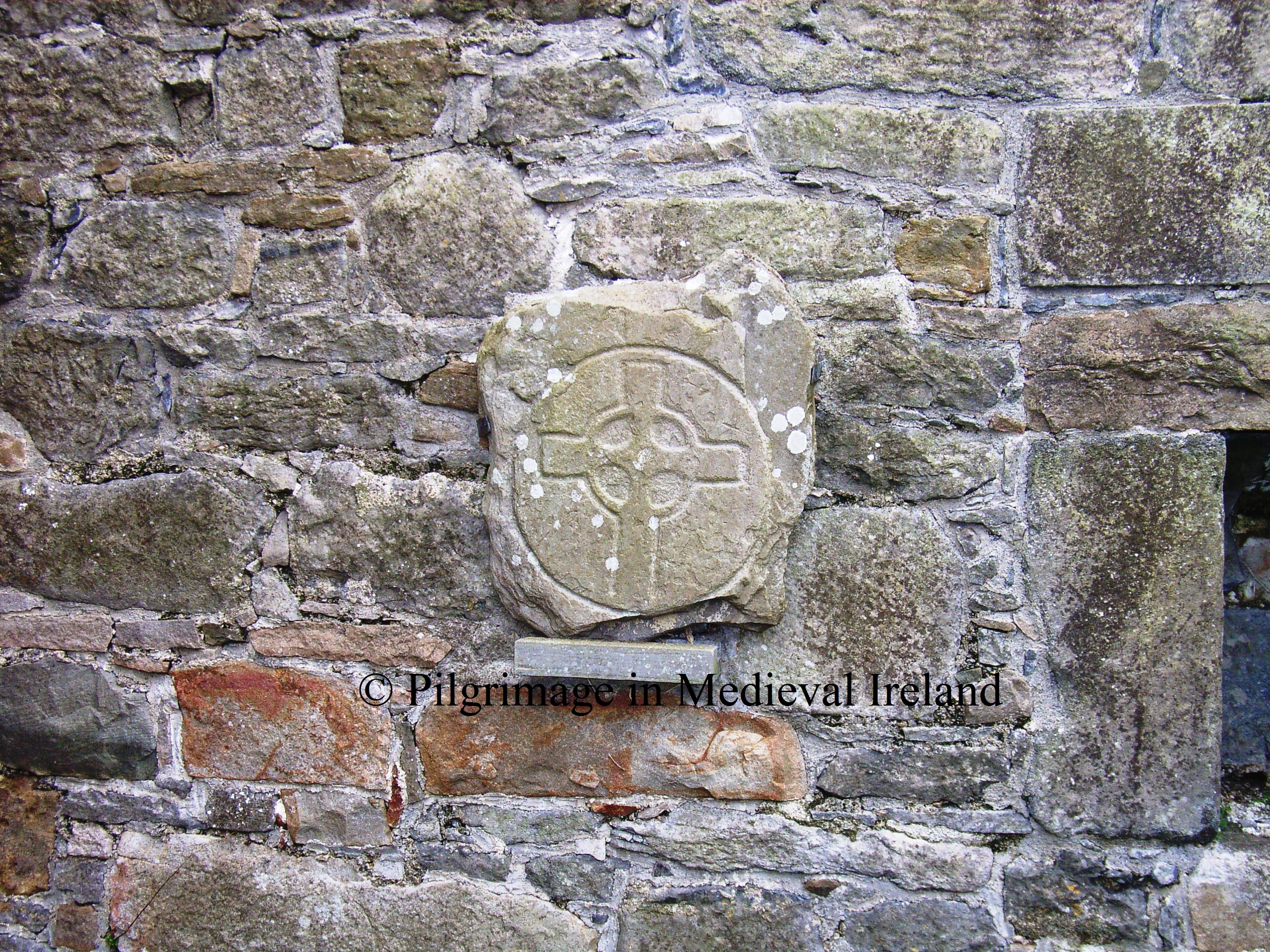
RIMG1615

Early medieval cross slab within St Manchan’s church

The main monastic complex  was located at the site of   the modern graveyard. All that  remains  today of this once vibrant monastery  are  two structures called St Manchan’s church and St Manchan’s house.

St Manchan’s church  was built-in  two phases, the  west end dates to the 12th century.  Further building work was carried out in the 15th century at the eastern end .  The  western end of the building  is the oldest with  traces large limestone blocks in its  lower walls and a large Romanesque doorway of 12th century date marks the  entrance in west gable.  A  round-headed Romanesque window also survives.
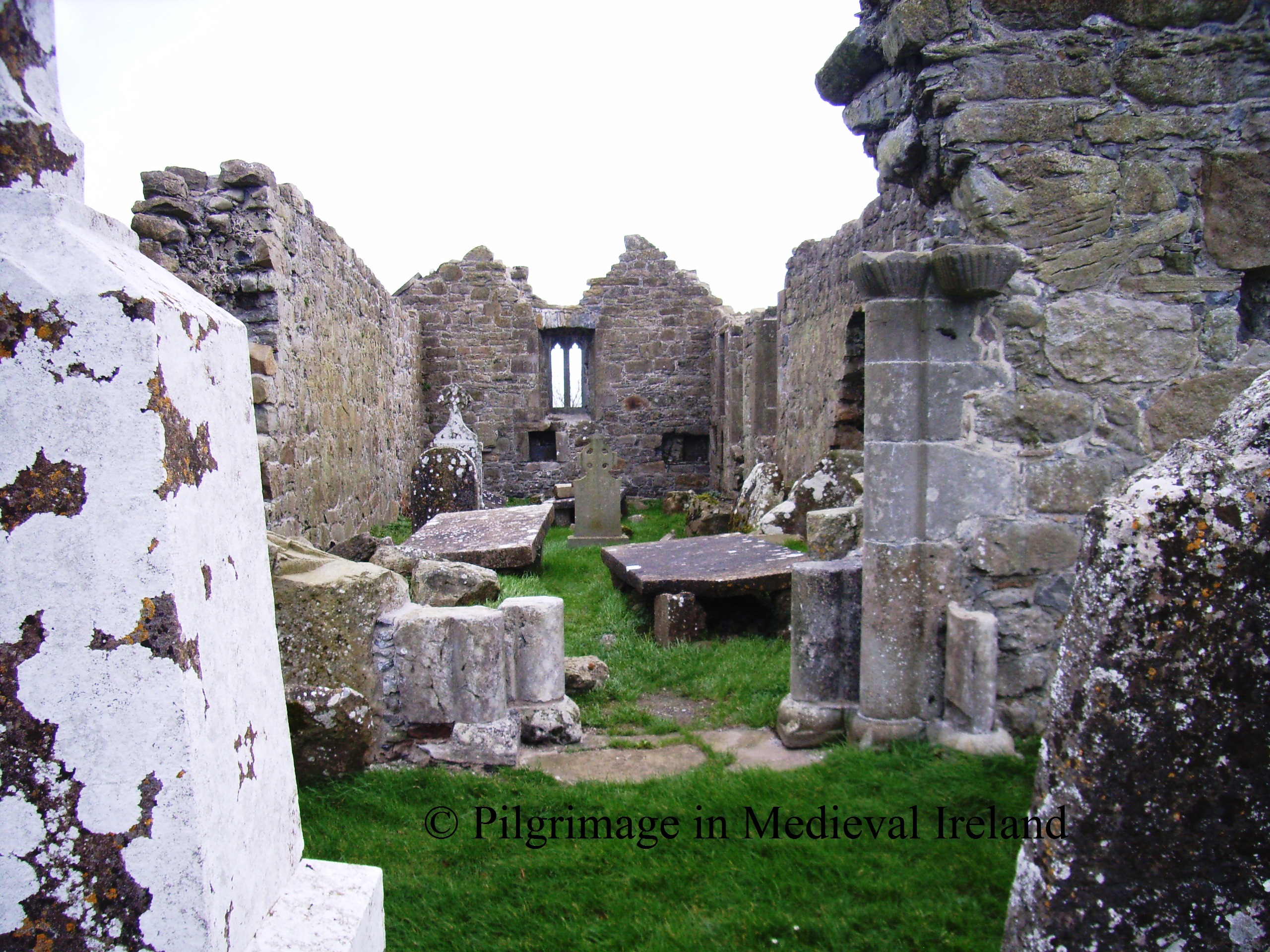
RIMG1627

Romanesque doorway at St Manchan’s church

Little remains of the second structure called St Manchan’ house, with  only the foot prints of the foundations   visible, the Archaeological Inventory of County Offaly suggest that it is  likely contemporary with the 15th century section of St Manchan’s church.
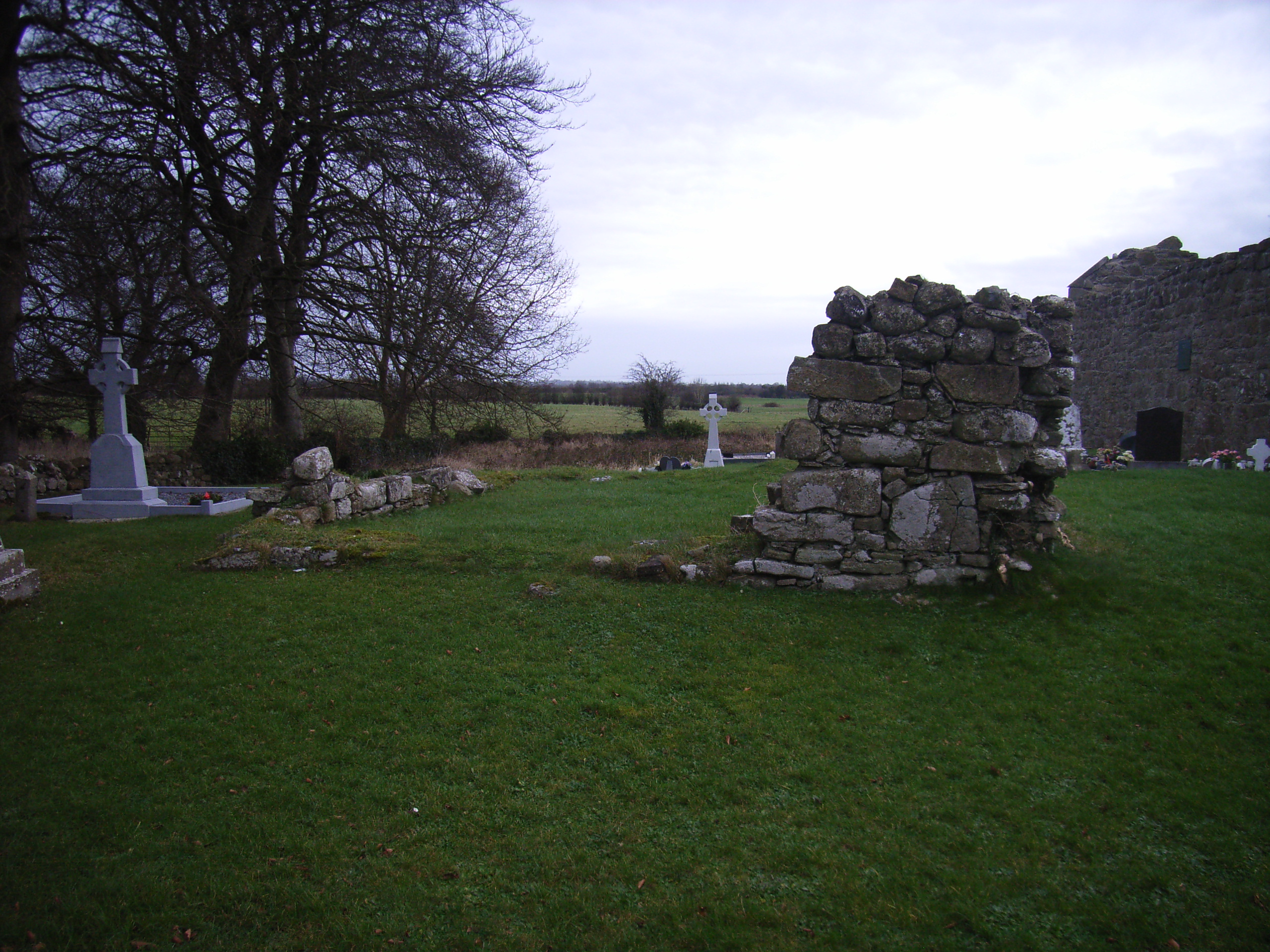
St Manchan's house

A third church  known as St Mella’s cell,  is located  approximately 350m to the  east.  The site is connected to the main monastic centre  by a narrow paved causeway. Local folklore recounts  that  depressions visible   in the surface of the paving stones of the causeway were  caused by  the saints cow.  St Mella was Manchan’s mother and  tradition suggest she  live here as an anchorite. The present church may have been built on the original cell.
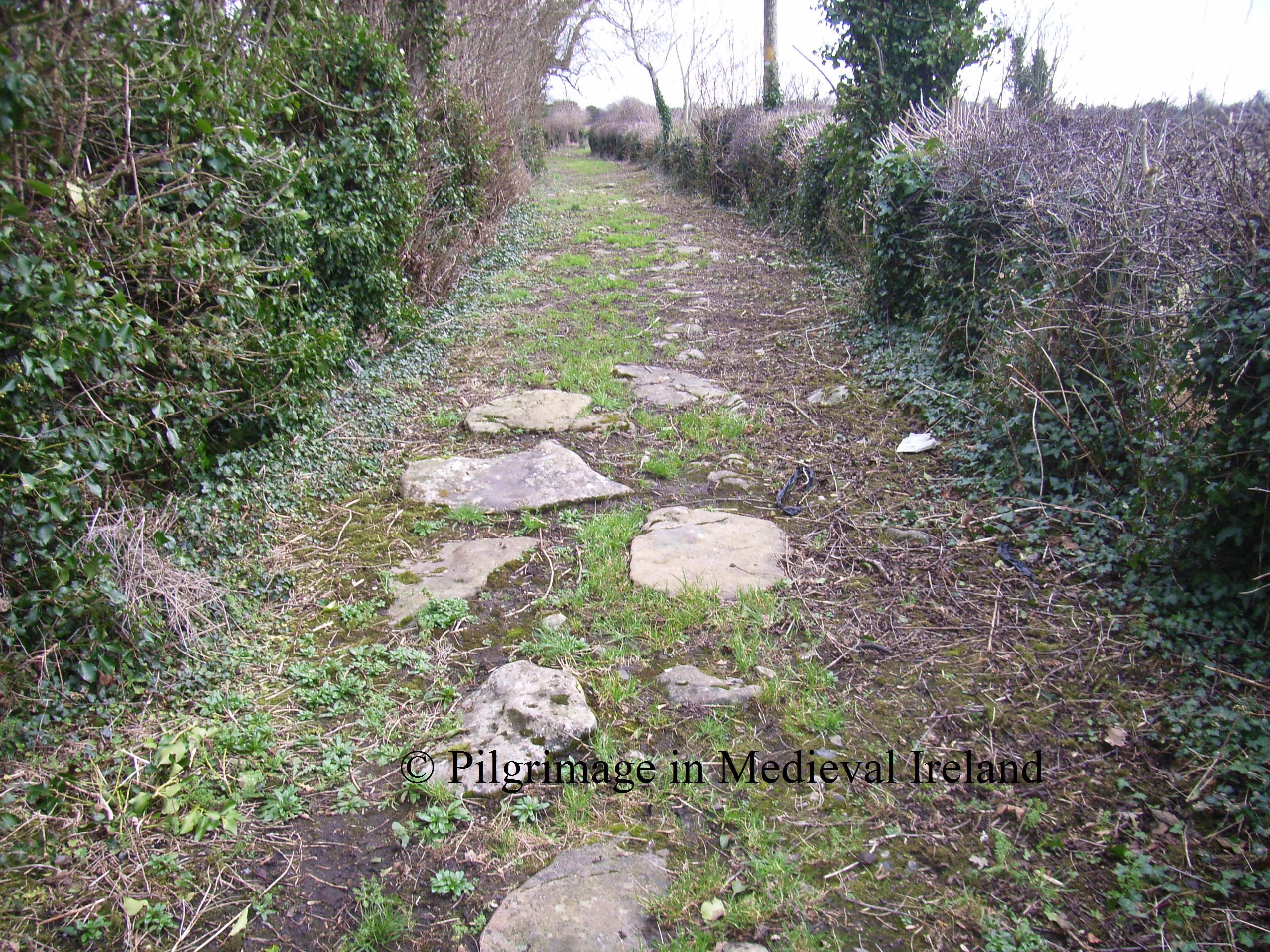
RIMG1636

Causeway leading to St Mella’s Cell

St Mella’s cell  is quiet small measuring  5.5m x 3.1m internally. The walls are  0.8m thick  and constructed  of large  what look like really large cut stones.  These stones are in fact thin slabs set on edge  in the manner of facing stones and the core of the wall is filled with stone rubble. This type of building technique is common in pre-Norman Irish church building.  The church is surrounded by  its original rectangular-shaped enclosure (43m E-W by 35.5m north-south).
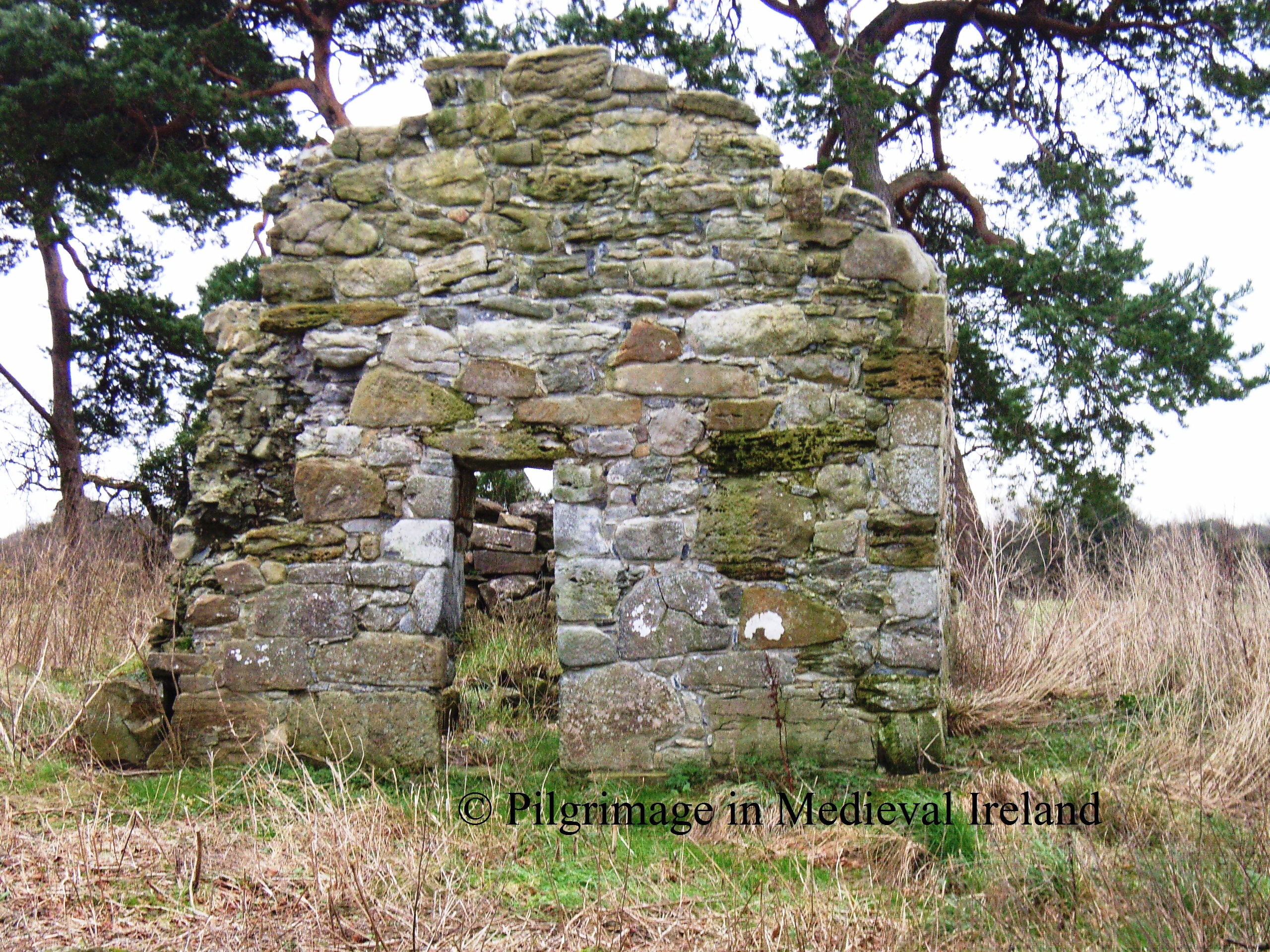
RIMG1646

Evidence for Pilgrimage

So what can we say about pilgrimage at Lemanaghan in medieval times?  Pilgrims came here to venerate St Manchan and the anniversary of  the saints  death on the 24th of January would have had a special appeal for pilgrims.  Pilgrims  probably  first began coming here following Manchan’s death.  Given Lemanaghan   proximity and close connections to Clonmacnoise,  the site likely attracted pilgrims heading to Clonmacnoise and to other sites such as Durrow and Rahan, acting as a secondary shrine.  Manchan was probably buried here we have no way of knowing if the saints grave had an appeal for pilgrims.  From the 12th century  onwards  a reliquary known as St Manchan shrine   would also have attracted pilgrims.
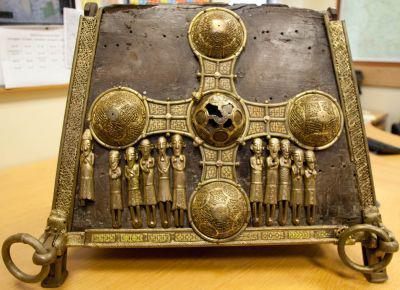
The shrine was   commissioned by High King of Ireland, Turlough O’ Connor and  was reputed to house the bones of St Manchan  and manufactured at Clonmacnoise. The annals for 1166 state

The shrine of Manchan, of Maethail (Mohill), was covered by Ruaidhri Ua Conchobhair , and an embroidering of gold was carried over it by him, in as good a style as a relic was ever covered.

This reference likely refers to the Lemanaghan shrine  although it is possible it may refer to second shrine now lost, that existed at Mohill.  Fragments of bone possibly from the saint were found within the shrine.  From the sparse references that exist the shrine appears to have  been  housed near the high alter of St Manchan’s church untill  as late as  the 17th century. It was later moved to the parish church at Boher where it remained until it was stolen last year. Thankfully the shrine was recovered the next day. St Manchan’s shrine is one of the finest  medieval reliquaries to survive in Ireland and its loss would have been significant.

St Manchan’s shrine is what is known as a   house- shaped shrine and resembles the pitched roof of  church or oratory. The shrine  is made of yew wood ( 48cm tall by 40 cm wide by 61cm long) and decorated with highly decorated bronze figures and bosses and  sits on four feet. The shrine was portable  which meant it could be  carried in processions. Four metal loops are found at each corner which allowed wooden poles to be treaded through.  A reliquary procession may have formed part for the pilgrim rituals on  the more important days in the pilgrim calendar such as the saints feast day. It likely that the date of the translation of the saints relics to the shrine would also have been a special day in the pilgrim calendar.

In modern times a piscina   (a shallow basin placed near the altar  of the church  used for washing the communion vessels), at the east end of the south wall of St Manchan’s church   became  a point of modern devotion. Votive offerings such as  coins, pins  and a small plastic statue of Christ are left  behind by modern pilgrims.
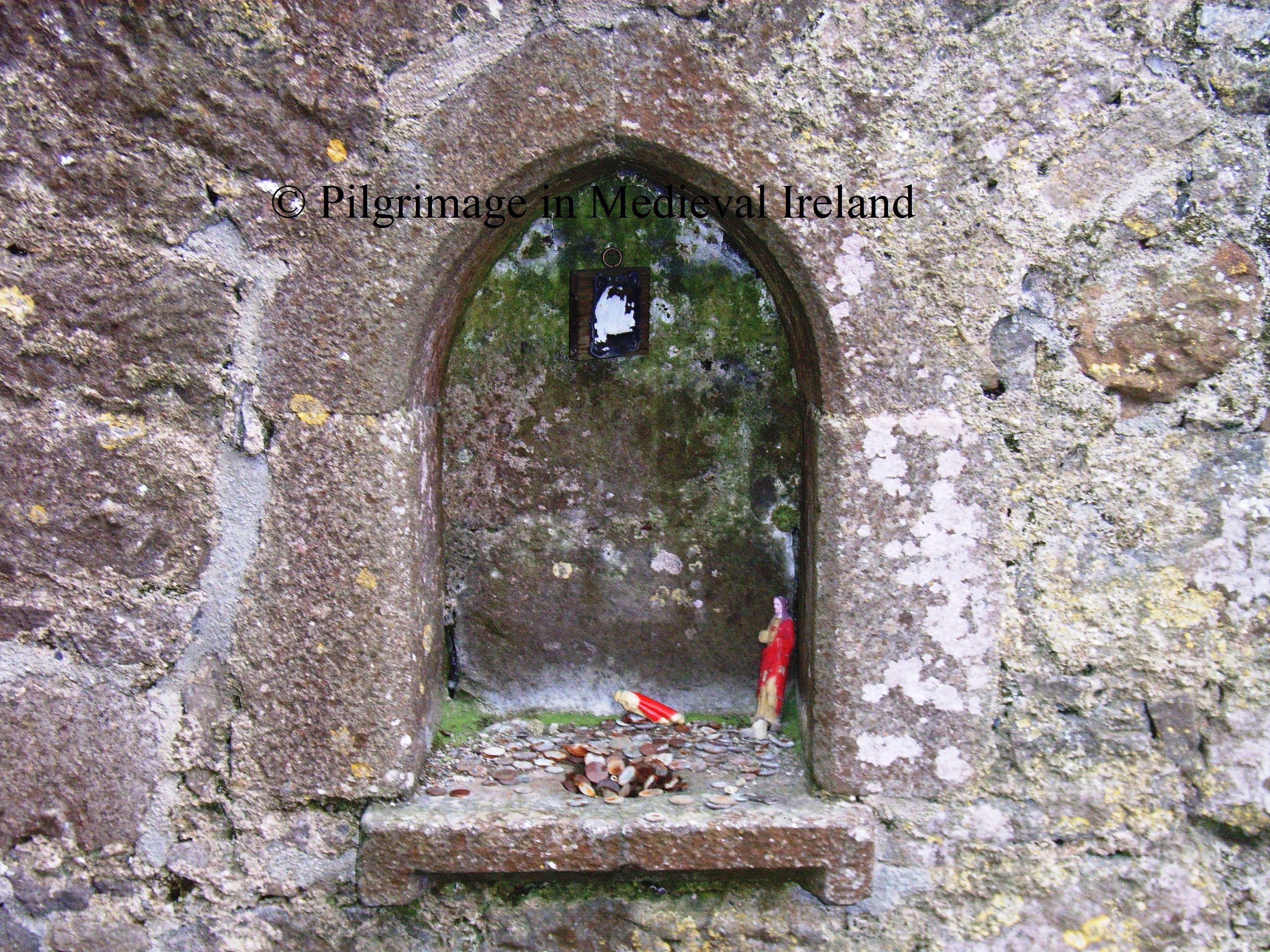
Piscina fille with votive offerings

Piscina with votive offerings

Apart from the  aforementioned reliquary, pilgrims would also have visited St Manchan’s holy well.  According to  Monahan writing in 1886  there were  three wells at the site

to which the blind, lame and persons afflicted with other chronic diseases, come on the anniversary of the patrons saint’s death.

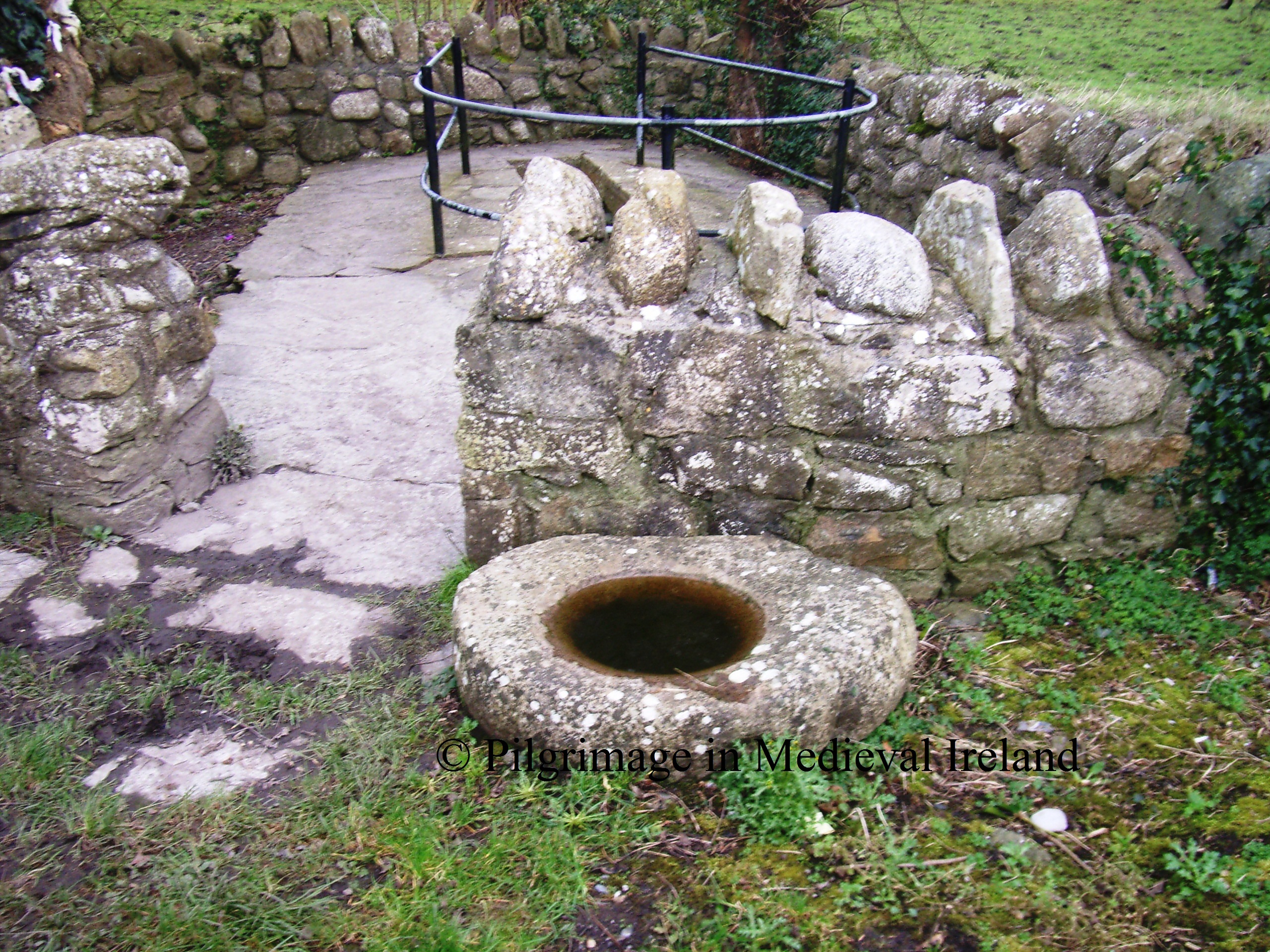
Today only one well holy well  remains, it is located close to  the main monastery beside the paved causeway  that connects the main monastic site with  St Mella’s church.  A large bullaun stone and rag tree are also associated with the well.
RIMG1628

Bullaun stone at St Manchan’s holy well

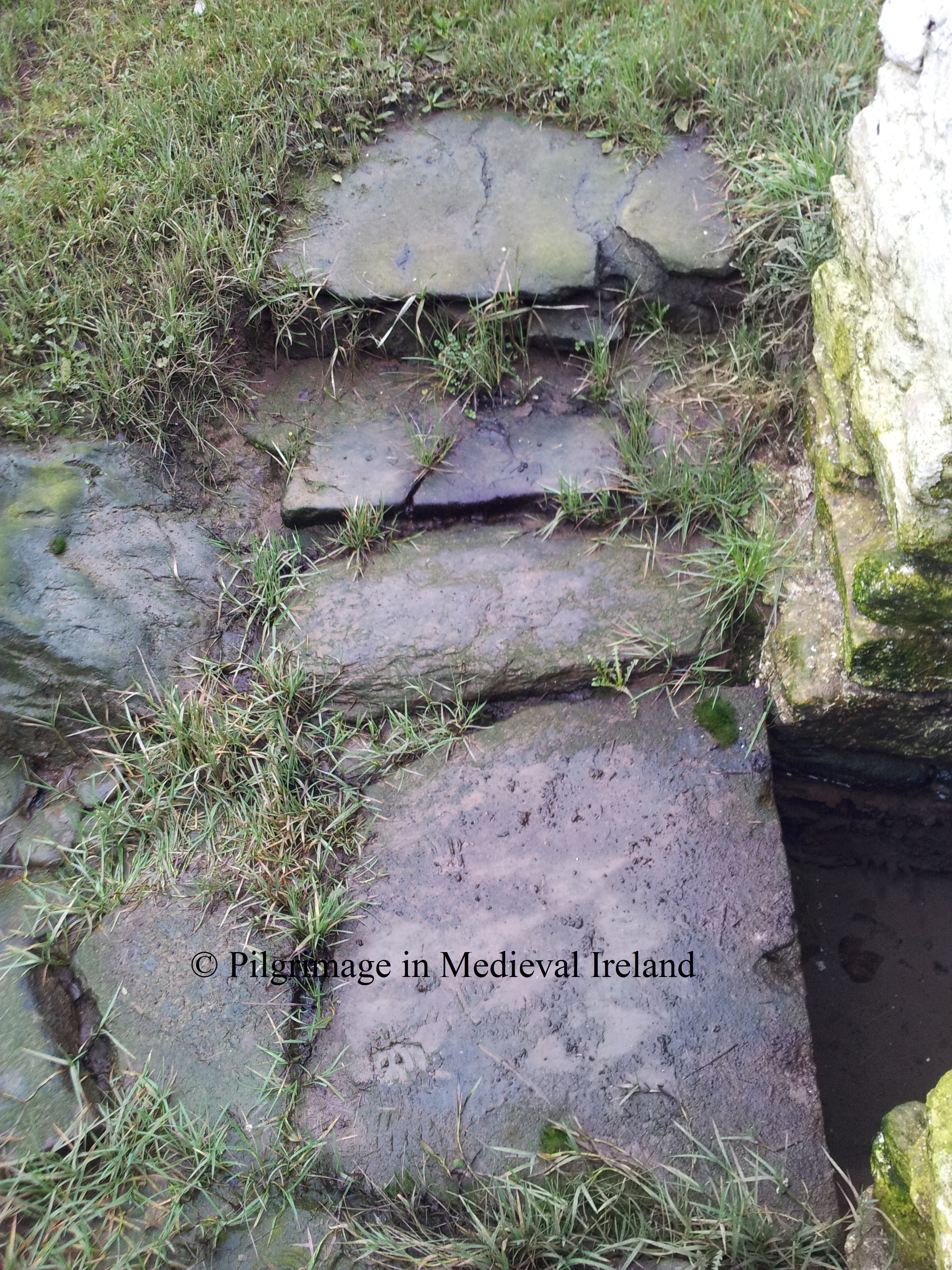
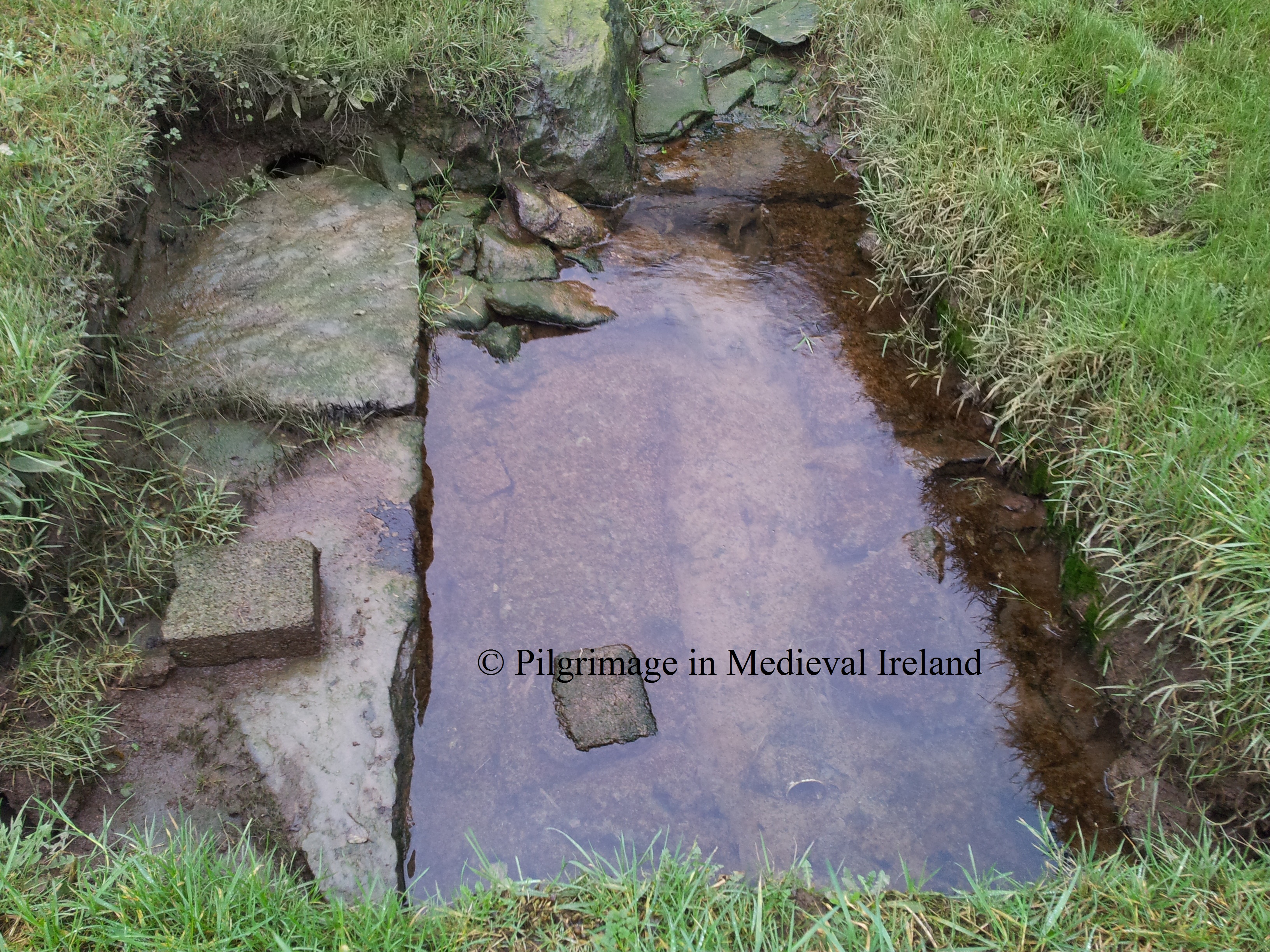
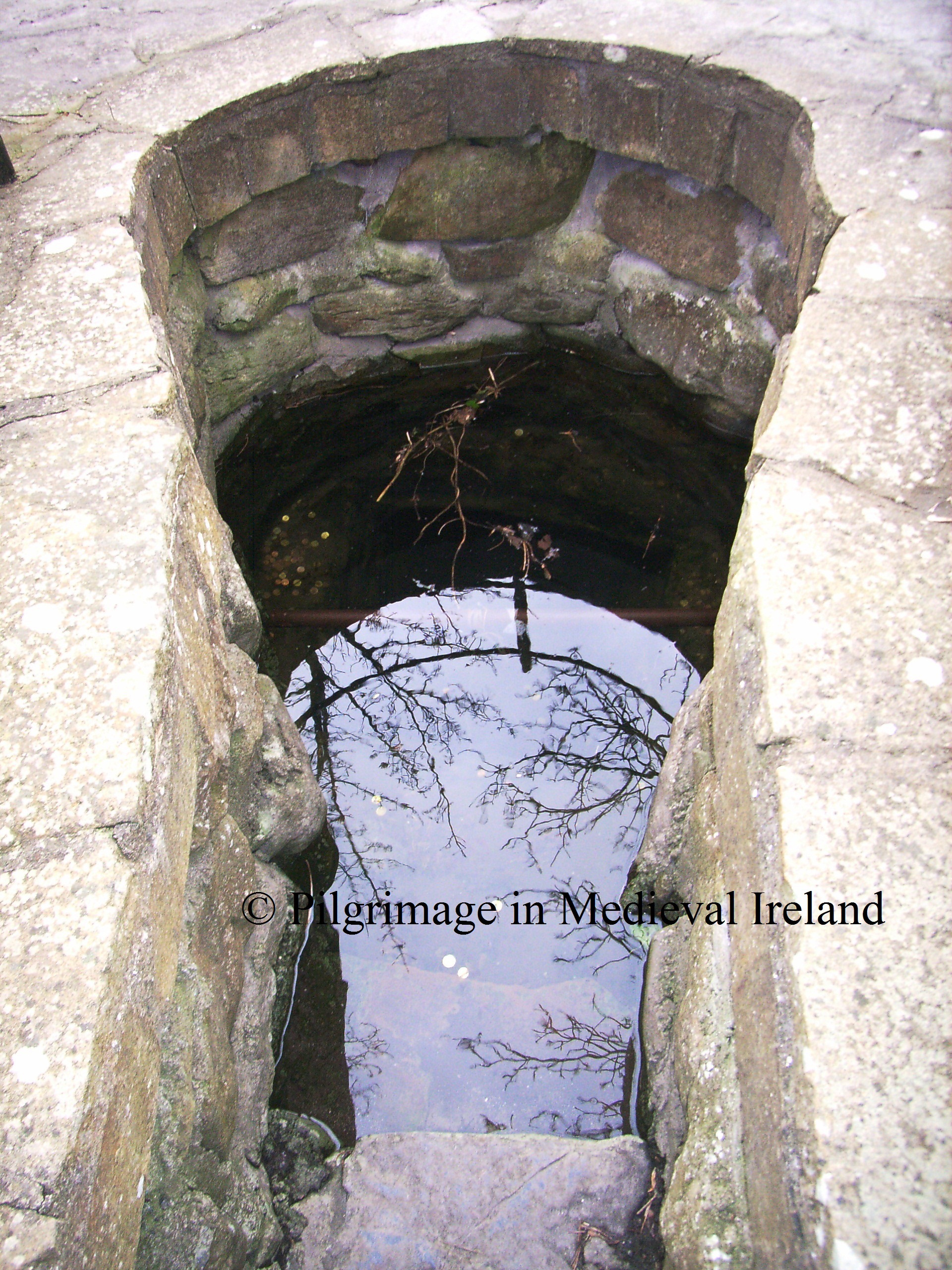
The wells at Lemanaghan may have been a focus of pre-Christian devotion and were christianised when the monastery was founded. The origin  legend for the well tells that  St Manchan struck a rock with his staff and water poured forth.  Another version of the tale states that an existing  well  was blessed by him.  Today people  visit the well throughout the year but the 24th of January the saint’s feast day still has a special appeal.  The  present  well, a natural spring,  is a product of   restoration work carried out  during the 1930s.  Four grave slabs in upright positions were revealed, set out in a cruciform pattern. The spring is enclosed by a stone wall ( key hole shaped) and accessed by series of steps. The surrounding area has been paved. The base of the well is full of coins left by modern visitors to the well.
RIMG1634

St Manchan’s well

The waters of the well are reputed to cure   nearly every ailment is cured , but particularly neuralgia, cancer and warts. The folklore suggests that for a  person to be cured they must apply water to the affected part and walk three times around the well. Beside the well is a misshapen ash tree, covered in rags, handkerchief, rosary beads etc. There is  local  tradition of taking pieces of wood to protect the home.  Similar  practices occur at other sites church as St Moling’s well at Mullinakill Co Kilkenny, where the wood of the tree beside the well is supposed to protect against fire.
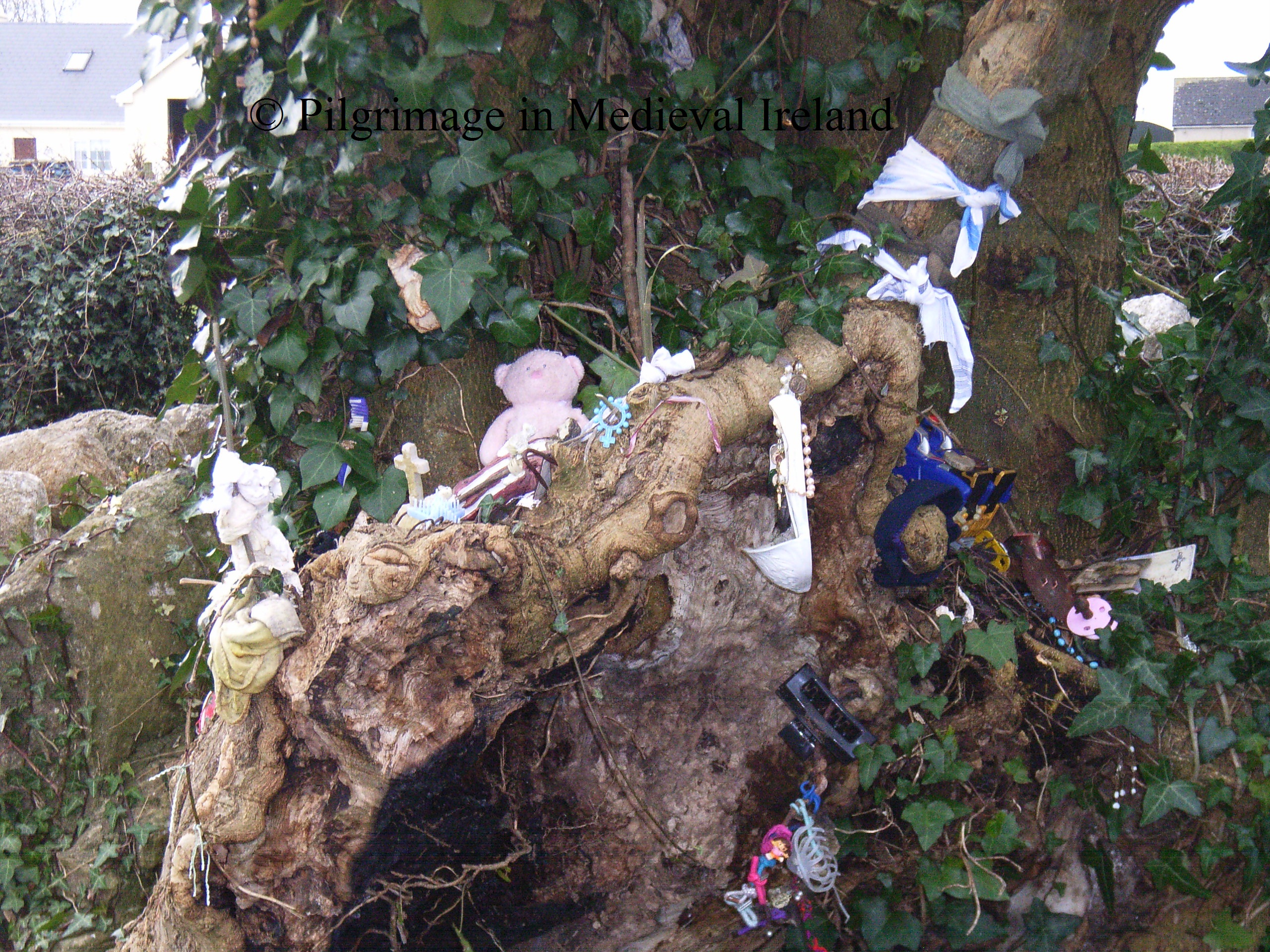
RIMG1631

Rag tree beside St Manchan’s holy well

Like most sites we can only get a  glimpse of the medieval pilgrimage tradition  here, through the centuries  pilgrimage has continued and adapted  to the modern pilgrim landscape which focuses on the  piscina within the church and the holy well and rag tree.  I think Lemanaghan was a pilgrimage site in its own right with St Manchan attracting pilgrims  from the locality and beyond but it may have also acted as a secondary shrine for pilgrims enroute to Clonmacnoise & Durrow. If you want to find out more about the site and its history check out the sources listed below.

© Louise Nugent 2013

References

Crawford,  H. S. 1911. ‘The early slabs at Leamonaghan, King’s County’, JRSAI, xli,  151-56.

De Paor, L. 1998, ‘The Monastic ideal; a poem attributed to St. Manachan’ in Ireland and Europe,   163-169.

Fitzpatrick,  E. & O’Brien, C.  1998.  Medieval churches of County Offaly.  Dublin: Government of Ireland.

Graves, J.1874, ‘The Church and Shrine of St. Manchan’ JRSAI, xiii , 134-150.

Monahan, J. 1886. Records relating to the dioceses of Ardagh and Clonmacnoise. Dublin : M. H. Gill and son.

O’Carroll, E. 2001. The Archaeology of Leamonaghan: the Story of an Irish Bog. Dublin.

O’Riain, P. 2011. The dictionary of Early Irish Saints. Dublin : Four Courts Press.

O’Brien, C. &  Sweetman, D. P. (eds) 1997.  Archaeological Inventory of County Offaly . Dublin : Stationery Office.

http://www.logainm.ie/Viewer.aspx?text=lemanaghan&streets=yes

Medieval pilgrimage in honour of St Féichín and the ‘ Seven Wonders’ of Fore, Co Westmeath

Today is the feast day of  the  7th century St Féichín. What follows is a short account of the saints life and the history  for pilgirmage  to his shrine at Fore, Co Westmeath.

St Féichín was born in Billa in the townland of Collooney in Co Sligo and his cult is represented in the area by a number of places dedicated to him, such as  St Féichín’s well in the townland of Kilnamonagh and St Féichín’s Bed in Collonney .

Féichín  became a  student of St Nathí of Ardconry  and  went on to found  a number of churches   around Ireland such as  Fore Co. Westmeath,  Cong in Mayo, Omey & High Island in  Co Galway  and Termonfeckin Co Louth . His cult  also speard to  Scotland  and a monastery dedicated to him was founded at Arbroath (where he is known as St Vigean).   The annals tell us St Féichín died in AD 665  at Fore, having caught the  Yellow Plague, which was raging through Ireland at the time.  His Life notes that at the time of his death 300o monks resided at Fore.  It is very interesting that tradition held he was buried ar Ciarán’s church or Castlekeeran near Kells Co. Meath instead of Fore.

A Brief  Description of the Ecclesiastical Remains at Fore

This post will focus on the evidence for pilgrimage at Féichín’s  monastic site of Fore.

First edition Ordnance Survey map  of Fore

1st ed. Ordnance Survey map of Fore

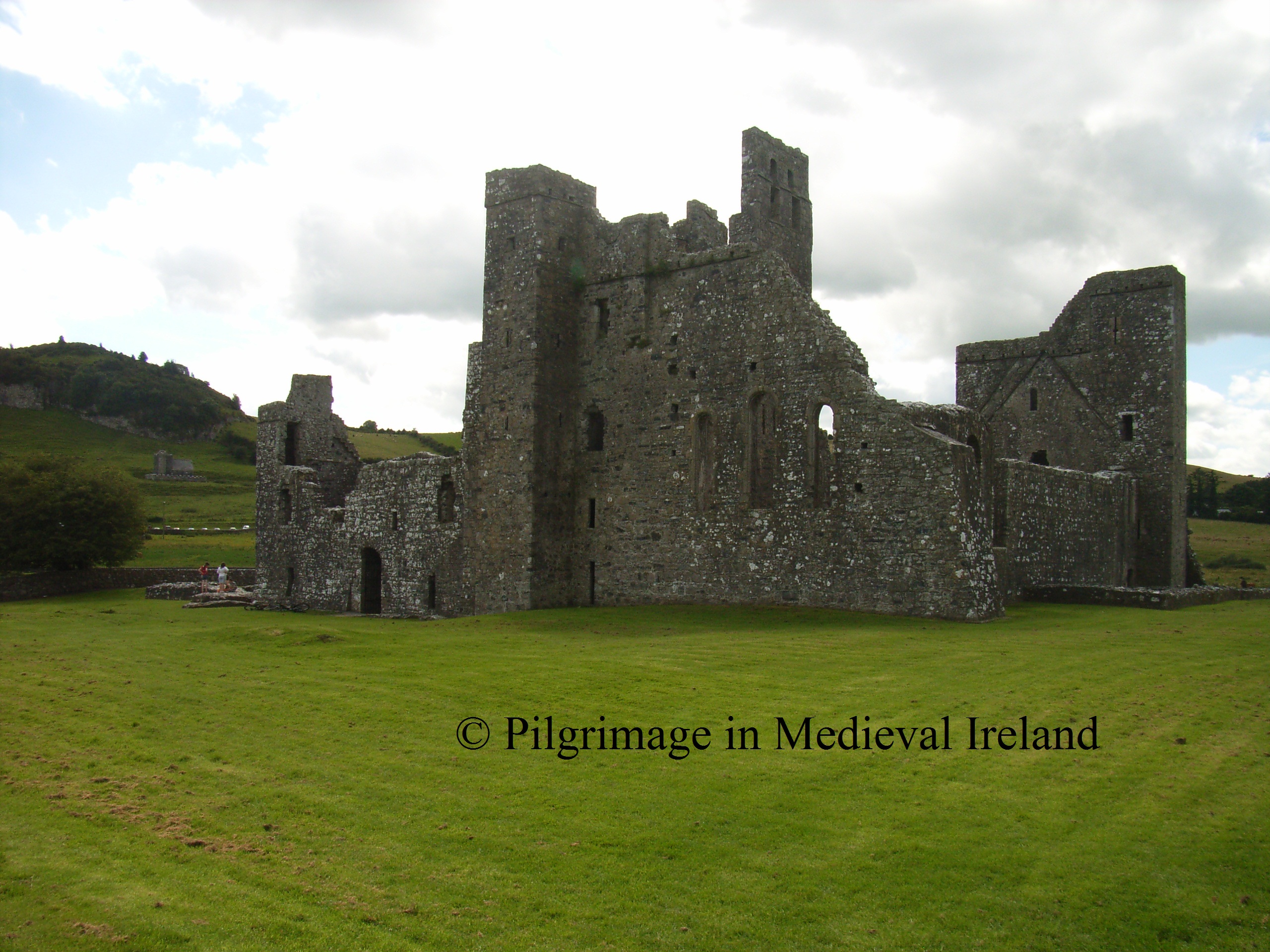
Fore is located in a valley,   the archaeological  remains  consist of an early medieval church and cross located on the rocky slopes of the valley. On the valley  floor are the ruinous remains of  a  Benedictine monastery,   a Norman Motte,  fragments of a medieval town wall and  up to 14 wayside or boundary crosses scattered around the valley.

The original  early monastic site  was located  on a north facing terrace on the west side of the village.  Today all that remains are  a 10th century church  known locally as St Féíchin’s church. The church sits within a historic graveyard with a medieval cross.

Medieval cross within the graveyard at St Féichín's church

Medieval cross within the graveyard at St Féichín’s church

Close by are  the remains of  a mill  and  two holy wells  called  Tobernacogany and  Doaghfeighin.

On a terrace above the church  a 15th century tower with an  anchorite cell  that is attached to a 19th mausoleum for the Grenville-Nugent family.

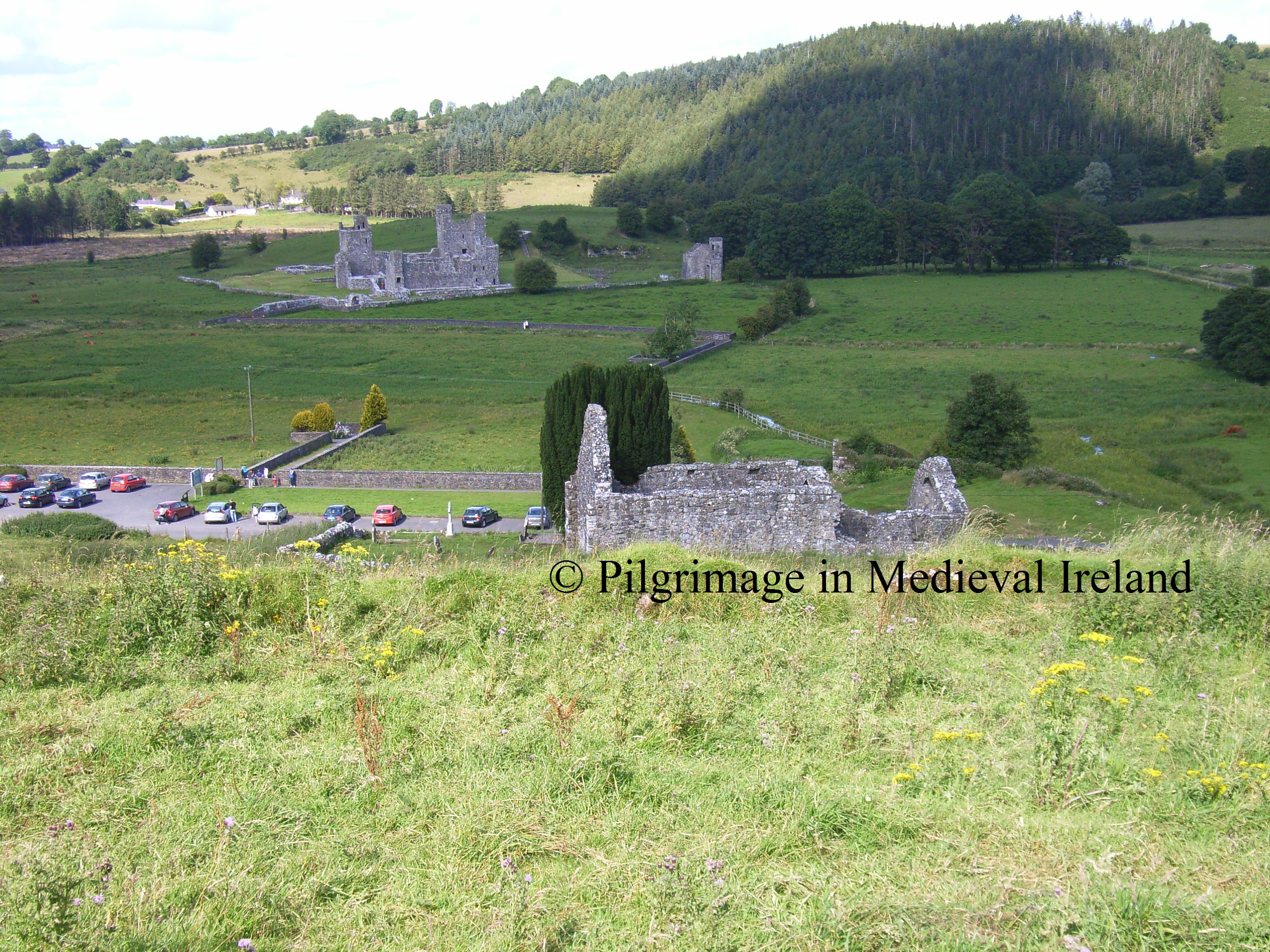
View of the early monastic site at Fore

View of the early medieval  St Féichín’s church. The  19th century mausoleum is located on the terrace above St Féichín’s church.

During the 12th century the area fell into Anglo-Norman control and  a Benedictine abbey was founded on the valley floor by Hugh de Lacy. The abbey was dedicated to St Taurin and St Féichín and was a dependant of  St Taurine’s monastery at Evreux in Normandy.

Benedictine Priory at Fore

Benedictine Priory at Fore

Pilgrimage at Fore

Details of the medieval pilgrimage at Fore are very  sketchy and uncovering the pilgrimage rituals are  difficult. The earliest written evidence of pilgrimage dates to AD 1607 when Fore is listed among the 12 Irish sites  granted a plenary indulgence to the faithful, by Pope Paul V.  The indulgence related to specific days Corpus Christi and the feast of the Annunciation.  Given the popularity of the cult of St Féichín  in early medieval times,  pilgrimage at Fore  is likely to be much much earlier. The Life of St Féichín records many miracles by the saint during his life time and pilgrims likely came here  in the years following the saints death.

There is a tradition associated with the Fore  known as   the  Seven Wonders of Fore;

1. The anchorite in a stone

2. The water that will not boil

3. The monastery built on a bog

4. The mill without a stream

5. The water which flows uphill

6. The tree which will not burn

7. The stone lintel raised by the saint’s prayers.

 ‘Wonder’ number 2 & 6  relate to the holy well called  Tobernacogany . In the 19th century pilgrims performed stations here on the 20th of January the feast of St Féichín, St John’s day, the 24th of June and on St Peter’s day the 29th of June. It was recorded that following devotions the pilgrims would drive a coin edgeways into the ash tree beside the well.

Rag tree at St Féichín's well / Tobernacogany

Rag tree at Tobernacogany

It was said that the wood from this tree wouldn’t burn and the water from the well would not boil. The well itself was known to cure headaches and toothaches.

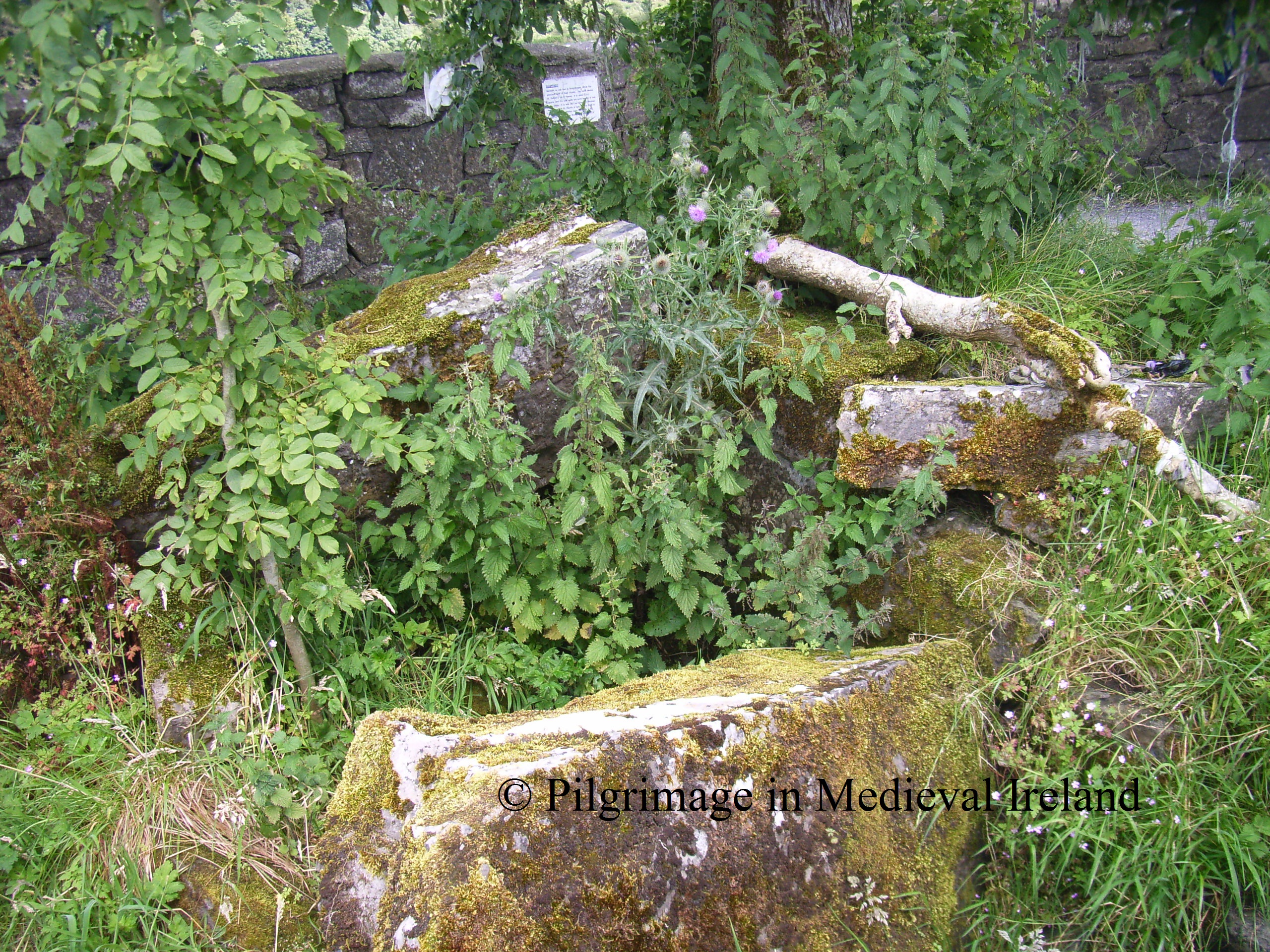
Another focus of 19th century devotion was Doaghfeighin or St Féichín’s Vat or Keen. This is a spring  which is defined by large stones arranged like a box. When I visited here the well was dry.

RIMG1405

Doaghfeighin (Feichin’s Vat)

Tradition holds that St Féichín would kneel and pray here. In the past  delicate and sick  children were immersed here in the water to obtain a cure through the  invocation of St Féichín.  A similar practice occurred at Glendalough during the 19th century when pilgrims would immerse sick children in a pool called St Kevin’s Keeve. Both wells are likely to have been a focus of   early  and later medieval devotion.

RIMG1403

Rag tree beside Doaghfeighin

The first ‘wonder’  the anchorite in a stone  likely refers to the anchorite cell attached to the 15th century tower. Within the mausoleum is  a stone which records the death of the last anchorite of Fore,  Patrick Beglan who died in 1616. This cell doesn’t appear to have been part of the  medieval or the 19th century pilgrimage stations.

Tower connected to ancohorite cell

Tower, Anchorite cell  &  Mausoleum

The third ‘wonder’ the monastery in a bog  refers not to the early monastic site which is located on the slops of the valley but the later Benedictine foundation location on the valley floor. Monasteries built on within bogs are not unusual in early medieval Ireland and Lemanaghan Co Offaly and Monaincha in North Co Tipperary are just two examples.  During the later medieval period the monastery would have been in possession of any relics associated with St Féichín.

View of benedictine Priory in the valley floor

View of Benedictine Priory in the valley floor

The ‘Wonders’ number 4 and 5,  the mill without a stream and  the water which flows uphill all refer to the   monastic mill, the ruins of which are still visible. This building stands on the original mill built by the saint.  According to local tradition the mill   was in use until 1875 when it was replaced by another mill.

RIMG1400

The mill  was  powered by an underground stream  which flows into a  now silted up triangular-shaped mill-pond.  The name Fore in Irish Fobhar means spring. The origin legend of the mill tells  that the saint decided to build a water-mill,  his carpenter scoffed at the idea of building the mill where there was no water. The saint

resorted to the lake, took his staff, flung it into the lake, which forthwith drove it against the side of the hill, which the staff at once pierced, cutting its way through the stone cliffs, drawing the waters of the lake after it, and coming out a mile distant at the exact point where the mill had been erected. And now came the punishment of the mill wright. He had gone to sleep in the mill when the saint departed to the lake. The wondrous staff, however, brought such a volume of water along with it that the mill was filled, and the sleeping millwright drowned, in punishment of his scoffing incredulity. St Fechin relaxed however, and when he had given him this severe lesson, miraculously restored him to life…

Geraldus  in his history of Ireland   written in the 12th century mentions the mill of St Féichín at Fore  and  notes  the prohibition against women entering either the churches or the mill.

RIMG1439

St Féichín’s church showing the large lintel over the doorway

‘Wonder’ number 7  refers to the enormous lintel over the door of St Féichín’s church .  Tradition records that this lintel was placed in position by the miraculous action of St Féichín himself.

According to legend when the church was being built the workmen had been labouring for hours striving to raise it, but to no avail. St. Féichín told them to go home to breakfast, and then began to  pray.  After some time spent in prayer, the saint took the stone in his arms, and without any difficulty placed it over the doorway.

With regards to  modern pilgrimage here. The rag trees beside the Tobernacogany and Doaghfeighin are covered in rags which suggests there is still a strong   local devotion to both  wells.

In 2010 a large-scale pilgrimage took place here. The Westmeath Examiner  for  2010 recorded  this  pilgrimage was to  commemorate  ‘the Jubilee Pilgrimage, and also to celebrate the year of the priesthood and as a preparation for the Eucharistic Congress in 2012′   Approximately 400 people from 9 parishes came here for this pilgrimage on May 23rd 2010.

The pilgrimage consisted of   the   Blessed Sacrament being brought in procession from Fore Church to the ruins of the Abbey,’ a trip which took over an hour’ . The   Blessed Sacrament was then carried along the walkway to the Abbey and around the Abbey. The nine parishes took turns carrying the Monstrance in procession with prayers read throughout and choirs from the nine parishes lead by Fore Choir.’ The paper also notes Local schools also prepared large banners which the children carried in the procession.

© Louise Nugent 2013

References

Ó Riain, P. 2011. A Dictionary of Irish Saints. Dublin: Four Courts Press.

Sharkey, O. 2004. Fore and Its  Ancient Buildings. Mullingar: Magpie Publications

Stokes, G. T.1892. ‘St Feichin of Fore and his monastery. JRSAI 12, 1-12.

http://www.westmeathexaminer.ie/news/roundup/articles/2010/05/27/3997364-big-turnout-for-fore-pilgrimage-of-hope-and-healing Accessed 15/01/2013.

St Bartholomew’s Holy Well Kinsalebeg, Co Waterford.

Yesterday I visited my first pilgrim site of 2013, St Batholomew’s holy well or Tobar Phárthanáin. The well is to be found  in the  parish of Kinsalebeg in Co Waterford, a short distance from the village of Pilltown and a few miles from the town of Youghal.

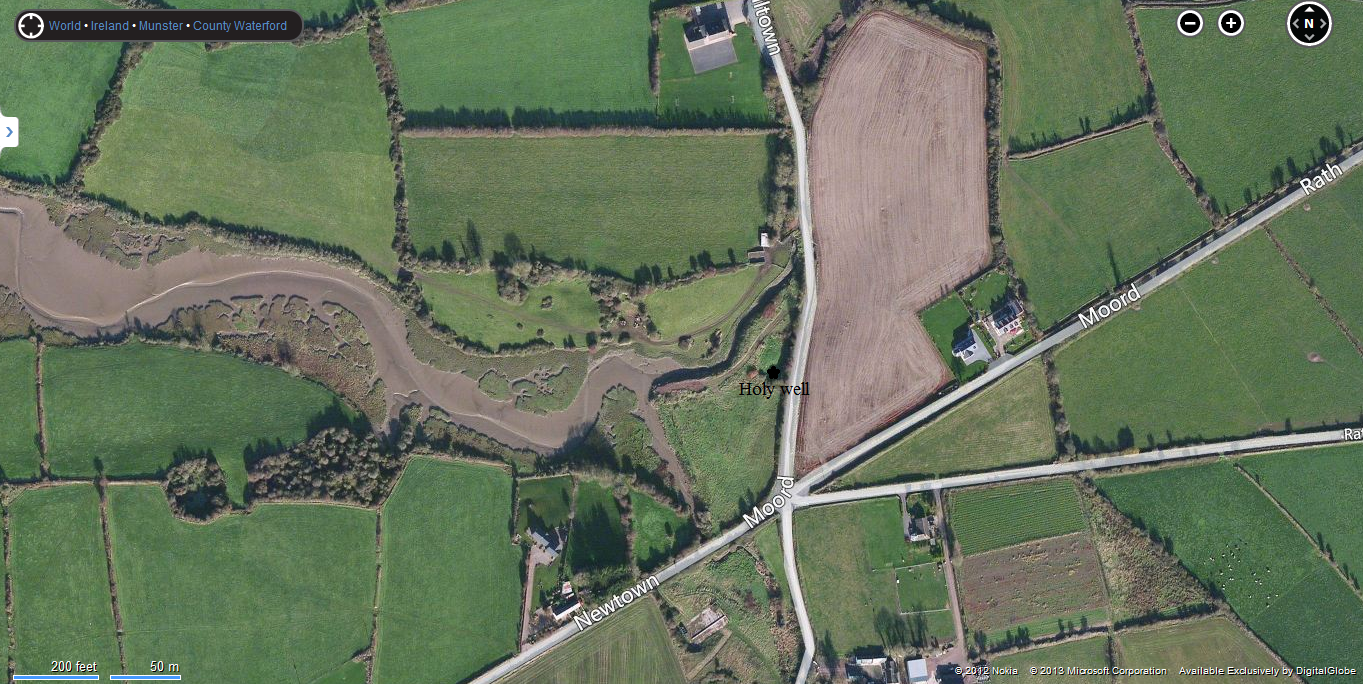
Location map of Holy well

Location map of St Bartholomew’s Holy Well. Image taken from Bing maps.

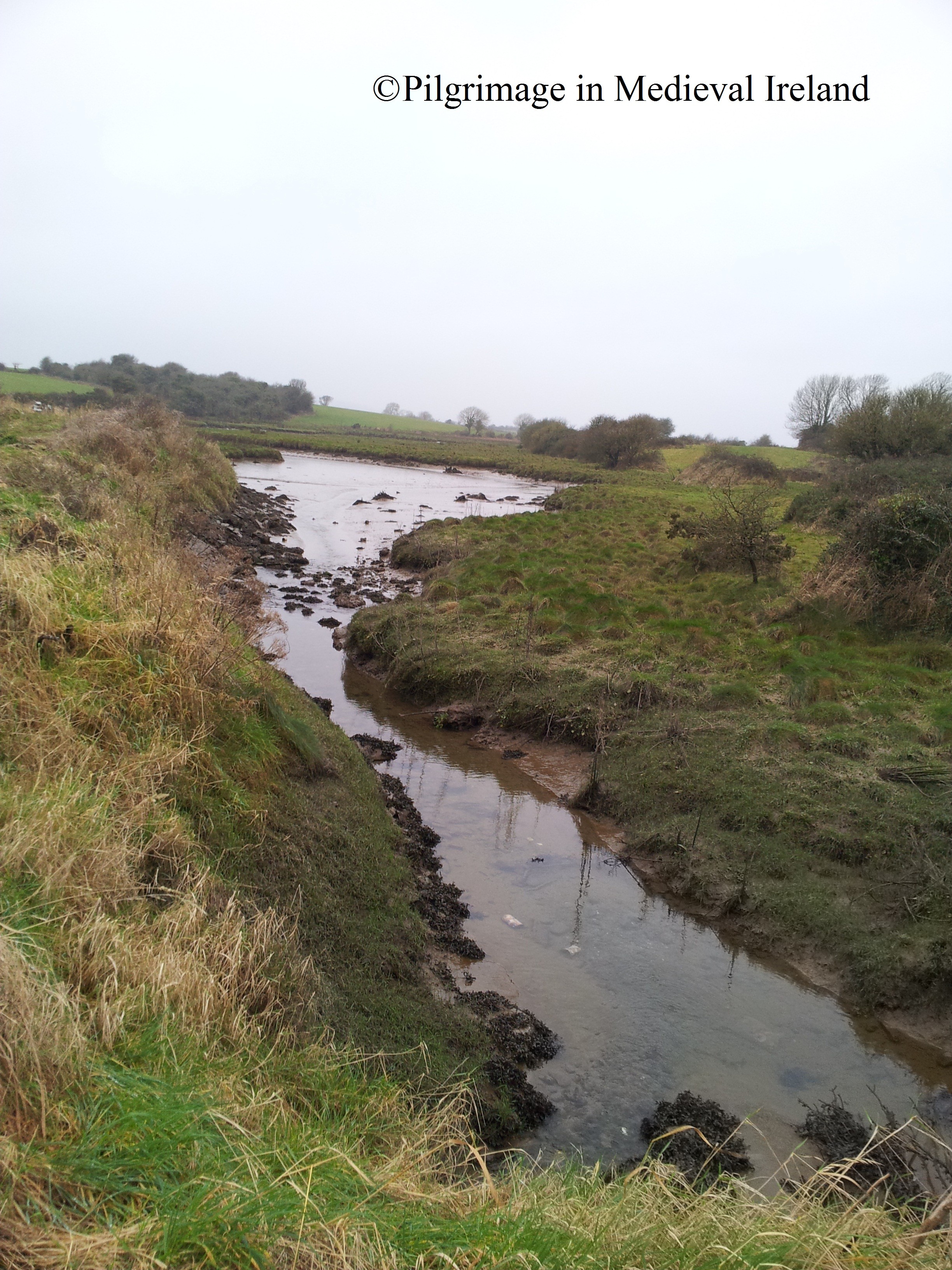
The well is located in a field of rough pasture on the east side of the Blackwater estuary, close to a cross roads in the townland of  Moord/Mord,  (An Móird/An Magh Ard or  “The High Plain”) about  mile south of Piltown. It’s really hard to find, I was really lucky to meet a local man who despite being in a hurry  brought me to the well.

The well is dedicated to St Bartholomew, who was one of the twelve apostles. The saints   feast day is  on the 24th of August.  There are a number of accounts of pilgrimage to the well   in the not too distant past, on this day. According to Power  writing in  1937  St. Bartholomew was traditionally held  to be the patron saint of the parish of Kinsalebeg. He also noted that his feast was kept  by local people

on the 24th of August, by visits to the ” Blessed Well” dedicated to him and that on the Sunday nearest to the feast, a public ” pattern ” is held at the well and at the adjoining village of Piltown.

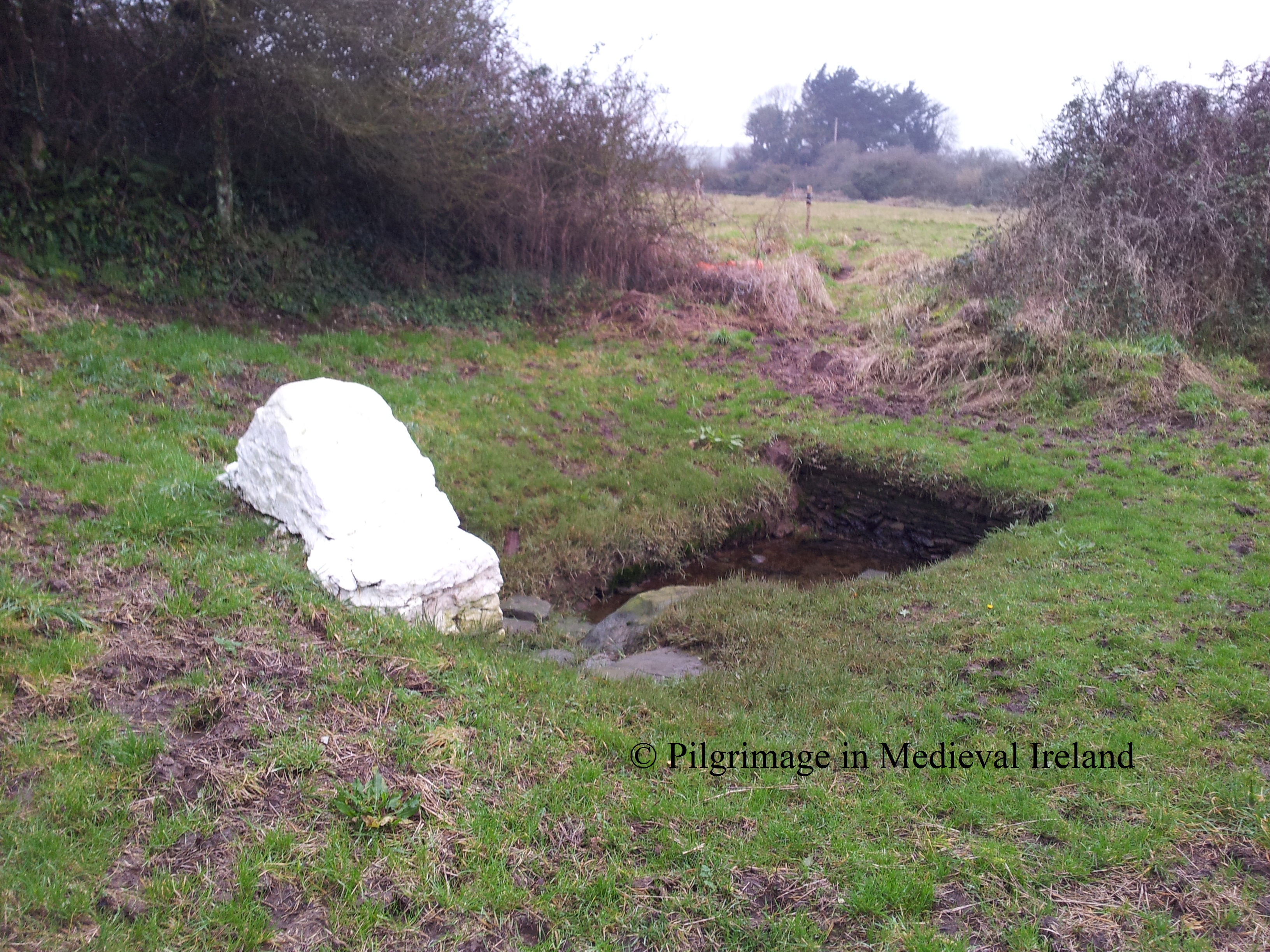
From the NE the well is hidden   in a hollow  in the field close to the boundary ditch.  A short distance to the W is a small stream running into the estuary.

20130105_140215

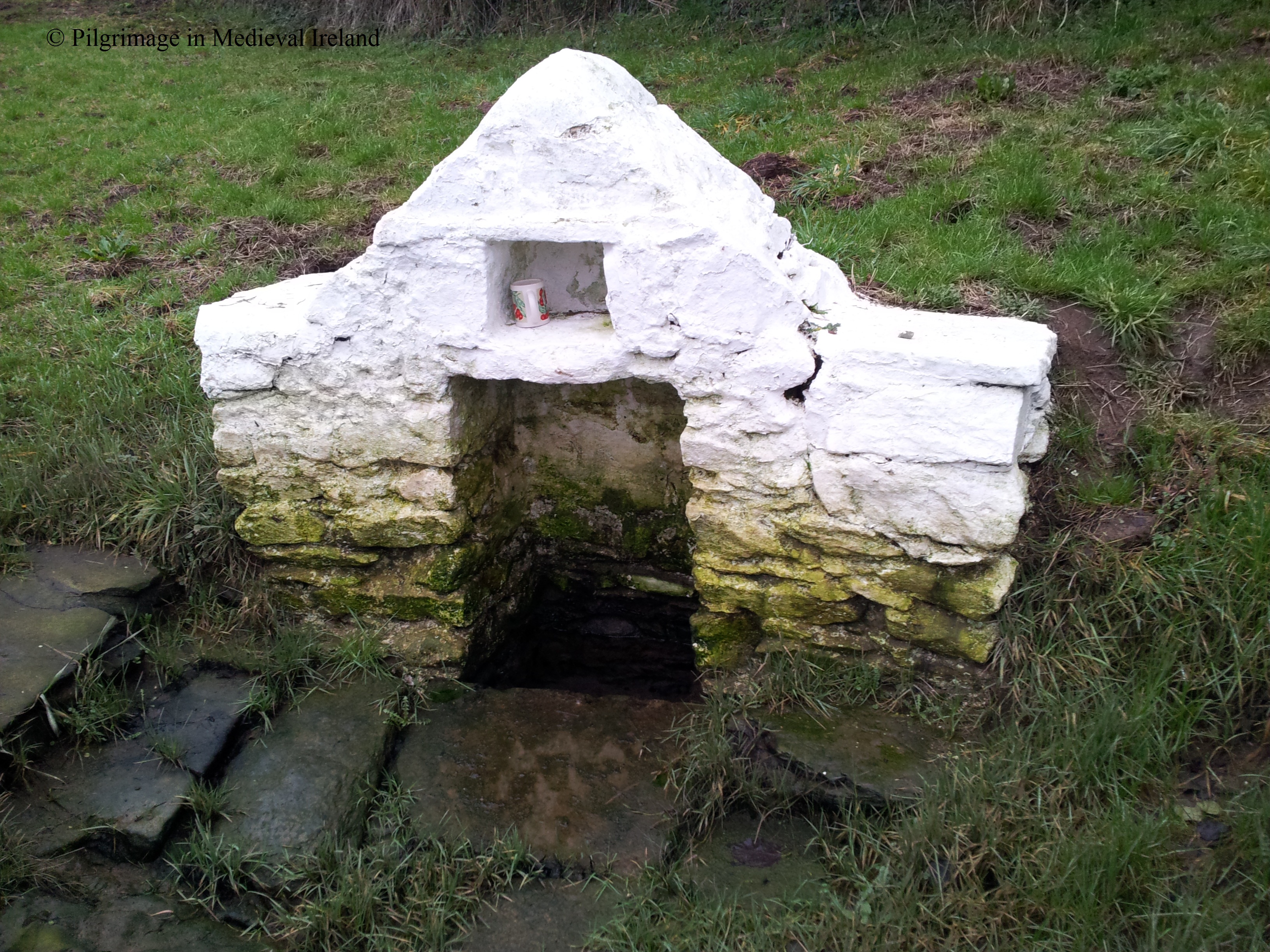
St Batholomew’s Holy Well

The well itself consists  of a small  of a rectangular stone and mortar built superstructure,  with a triangular-shaped top.

20130105_135630

Stone built rectuangular superstructure of St Bartholomew’s well with triangular-shaped top.

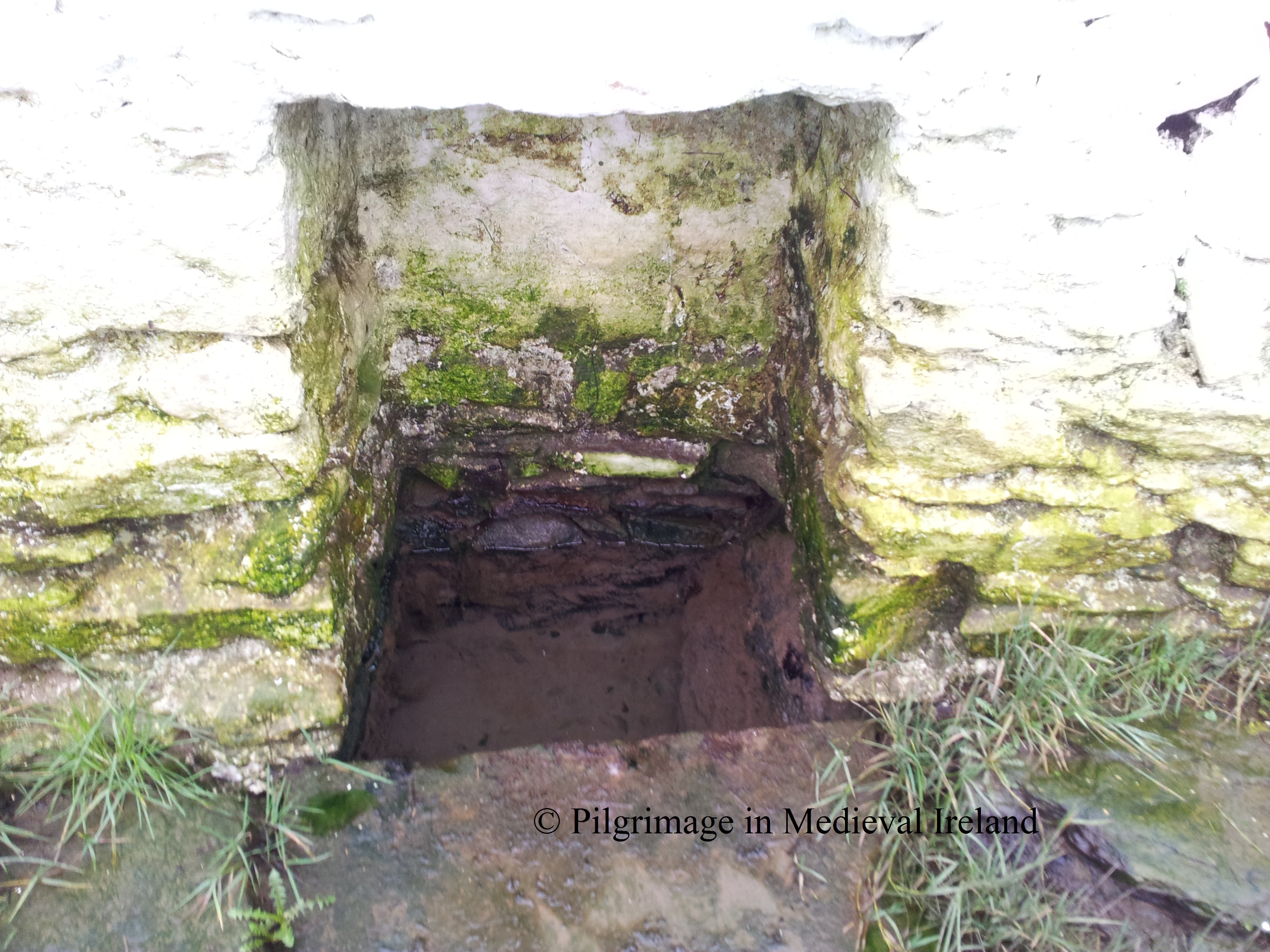
There are two rectangular recesses one at the base where the water can be accessed.

Recess for access to well waters

Recess for access to well waters

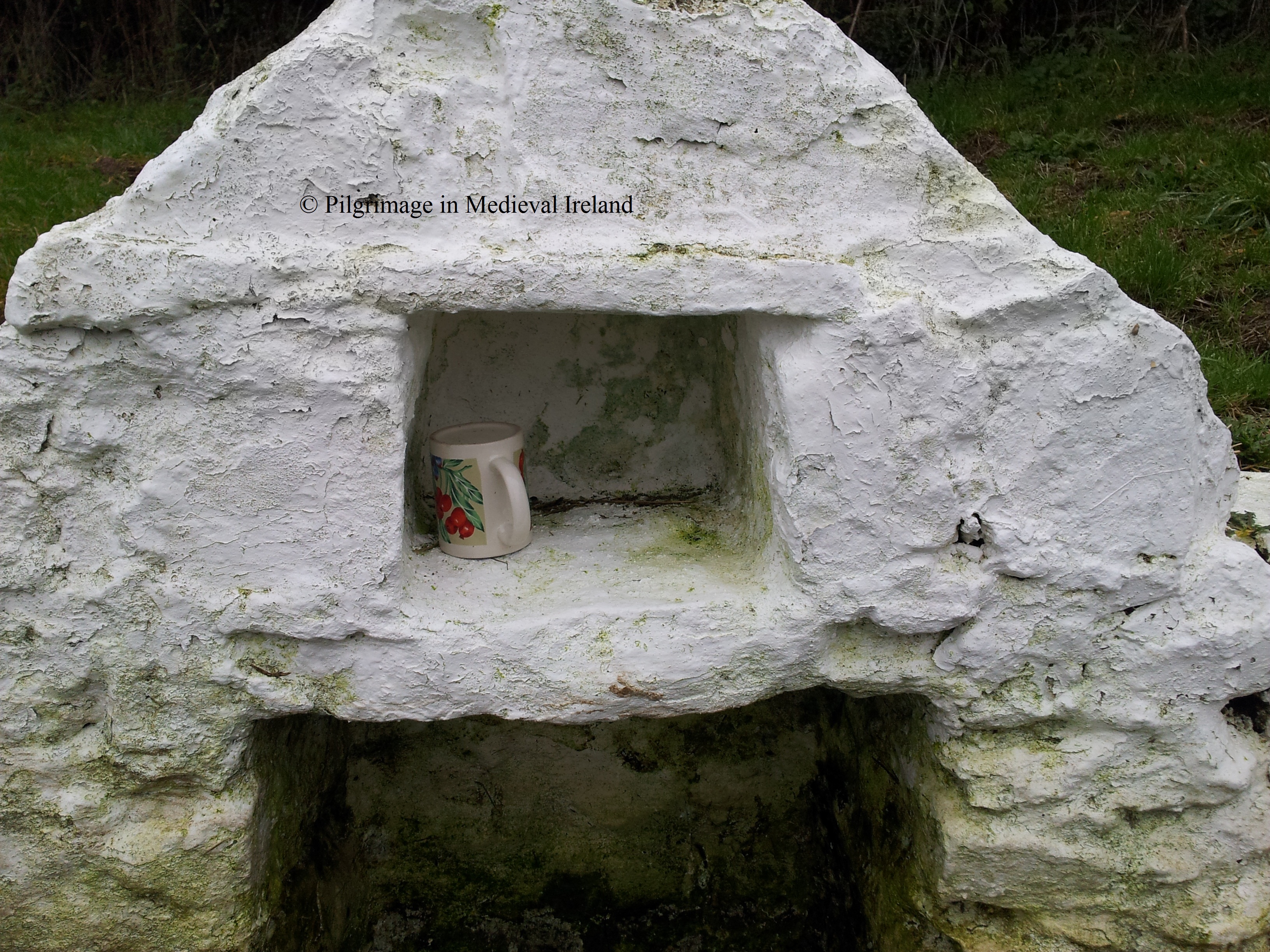
The second recess sits  just above the lower opening  and below the apex of the structure. When I visited here  a modern ceramic mug  was housed within. The structure is white washed.

20130105_135655

Upper recess in well superstructure . Note the modern mug.

Stone flags act as steps to the well and  divide it from  the large rectangular trough located beside it.

20130105_135703

The larger trough is cut into the earth and  stone faced . The eastern face appears to have collapsed in but the side is still well-preserved. The west  wall is stepped with stone facing  sitting on top of three large  flags which may have acted as steps into  the trough. Perhaps in the past  pilgrims would have taken water from the smaller trough and washed their limbs   in this one.

20130105_140027

FitzGerald writing in 1856  notes that  the well

is greatly resorted to for ‘giving  rounds’ at. It is celebrated for several cures, but especially for sore eyes.

A patron at the well is mentioned in a number of sources.  The Ordnance Survey Letters of 1840, state that a pattern was last held here in 1812 on St. Bartholomew’s Day. FitzGerald in 1856 wrote ‘there is a patron held here every 24th of August’. Power writing in  1937 notes

This is a well-known holy well at which a pattern is held and “rounds” made on August 24th.

However the I.T.A. survey of 1945  noted that

up to about 50 years ago this well was held in high repute and hundreds of people came here to “make their rounds”.Of late years very few visit it’.

This may suggest the pattern was reviewed for a time after 1840 before declining in popularity  in the early 1900’s. Today the well looks like it is maintained, the white washing of the masonry   and the presence of the mug suggests its probable still used but I wonder by how many people.  Despite the grey day it is really one of the nicest wells I have visited.

20130105_135822

Nearby stream flowing out into estuary.

Rituals  performed by  pilgrims  here in the 19th century  involved the ‘making of rounds’  a tale told by Fitzgerald in 1856 suggests that the pilgrim landscape extended beyond the well.

“ when I visited it last, a couple of months ago, a very intelligent young man of the neighbourhood  pointed out to me two houses some twenty yards from the well, which he said were built on the ground that was formerly taken in by the pilgrims in their circuit of ‘rounds’ , and that to his own knowledge the parties who made the encroachments all dwindled away to nothing – none of them ever had a day’s luck afterwards.”

I haven’t had time to consult the 1st or 2nd edition OS maps but  it is interesting to note that a short distance from the well are two small cairn of  what looks like building rubble .

The well was once associated with a rag tree which  is unfortunately no longer in existence. Fitzgerald gives the following colourful description of the tree and its associated rituals.

the fine old venerable  thorns which overshadowed  it bore a most motley appearance, actually crowded with old red, blue, and green ribbons and rags, as if torn from the dresses of pilgrims, and tied up as a finale to their ‘rounds’  and prayers.

He goes on to describe a conversation with a lady that he meet at the well  who described to him the meaning of this practice at the well.

An old crone engaged in giving her ‘rounds’ told me they were tied up by each to leave all the sickness of the year behind them.

This description of the tree sounds  so very colourful and vibrant. It makes you wonder  how many other wells also had rag tree that have disappeared.

St Batholomew’s holy well or Tobar Phárthanáin is a really peaceful and lovely well. If anyone has any other information about  the well or  modern traditions associated with  it,  I’d love to hear from them.

© Louise Nugent 2013

Bibliography

FitzGerald, E. (1856-7) Proceedings – “Jottings in archaeology”, JRSAI 4, 40-49, 289-91.

I.T.A. Topographical and General Survey of County Waterford. Ireland, 1945. [on-line] http://snap.waterfordcoco.ie/collections/efolders/155321/ita_survey.pdf [accessed 4/08/2012]

O’Flanagan, M. (Compiler) (1929) Letters containing information relative to the antiquities of the county of Waterford collected during the progress of the Ordnance Survey in 1841. Typescript. Bray.

Power, P. 1937. Waterford & Lismore : a compendious history of the united dioceses. Cork: Cork University Press, 128.

Saint Nicholas an Irish Connection

Given that it is  Christmas, this post has a slightly festive theme. It will  explore  the development of the cult of St Nicholas and the saints’  connections with medieval Ireland.

242px-Nikola_from_1294

St Nicholas of Myra

St Nicholas was born in the 4th century and following his death,  his cult developed and spread across the Christian world.  He was a very important saint and was the patron saint of  merchants, sailors, prisoners and children. Today he is venerated in both the Orthrodox and Catholic church. Over time his cult  developed into the modern Santa Clause tradition.

 Lycia

Map of modern day Turkey showing the territory of Lycia

St  Nicholas  was  born into a wealthy family in  Asia Minor in a place called  Patara (in the modern-day Turkey).  He became  bishop of the port town of  Myra in  the territory of Lycia.

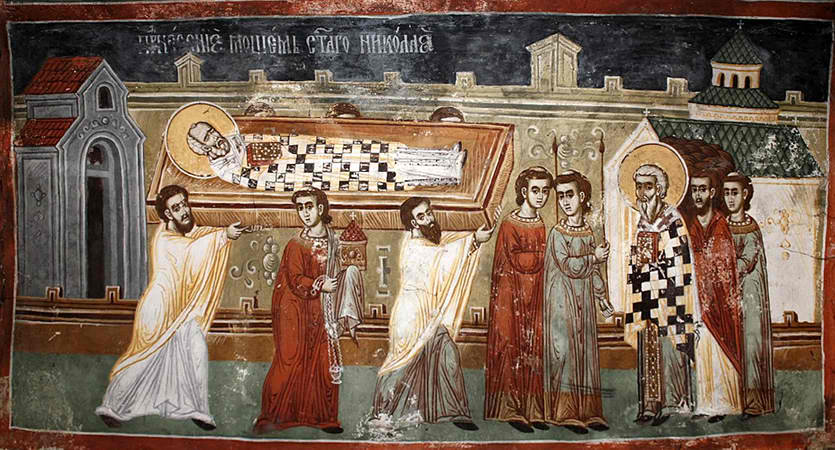
St Nicholas being carried to his burial place  (http://www.omhksea.org/2011/12/saint-nicholas-archbishop-of-myra/)

An image of St Nicholas being carried to his burial-place (http://www.omhksea.org/2011/12/saint-nicholas-archbishop-of-myra/)

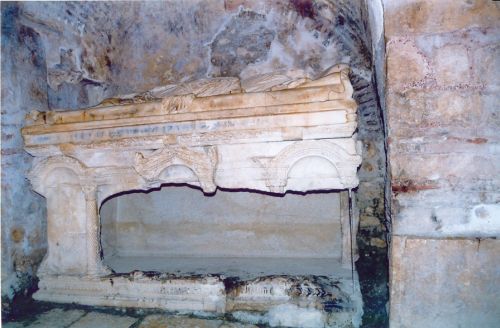
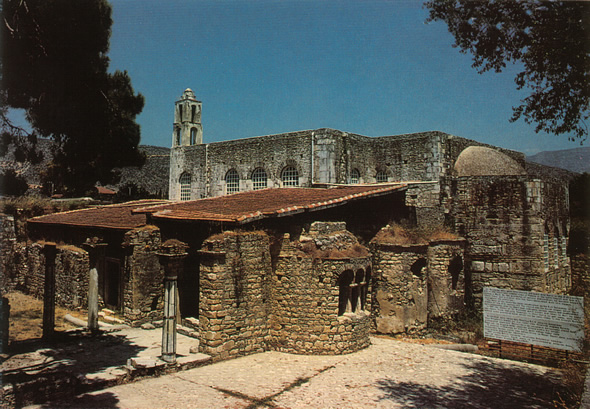
The site of his grave soon attracted pilgrims and Myra became a thriving pilgrimage destination. It is thought that the site of the saints grave is located within  the 9th century church  of St Nicholas on the outskirts of Myra. This church sits on an earlier 6th century  church which tradition holds was built over the grave of the saint. Within the present church , there is a  sarcophagus which is thought to have held the remains of the saint.

St Nicholas's tomb at Myra (from http://www.obgtravel.com/DemreE.htm)

St Nicholas’s tomb at Myra (from http://www.obgtravel.com/DemreE.htm)

Throughout his life , St Nicholas performed many miracles and  acts of kindness. Fresco’s within the church depict scenes from the saints life, such as  healing the sick and Nicholas saving the Basileios from the Arabs.

The church at Myra remained a place of pilgrimage  even after the remains of St. Nicholas were stolen in 1087 AD  by Italian sailor from Bari and  brought to  the port town of Bari  in Italy where they remain to this day.  Tradition holds that in their haste  the sailors left fragments of the body  in the grave and these were collected by Venetian sailors during the first crusade and  then brought to Venice. They  were then placed in a church  dedicated to the saint an  on the  Lido.  Over the centuries there was much disagreement between Bari and Venice as to who had the true relic of the saint. Interestingly  Professor of anatomy Luigi Martino at the University of Bari has examined both the remains at Bari and Venice and concluded that the fragments of bones in Venice were complementary to the bones in Bari. His investigations suggest that the bone  are from the skeleton of the same man ( http://www.stnicholascenter.org/pages/relics-in-the-lido-of-venice/ ).

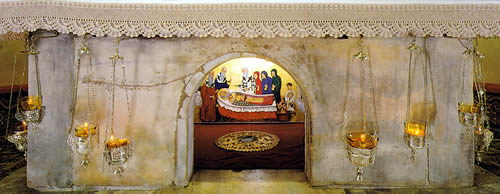
Thanks to the relics of the saint,  Bari  soon became a great centre of pilgrimage.   Following the saint’s death in the 4th century his body was said to exude a clear liquid called manna or myrrh which was believed to have miraculous powers. When the skeleton was moved to Bari it continued  to exude this clear liquid which was called ‘manna of the saint’. Pilgrims believed the manna had special healing powers .  The manna was diluted and made available in bottles decorated with images of the saint. Every year  on the feast day  of the translation of St Nicholas relics to Bari   a great festival  takes place which culminates in the extraction of the manna by the rector  of the Basilica  (this you tube  link shows this  ceremony

St Nichola's tomb at Bari (http://www.stnicholascenter.org/pages/relics/)

St Nicholas’ tomb at Bari (http://www.stnicholascenter.org/pages/relics/)

So what of the saints connections with Ireland?

The earliest evidence for the  cult of St Nicholas  in Ireland  occurs in the Hiberno Norse town of Dublin.  In  1038, Sigtrygg Silkbeard Olafsson, king of Dublin, with the support of Dúnán the bishop of the city, founded Christ Church Cathedral, with a   chapel  dedicated to St. Nicholas (Bairéad 2010).  For a really interesting discussion on the introduction of the cult of St Nicholas to 11th century Dublin see Eoin Bairéad’s article Nicholas and Dublin  reference given below.

In the  medieval period  his cult  was found in  Gaelic and Norman communities alike.  Dedications to St Nicholas are found attached to holy wells and medieval parish churches across  the entire island of Ireland.  At present I am putting together a database of all medieval sites dedicated to the saint. Hopefully by this time next year I will be able to share more information on the distribution of the cult in Ireland.

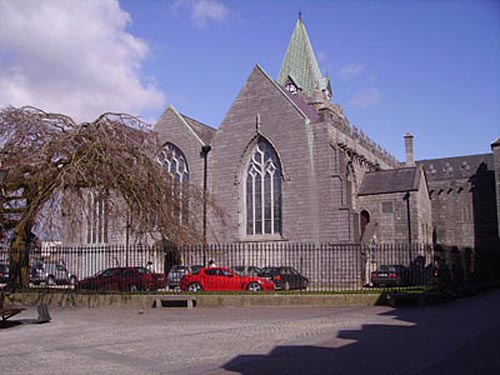
One of the most beautiful  medieval churches dedicated to St Nicholas in Ireland is the medieval collegiate church  in Galway city.

St Nicholas's collegiate church Galway

St Nicholas’s collegiate church Galway

Churches and chapels  dedicated to the saint are also found in the port towns of Drogheda  and Waterford.  Additional dedications are found at Dunsany Co Meath, Clonmel, Co Tipperary and Newtown Jerpoint  Co Kilkenny. Holy wells dedicated to the saint are found   in the counties of  Kerry, Limerick ,  Meath and Waterford .

Given the popularity of St Nicholas I see no reason why Irish pilgrims to Rome or Jerusalem would not have  visited Bari or Venice. The Via Francigena was one of the main pilgrim routes to Rome and from Rome it continued  south to the port of Bari.  Bari was also  one of the departure points for the Holy Land and the Church of the Holy Sepulcher in Jerusalem. Within Ireland local pilgrimages were made to holy wells dedicated to the saint  across the country.  I hope to discuss these pilgrimages further in another blog post.

Another likely place of pilgrimage  within Ireland is the deserted medieval town of Newtown Jerpoint Co Kilkenny. I visited   Newtown Jerpoint yesterday and had such a lovely time .  This unique site is in private ownership but it’s  owners Joe and Maeve O’Connell have opened this special place to the public. I highly recommend a visit here and if anyone is interested in visiting check out their website  www.jerpointpark.ie

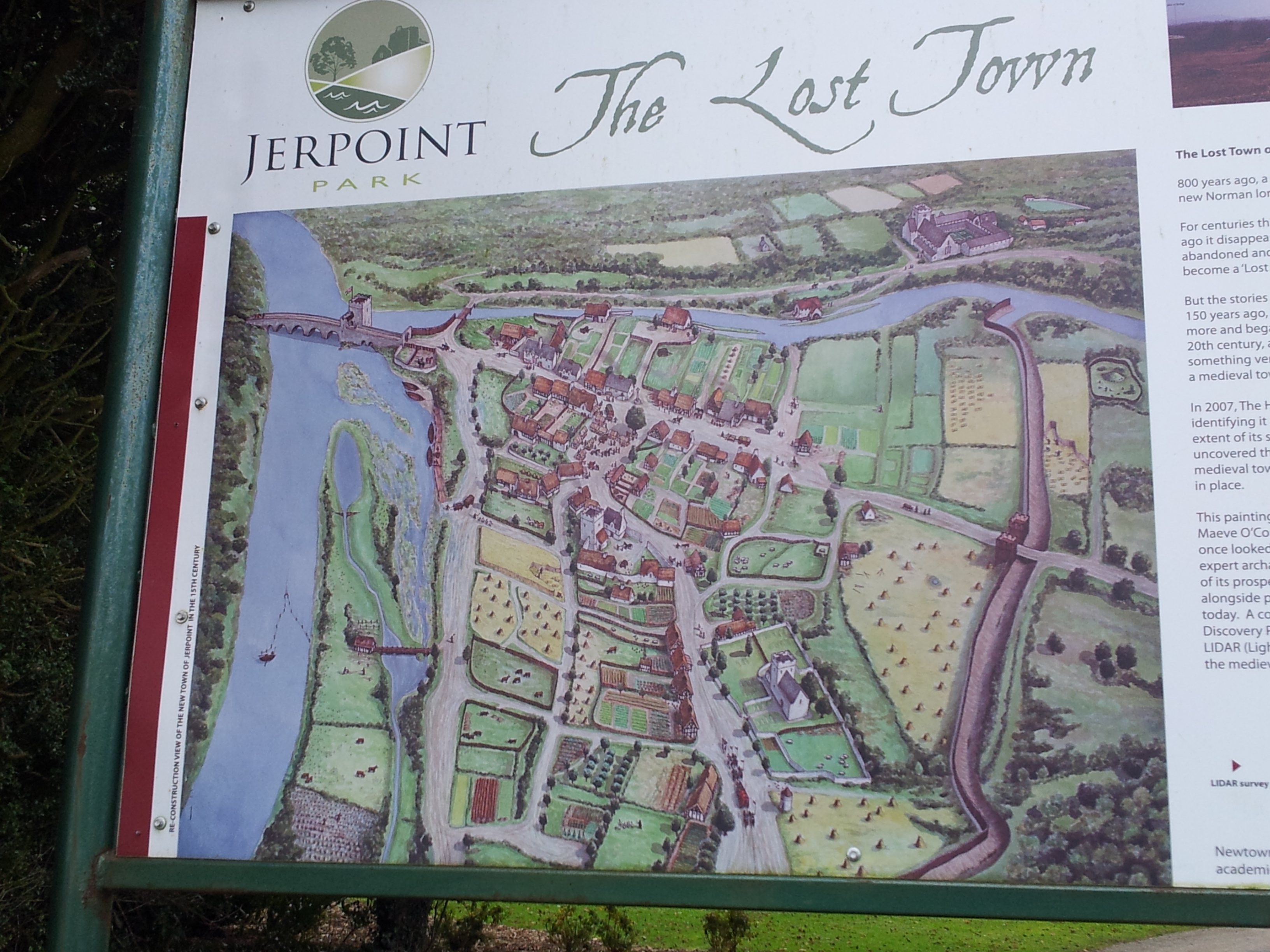
Located close to the great  Cistercian  foundation of Jerpoint Abbey. The medieval town of  Newtown Jerpoint  was founded  c.1200,  shortly afterwards a church dedicated to St Nicholas was built to cater for the towns growing population.  The town fell out of use in the 17th century.  The remains of the town are   preserved today as a series of earthworks but the guided tour really makes the landscape come alive and you get a real sence of what the town was like .

20121223_130057

Artists reconstruction of the medieval town

So what of the sites connection with pilgrimage? Although extensive records for the town’s history exist there are no  references to medieval pilgrimage  here however tentative evidence may be suggested by the  tradition that St Nicholas of Myra was buried here.  The  Newtown Jerpoint conservation plan  notes that ‘according to local legend , there had been fourteen wine-taverns among the trading establishments of Jerpoint.’  There are some who think that the large amount of taverns may have existed to cater for pilgrims.

20121223_130643

View of St Nicholas’s church at Newtown Jerpoint

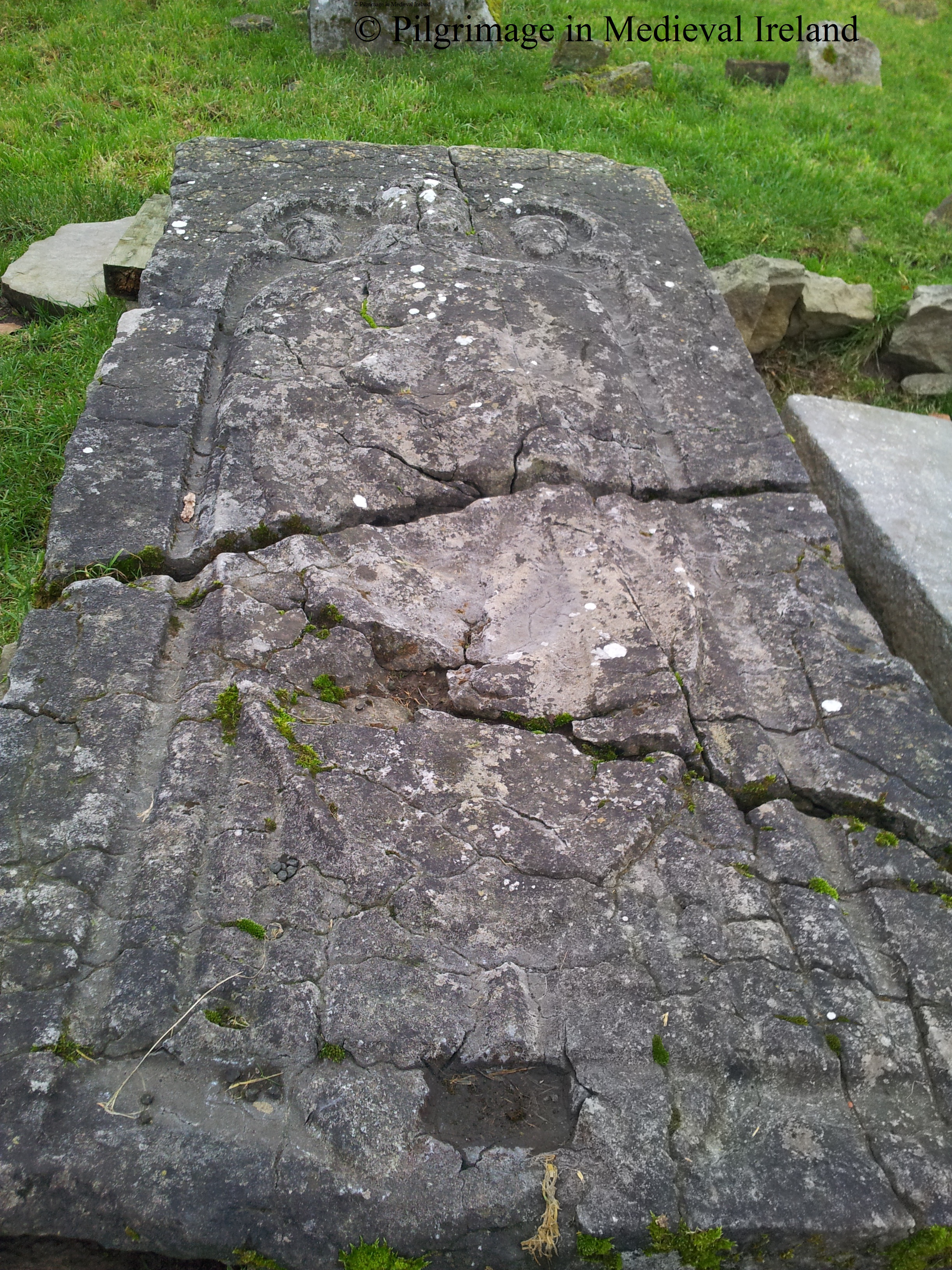
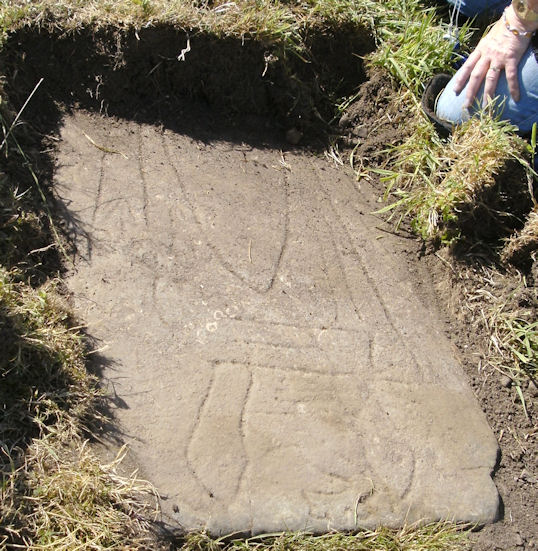
So tradition holds that St Nicholas’s grave is marked by  a large medieval  grave slab. The slab  has been dated to the early 14th century by John Hunt (1974, 197). The slab has an effigy of a cleric  dressed in a full chasuble (outermost liturgical vestment worn by clergy), his hands are raised palm-outwards on his chest. On his feet are pointed shoes. Above each shoulder are two heads  one wearing a mitre-like head-dress and the other a pill-box type head-dress.

20121223_133121

14th century grave slab which local tradition holds marks the burial-place of St Nicholas

Local tradition holds that this figure depicts  St Nicholas and the heads are two crusaders who  brought the saints remains back to Ireland.  The tale tells of a band of Irish-Norman knights from Jerpoint, traveling to the Holy Land to take part in the Crusades. On their return  home to Ireland, they seized St Nicholas’ remains, bringing them back to Kilkenny, where the bones were buried.

Another version of the story tells of a French family, the de Frainets, who removed Nicholas’ remains from  Myra to Bari , in 1169 when Bari was under the Normans. The de Frainets were crusaders to the Holy Land and also owned land in Thomastown, Ireland. After the Normans were forced out of Bari, the de Frainets moved to Nice, France, taking the relics with them. When Normans lost power in France, the Nicholas de Frainets packed up once again, moving to Ireland. This story has the relics being buried in Jerpoint in 1200.

Like all legends   there is   probably some  truth to this.  I think it is unlikely that  the  body of St Nicholas  was brought here,  if it had  such an important saint would  most certainly have been placed in an elaborate shrine (most likely within the church). However it is my opinion that the church was  in possession  of  one if not two corporeal  relics  of  St Nicholas.  Norman knights from Kilkenny  did participated in the Crusades to the Holy Land so it is possible one or two  of them brought some relics back with them.  I think that over time this   legend developed and attached itself to the near by burial slab which most likely depicts a cleric associated with the church or nearby Jerpoint abbey. Recently a second grave slab of a similar date has been uncovered at the site and  it also depicts a cleric.

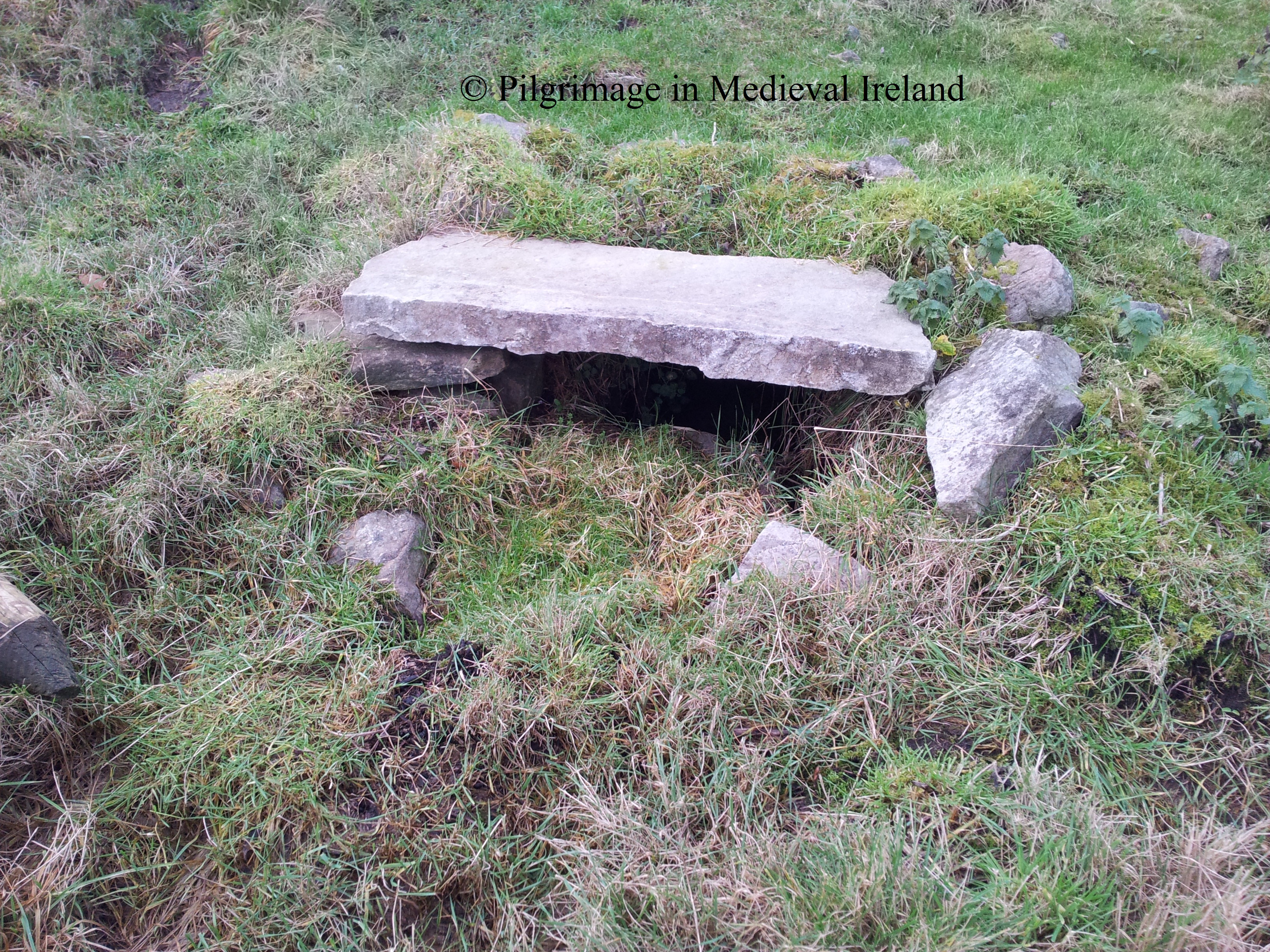
Any church in the possession of  a relic (s) had the potential of attracting pilgrims  and I see no reason why pilgrims would not have come here  to pray to St Nicholas.  A  holy well located a short distance from the church,  also   dedicated to St Nicholas  was another possible point of devotion and there was a tradition that the  water was a cure for skin complaints.

St Nicholas's holy well

St Nicholas’s holy well

Even if St Nicholas is not buried here Newtown Jerpoint is a very special place.  The  sites owner Joe told me he feels a strong connection with St Nicholas and the site and he suspects the saint is buried here. He also told me that  since the site has been open to the public there have been many  happy coincident  which have connected people,  the saint and the site. So  if you get the time take a visit to Newtown Jerpoint.

© Louise Nugent 2012

Bibliography

Bairéad, E.  2010. ‘Nicholas and Dublin’, In eds. Davies, M., MacConville, U. & Cooney, G. A grand gallimaufry: collected in honour of Nick Maxwell. Dublin: Wordwell.
Hunt, J. 1974. Irish Medieval Figure Sculpture. 1200-1600. Irish University Press.

http://jerpointpark.com/newtown-jerpoint-co-kilkenny-ireland/

http://www.stnicholascenter.org/pages/ireland/#i_354

http://www.sacred-destinations.com/turkey/kale-church-of-st-nicholas-myra.htm

Click to access Newton_Jerpoint.pdf

Holy wells of County Meath

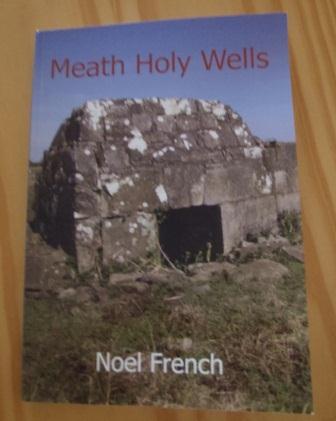
I had a lovely surprise this week,   I received a  gift  from my friend Muireann of a  newly published  book on holy wells called  Meath Holy Wells by Noel French. Holy wells have always interested me. They are really are  special and peaceful places. Given that there are approximately  3000 holy wells  in Ireland  they are many wells scattered around the country that  I am unaware of  and I must confess until now  I knew little of the wells in Meath.

Meath Holy Wells by Noel French

So what is a holy well? A holy well is a natural spring or natural  or man-made hollows ( bullaun stones)  in rock  which collect with water,  deemed to have a religious significance through association with the saint. The history of devotion at holy wells is  complicated,   the earliest references to the Christian use of holy wells  date to the seventh century but   many  are likely to have prehistoric origins and were apropreiated by the new christian church in the 5th and 6th centuries.  I think a small number were originally used for domestic use and developed into pilgrim features in the post medieval period. Without medieval documentation for a wells or excavation the dating of many of these monuments are very difficult, although a dedication to an early medieval saint suggests at least an early medieval date.

St. Lucy’s Well, Killua on the Meath – West Meath Border

Holy wells can occur in isolation but many are located close to ecclesiastical enclosures. There are found in both rural and urban  landscapes.  The majority of literary accounts of pilgrimage to holy wells date to the post medieval period, although a handful of holy wells are named in the medieval literature and its likely the tradition of pilgrimage to the well goes back to prehistoric times.  In many case  usually on the saints feast day there were special religious devotions at the well, people would gather and perform special prayers and rituals  ( rounding of the well ) on what was known as the pattern  day. The word pattern derived from ‘patron’  in reference to the patron saint, so pattern day refers to the patron saints day . There are many account of post medieval and modern pilgrims leaving votive offerings at  wells  such as pins, coins, buttons, holy medal and treads from shawls. Cruthes were left at Fr Moores well in Kildare. Even today at popular well pilgrims leave behind rosary bead,  candles, inhalers etc.

The book, Meath Holy Wells  records approximately 123 holy wells.  The Meath wells are dedicated to a wide range of Irish  saints  such as Patrick , Colmcille, Brigid, Kieran. Universal saints include the Blessed Virgin , Anne, Lucy and Nicholas.  Each well is described  and many accompanied by a  colour photo.  All the  traditions and folklore of the wells are recorded. Like elsewhere in the country many of the Meath wells are associated with healing, the waters of  St Seachnaill’s well,  Dunshauglan were said the cure swelling of any part of the body,  while the waters of St Ultan’s well Ardbraccan were a cure for sore eyes.

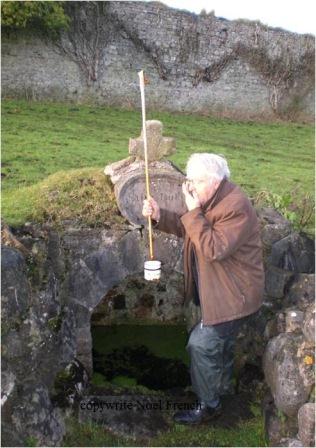
I discovered an astonishing  fact in the introduction,   that  the Meath archaeological Survey  ingnored these wells  and the County Development plan lists only 3 wells.  This is shocking when one considers the significance of these monuments.   Holy wells are of great cultural value and as  wells cease to attract pilgrims  they become ever vunerable to  being destroyed.  I was delighted to read that a significant number, such as St Johns well at Warrenstown are still the site of active pilgrimages.  This book  really showcases the value of the holy wells of county Meath and  it will hopefully make the people of Meath aware of their significance and go along way to help in their preservation for future generations.

Pilgrims at St Johns well , Warrenstown

This is really a lovely book and perfect for dipping in and out of . If anyone is  keen to  find out more about the holy wells of Meath, the book Meath Holy Wells – PRICE €15,   is available at Maguires, Hill of Tara, Newgrange, Antonia’s, Trim, Siopa an Caislean, Trim and Post Office, Trim. Also by post from Noel French, Castle Street, Trim  for €15 including postage.


St. Willibrord, Patron Saint of Luxembourg & the Carlow connection

I am delighted to present this exciting  guest post about St Willibrord  the patron saint of Luxembourg who has an  interesting connection to Co. Carlow. The post is  written by Dermot Mulligan  curator of the Carlow County Museum.

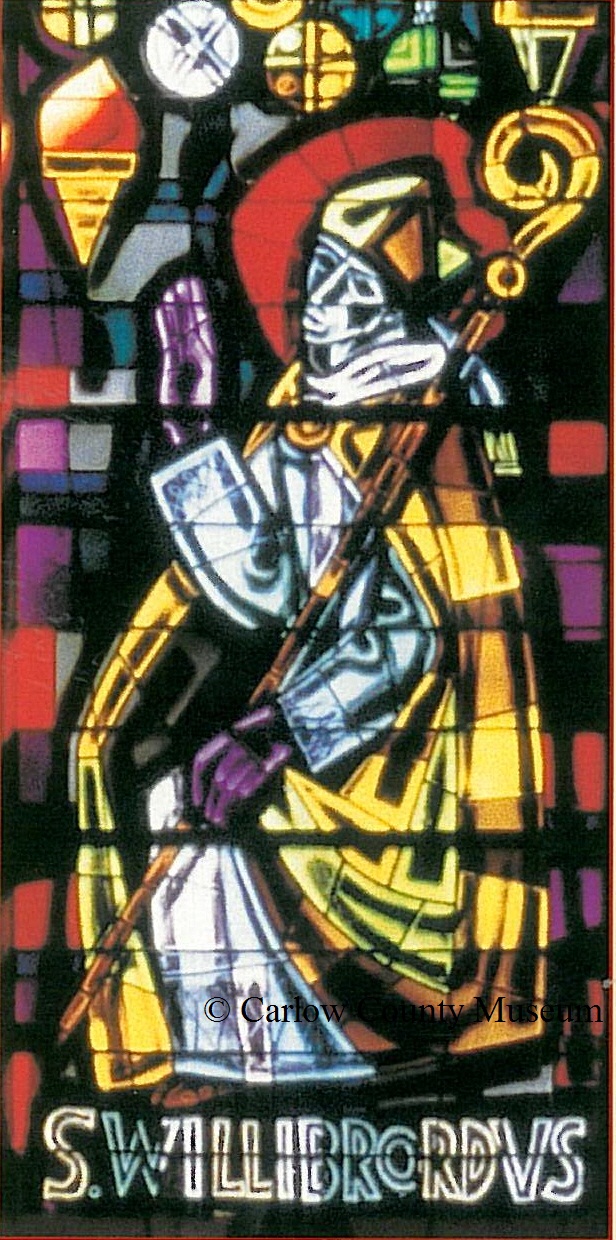
St. Willibrord as featured in a stain glass window in the Basilica of Echternach, Luxembourg. Photo Carlow County Museum.

Today November 7th is St. Willibrord’s Feast Day. He is from England, is the Patron Saint of Luxembourg, he was trained and ordained in County Carlow. In 690AD  he led a successful European mission from Carlow, and the annual hopping procession held in his honour in Echternach, Luxembourg has received UNESCO World Heritage Status.

Located in the townland of Garryhundon, Co Carlow is an archaeological site commonly referred to as Killogan, Rath Melsigi (Rathmelsh) or Clonmelsh Graveyard (¹). The site of Clonmelsh Graveyard at  Garryhundon  is situated on private land and is not accessible to the public. A worthy alternative is the magnificent St. Laserian’s Cathedral,  in the village of Old Leighlin.

Image of St Laseran’s Cathedral Old Leighlin taken from Wiki Commons.

During the seventh and eight centuries Rath Melsigi was the site of the  most important Anglo-Saxon ecclesiastical settlement in Ireland (2).

During the sixth century St. Colmcille established a monastery on the island of Iona off the coast of Scotland. In the late sixth century and early seventh century Carlow born (Myshall) St. Columbanus became the leading figure of Irish missionary work on mainland Europe. As a result of such work there were a number of monasteries established in Europe which had close relationships with abbeys in Ireland. It is believed that much of the early Anglo-Saxon manuscripts were written in Irish script either directly by Irish monks based in Britain or by Anglo-Saxon monks who were trained by Irish monks (3).

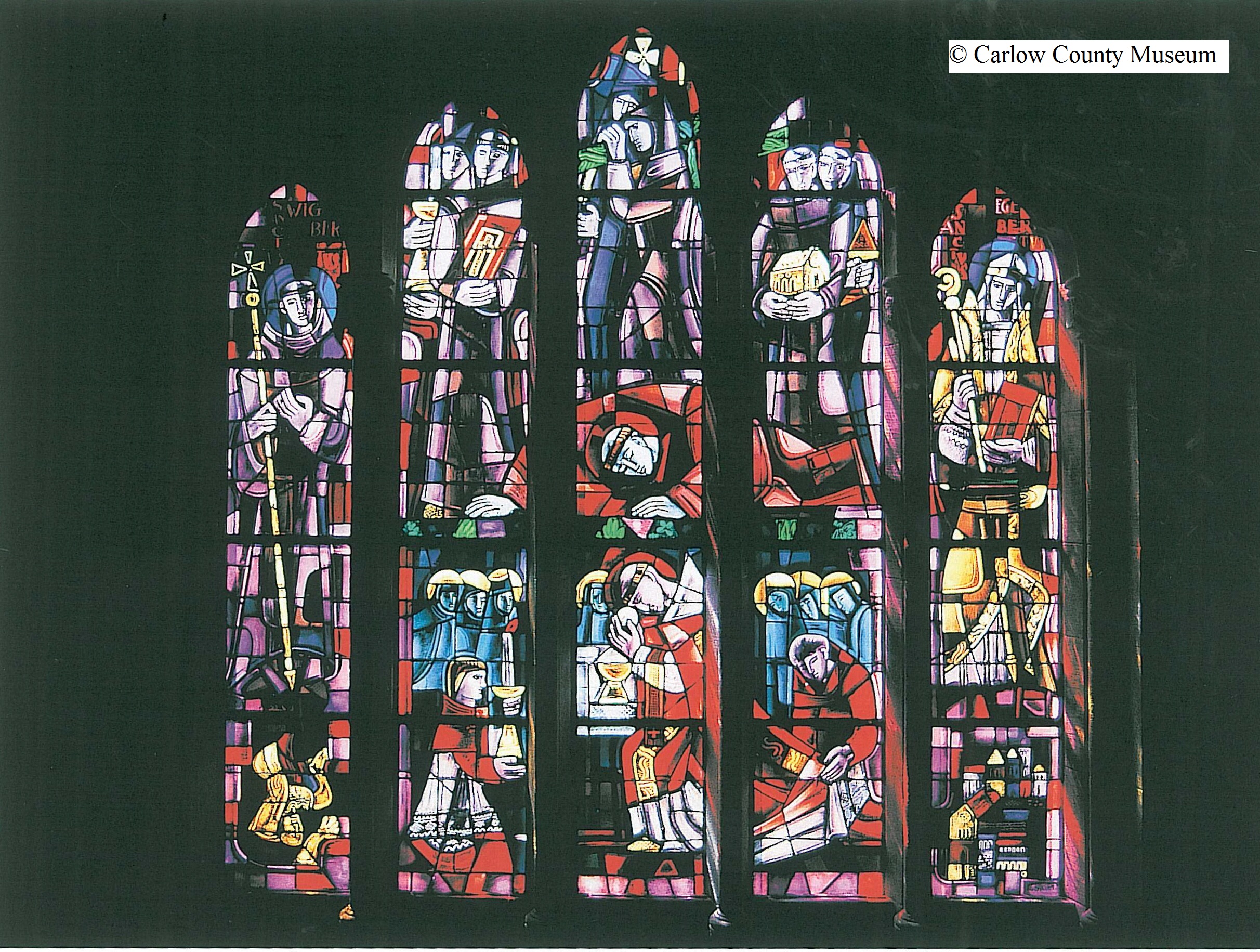
Stain Glass window in the Basilica of Echternach depicting St. Willibrord at Rathmelsh. Photo Carlow County Museum.

Building on this close relationship between Irish and European monasteries a number of ecclesiastical settlements were established in Ireland that accommodated European monks, in particular Anglo-Saxon monks. The most note worthy of these was the settlement in Garryhundon. It is quite likely that the site had a direct relationship with the monastery that was located at the site now occupied by St. Laserian’s Cathedral in Old Leighlin. This monastery, which is believed to have had over one thousand monks, was for several centuries a major ecclesiastical settlement.

From 678AD to 690AD a student named Willibrord from Northumbria was trained and based at Rathmelsh (4). From here he led eleven other Carlow based monks on a major mission to the Frisian Land and in 695AD he was consecrated a Bishop by Pope Sergius 1 (5).

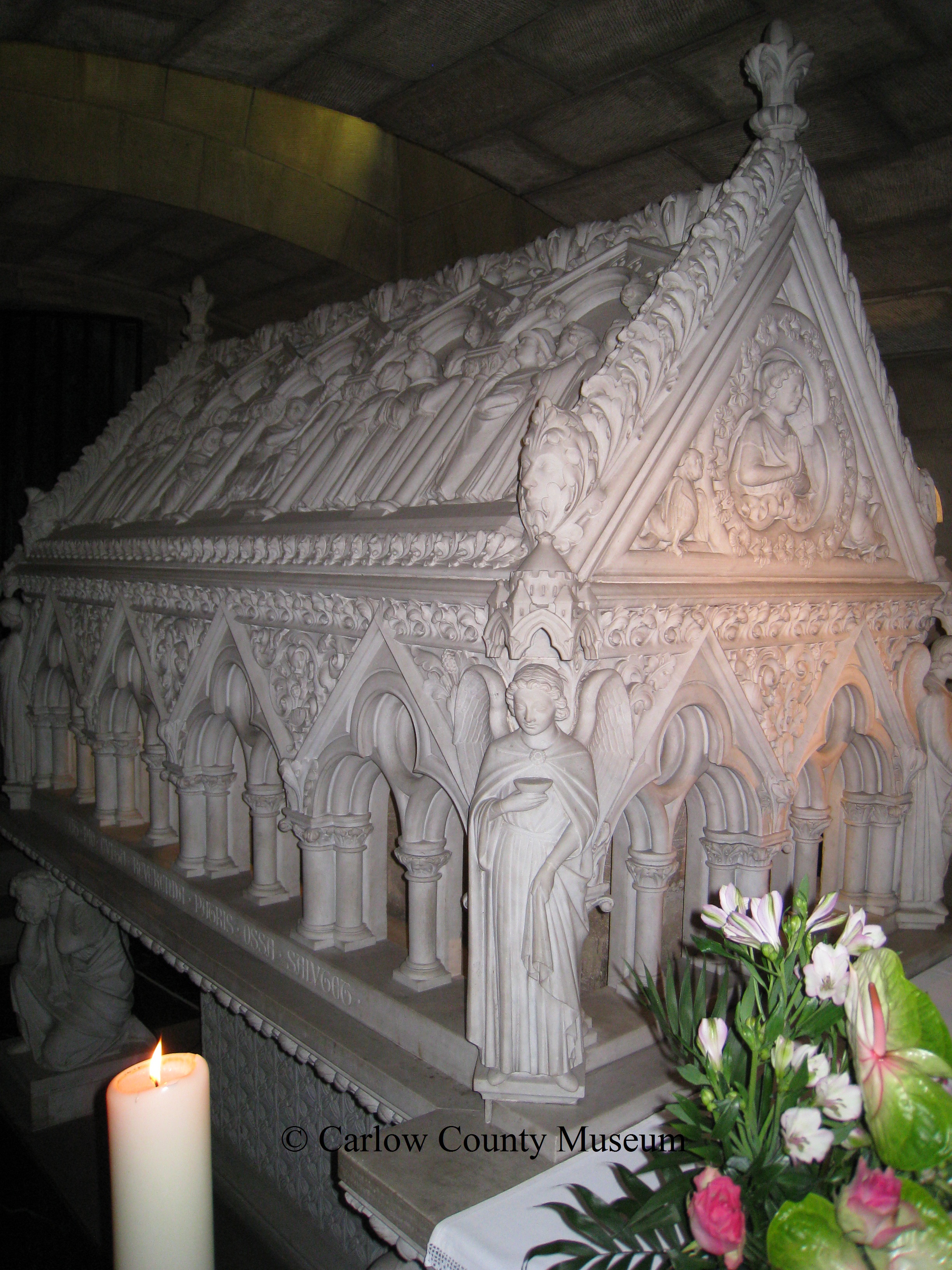
St. Willibrord’s tomb in the crypt of the Basilica of Echternach, Luxembourg. Photo Carlow County Museum.

He initially built a cathedral in Utrecht, Holland but later he moved to present day Luxembourg and to the town of Echternach where he founded an abbey. From here he continued to co-ordinate missions of the surrounding countries and in 739AD he died aged 81 (6). He is buried in Echternach, and he is the only saint to be buried in Luxembourg. As part of the abbey in Echternach he established a very important scriptorium and for a considerable period of time many great European bibles, psalms and prayer books were produced by the Abbey. It is likely that the initial scribes were from Carlow.

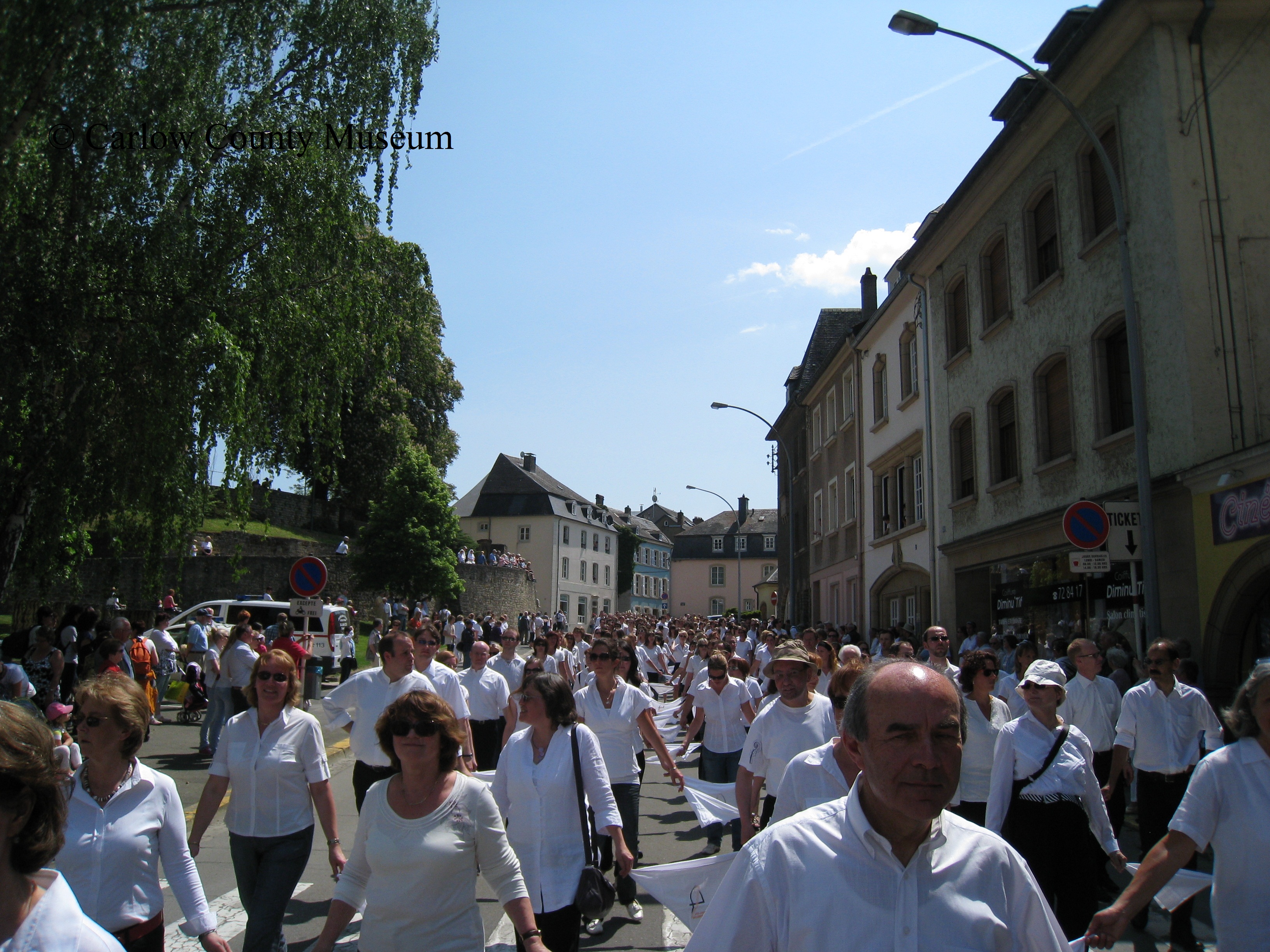
Great devotion and religious festivals are still held to this day in his honour and in particular a hopping procession, a dance that dates back to, if not predates                           St. Willibrord’s life time. The hopping procession takes place annually on the Tuesday after Pentecost Sunday and over thirty thousand people descend on Echternach to partake along with dozens of Cardinals, Arch-Bishops and Bishops from over one hundred and sixty parishes across Luxembourg, Belgium, Holland and Germany who still have devotions to St. Willibrord.

Hopping Procession in honour of St. Willibrord, over nine thousand people hop a two kilometer route from the monastery to the Basilica and past St. Willibrord’s tomb. Photo Carlow County Museum.

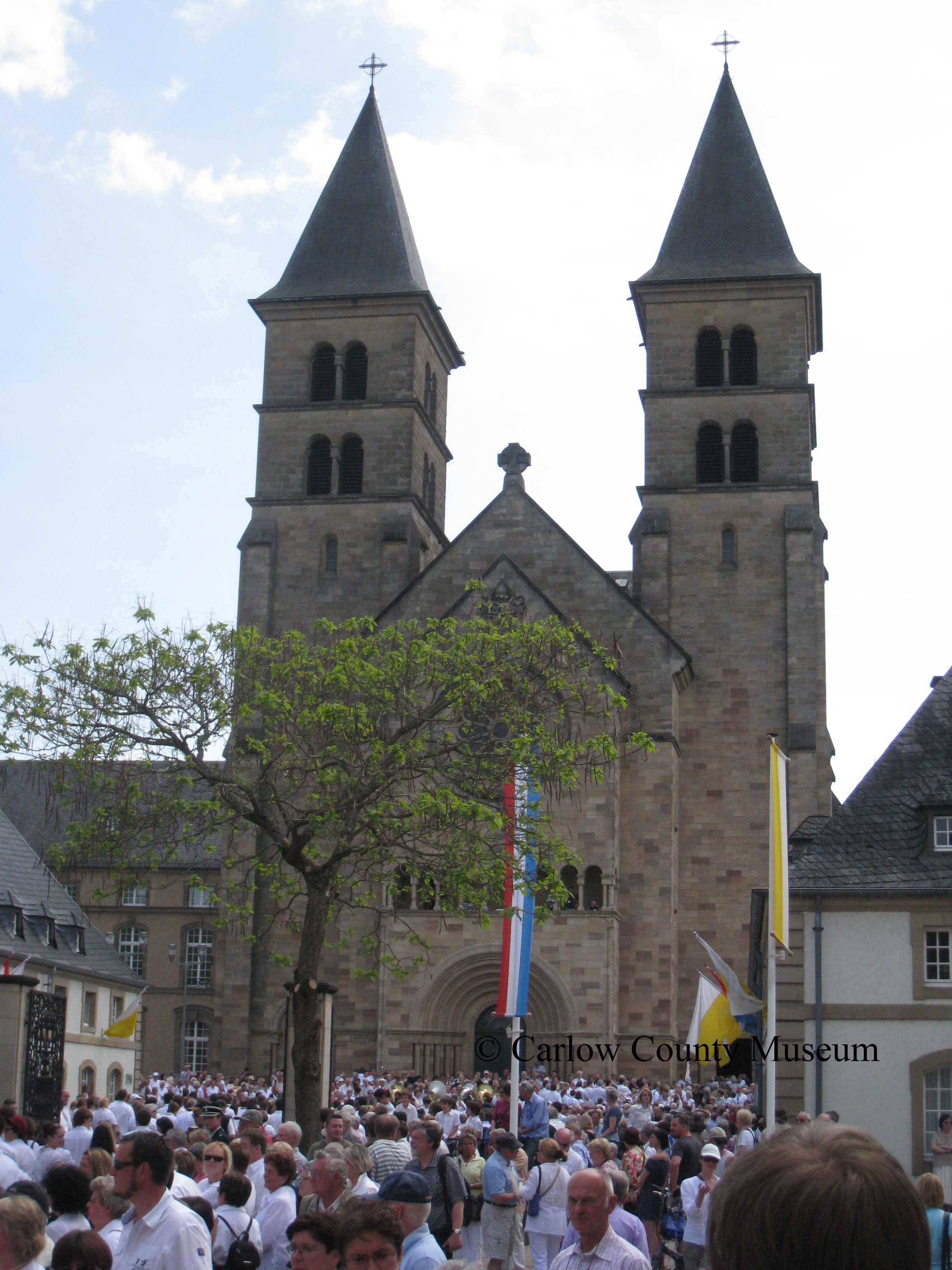
The abbey is now home to a large secondary school and in the adjoining Basilica                St. Willibrord is buried in the crypt under the altar. The hopping procession starts in the abbey square and proceeds for approximately two kilometers through the streets of the town, then into the Basilica, down into the crypt and past St. Willibrord’s remains. This unique procession coupled with the European importance of the abbey saw the procession granted UNESCO World Heritage Status in 2010 ( 7).

Hopping Procession in honour of St. Willibrord, over nine thousand people hop a two kilometer route from the monastery to the Basilica and past St. Willibrord’s tomb. Photo Carlow County Museum.

Towards the end of World War 11 the Basilica was badly damaged during the Battle of the Bulge but during the 1950s it was reconstructed including the instillation of a stain glass window depicting St Willibrord’s training, ordination and first mass at Rathmelsh(8).

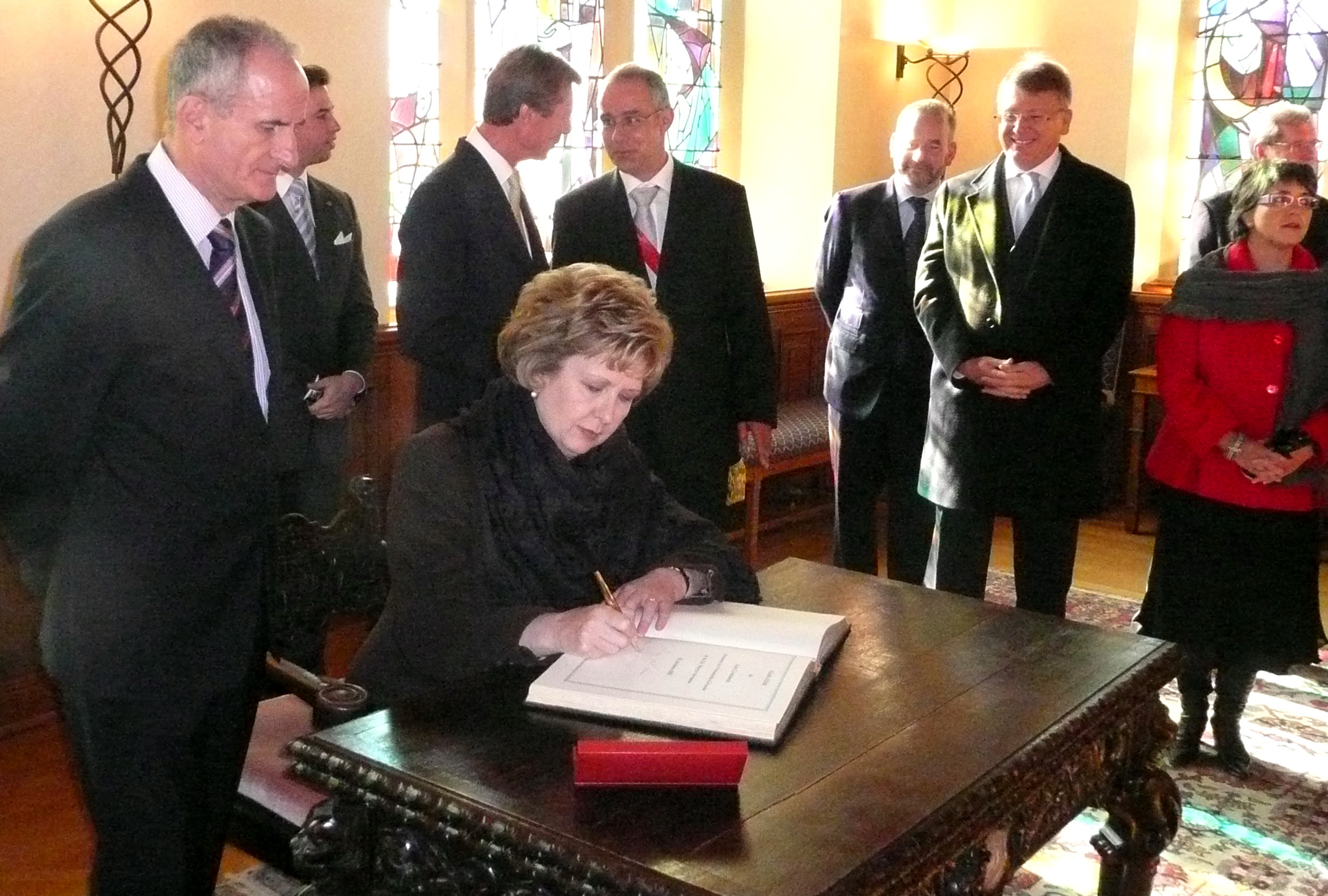
In October 2009 President Mary McAleese as part of her official state visit to Luxembourg visited Echternach. In May 2010 following an invitation from the St. Willibrord Foundation staff from Carlow County Museum visited the town during the famous hopping procession. In April 2012 Ireland’s newest County Museum, Carlow opened to the public in Carlow town and there is a section depicting St. Willibrord and his connection to the county.

President Mary McAleese & her husband Martin in Echternach during the Presidents State to Luxembourg in October 2009. Photograph Alain Muller, Willibrordus-Bauverein

Post written by Dermot Mulligan Curator of Carlow County Museum. Information & pictures supplied by Carlow County Museum.

Telephone:       059-9131554

Email:              museum@carlowcoco.ie

Website:          www.carlowcountymuseum.ie

Twitter:           @CarlowCountyMus

Facebook:    http://www.facebook.com/CarlowCountyMuseum

Download for free a copy of ‘Carlow Trails of the Saints’, which consists of three distinct driving trails around the county, http://www.carlowtourism.com/wp-content/uploads/Carlow-Trails-of-the-Saints.pdf

Footnotes:

1          Recorded Monuments County Carlow 1995. SMR Number: CW012-025 Garryhundon.

2          Professor Dáibhí Ó Cróinin, NUI Galway

3          Professor Dáibhí Ó Cróinin, NUI Galway. ‘The first century of Anglo-Irish relations AD 600 – 700’; The O’Donnell Lecture 2003, National University of Ireland.

4          Emile Seiler ‘St. Willibrord’; Carloviana, 2000.

5          Willibrordus-Bauverein ‘Die Basilika St. Willibrord in Echternach’.

6          Emile Seiler ‘St. Willibrord’; Carloviana, 2000

7                     http://www.unesco.org/culture/ich/en/RL/00392

8                     ‘Das Leben und Wirken des heiligen Willibrord’ Willibrordus-Bauverein, 2008


Holycross Abbey: Medieval Pilgrimage and Historic Tours

Holycross was  one of the more popular pilgrim destinations in medieval Ireland. For centuries pilgrims travelled here to venerate the abbey’s sacred relic of the true cross,  which gave  its name to the Abbey.

View of Holycross Abbey from across the river

My last few posts have been about community archaeology projects and this post continues the theme.   The Holycross Community Network have trained  19 of their members as tour guides and will be running guided tours of the abbey, to help visitors  gain a greater appreciation of the abbeys history and  architectural features .

Tour guides Liz Nevin, Marie Byrne, John Bourke, Mike Carley and Adam Tozer

From now until easter the community is offering free guided tours of the abbey (further information holycrossabbeytours@gmail.com / 086-1665869). Being a bargain lover  I headed along with my friend Ciara to one of  the Saturday tours. The  tour  I attended was given by three guides Adam, Liz and John who  entertained us  all with a combination of historical facts  and folklore associated with the site, as well as pointing out  many of the hidden carvings and masons marks scattered around the church and other buildings.

The  full history of the abbey and its association with pilgrimage is too complex to discuss in detail here so I will just give a quick overview  of the abbeys history and association with pilgrimage.

Adam pointing out the whispering arch to visitors  in the cloister area

On the tour we learned that the abbey started out as a Benedictine Abbey (1169) , it was re-founded  as a Cistercian monastery in 1180  by  Domhnall Ó’Briain the King of Thomond  (Limerick).  The abbey was granted a charter in 1185-6, which confirmed lands totalling almost 8000 acres (Stalley 1987, 245). The charter mentions an older name for the area Ceall Uachtair Lamann. The name suggests the presence of early medieval church  in the area.

A copy of  the charter granting lands to Holycross Abbey

It is said that  the original relic  at Holycross was probably the same relic presented in 1110 by Pope Pascal II to Muirchertach Ó”Briain, Domhnall’s grandfather. The relic was likely gifted to abbey either in 1169 or 1181/2 by Domhnall Mór Ó’ Briain. Over time the relic became an object of veneration and attracted large numbers of pilgrims. Scholars believe that there may have been at one time  up to three  relic here at the Abbey (Ó’Conbhuidhe 1999, 166; Halpin & Newmans 2006, 388).

View of  cloister arch

Peter Harbison (1992, 305)  is of the opinion that the later rebuilding was  financed by the stream of pilgrims who came here to venerate the cross. This was also a period when the abbey enjoyed the patronage of the Earl of Ormond, James Butler ,so I am sure this patronage also contributed to the revamp of the abbey. The re-modelling of pilgrim sites  was often the result of increased numbers of pilgrims or the desire to attract more pilgrims.  Alterations were often designed to make the relics more visible and accessible to the multitudes.

Romanesque doorway leading from cloister into the church

The church was  entered from the cloister through an Romanesque style doorway. The cloister and domestic buildings of the monks would have been off-limits to pilgrims who would have entered the church through the western doorway.

The abbey church is  cruciform in plan, with intricate vaulted ceilings.

https://i0.wp.com/www.tara.tcd.ie/bitstream/2262/40640/1/ertk2522.jpg

Vaulted ceiling in the transept of the church, photo taken prior to restoration. Edwin Rae Photo archive http://hdl.handle.net/2262/40640

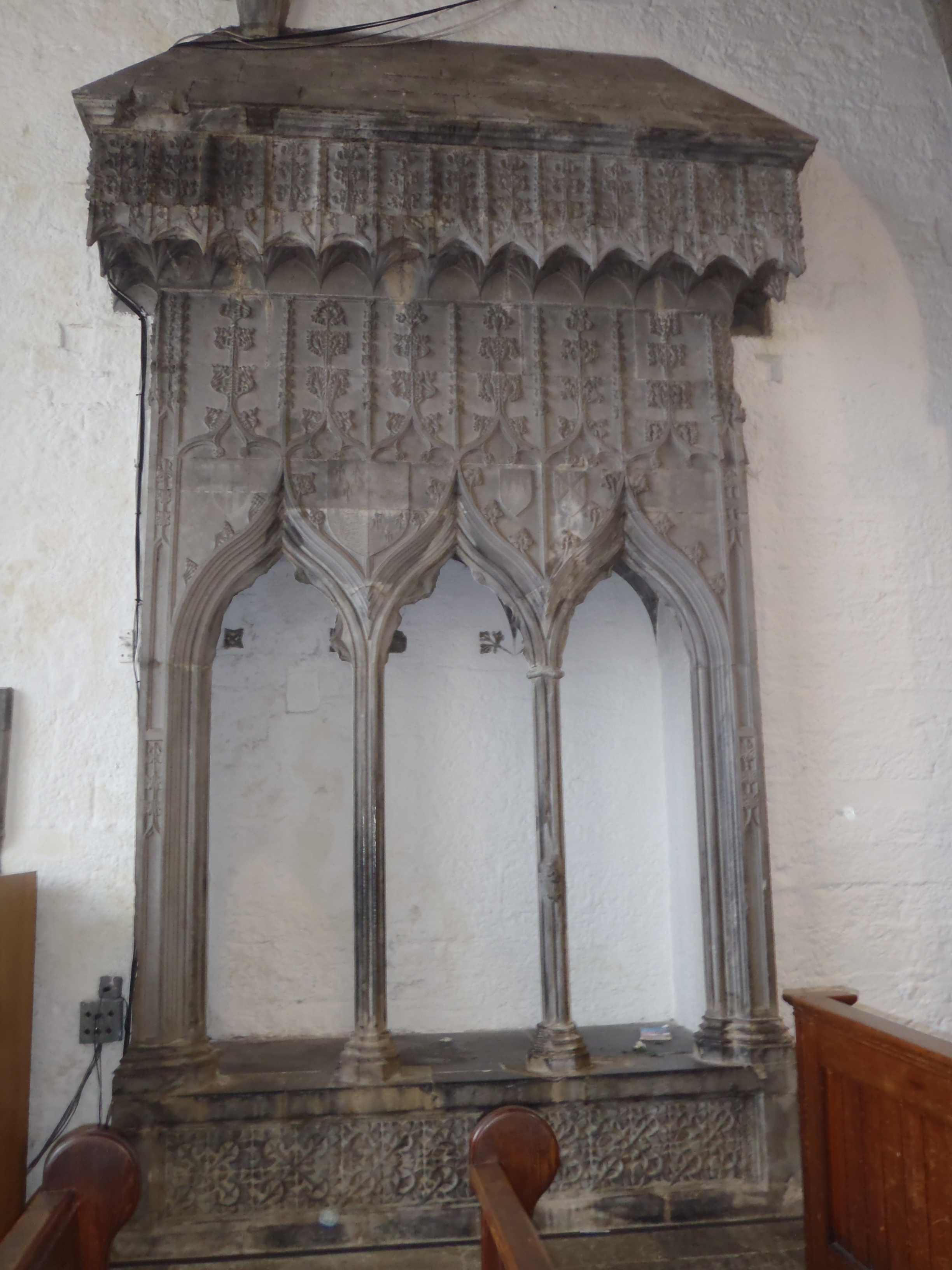
There are many interesting features within the church, too many to mention here.  One worth noting is  a beautifully decorated sedilia, traditionally called the ‘Tomb of the Good Woman’s Son’. The sedilia is located within the chancel of the church. The base is highly decorated  and the top of the structure has a series of shields/coats of arms;   the  abbey, the Butler arms and the FitzGerald arms  and the royal arms of England (Stalley 1987, 115).  In the medieval church, the  sedilia functioned as a  stone seat, it was used by priest officiating at the  mass. Over time a colourful legend about the ‘Good Woman’s son’ developed around the sedilia. The earliest recorded version of the tale dates to the mid 17th century. The tale recounts an English prince (some accounts name him as the son Henry II)  travelling through the Holycross area collecting St Peter’s pence, he was killed by an O’Forgarty, the ruling Gaelic family in the area and buried where he fell in a wood called Kylechoundowney (Hayes 2011, 10-12). Some years later a blind monk at the abbey had three visions directing him to go to the wood. Having explained his visions to the abbot, he was given permission to set forth and investigate.  Having reached the wood the blind man’s companion saw a hand sticking out from the ground. The blind monk miraculously returned his sight and a spring of water burst forth from the ground  (ibid). The body was brought back to Holycross and buried and the young man’s mother upon hearing the news  gifted the abbey a relic of the true cross (ibid). This   legend may have developed following the acquisition of a second relic of the true cross.
sedilia known as the Good Woman’s Tomb

Another very interesting feature is an elaborately carved tomb-like structure called the  ‘Waking Bier of the Monks’, situated between the two south transept chapels. Stalley(1987, 116), suggests that it may have possibly functioned as an elaborate shrine where one of the  relics of the True Cross could be viewed through the open-work  canopy .  The base of the  stucture (shrine)  resembles a tomb chest and  the upper section with its canopy, arcades  resembles  English shrines  such as St Albans, St Edward the Confessor at Westminster and St Swithun at Winchester. Hayes (2011, 105)  notes also that Dr Dagmar O’Riain-Raedel suggest the it may also have functioned  as the sepulchrum Domini (the Lords tomb), where following the Good Friday liturgy the relics of the cross and the consecrated Host were placed here to symbolise the burial of Christ  after the crucifixion.  Architectural fragments suggest a  second  shrine  which may  also have displayed a second relic of the cross. These fragments are  not on display at present in the abbey but it  was recorded in 1913, prior to renovations, as being located in the north-west angle of the north transept.  Both structures are contemporary and date to the main period of rebuilding.
Liz telling us the history of the ‘Waking Bier’

The earliest reference to pilgrimage is found in the Papal letters of 1488.  The letters mention ‘the oblations which are made by the faithful to the wood of the Holy Cross in the church of the same monastery and which are collected by collectors appointed for the purpose’. This reference implies that the pilgrimage was well established by 1488. Pilgrims often brought gifts to the shrine, animals, foodstuffs and in the later medieval period coins and wax votives and candles.

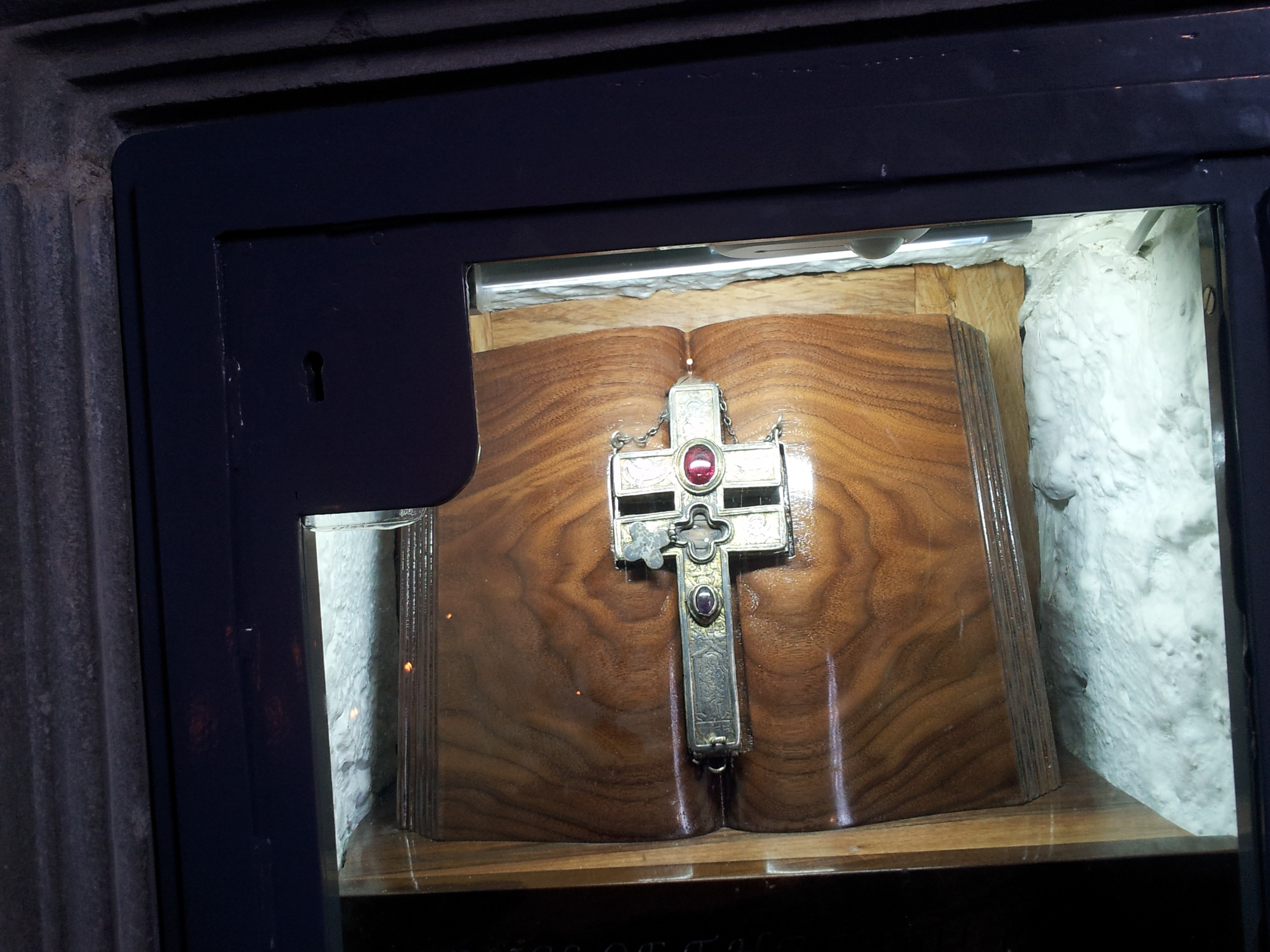
The Ormond relic’ a 15th century reliquary containing a relic of the true cross

The presence of ‘collectors’ implies that  significant numbers of people arrived with offerings. We  can only guess how pilgrims would have interacted with the  holy relic but given that this was a working monastery, the monks would have controlled the access of pilgrims ensuring that they did not dispute their daily prayers.  The pilgrims who came here were from all social classes and  came seeking healing both  physical and spiritual for themselves or loved ones, to ask protection and help in times of crisis,   to experience a miracle, others came out of devotion to God, some came out of  curiosity, others to experience to social side of the pilgrimage .

The main burst of devotion would have focused on feasts connected with the holy cross such as  the 3rd of May, the feast marking the finding of the cross and the 14th of September, the Feast of the Exaltation of the Cross (Exaltatio Sanctae Crucis)  a feast greatly observed in the medieval world and Easter.

The abbey also held one of its two annual fairs on the 14th of September,  most likely to take advantage of the large numbers of pilgrims.  A common practice at other pilgrim sites, the fair offered pilgrims a chance to combine prayer and devotion with  more secular pleasures. Medieval fairs were often associated with other activities, such as games and matchmaking and there are many parallels to the descriptions of pattern day festivities associated with mass pilgrimages of the 18th and 19th centuries. From medieval times, the area also has strong links with St Michael whose feast was the 29th of September . So September was a busy month for Holycross.  On special occasions like the feast of the cross,  the relic(s) at Holycross would have been displayed within the church either in the two shrines noted above or possibly displayed in a Rood Screen or the high altar.  It may also be possible that  relics were brought on procession  on busy feast days, as happens still with the relics of St Willibrod in Belgium.

Relics were not just a focus of devotion,  they were also used  in the swearing of oaths  and they were used to ward off evil, pestilence and plague. There are 16th-17th century references to the Holycross relic of the cross being brough out of the abbey as far away as Kilkenny to swear oaths on and even to improve fertility of crops  and there still survives a late medieval image depicting the relic of the True Cross at Holycross, being carried suspended from the abbot’s neck .

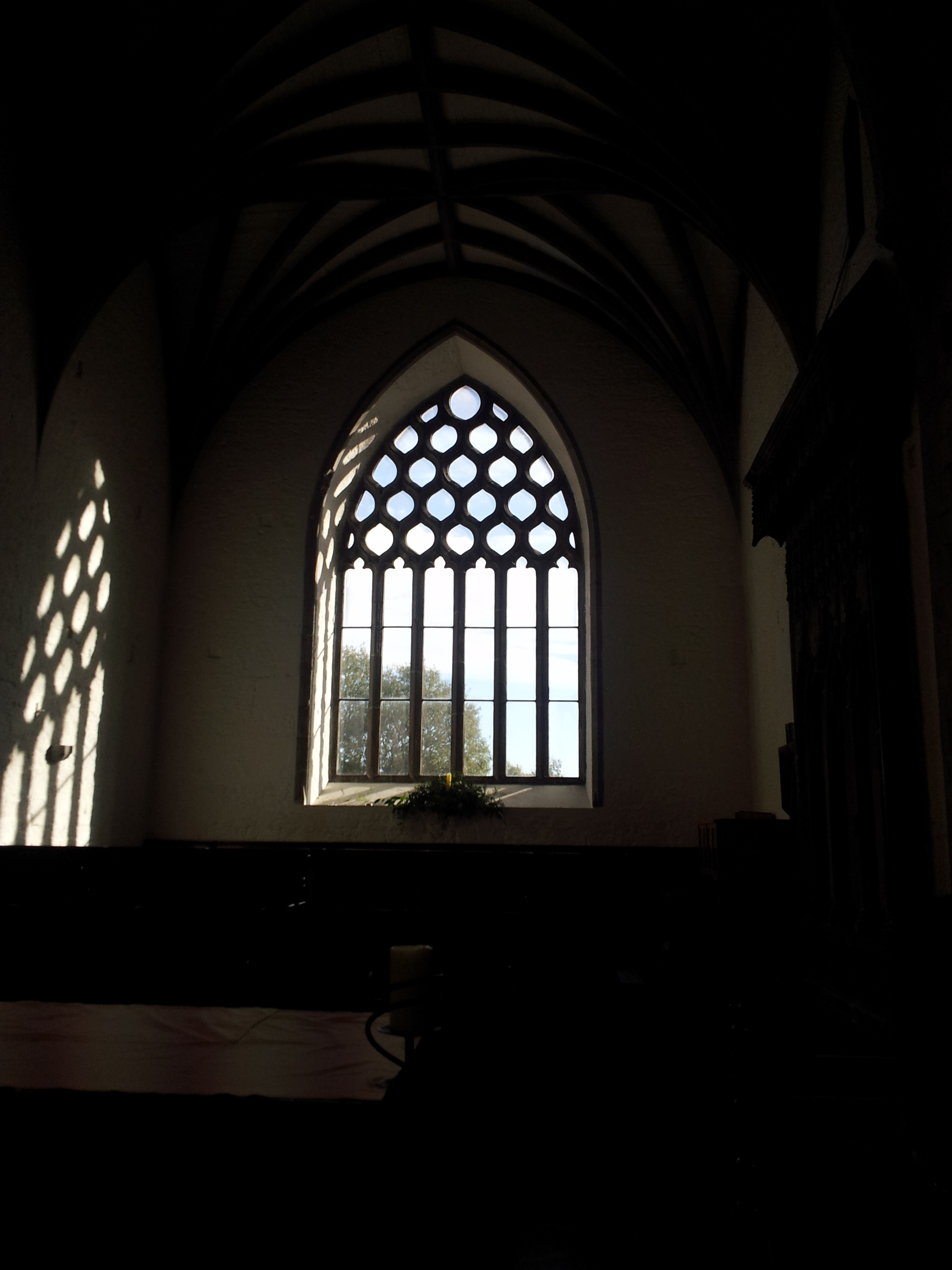
15th century window

Unlike many other Irish shrines pilgrimage at Holycross did not end with the reformation.   The relics at the abbey which also included a miraculous statue of the Blessed Virgin,  escaped  destruction by the reformers possibly because of the abbeys connections with the Bulters and there are many references and accounts of pilgrimage at Holycross post-dating the reformation.

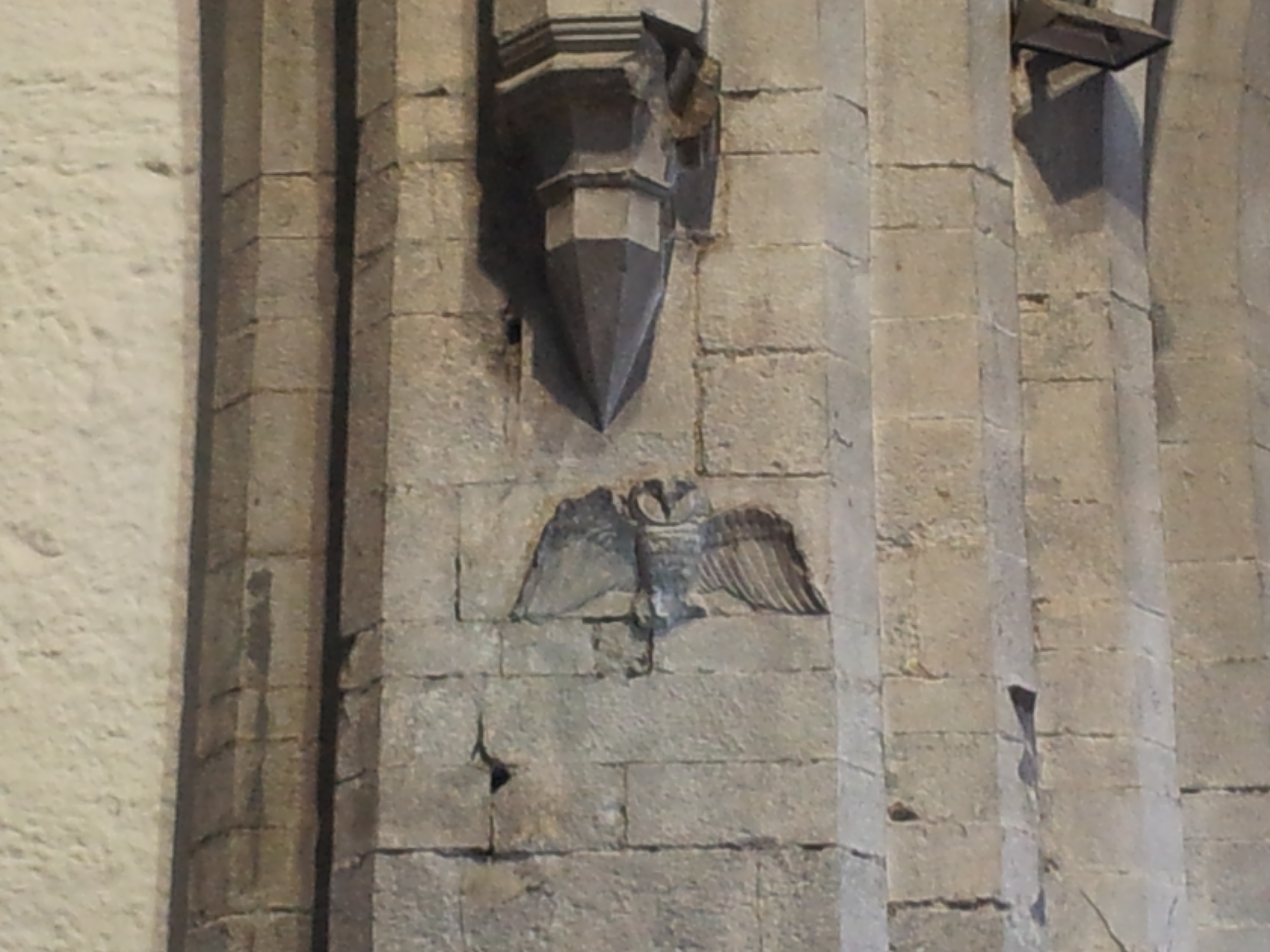
Carving of an owl at centre of the church

To   briefly mention just a  few references to post reformation pilgrimage;  in   1567  the Lord deputy complaining to the Queen wrote  ‘there is no small conflunence of people still resorting to the holy cross’. In 1579 James Fitzmaurice Fitzgerald is said to have venerated the relic  of the cross at the abbey a few weeks before his death at the hands of the Burkes, while 1583 Dermot O’Hurley archbishop of Cashel made a pilgrimage to the shrine shortly before his capture by the English. The relic of the cross would have attracted people from all classes  and in 1586 Camden writes of the ‘famous abbey’ to which the people still come to do reverence to the relic of the Holy Cross’. He goes on to say ‘It is incredible what a concourse of  people still throng hither out of devotion. For this nation obstinately adheres to the religion of superstition of their forefathers.’

Holycross Abbey, Thurles, County Tipperary - Pre Restoration

Holycross Abbey, Thurles, County Tipperary – Pre Restoration Image from the Edwin Rae Photo archive http://hdl.handle.net/2262/40632

The reformation began the decline of the  religious community at Holycross. In 1534 Willian Dywer, then Abbot, resigned his office  to Philip Purcell and the abbey became a provostry rather than a Cistercian abbey. By the 17th century the abbey had fallen into ruins and links with the Cistercians were finally broken with the death of Fr Edmond Coogan in  c1740.

The abbey and its church remained in ruins until the 1970’s when a  special act of parliament known as the HOLYCROSS ABBEY (COUNTY TIPPERARY) ACT, 1969 (http://www.irishstatutebook.ie/1969/en/act/pub/0007/print.html), allowed  for its re-consecration and restoration. This process is described in fully in an excellent book Holycross. The Awakening of the Abbey, by William Hayes details this process. There is lots more to add about the pilgrimage tradition and I will hopefully discuss it further in the coming months.

View of the restored  abbey church from the cloister

© Louise Nugent 2012

References

Halpin,  A. & Newman, C. 2006. Ireland. An Oxford Archaeological Guide to Sites

  from the Earliest Times to AD 1600. Oxford: Oxford University Press.

Harbison, P. 1991. Pilgrimage in Ireland. The monuments and the people. London:

Syracuse University Press.

Harbison, P. 1992. Guide to National and Historic Monuments of Ireland. Dublin:

Gill & Macmillian.

Nugent, L. 2009. Pilgrimage in Medieval Ireland, AD 600-1600. Vol.1-3.Unpublished PhD Thesis, University College Dublin.

Stalley, R.1987. The Cistercian monasteries of Ireland: an account of the history, art

  and architecture of the white monks in Ireland from 1142-1540. London: Yale U.P.

Graveyard recording at Newcastle

This week I  headed along to  another historic graveyard at Middlequarter,  Newcastle, Co. Tipperary.  The old graveyard at Newcastle  along with the graveyards at Molough, Shanrahan and Tubrid, are  currently being recorded by local community groups trained by Historic Graves (http://historicgraves.ie/).

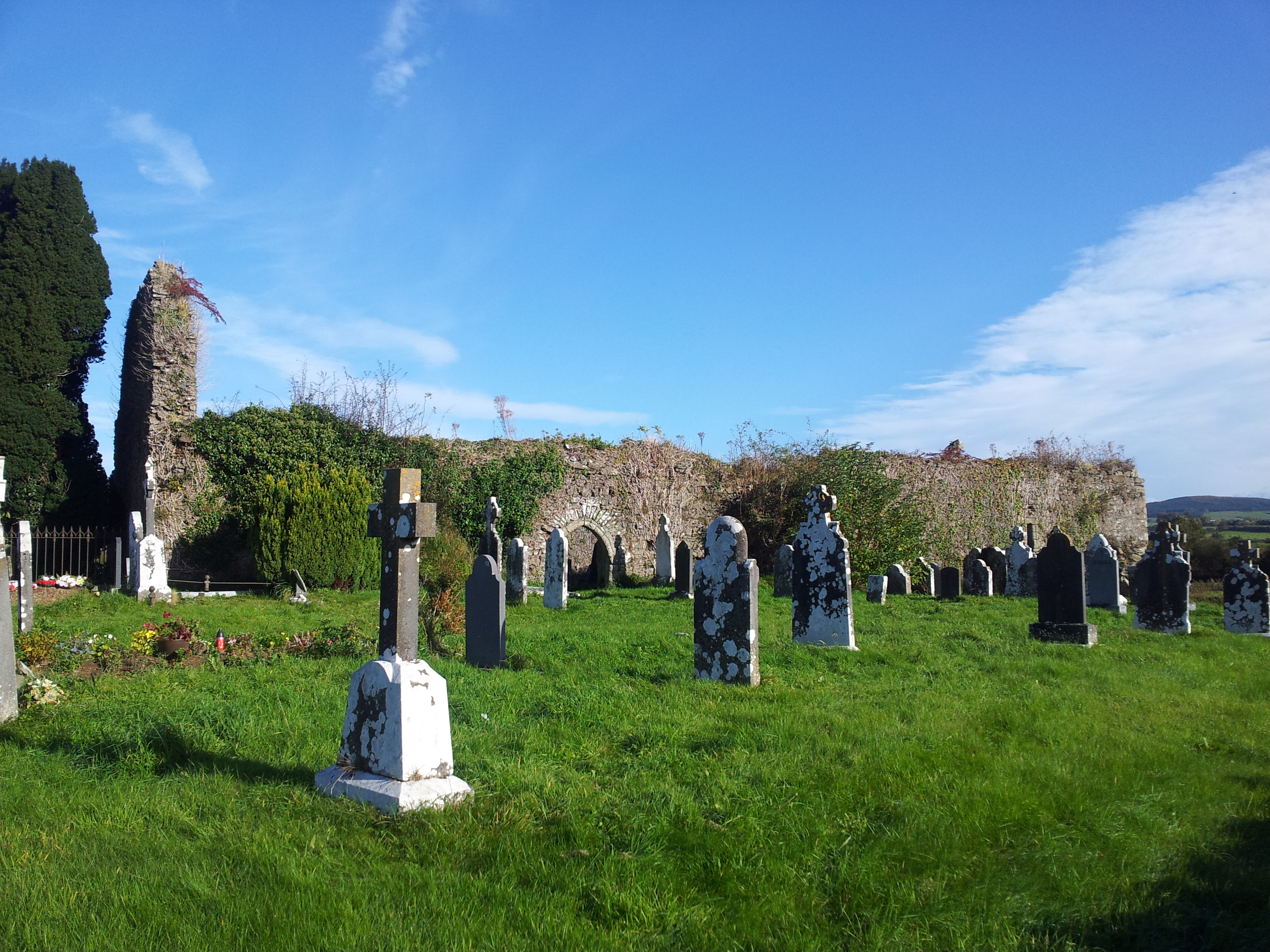
The Medieval Church and graveyard at Middlequarter, Newcastle, image taken from Bing maps

Newcastle graveyard  is located close  to  the Anglo-Norman castle which gives its name to the area.  The remains of the castle consist of a  hall house with a vaulted roof, a tower and a bawn. The castle  is strategically located  on the banks of the River Suir close to the fording point .  The castle  is  part of a group  of 12th -13th castles  built in a line along foothills  of the Knockmealdown mountains. This  area was the  frontier  between the Anglo-Norman territory and the Gaelic territory of the Déises . Newcastle was in the control of the Prendergast family from the 13th to the 17th century, it then  passed into the hands of  the Perry’s family.

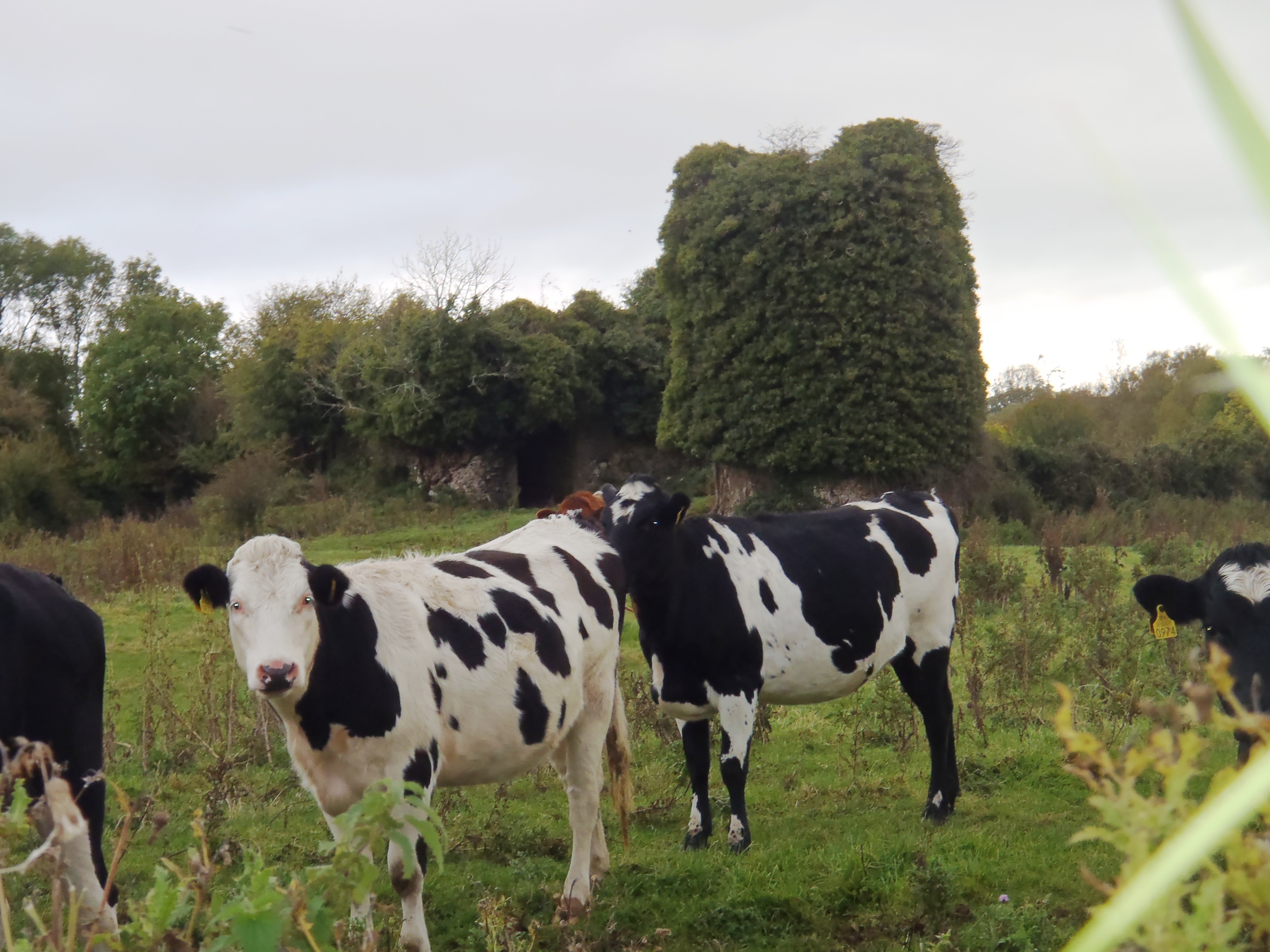
View of Newcastle castle from the nearby graveyard

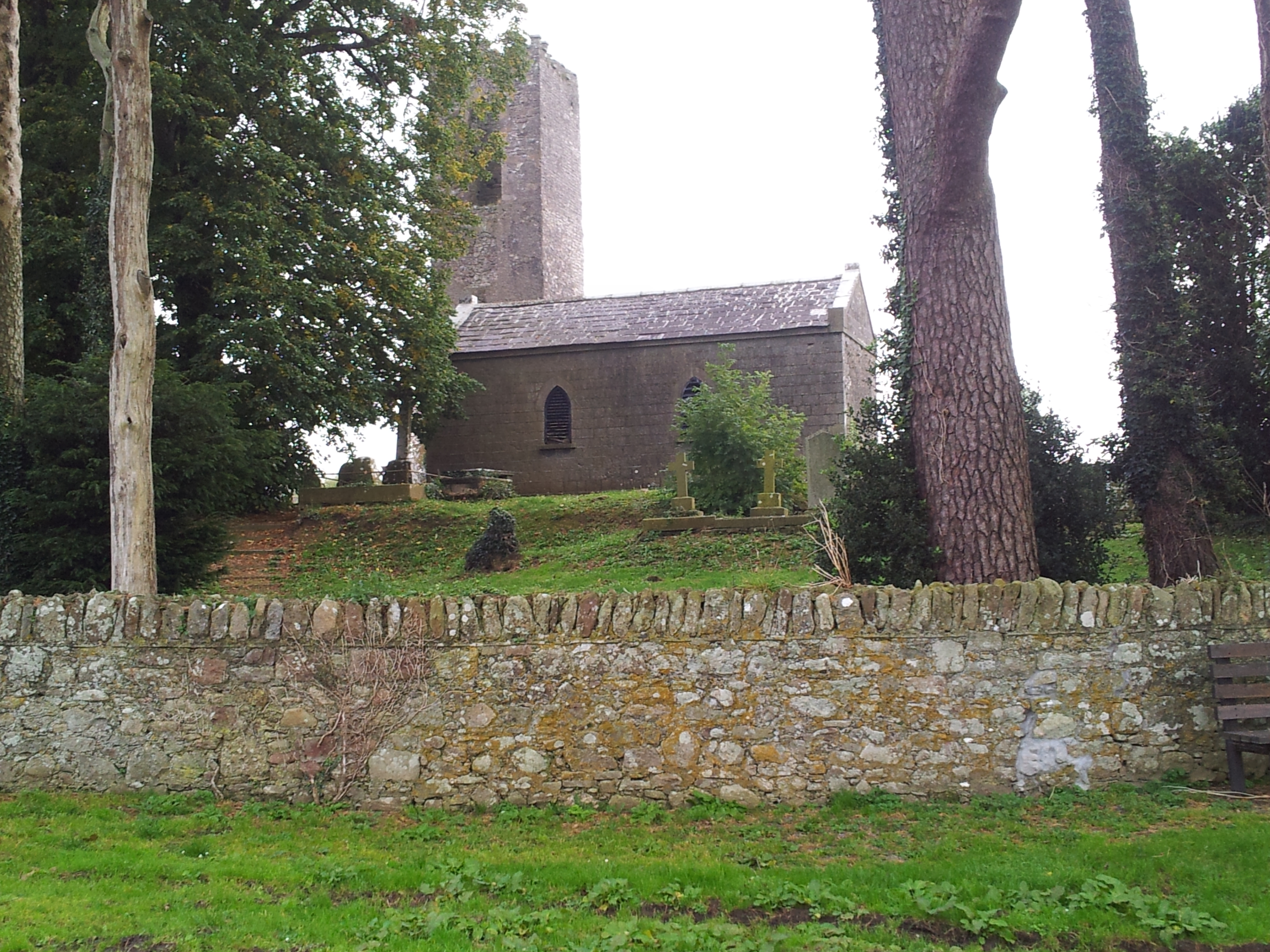
The historic graveyard  surrounds  a 12th /13th century church, which functioned as the medieval parish/manorial church .

The medieval church at Newcastle

Newcastle church is one of the largest medieval parish churches in the surrounding area, being 29m  in length and 10m in width. Any past dedication to a saint has long been forgotten and today the church is simply known as the old church.

Southern doorway of the church

The church is entered through two ornate doorways  at the west end of the church, located in the  north and south wall.  The south doorway is simpler in design with a moulded surround. The north doorway is slightly taller and has roll and fillet-mouldings with traces of hood- moulding over the apex of the door. Both doors are directly opposite each other.

The North doorway of the church at Newcastle

There is no evidence of an internal division   between the chancel and the nave within the church, nor is there any traces of a choir.

The east gable  of the church is now partially collapsed. Luckily the Ordnance Survey Letters of 1840 provide the following decription

Its east window is in the pointed style and constructed of brownish sandstone chiselled… 6 feet in height and 1 foot 8 inches in width. It is divided into two compartments the stone which separates them has been removed (O’Flanagan 1930 Vol.1,  22)

View from window at NE end of the church

The  Ordnance Survey letters also state that ‘ the church was burnt by a Prendergast who lived in Curraghcloney Castle’  (O’Flanagan 1930, vol. 1, 23).  However today  many   local people tell the tale, that it was Cromwell  who burned the church .

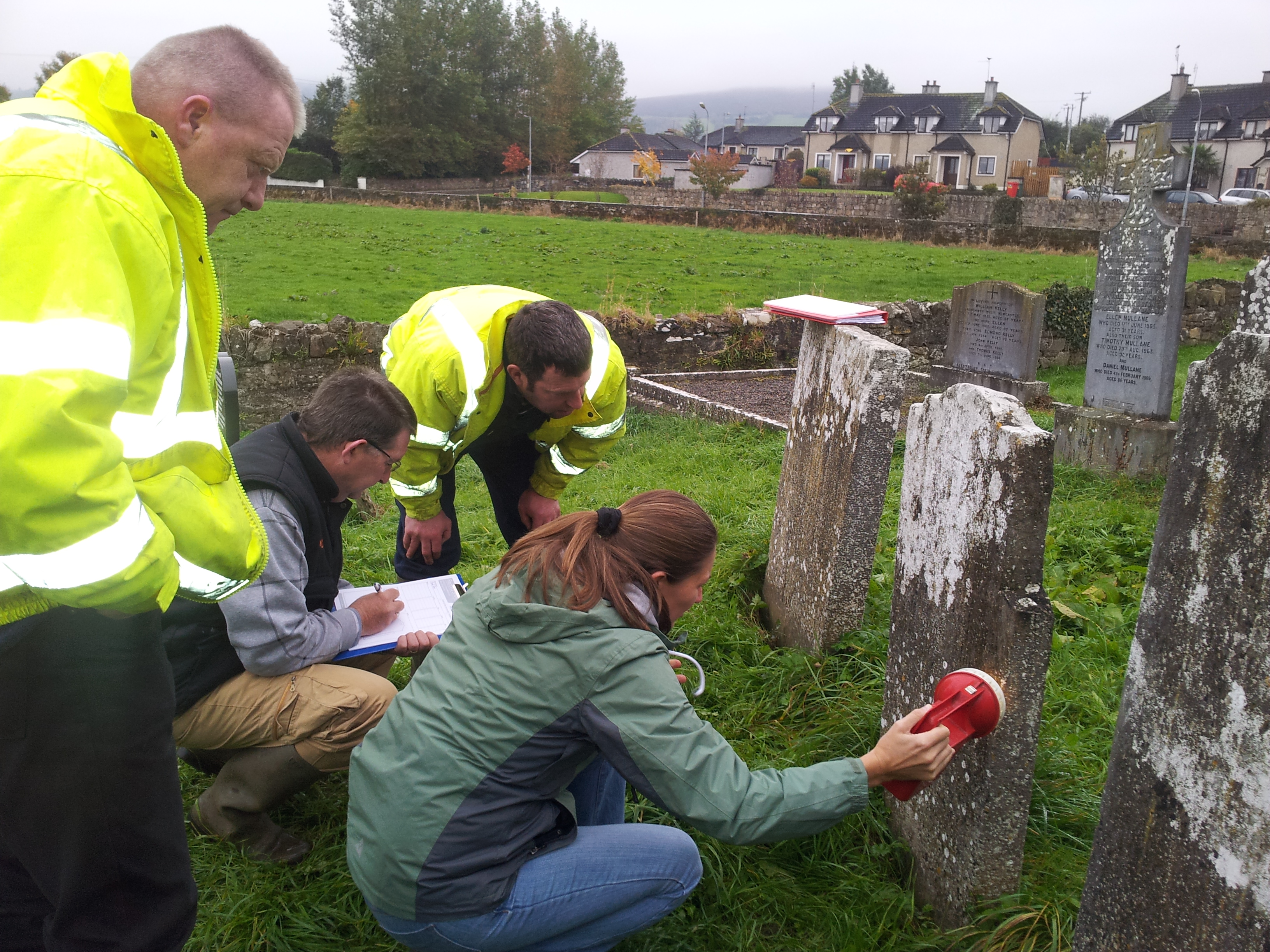
Volunteers recording gravestones at Newcastle

The graveyard  has a mixture of 18th , 19th and 20th century graves, including some very recent ones. In total there are  204  grave markers in  the graveyard.

Volunteers recording a gravestone

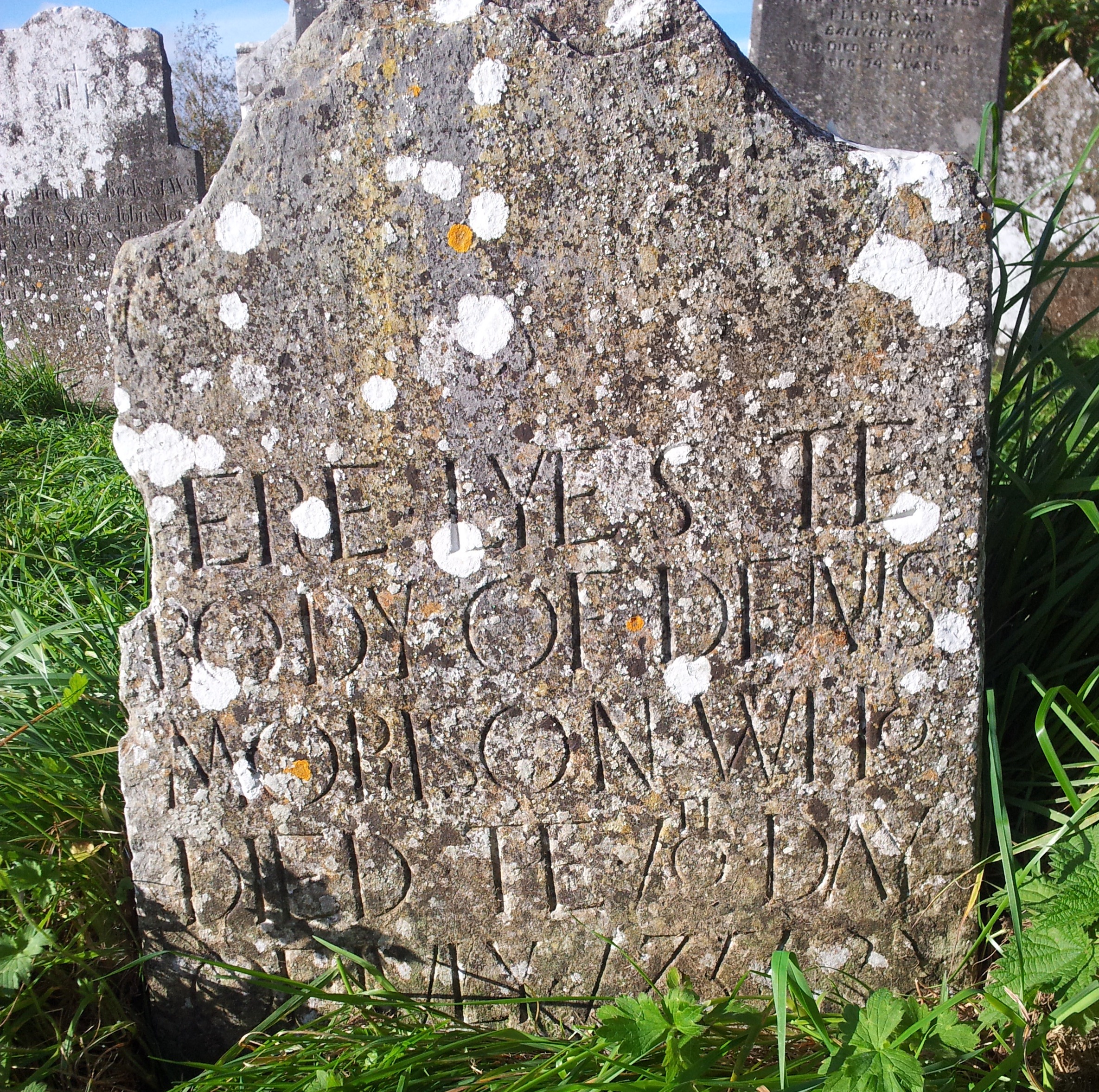
It is difficult to decide which gravestones to include here  as there are so many interesting ones. The stone below was carved in  1755  to commemorate the death of Denis Morison.

A simple gravestone dating to 1755

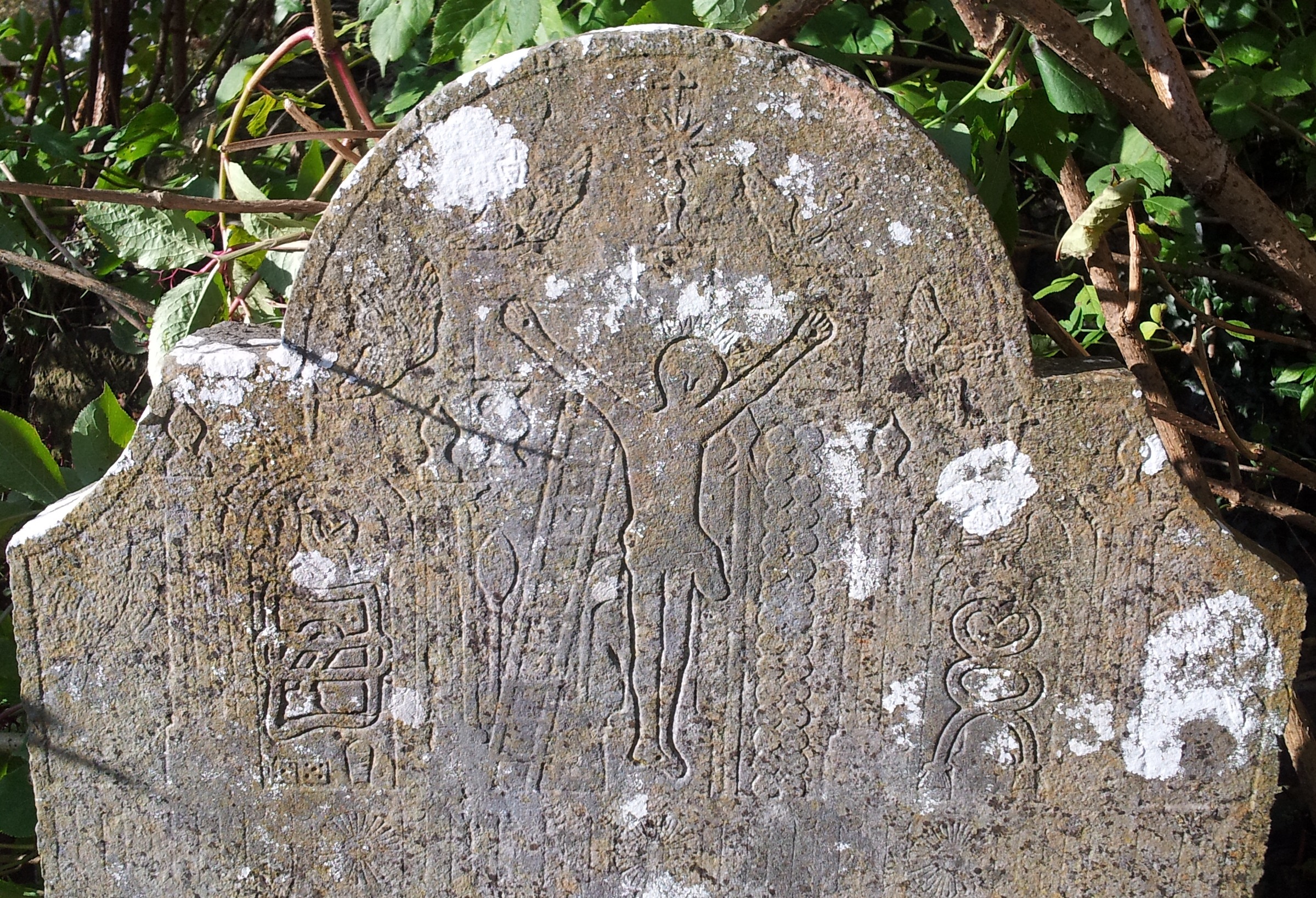
Some of the early gravestones have lovely decoration. The  stone below depicts the crucifixion scene and a stone by the same mason has been identified in Shanrahan & Tullaghmelan graveyards.

Crucifixion imagery on the gravestone of Daniel Long of Neddins died 1817

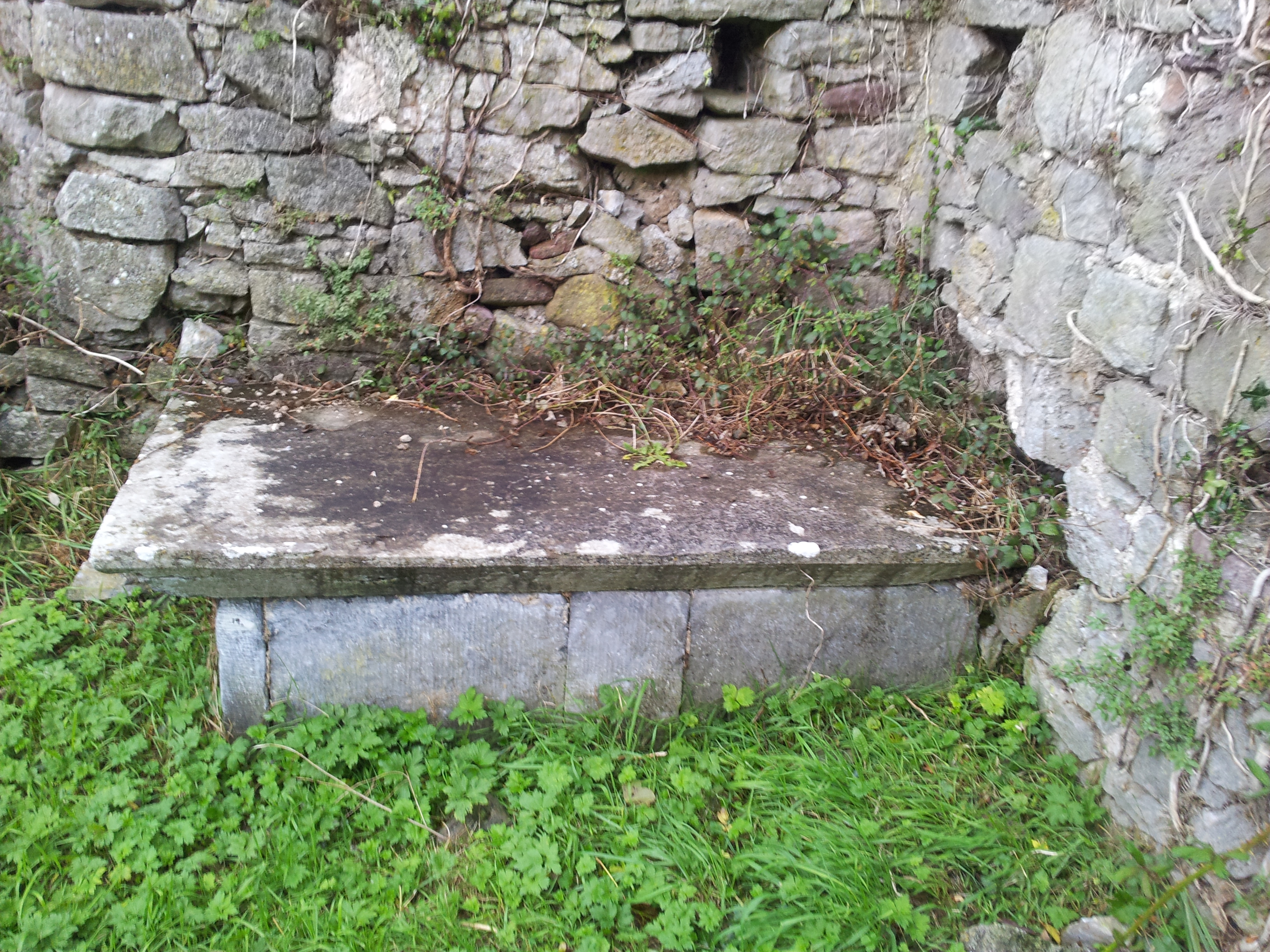
The interior of the  church is packed with approximately 60 burials. At the east end are three unusual  burials. A chest tomb sits in the NE corner of the church. The  inscription of the tomb is worn away and impossible to read.  O’ Hallian  in his book Tales from the Deise  gives the following   account of the inscription

Here lyeth the body of Jeffry Prendergast of Mullough in the county of Tipperary who served in Flanders as Captain under the Great Duke of Marlbourugh, from  whom he had the honour of reciting public thanks for his services at the siege of Ayr in 1710. Died 1713. he was an affectionate husband and tender father, in friendship steady and sincere; to all beneath him courteous, truly just and therefore universally esteemed and beloved. He lived under the influence of religion and died cheerfully supported by it the  27th day of March in the 64th year of his life.

Chest tomb of Jeffery Prendergast

John Burke’s A Genealogical and Heraldic History of Extinct and Dormant Baronetcies….. records that Jeffrey’s father Thomas Prendergast, esq was born in 1614 and married Elinor the sister of Walter the 11th Earl of Ormond. The text also says  Thomas died in 1725, aged 111 years ‘as appears on his tombstone at Newcastle, near Clonmel’.  Once the survey is complete if the tombstone commemorating Thomas survives I am sure the volunteers will uncover it.  I would wonder if he was not interred with his son Jeffery.

Beside the Prendergast tomb are two grave slabs which I recorded as part of a project for  college in 1998.  The  inscription on slabs have  deteriorated since  I last visited here. One  has a motif of  a horse standing on its hind legs in an oval frame. This is the grave of Samuel Hobson sq of Muckridge,  who died in 1782.  The second slab records the burial of ‘Lieu Henry Prendergast of Mulough’ and his wife who died in 1776 , along with  their a coat of arms.

Crest on the Prendergast grave slab

© Louise Nugent 2012

References

Hallinan, M, 1996. Tales from the Deise: an anthology on the history and heritage of Newcastle, the Nire Valley, and especially the Parish of Newcastle and Four-Mile-Water. Dublin: Kincora Press.

O’ Flanagan, Rev. M. (compiler) 1930. Letters containing information relative to the antiquities of the county of Tipperary collected during the progress of the Ordnance  Survey in 1840. 3 Vols. Bray: Typescript.

Power, Rev. P. 1937. Waterford and Lismore; a compendious history of the united

  dioceses. Cork: Cork University Press.

Graveyard Recording at Shanrahan and medieval pilgrim rituals

At the moment there are some really exciting community archaeology projects taking place in Ireland. I want to tell you about one project  happening over the next two  weeks  in South Tipperary.  This project  involves the training of local communities  to record   historic gravestones at the old graveyards at Newcastle, Molough Abbey, Shanrahan and Tubbrid.  The  training and mentoring for the project  is being provided by Historic Graves.  As you can see from their  website   http://historicgraves.ie/  Historic Graves have  successfully completed similar project  all over the country.

Map showing the location of the four graveyards taken from google earth

Today I headed  over to  Shanrahan  graveyard, located  just outside of Clogheen, to see how the project works.

View of Shanrahan Church and Graveyard

Shanrahan is a really interesting place,  at the center of the graveyard are the ruins of a  medieval parish church. The church is unusual in that it has  two Sheela-na-gigs.   Sheelas  are  figurative carvings  of naked   women, usually bald and emaciated, with lug ears,  squatting and pulling apart their vulva.  These carvings are found on medieval church, sometimes castle sites in  Ireland and England.

There are lots of theories about  the purpose of these carvings,  some believe that were used to ward off evil,  others that they were symbols of fertility, others that they were used to warn against the dangers of lust  etc . If you want to find out more  about  these strange carvings check out the  bibliography below.

Sheela-na-gig on the church tower.

John Tierney of Historic Graves, kindly brought me on a guided tour and explained how  the recording is   done. I also got to meet the volunteers who were all having a great time  and doing an excellent  job recording the inscriptions.

Volunteers taking a brake for the recording

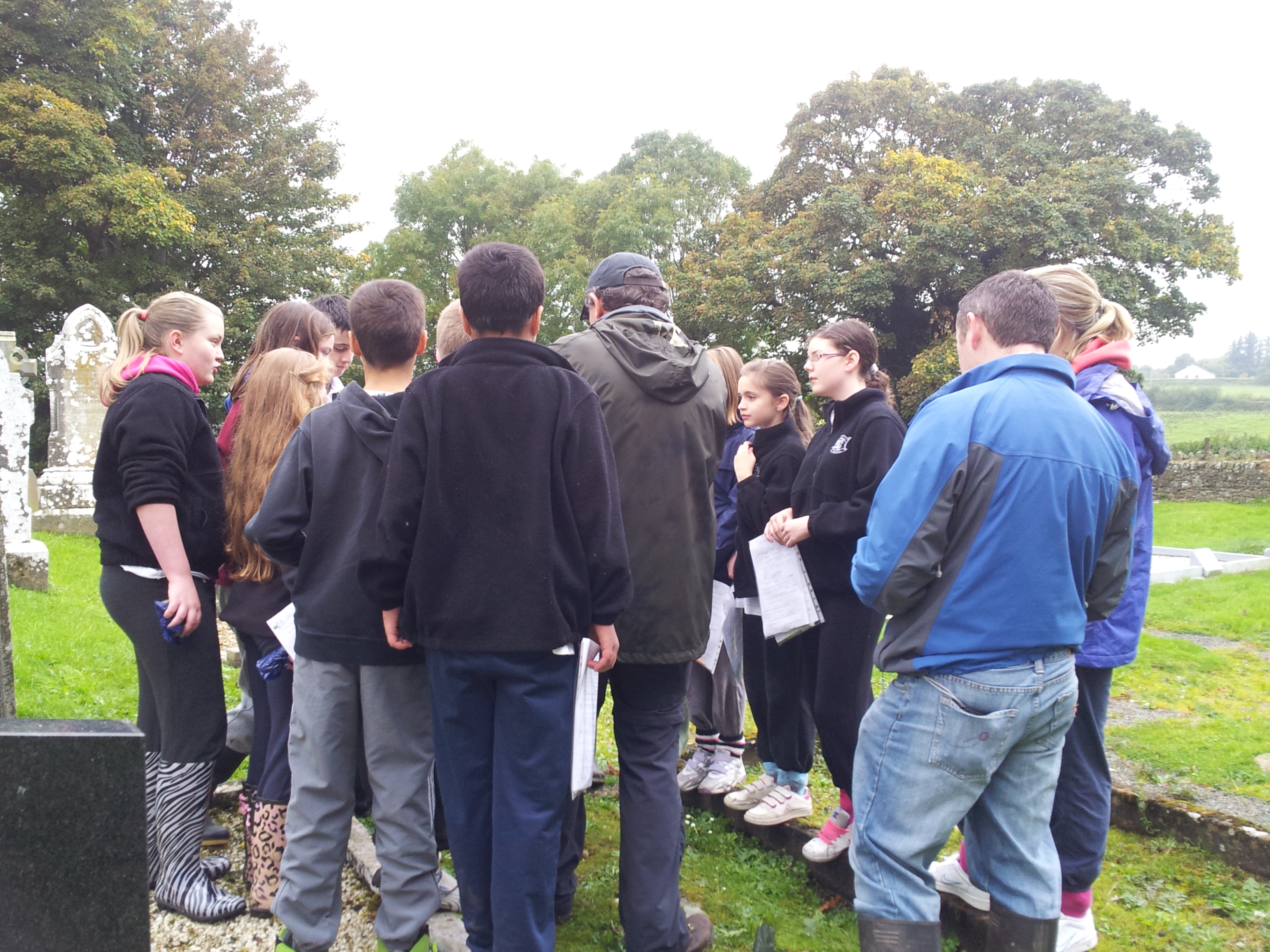
The project  also involves the  local primary schools.

John explaining the recording to the local school kids

The gravestones are numbered, then photographed using a special camera which provides each photo which a geo tag.  This information can be used to produce a plan of the  graveyard.  Next the inscriptions on the stones are recorded.

Patsy McGrath, Michael Moroney, Michael Fennessey recording an 19th century headstone

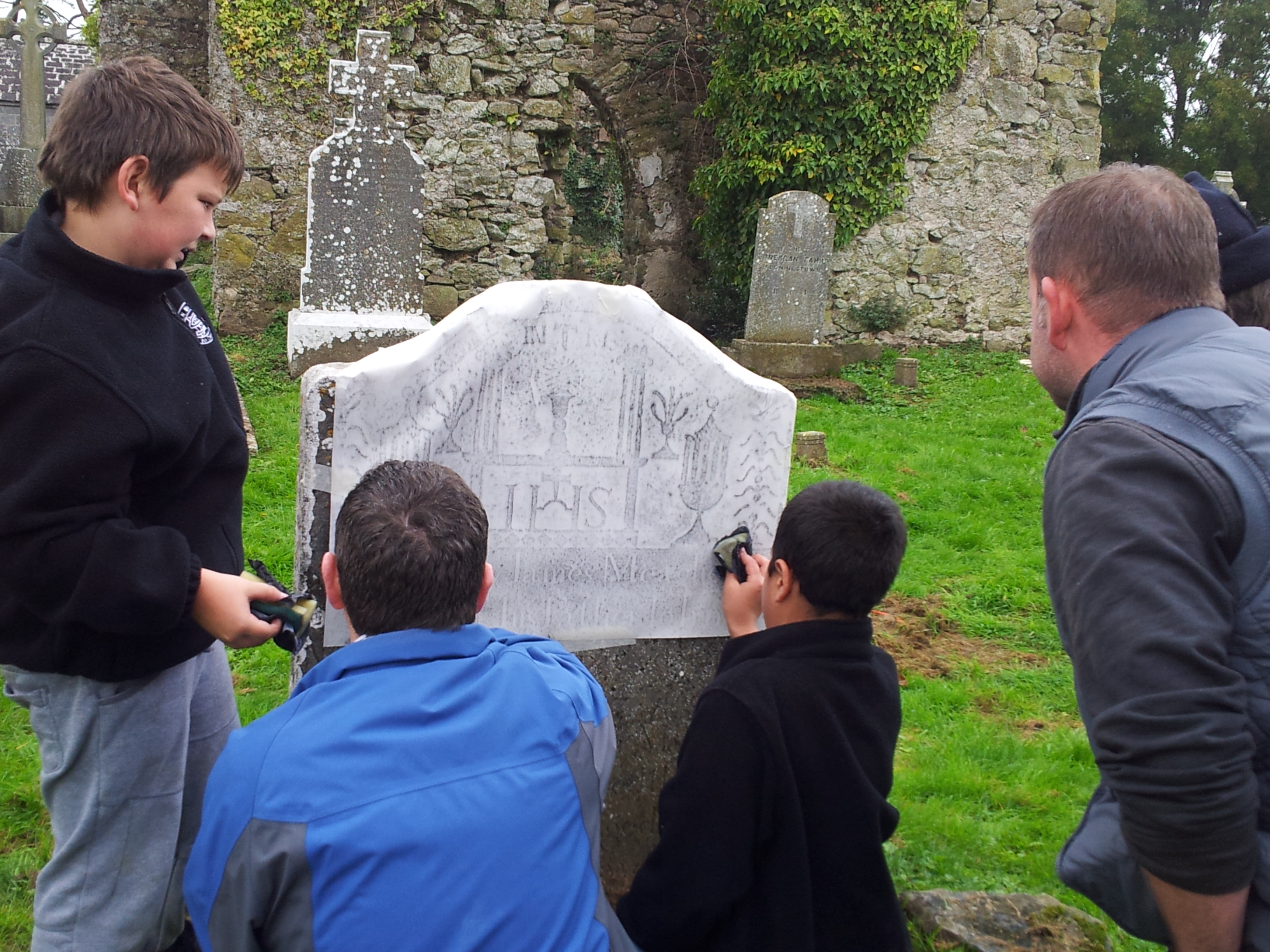
Once the stones  have been photographed and  the inscriptions recorded ,  a rubbing is taken of  each gravestone .

Rubbing of 19th century gravestone

The local  kids  from Clogheen  primary school came along  for a visit and  to help out  with the recording.

School kids taking a rubbing of gravestone

Projects like  this are really important. They help  local communities become aware  of the importance of  Irish graveyards. Each stone has its own story and can tell alot about the social  history of the time . The location of graves and style of headstone  can  tell us about class and religious differences .  They provide a record of people who lived in the area , as well as  a record  of  folk art for the 18th – early 19th century. They also provide imformation about the people who made the stones.  Additionally projects like this make people aware of good practice in maintaining and looking after graveyards. This in turn  means they are less likely to engage in bad practice like sandblasting  or cleaning stones with wire brushes which ultimately  damages the stones.


Close up of the angel Gabriel blowing a trumpet


Just  when I thought I was having a pilgrim free day  John brought me to see the grave of Fr. Nicholas Sheehy 1734—1766.  An  opponent to the penal laws, the preist was   hung , drawn and quartered  after he was falsely accused  of  murder.  The candles on the grave and the flowers immediately pointed to people coming to the grave.

The grave of Fr Sheedy


John then pointed out a small hatch or door in the side of his tomb and noted he had seen a similar hatch at priests grave in Cavan also dating to the penal times.

This opening allowed people to remove soil  from the grave within, the soil which was  seen to be holy and have healing powers,  was  take away  to be used for cures.

The soil within the tomb

Fr.  Sheehy’s tomb  immediately reminded me of medieval pilgrims who were known to take   dirt/earth from the saint’s grave, or  cloths touch against the saint’s shrines or oil from the lamps that burned at the shrine, home with them. The tradition of healing soil is recorded  in early Greek medicine, where certain soils were seen to have curative powers.   In the medieval world the healing  power of the earth came from the belief that the soil was a type of  relic. Pilgrims believed the earth or dirt from the saints graves had been scantified because of its proximity to the saints body . There are many  accounts of 19th century  and even modern pilgrims  taking  the holy earth from the grave of the saints home with them, to use for cures and protection.  At Ardmore  the soil from St Declans grave was sold to pilgrims in the 19th century, while at  Clonmacnoise the practice of taking earth from the grave of St Ciarán caused the walls of Temple Ciarán to become unstable and lean in. I think this could be a topic for another blog post.


References
McMahon, J. & Roberts, J. The Sheela-na-Gigs of Ireland and Britain: The Divine Hag of the Christian Celts – An Illustrated Guide Mercier Press Ltd. (2000).
Kelly, Éamonn Sheela Na Gigs. Origins And Function Country House (1996).
Freitag, Barbara Sheela-na-gigs: Unravelling an Enigna   (2004)

A quick note on a medieval baptisimal font at Ballybacon, Co. Tipperary

About two weeks ago I finally got to visit the beautiful medieval baptismal font at Ballybacon Co. Tipperary. I first came across an article on the font (M. Cahill and E. Twohig, Baptismal Font from Ballybacon Old Church, Co. Tipperary , Journal of the Cork Archaeological and Historical Society , 81, 1976, 92-3, fig.1) when I was doing research for my MA thesis on the Rian Bó Phádraig in 2000. I have always wanted to see the font    in person and after several failed attempts  I finally managed to achieve my goal.

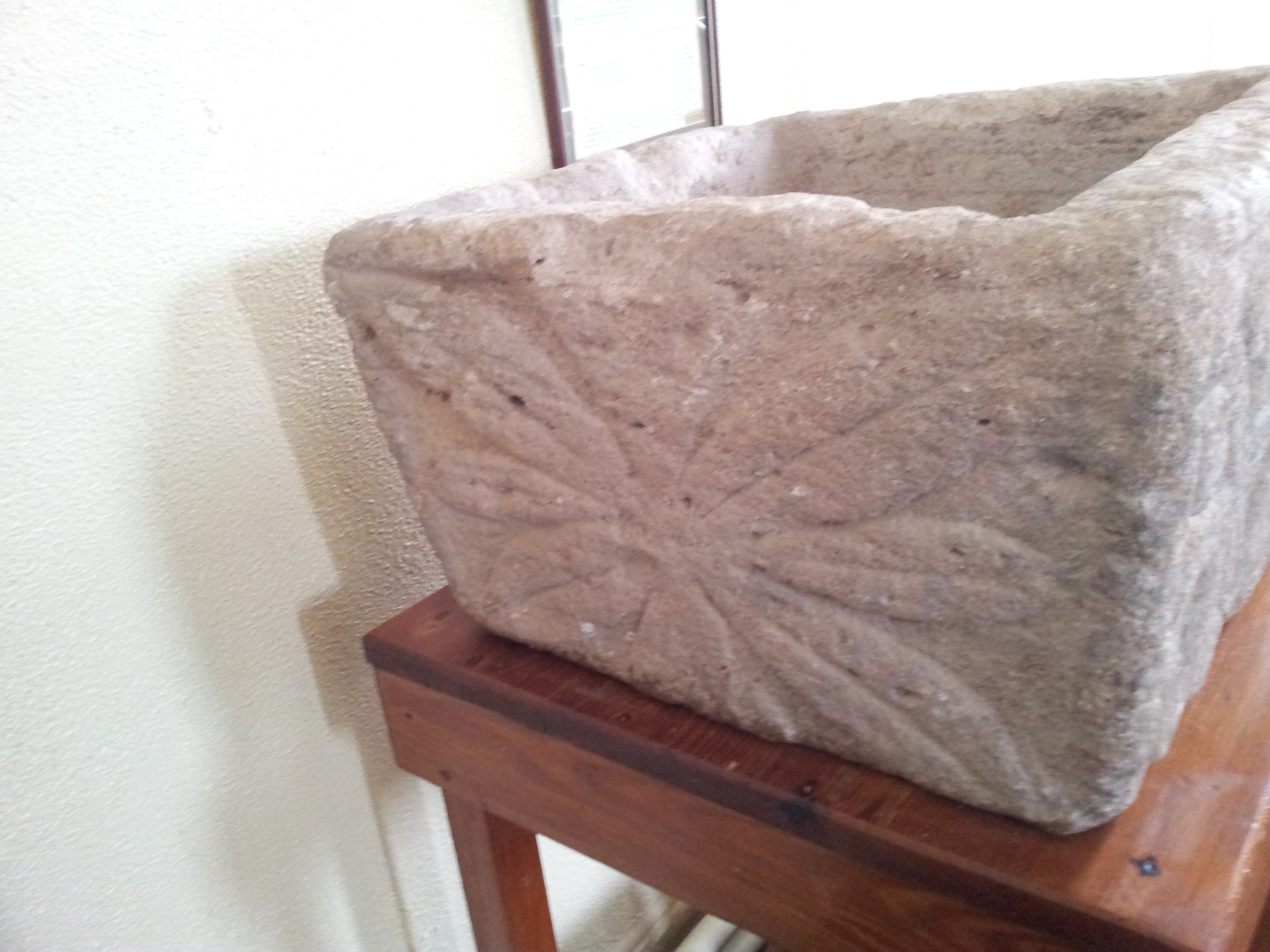
The front panel of the medieval font, showing floral decoration.

The font  is smaller than I imagined but very impressive. It is rectangular in shaped and carved from a single piece of fine grained granite it measures 32cm in height x 58cm wide x 56cm deep. The interior is also rectangular with a central drain hole. All the outside faces of the font are decorated in low relief with circular and floral pattern which is very pretty. The underside of the font has a large circular depression 0.32 m in diameter which could suugest  that it rested on a single columnar base.  Pike (1979, 9) suggests that the font is ‘pre-conquest’ while Cahill and Twohig (1976) date it to the mid-to late- 13th century. Today the font sits on a small wooden table in the modern parish church at Ballybacon.

Side panel of the medieval font, showing a floral motif

Originally  the font was located at the nearby medieval parish church of Ballybacon in the townland of Raheen. The church is today covered in ivy it has a simple undivided plan and is aligned E-W, and probably of 13th-century date, built of roughly coursed limestone and sandstone rubble, with a base-batter (Farrelly 2011).

Google earth map showing the modern and medieval parish churches of Ballybacon, Co. Tipperary.

Ballybacon or Baile Uí Phéacháin in Irish means  “O’Peakin’s Homestead”. It is interesting to note that there is a site  dedicated to a saint to St Peacáin/Beagán at Toureen Peakaun (Kilpeacan)  located in the parish of Kilardry, Co Tipperary. It may be possible to speculate that Ballybacon church was originally dedicated to this saint and there was an earlier church here prior to the 13th century.  Tentative evidence to support this idea  is the  presence of a possible early medieval cross slab at the site and the fact that the church is located beside the  townland boundary of Glebe and Raheen. Many early medieval churches were located in boundary positions and the kink in the road beside the site is very curved and may suggest the presence of a circular enclosure.

the ruins of the medieval church at Ballybacon.

According to a local man Francis Carrigan the font was removed at some point to a nearby farm where it was used as a tough for pigs.  It was later rescued and returned to the medieval church before it was moved  in 1975 a few hundred yards away to the modern parish church where it resides today.

References

Cahill, M. &. Twohig, E. 1976. ‘Baptismal Font from Ballybacon Old Church, Co. Tipperary’ , Journal of the Cork Archaeological and Historical Society , 81, 92-3, fig.1.

Farrelly, J. 2011. ‘Church at Ballybacon ‘. http://webgis.archaeology.ie/NationalMonuments/FlexViewer/accessed 28/02/2012.

Garton, T. 2008. ‘Ballybacon, Tipperary’, http://www.crsbi.ac.uk/search/county/site/id-ti-balba.html accessed 18/09/2012.

Pike, J. 1979. Medieval Fonts of Ireland, privately published, Greystones, 9.

Power,P. 1937. Waterford and Lismore – A Compendious History of the United Dioceses, Cork, 71.