I like to try out new social media platforms really like Storify so I put together a story of pilgrimage based on my blog posts , tweets and facebook post etc .
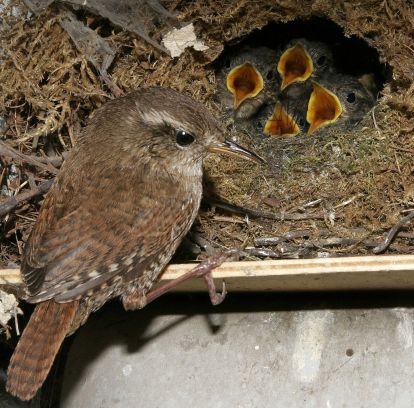
The 26th of December is the feast day of St Stephen,often shorted to Stephens day or Stephens.. In Britain the 26th of December is commonly referred to as Boxing Day , as this was the day servants and tradesmen would traditionally received gifts known as a “Christmas box” from their masters, employers or customers. In Ireland the day was also known as Wren Day, in Irish Lá an Dreoilín. Other variants include Day of the Wren, or Hunt the Wren Day. This name comes from a very old tradition focused around a tiny bird called the wren.
Lá an Dreoilín/Wren Day
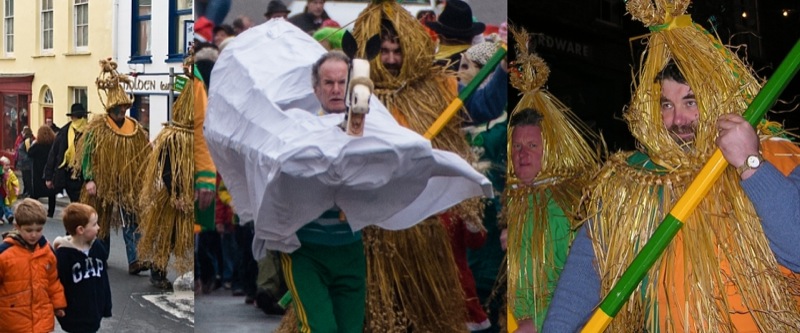
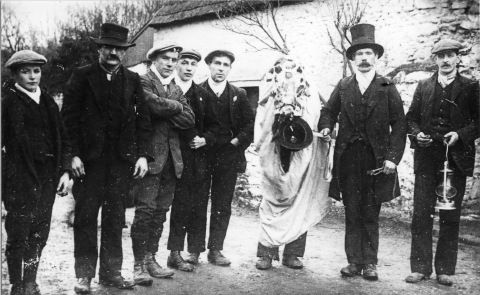
Lá an Dreoilín or Wren Day is a very old tradition and was once practised throughout most of Ireland up to the middle of the last century, with the exception of northern Ulster. The word wren was pronounced ‘wran’. Traditionally on Wren Day, groups of mostly boys and men called ‘The Wren Boys’ would dress up in old clothes and paint their faces. They then travelled from door to door singing, dancing and playing music demanding money to “bury the wren”. This process was called going on the ‘wran’.
In modern Ireland the tradition has faded out in most parts of the county but it is still carried on in pockets of the country especially in Co Kerry, in the Dingle peninsula and in parts of Co Limerick and Galway with people going from house to house.
Heralding their arrival by loudly playing the bodhran (an Irish drum) as they make their way towards the door, and with barely enough time to shut the startled dogs away, the door is opened wide and the musicians stream in. Dressed in old clothing, mostly in white, with assorted bits of tinsel, straw and holly attached to hats of all descriptions, they file in and proceed to entertain us with a few songs, some traditional airs expertly played on fiddles, bodhrans, accordions, tin whistles and flutes, and Irish dancing. The entire performance lasts less than 10 minutes, and they play themselves out again, back into the night!
The modern wren tradition now also incorporates street parades. The straw boys often take part in the parades and other organised Wren Day events.
In Dingle the wren tradition also incorporates
A pantomime-type horse with a wooden head, snapping jaws and a body made from cloth stretched across a timber frame, it is worn on the shoulders of one of the members of the Wren – who whirls and capers at the head of the parade (Woods 1997).
Originally the ‘Wren boys’ carried a dead wren or wrens with them on their escapades. The wren is no longer part of modern celebrations which are a much more animal friendly affair.
Catching a wren was not an easy task. The wren was obtained the days or the day before the 26th. The wren boys would go out into the woods and bogs or search the thatched roofs of houses and any other places this poor little bird would live. They would hunt for and if found they would then kill the little bird. The following day the bird was paraded through the town or rural areas on top of a decorated pole or holly branch coloured in ribbons and coloured paper. What follows is a description of the wren hunt from Cork in 1840
For some weeks preceding Christmas, crowds of village boys may be seen peering into the hedges, in search of the “tiny wren”; and when one is discovered the whole assemble and give eager chase to, until they have slain, the little bird. In the hunt, the utmost excitement prevails; shouting, screeching, and rushing; all sorts of missiles are flung at the puny mark; and not unfrequently, they light upon the head of some less innocent being. From bush to bush, from hedge to hedge, is the wren pursued until bagged with as much pride and pleasure, as the cock of the woods by the more ambitious sportsman (Hall, 1841 23).
Ireland: its scenery, character etc.(Volume I) by Mr and Mrs S.C. Hall. London: Hall, Virtue & Co., 1843. Drawn by D. Maclise, engraved by Landells. (http://www.corkpastandpresent.ie)
The killing the bird has long died out and any reference to the killing of this tiny bird in a modern context is symbolic. Catching the wren was not easy task and if a wren could not be found people would improvise and there are 20th century accounts of toy birds and props being used instead of the live bird (Danaher 1972, 246).
The Schools Folklore Essays from Clogher in Co Mayo recorded in the 1930s, recalls a piece of turf dressed up with feathers being used as a substitute for the poor little wren
Going out in the Wren” is still practised: only young boys now go out in the wren but formerly grown men did the same.
Now the boys go in batches or singly. If they can manage to catch a wren they dress him up in ribbons, put him into a small box also arrayed in ribbons and bring him round with them. But if they can’t get a wren they stick feathers in a small ciarán of turf and this does instead. They disguise themselves -thats an essential part of the game. There is no particular sort of disguise. They go from house to house getting money in each house. Sometimes batches of boys from 16 to 20 years do the rounds. These have often tin whistles or sometimes melodeons or mouth organs (NFCS Clogher 0095: 80).
In another account from Co Wexford dating to 1867 the bird was tied to the bush alive. This was no less cruel the killing the bird, as the little wren was brought from house to house tided to the bush which was shook vigorously as described below in an excerpt from The banks of the Boro: A Chronicle of the County of Wexford by Patrick Kennedy
The professional artist used by some means to secure a live wren, and fasten it by a string to the twig of an ivy or holly bush, and enlivened by the strains of an ear-piercing fife, invade the quiet of strong farmer’s houses and dance and shout, and sing the well known legend…..Then hands were taken, and steps performed round the bouchal na druleen[wren boys], who capered away in his best style, shaking the bush ans the poor prisoner in unison. They generally succeeded in extracting drink or money.. In most buys under the age of 15 pity for the sufferings of the small animal is the exception (Kennedy 1867, 233-234).
This must have been very traumatic for the little bird. Thankfully the practice of using live or dead wrens has long died out.
So why did the poor little wren receive such harsh treatment? According to folklore the Wren was blamed for betraying the Christian martyr St. Stephen when he was in hiding by making noises, hence the reason for hunting the Wren on St. Stephen’s Day.
Wren Boys Athea Limerick 1946 National Museum of Irelandhttp://www.communityarchives.org.uk/content/organisation/our-irish-heritage
When the groups of wren boys travelled around from house to house, a poem was recited and a number of songs grew up around the tradition. In Halls account from Cork in 1840 (Ireland: its scenery, character etc.) the poem recited was as follows
The wran, the wran, the King of all birds,
St Stephen’s day was cot in the furze
Although he is little his family’s grate,
Put yer hand in yer pocket and give us a trate.
Sing holly, sing ivy- sing ivy, sing holly,
A drop just to drink it would drown melancholy
And if you dhraw it ov the best,
I hope in heaven yee sowl will rest,
But if you dhraw it ov the small
It won’t agree wid de wran boys at all
A similar poem was recorded in Drogheda Co Louth in the 1930’s. This poem was recited throughout the country in the 20th century with slight variations and is still recited today.
The wran the wran the King of all birds, St Stephen’s day was caught in the furzse.
Although he was small his family was great. Rise up landlady and give us a trate.
In all the poems the wren is called the King of all birds. A lovely Irish folk tale recalls how the wren became king of all birds
Many years ago all the birds gathered together and wanted to have a king. The birds were satisfied that the bird that would fly the highest was to be their king. All the birds flew up into the air and the eagle far above them looked down and shouted, “I am the king of all birds.” But the wren hopping out from beneath the eagle’s wing shouted “You are not the king yet” and he flew still higher. The eagle was too tired to follow him and the wren was the king. When the wren came down out of the air the birds said he was too small and they proposed to drown him. But no water was to be found so all the birds began to cry into a bowl. When the bowl was filled with tears the clumsy owl tripped over the bowl and spilt it. They had all their tears shed and had nothing to drown him and he is still the king of all birds (NFSC Raheenagh (B.), Volume 0493: 025).
Music was and still is a very important part of the wren tradition. The Wren Boys usually carried some musical instruments with them such as a tin whistles or “sometimes melodeons or mouth organs”. They would play music and often dance and amuse their audience ‘by quips, pranks and buffoonery’ (Danaher 1972, 249). I have included anRTE documentary on the Wren tradition in Mountcollins West Limerick which provides further insight into the process.
At the end of the day the wren was normally buried when all housed were visited. In Mountcollins Co Limerick it was lucky for the wren to be buried opposite a house. In other cases the wren was buried opposite a house that refused to give any food, drink or money to the wren boys, it was said no luck would enter the house for the next 12 months (Danaher 1972, 249).
The money that had been collected was either on the “wren” divided up between the group, this was the norm for groups of children. Adults would often use the money to buy food and drink to be consumed later at a ‘Wren Party’ or spent that night in a public house (Danaher 1972, 248, 250). In modern Ireland the money is often given to charity.
When night falls they go (the ) to a public house and spend the money (NFCS Denmore, Volume 0977: 135).
The tradition of hunting the wren seems to be very ancient and very similar traditions was also carried out in parts of Britain and France.
Hunting the Wren was also a central part of Christmas traditions on the Isle of Man. The following is an article by Howard Caine describes the traditions
This ritual hunting of the hapless bird would seem to have originally taken place on Christmas Day, when folk would head out in the early hours to hunt down and kill their prey, before bringing it back to the local church. It would then be plucked and buried with much ceremony and singing in Manx.
The feathers of the dead bird were considered lucky and were believed to have the power to protect fishermen from shipwreck, to say nothing of a more general protection against witchcraft.
Later, the custom seemed to migrate, (something the wrens no doubt wished they had picked up on) to St Stephen’s Day on 26 December. Young men would chase down the birds, beating them from bushes with long sticks and general carousing.
They would suspend their dead quarry on top of a pole decorated with ribbons and evergreen leaves – which would then be paraded around the houses where dancing and singing would take place – before the feathers were distributed and hopefully some form of financial contribution would be made to the performers.
In Wales the hunting of the wren occurred on the Twelfth Night of Christmas. Groups of men would go out Hunting the Wrenhe tiny bird would be caged in a wooden box and carried from door to door. Householders would pay for the privilege of peeping at the poor wren in the box. Songs about the wren were also sung below is a song from Pembrokshire
Joy, health, love and peace be all here in this place
By your leave we will sing concerning our King
Our King is well dressed in the silks of the best
In ribbons so rare no king can compare
We have travelled many miles over hedges and stiles
In search of our King unto you we bring…
Old Christmas is past Twelfth-tide is the last
And we bid you adieu – Great joy to the new
Below is a youtube video of a Welsh song about hunting the wren.
St Stephens Day in Wales was associated with Mari Lwyd (Grey Mare / Holy Mary) a horse skull covered in ribbons. The horse-figure was carried from door to door by wassail-singing groups during the Christmas season. The Welsh Museum blog provides the following description below. The Mari Lywd custom reminds me of the horse used by the wren boys in the Dingle area which I mentioned above.
This figure (which is, of course, represented in other countries) seems to have been once known all over southern Wales but during the present century relatively little has been seen of it outside of Glamorgan, where it is not yet completely extinct.
The attendant ritual began with the singing of traditional stanzas by the Mari Lwyd group at the door, soliciting both permission to sing and entry into the house, and issuing a challenge to a versifying contest.
Next followed the pwnco, the debate conducted to the same music in a combination of traditional and impromptu stanzas) between a member of the group and an opponent within the house. This usually amounted to heavy leg-pulling in which the contestants mocked each other’s singing, drunkenness, etc.
Victory in the debate would ensure admission into the house for the Mari Lwyd group, to partake of cakes and ale and perhaps collect a money gift as well. In at least some cases, after the end of the debate, the group would sing additional stanzas introducing its individual members and finally, after entertaining the occupants of the house, it would deliver a farewell song (https://museum.wales/articles/2014-06-14/Christmas-customs-The-Mari-Lwyd/).
I really enjoyed researching the Irish Wren tradition, and id love to find out more about the tradition outside of Ireland. Im also glad the little wrens of Ireland can sleep safely now.
The recent arrival of cold weather and a conversation reminiscing with my mother about the strong wind wind that whipped the roof off her garden shed a few years back, reminded me of one of the Ordnance Survey Letters written by John O’Donovan in 1839 while in Co Wicklow. The letter in question refers to what was known as the ‘Night of the Big Wind’/ ‘Oiche na Gaoithe Moire’, a terrible storm that swept across Ireland on the 6th-7th January 1839. The storm cause a massive amount of damage around the country and its effects were such that the event lived in the minds of the people for decades to come. The foricity of the storm was such that it made its way into oral history of the county.
Description of the Devastation caused by the ‘Night of the Big Wind’.
All across the country, hundreds of thousands of people awoke to the sound of the furious tempest, their windows shattered by hailstones, their brick-walls rattling, their rain-sodden thatched roofs sinking fast. As the wind grew stronger, it began to rip the roofs off houses. Chimney pots, broken slates, sheets of lead and shards of glass were hurtled to the ground. (Rather astonishingly, someone later produced a statistic that 4,846 chimneys were knocked off their perches during the Night of the Big Wind). Many of those who died that night were killed by such falling masonry. Norman tower houses and old churches collapsed. Factories and barracks were destroyed. Fires erupted in the streets of Castlebar, Athlone and Dublin. The wind blew all the water out of the canal at Tuam. It knocked a pinnacle off Carlow Cathedral and a tower off Carlow Castle. [3] It stripped the earth alongside the River Boyne, exposing the bones of soldiers killed in the famous battle 150 years earlier. Roads and railway tracks in every parish became impassable. All along the Grand Canal, trees were pulled up by the roots and hurled across the water to the opposite bank (Bunbury 2009)
For those of you who don’t know, the Ordnance Survey of Ireland was established in the year 1824, to undertake a townland survey of Ireland and to map the entire country at a scale of 6 inches to one mile, for the purpose of the creation of a tax system. The mapping was completed by 1842, and a full set of maps exists for each Irish county. The maps and later editions can be viewed on the Ordnance Survey of Ireland website.
The Ordnance Survey Letters are manuscripts containing the surveyors’ field notes, commentaries and correspondence to the Ordnance Survey headquarters in Dublin during the mapping. John O’Donovan (1806-1861) was a historian who worked for the Ordnance Survey. He led the information collection part of the project, many of the surviving letters were complied by him. The letters are of great use to historians and archaeologist as they provide information on placenames, details on topography and often detailed description of historic sites such as castles, ringforts and churches. The letters are also interesting as they occasionally provide a ‘unique glimpse into everyday life in many parts of Ireland in the years leading up to the Great Famine’.
Ordnance Survey Letter –Rath na Riogh Meath (taken https://www.ria.ie/library/catalogues/special-collections/modern-manuscripts/ordnance-survey-ireland-archive
They also occasionally give a glimpse of the day-to-day lives of the compilers and their everyday trails and tribulations.
One of my favourite letters dates to January 1839 and relates to John O’Donavan’s journey from Baltinglass to Glendalough Co Wicklow and his stay at Glendalough during the ‘night of the Big Wind’. O’Donovan travelled with Thomas O’Connor who also worked for the Ordnance Survey. The letter decribes the details of the journey and the stay at Glendalough with such detail, that you almost feel you are withnessing the events unfolding. You also get a rare glimpse of the personalites of O’Donavan and his survey team.
According to the letter the pair travelled first from the town of Baltinglass to Blessington and then on to Glendalough. The distance between Blessington and Glendalough was according to O’Donavan ‘only sixteen miles’ and was undertaken on foot. In modern Ireland where we all rely so heavily on cars and buses, the thoughts of walking sixteen miles seems out of the ordinary but during the nineteenth most journeys were by foot so O’Donavan and his companion were undaunted. The route from Blessington to Glendalough would have taken the pair over the mountains into the Kings River Valley through the Wicklow Gap and on to Glendalough. This route was used by pilgrims visiting Glendalough for centuries.
We left Baltinglass on Friday and travelled by car to Blessington, expecting to be able to get a car thence to Glendalough: but the Hotel Keeper would not send a car thither at the usual price per mile and I was not willing to give him more. So on the next morning, which promised to produce a fine hard day; we set out for Glendalough on foot across the mountains, thinking nothing of the distance, which is only sixteen miles around the road.
The initial part of the journey seems to have been quiet pleasant until the weather changed and it began to snow.
We came on in very good humour for seven miles, stopping on the way to look at old churches, but when we reached the side of what they called the Cross Mountain, the day suddenly changed its aspect, the snow fell in luxuriant heavy leaves (drops) and before we reached the top of the mountain we found ourselves in the middle of a snow storm.
Managed to survive Art O'Neill challenge over the Wicklow mountains today. Not too bad except for the odd snow storm! pic.twitter.com/7VY45X9mfh
The onset of heavy snow caused some concern for O’Donavan. Despite his companions wishes to keep going, for safety reasons he decided they should head back towards civilisation, a wise decision given the remoteness of the area they travelled through and the lack of available shelter. The pair turned back and found shelter at Charley Clarke’s public house.
I stopped short and paused to consider what it was best to do. The clouds closed around us and the wind blew in a most furious manner. Here we met a countryman who told us that the distance to Glendalough was nine miles, that the road was for six miles uninhabited, and that the last flood has swept away two of the bridges. I got a good deal alarmed at finding ourselves a mile and a half into the mountain and no appearance of a cessation of the snow storm. I told O’Conor, who was determined to go on, that I would return, that I did not wish to throw away life to no purpose. I returned! (Coward) The whole side of the mountain looked like a sheet of paper horribly beautiful, but the wind was now directly in our face.
From O’Donavan’s account Clarke’s inn was a bit of a dump. The room was damp and cold and if events happened today O’Donavan certainly wouldn’t have given the inn a good review on Trip adviser.
We returned three and a half miles and stopped at Charley Clarke’s public house, where we got infernally bad treatment. The next morning, I felt very feverish from having slept in a damp bed in a horribly cold room.
The weather seems to have improved the following day and O’Donavan ‘ resolved’ to carry on with the journey to Glendalough. Having caught a chill from the night before, he must have felt rotten as he began his journey.
… seeing that the snow began to thaw and it being Sunday, I resolved to go on to the Churches[Glendalough]. I never felt so tired!
Although the weather had improved the conditions of the journey were far from pleasant. The heavy covering of snow disguised hollows in the ground which made the terrain more difficult to navigate. Having occasionally had to worked while sick in winter on archaeological sites I can sympathise with and imagine how wretched O’Donavan felt as he set forth.
Sinking thro’ the half dissolved masses of snow and occasionally down to the knees inruts in the road, which proved exceedingly treacherous as being covered with the snow. One of my shoes gave way and I was afraid that I should be obliged to walk barefooted.
We moved on, dipped into the mountain, and when we had travelled about four miles we met a curious old man of the name Tom Byrne, who came along with us. We were now within five miles of the Glen but a misty rain, truly annoying dashed constantly in our faces until we arrived at Saint Kevin’s Shrine. Horribly beautiful and truly romantic, but not sublime!
I came across this you tube video of Wicklow Mountains in the snow. Imaginine travelling on foot in these conditions.
When they finally arrived at Glendalough the pair booked into the local hotel. Their feet and clothes must have been soaked, and O’Donavan purcases a pair of wool socks. Having changed clothes they headed off to explore the ruins of Glendalough, which must have been quite impressive in the snowy landscape.
Fortunately for us there is now a good, but most unreasonable expensive kind of a hotel in the Glen, and when I entered I procured a pair of woollen stockings and knee breeches and went at once to look at the Churches, which gave me a deal of satisfaction. (I looked like a madman!)
The ruins gave O’Donovan ‘ a deal of satisfaction’ and he must have felt the awfulness of the previous day was behind him.
However ,things soon began to go down hill when they returned to the hotel later that evenining. Following a ‘bad dinner’ they retired to their beds, unaware one of the worst storms Ireland had ever seen was on its way. O’Donavan’s mind was full of work he writes that could not sleep, thinking of all he had to do and for fear of further snow.
We got a very bad dinner and went to bed at half past twelve. I could not sleep but thinking of what we had to do and dreading a heavy fall of snow, which might detain us in the mountain. O’Conor fell asleep at once.
Around 1 o’clock the storm hit Glendalough.
At one o’clock a most tremendous hurricane commenced which rocked the house beneath us as if it were a ship! Awfully sublime! But I was much in dread that the roof would be blown off the house.
O’Conor seems to have been obvious to what was going on around him and continued to sleep soundly much to O’Donavan’s annoyance.
I attempted to wake O’Conor by shouting to him, but could not.
The wind continued unabated. Around 2 o’clock things took a nasty turn when the window of their room blew in. With difficultly O’Donavan managed to close the shutters of the window, holding them shut with his body, only moments later for them to be blown open again by another gust of wind and O’Donavan thrown across the room with the force of the wind.
About two o’clock the storm became so furious that I jumped up determined to make my way out, but I was no sooner out of bed than the window was dashed in upon the floor and after it a squall mighty as a thunderbolt! I then, fearing that the roof would be blown off at once, pushed out the shutter and closed it as soon as the direct squall had passed off and placed myself diagonally against it to prevent the next squall from getting at the roof inside, but the next blast shot me completely out of my position and forced in the shutter.
Only now did O’Conor wake up!!
This awoke O’Conor who was kept asleep as if by a halcyon charm!
O’Donavan closed the shutters again and his companion went to seek help from the hotel staff. Eventually the ‘man of the house’ secured the window.
I closed the shutter again despite of the wind and kept it closed for an hour when I was as cold as ice (being naked all the time). O’Conor went to alarm the people of the house, but he could find none of them, they being away securing (saving) their cattle in the outhouses which were much wrecked by the hurricane. The man of the house at last came up and secured the window by fixing a heavy form against it.
Poor O’Donavan spent the rest of the night in the kitchen. I get the sense that the hours that followed were not any less dramatic.
I then dressed myself and sat at the kitchen fire till morning. Pity I have not paper to tell the rest.
The next day the damage of the storm became clear, many homes in the area were badly damaged.
A tree in the Church Yard was prostrated and many cabins in the Glen much injured.The boat of the upper lake was smashed to pieces. The old people assert that this was the greatest storm that raged in the Glen these seventy years. We go on to-night to Dublin by the coach which passes here at one o’clock. O’Conor returns to Blessington to finish the barony of Lower Talbotstown.
Being on a tight scheduled the pair boarded a stage coach and head on their way and so the letter ends.
Corlett,C. & Medlycott. J. 2000.The Ordnance Survey Letters – Wicklow. Published by Roundwood & District Historical & Folklore Society and Wicklow Archaeological Society.
The Killamery high cross is a wonderful hidden gem, just off the main Clonmel to Kilkenny Road, about 5 miles south of Callan. The cross is located at the site of the early medieval monastery of Killamery. Today the site is dominated by a Firsts Fruits church, dedicated to St Nicholas. The church was built in the year 1815 with a gift of £900 from the Board of First Fruits and was in use until the early 1900’s. During the 19th century it was a rectory, in the diocese of Ossory and it formed the corps of the prebend of Killamery, in the gift of the Bishop; the tithes amount to £280.
St Nicholas First Fruits Church at Killamery
Killamery or Chill Lamraí in Irish translates as the Church of Lamraighe and it gives its name to the townland and the civil parish where the site is located.
The patron saint the early medieval monastery was St Gobán. The Martyrology of Óengus records the saints feast day as the 6th of December. In later centuries the site became associated with another saint, St Nicholas of Myra whose feast day is also on the 6th of December. Little is know about the early history of the site and it is not until the 11th century that it appears in the historical records. The Annals of Four Masters in 1004 record the death of Domhnall son of Niall the abbot of Cill-Laimhraighe. During the later medieval period site appears to a have had a parochial status. An Anglo-Norman Motte is located c.100m to the southwest of the site.Mottes were earth and timber castles composed of a large artificial pudding bowl shaped earthen mound with a wooden palisade around the summit, enclosing a timber tower known as a bretasche (Farrelly & O’Brien 2006, 289).
According to Grey (2016, 278)
The townland of Killamery appears to have been See lands from an early date, until the bishop exchanged the townland with William Marshal for the townland of Stonycarthy, between 1192 and 1231. Marshal granted the townland to de Albin (Tobin) and it remained in the hands of the Tobins (Brooks 1950, 252-61), until it was forfeited in Cromwellian times by James Tobin. The church of Killamery became the prebendary of the diocese of Ossory on the establishment of the chapter and continued to form the corps of the diocesan chancellor until at least the fifteenth century (Carrigan 1905, iv, 311-20).
Today little remains of the earlier church settlement. During the 19th century much of the remains relating to the early medieval and medieval of Killamery was destroyed. The Ordnance Survey Letters of Kilkenny (1839, 120) state
The foundation, between three and four feet high, remains on the south-east side of the churchyard or burying ground, measuring 23 feet by 18, walls 2 feet nine inches thick; this part would appear to have been the Quire of the Church, as vestiges of some more extensive building may be traces, projecting to the west from it. There is a yew three within the area of the choir five feet in circumference , and two white thorns of good growth near it (Herity 2003, 120).
In 1853 the Kilkenny Archaeological Journal recorded a visit by Mr Dunne who described
A portion of the ancient chancel wall which enclosed the tombs of the family of Lee had been destroyed only the week before he visited it, and the stones had been used for a wall near the police barrack. The body of this ancient place of worship, with its ivy-covered arch, had been taken down in the year 1815 to serve for material for the present parish church, and the moss-covered stones that were uprooted on this occasion were thrown into a common shore (Stokes & Westropp, 1896/1901, 572).
A small number of early medieval features are found in the graveyard beside the First Fruits church. They include an early medieval, cross slab, a bullaun stone, high cross and a holy well.
Historic graveyard at Killamery containing high cross, cross slab and bullaun stone.
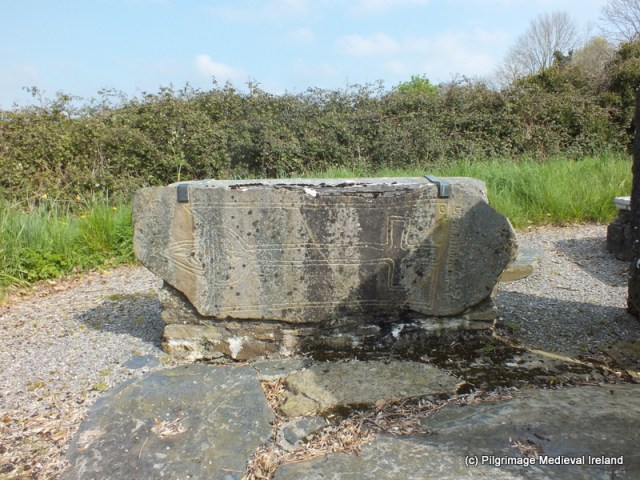
The cross slab a large rectangular slab of stone with a large latin cross set within a frame above the cross is the inscription OR AR THUATHA. The slab is set on its side against a large block of stone.
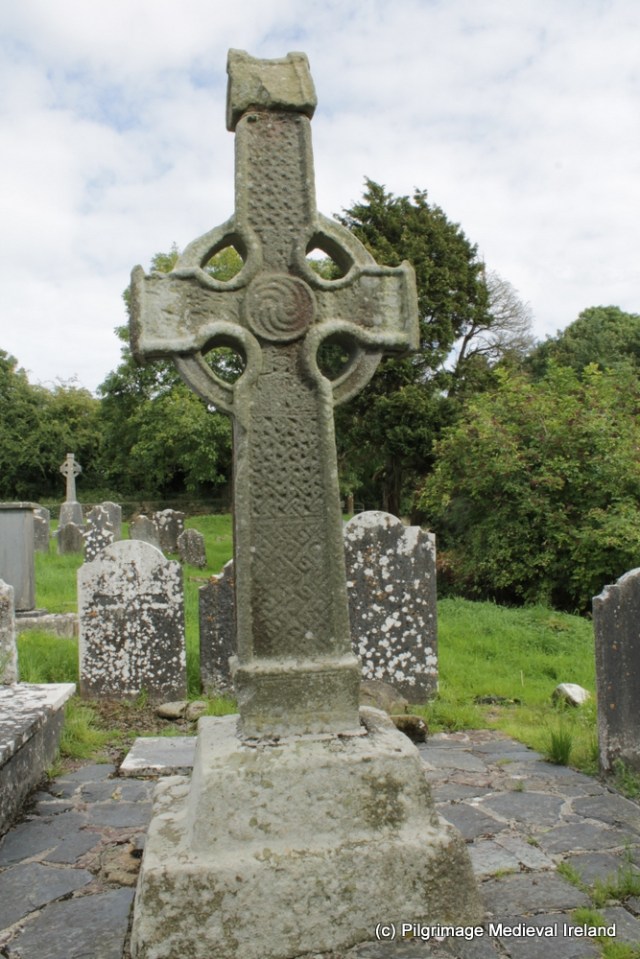
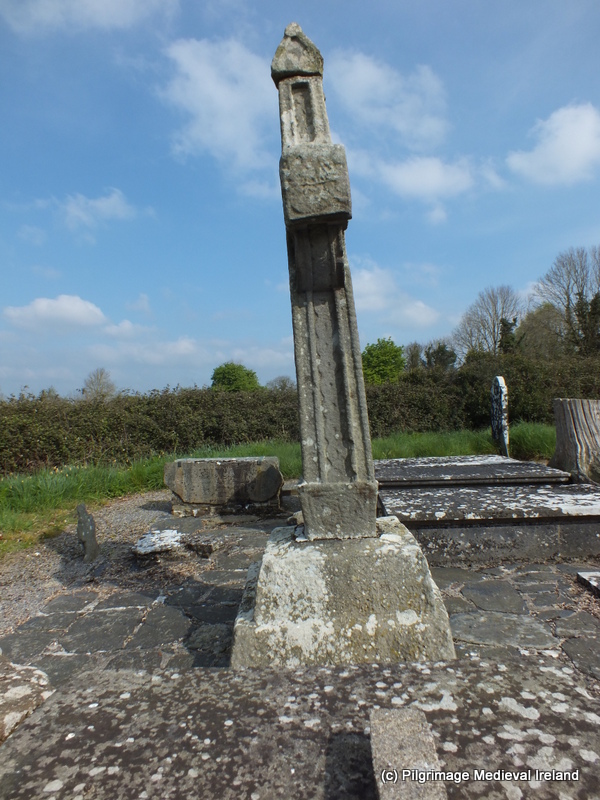
The high cross dates to the ninth century it is elaborately decorated and sits on a stone plinth.
East face of the cross at Killamery
A panel on the base of the western face seems to contain an inscription which MacAlister transcribed as OR DO MAELSECHLAILL. “OR DO” means pray for and he identified Maelsechnaill as high king of Ireland who reigned AD 846 to 862 (Harbison 1994, 78).
West face of high cross at Killamery
Above the whorl at the centre of the head of the west face is a panel showing one figure holding a child as another approaches from the right-perhaps Adam and Eve at Labour. Beneath the whorl is a figure flanked by angels, possibly God creating the Seventh Day…The hunting scenes on the arms of the cross (Harbison 1994, 79).
Western wheel of face high cross at Killamery
Western face of wheel of cross at Kilammery the side arms depict a hunting scene
Figure at base of wheel of the western face of high cross at Killamery perhaps depicting creation day
Central boss of wheel of high cross on the western face
The eastern face of the high cross depicts interlaced animals.
Drawing of decoration of the easern face of the high cross
Interlinked serpents on the east face of the high cross at Killamery
Interlinked serpents on the east face of the high cross at Killamery
The sides of the cross are also highly decorated. The ends of the arms have scenes from the bible the southern arm Noah in the Ark and the northern arm a scenes from the life of St John the Baptist.
Northern side of the high cross at Killamery
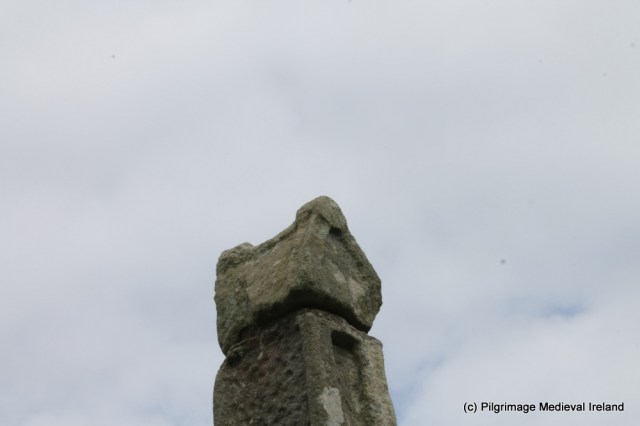
According to the Ordnance Survey Letters (1839) stations were performed there on Good Friday during the mid 19th century. It was
frequently visited by persons afflicted with head ache, on which occasion the mitre, which is loose is taken off the cross and put three times on the patient’s head, at the time reciting some prayers, after which a cure may be expected to follow (Herity 2003, 120)
The ‘mitre’ cap stone on top of the high cross was used to cure headaches in the 19th century.
A large bullaun stone is located close to the high cross. Its base is worn through . Megalithic Ireland blog makes note of a second bullaun stone at the site which I did not see. I really hope I missed it and it has not disappeared from the site.
Stokes & Westropp (1896/1900, 378) recounted the presence of a third bullaun stone at the site and that it marked the grave of St Gobban.
There is a tradition that a bullaun, i.e. a cup-marked stone, probably
a rude font, lay at the side of the grave of Saint Goban at one time, but
that it was broken in pieces by the Palatines of New Birmingham, in the
County Tipperary.
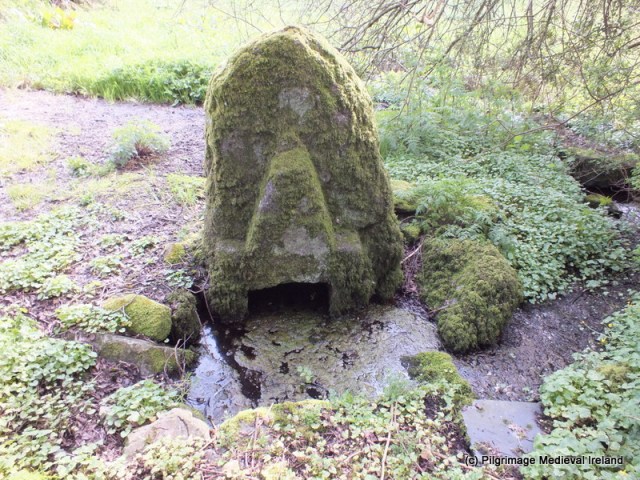
A small and very unusual holy well is found on the north side of the graveyard.
The well is marked by a large granite boulder. One side of the stone has been shaped in to gable shape over a recess.
St Nicholas holy well Killamery 2014
When I visited the site in the summer of 2016 the well was dry and a rectangular recess normally filled with water from the well was visible at the base. The well was dedicated to St Nicholas of Myra. In the past a pattern or patron day was held here on December 6th the feast day of the saint. The tradition of pilgrimage here has long died out. Evidence of the saints importance to the area is illustrated by dedications of the nearby church and school at Winegap to the saint. Interestingly the feast day of the founder St Gobán, coincided with that of Saint Nicholas of Myra. St Nicholas was a very popular Norman saint and it is possible that his association with the site was linked to the establishment of the Anglo-Norman settlement of Killamery and was used to replace the earlier cult of St Gobán.
View of the back of boulder over St Nicholas holy well Killamery
Bouder marking St Nicholas holy well at Killamery
Recess at base of boulder at St Nicholas holy well Killamery
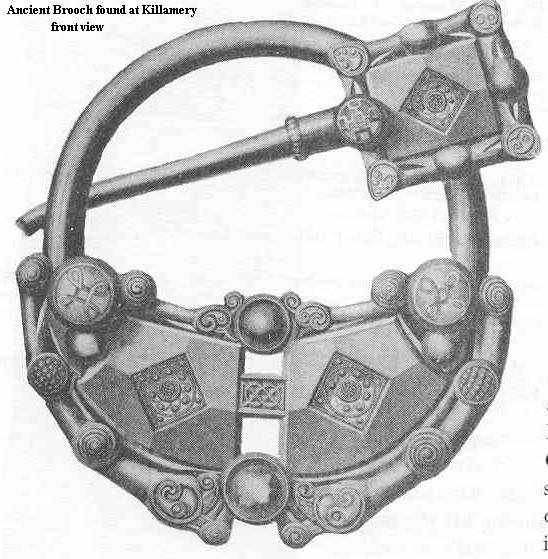
Although not directly related to the early medieval monastery. In 1850’s a sliver pin brooch was found by a labourer digging in a field within the parish of Killamery. It was said the man accidental broke the pin with a blow from the spade.The broach dates to the ninth century and was made in Ireland but the design was influenced by Viking design (Whitfield & Oskasha 1991). The pin shows evidence of Viking-style stamped ornament on the pin. The broach has an inscription on the back which probably reads: CIAROD[UI]RMC[.R]. According to Whitfield & Oskasha (1991, 59) ‘text contains a male personal name, probably CIAROD[UI]R MAC [.R]. It can be interpreted as ‘[the possession] of Ciarodur son of [-]’ It is likely Ciarodur was the owner of the broach (ibid, 60).
Crawford, H. 1913. A Descriptive List of Early Cross-Slabs and Pillars (Continued). The Journal of the Royal Society of Antiquaries of Ireland,3(3), sixth series, 261-265.
Farrelly, J. & O’Brien, C. 2002. Archaeological inventory of County Tipperary. Vol. I, North Tipperary. Dublin: The stationary office.
Harbison, P. 1994. Irish High Crosses.Drogheda: The Boyne Valley Honey Company.
Herity, M. 2003. Ordnance Survey Letters of Kilkenny. Vol.1 & 2. Dublin: Fourmasters Press.
Whitfield, N., & Okasha, E. (1991). The Killamery Brooch: Its Stamped Ornament and Inscription. The Journal of Irish Archaeology,6, 55-60.
Lewis, 1837 Topographical Dictionary of Ireland Vol. 1, 123.
Stokes, M. & Westropp, T. J/ 1896/1901.’Notes on the High Crosses of Moone, Drumcliff, Termonfechin, and Killamery. (Plates XXVIII. to LI.)The Transactions of the Royal Irish Academy , Vol. 31 (1896/1901), pp. 541-578.
The first day of winter is upon us, in ancient times this day was celebrated as the festival of Samhain ( 1st November). The eve of this day was also of great importance and was known as Oíche Shamhna ( night of Samhain) or Hallowe’en. The name Hallowe’en derives from the fact this is the evening before the Feast of All Saints (The Hallowed Ones).
Where I’m from everyone pronounces the ‘a’ in Halloween. I asked my parents about this and they told me this was how they and my grandparents had always pronounced the word. Ive been doing a lot of driving recently and I have noticed that everyone on the radio pronounces the ‘a’ as a ‘o’ saying Holloween. I wonder is this a new development?
Halloween Traditions
When I was a child Halloween was pretty low key in our house but great fun. We usually celebrated the event with our cousins who lived near by and we would play bobbing for apples, where a large basin of water was placed on the table and we each took turns fishing the apples out of the basin. This was no easy feat as you had to use your our teeth, keep your hands behind your back. We would eat lots of sweets and tell ghost stories. I don’t remember dressing up in costume but we always had a plastic masks that we bought at the pound shop or made from a cereal box. There was always barm brack a type of light fruit cake which I hated but would pretend to eat in the hope of getting the slice of cake with the coin inside. Traditionally, a ring and a coin were baked into the cake. If you got the coin would be rich and if you got the ring you would get married.
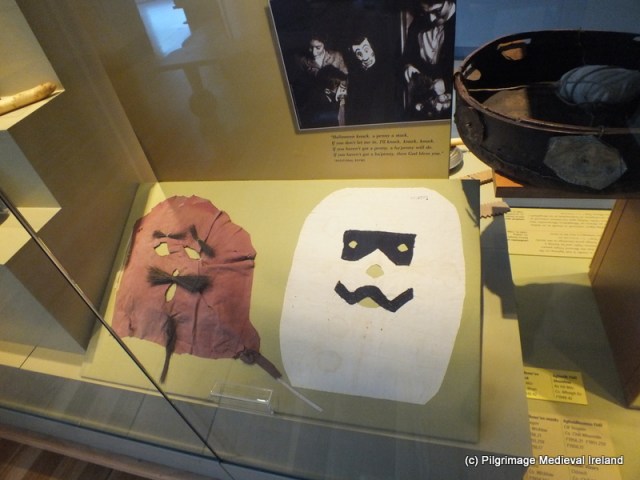
I visited the National Museum of County Life at Turlough Park Co Mayo this summer. The museum has a really interesting exhibition on the old Halloween traditions celebrated in Ireland. The wearing of masks is an old Halloween tradition in Ireland and the exhibition includes a number of Irish traditional Halloween Masks called Fiddle Faces. There was a long standing tradition of gangs of masked boys going to each farm house in the district in order to receive food or money, doing mischief if they were not well received.
Halloween Masks called Fiddle Faces at the National Museum of Ireland
Halloween Masks called Fiddle Faces at the National Museum of Ireland
Hallowe’en was also known as ghost night or spirit night and the souls of the dead were expected to return to the family home. Evil spirits were also thought to be active and people avoided travelling alone on this night (Museum of Country Life website)
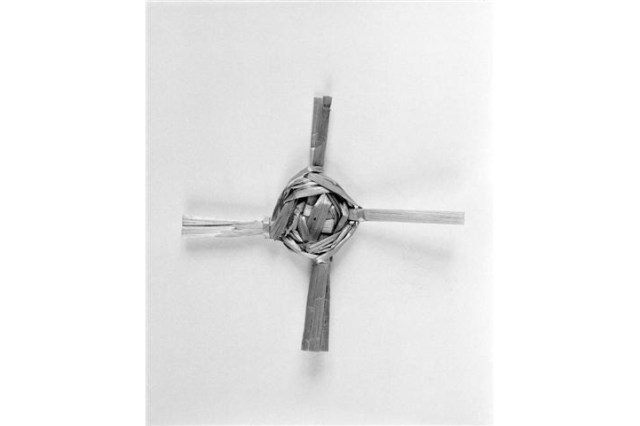
It not surprising then that special crosses were made and placed above the door to protect the home from bad luck for the coming year. This Halloween Cross is from Barr Thráú, Iorrais, Mayo and is on display at the National Museum of Ireland-Country Life.
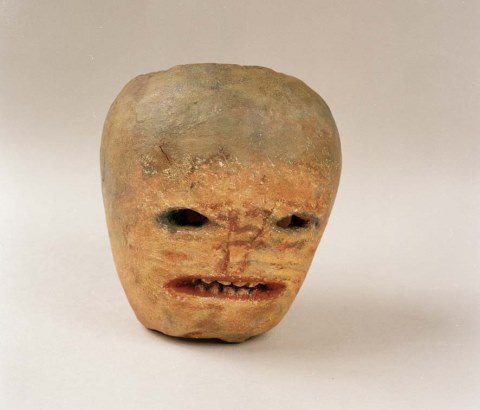
Another very old tradition was the carving of turnips into a figure known a Jack O Lantern. In my opinion the turnips are terrifying when compared to the pumpkin.
According to folklore, the Jack O’Lantern is named after a blacksmith Stingy Jack who tricked the devil into paying for his drinks. Unable to enter heaven or hell when he died, the devil threw him a burning ember.He was left to wander the earth carrying it about inside a turnip – or should that be a pumpkin? (Fowler 2005)
Jack O Lantern on display at the Museum of Country Life Co Mayo
Irish immigrants took the tradition of Jack O’Lantern to America where pumpkins were substituted for turnips. The Jack O Lantern below was traditionally carved in (Fintown) Baile na Finne, County Donegal Gaelltacht, c. 1903 .
Jack O Lantern below was traditionally carved in (Fintown) Baile na Finne, County Donegal Gaelltacht, c. 1903 National Museum of Ireland .
In recent years in Ireland the turnip has been slowly replaced by the pumpkin which is now widely available in supermarket. There is a perception that the turnip is difficult to carve and the pumpkin is less work. There are however benefits to making the effort and carving a turnip for Halloween, turnips last longer then pumpkins when carved. In my opinion they have a lot more character then the pumpkin. You get more for your money, three turnips are the price of one pumpkin. You can also turn the turnip leftovers into dinner. My tip for anyone who wants to try carving a turnip is to use a melon baller to scope out the inside.
My attempt at carving a Halloweenturnip
My attempt at carving Halloween turnips
If you can I highly recommend a visit to the permanent Halloween exhibition at the Museum of Country Life.
Folklorist Barbara O’Flynn tells Marian Richardson about the different ways Halloween is celebrated in urban and rural areas. She says bonfires and trick or treating are customs associated with the eastern half of Ireland, but they are now spreading throughout the country. Halloween was traditionally marked in the West of Ireland by playing practical jokes, like throwing cabbage against people’s doors or switching gates on farms.Divination is still widely practised, with four plates used to foretell death, marriage, prosperity or travel. The return of the dead remains a big part of Halloween, and an example of the overlapping of Christian and pagan traditions, which is seen throughout Irish folkore ( RTE Archive)
The tweet below also has links to the RTE Halloween Archives.
This blog post has been re blogged from the Early Medieval Archaeology Project blog. The post was written by Prof Aidan O’Sullivan of the School of Archaeology at UCD and provides a fantastic discussion of implications of the proposed taking by Seanad Éireann of facilities belonging to the National Museum of Ireland
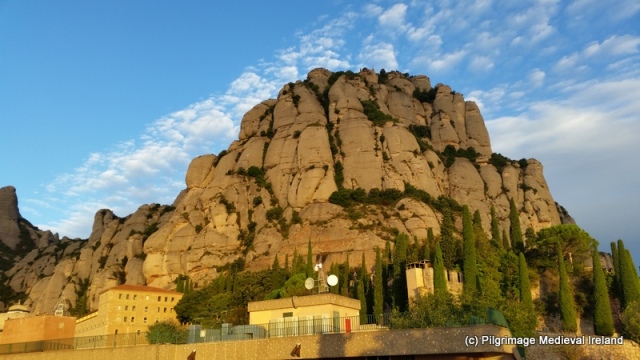
Recently I paid a visit to the medieval pilgrim shrine of the holy statue of the Blessed Virgin of Monserrat in Spain.
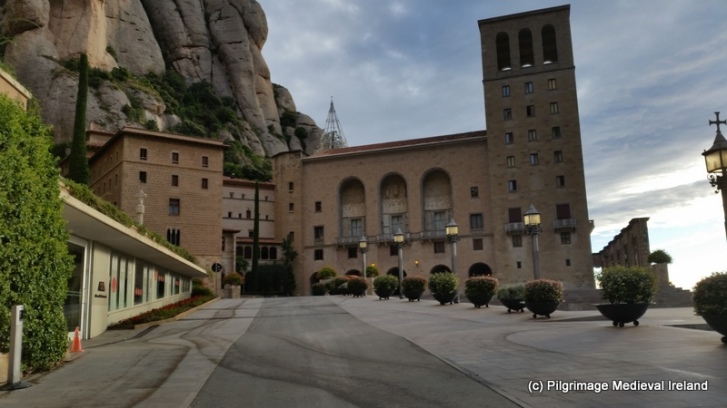
View of the monastery of Montserrat
The shrine is located at a Benedictine abbey at Montserrat, around 40 miles from Barcelona in the province of Catalonia. The abbey is a working monastery and home to 80 monks. The monastery is overshadowed by majestic mountains. The name Montserrat is derived from Catalan and means ” serrated mountain”. When you stand back and look at this jagged and rocky mountain you can see why the name was chosen.
Religious activity in the area can be traced back to early medieval times. It is said that a hermitage dedicated to the Blessed Virgin, was constructed here some time between the sixth-ninth centuries. According to legend the statue which is the focus of the pilgrimage was carved by St Luke and brought to Spain and hidden in cave at Monserrat. In the year 880 some shepherds were grazing sheep in the mountains when they saw a light and heard otherworldly singing. When the shepherds when to investigate they found the statue in a cave.
Following the discovery of a statue of the Blessed Virgin and Christ Child, the site gradually evolved and by the eleventh century abbot Oliba of the Monastery of Ripoll established a small monastery here beside the chapel of Santa María. A small Romanesque church was built beside the monastery and the image of the Virgin placed inside.
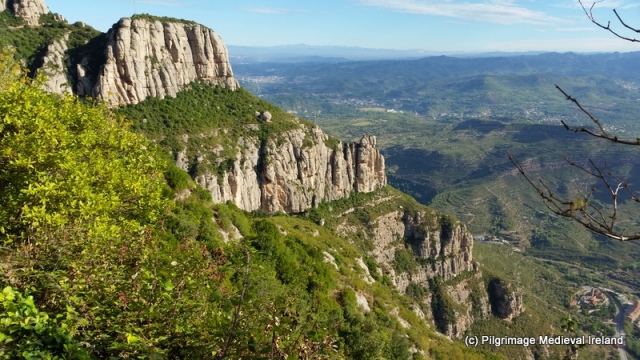
View of the valley below the monastery at Monserrat
My pilgrimage to Monserrat began in Barcelona when I boarded a coach at 6.45am. I arrived at the monastery at 8am. Monserrat is a very important tourist destination and attracts vast numbers of tourist each year so the site is always busy throughout the year. My early morning start meant that I and my fellow travelers were able to arrive just as the shrine opened and experience the place without the bustle of crowds, who arrived later in the morning.
The Vewpoint of the Apostles is the first monument that tourists who arrive by car or coach see. It is named after the Chapel of the Apostles which was demolished in the early twentieth century. It offers spectacular views of the valley below. It is located beside a piece of sculpture known as The Stairway to Understanding . The Stairway is a concrete monument 8.7m high created in 1976 by Josep Maria Subirachs. The sculpture consist of nine blocks placed one on top of the other that represent the different beings of creation from the more material to the most spiritual.
This slideshow requires JavaScript.
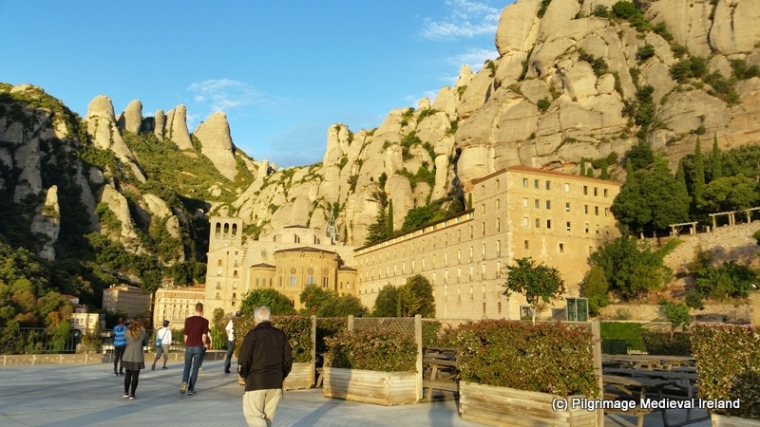
From this point you walk along an avenue known as Passeig de l’Escolania or the Choir Walk, passing the buildings where the which houses the choristers.
As you approaching of basilica of Montserrat you are at all times aware of the mountains that tower of the monastery.
The monastery also houses the Publicacions de l’Abadia de Montserrat, a publishing house that is the oldest printing press in the world, still in operation. Its first book was printed in 1499 and you can buy many of its modern publications in the monastery gift shop.
Approaching Plaça de la Crue (Square of the Cross)
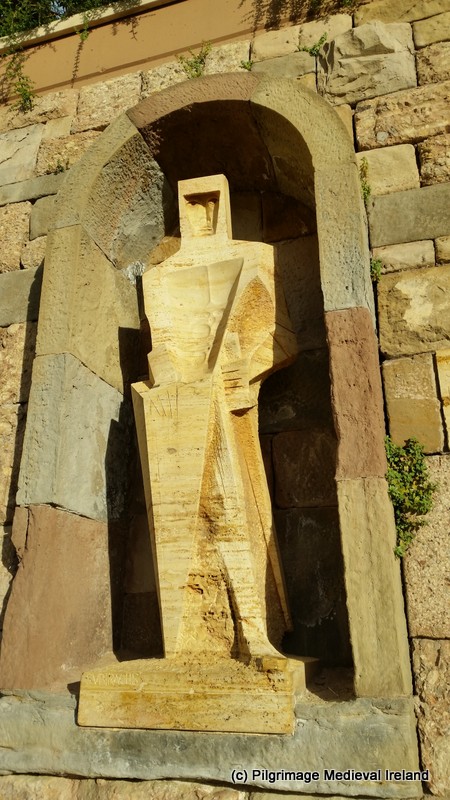
As you approach the basilica and the Plaça de la Crue you pass by a wonderful sculpture of Saint George carved by Josep Maria Subirachs, an identical statue of the saint carved in a different darker type of stone is found in the La Sagrada Familia in Barcelona. St George along with Our Lady of Monserrat is a patron saint of Catalonia.
St George by Josep Subirach.
The monastery buildings are constructed from polished stones quarried from the mountain. When the sun shines on the stone it gives it a lovely warm golden colour which blends into the surrounding mountains. From the Plaça de la Crue you enter into the atrium in front of the basilica.
From the Plaça de la Crue you enter into the atrium
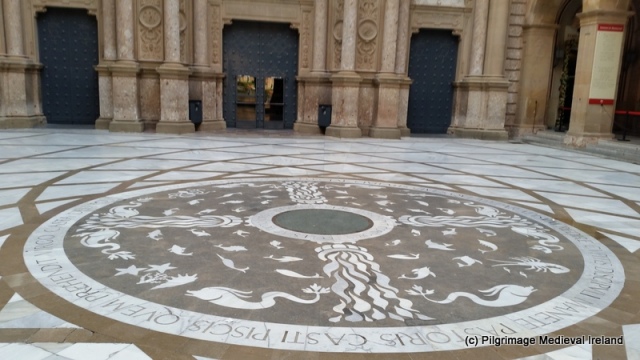
The atrium of the basilica is surrounded by buildings constructed in the eighteenth century. The mosaic floor is particularly impressive and was designed by Fr Benet Martinez (1918-1988).
Mosaic floor in the atrium at Monserrat
The floor is a reproduction of a design by Michelangelo for the Campidoglio in Rome.
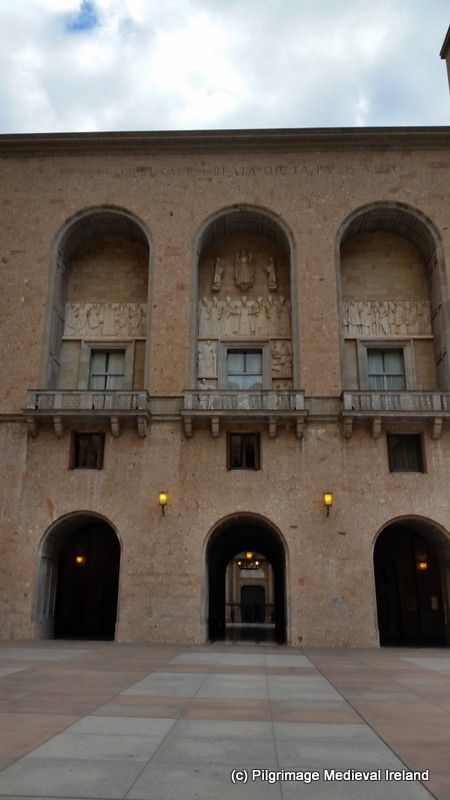
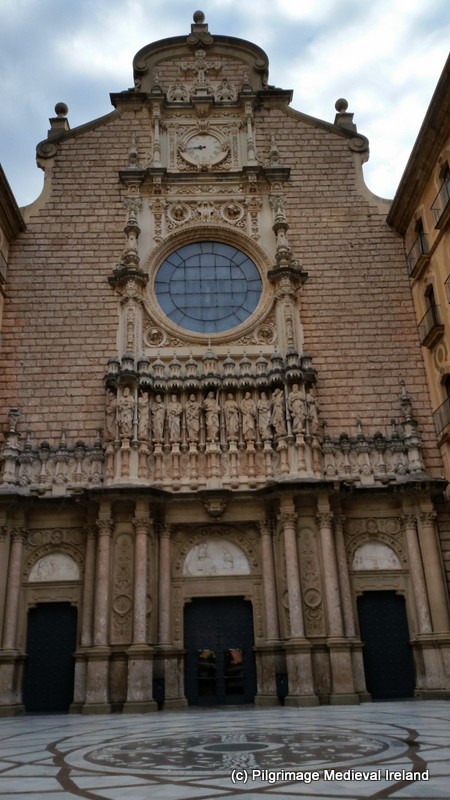
Facade of the bascilia at Monserrat
The current facade of the basilica was created in 1901, above the door are sculptures of Christ and the twelve apostles.
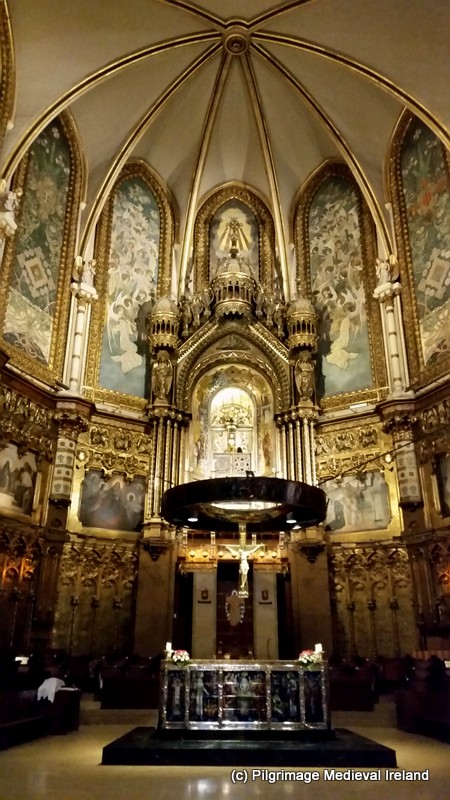
The statue of Our Lady of Monserrat is located in the basilica above the high altar.
High altar within the basilica church.
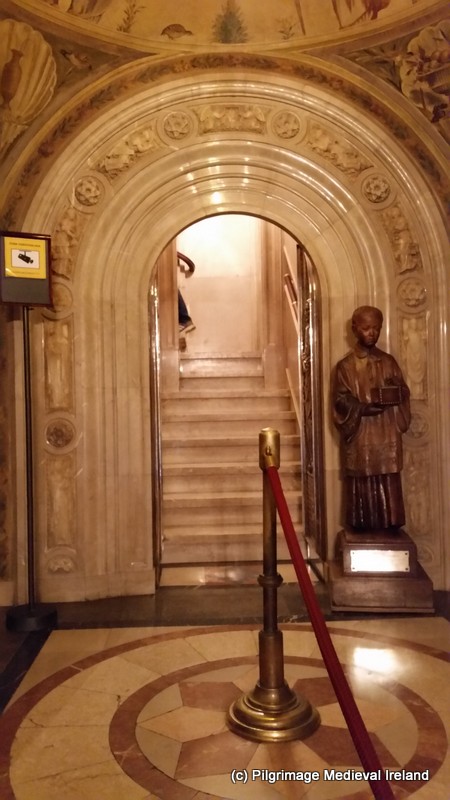
Stairs leading to the shrine of the statue of Our Lady of Monserrat.
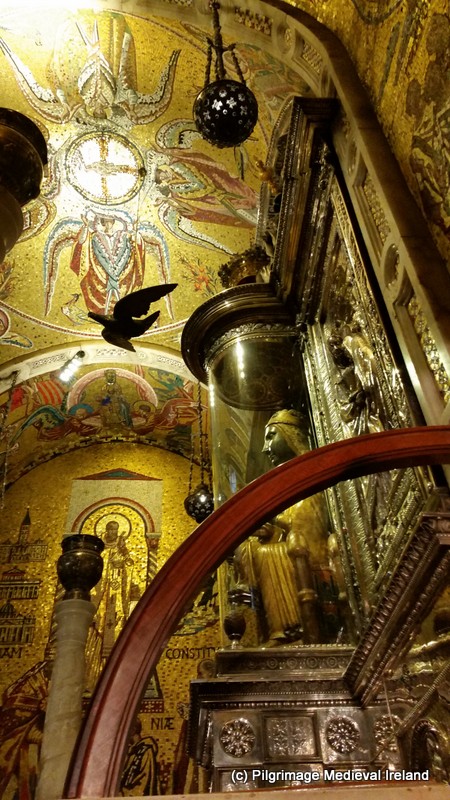
The shrine is very elaborate and its walls are covered in gold mosaic and marble. The ceiling depicts the four archangels.
View statue from top of stairs
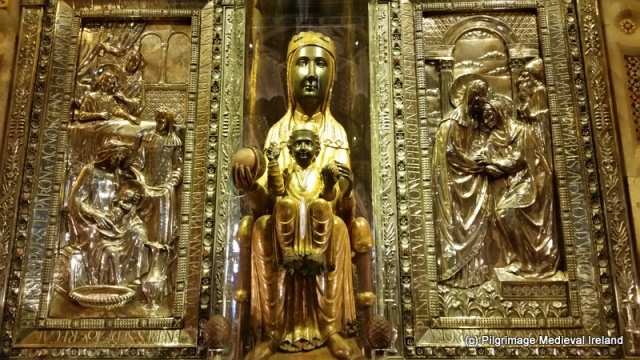
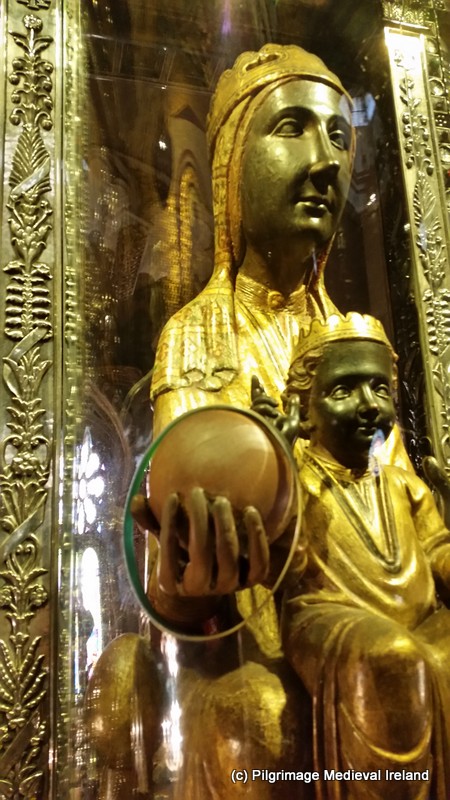
The statue of Our Lady of Monserrat is Romanesque, polychrome statue 95cm (38inch) in height. The statue depicts Our Lady in Majesty. Mary is in a seated position with the Christ Child seated on her lap. In her hand she holds a sphere which symbolized the universe. Her left hand is placed on the Christ Child’s shoulder and is symbolic of his omnipresence. The Christ Child holds a pineapple in his hand the symbol of eternal life, with his other hand he offers a blessing. The image is popularly known as La Moreneta (the Dark One), due to the dark colour of the Blessed Virgins skin, a result of age and centuries of candle smoke. Pope Leo XIII proclaimed Our Lady of Montserrat Patron Saint of Catalonia in 1881.
The statue in turn sits within a silver shrine. According to the Monserrat website
In 1947, the image was enthroned in a silver altarpiece, paid for by popular subscription and installed in the upper section of the basilica apse.
Our Lady of Monserat behing glass
Today the statue is protected behind glass. There is an opening for the globe held in Mary’s hand. This opening allows the globe to be accessible to devotees. Modern pilgrims will often touch, kiss, rub rosary beads and cloth against he globe it as they pray before the statue.
The statue of Our Lady of Monserrat holds a globe symbolizing the cosmos in her hand.
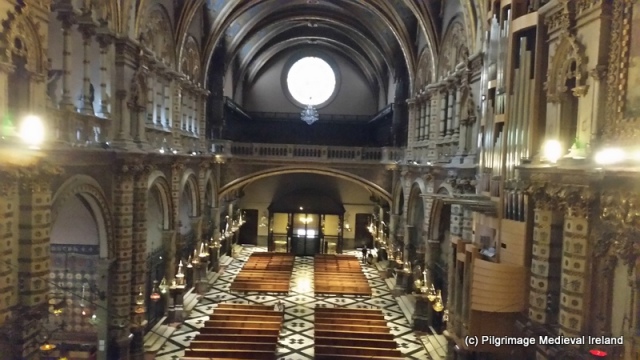
The statue looks out the basilica church. It must be quiet a sight to see the church full with pilgrims.
View of the basilica church from Shrine of the Lady of Monserrat from above the altar
Monserrat has been a pilgrim destination from at least the twelfth century when the current statue was created. Many miracles were recorded in medieval times and Alfonso X el Sabio in the thirteenth century recorded some in Cantiagas de Nuestra Señora (Talbot 2010, 454). Throughout the late medieval period the statues was visited by countless pilgrims including St Ignatius Loyola.
In recent centuries the shrine has had a more turbulent history. The monastery was sacked by Napoleon in the early nineteenth century destroying much of the medieval fabric luckily the statue survived after being hidden by the monks. In the twentieth century 23 custodian monks were shot during the Spanish Civil war. Today the site continues to attract pilgrims and it is also one of the most popular tourist destination in Catalonia.
The side chapels and the grounds of the monastery are filled with wonderful sculpture by Spanish artist. If you follow this link it will you can experience a virtual tour of Monserrat Cathedral and shrine.
Resurrection of Jesus Christ, by Josep Maria Subirachs in the Chapel of the Holy Sacra- ment
Crucifixion side chapel at Monserrat Bascilica
Votive Lamp
Consecration Cross near doorway of Monserrat Bascillia
Montserrat is also famous for the boy’s choir called L’Escolania who trace their history back to 1223 . The Boy’s Choir performs at least two times a day for most of the year at the Montserrat Basilica they also give concerts around the world . They specialize in a type of singing known as Gregorian chanting.
St Ita and her donkey featured in my last post on The Miraculous Animals of the Irish Saints. There is another great story about St Ita and a beetle which I really want to share with you. As well as running a monastery for nuns Ita was also the foster mother to many Irish saints including St Brendan and St Mochaomhóg, who was her nephew. They along with other saints came to study at the school attached to Kileedy (Gwynn & Hadcock 1988, 392; Ó’Riain 2011, 377).
Ita followed a very strict and devote lifestyle and the ninth century Martyrology of Oengus tells that Ita engaged in sever fasting and ‘she succoured great grievous disease’.
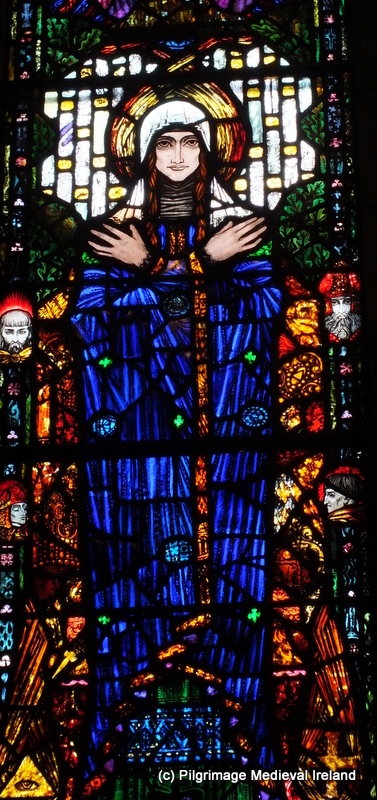
Stain glass window by Harry Clarke of St Ita of Kileedy Honan Chapel UCC
The Martyrology also depicts Ita as a very kind and caring person. It was said she once let a stag beetle as ‘big as a lap-dog’ suckle at her side. The beetle caused much damage eating ‘the whole of one of her sides’ which the saint endured without letting anyone know (Stokes 1984, 44–45).
One day the nuns at Kileedy saw the beetle . You can only imagine the scene of horror when the nuns were confronted with this mutant beetle strolling the monastery and its not surprising they killed the creature.
Ita soon missed the beetle and having searched in vain for it asked her nuns ‘Where has my fosterling gone?’ (Stokes 1984, 44–45). The nuns told Ita what they had done but upon hearing the news of the beetle’s death the saint became very sad. According to the Martyrology of Oengus she then asked God to send her the Christ child to foster and he was sent to her as an infant and she composed a poem which begins ‘Jesus, who is nursed by me in my little hermitage’ (ibid).
References
Killanin , L. & Duignan, M. 1967. The Shell Guide to Ireland. London: Ebury Press.
O’Riain, P. 2011. The dictionary of Early Irish Saints. Dublin : Four Courts Press.
Stokes, W. 1905. The Martrology of Oengus the Culdee. London: Printed for the Henry Bradshaw Society.
I’m delighted to have reached the finals of the Littlewood Ireland Blog Awards 2016 in both the Education and Arts and Culture categories. There are lots of amazing blogs in each category so its fantastic to have gotten this far.
A big thank you to all who voted for my blog and for all your support and kindness. Thanks also to Littlewoods Ireland for sponsoring this years blog awards.
Last summer I spent a day exploring some of the archaeology sites in the parish of Kilmovee Co Mayo. Kilmovee is located a short distance from the town of Ballaghadreen in Co Roscommon. Local man, Tommy Horan was kind enough to act as my guide for the day.
The parish gets its name from St Mobhí. Kilmovee or Cill Mobhí in Irish, means the church of St Mobhí. It is said he came to the area as a missionary, continuing on the work of St Patrick.
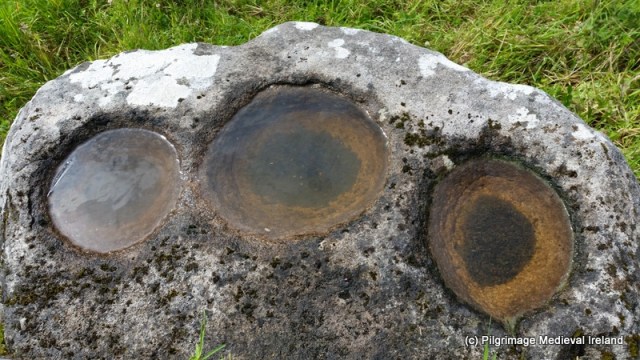
Bullaun stone known as Na Trí Umar Bheannaith in townland of Rushes
The day began in the townland of Rusheens West with a visit to one of the largest bullaun stones I have ever seen. The stone is known as Na Trí Umar Bheannaithe/The Three Holy Water Fonts. The bullaun stone is a large boulder with three large depressions. It sits on a plinth against a wall at the side of a small byroad. Folklore tells that the stone was transported from Killericín and placed in its current position.
Bullaun stone known as Na Trí Umar Bheannaith in townland of Rusheens West
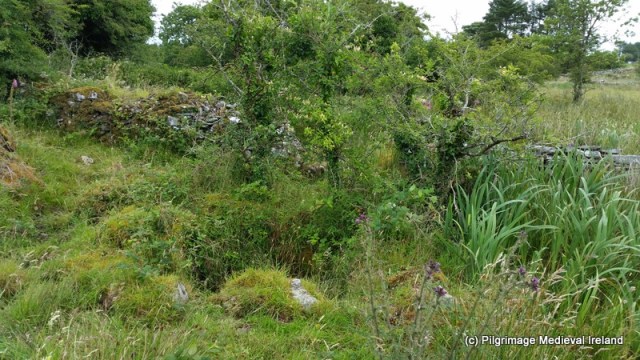
From the bullaun stone we travelled on to the site of a holy well called Tober na Bachaille/The Well of the Crozier. The holy well is located in marshy field. As the site is on a working farm so permission should be sought before gaining access.
Field where Tober na Bachaille/ The Well of the Crozier is located.
Folklore tells that when St Mobhí came to the area as a missionary he needed somewhere to baptise new converts. Not having a suitable water source the saint struck the ground three times with his crozier and three wells sprung up on the spot.
It is thought there was originally three wells here but today only one well is visible. The well is very overgrown and a small blackthorn tree grows beside it. The well is a spring enclosed by a low stone wall. The location of single well is marked on the 1st ed. (1839) OS 6-inch maps which could suggest that the three springs are within the well enclosure. Unfortunately the Ordnance Survey Letters relating to Mayo fail to mention the well. The Folklore Commission National Schools Essays provides an origin tale for what it calls the three Blessed Wells in the parish.
St Movee’s sister was a nun and she lived in Sligo. One day she came to Kilmovee to see her brother and the church. She was passing down through Barralackey and there was a boy minding cows. He told her he would help her and he told her that the Ardeull people thought she was a witch and that they were to follow her. He said he would go with her to the church only he had a long way to bring water to his cows. She was very thankful to him and said he would never again be short of water and she — [can’t read the word] on a rock and water filled in it and is there still. In three long steps she reached the church and every step she gave a well sprang up three well in succession and these are called the ‘Blessed Wells’ (NFSC Cloonierin 114:52).
Tober na Bachaille is no longer visited by pilgrims and as a result it has become overgrown. Local knowledge may shed more light on the well(s) and traditions relating to pilgrimage.
View of Tobar na Bachaille
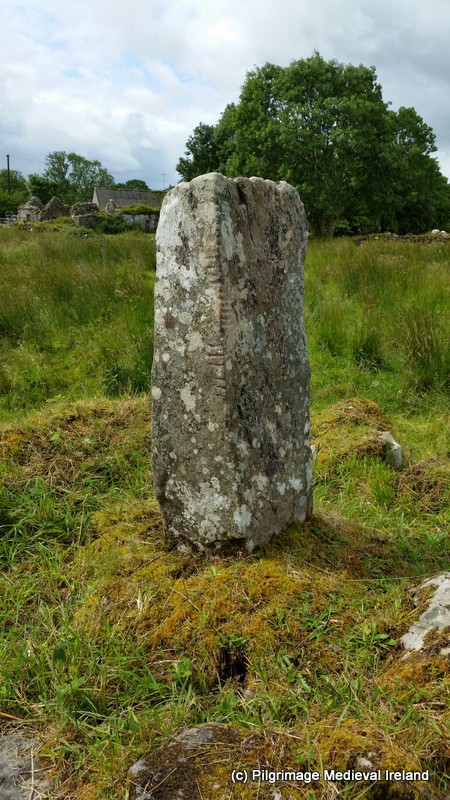
To the north of the well is a large stone built penitential cairn or leacht. Sitting on top of the cairn is a stout Ogham Stone.
View of penitential cairn with ogham stone beside Tobar na Bachaile
Macalister noted that the ogham stone, once acted as a ‘kneeling stone’ and sat on the low wall surrounding the holy well. The stone had moved to its current position by the 1940’s (Macalister 1945, 7-9). An ogham inscription is found along one of the edges of the stone. Macalister identified this inscription as AlATTOS MAQI BR…. He also suggests that the top of the stone was deliberately cut away by a mason during the building of the wall around the well (ibid).
Ogham stone beside Tobar na Bachaile
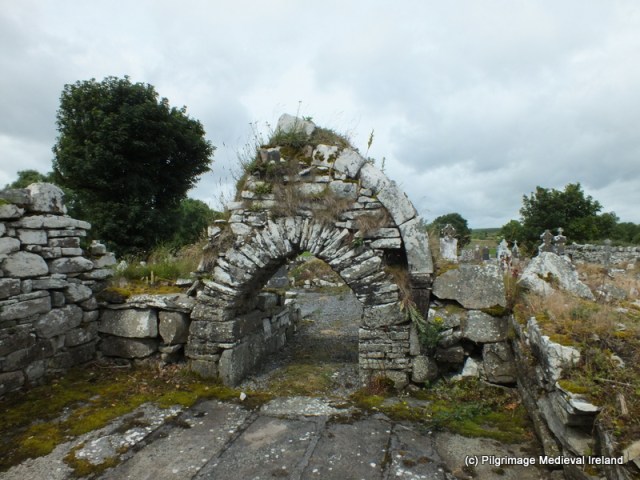
From the holy well we traveled on to the ruins of a medieval parish church called An Teampall Nua also known as St Patrick’s church. Local folklore recalls that when the church was first built it was called the ‘New Temple’.
This slideshow requires JavaScript.
All that remains of the church are the chancel and parts of the nave walls. The walls of the church have been rebuilt and incorporated architectural fragments of windows and doors. A chancel arch still survives in relatively good condition and appears to have been remodelled in the past. The original arch was rounded and built of cut sandstone, it was later altered and filled with masonry and replaced with a smaller to a pointed arch defined by vousoirs. The exterior of the church is surrounded by rubble masonry that likely came from the church. In 1838 the Ordnance Survey Letters for Mayo described the church as on
on the East gable of which there is a window about 6 feet and 6 inches broad. Part of side walls remain, West gable is perfect (Herity 2009, 288).
The church is surrounded by a historic graveyard and mass is said here once a year.
Our day concluded with a visit to a large ringfort called An Caiseal located in the townland of Kilcashel/Coill an Chaisil, which means ‘the wood of the stone fort’.
The ringfort is very well-preserved and is on private land so permission must be obtained before entering. The fort measures 30m in diameter and is constructed of a single circular wall which is 5m thick and 3m high.
View of exterior of Caiseal ringfort
The fort is entered through a formal linteled entrance.
Linteled entrance
The interior contains the ruins of two house sites and a souterrain.
The top of the walls are accessed from the interior via four sets of V shaped stone steps.
Stone steps in interior walls of ringfort
Another interesting feature of the fort is a creep-way that links two internal wall-chamber within the walls.
The wall chambers appear to be aligned to the morning sun.
For three mornings, light goes into the back of the chambers which are two meters deep and joined at the back by a six meter passage way. Each morning the new sun has moved on half a meter on the back of the wall. There is about 20meters of the back wall (of the Caiseal) that is traversed by the sun. This means that the sun shines only for about 40 days on the back wall twice a year. This is between Winter solstice and both equinoxes… The first chamber was lit on the 5th of October, the Second was lit on or about the 21st of October, but due to the curvature of the wall it is still in the chamber on the 24th …
Two months later the sun will again be shining in the this chamber on the 20/21 February as the days lengthen (Mac Gabhann no date 10-11).
Image of the chamber being illuminated by light (Mac Gabhann no date 10-11)
For a more detailed discussion of the archaeology of this site see the Kilcashel project website. My day in Kilmovee was a brilliant experience and it reminded me of the wealth of local archaeological and historical sites that are to be found within and around all Irish villages. So really you don’t need to travel very far to find wonderful historic and archaeological sites to visit.
As many of the sites we visited were on private land, permission was always obtained before going to the sites. If anyone is interested in visiting the area please contact the Kilmovee Community & Heritage Centre, the people who work here are so helpful and will be able to help you find out if access is possible. Contact details and opening hours can be found on the Kilmovee website and Facebook page (see links below). The community centre also houses a wonderful Heritage Centre called ‘Cois Tine’ (beside the fire). The centre is design is based on a traditional Irish cottage and holds lots of information, photographs about the parish history, archaeological sites and folklore connected to the area. I recommend a visit to the Heritage Centre before any exploring as it is a great way to begin a trip around the parish.
If you are in the area I would also highly recommend a visit to Urlaur Abbey located just a few miles from Kilmovee. Located on the edge of Urlaur lake the Friary built circa 1432 is one of Ireland’s best kept secrets. Its setting alone is worth a visit.
References and useful links
Herity, M. 2009 (ed) Ordnance Survey Letters of Mayo. Dublin: Fourmasters Press.
Macalister, R. A. S. 1945. Corpus Inscriptionum Insularum Celticarum,Vol I. Dublin: Stationery Office.
Mac Gabhann, S. no date. Cill Mobhí. A handbook on local history and Folklore.































 Pilgrimage In Medieval Ireland