From Carlow to Jerusalem: The extraordinary story of a 19th century Irish Pilgrim

One of the most fascinating pilgrim stories that I have come  across  in the course of my research is the tale the Irish priest  Father Joseph Braughall.   The following account is based on an article written by Gerard MacRory  published in the Irish Monthly Journal of 1950. The article in turn appears to be based in the personal correspondence of the priest and Vatican archives.

In 1821, Fr Braughall then aged 41, was the parish priest of Graignamanagh, Co Carlow (not to be confused with Graignamanagh Co Kilkenny).  He became very ill and  to use the old term ‘took the bed’.  Fearing for his life, like many medieval pilgrims before him,  the priest vowed he would make a pilgrimage to the Holy Land if he recovered. Braughall made a recovery although he was to be plagued throughout his life with recurring ill-health. Shortly afterwards he began preparations for his pilgrimage.

The Bishop of Carlow Dr Doyle granted the priest  a leave of absence and he sold his belongings.  In the summer of 1822 he set sail to France with £5  in his pocket . Given the geographical location of Carlow its likely he set sail from Dublin or the port towns of New Ross or Waterford.  He arrived safely in France  and travelled on to Paris where he became ill again. Fearing that  his ill-health would prevent his pilgrimage to the Holy Land he wrote to the Bishop Doyle informing him that he planned to travel to Italy to join the Carthusian order instead. The Cartusian’s were founded by St Bruno in the late 11th century and their life style  combined  eremitical and cenobitic life.

When he was well enough he travelled to Rome. His health must have improved as he changed his mind about becoming a hermit and decided to continue with his  planned  pilgrimage.  Braughall  proceeded to the  Vatican where he received an audience with Pope Pius VII.

wmr_aph_n070493_624x544

Pope Pius VII

Pope Pius VII  blessed Braughall’s pilgrim habit and  presented him with documents of authentication necessary  for his journey to Jerusalem, Syria and Palestine.

Father Braughall left Rome and with great difficulty  managed to secure passage on a ship sailing to Cyprus in the Italian port of Livorna, (known in English  as Leghorn). He continued this journey from Cyprus  to Beirut in Lebanon on board a  felucca,  a wooden sailing boat with a distinctive sail used in the Mediterranean, the Red Sea and the Nile.
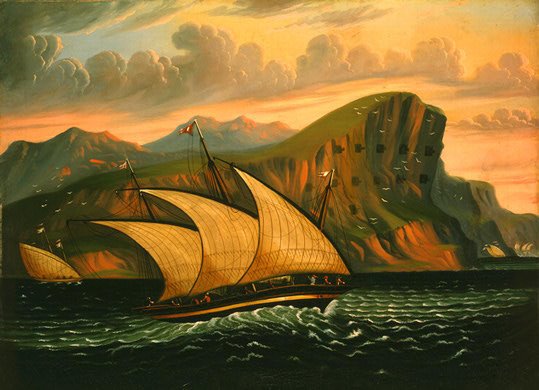
1850 - Felucca off Gibraltar

Painting by  Thomas Chambers (English-born American artist, 1808-1869) Felucca off Gibraltar.

From Lebanon Braughall managed to secure  passage with a trade caravan  travelling to Jerusalem.

Berber_Trade_with_Timbuktu_1300s

Image of a Trade Caravan to Tumbuktu in 1850 from Travels and Discoveries in Northern and Central Africa by Prof. Dr. Heinrich Barth, vol. iv, London 1858)

When he finally arrived in Jerusalem he was physically in a weakened state and his  finances were exhausted.

06733v

Jerusalem (El-Kouds). First view of Jerusalem from the south / American Colony, Jerusalem. (http://hdl.loc.gov/loc.pnp/matpc.06533)

At this time the Holy Land was part of the Ottoman Empire. Any  pilgrim wishing to enter any of the pilgrim sites such as the Holy Sepulchre could only do so at certain times and upon payment of a fee to the Governor of the city. Fr Braughall  requested  and was granted an audience with the Governor of the Provence.  The priest must have made a good impression on the  Governor  as he was granted a free  pass  to all the shrines in Jerusalem. Having completed his pilgrimage which included praying for 9 days and nights  within the Sepulchre church, while existing on bread and water, he  set off on his return journey.

We are told he travelled to Cairo in Egypt  but became ill with fever and dysentery. While in Cairo he stayed with a small religious community. The community appear to be Franciscan missionaries  and consisted of  four priests and two lay brothers. Within days of Braughall’s  arriving  the community had succumb to his illness and died and he was forced to bury them. Braughall may have felt some responsibility for their deaths as he  stayed on in Cairo and took over their duties until he was relived. MacRory states up to 40000 people died in the city during this outbrake.  Once his replacements arrived with the help of  the English Consul he received passage from Alexandria back to the port town of Livono in Italy.

We are not told what he did next  but his health  deteriorated yet again and for the next few years he seems to have drift through Portugal and Spain. In 1838 he returned to Carlow penniless  where he remained  for a short time as a guest at  St Patrick’s College in Carlow town. He had been away for 16 years.

carlowcollege

St Patrick’s College Carlow

The President of the college Dr Fitzgerald invited him to stay permanently but he refused deciding instead to return to Italy to live out his days as a hermit.

In 1839 Braughall set out again for Italy and travelled to Vesuvius where he tried  to enter one of the many hermitages dotted along the mountain slopes. The church authorities of Naples  in whose jurisdiction the hermitages were  became aware of his presence and were suspicious of his motives. They demanded to see his papers of identification which he could not produce. He was  then forced to write to the Sisters of the Presentation Convent at Carlow appealing to them to approach the bishop and to ask for a letter stating who he was and  of his former pilgrimage to the Holy Land. It is interesting that he did not write directly to the bishop.

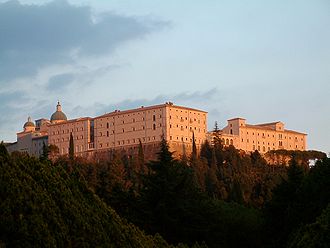
Eventually a letter arrived from the bishop and was presented to the authorities but they  still remained suspicious and  demanded the letter be authenticated by the Holy See.  Once the  Vatican confirming his  story Fr Braughall left Naples and joined the  Benedictine monastery at Mount Cassino.
330px-Monte_Cassino_Opactwo_1

Monte Cassino Monastery

Fr Braughall became well-known and admired  for his piety. According to MacRory

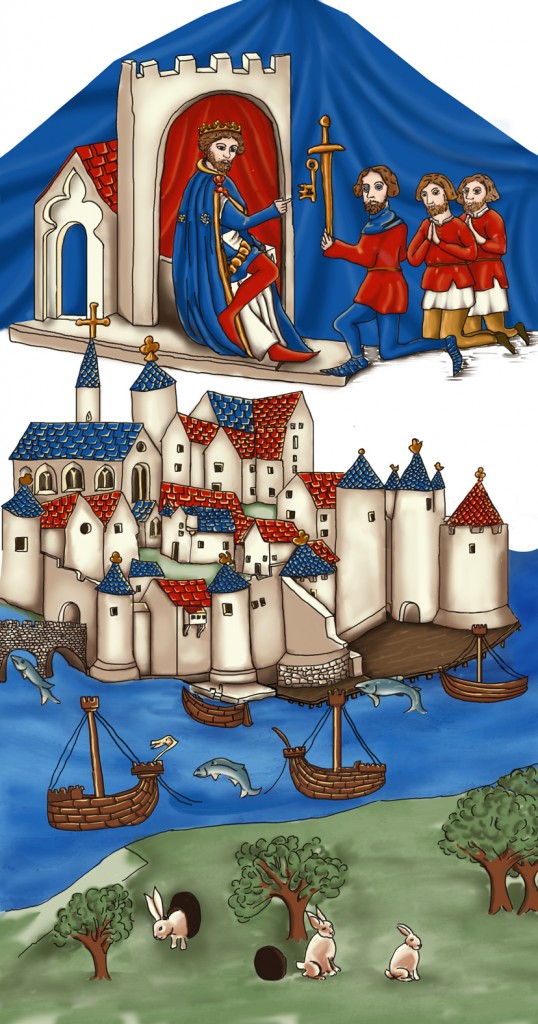
It is recorded that when  the King of Naples and his family visited Mount Cassino they found Father Braughall  kneeling in adoration before the Tabernacle. The royal party, preceded by the King, reverently took up and kissed the hem of Father Braughall’s habit, while he, unconscious of their presence in the depth of his devotions, prayed on.

Fr Braughall made one final pilgrimage to the Holy Land following the vision of  what he believed was his Angle Guardian. He died in 1850 and was buried at Mount Cassino  along way from Carlow.

Reference
Gerard MacRory. 1950. ‘Pilgrim Priest’,The Irish Monthly Vol. 78, No. 925, 314-318

Pilgrimage in Medieval Waterford

This blog post is a brief review of the evidence for pilgrimage in the town of Waterford during the late medieval period. The information comes from a paper I am working on about  the archaeological evidence for pilgrimage in medieval Ireland.

Medieval Waterford

During the late 1980’s large areas of the medieval and Viking town of Waterford were excavated and the results published in the much sought-after book Late Viking age and medieval Waterford : excavations 1986-1992. These excavations were hugely important and have provided vast amounts of information, answering questions about how people lived and how the city grew and developed over time.  The majority of the artefacts from the excavations are on display in the Waterford Museum of Treasures. The  museum is a fantastic place and I would highly recommend a visit if you’re in the area. The many beautiful and rare artefacts on display show the domestic, military, trade and religious life of the medieval town of Waterford. Among the items on display are two tiny artefacts which provide evidence of personal devotion and pilgrimage.

4-charter-worked-up-alternative-with-quay-smaller

The medieval town of Waterford by Rubicon’s Sara Nylund.

The  artefacts in question are pilgrim badges purchased by medieval pilgrims who lived in Waterford.

Pilgrim Badges

From the beginning of Christian pilgrimage continuing to modern times, pilgrims  have been bringing home mementoes of their pilgrimage for example earth/dust from the saint’s tomb/grave, holy oil or water from the shrine but it was not until the 12th century that souvenirs were mass-produced and sold to pilgrims.

The badge  was  the most popular type of pilgrim souvenirs.  They were made of  made of lead or pewter making them cheap to manufacture and very affordable. Each badge was  decorated with  an image relating to the shrine it was sold at for example the  badges from the great shrine of Canterbury  depicted St Thomas á Beckett or scenes of the saint’s martyrdom.

To date there is no definitive evidence that  pilgrim souvenirs were produced at Irish shrines but the recovery of pilgrim souvenirs from urban and burial excavations across  Ireland tells us many Irish pilgrims were engaged in long distance pilgrimage abroad during the later medieval period and purchased souvenirs as mementoes of their pilgrimages.

Pilgrimage and Waterford

Waterford like other Irish  port towns  had strong links with pilgrimage. There would have  been  a constant flow of pilgrims embarking on and returning from foreign pilgrimage via the wine  and trade ships. Some of these pilgrims would have lived within the town walls, others came from the surrounding hinterland and some travelled long distances to reach the port. Most of the pilgrims who left Waterford are anonymous. We do not know who they were or where they went on pilgrimage.

One Waterford citizen whose pilgrimage was recorded was the  Mayor of Waterford James Rice (1467-1486).  Rice made two pilgrimages to the shrine of St James at Santiago de Compostela in northern Spain in the 15th century. The first pilgrimage was made for the Jubliee year of 1483.

Archaeological Evidence of Pilgrimage from Waterford

Analysis of the two badges found in Waterford suggest they were produced on the Continent.

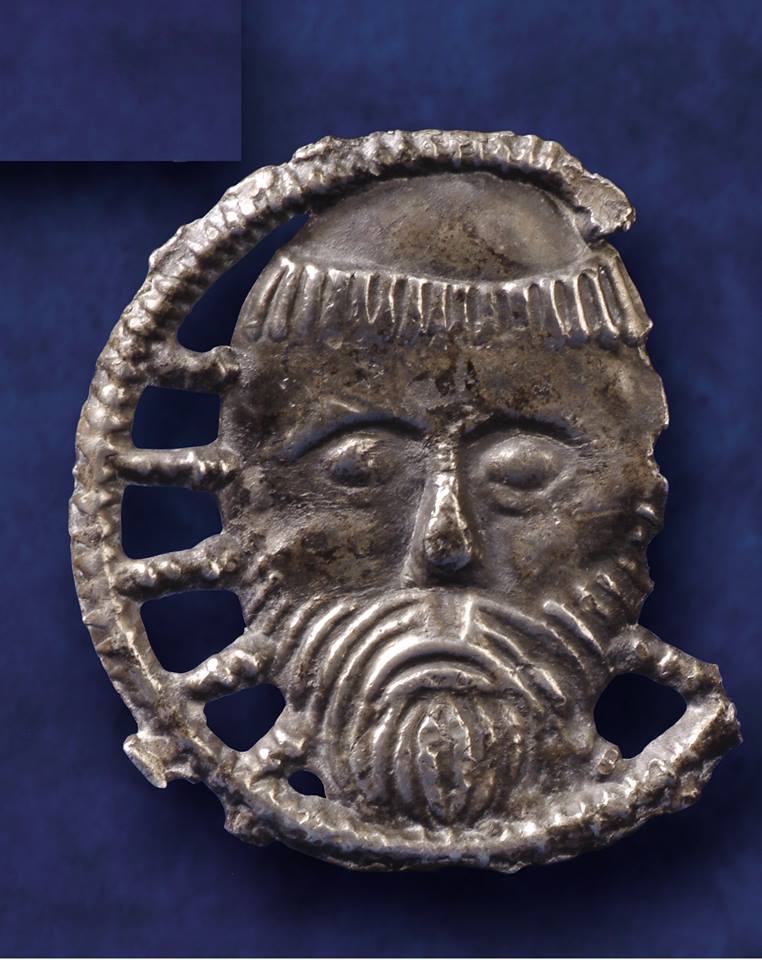
One of the badges is circular in shape. It was made of a tin-lead alloy and depicts the face of a bearded man, probably St John the Baptist. Similar style badges have been discovered at London and Canterbury. It is likely that the English and the Waterford badges represent the relic of the head of St John the Baptist, which was removed following the sack of Constantinople in 1204  to Amien Cathedral in France.  This relic was a major draw for pilgrims throughout the medieval period. Today it continues to draw pilgrims mostly from the Orthodox church but on a much smaller scale.

The badge was found in the backyard of a 13th century sill-beam house which may suggest someone who lived in the house had acquired the badge on pilgrimage and lost or  thrown it away at a later date.

970953_476576755750054_1283440569_n

Pilgrimage badge depicting the relic of St John the Baptist Head found during excavations of Medieval Waterford. Image (c) of Waterford Museum of Treasures.

The second badge  is extremely interesting.  It is unique with no other example of its type found elsewhere. It is  rectangular in shape and depicts the death of an unknown saint who is tied to a tree while a man with a hooked stick/bar  beats him. The badge bears the inscription  + SIGL/LVM: IONANNI/S: CRVCIFIX/I: A IVDEIS: P (the seal (or sign) of John, crucified by the Jews at P). The design and style of the badge suggests  that it was produced in France but  its exact origins are unknown. This badge  was also found in a 13th century context in association with a domestic setting.

???????????????????????????????????????????????????????????????

Pilgrim badge from unknown shrine on display at the Waterford Museum of Treasures.

Although countless Waterford pilgrims travelled within and outside of Ireland on pilgrimage the majority leave no trace of their journey. The discovery of these badges is very exciting. The badges provide additional destinations of  Irish pilgrims  not recorded in any of the historical records.  The badges also mark pious acts  carried out by  two of the citizens of Waterford. They are  personal items owned, touched and worn by the pilgrim who purchased them and provide information on the devotion to the saints. While it is generally accepted that  pilgrimage was an important part of medieval life, most pilgrimages go unrecorded and it is only through the discovery of artefacts such as pilgrim souvenirs that we can answer some of the many questions pertaining to pilgrimage in medieval Ireland.

 References

Hurley, M. F. 1997. Late viking age and medieval Waterford: excavations 1986-1992. Waterford: Waterford Corporation.

McEneaney, E. (ed.) 1995. A History of Waterford and its Mayors, from the 12th century to the 20th century. Waterford: Waterford Corporation.

Rubicon Heritage, 2012. Recreating the Earliest Image of an Irish City: The Waterford Charter Roll

Homepage


Molana Abbey, Co Waterford

Molana abbey has been on my list  of  places to  visit for a such a long time and I finally got my chance this week and boy was it worth the wait!!

The abbey is  located  on an island in the Blackwater estuary on the  Ballynatray estate just outside of Youghal. On private property the site is open to the public during the summer months on  Tuesday, Wednesday and Thursdays.

1-DSCF0264

View of Molana Abbey, hidden among the trees

History of the Molana

Molana was  founded in the 6th century by a little known Irish saint  called  Maol Anfide, a contemporary of St Mochuada of Lismore. The saint  built a monastic settlement here on a small island  called Dairninis  or the ‘island of  the oak’ . No architectural evidence remains of this early settlement and today the ruins on the island date to the late 12th and  13th century.

In 1806 Dairninis  Island was joined to the mainland by a causeway and bridge  by Grice Smyth the then owner of the Ballynatray estate.  I was delighted to see oak trees still growing on  the island and along the causeway continuing the tradition of the place-name origins for the site.

1-DSCF0263

Causeway leading to Molana Abbey

Turtle Bunbury’s excellent blog post Molana Abbey from the Stone Age to Dissolution tells of the sites early history

By the early 8th century, Molana was a major stronghold of the Céili Dé (Servants of God), a monastic order determined to reform the church. Its abbots subsequently played a key role in the subsequent introduction of Continental ideas to Ireland. Indeed, as Dr Dagmar Ó Riain-Raedel noted in her thesis on the island, the Abbey’s greatest hour came in about AD 720 when its Abbot, Ruben Mac Connadh of Dairinis, working with Cu-Chuimne from the island monastery of Iona, produced the Collectio Canonum Hibernensis. This was a profoundly valuable and important book for the church, written in Latin, effectively dictating the first rules of Canon Law. Its very title reflects its origin as a compilation of over two hundred years worth of canon law and synodal decrees. The text itself drew heavily upon previous ecclesiastical regulations and histories, all dating from the centuries prior to 725. It also included papal epistles, acts of synods, eccleiastical histories, a definition by Virgilius Maro Grammaticus, a compusticial tract by Pseudo-Theophilus, spurious ‘Acts’ of the council of Caesarea, the so-called dicta of Saint Patrick and several quotes from all but one of the works of Isidore of Seville.

Indeed, there is reason to believe that Molana Abbey may have been home to the first library in the south of Ireland. Unfortunately, none of these original manuscripts have survived but copies can be found in archives all over the Continent. Collectio Canonum Hibernensis was circulated throughout Western Europe for the next four hundred years

Despite this fascinating early history no physical remains of what was once an important and influential monastery are to be found.

1-molana 064

The ruins of Molana Abbey on Dairinis Island

By the 12th century Molana abbey was re-established as an Augustinian Priory  by Raymond le Gros FitzGerald, who tradition holds was buried here. References to the later history of Molana are sketchy. Interestingly in 1450 Molana was at the centre of a scandal.  Pope Nicholas V compiled a mandate for the investigation of claims that the Prior of Molana John McInery, was guilty of simony, prejury and immorality.

The abbey was granted an indulgence in 1462, by the then Pope Pius II , to all those who came here to pray and to give money to the maintenance of the abbey. Such an indulgence would have made the abbey a focus of pilgrimage for at least the duration of the offering of the indulgence.

The names of some of the later priors of Molana are also mentioned in historical sources.The abbey was suppressed in 1541 and fell into the hands of Sir Water Raleigh. By the 19th century the abbey was in possession of the Smyth family and was a focal point on their estate, with their stunning Georgian mansion looking across at the ruins.

1-DSCF0367

View of Ballynatray House from Molana Abbey

The Architectural Remains

Today the sites consists of a number of ruined buildings  that date to the late 12th /13th century. The buildings included a  church, monastic buildings and a cloister all  built of a red sandstone, which gives the site a lovely warm feeling . There are a number of cracks in the walls so some of these building do not appear to very stable.

The church is  large (17m x 7.6m)  with an undivided nave and chancel . The nave is the oldest part of the building and appears to incorporated part of an  earlier church. The chancel  was a later addition and dates to the 13th century. It has eleven large lanclet windows (tall, narrow windows with a pointed arch at its top) which must have looked quiet magnificent when the church was in use.

1-DSCF0340

Undivided church at Molana

The east wall of the church is in a poor state of repair but traces of a decorated  moulded window embrasure still remain.

1-DSCF0336

Decorated moulding of window in the east wall of church

Attached to the north wall of the chancel are the remains of  a two-story building which was probably used as the abbot’s or prior’s accommodation. It has a fine  pointed doorway of dressed sandstone and a spiral stairs.

1-DSCF0362

Building on the north side of chancel of church

At the centre of the ruins is a small cloister (19.65m N-S; c. 14.75m E-W). There is no evidence of an arcade but corbels in the outer walls of the surrounding  buildings suggest a roofed walkway.  Today the cloister is dominated by a  19th century statue which depicts the founding saint.

1-DSCF0280

Cloister of the Abbey

The statue was placed here in 1820 by Mrs Mary Broderick Smyth, the wife of Grice Smyth. A  plaque  on the statue plinth has the following inscription

This statue is erected to the memory of Saint Molanfidhe who founded this abbey for Canon Regular A.D. 501. He was the first Abbot and is here represented as habited according to the Order of Saint Augustine. This Cenotaph and Statue are erected by Mrs. Mary Broderick Smyth A.D. 1820

1-DSCF0290

Statue of St Mael Anfeid

The saint is dressed in a cloak and robe  with a very pretty floral pattern on the hem.

1-DSCF0375

Floral pattern on the hem of the statue

The building on the SW side of the cloister has traces of plaster and some  orange paint which may indicate traces of a wall painting. According to the Archaeological Inventory for Co Waterford  in 1908 traces of a wall painting were noted in the refectorum.

1-DSCF0389

Traces of possible wall painting in the building at the SE side of the cloister

In the same room, a plaque is set into a window embrasure on the south wall. This plaque was also placed here by Mrs Smyth,  and has the  following inscription

Here lies the remains of Raymond le Gros, who died Anno Domini 1186

1-DSCF0396

Plaque dedicated to Raymond Le Gros set into a window embrasure

The fascinating  history, architectural remains combined with  the stunning setting all  make Molana a truly amazing, spiritual and peaceful place.

References

Bunbury, T.  Molana Abbey from Stone Age to Dissolution

Moore, M. 1999. Archaeological Inventory of County Waterford. Dublin: Stationery Office.

Power, Rev. P. 1898. ‘Ancient ruined churches of Co. Waterford’, WAJ 4, 83-95, 195-219.

Power, Rev. P. 1932. ‘The abbey of Molana, Co. Waterford’. JRSAI 62, 142-52.

St Patrick’s well and Cloghaphuill in the parish of Rathvilly Co Carlow

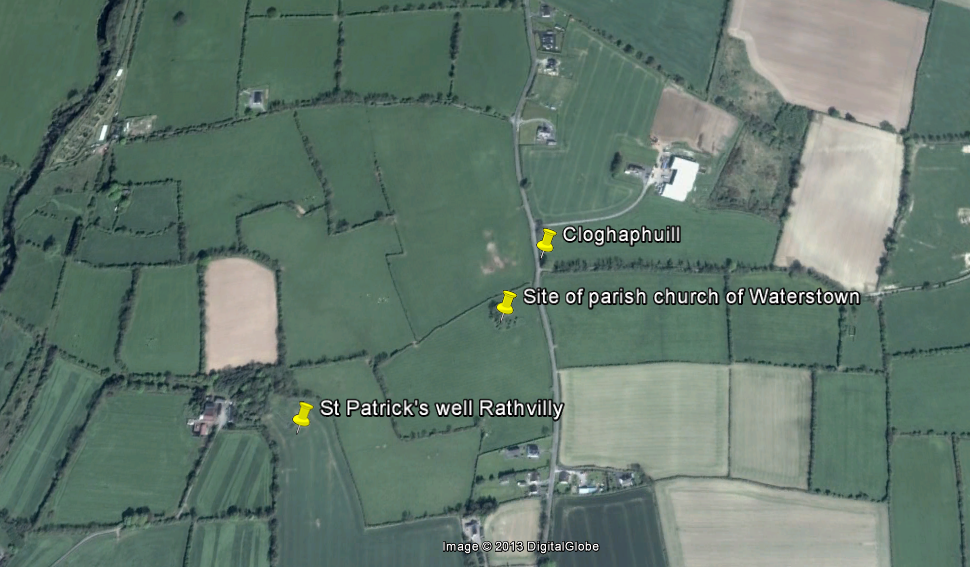
The parish of Rathvilly ( Ráith Bilech  ‘fort of the old tree’) in Co Carlow has two really interesting pilgrimage sites,  still venerated by local people; St Patrick’s well in Rathvilly townland and  Clogh-a-phuill (the stone with a hole), a roadside shrine,  in neighbouring townland of Ladystown.

rathvilly

Location map of St Patrick’s well and Cloghaphuill ( from Google Earth)

St Patrick’s well

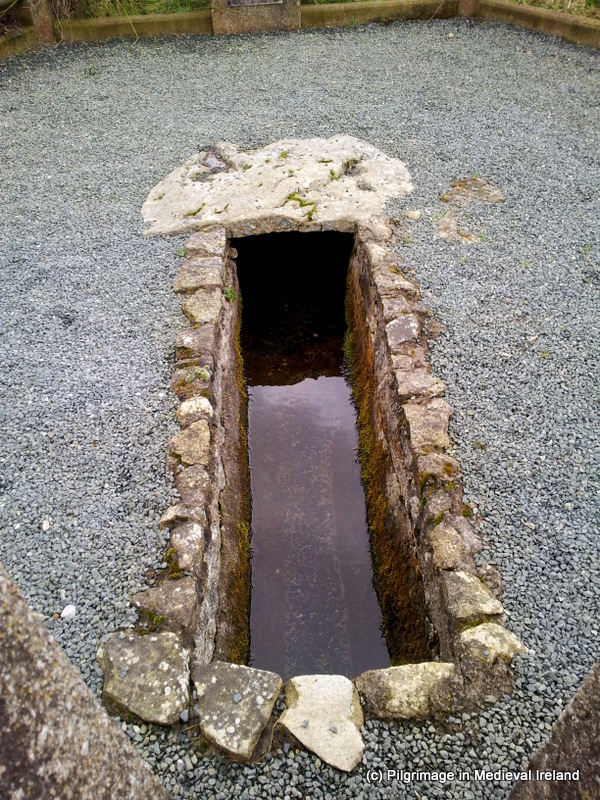
St Patrick’s well is located  on private land in the townland of Patrickswell (Tobar Phádraig) at the bottom of a long sloping field.

1-20130318_123957

St Patrick’s well at Patrickswell, Rathvilly Co Carlow

According to tradition St Patrick baptised Crimthann the  King of Leinster along with his wife and child at this spot.

1-20130318_124038

The large flat capstone which covers St Patrick’s well

The well itself is a natural spring capped by  a large flat slab. The water follows  away from the well through a stone lined channel.  The area surrounding the  well was  enclosed in 1953 with a hexagonal fence. More recently the  ground surface surrounding the well was covered in gravel.  I didn’t see any drinking cups or votive offerings at the site but there were some coins in the waters of the well. The wells water is renowned as a cure for warts. People still visit the well especially around St Patrick’s day.  I am currently looking into the medieval and post-medieval pilgrimage at the site so I will keep you posted on what I find out.

Waterstown church & Cloghaphuill

A short distance from St Patrick’s well is  the ruins of a medieval church at Waterstown. On the 1st edition ordnance survey map of Co Carlow 1840 the site is recorded as church, graveyard and cross.  The map shows the  church  as a rectangular building within a rectangular enclosure. The Ordnance Survey  25 inch map for the area recorded in the early 1900’s, shows the site as sub-oval mound with a cross at the summit.

In  Ryan’s  The History and Antiquities of the  County Carlow  in 1883 the site is described as  follows

is a rude stone cross, embedded in a socket of like material and about seven feet in height. It is supposed that  the parish church formerly stood at this place.

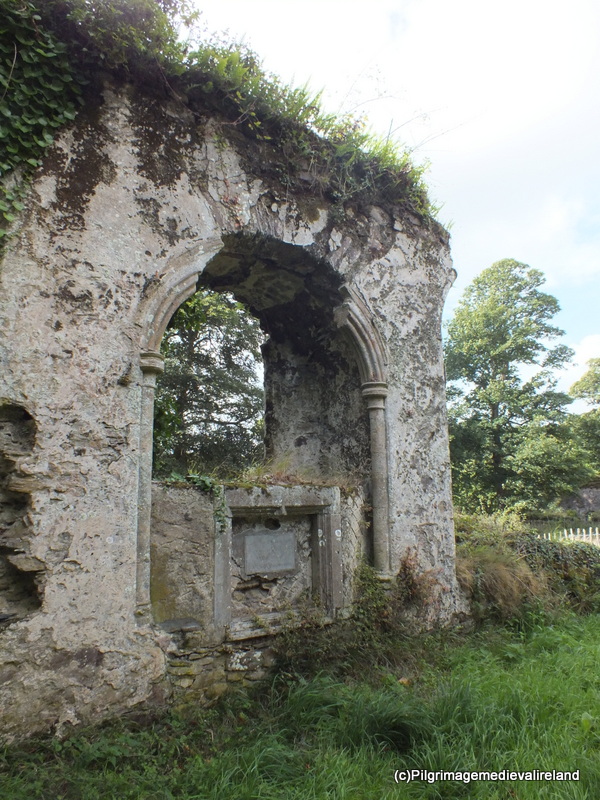
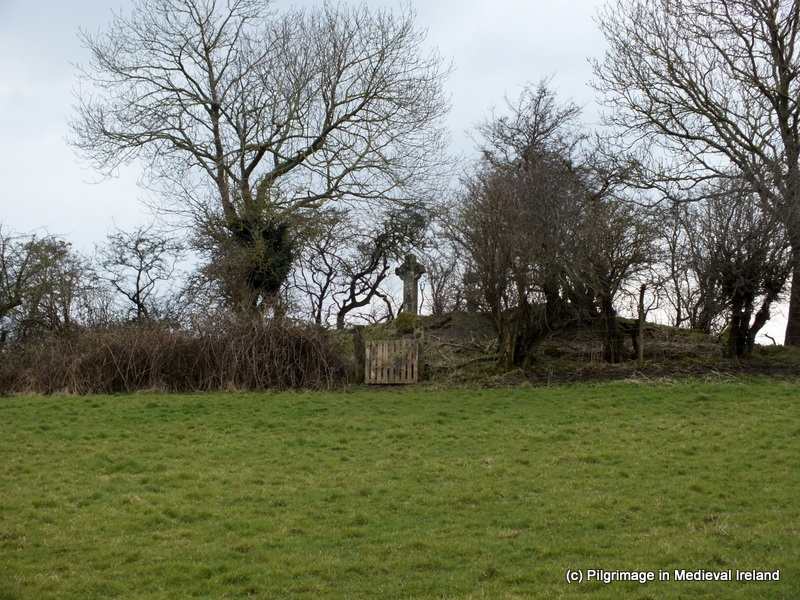
Today the site  is a mound  covered in thick vegetation with two crosses on the summit. On the southeast side of this mound are traces of walls of a structure (most likely the church).

1-DSCF1186

Waterstown church in the parish of Rathvilly

On the summit of the mound are two  medieval crosses. The larger of the two,  is a high cross made of granite, it is undecorated cross with a solid wheel and edge moulding and sits in  a large rectangular cut stone.

1-20130318_131445

Granite high cross at Waterstown

The second smaller cross  is made of limestone. It  has a solid wheel but the arms of the cross have been damaged and it is decorated on both sides.  The front face depicts the crucifixion of Christ and back has an abstract design. The cross sits in a large earth-fast boulder.

1-20130318_132737

Late Medieval cross at Waterstown

These two crosses may suggest that this was more then just a parish church in  the early medieval. I have not come across  any reference to pilgrimage taking place here at Waterstown or  a dedication to a saint  but given the areas connection with St Patrick perhaps we can speculate the  site was associated this saint.

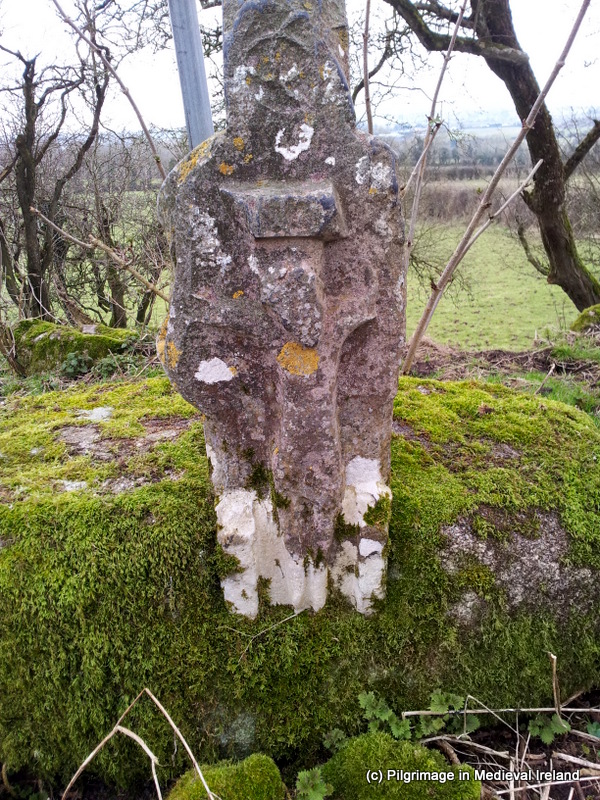
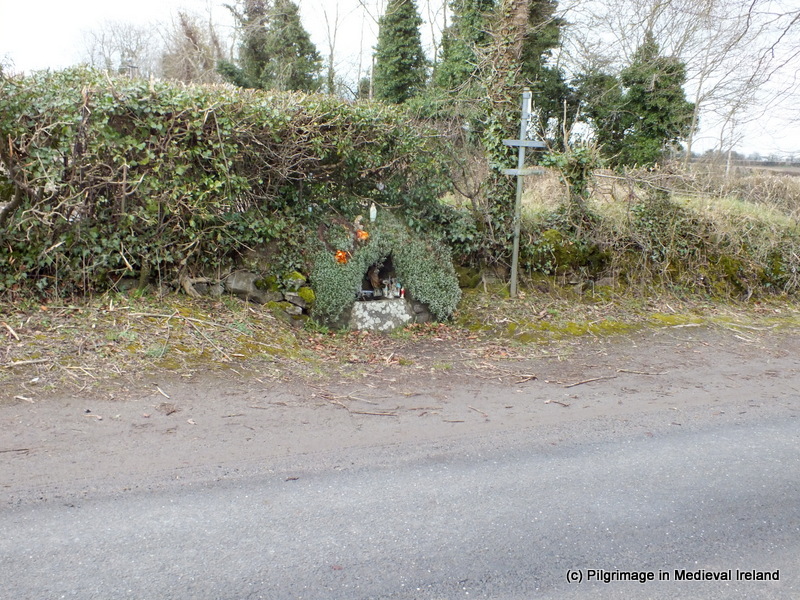
A short distance away in the townland of Ladystown at the side of the  Rathvilly-Balintglass  road is the  shrine  called Clogh-a-phuill  (stone with the hole). The shrine is the base of a cross that  most  likely came from the nearby church site at Waterstown. It may even have  supported smaller decorated cross mentioned above.

1-DSCF1172

Clogh-a-phuill the wayside shrine at Ladystown in the parish of Rathvilly

The shrine is still visited by people and while  I was at the site a man came along and stopped his car, got out and said some prayers here before heading away .

1-DSCF1173

Clogh-a-phuill

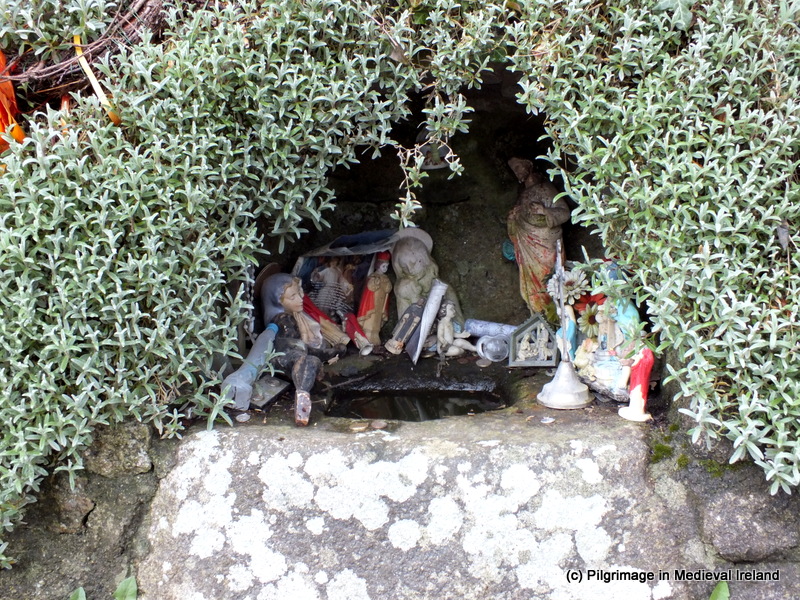
There is an array of votive offerings  holy statues, rosary beads and coins left here by pilgrims.

1-DSCF1175

Votive offerings at Clogh-a-phuill, Ladystown

I am continuing to do research on this site so I will keep you posted on any new findings. I would also be delighted to hear from anyone who has any information on the modern pilgrimage at either site

References

Ryan, J. 1838. The History and Antiquities of the County of Carlow. Dublin: Richard Moore.

My photos on exhibition at Eigse festival in Newcastle

Each year the village of Newcastle in South Tipperary has a festival called the Éigse  festival which celebrates the   life in the Breac Gaeltacht of Newcastle. This weekend event consists of lectures, walks and music events  relating to Gaelic language, ecology and heritage or the area.

1-SAM_1631

Medieval parish church of Newcastle

My contribution to this years event was a talk on the  Historic Graveyard  at Newcastle  and  also many of my photos,  that were taken during the  graveyard recording  late last year, formed part of an exhibition at the local community hall.

1-67

One of the oldest gravestones at Newcastle dating 1778

A big thank you to the organisers of the event, especially Michael Desmond  and to all who turned out to the talk and to see the photos.


Coole Abbey Co Cork

Coole Abbey  is a really interesting site, located about 4-5 miles outside of the scenic town of Castlelyons in Co Cork.  The site of an early medieval  monastery,  founded  by St Abban in the 6th century,  today  all that remains of  the early monastery  are two churches and a holy well. Of the surviving churches the  smaller of the two  sits in a field beside the road from Conna to Castlelyons. The  larger church is located c. 200m to the northeast  in an  historic graveyard.

map coole

Location map of the churches and Holy well at Coole (taken from Bing Maps)

Placename Evidence

Cúil  is the Irish for Coole and it translates as corner or nook.  Early medieval documents  refer to the abbey as Cúil  Chollaigne.

The Saints Associated with Coole

Coole is associated with two saints  Abban (Abán)  and Dalbach.

St  Abban  was born into the Uí Chormaic (Dál gCormaic ) dynasty in Leinster. He is associated with the churches of Mag Arnaide (‘Moyarney’/Adamstown, near New Ross, Co. Wexford) and Cell Abbáin (Killabban, Co. Laois) . In Munster  he established a monastery at  Ballyvourney, Co Cork  which he later surrendered to St Gobnait. He is also associated with Killagh Abbey near Milltown Co Kerry and Kilcrumper near Fermoy and  he founded  the church at Coole  (Cúil Chollaigne). Abban has two feast days the 16th of March and the 27th October (O’Riain 2012, 51-52; 254).

The second saint  association with Coole is St Dalbach. Dalbach  and the church at Coole were associated with the anchorite movement known as the ‘Céili Dé’ (clients of God)  who flourished in Ireland  between 750-850. The saints pedigree links him to a Cork based tribe known as the Uí Liatháin. The saints obit was entered in the annals for the year 800 and his feast was assigned to the 23rd October ( O’ Riain 2012 ,254).

There are few  early medieval historical references to the site. One that is of interest is found in Mac Carthaigh’s Book a collection of annals that date from 1114 to 1437.  The annals for the year  1152  states the churches of

 Cork, Imleach Iubhair (Emly), Lismore, and Cúil Chollainge (Coole) were burned in the same year.

The Annals of the Four Masters also record that in 1151

Gillagott Ua Carrain, lord of Ui-Maccaille, was killed at Cuil-Colluinge, by the Ui-Mictire

Architectural remains

The Cork Archaeological Survey mentions the  presence of a  low curving earthen bank   that can be picked out  c. 70m north of the smaller church. The bank  curves northwest – eastnorthwest  in the field and it may  represent evidence of an early  ecclesiastical enclosure.

The two surviving churches date to the  12th & 13th centuries. The smaller  church is  built of sandstone and most of the fabric dates to the 12th century. It  is rectangular in shape, with  only the east gable surviving to any great height.

Smaller church beside the road

Smaller church beside the road

A modern style has been inserted into the west gable.  The church has some pre-Romanesque feature such as antae which  project from the  east ends of the north and south wall. It is thought antae which are corner projections  found on some early stone churches  were attempts to imitate  wooden churches  which  had stout corner posts jutting out beyond the gable-wall. Another early feature is  a gable headed (triangular headed) east window with exterior rebate  which is found in the east gable.

06-DSCF2046

East gable of church showing gable headed window and antae

Archaeologist Tomás Ó Carragáin (2010, 102-103)  suggests the gable headed window  dates to the  11th century.  Within the church there is a stone altar which sits in front of east window.  It is likely it was  restored at some point in the past by the office of public works (ibid., 336). There is  also a local traditionally that  mass was said here in penal times .

Altar in front of the wast window

Altar in front of the east window

The second church is larger in size and  it functioned as the parish church in late medieval times. Today it  is situated within a historic  graveyard  filled with 18th and 19th century gravestones.

Larger church at Coole

Larger church at Coole

The  church consist of a nave and chancel.  The nave appears to be Romanesque  c. 12th century  in date  and the west wall has traces of a roll-moulded jambs in the lower course of the door. The nave  is a later addition and dates to the 13th century.  The east gable of the nave has a piece of Romanesque sculpture in the form of  a finely carved  rosette.  Similar rosettes stone in England date 12thc century. This stone was  probably re-used from an earlier church here.   A similar type stone is found c. 20 miles away  at another small monastic site at  Kilmolash in Co Waterford.

Rosette  carving in the -- gable

Rosette carving  east gable

A large  well carved pointed arch,  which appears to be  a later insertion, joins the nave and chancel.

Arch between  chancel and nave

Arch between chancel and nave

The  chancel  is later then the nave and was  added in the late medieval period  (Ó Carragáin 2010,  307).

Door into ----

Pointed doorway in the south wall of the  church

Records dating to 1615 state the church’s nave  was ruinous but  the chancel was in repair. The building ( chancel) was in use until the 18th century  when it was finally abandoned.

Relics of Coole

The Pipe Rolls  of Cloyne  mention a relic  called the Coole missal  upon whose page margins  important memoranda of the lands and rights of the church were recorded (Power  1919, 47)

Waters (1927, 53) writing in 1927  mentions that a relic of Saint Patrick’s tooth was kept here but he does not say where he came across this information and I cant find any reference to this relic in the   Lives of Abbán  etc or in antiquarian books relating to Cork. If there was a relic of  St Patrick’s tooth here it is likely to have come here in the  later medieval, as Patrician links in Munster  for the early medieval period are minimal or its equally possible it is folklore that developed around the site in the post medieval period. These are just some initial thoughts and I will delve into this  more deeply in the coming weeks and keep you posted on what I find out.

Holy well

Below the church is  a lovely holy well. There is little information about the well  but it is  still in use as a number of statues and votive offerings sit on top of the small corbelled well house that covers the well.

The well is marked simply as  holy  well  on the 1st edition OS  maps and Power in 1919 who is usually most detailed in his recording of sites also refers to the site as simply the holy well (Power  1917, 51) and  that  it was ‘still venerated’

013-DSCF5262

The information plaque at the sites  connects the well to St Devlet  and suggests this is an Anglicisation of St Dalbach. The plaque gives the following  folk tale of the origin  for the well.

Long ago the blessed well at Coole was just a spring. A female inhabitant of Coole Abbey House was reputed to have  seen a monk praying at this spring and she ordered an oratory to be built over it.

It also states that the waters here hold a cure for sore eyes and warts but one has to visit the well and ‘pray at  each of the seven kneeling  stones exposed around the outside  of the well chamber’.

Id love to hear from anyone who knows more about the well and the traditions associated with it. If anyone does have any information you can email me at pilgirmagemedievalireland@gmail.com.

References

Thanks to Terry O’Hagan the author of the blog Vox Hibernionacum  for discussing the cult of St Patrick in Munster, but any omissions or misunderstandings are my own.

http://www.askaboutireland.ie/learning-zone/secondary-students/art/irish-churches-monastic-b/early-monastic-churches/

Coole Abbey & Church

Ó Carragáin, T. 2010. Churches in Early Medieval: Architectural, Ritual and Memory. Yale Press.

O’Keeffe, T.  2003. Architecture and Ideology in the Twelfth Century Romanesque Ireland Dublin: Four Courts press.

 O’Keeffe, T 1994 “Lismore and Cashel: Reflections on the Beginnings of Romanesque Architecture in Munster “JRSAI 124, 1 18-52.

Ó Riain, P. 2011. A Dictionary of Irish Saints. Dublin: Four Courts Press.

Power, Rev. P 1919. ‘The Churches of Coole County Cork’ JRSAI Vol.1 , 47-54.

Pilgrimage to St John’s well at Mushera Mountain Co Cork.

On Monday evening last on mid summers day  I headed to the annual  pilgrimage at St John’s holy well on the slopes of Mushera Mountain.  So after work armed with directions from my friend Cork based archaeologist Flor Hurley, I headed off to find the well and got very lost …. Nothing to do with Flor’s directions and a bit to do with my bad sense of direction  but I  did find my way eventually. My short unplanned diversions helped me to appreciate  that this is truly a beautiful part of the country. I noticed a lot of signposts for wedge tombs, stone circles and standing stones in my travels  so I will have to take a trip back to do some exploring.

The well

The holy well sits at the edge of a forestry plantation close to the road through the mountains.

1-DSCF9573

St John’s well and surrounding landscape

The well is a natural spring that is cover by a large grotto.   Within  is a statue niche with a large statue of St John. There were lovely bunches of wild flowers and  some cups left beside the statue. The well is accessed through a rectangular opening below the statue and I noticed that some coins had been thrown in. There was also a box for petitions or notes what would be written by pilgrims to ask the Saint to intercede on their behalf.

1-DSCF9575

Statue of St John and recess for access to Holy Well

A circular area has been tarred in front of the grotto/well and  twelve stations of the cross are found along the edge of this area. This circular area is linked to a lower car park and the main road via a small tarred roadway.

1-DSCF9572

Station of the cross along the edge of the car park in front of the well

The modern grotto was erected in the 1950’s and the car park and stations of the cross are also a recent creation. There are a number of benches which have been donated by families in memory of loved ones which make for a peaceful place to sit.

The site looked very different  in the past as this photo from the 1920s shows  it consisted of a small corbelled structure set in heath land.

1-DSCF9570

St John’s well in 1920

Traditional Stations at the Well

Those partaking in the traditional pilgrim rituals at the well  are said to be “paying of the rounds” this is an expression I haven’t heard before as  at other well sites the pilgrim is described as “doing the rounds”.  The rounds consist of  Seven Our Fathers and Seven Hail Mary’s and Seven Gloria said while kneeling in front of the well. Then one decade of the rosary is said three times as the pilgrim circles the well. The prayers conclude with the Rosary being said in front of the well.  I noticed two flat portable stones with crosses incised by pilgrims on the step in front of the grotto. The incising of the crosses appear to be part of the modern pilgrim traditions here.

1-DSCF9582

Stone incised with crosses made by pilgrims

This well is one of   three holy wells located on Mushera mountain. All three  are called St Johns’s Well and all dedicated to the same saint. One is in the adjoining  parish of  Aghina  on top of the mountain and the   second is located on the old Butter road   in Banteer parish.  The well discussed here is  found is  in the parish of Millstreet.  Devotion to the other wells has waned over the years and now  the well in the parish of Millstreet is the main focus for devotion in the area. Time didn’t allow for me to visit the other wells but I do plan to head back before the end of the summer.

Like many other Irish wells the waters here are believed to have a cure . The wells waters are reputed to cure warts and one lady I spoke with at the pilgrimage mass told me her son had been cured of warts after coming to the well.

Folklore of the Saint

Tradition holds that  the saint came to the  Muskerry hills with  his three sisters.   His  three sisters  were saint’s  Lasair,  Ingean Bhuide and Latiaran who I discussed  earlier in the year on Facebook page. The feast days of the sisters   were honoured at quarterly periods and may be associated with pre Christian religion. The connection with the well here with mid summer may also suggest that St John like his sisters evolved from pre Christian deity at the well when an earlier cult at the well was Christianised.

Past Pilgrimage & the Pattern Day Tradition

Like many  holy wells this was the focus  of a pattern day festival

The Millstreet.ie blog  gives the following  discussion of the pattern day

June 24th is the feast day of St John and down through the ages it has been a big occasion on the mountainside.  Up to about 1940, St John’s Day had a pattern as will.  The pattern consisted of tents set up abut a mile and a half from the well on the Macroom side, in the townland of Moulnahourna.  There were sweet and cake stalls, lemonade, cigarettes and porter tents, and of course the indefatigable three-card-trick men.  Occasions for celebration at that time were few and far between, Christmas, St John’s Day and March fair which lasted three days in Millstreet.  Due to this and the presence of the porter, these occasions rarely ended without a fight, these may have been faction fights.Two sisters from Millstreet, Han and Judy Murphy sat on either side of the Well “selling the water”.  One of them would fill a saucepan with water from the Well and received payment for it.  Pilgrims wisited the Well in the morning.  It was normal practice from Ballinagree and Rylane areas to visit the Well on top of the mountain in their own parish.  Most other pilgrims visited the Well  on the Millstreet side as is the case today.  After doing the “round” they continued on to the pattern to enjoy the remainder of the day.  An old character from Ballinagree, Bill O’Dea always turned up to entertain the crowd with his songs.  Another man from Bawnmore, nicknamed   St Joseph because of his long white beard also sang to the crowds.  His real name was Lucey.  Over the years the crowds got smaller at the pattern until eventually it was no longer held.  The dancehalls took over at that time, but local people still come to pay their “rounds” as usual.

Modern Pilgrimage at St John’s Well

This years  pilgrimage consist of mass which began at 8pm at the well on the 24th of June.  Many people visited the well before and after mass and took water home in bottles.  Despite it being June it was really cold probably due to the altitude of the site.

1-DSCF9611-001

Pilgrims assemble for mass at St John’s Well

Many of the older people parked in the area in front of the well and some stayed in their cars throughout. The rest of the people gathered around the edge of the  circular carpark.

1-DSCF9602

The Priest saying mass

Three priests  officiated at the mass Canon Jackie Corkery, Fr Frances Manning and Fr James McSweeney. The Millstreet Pipe band and the choir provided music throughout.

1-DSCF9641

The Millstreet Pipe Band at St John’s well

This is a real community  event and people from all the surrounding areas assemble here each year. I look forward to returning to find the other Holy Wells and seeing what I can find out about the history of the site.

References

St Johns Well

Pilgrimage to St John’s well Carrigaline, Co. Cork

The 24th of June is the feast of St John the Baptist. This day also coincides with the pagan celebration of mid summer and many pagan traditions continue even down to modern times such as the tradition of lighting bonfires.  There are many holy wells around Ireland dedicated to St John the Baptist and pilgrimage is still undertaken on the saints feast day at a large number of them.

Location Map of St John's well at the edge of Carrigaline town (taken from Google Earth).

Location Map of St John’s well at the edge of Carrigaline town (taken from Google Earth).

On  Sunday  last, St John’s Eve I attended the annual pilgrimage to St John’s well in the town of  Carrigaline, Co Cork. St John’s well or Tobar Eoin Óg  is  located in small wood in the townland of Ballinrea on the outskirts of the town of Carrigaline.  Also attending the  pilgrimage was  Richard Scriven  (Geography UCC)  who is currently doing very interesting PhD research  on modern pilgrimage in Ireland. For more details of Richard’s research check out his blog liminal entwinings.

St John’s Well

The 1st ed Ordnance Survey map of 1840  records the  well as  St Rinoge’s well elsewhere it is called Renogue’s well . Rinoge/Renogue  is likely a corruption of Eoin Óg  the Irish name for the well.

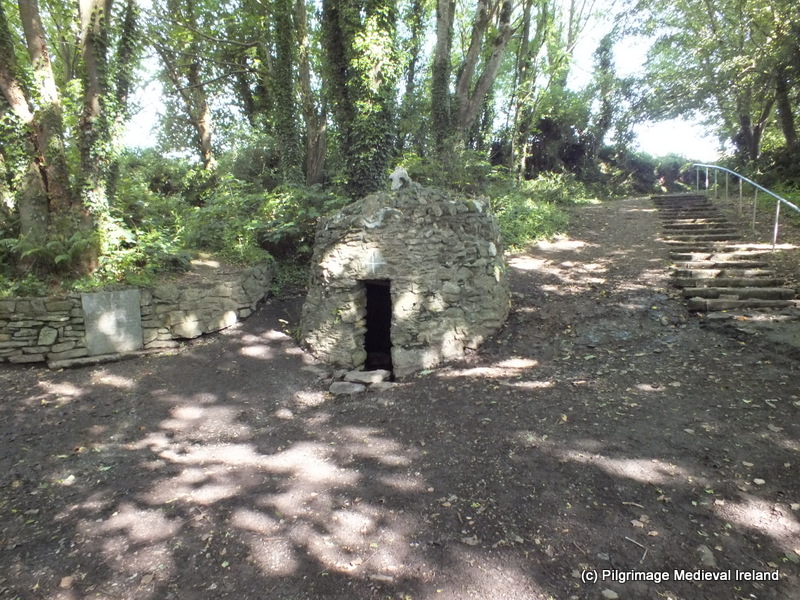
The site consists of  a spring well covered by a corbelled structure, beside the well is a large tree surrounded by a low circular wall with a stone plaque which  provides a short history of the site.

1-DSCF9538

St John’s well

A number of benches are located  at the site and  steps made of railway sleepers make the site more accessible. A small stone altar is located opposite the well.

Lewis’s Topographical Dictionary of Ireland  dating to 1837 gives the following account of the well

At Ballinrea there is a mineral spring, which is considered to be of the same kind as that of Tunbridge Wells, and has been found efficacious in cases of debility; and near it is a holy well, dedicated to St Renogue, which is resorted to by the country people on the 24th of June.

The Carrigaline Parish websites states that

According to tradition the well was discovered by a blind man whose sight was restored. In gratitude he built the beehive shaped stone surround, which can be still seen today.

It is recorded that in the early 19th century huge crowds  of people attended a  patron/pattern day  on St  John’s Eve (23th June) at the well.

According to the plaque at the well, the water  has healing powers and it is customary for pilgrims to say a decade of the rosary at each of the inscribed crosses  that are found in the walls of the well house. The practice of incising crosses is seen at many other pilgrim site such as St Declan’s well at Ardmore, Co Waterford and the practice seems to be a post medieval and  modern tradition.

1-DSCF9502

Well house showing one of the incised pilgrim cross over the door of the well.

Modern Pilgrimage on St John’s Eve

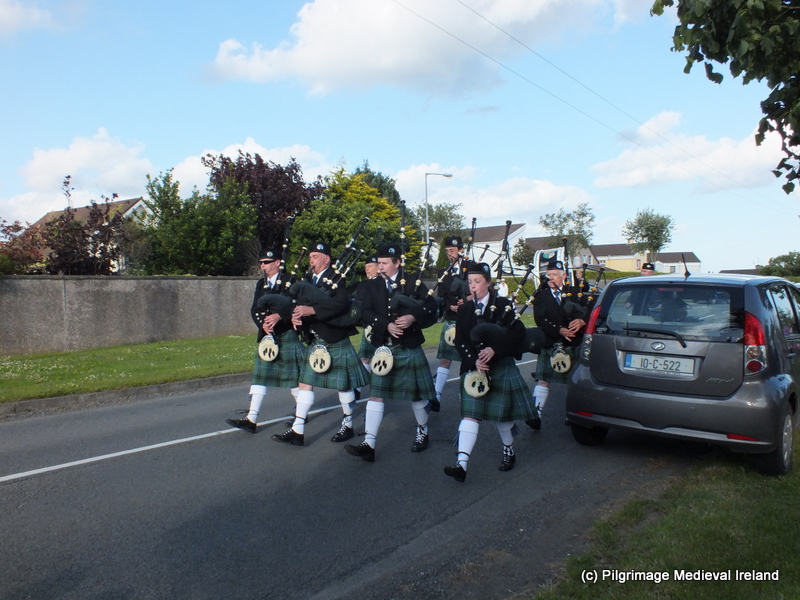
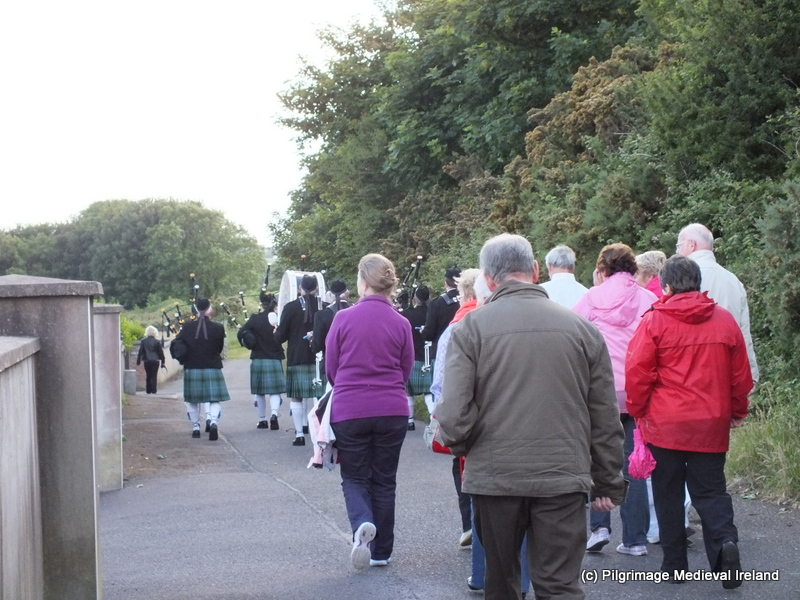
It is an annual tradition for the people of Carrigaline and the surrounding area to visit St Johns well on the eve of the saints feast.  It’s a tradition which likely goes back generations.  Pilgrimage in 2013 began with pilgrims  gathered on the Ballintrea road close to the Dun Eoin housing estate  at 7.15 pm.  People stood around and  chatted and waited for others to arrive. When a crowd had gathered at 7.30 the Carrigaline  pipe band  began a processional walk to the well. The band was immediately  followed by the  parish priest who was then followed by the rest of the people ( pilgrims). The Procession headed along a lane way with a signpost for the well, past some house,  then on to a grassy lane which leads down into a grove of trees. The band played throughout the procession and were really excellent.

009-DSCF9326 (1)

The Carrigaline Pipe Band heading the procession to St John’s well.

039-DSCF9342 (1)

Pilgrims in procession to the well

The walk  was very pleasant and took about 5-10 minutes to complete.  When we all arrived at the well the band took a well deserved brake  and lines up beside the alter. The rest of the people assembled around the clearing facing the stone alter opposite the holy well . There were  two priest from the parish of Carrigaline present to lead the prayers.

1-DSCF9435

The prayers began with the  sorrowful mysteries (five decades of the rosary an explanation of rosary is in the references below).  The parish priest lead the prayers  and  moved around the well clockwise, in the same manner as any pilgrim visiting the well to perform the stations would do.

128-DSCF9389

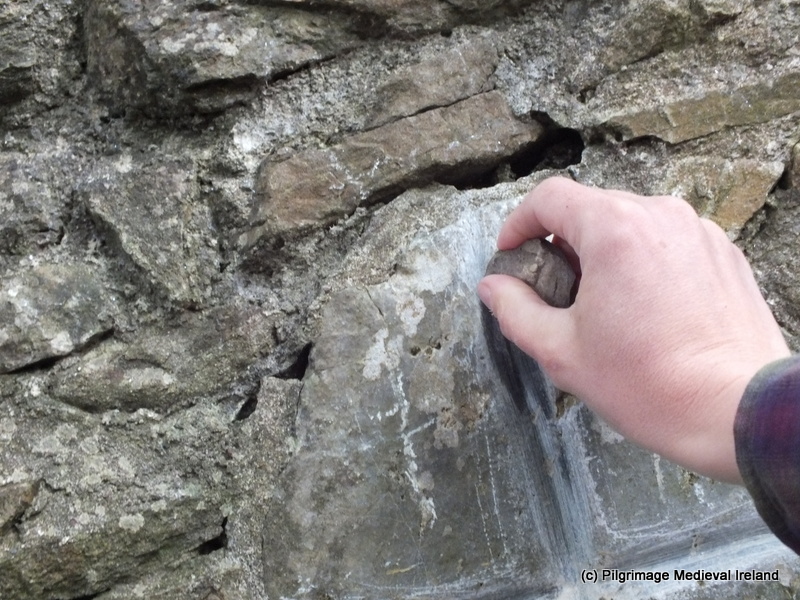
The a cross was incised with a small stone at each of the crosses around the well.

When each decade of the rosary is begun the pilgrim takes a stone and  scratches a cross into the incised  stone.

1-DSCF9524

Pilgrim incising cross on one of the stones

These stones five in total are located around the well and have deeply incised crosses. The crosses have been created by generations of pilgrims who visited the well.

1-DSCF9534

Cross incised by pilgrims at back of the well

Following the rounds of the well  there was a ceremony called Benediction of the Blessed Sacrament  for those of you who don’t know  what that is it is a devotional ceremony, the sacrament (host) is displayed in a monstrance  in this case  on the small stone altar opposite the well.  The  a priest blesses the congregation with the Eucharist at the end of a period of  prayer.

113-DSCF9381 (1)

A number of  hymns were sung by the choir and played by the pipe band such as ‘Faith of our Fathers’. When the ceremony finished  many of those present lined up and took water from the well. Some of them incised the cross over the well door. Unlike other sites people didn’t seem to bring water bottles with them.

300-DSCF9482 (1)

I returned to the well the following morning,  to see what it was like without the hustle and bustle of people.   It really is one of the most beautiful wells I have visited and so peaceful with lots of singing of the birds.

References

http://www.carrigalineparish.ie/index.php/parishhistory/

http://www.carrigalineparish.ie/index.php/parishhistory/

http://en.wikipedia.org/wiki/Benediction_of_the_Blessed_Sacrament

http://en.wikipedia.org/wiki/Rosary

St Colmcille’s well Disert Donegal

Today is the feast day of St Colmcille who along with St Patrick and St Brigit he is one of the three patron saints of Ireland. In 2008  my good friend Fiona Beglane  brought me to  see  a holy well  associated with the saint. The well in question is located   in the townland of Disert, in the parish of Inver, in Co Donegal. Over the last few years I have been to a lot of pilgrim sites but  this is  one of the most beautiful place  that I have spent time.

Location

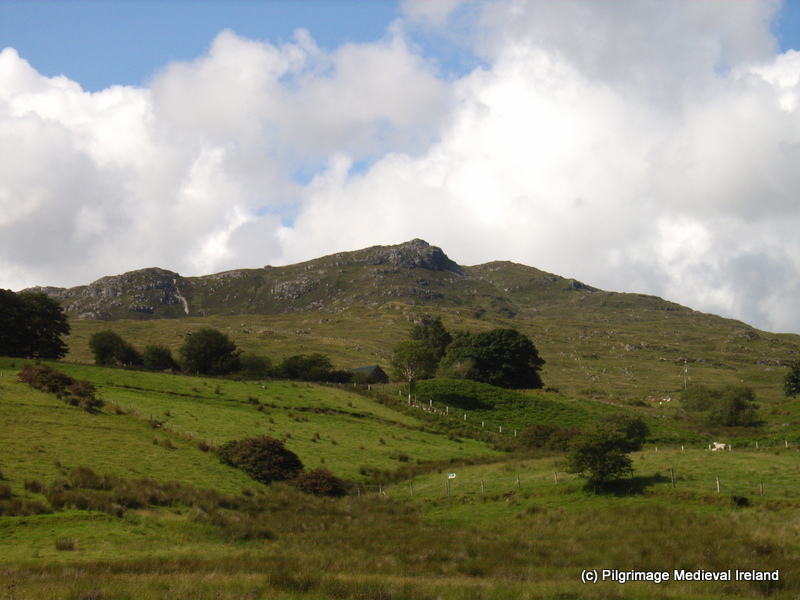
St Colmcille’s well  is situated in rough pasture at  the foothill of the  Carnaween hill and the Bluestack  mountains close to the banks of  the Eanybeg river.  As you can see from the photo below this is  the most glorious of  locations.

26-RIMG1175

The site consists of a holy well located close to a small graveyard that is surrounded by a stone wall and the remains of  megalith and associated enclosure.   All three  monuments  are points in  the pilgrim landscape of the site.

24-RIMG0299

The Eanybeg river

Meaning of Placename

The townland name Disert (Dísert in Irish) comes from the Latin word desertum meaning desert. During the 4th century  there was a movement of hermits in the East (Syria and Egypt)  retreating into the desert to live a life of isolation and prayer. It is probable that the idea of  living as a hermit came to Ireland from the East  via Gaul and Britain. The Irish placename ‘Dísert,’ and its variants ‘Dysert,’ and placenames of which ‘Dísert’ is a component, for example, Dísert Diarmata, Castledermot, bear witness to the existence of hermits and hermitages in  Ireland. There is no visible evidence of an early or  late church here but  according to tradition St Colmcille blessed the well here which was already of local importance.

History of the Site

The earliest references to Disert  dates to the 17th century.  The History of the Diocese of Raphoe mentions that Hugh Roe O’Donnell, chief of Tir Chonaill gave an estate at Disert to the Franciscans around the year 1460. Yet according to Meehan (1997, 14)   the Franciscans have no record of their order in the parish of Inver. Local tradition held that the Franciscans  who fled their monastery at Donegal after the Plantation of Ulster lived east of Disert in the townland of Friary and made their way between Killymard and Glenfinn along Casan na mBrathar.  Local tradition does states  seven monks were buried in the ‘garden’ or enclosure at Disert (ibid).

According to the Ordnance Survey letters for 1835 & the Annals of the Four Masters in the year 1611

Niall O’Boyle Bishop of Raphoe died at Gleann Eidhnighe on the 6th of February and was interred at Inis Caoil (Inish Keel).

Meehan(1994, 14) and the notice board at the site state it was at  Disert that the bishop died and  was carried out of the hills to his Kiltoorish for burial.

St Colmcille’s Well

03-RIMG0278

St Columcille’s well is located within the enclosing fence

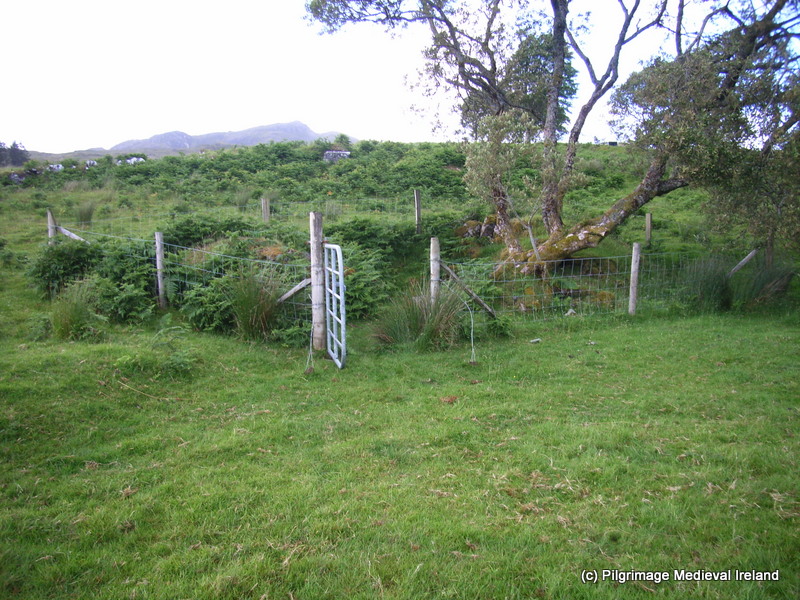
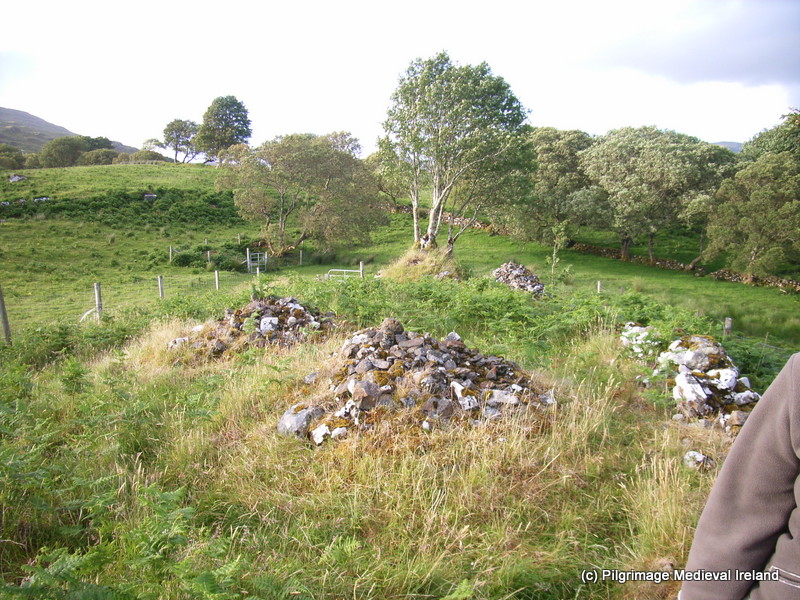
The  holy well is fenced off by wire railing.  The well covered by a  trap door which need to be opened to access the water.  The well shaft/hole is lined with roughly coursed stones and the well very little water when I visited it  in the summer of 2008. There are two cairns beside the well which have kind of merged together and are covered with vegetation.

02-RIMG0277

St Columcille’s well

The graveyard

Close to the well is a wedge shaped graveyard which is defined by a stone wall. The graveyard was used  for  the burial of  adults  until the 1840’s  and for unbaptised  babies until the 1930.  Within  the enclosure  is a stone altar with a metal cross beside an old tree.

15-RIMG0290

Interior of graveyard with holy well in the background

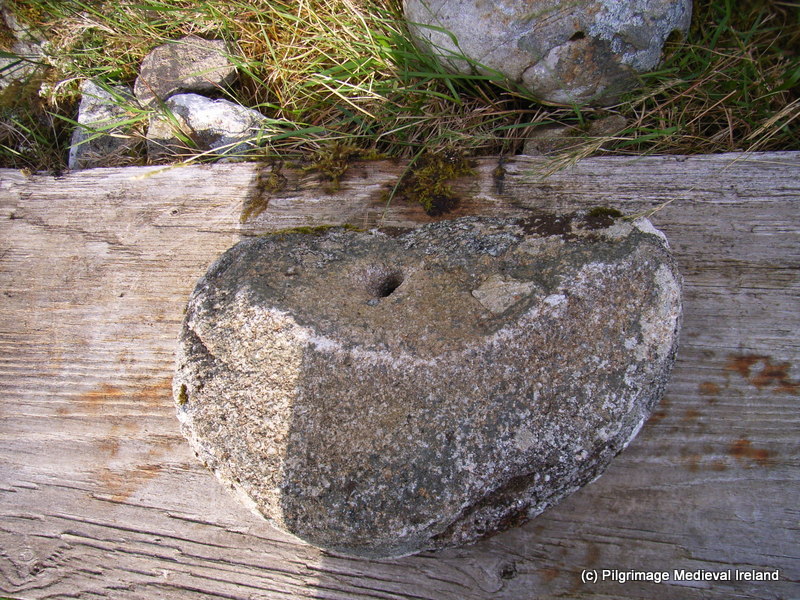
Sitting on the altar are a number of holy stones one of which  is a quern stone. There are a number of  low stones  in the grass which act as graves marker  and    four low stone mounds or  penitential cairns scattered about the graveyard. According to  Walking Ireland Website the site was used during penal times as a safe place to say mass.

The priest was said to travel up and down the river Eany between the Alt in Ardaghey saying mass in each, on alternate Sundays. The bullaun stones were said to have been used as candle holders. Fr. Dominic Cannon was parish priest of Inver from the 1770″s until his death in 1801.

05-RIMG0280

Altar within the graveyard

St Colmcille’s Arch

St Colmcille’s Arch  is another part of the pilgrim landscape. The arch is  what appears to be the remains of  a  ‘Megalith’  it consists of  two orthostats (upright stones) approximately 1m high with a lintel stone resting on them.  Piled on the lintel stone are small stones which form a pyramid.

56-RIMG1205

St Colmcille’s arch

When you pass through the arch you enter a  sub oval enclosure roughly 5m by 6m.

The Turas at Disert was noted for its cures. East of the megalith is a large slab or concave stone. The penitents lay on this flag and pressed their back into the cavity. This was a noted cure for backache. The well water was said to cure toothache. The water in the bullaun stone was said to cure warts. It was also used to cure eye complaints. In those days people came to the Turas at Dysert on June 9th – the Feast of Colmcille – from far and wide. (Meehan 1997)

Modern pilgrimage

According to the notice board at the site in former times people came here on the 9th of June the feast of the saint. In modern times mass is said in the graveyard on the first Sunday of July followed by the  traditional climb  of the nearby Carnawee Mountain. In the past  at the  top  people meet those from the Glenties side of the mountain for an afternoon  &  evening of dancing and singing.  Fiona Belgane carried out a detailed survey of the site called Disert: St Colmcille’s Well and Megalith, which states

pilgrims traditionally start at the  well with prayers as they walk around the  stones barefoot whilst praying. They then walk to the altar, over the hill whilst saying the rosary. At the altar they circumnavigate the stones found there before mass is said. 15 decats of the rosary are said whilst walking around the well. ( Unpublished project by Fiona Beglane)

Meehan (1997, 14-15) states

As well as prayers being said at the well the Rosary was recited and Paters and Aves were said as the pilgrim made his or her way round the heaps or cairns walking on the right hand or deiseal and placing a pebble on top of the cairn as the prayers were said.

Disert  is renowned for cures,  and I have already mentioned  the healing stone east of the megalith where penitents lay on the flag and pressed their back into the cavity, to cure backache. The stone reminded me of  St Kevin’s chair at Hollywood. Penitents would also crawl through the megalith (St Colmcille’s arch)  and  rub the affected part of the body against the stone. The water of the well was a cure for tooth ache. The water in the bullaun stone was a cure for warts. The quern stone was used to cure eye complaints, the pilgrim would hold the stone up to their eye and look through  the hole at its centre.

06-RIMG0281

Quern stone known as the “Cure”.

Local tradition  has it that a test of male virility was to carry two stones from the altar in the graveyard to the well and back three times, whilst holding them from the top.

07-RIMG0282

On the left of the photo are the stones carried to the holy well and back.


The soil from Disert   is reputed to be holy and to have certain powers.  Like other Columban sites in Donegal, such as Gartan and Tory, the clay at Disert is said to banish rats. The clay must be lifted from the right hand side of the altar and in former times great stress was laid on it being asked for and received with great reverence. Newspaper reports have suggested that uranium in the clay caused it to banish rats but these reports haven”t lessened the belief in its power. Until recently Disert clay was often put in the foundation when houses were being built  (Meehan 1997, 17)

References

Anon. Information Board at the Site.

Beglan, F.(unknown) Disert: St Colmcille’s Well and Megalith.unpublished.

Meehan, H. 1997. ‘Disert in the Blue Stacks.’ Donegal Annual, Vol. 49, 12-23.

O’Donovan, J. 1835. Ordnance Survey Letters Donegal.

The Disert Circular Walk http://www.walkingireland.ie/section-2.aspx?item_id=140

An exciting day out in the King’s River Valley

On Saturday I gave a lecture on St Kevin’s road  at  the Hollywood  Co Wicklow . The  audience  was great  and made me feel so welcome.   While having a cup of tea and a chat afterwards   I was told about a number crosses and old roads at the northwest end of the King’s River Valley.  The following  morning I set off to see some of these sites  in the company of  four local people  C.J, Ite, Francis and John,  who kindly gave up their Sunday to  show me around.

So armed with out maps we headed up the Johnstown road  to Valleymount to the townland of Ballintubber.

11-DSCF6873

View of Poulaphouca Reservoir from the Johnstown road

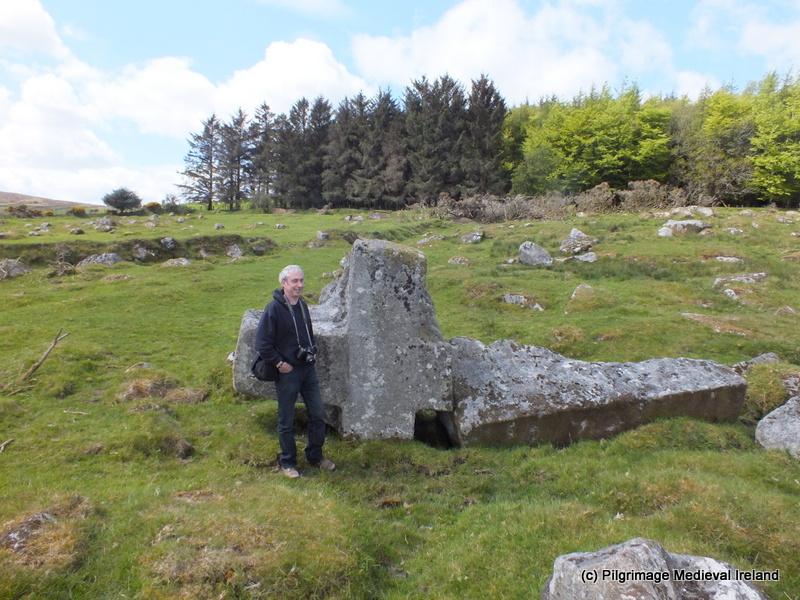
In Ballintubber is one of the most amazing archaeological site I have ever visited. The site is an enormous broken  granite cross.

30-DSCF6892

Broken high cross with Francis who is 5 ft 7″ acting as a scale

This large cross was in the process of being moved onto its side  when it broke and was abandoned. As I looked at this  broken cross  I couldn’t help but wonder what the mason said when it broke, I imaging given the effort involved in get the cross  to its semi completed state there was a lot of cursing. The cross was carved from a single piece of rock  probably a large boulder like those scattered around the field.

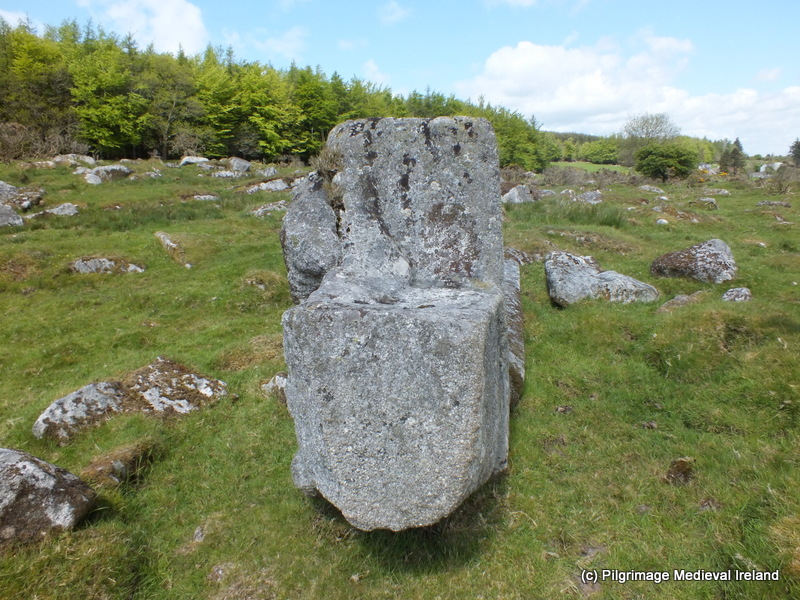
35-DSCF6897

Top of the cross

The shaft of the cross is approx. 3m in length and the head is 1.95m. This makes the entire cross approx 5 m tall.  Tool  marks left by the mason  are on the upper face of the cross. The cross really puts into perspective the efforts involved in creating the many high crosses that are found on monastic sites around the county.

For a detailed discussion of this cross see Chris Corlett’s  excellent  article   ‘The abandoned cross at Ballintubber,  Hollywood, Co Wicklow’ (complete reference below).

The next site we visited was a set of stepping-stones on the Kings River in the townland of Walterstown.  These stones could very well be part of an ancient route used by travellers and  pilgrims. They are marked on the 1st edition Ordnance Survey Map of 1840.

25-DSCF6941

Stepping-stones across the King’s River

Directly opposite the stepping-stones  within a modern forest is  a large flat top mound which may possibly  be a small  Anglo-Norman motte . The site is marked as an enclosure on the RMP maps but  it clearly isn’t one and is a flat topped mound.  If this is  an Anglo-Norman motte its  presence could confirm an ancient route in the area.

18-DSCF6934

Possible Anglo-Norman Motte close to the stepping-stones on the King’s River

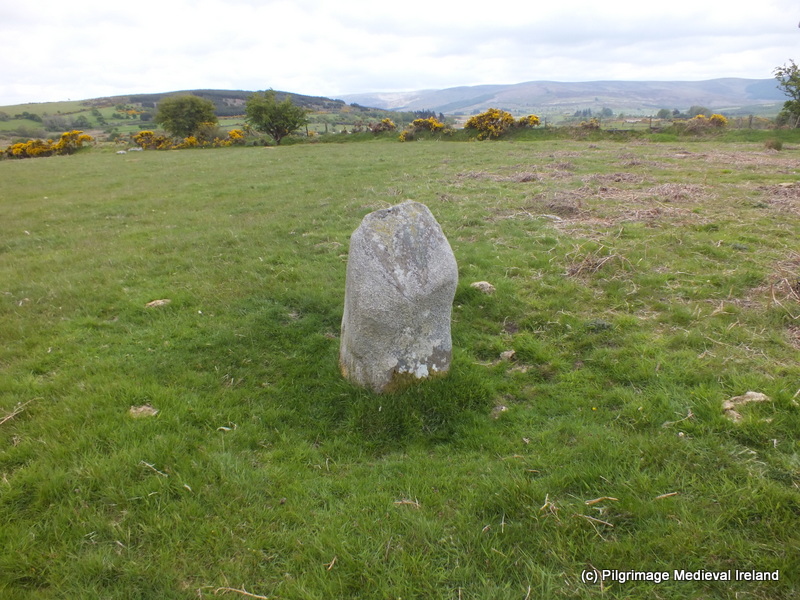
From  the stepping-stones  we headed on to see a standing stone also in the townland of Walterstown.  This stone  is directly in line with a mountain pass and may also have acted as a route marker for a prehistoric route.

54-DSCF6970

Standing stone in Walterstown

After a fantastic day  I   said goodbye to my companions   and I headed home via Blessington where I  stopped to see  two high crosses.  Geographically these crosses are the closest  to the Ballintubber cross that I  visited earlier.

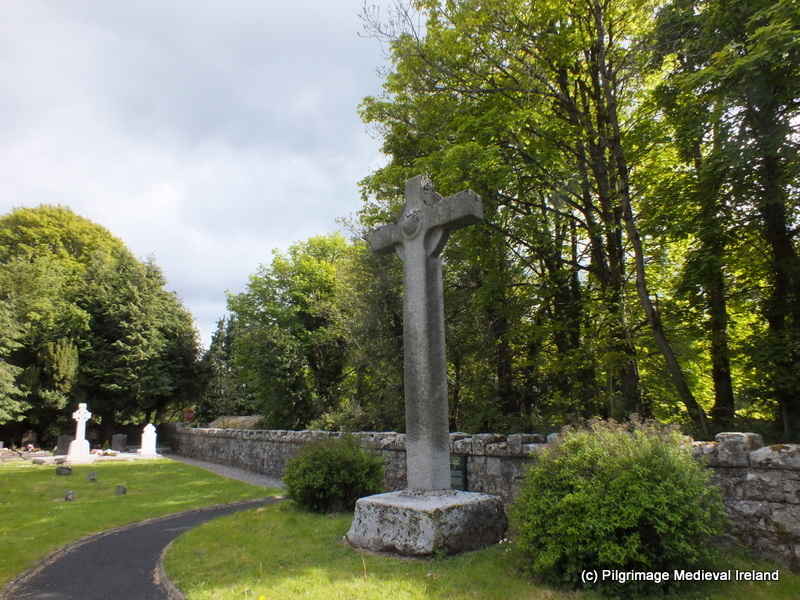
The  two crosses were formerly located at Burgage More church and graveyard  but moved to there present locations at the graveyard in Blessington when the  Liffey Valley was flooded. The larger cross is known as   St Mark’s cross,  it is very tall and has unusually long arms and a central boss design. It stands 3.95m high.

80-DSCF6996

St Mark’s cross in Blessington

The Ordnance survey letters  (1840) refer to the name of the cross as St Mark’s or  St Baoithin’s cross.

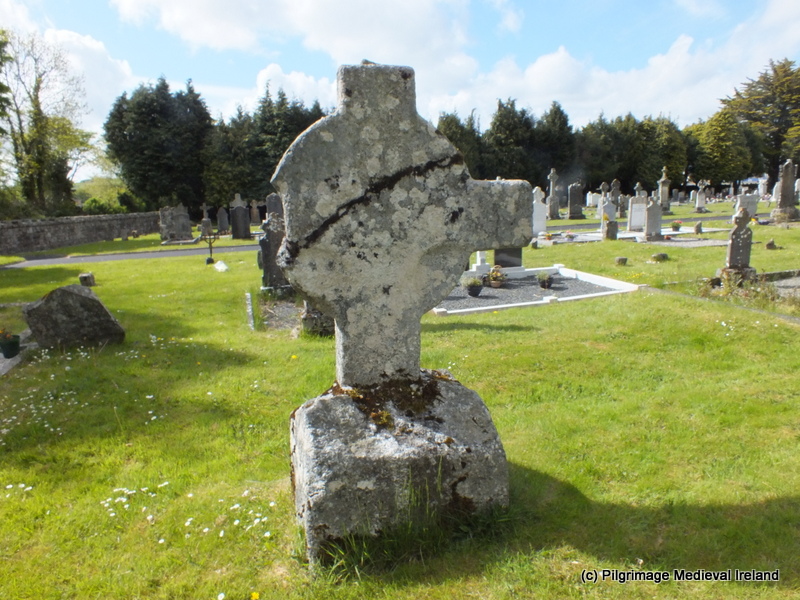
The second cross is broken with one of the arms missing and  is  more squat.

66-DSCF6982

Smaller cross at Blessington

So all in all I had a great weekend and can highly recommend a trip to west Wicklow.

Reference
Corlett, C. 2011.  he abandoned cross at Ballintubber,  Hollywood, Co Wicklow’. Archaeology Ireland, Vol. 25,  No. 2, 26-28.