IHS Monogram/Insiginia on 18th and 19th Century Gravestones

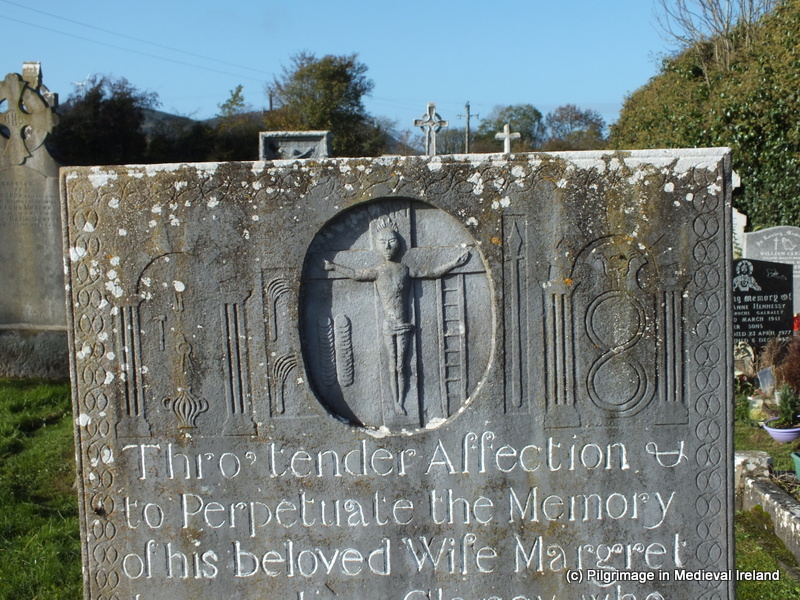
As you know I am a big fan of the current movement to record historic graveyards and the great work being done by  Historic Graves and local communities around Ireland.  I  am amazed by the  many examples of 18th and 19th century  folk art preserved around the country in historic gravestones.

1-20121016_114431

Gravestone from Tubbrid Co Tipperary

The majority of 18th and 19th century gravestones that I have encountered  bear the  monogram IHS at the top of the stone.  I have often wondered about its origins and meaning.  What follows is just some observation on this motif, I intend to delve deeper when time permits.

1-west cork 018

Gravestone with IHS motif from St Olan’s church Aghabullogue Co Cork

What does IHS Stand for ?

The three letters IHS are what is known as a  christogram. This is a  combination of letters that forms an abbreviation for the name of  Jesus Christ.

So IHS stands for the name Jesus.   You might be thinking  how can this be as there is no I or H in  the word.  The answer to the question is that in Greek  the word Jesus is written as ιησους’ it is transliterated as ‘ihsous’ . In Latin the name is written Iesus  and in English Jesus. The insignia ‘IHS’ comes from the Latinized version of the Greekιησους’. IHS, it is the first three letters of the Greek spelling of the Holy Name Jesus. According to the New Advent Catholic Encyclopaedia

In the Middle Ages the Name of Jesus was written: IHESUS; the monogram contains the first and last letter of the Holy Name. It is first found on a gold coin of the eight century: DN IHS CHS REX REGNANTIUM (The Lord Jesus Chirst, King of Kings).

The monogram became popular  after the 12th century when St Bernard  encouraged devotion to the Holy Name of Jesus and  it was widely used in Western iconography. St Bernadino of Sienna (1380-1444), a popular Franciscan preacher,  is said to have placed the monogram on a tablet and held them both  before a crowd of people and  rays  were said to radiate from the sign.   From that time on the IHS  was often depicted in a sunburst.  A number of 18th/19th century gravestones bear this design see photo below.

1-20121010_115430

Rubbing of gravestone from Tubbrid Co Tipperary, note the  IHS is framed in a sunburst

Towards the end of the Medieval period IHS became a symbol  like the Chi-Rho ( Chi-Rho is the Greek letter Χ combined with the letter Ρ represents the first two letters of Christ (ΧΡΙΣΤΟΣ) and it is the most common monogram of Christ).

IHS__Sun_Symbol_Big

IHS within Sunburst at St. Finbarr’s Church in Magheross, Carrickmacross (http://www.carrickmacrossworkhouse.com/index.php/headstones-crests-symbols)

Maere (1910) notes that sometimes

the H appears a cross and underneath three nails, while the whole figure is surrounded by rays.  IHS became the accepted iconographical characteristic of St. Vincent Ferrer (d. 1419) and of St. Bernardine of Siena (d. 1444). The latter holy missionary, at the end of his sermons, was wont to exhibit this monogram devoutly to his audience, for which some blamed him; he was even called before Martin V.  St. Ignatius of Loyola adopted the monogram in his seal as general of the Society of Jesus (1541), and thus it became the emblem of his institute (Jesuits).  IHS was sometimes wrongly understood as “Jesus Hominum (or Hierosolymae) Salvator”, i.e. Jesus, the Saviour of men (or of Jerusalem=Hierosolyma).

In Medieval England the name of Christ was considered powerful protection against demonic agents such as ghosts. ‘It was used apotropaically in England from the end of the 12th century, engraved on material culture in the abbreviated trigram IHS (from the Greek IHCOYC, Jesus)‘(Gilchrist 2008, 126). With this in mind its very interesting that one of four bells made for the west tower of  Ely Catherdral  in 1345-6  by John of Gloucester was named IHS.  Bells were meant to ward off evil and in Germany and parts of Scandinavia  pilgrim badges were incorporated into medieval bell moulds. There are also  examples of IHS  appearing on medieval grave slabs and holy water fonts  in England.

I dont as yet  know how old the use of IHS is in Ireland  but it  most likely  dates to medieval times.

1-20131021_133727

IHS stone at the entrance to the  Augustinian Priory on  O’Connell St Limerick City.

A 17th century example is found at  Augustinian Priory on O’Connell Street Limerick City in Limerick.   The Limerick city Augustinians were originally based in the town of Adare Co Limerick but following the reformation moved into the city and eventually ended up at their current location.

The stone is located on the right as you enter the church from O’Connell St.  As you can see from the photo the insignia is cut in relief on to a rectangular dressed stone. The stone is  not original to the church, according to the Augustinians of Limerick Website.

 The stone is the original lintel stone dated 1633 from the order’s first chapel in Limerick at Fish Lane. The O’Doherty family saved this stone in 1933 when the buildings in Fish Lane were knocked for new houses. The stone was kept in their stonecutting yard until  brought to the attention of the Prior, Fr Vincent Lyons in 1961. Fr Lyons bought the stone and in October 1962, it was inserted into the wall of the church.

1-20131021_133722

IHS stone at the Augustinian Priory Limerick City

The H has a cross extending from it and a heart underneath  which I assume  must represent the sacred heart.

IHS was appearing on  funerary monuments by the early 17th century. One of the earliest example I have come across  from my very limited search was record by Chris Corlett (2012).  He   notes that  IHS  is incorporated into the base of a cross on a stone commemorates a James Grace who lived in nearby Rathvilly (Co. Carlow) and who died in 1605 at Baltinglass Abbey Co Wicklow.

Robert Chapel (2012) records two early 17th century  grave slabs with IHS near Craughwell   in Co Galway, one  at Killogillen ( whoes inscription bears the date 1614)  and the other  at Killora (whoes incription  bears the date dated to 161(?) 9). This design becomes a very common feature of  18th and 19th century headstones. There are likely many other earlier examples but time has not allowed for a more intensive search.

A variant of this motif is the cross coming from the H with  three nails  arranged  underneath. This motif was used in late medieval period and was popularized in the fifteenth century by Franciscans and was eventually adopted by the Jesuits. It also  occurs  on the 18th and 19th century gravestones (see below).

 Father Ryan Erlenbush (2012) in his blog What does IHS stand For? The meaning of the Holy Name of Jesus

After three nails were added under the insignia (together with a cross above), some noticed that the inscription now contained a “V” below the IHS – so that we see IHSV.  In this form it was adopted by St. Ignatius as the symbol of the Jesuits. IHSV was interpreted to mean In Hoc Signo Vinces, “In this sign, you shall conquer”. It was taken as a reference to the victory which Constantine won against Maxentius at the Milvian Bridge on 28 October 312. Before the battle, the future Emperor saw a sign in the sky (probably the Greek chi-rho X-P, the symbol of “Christ”) and heard the words εν τουτω νικα, which is Greek for “In this [sign], you shall conquer”. The phrase was translated into Latin and it was noticed that the first letters of each word added up to IHSV – thus was born the legend that IHS stood for Constantine’s vision and the Christianization of Rome. Most certainly, in the Holy Name of Jesus we shall conquer every enemy – and the last enemy to be destroyed is death itself).

1-20121101_124013

Gravestone with IHS and three nails at Newcastle graveyard Co Tipperary.
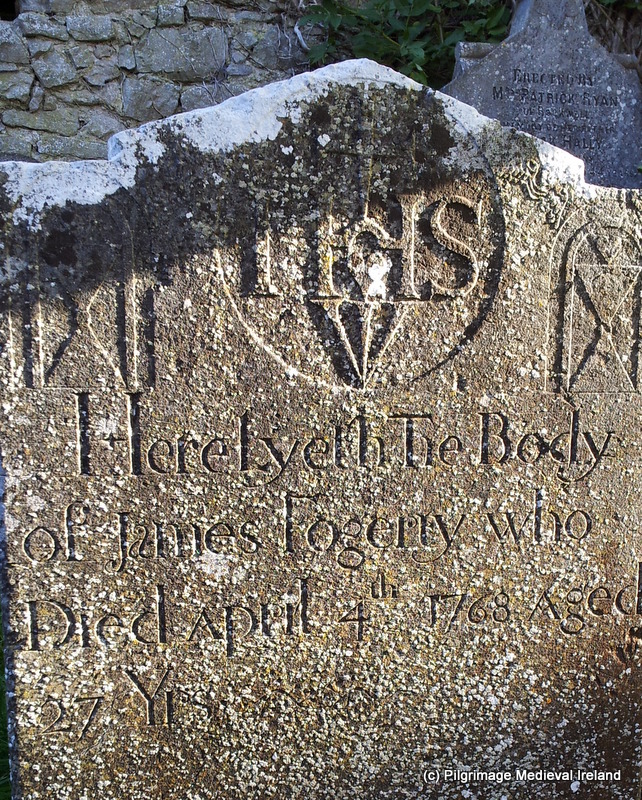
So it seems that the IHS motif has a long tradition in Ireland and the  stonemasons who made these stones  were drawing from a common  Christian tradition and iconography which can be traced back to the medieval period. This is a really interesting  topic and I hope to come back to it again.

References

Anon. Holy Name of Jesus,   at http://www.newadvent.org/cathen/07421a.htm

Chappel, R. 2012.’Workingman’s Dead: Notes on some 17th to 19th century memorials, from the graveyards of Killora and Killogilleen, Craughwell, Co Galway, Ireland. Part II. http://rmchapple.blogspot.ie/2012/04/workingmans-dead-notes-on-some-17th-to.html

Corlett, C. 2012, ‘ The Grace Memorial Stone at Baltinglass Abbey’, http://www.christiaancorlett.com/#/blog/4564514201/The-Grace-memorial-stone-at-Baltinglass-Abbey/3705554

Erlenbush, R. 2012. ‘What does IHS stand For? The meaning of the Holy Name of Jesus’ http://newtheologicalmovement.blogspot.ie/2012/01/what-does-ihs-stand-for-meaning-of-holy.html

Gilchrist, R. 2008. ‘Magic for the dead? The archaeology if magic in late medieval burials’ Medieval Archaeology, Vol 52, 119-159.

Maere, R. (1910). IHS. In The Catholic Encyclopedia. New York: Robert Appleton Company. Retrieved December 7, 2013 from New Advent: http://www.newadvent.org/cathen/07649a.htm

http://www.carrickmacrossworkhouse.com/index.php/headstones-crests-symbols

http://en.wikipedia.org/wiki/Christogram#Western_Christianity

http://www.crosscrucifix.com/glossaryhome.htm

The Princess and the Saint: the visit of Princess Grace of Monaco to Croagh Patrick.

I love old  Hollywood films but  I never thought I would be writing about one of my favourite actresses Grace Kelly  and one of my favourite pilgrim sites Croagh Patrick in the same blog post. Grace was born  on the  12 November 1929, as her surname would suggest she was of Irish decent.  Grace  had a short but successful film career staring in some classic films like High Noon and  Dial M for Murder.  She retired at the age of  26 when she married  Prince Rainier of Monaco.

Grace_Kelly_-_High_Society

Grace Kelly

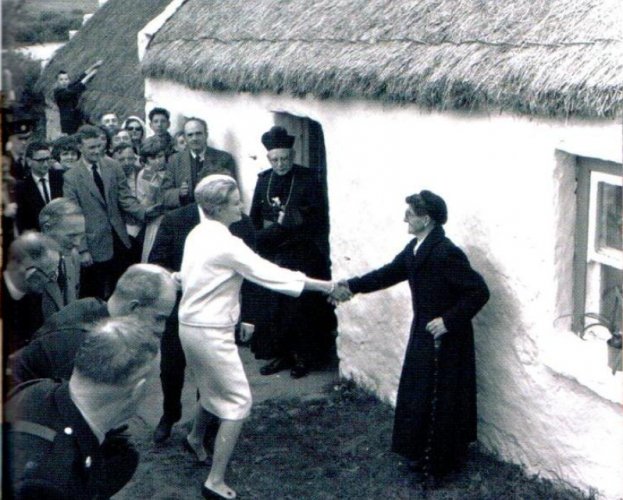
In 1961  Princess Grace and her husband Prince Rainier  came to Ireland.  During the trip they travelled to Co Mayo, visiting the family home place of  Grace’s grandfather John Peter Kelly in the townland of Drimurla, who  left Ireland in 1887 for America.  At the  time of the visit the Kelly homestead was in the ownership of a lady known as the Widow Mulchrone.  According to the Mayo News

For weeks preparations had been made for the special royal visit of June 15 1961. The roof was newly thatched, the hedges cut and the pathway sanded. Dressed in black, and wearing her finest apron, the widow had spent the morning baking griddle cakes and polishing the glassware and good china. Up in “the good room”, which doubled up as the widow’s bedroom, she set the tables with six cups and saucers and bedecked it with a selection of cakes and soda bread. Back in the kitchen a big black kettle hung boiling and hissing over the open fire. According to lore, the widow regaled the royal visitors with stories and, at one point, ordered an on-duty policeman to “wet another cup of tay, the prince could murder another drop”. She even recited a special poem to mark the occasion, which she dubbed the most important day of her life.

princess_grace_newport5-5-623x500

Princess Grace visiting her ancestral home  (http://gracekellyfilmfestival.ie/GKFF_gallery.html#)

During her time in Mayo the princess also made a pilgrimage to  Croagh Patrick, as many of her ancestor had done before her.  Wearing a two piece suit, sun glasses and glamorous headscarf, Princess Grace was one of the most elegant and stylish pilgrims to ever visit the holy mountain.  The photos and film footage of the visit show her  wearing flat shoes and carrying a blackthorn walking stick.  Looking every inch the  Hollywood star she walked  along the laneway  which leads from the modern car park to the statue of St Patrick at the base of the mountain.  The royal couple was followed by photographers, curious local people and members of the  garda síochána.  One can only imagine the excitement of people who lived in the area.

at shrine

Princess Grace praying at the base of Croagh Patrick (image taken http://gracefilm.tumblr.com/post/45526095619/princess-grace-makes-her-way-to-the-shrine-of-st)

The princess  didn’t climb to  the summit of Croagh Patrick  but she prayed before the  statue of St Patrick which stands  at the mountain’s base.  There is fantastic film footage of the event  available on the British Pathé website (the link is below in references).

abeafefb1775bcdec36d9c59ed895122f3c48dfd51b567278a751fd8370b3dbb

Coming down the mountain (image taken  http://gracekellyfilmfestival.ie/GKFF_gallery.html#)

 Princess Grace’s visited Ireland on two other occasions but the this first visit is still remembered fondly in Co Mayo.

References

Ryan, A. 2010. ‘Fairtale Princess Grace dreamed of Mayo Roots’, http://www.mayonews.ie/index.php?option=com_content&view=article&id=12325:fairytale-princess-grace-dreamed-of-mayo-roots&catid=3:news-features&Itemid=29

http://www.mayonews.ie/index.php?option=com_content&view=article&id=12325:fairytale-princess-grace-dreamed-of-mayo-roots&catid=3:news-features&Itemid=29

http://gracekellyfilmfestival.ie/GKFF_gallery.html#

http://www.dailyedge.ie/grace-kelly-and-ireland-543199-Sep2012/

http://www.britishpathe.com/video/princess-grace-makes-croagh-patrick-pilgrimage-aka

Memento Mori in 19th century America: the death of Irish emigrant Mrs Fagan.

I have just been  reading  a very fascinating blogpost by Damian Sheils of the Irish in the American Civil war  about a man called James Fagan.  James who was born in Athlone, he emigrated from Ireland, fought with the  3rd US Infantry in the American Civil War.  As I read through the post,  I came across a fascinating  pieces on the death of his wife which immediately reminded me of the film The Others, where the character  Grace played by Nicole Kidman, finds a ‘book of the dead’ an album of Memento Mori  style  portraits also known as post-mortem portraits, of deceased corpses.

Following his wife’s death,   James  Fagan had a post-mortem photograph commissioned  of her body posed in a coffin.  Although this may sound macabre to modern ears this was at one time a perfectly normal occurrence. Post mortem photography involves the photographing of the deceased, often in their coffins or posed as if sleeping. The corpse was often posed beside living family members.  This practice very popular in Europe and but less so in  America during the 19th century. The body was propped and  eyes opened  all in an attempt to make the corpse life like or positioned to look as if sleeping.   I must confess that  any of the images  of post-mortem photography I have seen  make me uneasy, there is something so sad and heart wrenching but at the same time truly creepy about these photos.

220px-Victorian_era_post-mortem_family_portrait_of_parents_with_their_deceased_daughter

Parents posing with their deceased daughter

These photographs provided family members with a  keepsake and a way   remember the deceased.  Mortality rates were very high for children during this period so these photos were  especially common for  infants and young children, who were posed to look like they were sleeping.   This was often the only image  the parents had of their child and was a treasured possession. According to Wikipediea ‘The practice eventually peaked in popularity around the end of the 19th century and died out as “snapshot” photography became more commonplace, although a few examples of formal memorial portraits were still being produced well into the 20th century‘.

With regards to James Fagan, his wife’s  photo was described in a  newspaper  as follows (taken from blog post by Damian Sheils)

After the death of the first Mrs. Fegan, he employed a photographer to testify to his love for the dead and his respect for his officers. The photograph was taken on a 10 x 14 inch plate, and depicted Mrs. Fegan after death, surrounded by burning candles, with a saucer filled with earth from old Ireland at the head of the handsome coffin in which the remains were. Beside the body, attired in full dress uniform, knelt the sergeant. The expression of his face was untranslatable. The photograph was a mixture of the grotesque, the horrible and the piteous. The sergeant meant it for the best, and spent two months’ pay in having a lot of these souvenirs made, one of which he presented, “in memory of the late Mrs. Fegan with his rispictful compliments,” to each officer of the Third Infantry on duty at Fort Dodge at the time. Few that have seen one of these photographs will ever forget it. Significant trifles of the picture were that the sergeant had on white Berlin cotton gloves and also wore the black leather neck stock.’ (9)

The picture was unusual as James Fagan looked distressed in the photo ‘the expression of this face was untranslatable‘.   Any of the photos I have seen which have living adults the expression on their faces are always solemn but never expressive.  Thus  I can understand how those who saw the photo would ‘never forget it‘ most likely because of Fagan’s expression.

What was also interesting was the fact that a saucer of soil from Ireland was placed at the head of Mrs Fagan’s coffin. It seems that James or his wife when leaving Ireland had brought some earth with them to their new home.  The saucer of earth was most likely buried with Mrs Fagan.  I wonder how many of those who emigrated would have taken  a physical  part of Ireland  within them? The majority who left  Ireland in the 19th century especially around the time of the famine would have had few possession and a piece of soil would have been easy to obtain and pack.  According to the  Irish company Auld Sod Exporting Company who exports Irish soil to America,  many modern Irish emigrants have a desire to be buried with a piece of Ireland . The company’s website notes that it was common for 19th century emigrants to take some soil with them when leaving Ireland.

These customs although strange to the modern world must have brought comfort to the families left behind and were for them a valid way of remembering the dead.

References

Enoch, N. 2013. ‘Morbid gallery reveals how Victorians took photos of their Dead relatives’ http://www.dailymail.co.uk/news/article-2270169/Post-mortem-photography-Morbid-gallery-reveals-Victorians-took-photos-DEAD-relatives-posing-couches-beds-coffins.html

Sheils, D. 2013. ‘Drop the lifinant a curtsey woman the long service of sergeant James Fegan 3rd US Infantry’,  http://irishamericancivilwar.com/2013/11/15/drop-the-liftinant-a-curtsey-woman-the-long-service-of-sergeant-james-fegan-3rd-us-infantry/

http://en.wikipedia.org/wiki/Post-mortem_photography

http://www.auldsodgifts.com/official-irish-dirt

http://www.irishcentral.com/news/Irish-dirt-a-big-seller-in-the-United-States—Dublin-company-cleans-up-with-Irelands-muck-183770191.html

Gravestone recording at Ballylanders, Co Limerick.

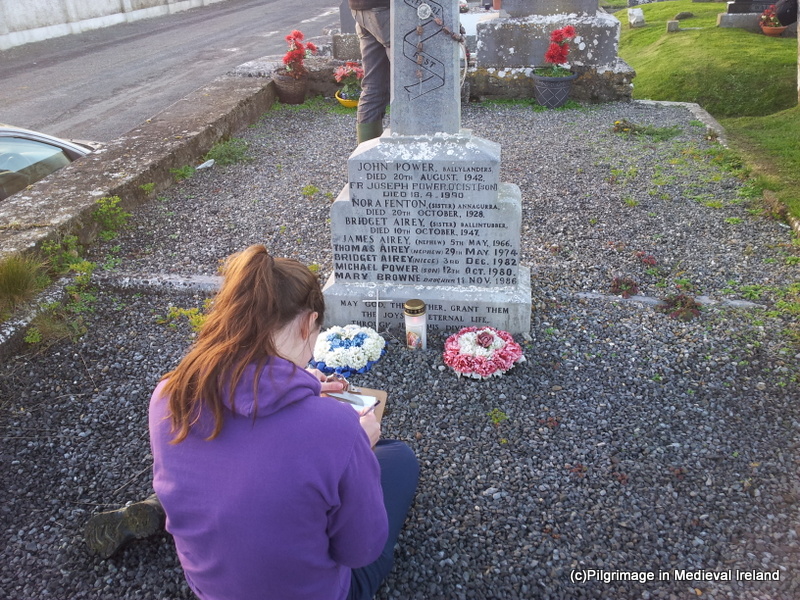
This week  I called up to Ballylanders in Co Limerick, where my good friend archaeologist  Colum Hardy and a team  of local volunteers are recording the historic graveyard known as Ladywell. Colum is employed by the Ballyhoura Development company who are currently recording all of the historic graveyards in the Ballyhoura area. Like the graveyard recording in the Knockmealdown area (NewcastleShanrahan and Tubrid Co Tipperary)   which I have previously written about,  the Ballyhoura project began with community training by John Tierney and Historic Graves in March 2012.  A series of training programmes were put in place in a number of local communities.  According to Colum ‘ With the ongoing and increasing interest and support and dedication from an army of volunteers from the Ballyhoura Region the project has continued with well over 70+ historic graveyards now recorded.’  As the graveyards are recorded the results are placed on the Historic Graves website .  The work from the project has built up a huge genealogical repository of information for the region  and is being availed of by people all over the world who have traced their roots to the area.

1-DSCF3223

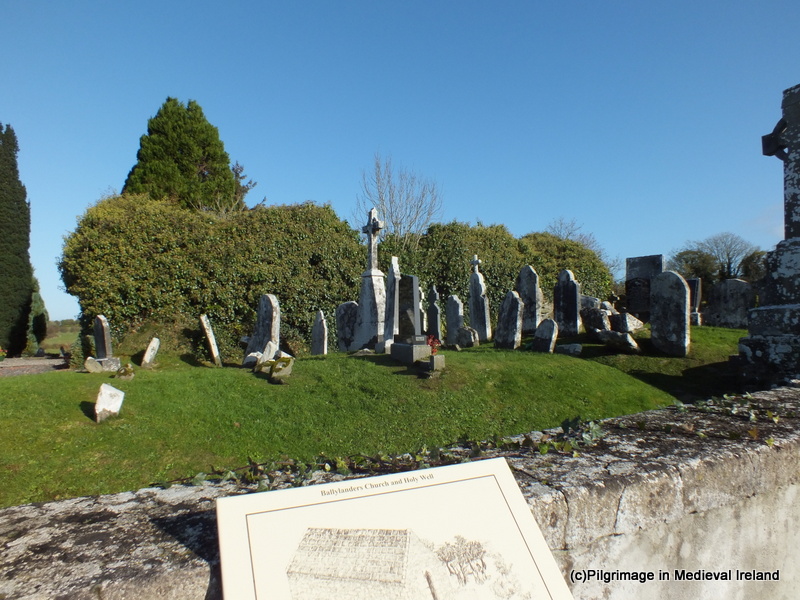
Medieval church at Ladywell,  Ballylanders.

The graveyard surrounds a late medieval church which is now covered in a dense covering of ivy which obscures a pointed cut stone door way and an ogee headed window.  According to the notice board the church is known as the spittle church. Interestingly ‘spittle’ as a placename element usually indicated the presence of a hospital. The townland to the east of the church is called Spittle.

1-limerick today 048

One of the volunteers recording the gravestones.

The graveyard  that surrounds the church has a number of fine examples of 18th and 19th  gravestones. A number of the stones have images of the passion on it.

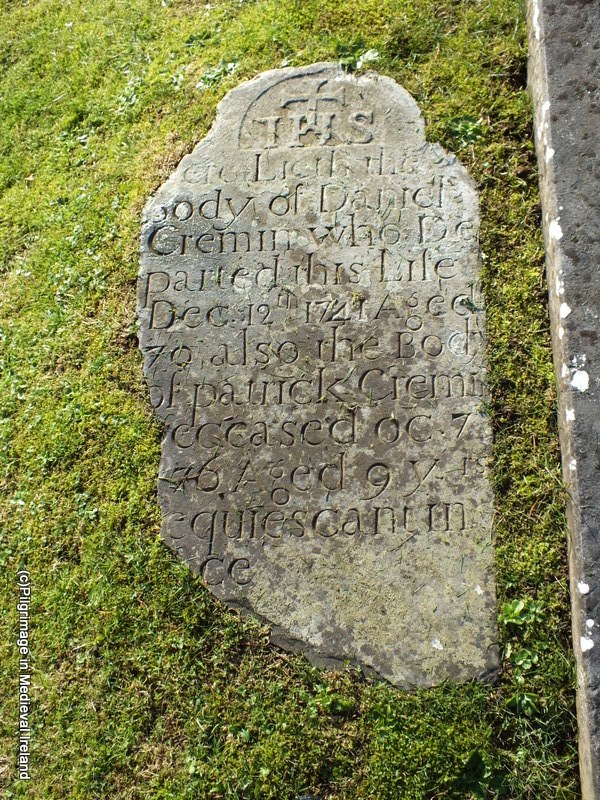
1-DSCF3187One of the  oldest stones is found close to the east gable it is a simple slab with  IHS design with a cross extending from the H. The left side of the stone is damaged but it is still possible to read the inscription.

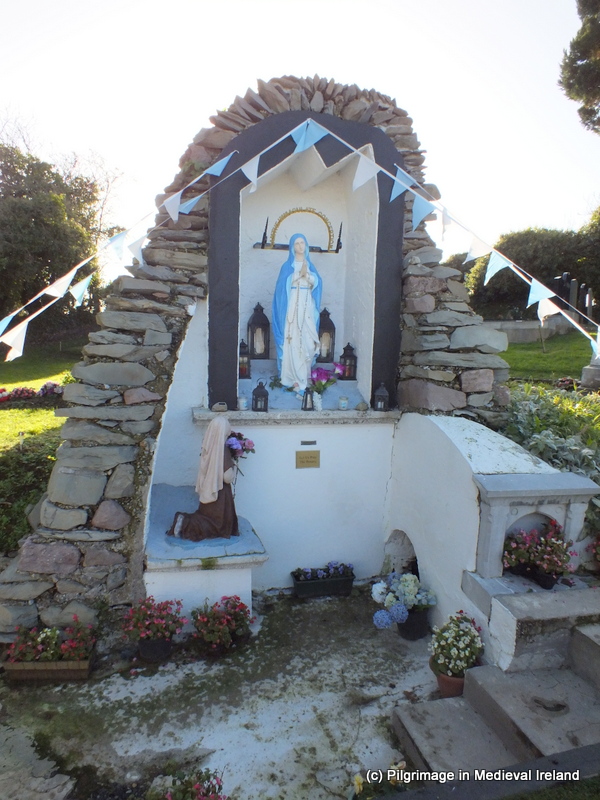
1-DSCF3144This stone record the death of Daniel Cremin who died the 12th of Dec 1741 aged 70 along with Patrick Cremin who  died Oct 7, 1776 aged 9 years.  On the north side of the graveyard is an elaborate grotto which incorporates a holy well.

1-DSCF3136

Grotto and holy well at Ballylanders.

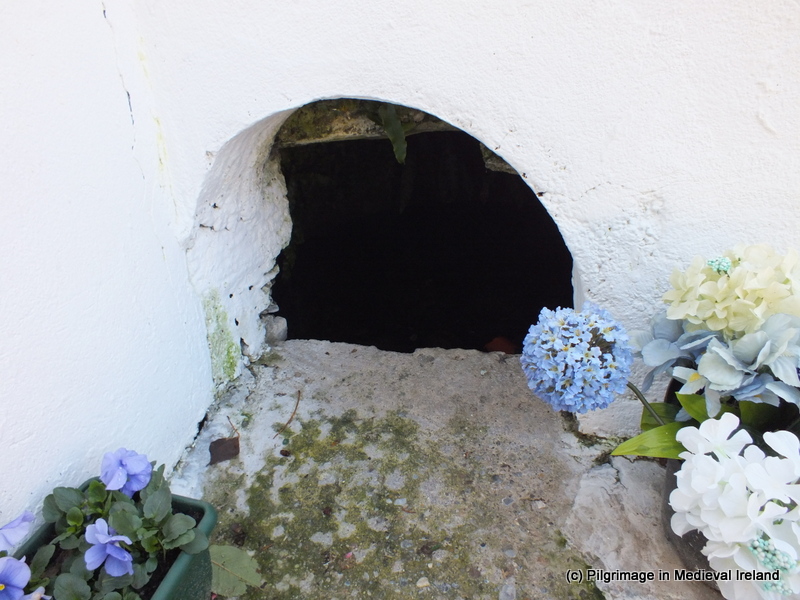
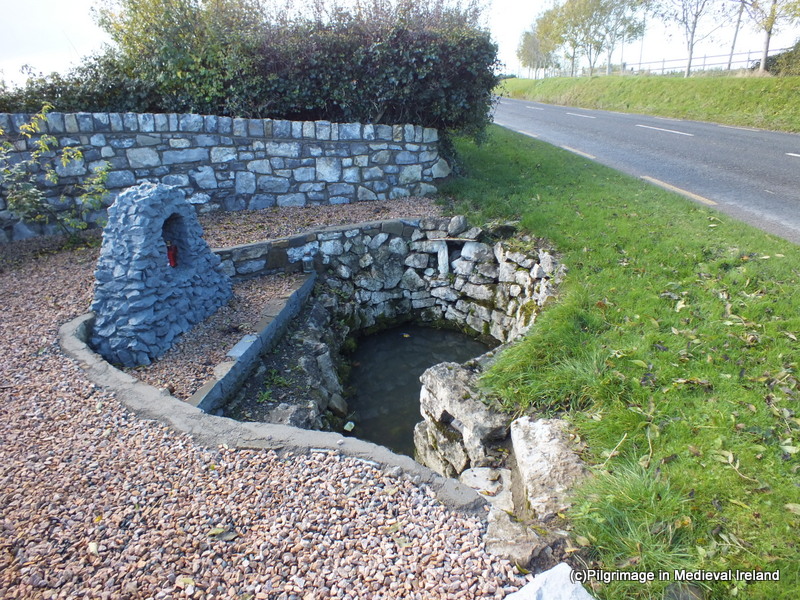
The well is known as  Lady well and is dedicated the Blessed Virgin.  The water from the well is traditionally held to cure sore eyes. According to the notice board at the site, in 1840 a rag tree once stood beside the well.  The well is still visited by local people and a pattern still takes place here on the 15th of August.

1-DSCF3215

Holy well dedicated to the Blessed Virgin  at Ladywell, Ballylanders.

References

http://historicgraves.com/

http://visitballyhoura.com/

List of Genealogical Sources for the area at http://visitballyhoura.com/index.php/2012/06/12/genealogical-resources/

Black Dog Holy Well, Kilmallock, Co Limerick

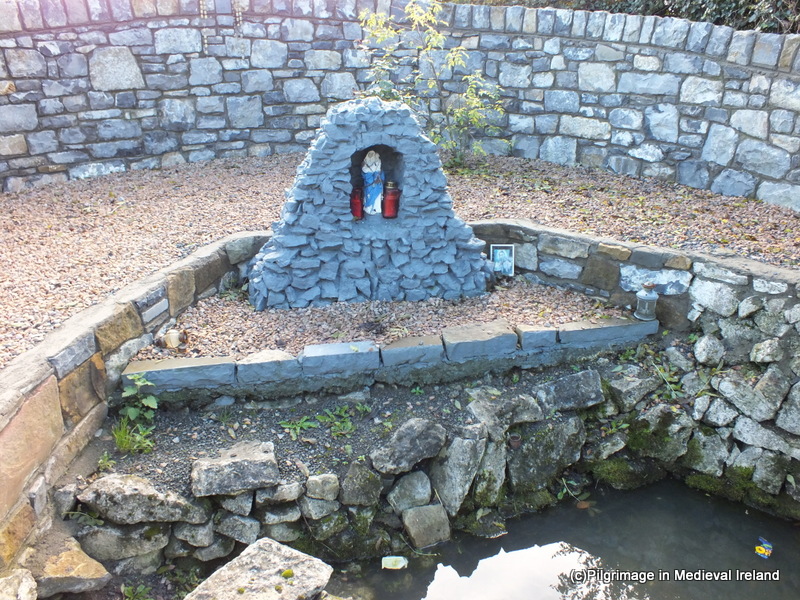
Black dog well is situated on the side of the  Tipperary/ Kilmallock road just on the outskirts of Kilmallock town.  It consist of a  small spring well enclosed by a rough stone wall.  The well is tear shaped and a series of stone steps provide  access at the narrow end.

1-DSCF3258

Black dog holy well, Kilmallock.

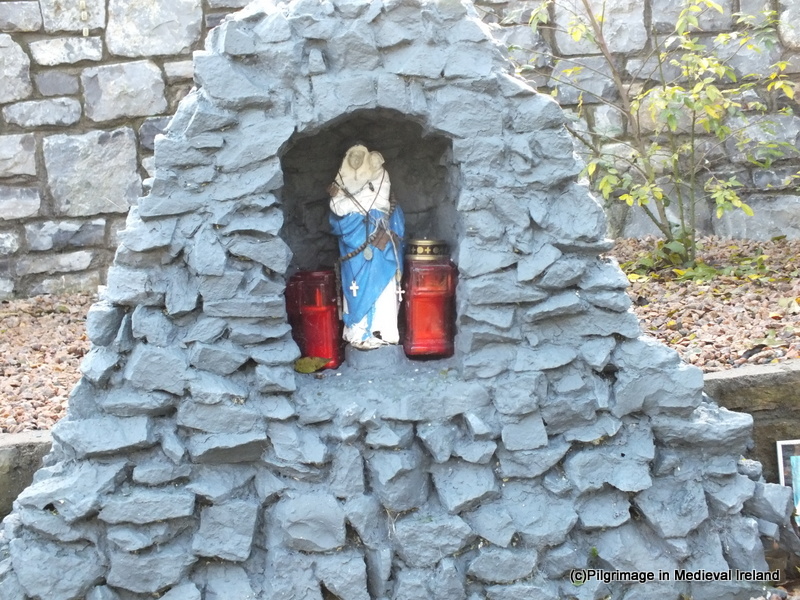
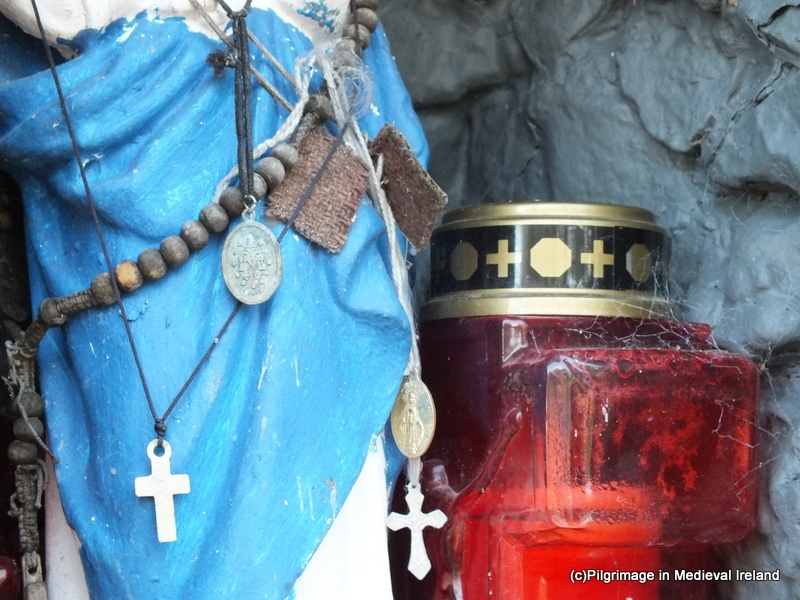
A small grotto with a statue  of the Blessed Virgin and Child is located beside the well.  Votive offerings in the form of immaculate medals, rosary beads and brown scapula are found on top  of the grotto and draped around the statue.  According to the Limerick Diocesan web site, the travelling community  maintained the well.  The area surrounding the well was landscaped last year but luckily there has been little change to the well structure.

1-DSCF3261

Small grotto at Black dog, holy well.

The old name for the well was Tubberidinee, which derived from Tobar Rí and Domhnaigh (The King of Sunday’s well) which must have been an older name for the well. Today the well is known as ‘Black Dog’ holy well, this names comes from a folk tradition that at night a black dog comes out of the well.  According to Ó Danachair, the well was associated  with eye cures and people who were cured reported  seeing eye a trout in the well.

1-DSCF3232

Statue of the Blessed Virgin and Christ child at Black Dog holy well.

Interestingly all the statues at the well suggest an association with the Blessed Virgin but a local man who I met at the well tells me that well is associated with St Brigit.

1-DSCF3242

Votive offering including holy medals and brown scapular.

References

Ó Danachair, C. 1955. ‘The holy wells of Co Limerick’ JRSAI, Vol. LXXV, 193-217.

Seoighe, M. 2012. The Story of Kilmallock. Kilmalock Historical Society.

http://www.limerickdioceseheritage.org/Kilmallock/sitesKilmallock.htm

Irish traditions and the Infant of Prague

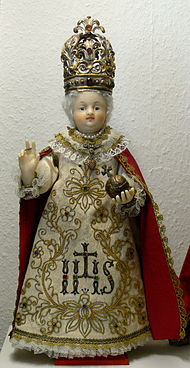
The Infant/Child of Prague is a small wax medieval statue of the  Christ child, adorned in an elaborate robes, housed in the Carmelite Church of Our Lady Voctorious in Malá Strana, Prague.  Copies/reproductions of this statue were at one time  found in the majority of Catholic homes around Ireland.  This little statue was called upon for help to ensure good weather for family occasions such as wedding, communions  and confirmations.  Prague is a long way from Ireland so  how did the tradition of this statue from the Czech Republic arrive in Ireland?

The origins of the statue

The very early history of the statue is obscure but it appears to have been made in Spain and  the Spanish noble woman Isabella Manrique  gifted the statue to her daughter  Marie  on the occasion of her wedding to the Czech nobleman Vratislav of Pernstyn. Later the statue came into the possession of her daughter the Princess Polyxena von Lobkowicz, who in 1628 presented the statue to the Carmelite friars  at the church of the Virgin Mary the Vicorious in Malá Strana, Prague.

190px-Prager_Jesulein_c1870_MfK_Wgt

An early German copy of the statue, note the white wig as opposed to the traditional blonde hair. circa. 1870

During the 30 years war the monastery was sacked and the statue lost.  Some years later in 1638  Fr. Cyrill found the statue on a rubbish  heap  in the ruins of the church. He  placed the statue back in the church and one day while praying before it  the priest  heard the statue utter the words

Have pity on me, and I will have pity on you. Give me  my hands, and I will give you peace. The more you honor me, the more I will bless you.

The statue was later restored to its former state and the damages  such as the loss of its hands, that had occurred over the years, were repaired.   In the ensuing years any miracles were performed  and devotion to the statue grew steadily and spread. Over the years  tiny and very elaborate vestments were given as gifts to the statue. In 1713 the caretakers of the statue began to change the robes of the statue according to the liturgical norms. The statue has a wardrobe of around 100 hundred vestments. In 1913 Pope Pius X established a confraternity to the Infant of Prague and today over 2 million people visit the shrine annually.

Irish devotion and traditions

Devotion to and small replica statues of the Infant of Prague became popular in Ireland in the late 19th to early 20th century in Ireland.  Over the years the statue has become linked to Irish wedding customs. Although there are some variations, most  customs insist on placing of the statue outside  of the brides house under a hedge or bush in the garden to  guarantee  fine weather.  Some people say the statue needs to be outside the church where the wedding is to take place and  others even go so far as to bury it in the garden.  The custom developed from a belief that the statue can control weather. The statue was even used to try to aid  good weather for this years G8 summit by Ferghal Purcell the general manager of the Lough Erne Resort, the location where  the summit was being held.

Navan born actor and former bond star Pierce Brosnan engaged in the custom  for his wedding to Keely Shaye Smith.

We got married in Ballintubber Abbey and held the reception in Ashford Castle, it was August and I remember this old woman telling me we had to get a Child of Prague statue and put it outside the west corner of the building to make sure it didn’t rain. The Child of Prague is a little statue of Jesus dressed as a king and it’s an old tradition to put it out the night before a wedding. So I staggered out after my night out with the lads and many Guinnesses into the gardens of Ashford Castle and found a hydrangea bush and put the statue in it (Taylor 2013).

There is also a tradition that  the power of the statue was strongest if its head has been knocked off  but his had to happen “accidentally”.

1280870_669351933075319_1552199021_n

Headless Infant of Prague photo provided by Maura Wall Barret.

Another Irish tradition was that people would place a coin under the statue  to ensure the house would never be hungry or in want

References

Ferguson, S. 2013. ‘Religious statue believed to guarantee good weather’ BBC News’ http://www.bbc.co.uk/news/uk-northern-ireland-22783440

Taylor, R. 2013. ‘Child of Prague ensures Brosnan’s big day is shaken, not soaked’ Irish Times http://www.irishexaminer.com/ireland/child-of-prague-ensures-brosnans-big-day-is-shaken-not-soaked-232781.html

http://en.wikipedia.org/wiki/Infant_Jesus_of_Prague#cite_note-2

http://catholicheritage.blogspot.ie/2011/10/child-of-prague.html

http://www.navstevapapeze.cz/places/prague/church-of-our-lady-of-victory-infant-jesus-of-prague%5Ben%5D

Halloween and the Feast of All Saints

The modern celebration of Halloween draws on Christian and pagan traditions. The word Halloween derives from ‘All Hallows Eve’, in turn ‘All Hallows’ was  another name for the feast of  All Saints.

All Saints

All Saints is celebrated on the 1st of November within the Catholic  church and commemorates all of the saints and martyrs. The tradition of  commemorating the saints and martyrs dates back to the 4th Century.  In 608  Pope Boniface IV decided to remember all the  martyrs on one special day and the 13th of May was designated as the Feast of All Holy Martyrs.  In 837 Pope Gregory IV extended the festival to remember all the known and unknown  saints . The festival was renamed the Feast of All Saints  and the 1st of November was chosen for the festival.

The Martyrology of Oengus  written circa 800 records the Irish keeping All Saints on the 1st of November but additional  feasts of All Saints of Europe on the 20th of April and All Saints of Africa on the 20th of December. Later the 1st of November became the sole commemoration date for All Saints in Ireland.

In  medieval times the church held a vigil on All Hallows’ Eve. During the vigil  worshippers would prepare for the feast day with prayers and fasting.


The 2nd of November is the feast of  All Souls  a day which commemorates the faithful departed. The feast  began in the 11th century and was connected with Christian concerns with death and purgatory. Later a popular belief developed that the souls in purgatory could  on this day appear  back on earth  to haunt those who had wronged them. The souls would take the form of ghost, witches or toads. (Farmer 2011, 14). It was also believed  one could help the dead  on this day  by giving alms in the form of coins or food (ibid). In Britain a small round cake called soul cake was made and  the cakes were given out to soulers (mainly consisting of children and the poor) who would go from door to door on Halloween,  singing and saying prayers for the dead.

Over time these medieval beliefs were subsumed into the popular customs for Halloween which is  now celebrated on the Eve of All Saints. The modern Halloween is a combination of Christian traditions regarding the feasts of  All Souls and Saints and the pagan festival of Samhain.

An Irish tradition that I remember well from my childhood was the  of lighting a candle in the window on the Eve of All Souls so that the souls could find their way. As a child I remember my grandparents and my mother honouring this tradition.

candel

If anyone is interested in finding out about Halloween tradition check out the blog post  An Irish Halloween by the Silver Voice .

In Ireland, it was tradition to light a candle and place it in the window for each of the departed. In the evening, say your prayers around the candle before – See more at: http://www.irishcatholic.ie/article/celebrating-all-saints-and-souls#sthash.OzRjf7mv.dpuf

References

Falmer, D. 2011. The Oxford Dictionary of Saints. Oxford: Oxford Press.

http://www.bbc.co.uk/religion/religions/christianity/holydays/allsaints_1.shtml

http://www.catholic.org/saints/allsaints/

http://www.ucc.ie/celt/online/G200001.html

All Souls Day is celebrated to honour the faithful departed. – See more at: http://www.irishcatholic.ie/article/celebrating-all-saints-and-souls#sthash.OzRjf7mv.dpuf

Relics on tour. St Anthony of Padua visits Ireland.

Last Thursday the relics of St Anthony of Padua arrived in Ireland. The relics and their caretakers are on a whirlwind  tour of Ireland that takes in Dublin, Wexford, Cork, Limerick, Galway and Belfast, from the 17th  to the 24th of October. Each of these locations  will become centres of pilgrimage for the duration of the relics visit.

anthonypadua

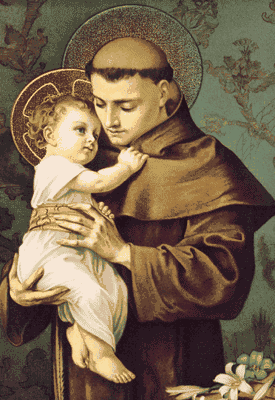
St Anthony of Padua.

Who was Saint Anthony?

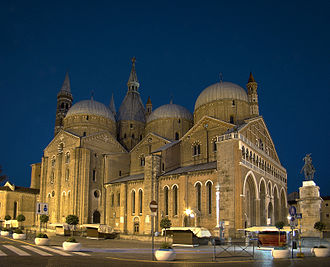
St Anthony  was born in Lisbon in 1195.  At the age of 15 he joined the Augustinians but later  became a  Franciscan Friar. Anthony was a favourite disciple of St Francis of Assisi, the founder of the Franciscans. He was also a great orator and  teacher. He died in 1232 and was buried at Sancta Maria Mater Domini Church outside the walls of the town of Padua. Many miracles occurred at his funeral and continued to occur at his tomb in the months that followed. Due to the great devotion to the saint he was canonized  just a year after his death.  Like many other medieval saints Anthony’s body was exhumed  and in 1263  it was moved to an elaborate tomb in the Basilica in Padua.

330px-Veneto_Padova1_tango7174

St Anthony’s Basilica Padua.

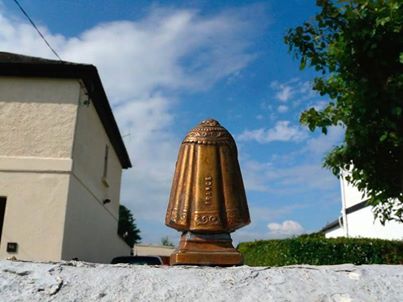
  St Anthony’s relics have come to Ireland  to mark the 750th anniversary of the translation of his relics (the moving of the saints body  from the original grave to a new tomb/shrine)  and the discovery of his incorrupt tongue. St Bonaventure who  presided over the  opening of Anthony’s coffin, discovered that the saint’s vocal organs and tongue were intact. “Oh blessed tongue, that ever praised the Lord and led others to praise Him!” St Bonaventure exclaimed. The saint had been known as a wonderful preacher of the Gospel and it was thought this was why the tongue was still preserved. The relics are said to have worked many miracles and are still venerated to this day.

 St Anthony is  the patron saint of lost things .  I remember as a child when I  or any of my family lost something   my mother would say “pray to St Anthony and he will  find it for you” .  The prayer was ” St Anthony seeks St Anthony finds”.

St Anthony comes to Limerick.

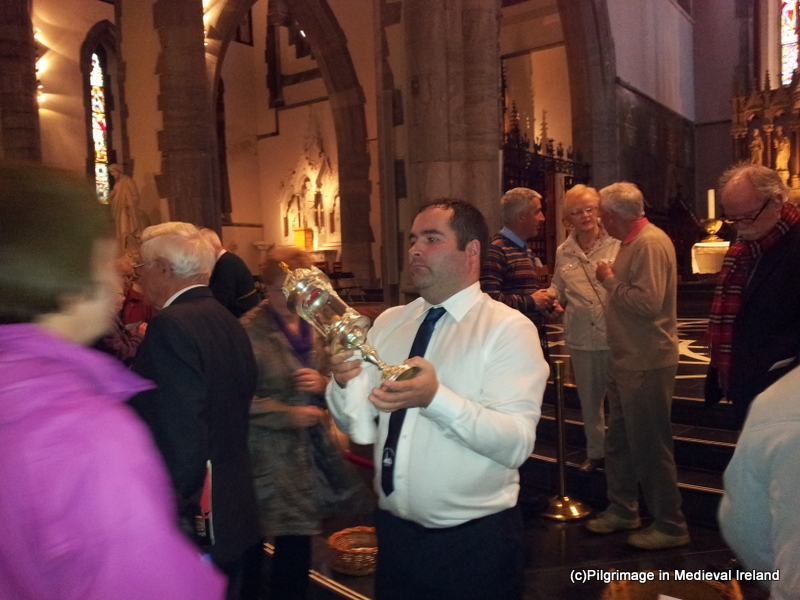
Today for one day only,  the relics of the saint were on display at St  John’s Cathedral in Limerick city.  I headed  along  to see the pageant.  The two relics – a small piece of bone from the Saint’s rib and a layer of St Anthony’s cheek were accompanied by  two  Franciscan Friars also from Padua. Both relics were housed inside two elaborate reliquaries and were displayed in front of the altar of the church.

1-DSCF2823

Reliquary containing the rib of St Anthony.

Today’s pilgrimage began with mass at 10am. Fr Mario Conte, the international editor of the Messenger of St Anthony magazine , gave a sermon on the relevance of relics in today’s church and he also discussed the importance of St Anthony. The relics remained on display for the rest of the day, and following the mass, hundreds of devotees, lined up throughout the day  to  venerated the relics.

1-S0232818

Pilgrims waiting to see the relic’s of St Anthony.

As I watched the pilgrims approach the relics I was struck by the similarities between these modern pilgrims and  the descriptions I had read  of medieval pilgrims at  European shrines.  Medieval pilgrims did their best to get as close to the saints’ relics as possible and if permitted  they would touch and kiss the relics of the saint. Pilgrims also liked to take away secondary relics known as  Brandea,  pieces of cloth, usually linen, that had touched  the saints relics.

800×600

1-DSCF2913

Pilgrim kissing the reliquary of St Anthony.

 The  Limerick faithful formed an orderly queue up the central aisle of the church. When the pilgrims reached the relics they touched or  kissed the reliquary.  Some pilgrims  brought pieces of cloth or rosary beads  with them and pressed them against the relics, creating secondary relics, that they then took away with them as mementoes of their pilgrimage. A modern twist on this pilgrimage was the use of mobile phone to take photos of the relics as a memento.

1-st anthony relics limerick 057

Reliquary containing the saints flesh.

The relics will now travel to Galway city where they will be on display  tomorrow. From Galway they will travel to Dublin and then on to Belfast before heading back to Italy via Britain.

Reference

http://www.advertiser.ie/galway/article/64492/st-anthonys-relics-to-visit-galway-cathedral

http://en.wikipedia.org/wiki/Basilica_of_Saint_Anthony_of_Padua

In search of a cure: the pilgrimage of James Shee to Lady’s Island, Co. Wexford in 1694.

The 17th  and 18th centuries in Ireland were a very interesting time in the history of Irish pilgrimage. Society experienced many changes, the Catholic religion practised by the majority  became second to Protestantism the new religion of the state. It was a violent time of political upheaval and social change in which various conflicts culminating with the Cromwellian conquest  of  1649-53, and the later Williamite Wars  of 1689-91, resulted in a major shift in the social structure of Irish society, with the Irish catholic aristocracy being largely replaced by a new English protestant ruling class.  Additionally churches and monasteries were dissolved, as were the monastic orders who controlled them, continuing the work of the reformation initiated by Henry VIII in the 16th century. State laws were imposed to curtail the religious freedoms of those who did not follow the state religion. Monasteries and churches were stripped of their valuables and many of the precious relics of the medieval period such as the Bachall Íosa or the miraculous statue of Our Lady of Trim were destroyed by iconoclasts. During the medieval period  the majority of pilgrim sites were controlled by religious orders but  following the dissolution the church often had little input into how the  sites  were accessed. Pilgrimage in  a sense now came to be  controlled of the pilgrims. Pilgrim rituals adapted and changed  to these new circumstances, becoming more fluid and less formal. Despite the efforts of  the State to suppress pilgrimage, the practice continued and in some cases thrived at a local and regional level.

One of the more interesting stories of pilgrimage from this period is found in the papers relating to the Power Shee family in the National Library of Ireland.  Within these records are the papers of Mary Kennedy (1733-1784) whose maiden name was Shee. Mary transcribed a list of family births and deaths from her father William Shee’s prayer-book. The original list was written by William Shee (1694-1758) and his father, James Shee (1660- 1724) of Derryhinch/Derrynahinch Co Kilkenny.

Mary’s grandfather James was born in Derryhinch/Derrynahinch in 1660 to William Shee and Ellen Rothe. Both William and Ellen were descendants of prominent Kilkenny Merchant families. James began a tradition later  continued by his son William of recording important life events in his prayer book. The list began with the date of James marriage to Mary Trapps (1660-1706) on the 25th of May 1684 (Ainsworth & MacLysaght 1958, 250). He subsequently recorded the birth of their children.  Their first child William was born Friday the 8th of May 1685 but died sometime later. A second son George was born on the 11th of April  1686,  the following year a daughter called Ellen was born ‘…Saturday the last of December 1687 between 7 and 8 in the morning.’  Elizabeth was born in June 1690 and a son Henry on  the 13th November 1691. Another son who was also called William was born  in 1693.  In the prayer-book James writes the child  was taken very ill on the  20th of March 1693 and wrote ‘I promised to make him a Church man if I found he had vovation’ but the  boy died on the 8th of May the following year. Shortly after the child’s death another boy child was born in 1694 and he was christened  William (Ainsworth & MacLysaght 1958, 250-251).

Some time in 1693/94  he writes

My daughter Ellen being very ill, I promised to make a pilgrimage to Our Lady’s Island, in honour of Our blessed Lady. This performed’ (Ainsworth & MacLysaght 1958, 250

Having lost two children James and his wife must have been very frightened for Ellen. We do not know what sickness the child had but  the mortality rate for children was very high in 17th century Ireland. James and his wife are likely to have been able to afford medical care but as there had been few medical advancements since medieval times medical intervention had limited success. The death of children from what are today preventable and curable illnesses was a harsh reality for parents rich and poor.The decision for James to undertake a pilgrimage and to turn to the Our Lady for help is very understandable in the context of the time. Throughout the medieval period and up to early modern times there was a very strong belief that many diseases were caused by divine intervention. There was also a very strong belief in the power of the saints to heal and certain pilgrim sites were known for their healing powers. Even today there are holy wells around the county held to have the power to cure ailments related to certain parts of the body such as eyes, skin, and limbs etc. that still attract pilgrims in search of a cure. Vows of pilgrimage undertaken in times of crisis were common throughout the medieval and post medieval period.  Additionally it was not uncommon a person to perform pilgrimage on behalf of a loved one who was too ill to travel.

James’s daughter Ellen was 6 or 7 years old when she fell ill and was too young and sick to undertake a pilgrimage on her own, so it was logical that her father would go on pilgrimage on her behalf.  Lady’s Island was located in the southeast corner of Wexford in the barony of Forth and Bargy some 80km from Derryhinch. During the 17th century a unique dialect of old English called Yola  was widely spoke by the inhabitants of this area of Wexford. The language of the area would have been difficult to understand for outsiders like James.  The journey to and from Kilkenny would have taken a few days to complete.  So why would James have travelled here?

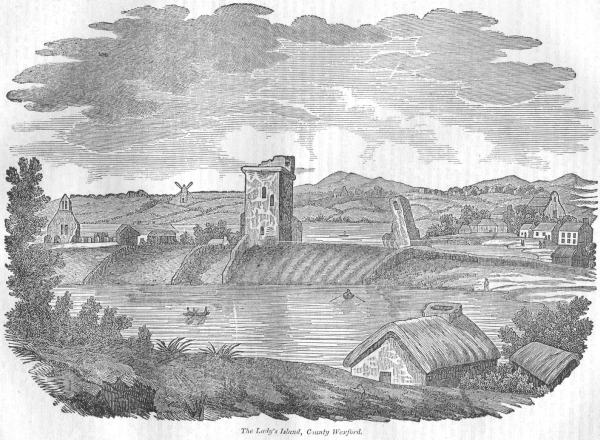
LadysIslandDPJ1-30

Lady’s Island 1833 taken from The Dublin Penny Journal, Volume 1, Number 30, January 19, 1833

Lady’s Island  is still an active pilgrimage site today.  Tradition holds it has been a place of pilgrimage from the 6th century and it continues to attract pilgrims to this day. For the purpose of this post I will only focus on the evidence for pilgrimage here in the 17th century.

During the 17th century Lady’s Island was a pilgrimage site of regional importance. In the early 1607 Pope Paul V issued a plenary indulgence to all who visited here on the Feast of the Nativity of Our Lady (8th September) and on that of the Assumption (15th August).

Lady’s Island was also  known as a place of healing. An account of the island written in the 1680’s  states of the island

a church, builded and dedicated to the glorious  and immaculate virgin Mother; by impotent and infirme pilgrims,  and a Multiude of persons of all Qualities from all provinces  and parts of Ireland, daily frequented, and with fervent devotion visited, who, praying and making some oblacions, or extending charitable Benevolence to Indigents there residing, have there miraculously cured of grievous Maladyes, and helped to the perfect use of naturally defective Limmes, or accidentally enfeebles or impaired Sences.  (Hore 1862,  61)

Given the site’s status and its association with healing it makes sense that James would come here. Unfortunately he does not record anything of this pilgrimage other than it was completed. Given that the saints power was held to be at  its strongest on the saints feast day its likely. if timing permitted, that the pilgrimage would have tried to target one of the Marian feast days.

According to Colonel Solomon Richards, writing in 1682, the ‘most meritorious’ time to visit Lady’s Island was  between the 15th of August and the 8th of September (Hore 1862, 88)

Richards also describes the ritual practice of the pilgrims and we can assume that James completed his pilgrimage in one of the manners described below:

And there doe penance , going bare-leg and bare foote, dabbling in the water up to the mid leg, round the island. Some others goe one foote in the water, the other on dry land, taking care bot to wet the one nor to tread dry with the other. But some great sinners goe on their knees in the water around the island and some others that are greater sinners yet, goe three times round on their knees in the water.

1-DSCF1002

Modern pilgrims walking along the edge of Lady’s Island

According to Richards the pilgrimage culminated with the making of offerings at the chapel on the Island. This was most likely the ruined medieval church.

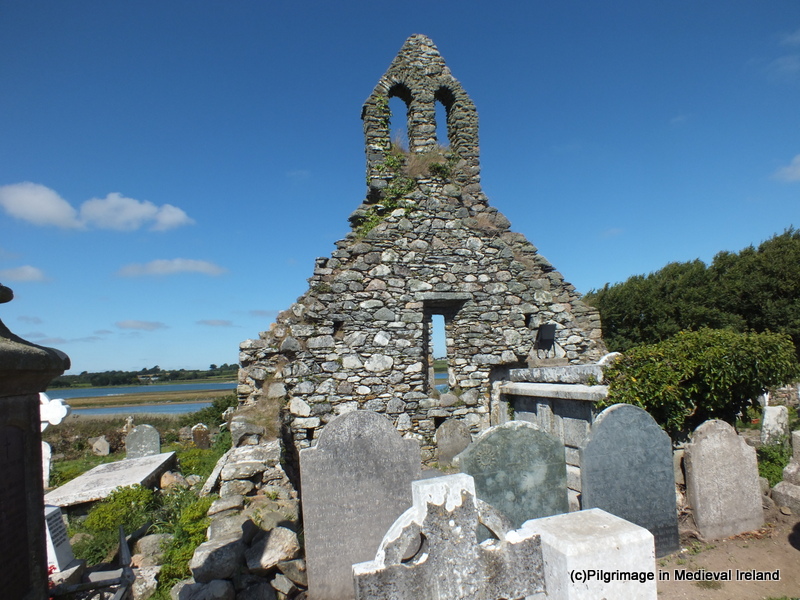
1-DSCF0869

Ruins of the medieval church on Lady’s Island

Having completed his pilgrimage James would have returned home. Ellen recovered from her illness and lived to adulthood  and is recorded to have married William Mulhall. James continued to write the births and deaths of his family in his prayer-book and following his death in 1724 the tradition was continued by his youngest child William.

James and Ellens story is one that was paralleled in medieval times and even modern times, and shows how a father was prepared to do all that he could to save his child .

References

Ainsworth, J. & MacLysaght, E. 1958. ‘No 20, Survey of Documents in Private Keeping:Second Series’ Analecta Hiberbica, Vol. 1, 3-361; 363-393

Church Records pertaining to the Shee family at http://records.ancestry.com/James_Shee_records.ashx?pid=52588493

Gillespie R. 1997. Devoted People. Manchester: Manchester University Press, 90-91.

Hore, H. 1862. ‘Particulars Relative to Wexford and  the Barony of Forth: By Colonel Solomon Richards, 1682.’ The Journal of the Kilkenny and South-East of Ireland Archaeological Society, Ser. 2, Vol. IV, 84-92.

Lady’s Island, County Wexford, in 1833. http://www.libraryireland.com/articles/LadysIslandDPJ1-30/index.php

Lady’s Island website http://www.ourladysisland.ie/

National Library Manuscripts. Reference #32383: Power O’Shee Papers (from 1499), the property of Major P. Power O’Shee, of Gardenmorris, Kilmacthomas, (now in the National Library of Ireland), relating to the families of Shee of Sheestown, Co. Kilkenny and Cloran, Co. Tipp., and Power of Gardenmorris. XX (1958).

.

19th century Folk Art at The Famine Warhouse in Ballynagarry Co Tipperary

Last Saturday I visited the  site of the 1848  Ballingarry Famine Warhouse a two storey farm-house in the wilds of east Tipperary. It gets the name warhouse as it was the location of  the principle scene of action in the 1848 Young Irelander rebellion. A visit to the house is a must for anyone interested in this period of Irish history. The exhibition is very well done and it is  free entry too.

1-phome 026

Ballynagarry Warhouse

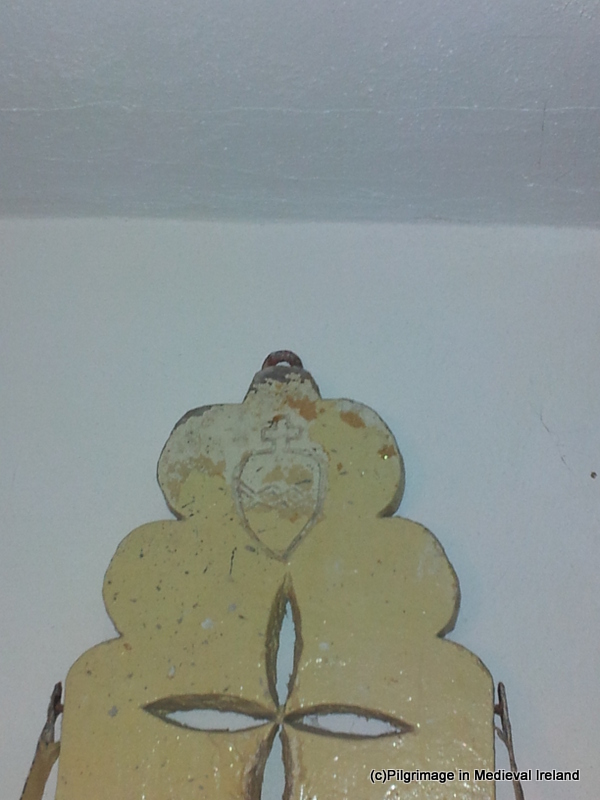
I am very interested in Irish folk art especially  art relating to personal devotion in the 18th-19th century. As I wander around the exhibition within the  house, I came across  a small wooden plaque sitting above the fireplace now painted in a thick yellowish paint. The plaque has a cross design with a hand craved image of the the sacred heart above it.   It has two tin metal straps on either side that were originally used to  attach it to a wall. There is also a loop  at the top which may also be  have been used for attachment to a wall. At the base there is a strip of timber with nails which appears to be a more recent addition. 1-phome 031

According to the tour guide this  plaque was found within the house during renovations but its original location within the house is unknown. This piece likely dates to the late 19th early 20th century and it is an example of devotional folk art.

1-phome 033

Incised sacred heart at Ballynagarry

Similar type artefacts were  found in vernacular house around the country during the 19th -early 20th century unfortunately few survive today.

References

http://ballingarry.net/warhouse/index.html