On a recent visit to Tyressspass I stumbled across a roadside holy well dedicated at the edge of the village on the side of the L1024 Killavally road.
The holy well, like the parish church, is dedicated to St Stephen, a rare dedication for an Irish holy well.
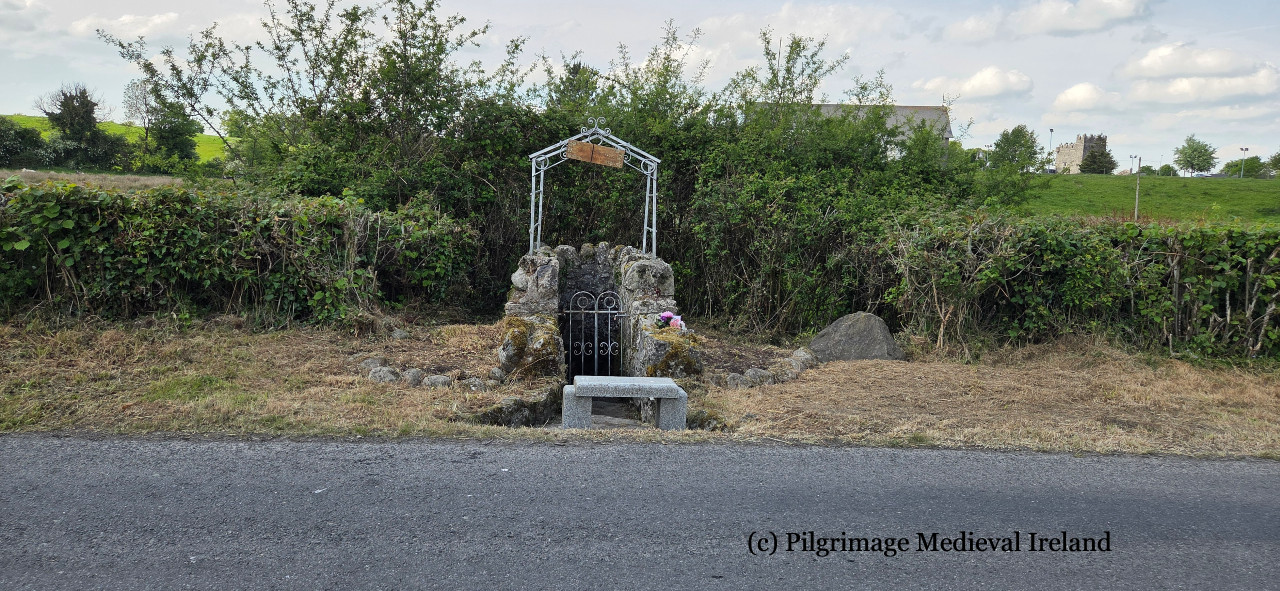
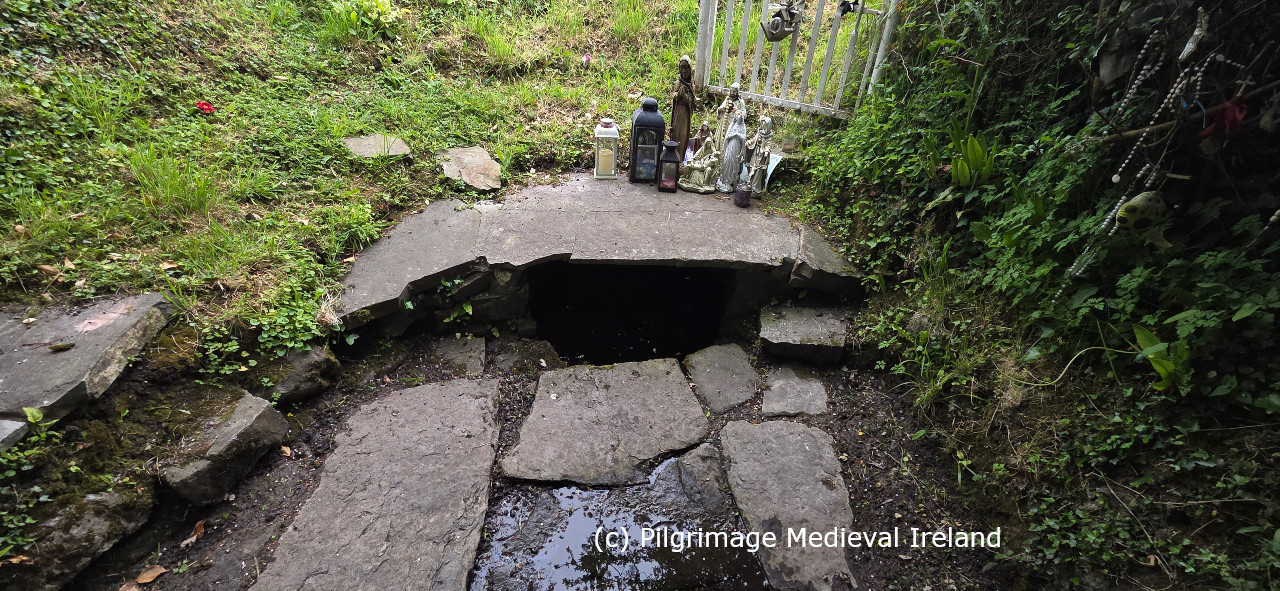
St Stephen’s Holy Well, Tyrellspass, Co. Westmeath
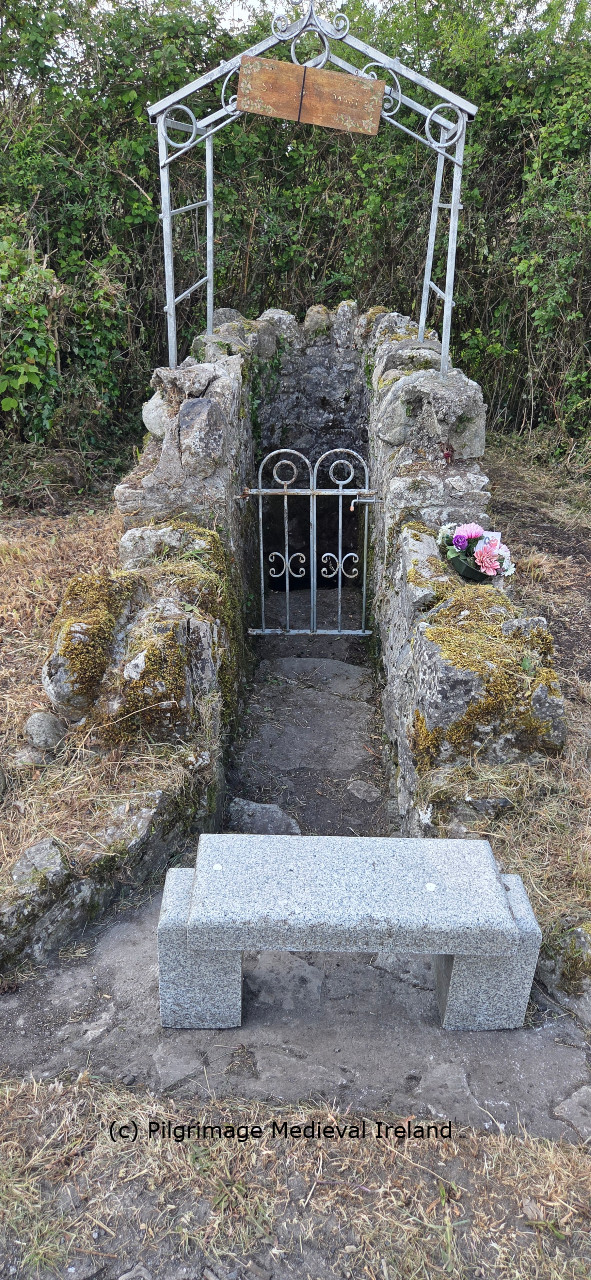
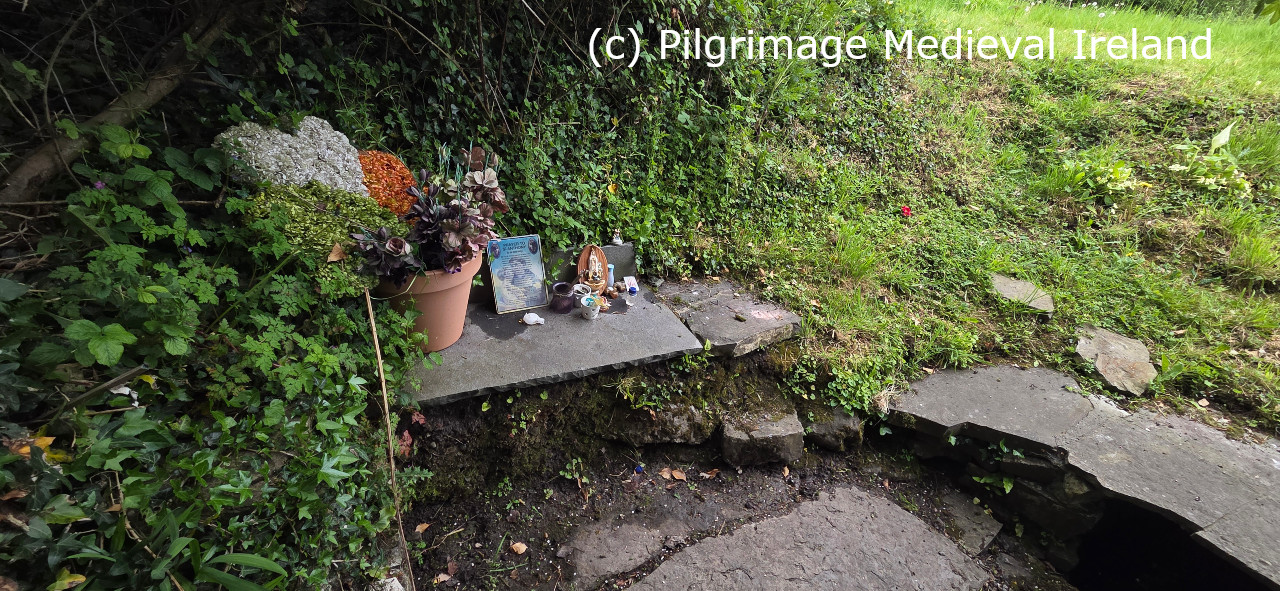
The well is a natural spring that is now defined by circular stone wall. The upper section of the well is incorporated into a U-shaped enclosing wall, part of which shows signs of more recent rebuilding.
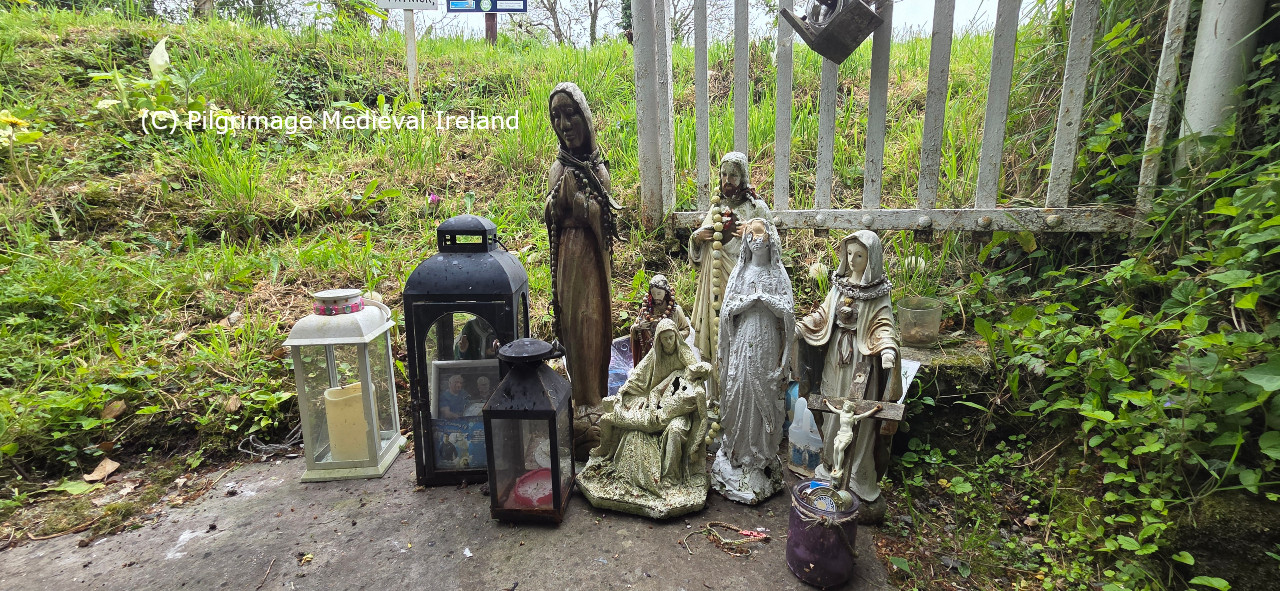
St Stephen’s Holy Well, Tyrellspass, Co. Westmeath
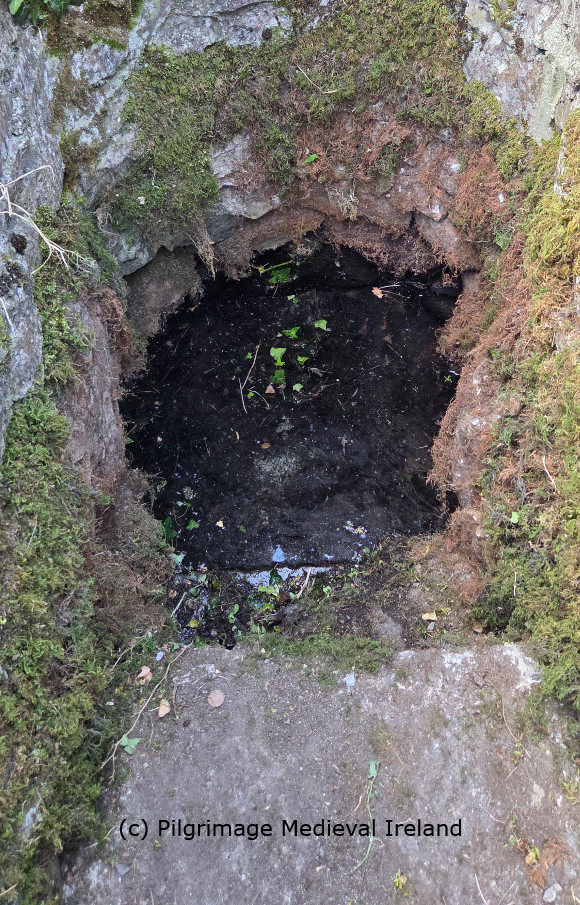
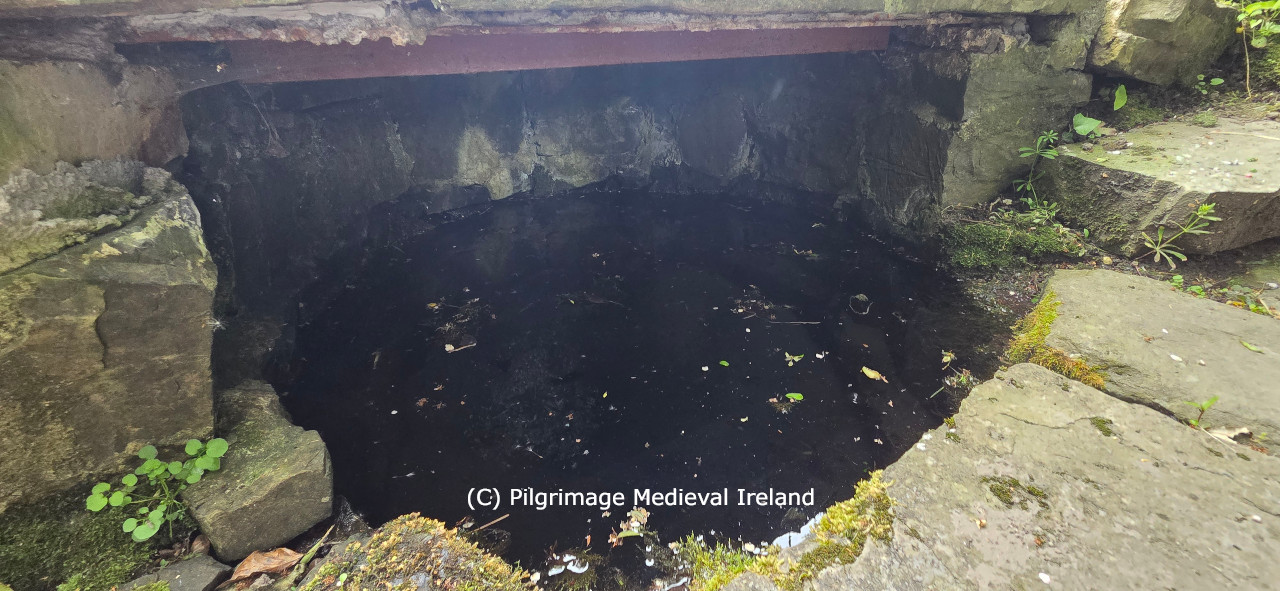
The interior of the well accessed through a small metal gate and several steps that lead down to the water.
Interior of St Stephen’s Holy Well Tyrellspass Co. Westmeath
I’ve not been able to find any information on the well’s history but if you find yourself in Tyrrelspass to take the time to visit this charming holy well.
This short blog is about St Patrick’s holy well, at Ardrass Upper, in Co. Kildare, a lovely well that I stumbled across one rainy Sunday on my way to Dublin.
This roadside holy well, is easy to miss being located on sharp bend on the R403 road to Celbridge. Parking is just about possible at the entrance to the well.
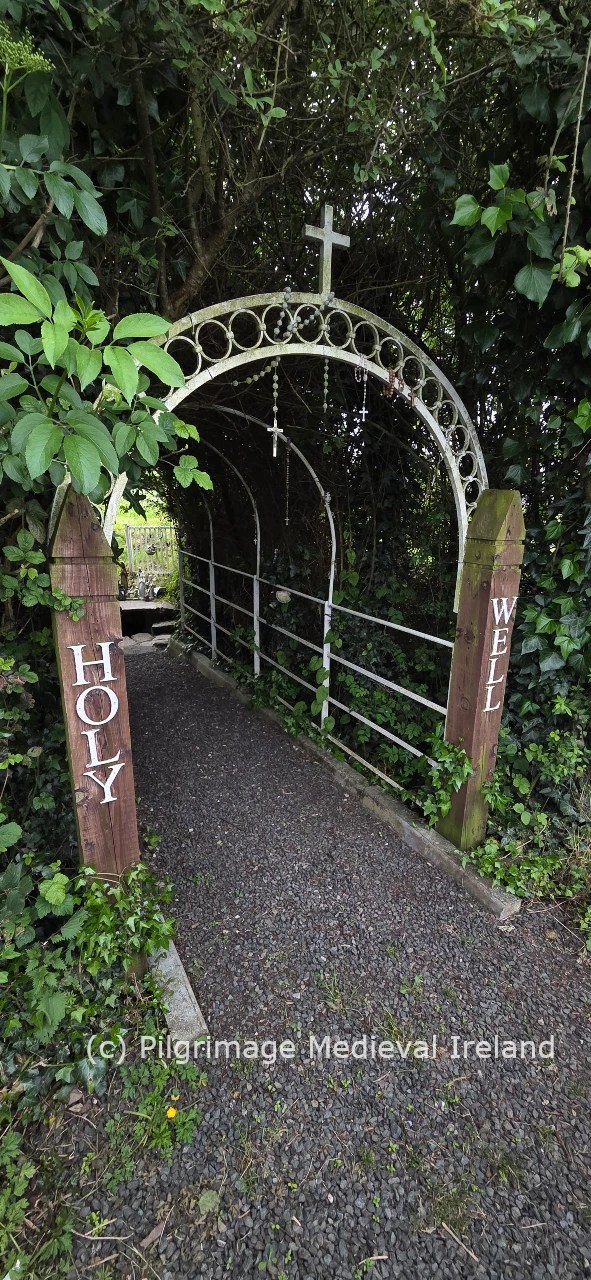
The holy well is accessed via a small gravel path framed by a metal arch that leads to an open space.
Entrance to St Patrick’s holy well, at Ardrass Upper, Co. Kildare.
The well is a natural spring that sits within a ciruclar stone lined depression, covered by a large flagstone. The area infront of the well is also paved with flat flags.
St Patrick’s holy well, at Ardrass Upper, Co. Kildare.
Like many Irish holy wells, it is difficult to know how long the well has been venerated. There are few historic records. The well is not marked on the 1st edition Ordnance Survey 6-inch map of 1839. It is record on the later 25-inch Ordnance Survey map of 1910 as St Patrick’s holy well. Interestingly this map records the hill directly behind the well as St Patrick’s Hill. The 25-inch Ordnance Survey map also records a circular feature called St Patrick’s Bed close to the summit of the hill. This map suggests a larger pilgrim landscape once existed here. The antiquity of this landscape is tentatively strengthened by the presence of a medieval church dedicated to St Patrick which sits within an earlier ecclesiastical enclosure, located 300m to the southwest.
Like many pilgrimage sites St Patrick’s holy well, at Ardrass Upper, went through an ebb and flow of popularity. Pilrimage is now focused solely on the holy well. The Holy Wells of County Kildare A pilgrimage to the sacred sites of County Kildare 2023 notes the well was ‘found to be dirty in 1979’. Today the well is clearly cared for and evidence of pilgrimage is also present, represented by several rosary beads tied to the metal arch, along with lanterns and holy statues including one of the Pieta sitting on top of the flag that covers the well.
Votive offerings at St Patrick’s holy well ArdrassVotive offerings at St Patrick’s holy well Ardrass
The earliest written record of the well is found in the Ordnance Survey Letters Kildare 1837-39, where the well is named. The text unfortunately provides no other details about the well or the pilgrimage (Herity 2002, 14).
Interior of St Patrick’s holy well
Fr. J. F. Shearman in his article ‘Loca Patriciana: An identification of localities, chiefly in Leinster, visited by Saint Patrick’ notes the St Patricks well was
still frequented by pilgrims who hang up votive offerings of rags on an ancient thorn which overhangs the well. (Shearman 1874-5, 306).
The folklore collections schools essays for Clane (Pres. Convent)
“At Ardrass near Straffan there is a holy well named Saint Patrick’s well. Old tradition says if you pay three visits to the well you get cured of your illness. Some leave medals, pennies and even pieces of string in thanksgiving. These can be seen hanging on the bushes over the well even to the present day.” The Schools Collection, Volume 0773, Page 478
For anyone planning to visit the holy well be careful when parking and getting in and out of your car as the R403 road which leads to the town of Celbridge a commuter town, is very very busy.
References
Giacometti, A. and Boazman, G. 2023. Holy Wells of County Kildare. A pilgrimage to the sacred sites of County Kildare 2023. Kildare County Council.
Herity, M. ( ed . ) 2002,, Ordnance Survey letters Kildare letters containing information relative to the antiquities of the county of Kildare during the progress of the ordnance survey in 1837 , 1838 and 1839. Dublin , Fourmasters Press
Sherman, Rev. J. F. 1879.’LOCA PATRICIANA.-No. VII.-ST. PATRICK’S VISITATIONOF LEINSTER, DRUIM URCHAILLE, NAAS. BAPTISM OF IOLLAN, AND OILILL, &c. FORACH PATRICK. THE SONS OF LAIGHIS FIND. THE UI-ERCAN, &c. VISITS HY-CINNSELACH. BAPTISM OF CRIMTHAN AT RATHVILLY, VISITS DUBHTACH AT DOMNACHMORE MAGH CRIATHAIR.’ The Journal of The Royal Historical and Archaeological Association of Ireland: Originally Founded as The Kilkenny Archaeological Society in the Year M.DCCC.XLIX. Vol. III Fourth Series, 279-206.
Doon holy well is one of the most popular wells in Co Donegal. The well
…..was established by a Lector O’Friel who is reputed to have lived in the Fahans area and had remarkable curative powers. When the locals asked him what they would do once he was gone from them, his answer was the creation of Doon Well. According to tradition, he was supposed to have fasted for 18 days and on each of these days he walked from Fahans to Doon a distance of some four miles. On the 18th day he blessed the well promising that if the people believed in the holy water then they would receive the same cures and blessings that he had imparted to them. According to local tradition it was a Fr. Gallagher in the 1880’s who blessed the well and he is still prayed for as part of the turas.
The schools collection record a similar origin story in the 1930s.
The well was founded by Father O’Friel about thirty years ago, and it was blessed by Father Gallagher. When any person goes to Doon well, they have to say one our father and one hail Mary for the intentions of these priests. It was people named Gallagher’s who put the shelter around it. When we go to Doon well, we have to go to the people that are in charge of it and get a penny ticket from which to say the prayers.
Doon well is situated in the front yard of a farm house. The holy well is covered by a small stone walled rectangular structure, with a large flat flagstone roof. The area around the well is paved and a series of steps provide access to the interior of the well. The well and its surrounding are very well maintained.
Doon holy well photo taken in 2016
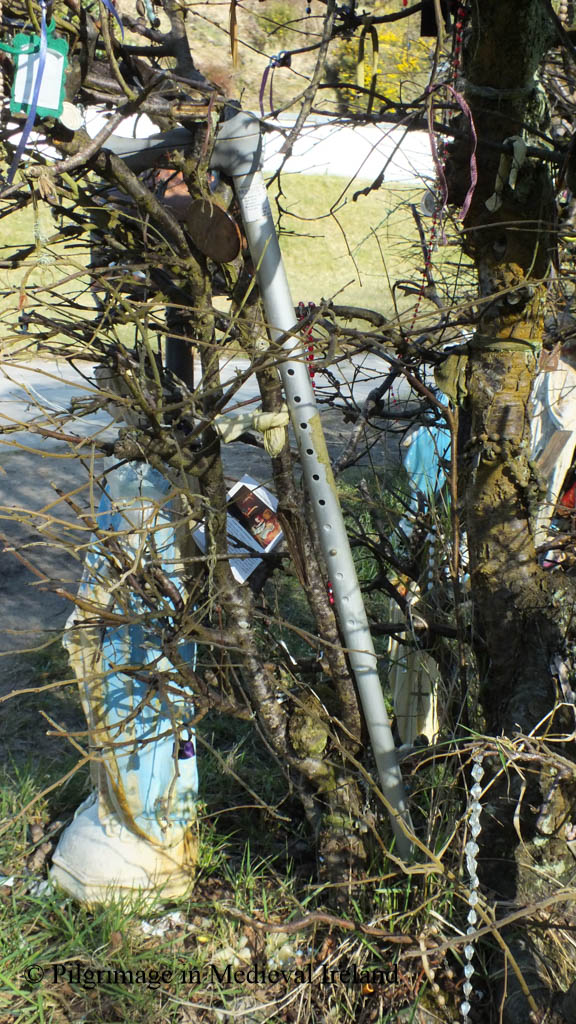
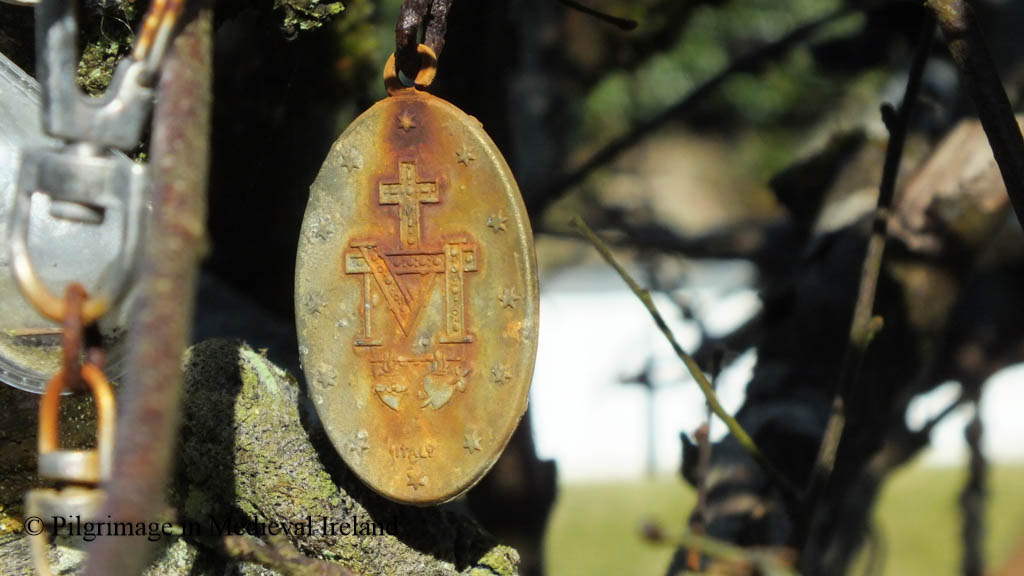
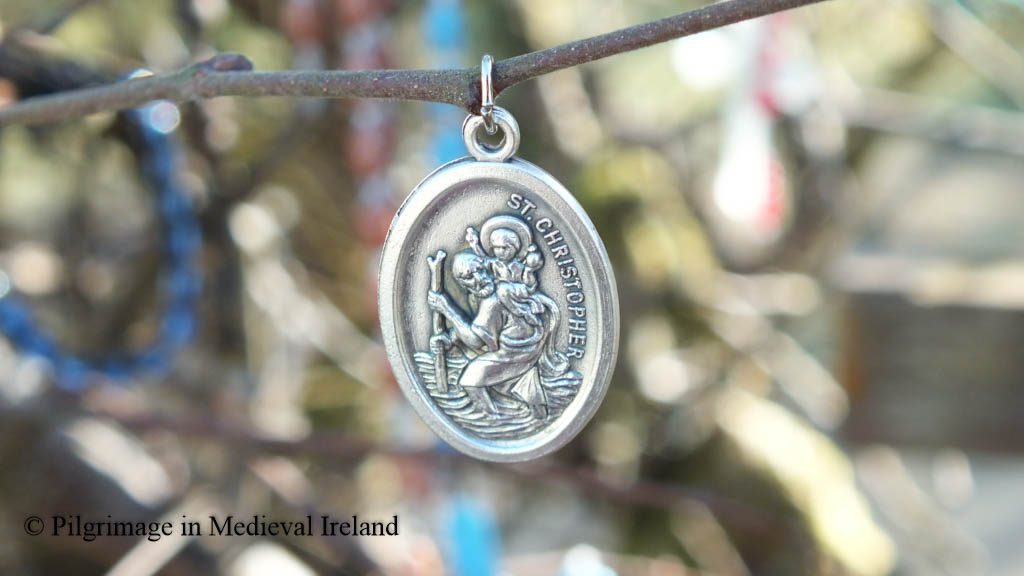
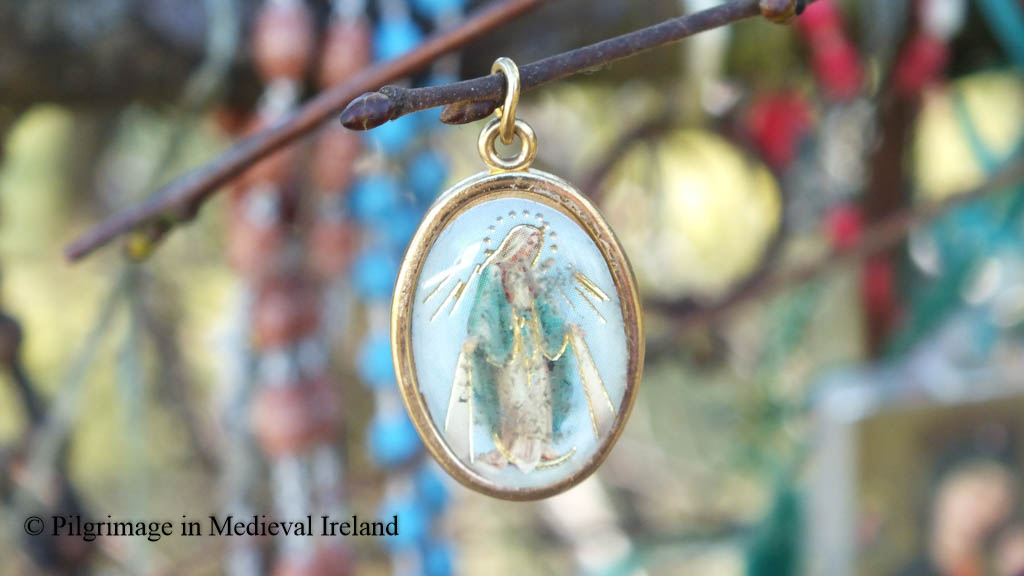
There are two small rag trees beside the well. The trees are covered in a wide variety of offerings left by pilgrims. The offerings include religious medal, hair ties, rosary beads, religious statues and scapula. The volume of offerings show how popular the spot is still with pilgrims.
Rag trees at Doon holy well photo taken in 2016
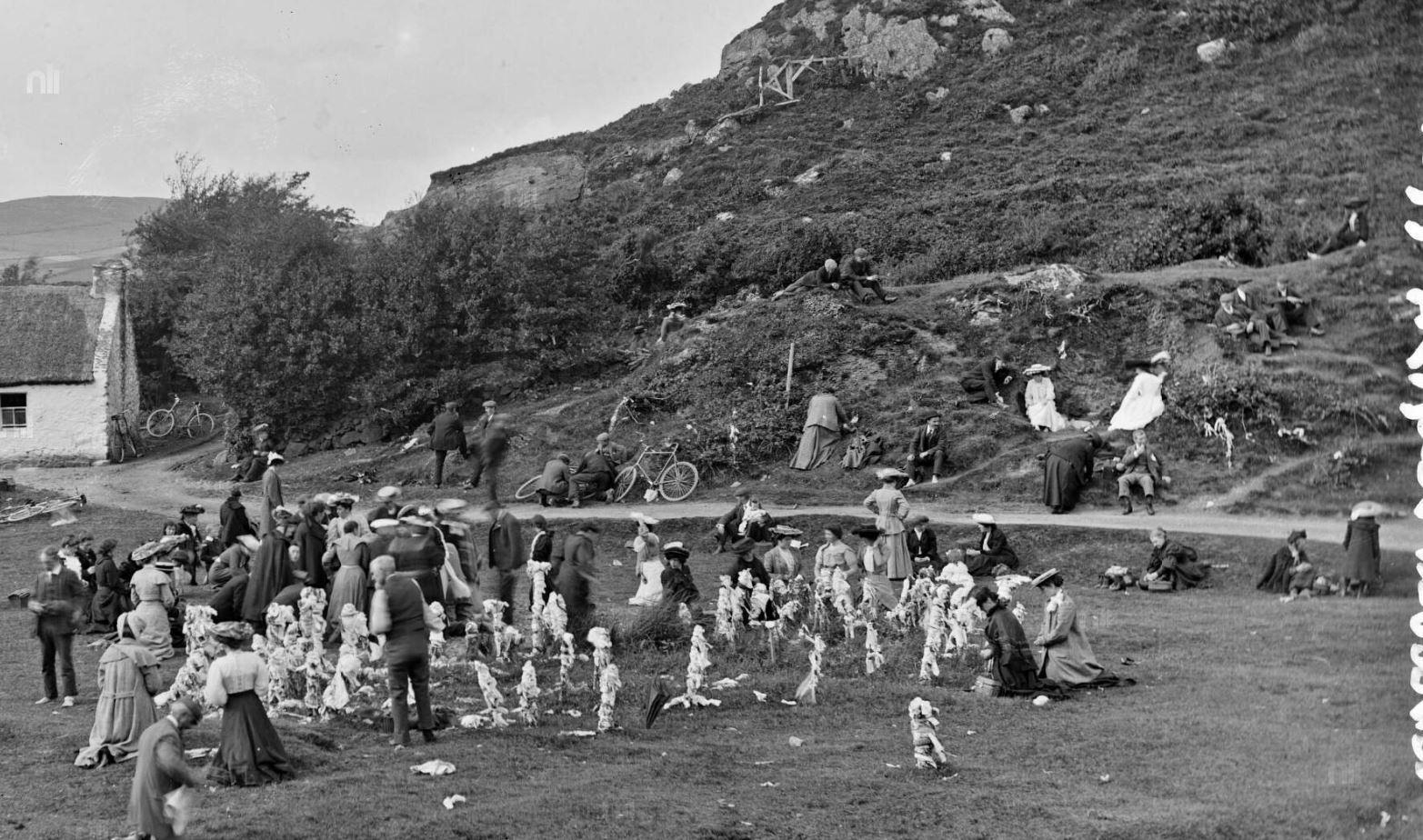
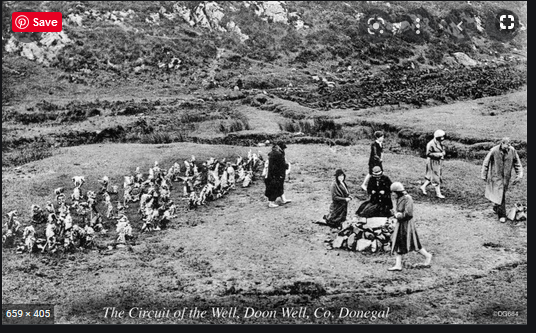
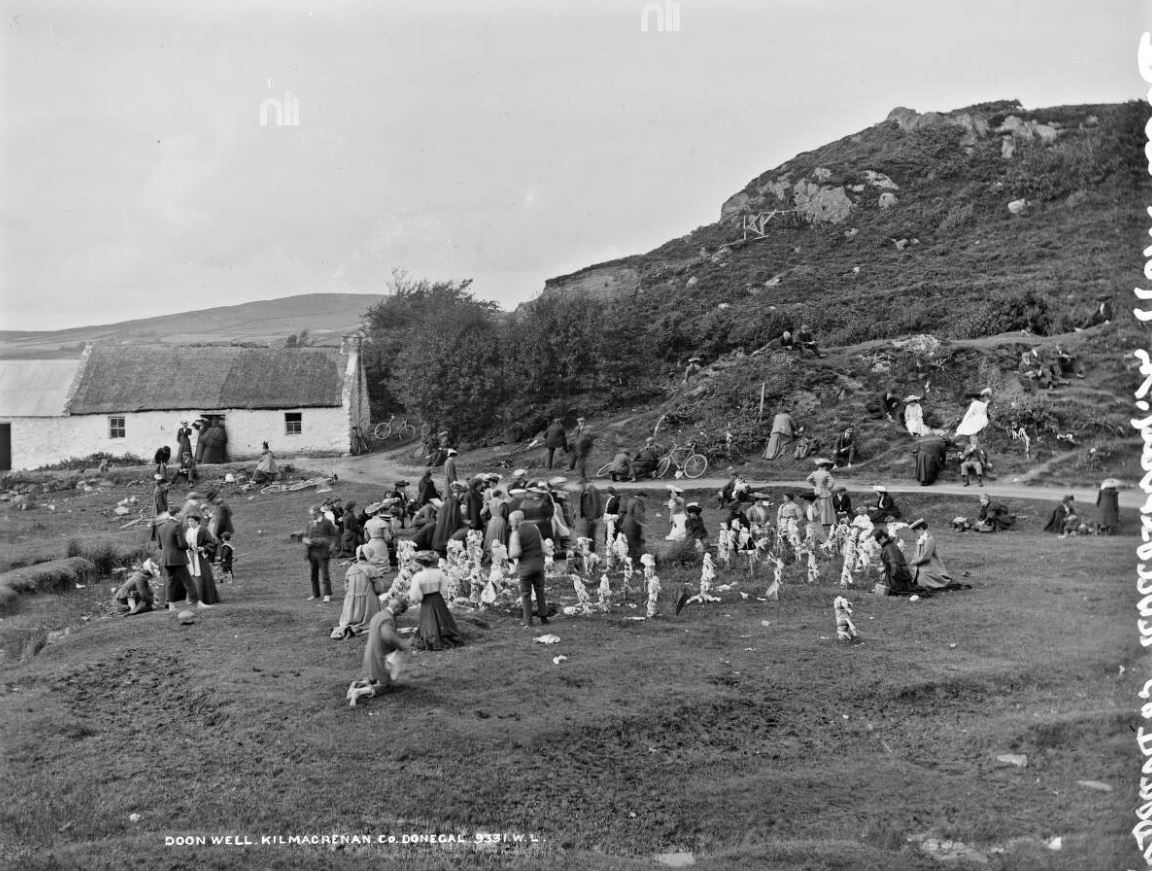
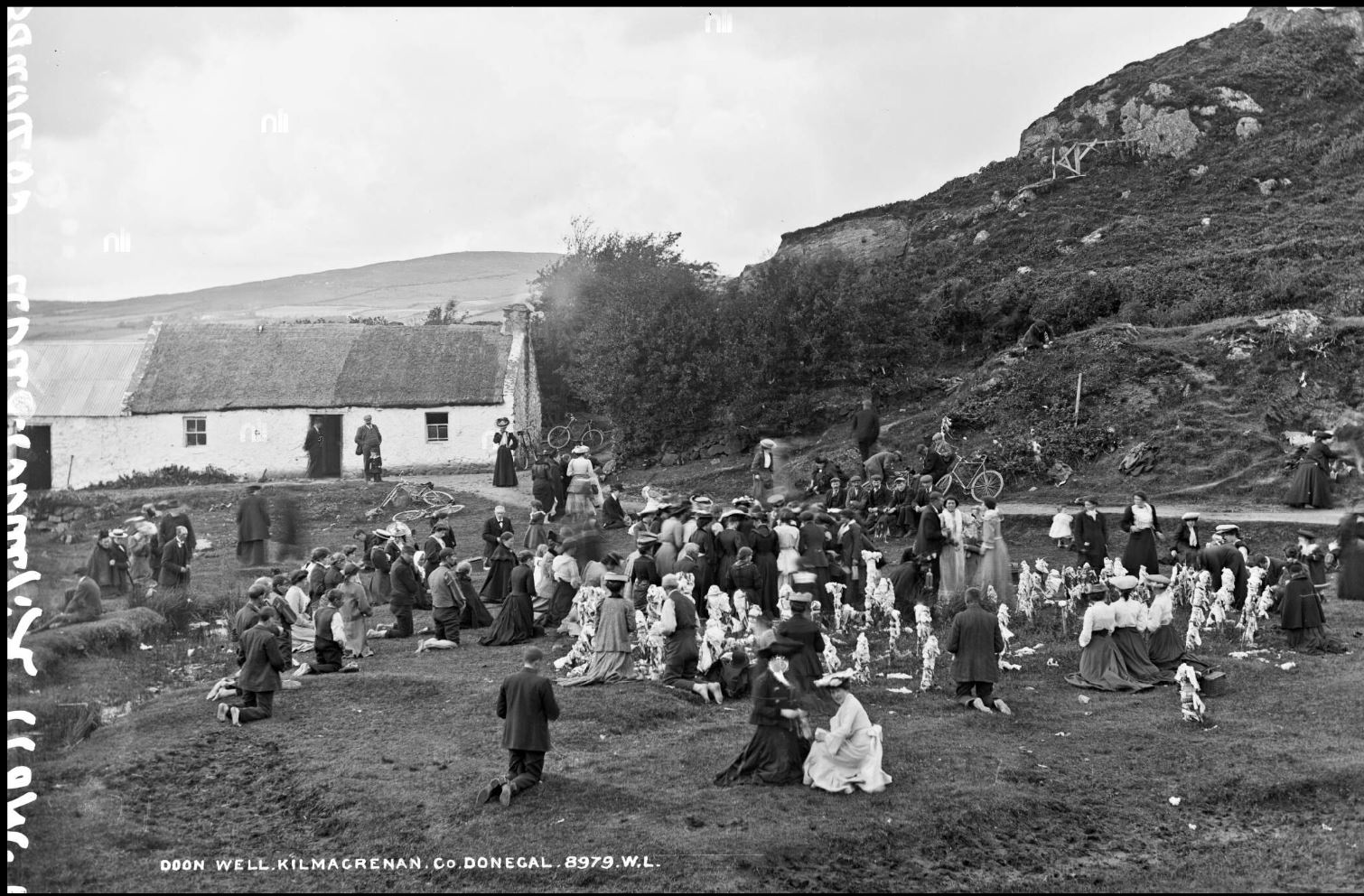
Doon holy well it is a living landscapes ever evolving. Its current vista was created in the early 2000s. This photo essay uses images of Doon holy well from the photographic collections in the National Library of Ireland (NLI) and the National Museums Northern Ireland (NMNI) to show how the well has changed over time and to provide a glimpse of how pilgrims experienced Doon well over a 100 years ago.
Landscape surrounding Doon holy well photo taken in 2016
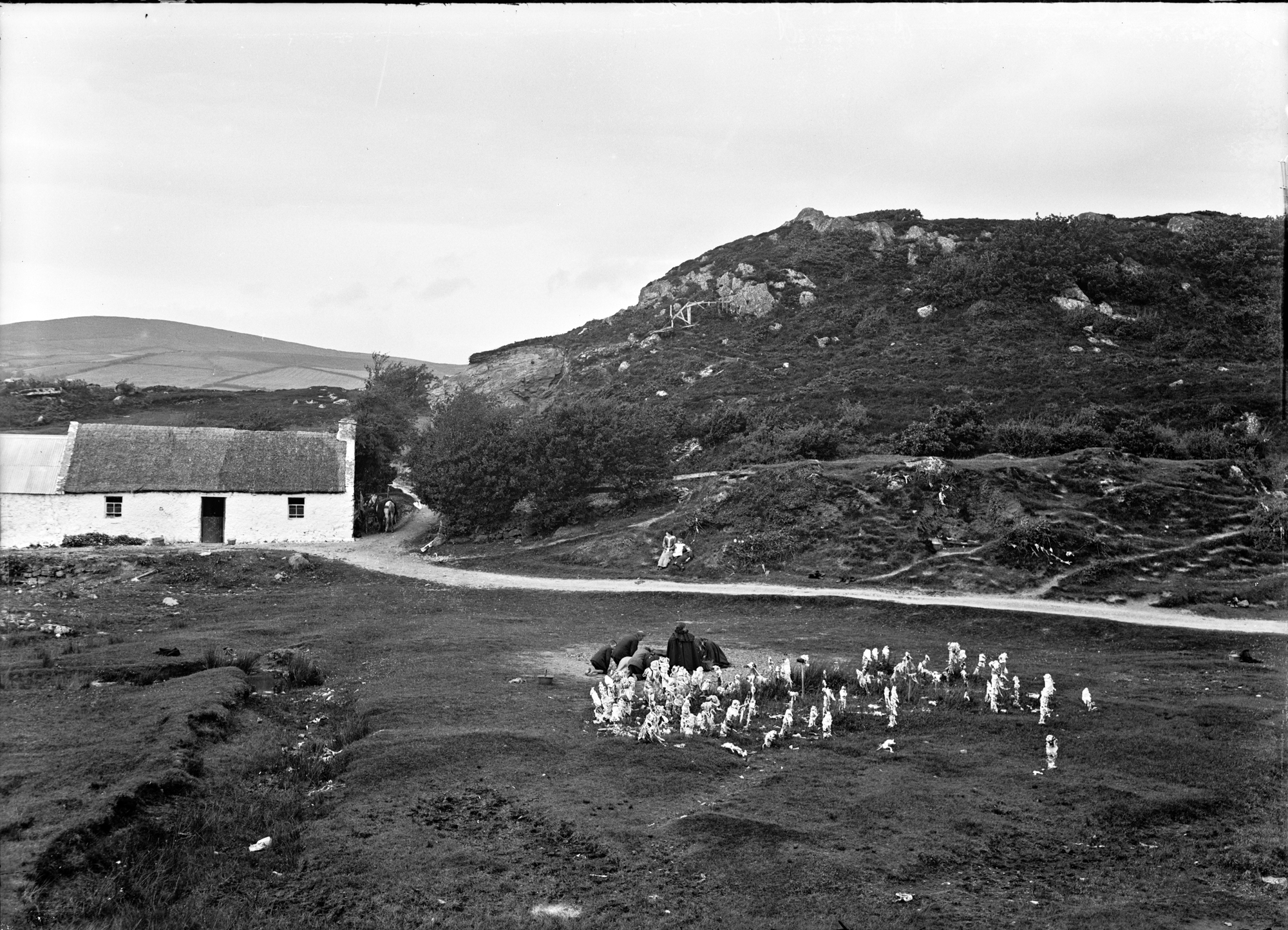
At the turn of the twentieth century the well was located in an open marshy landscape.
Doon well is situated in the parish of Kilmacrenan. It is situated in a green field by the roadside. It is a hilly rocky place, and there are a lot of hills and rocks around it. There is white and purple heather growing on the rocks, and people when they go to the well, go in search of the White heather, as it is very scarce around our district.
The well was originally an open natural spring. It was covered with stones to keep the waters clean some time in the 1800’s.
It is a long time since the well was first sheltered by stones which are built around it to keep the water clean and a large flat stone known as a flag was placed on top.
The Schools’ Collection, Volume 1083, Page 036
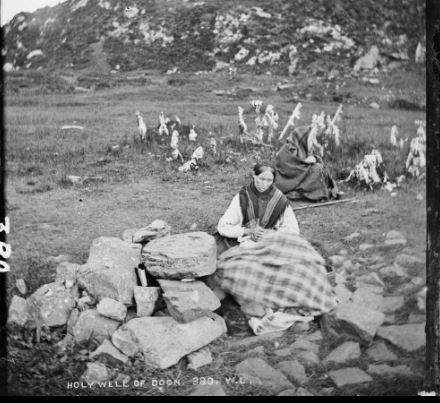
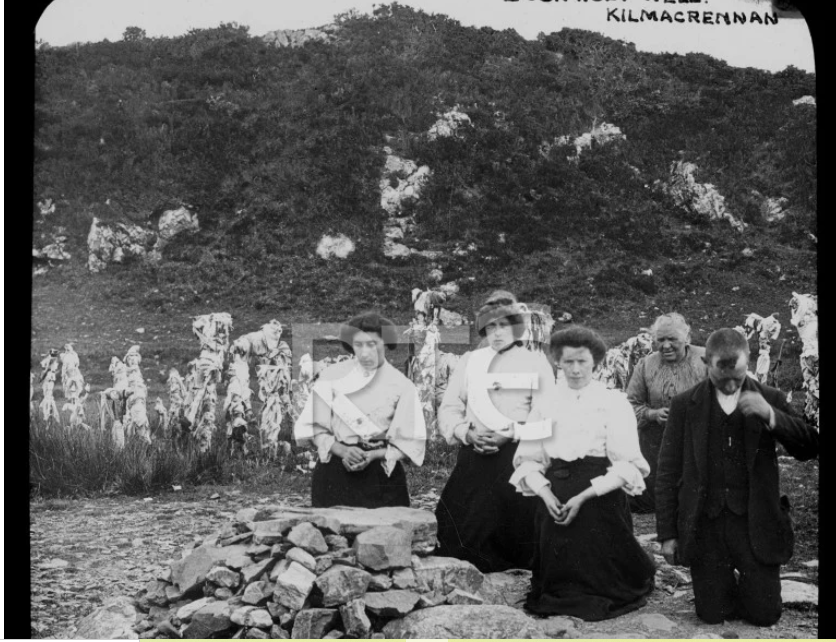
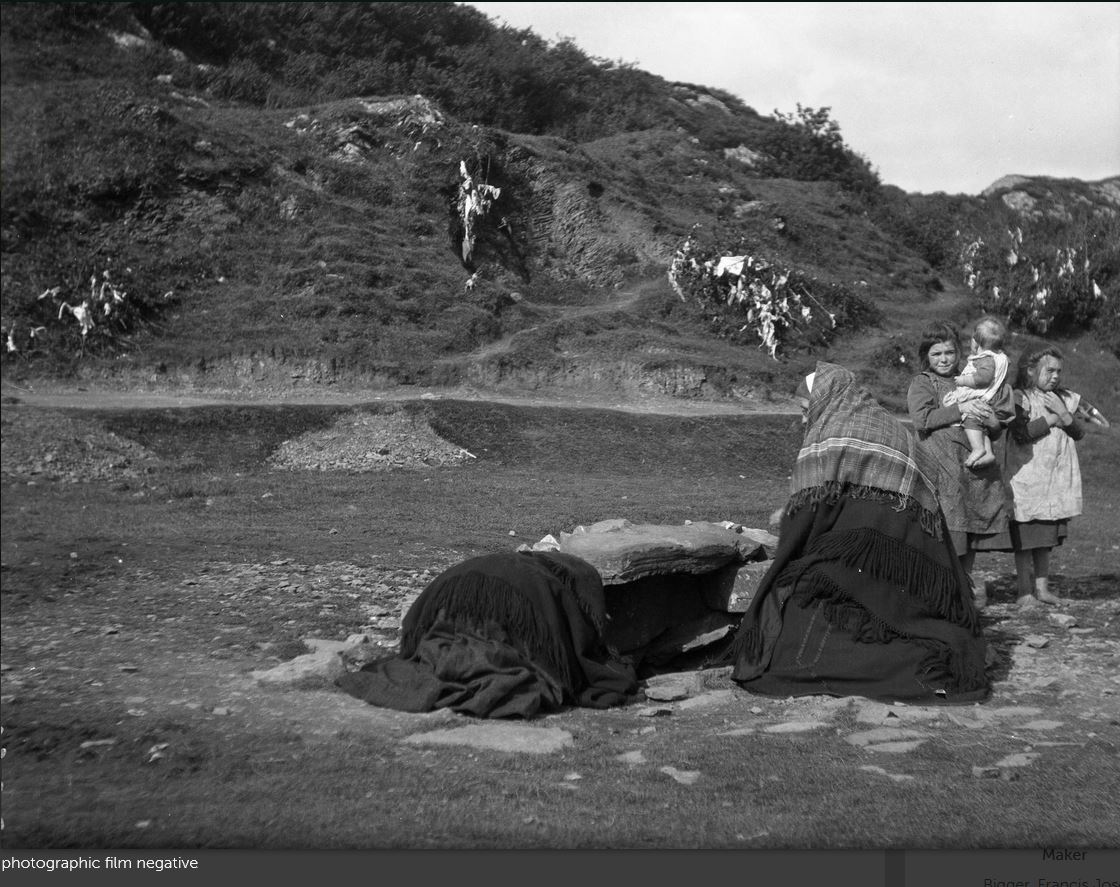
A photo of two women praying at the well from circa 1870-1890 shows the well covered by a collection of large stones stacked on top of each other.
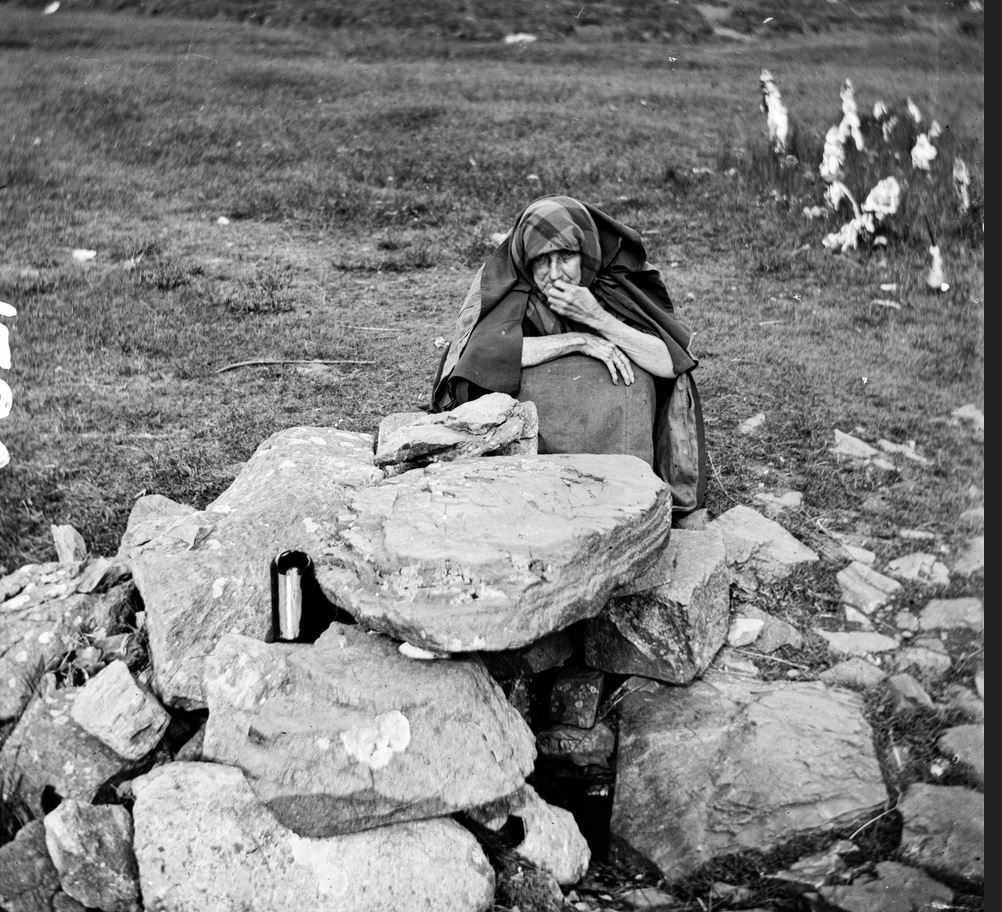
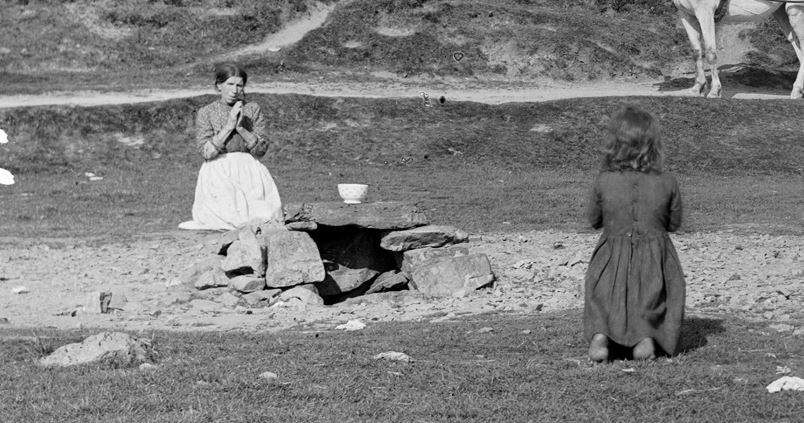
Another early image of the well also in the National Library of Ireland (NLI) collections shows the well in a similar state. The photo show an elderly woman crouch in prayer beside the well. The woman’s expression is incredibly soulful and haunting.
Doon Well at Kilmacrenan in Co. Donegal. Date: 1860-1883 NLI Ref.: STP_1720
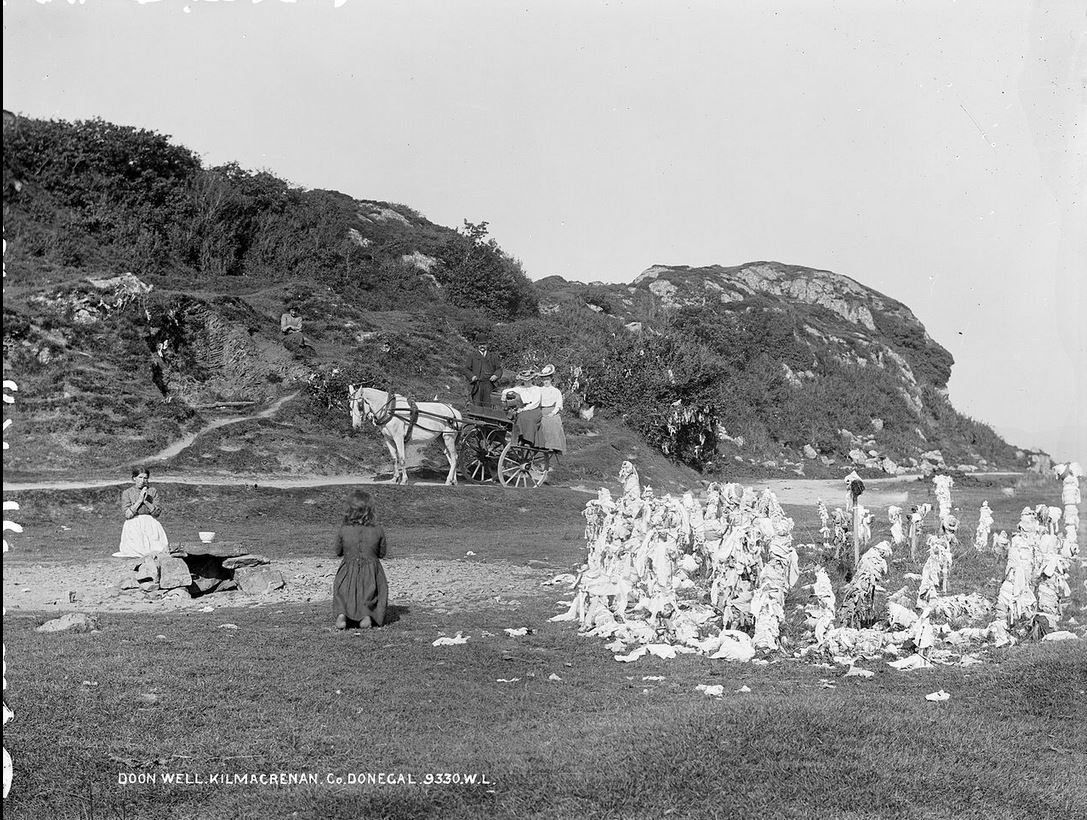
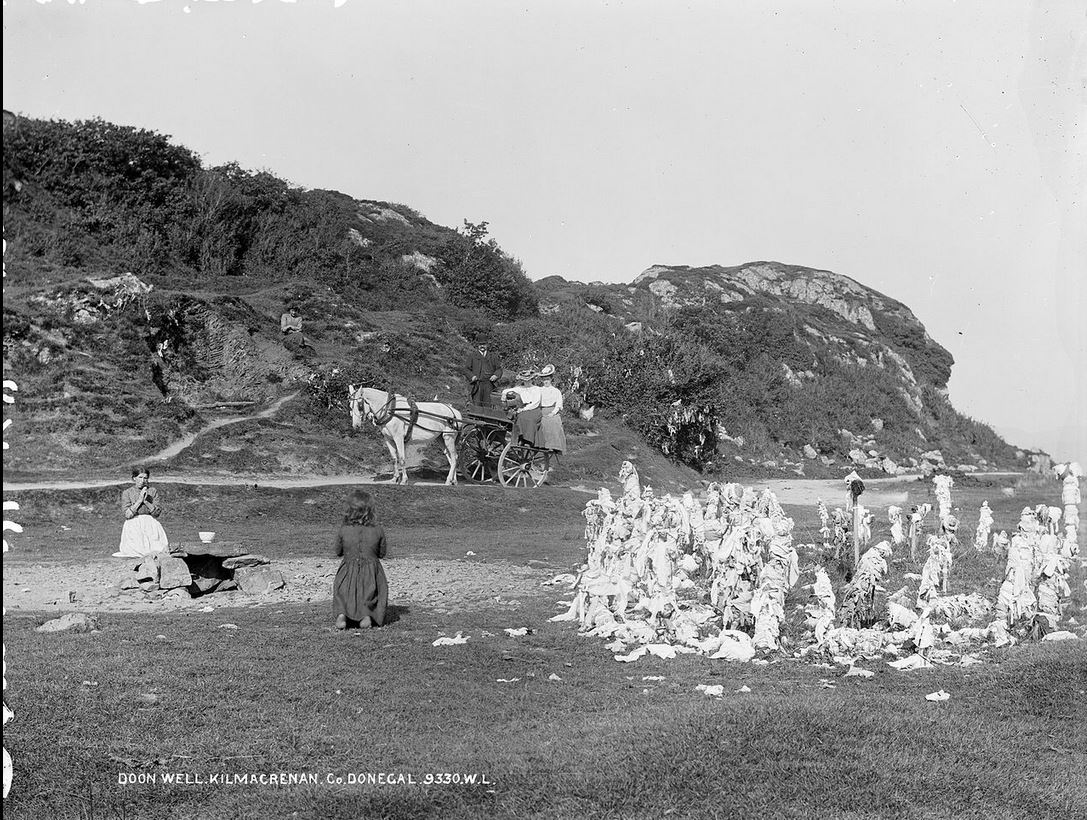
In later images the well has a more formal covering, with a large flat flag stone used as a roof. A photo was taken by Robert French in the late nineteenth-early twentieth century and shows the well surrounded by low wall on three sides covered with a large flat flag stone. The walls are made up by irregular shaped stones of different sizes. The area surrounding the well is without grass pointing to continuous traffic of pilgrims, who made “rounds” of the well.
Doon holy well at the turn of the 20th century taken by Robert French of Lawrence Photographic Studios, NLI Ref.: L_ROY_09330Doon holy well at the turn of the 20th century taken by Robert French of Lawrence Photographic Studios, NLI Ref.: L_ROY_09330
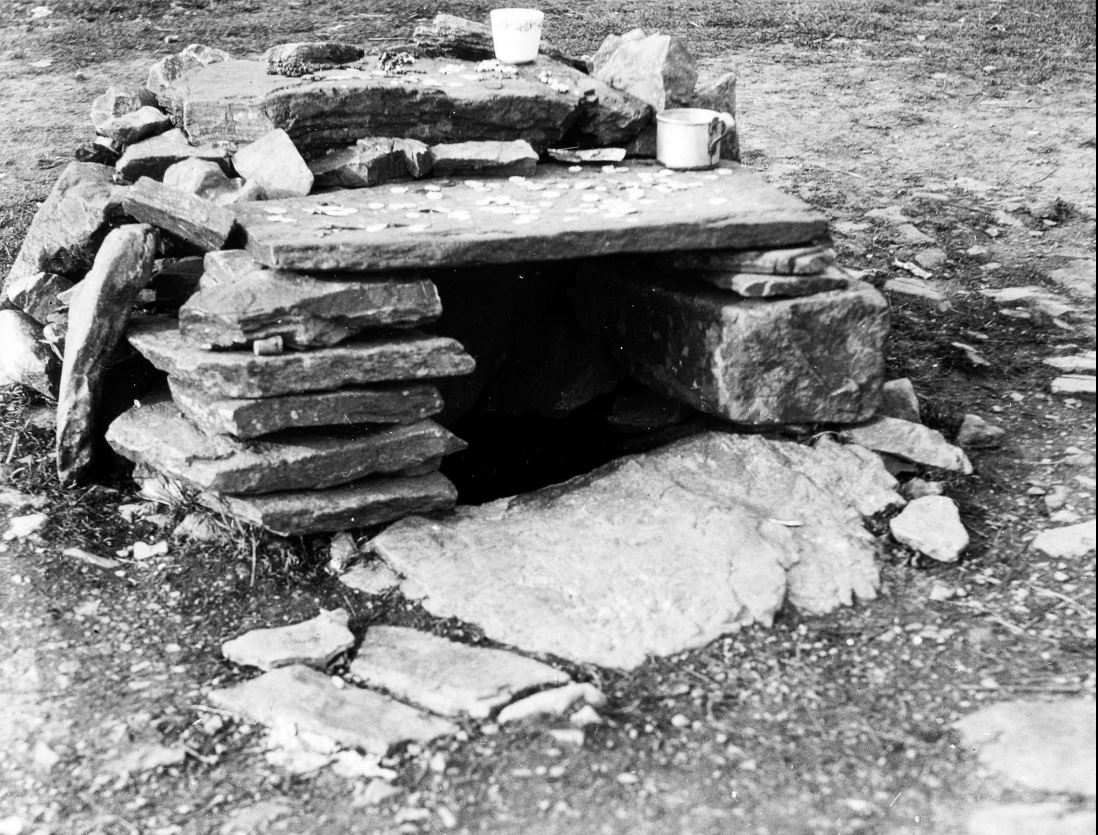
A photo in the NMNI collections, from the 1930s shows additional changes to the well superstructure. In the photo the superstructure has been extended and a second flat stone used as part of the roofing of the well.
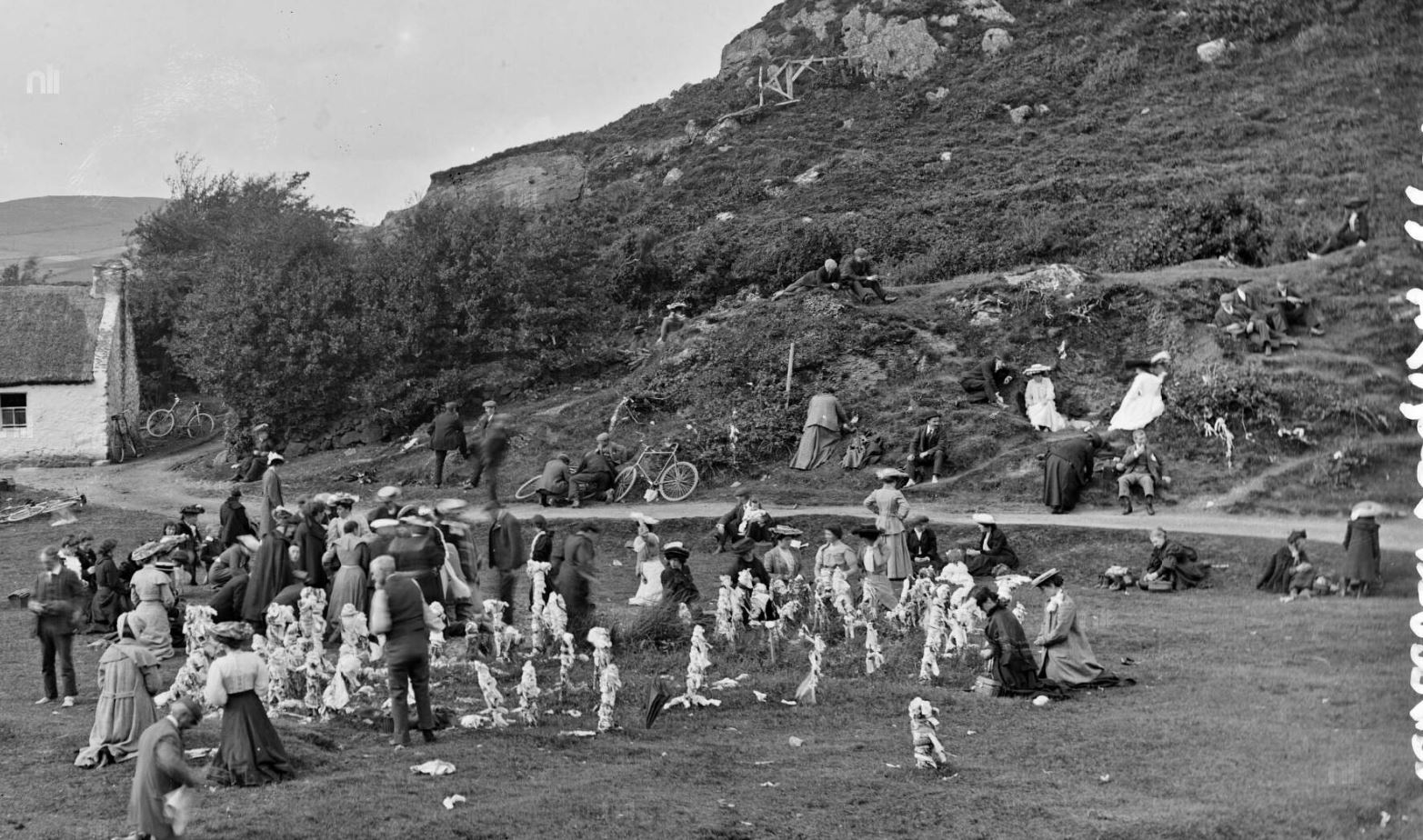
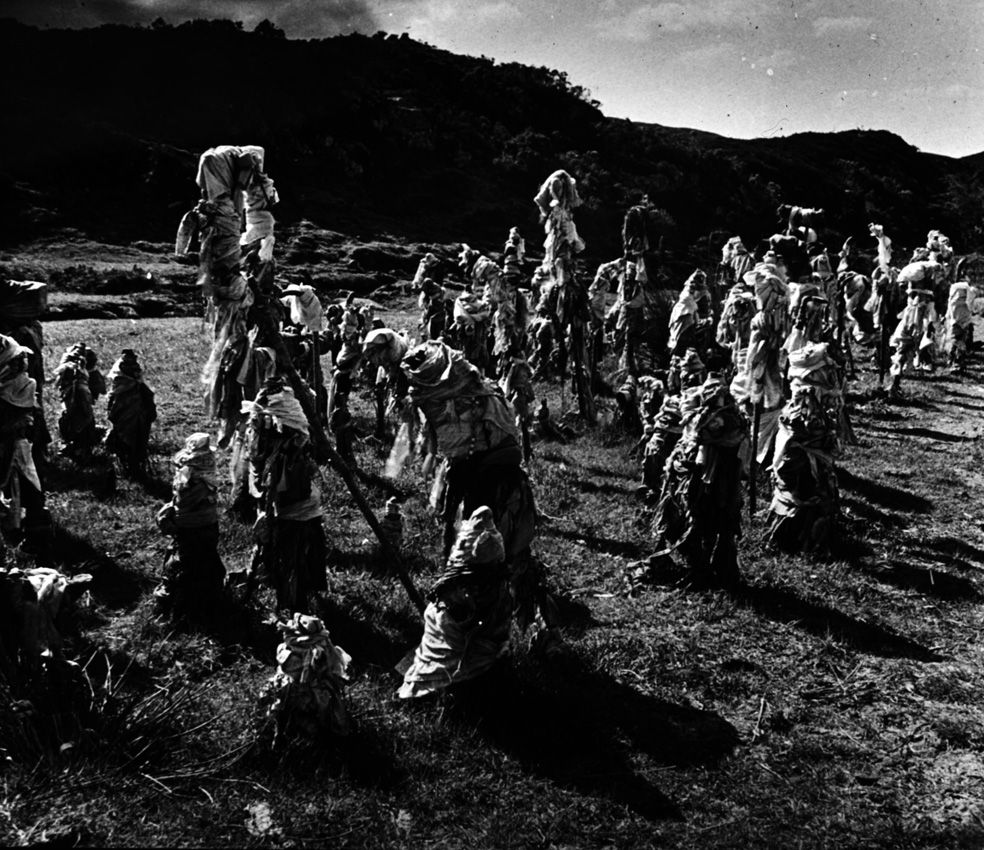
Modern visitors may be surprised that the rag tree beside the well are a more recent addition to the landscape. In times past the well was surrounded by crutches and sticks covered in bandages and cloths. Rags were also tied to bushes close to the well.
In the past it was common for pilgrims who believed they had been healed to leave behind their crutches and bandages and rags at the the well. Interestingly when I visited Doon well in 2016 there were 2 crutches left at the rag trees.
A boy from the Ross’as was cured at Doon well. He was lying for seven years before that. It was his aunt that took him to Doon well at first. The first thing that a person notices at Doon well are the two new crutches that he left behind him when he was cured.
The people drink it and wash the affected parts with it. They also take bottles of water home with them. You have to wash your feet in moss water and lift the water while still on the bare feet.
The Schools’ Collection, Volume 1085, Page 126-7.
The tradition of leaving behind offerings at the well is a long standing tradition. In the 1930s pilgrims left handkerchiefs and strips of cloth along with religious medals (The Schools’ Collection, Volume 1085, Page 126 (Woodland, Co. Donegal).
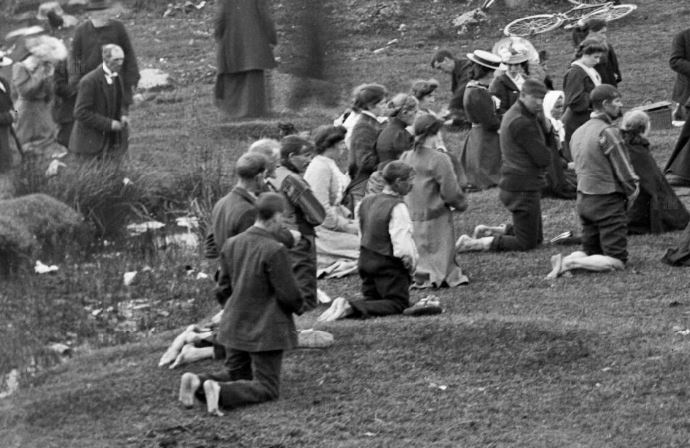
Two shawled woman kneeling in prayer at Doon holy well the NMNI the Bigger collection BELUM.Y10247
It is the custom always to leave something behind you at the well, some leave a hanky, others leave little things belonging to themselves. People take the water home with them from Doon Well.
The Schools’ Collection, Volume 1076, Page 431
Doon holy well is visited throughout the year. Two main vigils are held here, one on New Year’s Eve and the other on May Eve.
People go to Doon well on St Swithin’s day, St Patricks day, and Easter Sunday. They very often go on any week day, but usually on a Saturday or a Sunday.
The Schools’ Collection, Volume 1084, Page 036
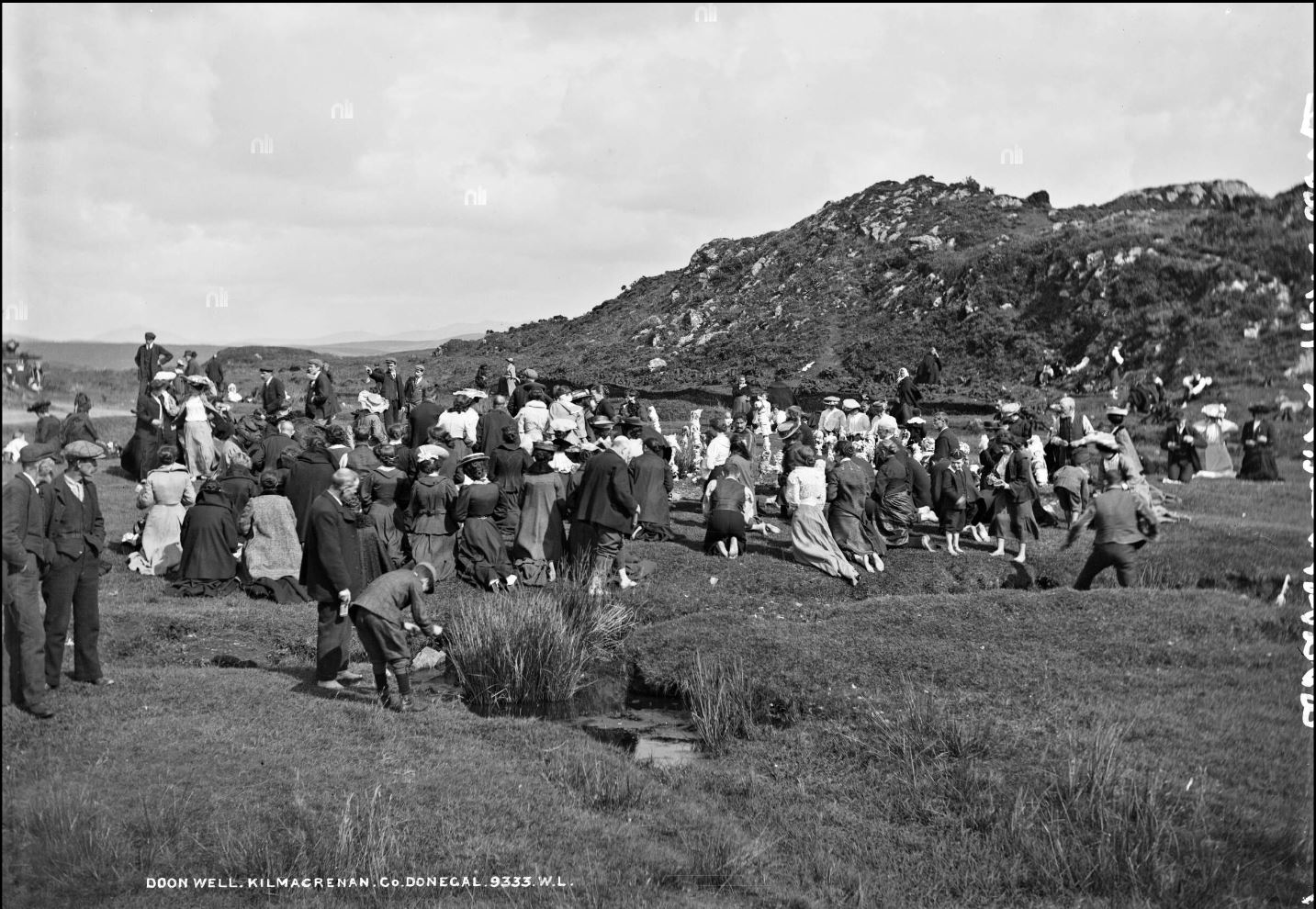
Pilgrims at Doon holy Well taken circa between 1865-1914 L_ROY_09332
A plaque at the well details the prayers made by modern pilgrims. Modern pilgrims say five Our Father and Hail Mary and the Apostles Creed for their intention. These prayers are repeated if the pilgrim decides to take water from the well. Pilgrims also say an Our Father and Hail Mary for Father O’Friel and also an Our Father and Hail Mary for Father Gallagher who blessed the well. An additional Our Father and Hail Mary is recited for the person who put the shelter around the well. Pilgrims throughout the decades have made their prayers in their barefeet while walking in circles around the well.
Plaque detailing pilgrim prayers at Doon holy well.
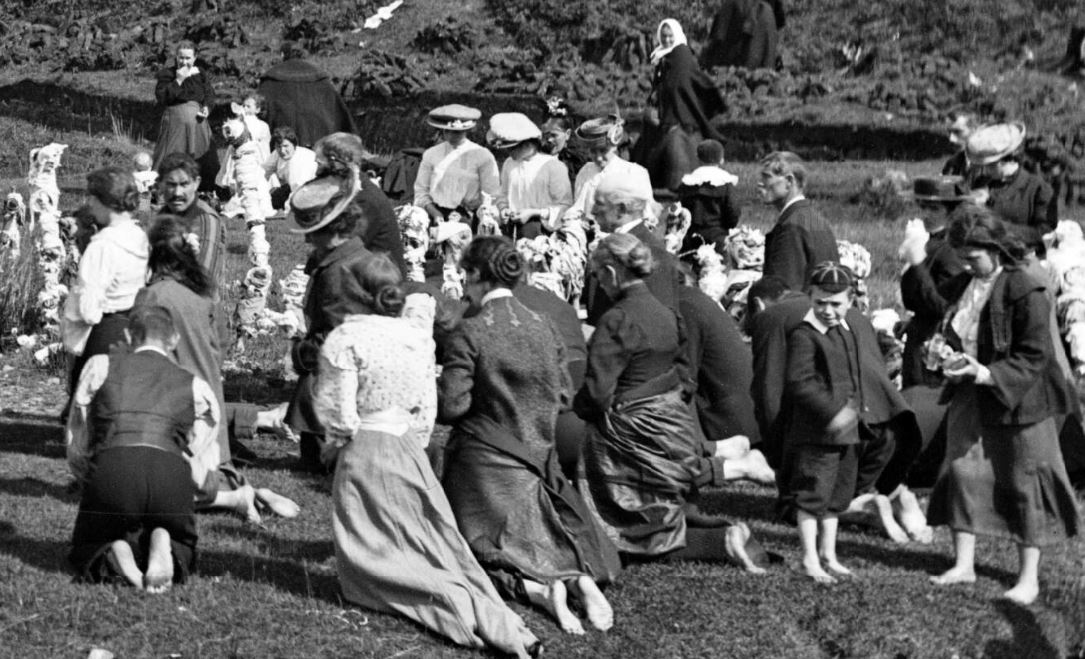
There are many photos from the late nineteenth and early twentieth centuries with pilgrims making their prayer and barefoot at the well.
Pilgrims making round at Doon well barefoot in the early twentieth century
In the 1930s the pilgrim rituals are described as follows
To make a pilgrimage correctly one has to fasting and when he comes in sight of the well their shoes must be taken off as it is believed the ground is blessed. He washes his feet in the water, which is to be got all around. Then the prayers are proceeded with Five Our Fathers, Give Hail Mary’s, and Five Glorias in honour of Father O Gallagher and Father O Friel, and the same for the person who sheltered the Holy Well. Also a creed for every bottle of Holy water lifted.
The Schools’ Collection, Volume 1083, Page 036
I hope this post inspires some of you to visit Doon well, its such an interesting place. Its also located close to Doon Rock the former inauguration site of the O’Donnells. The Voices from the Dawn blog has a very interesting blog post on the Rock of Doon.
St Sourney (Sairnait in Irish), is the patron saint of the holy well and medieval church at Drumacoo, Co Galway (Gwynn and Hadcock 1970, 34). Sourney was a holy woman who lived in Ireland during the sixth century, little is known about her life. She is also the patron of the small early medieval church of Teampall Asurnaí (St Sourney’s Church) at the village of Eochaill on Inismore. Tradition holds she also founded a monastery at Drumcoo during lifetime. Her feast day was celebrated on the 3rd May.
The schools collection for Ballinderreen, Co. Galway record an interesting folk tale relating to the saint.
Saint Surney sent one of her servants to Island Eddy for a coal, the servant went and she got the coal from the woman of the house who put it into her pinafore and as she was coming home the coal burned ahole in her pinafore. The saint was vexed when she saw the hole and she cursed Island Eddy and she said that anyone would come from island Eddy to Arran with a dry feet and the sea came between Island Eddy and Arran and the people never come out without a boat. Saint Surney was a very holy woman and she never cursed until she cursed Island Eddy. A little girl always stayed with the saint till after her death. The saint used to pray for hours every day and every one knew she was a saint because she used to pray very often.
The Schools’ Collection, Volume 0033B, Page 03_004
The modern visitor to Drumcoo will find a multi-period church surrounded by a later historic graveyard.
View of St Sourney’s Church, the site of an early medieval monastery at Drumacoo, Co Galway
The oldest part of Drumcoo church can be seen in the north wall and the west gable. The style of masonry and the flat lintel doorway (trabeate doorway) suggest the presence of a simple pre-Romanesque style stone church that was later modified.
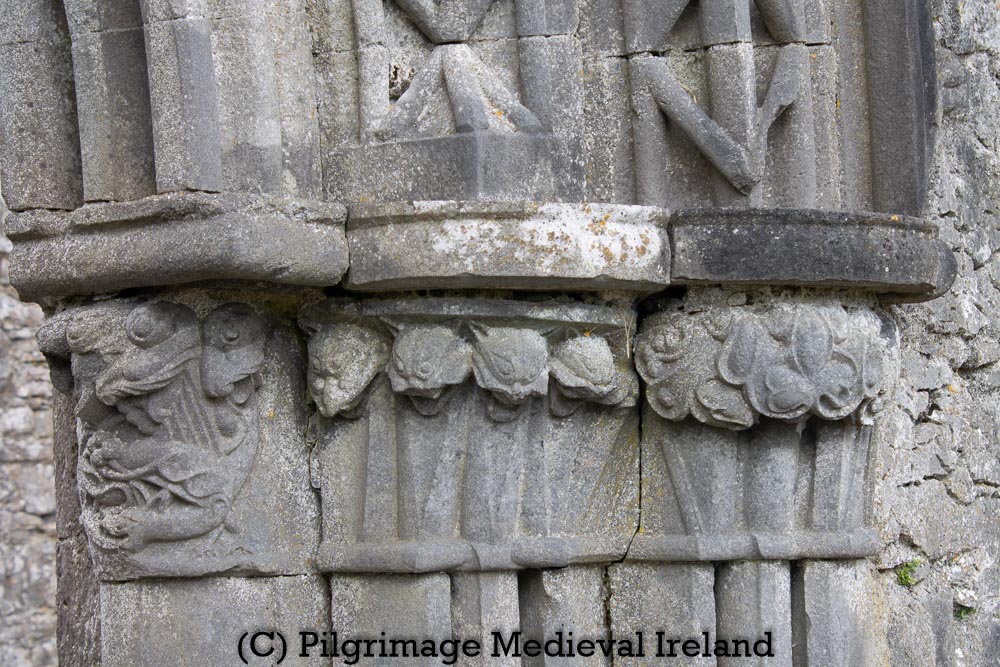
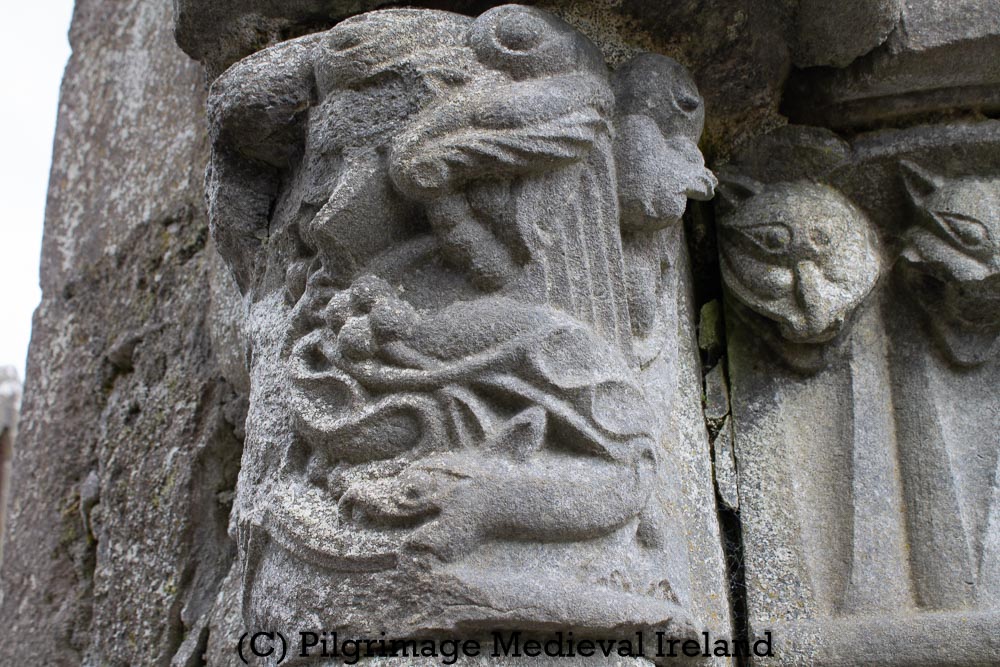
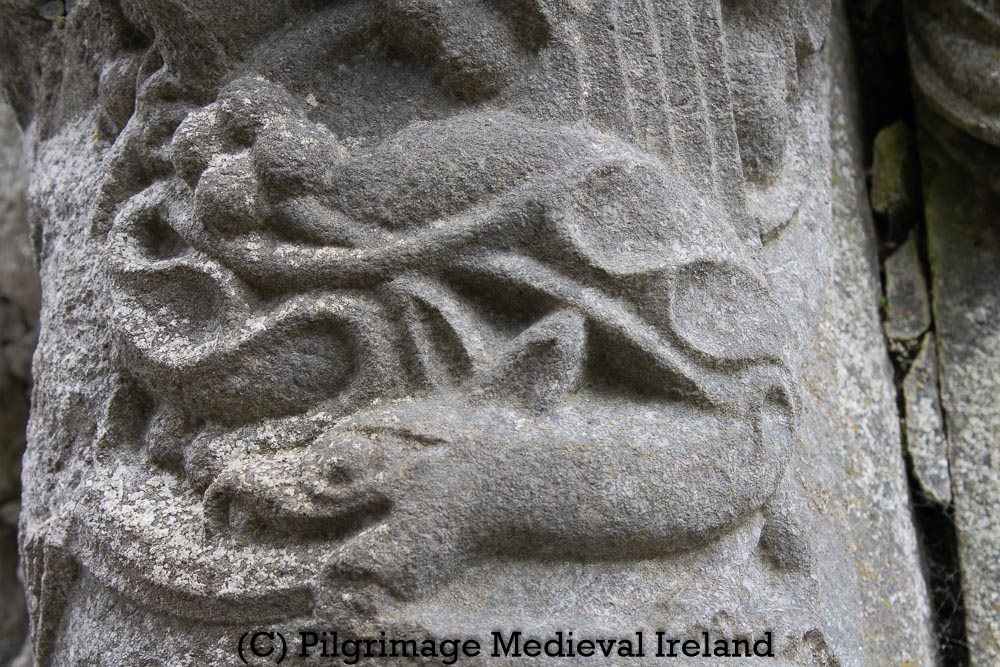
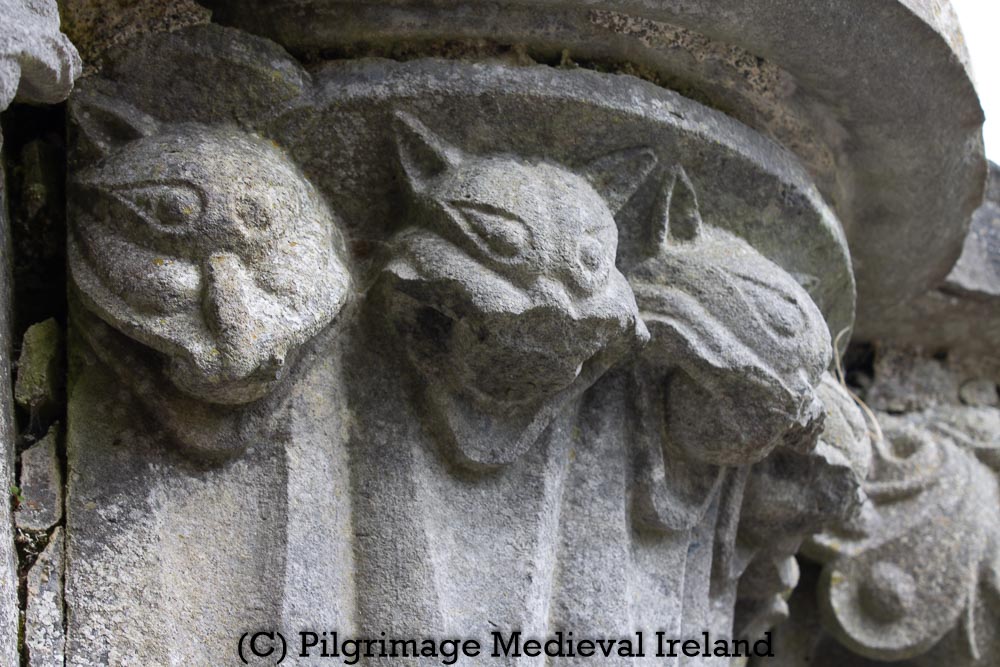
The southern wall is later and dates to around the mid thirteenth century. This wall has a very fine pointed doorway with intricately carved features including the heads of a number of cats. The door is the work of a very skilled crafts person.
The beautiful S. door is one of the minor masterpieces of the Connacht Transitional style and seems, like the E. windows, to be the work of the Boyle-Cong-Knockmoy-Corcomroe school of masons.
(Killanin & Duigan 1967, 318).
The east gable of the church has two fine carved single-light windows, one of which was blocked up. On either side of the windows are finely carved pointed aumbry.
View of the east gable in the interior of Drumcoo Church
The earliest recorded evidence of pilgrimage at Drumcoo dates to the nineteenth century, but its likely the tradition of pilgrimage was much older.
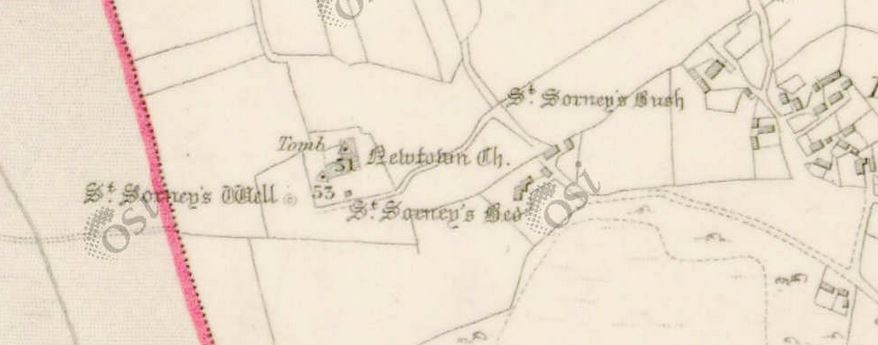
The 1st edition Ordnance Survey map shows an extensive pilgrim landscape surrounds the church, a holy bush, a saints bed and the holy well, all were dedicated to St Sourney.
1st edition Ordnance Survey map for Drumcoo
The contemporary Ordnance Survey Letters Co Galway (1838) also records these religious stations.
Sórnach [Sourney] whose Bed (Leabaidh), bush (tseach) and well (tobar) are shewn in the townland of Drumacoo.
(Herity 2009, 75)
St Sourney’s bush does not appear on later ordnance survey maps suggesting devotions and local interest in the tree ceased after this time.
St Sourney’s bed was described in 1890 as
one of those stone cells in which many of our early Saints loved to do penance. It measures about 6 feet [1.83m] in length by 4 [1.22m] in width externally.
(Fahey 1893, 33)
In 1980’s the bed was described as
completely ivy-covered and consisted of a rectangular mass of stone (L 2.6m; Wth 2m; H 1.7m) aligned N-S. According to local information, it was subsequently destroyed during a graveyard clean-up.
Galway Archaeological Survey, UCG
Only St Sourney’s holy well has survived, although it was rebuilt in the 1980’s using stones from St Sourney’s bed.
The well was recently rebuilt by a work crew who unfortunately took the stones to build it from what was reputedly St. Sairnait’s cell or ‘bed’
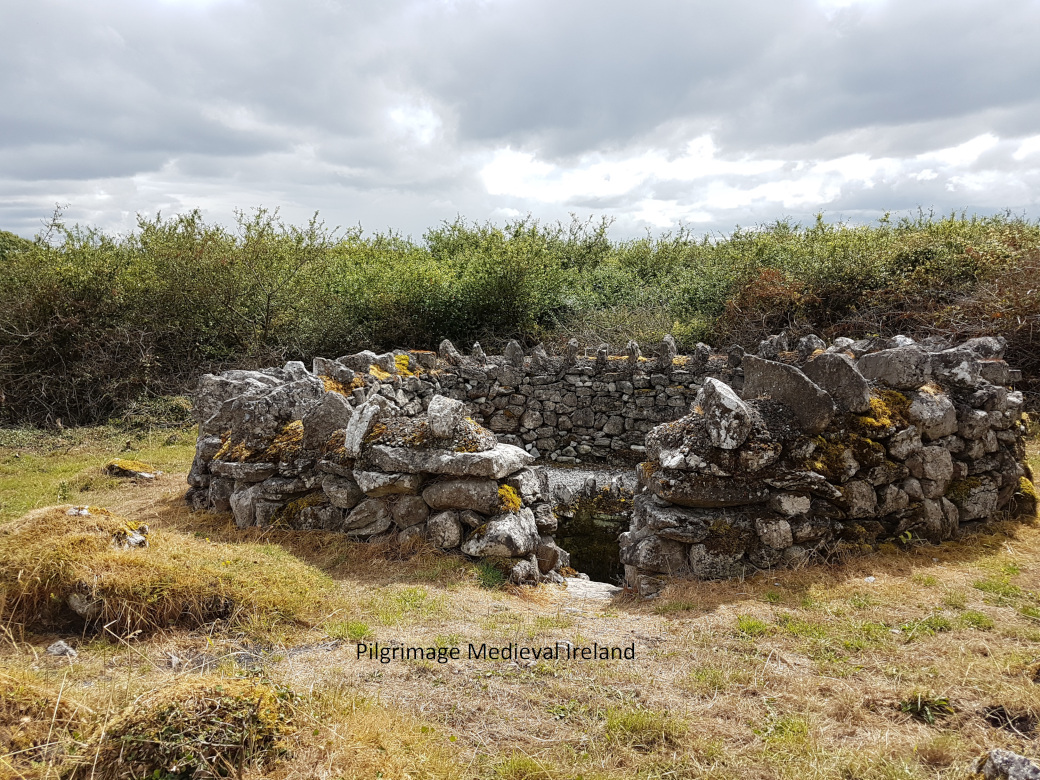
The holy well is located a short distance to the southwest of the medieval church. The well is enclosed by a circular stone wall.
St Sourney’s Holy Well Drumcoo Co Galway
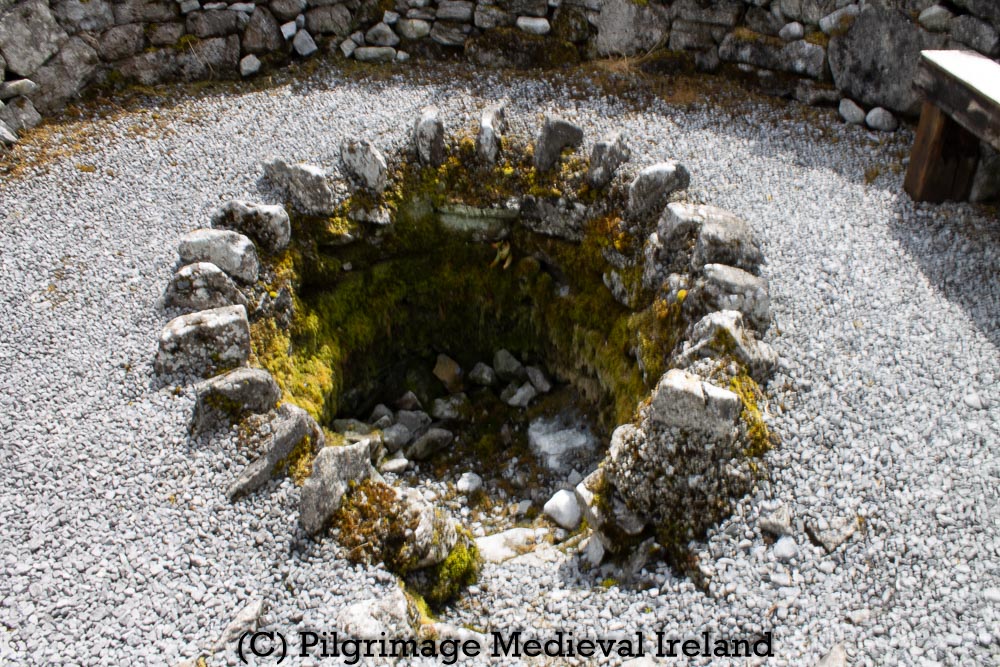
A gap in the wall provided access into a circular area covered by gravel. The holy well sits at the centre, below ground level. Stone steps provide access to the stone lined interior of the well. When I visited the well it was dry.
Interior of the Sourney’s Holy Well Drumcoo
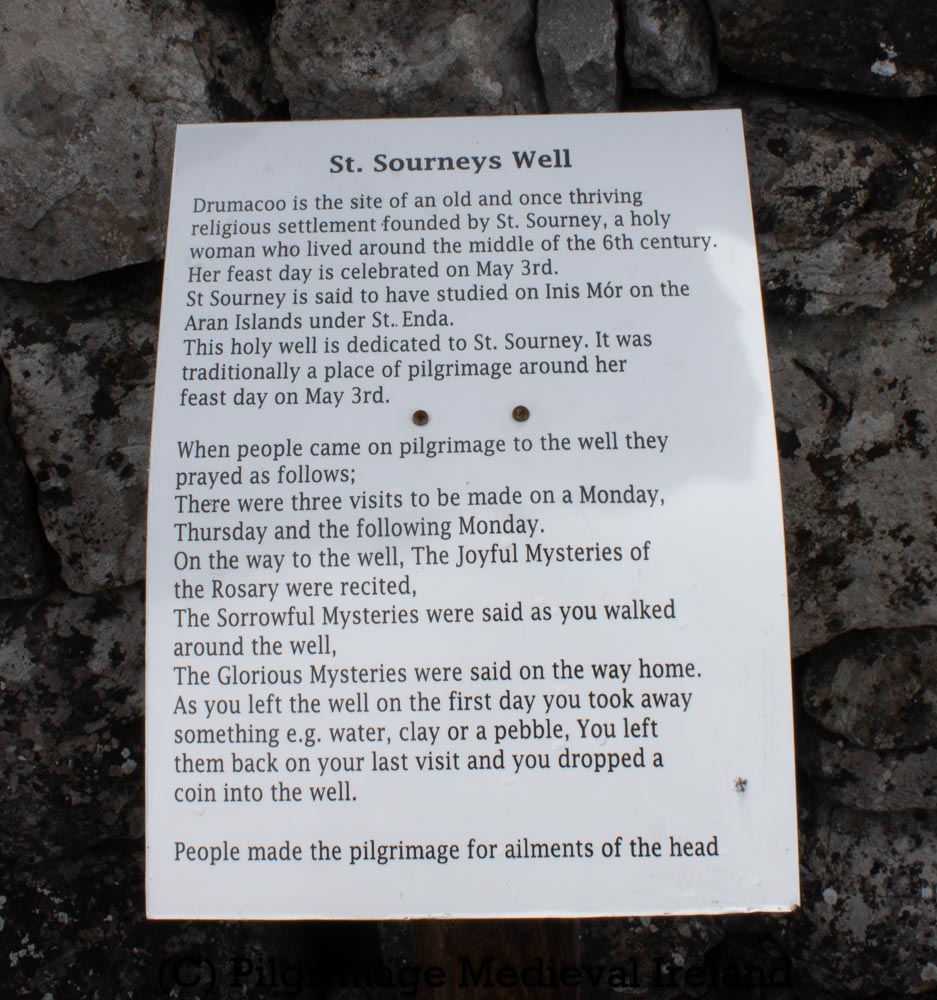
Its was said that the wells water was an effective cure for a pain in the head. In the 1930’s those in search of healing would visit the holy well and devotions performed on two consecutive Mondays and the intervening Thursday.
If a person is subject to a constant headache he goes to this well for a cure. He goes to the well three times, on Monday,Thursday and the following Monday. Every time he visits the well he should leave something, if only a button, on a bank of earth which is raised beside the well. He says certain prayers at the well, then he brings a bottle of water from the well and washes his forehead with it every day.
The Schools’ Collection, Volume 0033B, Page 01_047
Details of the pilgrim rounds at St Sourney’s Holy Well
Bibliography
Fahey, J.A. 1893 (Reprint 1986) The history and antiquities of the diocese of Kilmacduagh. Galway. Kenny Gallery.
Higgins, J.G. 1987 The Early Christian cross slabs, pillar stones and related monuments of County Galway, Ireland, 2 vols. British Archaeological Reports, International Series 375. Oxford.
Herity, M. 2009. Ordnance Survey Letters Galway. Dublin: Fourmasters Press
Killanin, M.M. and Duignan, M.V. 1967 (2nd ed.) The Shell guide to Ireland. London. The Ebury Press.
Harbison, P. 1970 (Reprint 1992) Guide to the national monuments in the Republic of Ireland. Dublin. Gill and Macmillan.
The Tybroughney pillar, an early medieval pillar stone in the townland of Tybroughney/Tibberaghny, Co Kilkenny is one of the most interesting early medieval carvings in Ireland.
The townland of Tybroughney is associated with two saints. The first is St Fhachna, who is tthe patron of a holy well that gives its names to the townland. The name Tybroughney Tiobra Fhachna translates as St Fhachna’s holy well.
The second saint is St Modomnoc a hermit who founded a monastery here in the sixth century. The former monastery is said to be located at the ruins of the medieval church of Tybroughney.
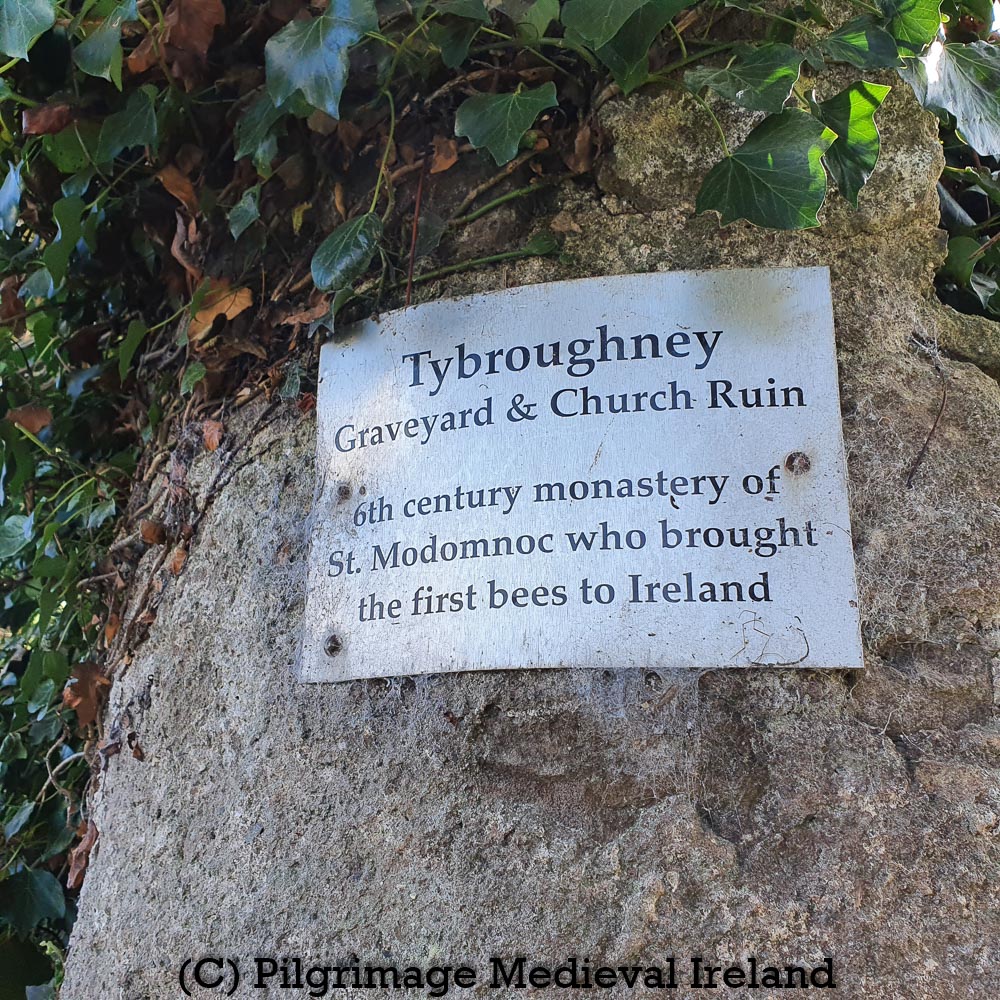
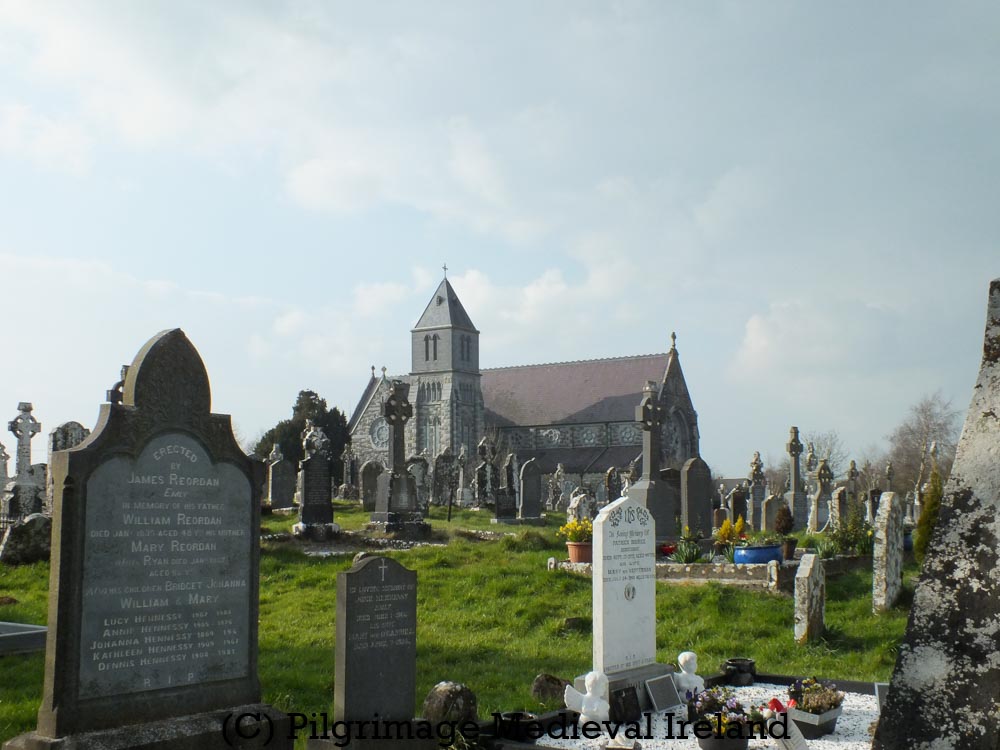
Tybroughney church is located close to the site of a medieval castle and the main Waterford-Clonmel railway line. You have to cross a field to get to the church and graveyard. A fine stone gateway into the field has a plaque on commemorating St Modomoc,
Tybroughney Graveyard and Church in Ruin. 6th century monastery of St Modomnoc who brought the first bees to Ireland.
Information sign of the on pillar leading to Tybroughney church and graveyard.
Like St Gobnait,St Modomnochas a strong connection with bee keeping and bees.
The patron saint of Tybroughney is St Modhomhnoc. He is said to have been the first to introduce bees into Ireland. During his sojourn with St David, in Menevia, he had charge of the bees of the monastery, and attended them with the greatest care, so much that they were fruitful of honey in his hands. When he was returning thence to Ireland, and had biddin farewell to the holy abbot and monks, and had entered the coracle, to set sail, the bees, forming a large swarm came and settled in the boat along with him. Modhomhnoc, unwilling to the monastery of this treasure, brought them back to their hive. A second time, however, as he again entered the boat, they followed him, and, when he again brought them back, they repeated the same a third time. St David hearing this told him to bring the bees with him to Erin
The Schools’ Collection, Volume 0843, Page 345
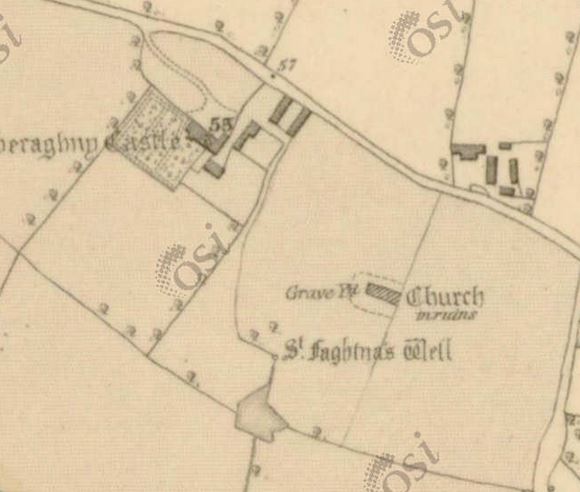
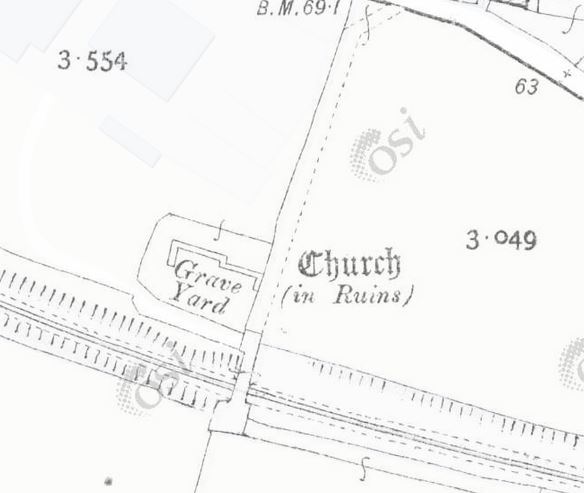
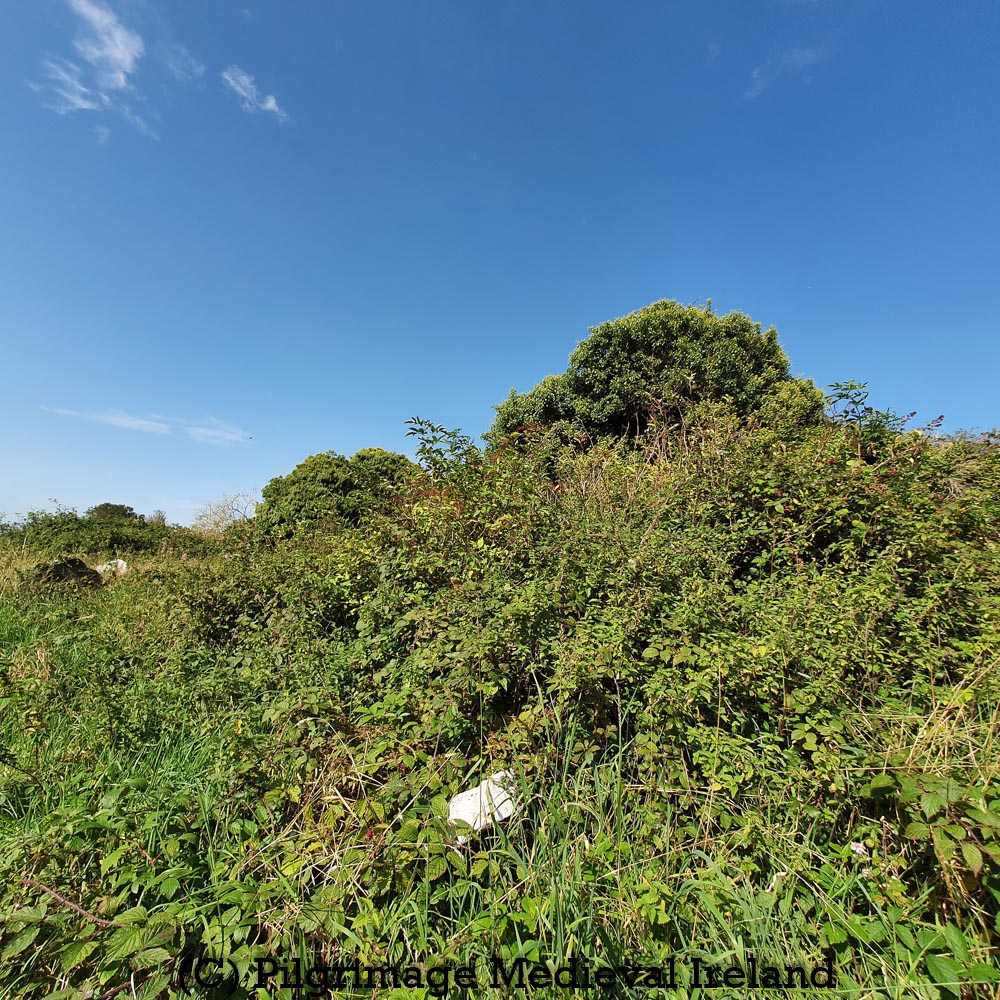
The church is found beside railway gates. It is difficult to examine the church and surrounding graveyard as it is very overgrown. The 1st edition Ordnance Survey map dating to the 1840s, shows the church as a rectangular building while the later 25″map shows it as a nave and chancel church.
The Ordnance Survey Letters of Kilkenny 1839 described the church
The ruins of the church of Tiobtrait Fachtna (Note added: Tybroughney) stand in the Townland of that name and consist of Nave and Choir, the former 50 feet 8 inches by 30 feet 10 inches, the Choir 28 feet 9 inches by 18 feet 10 inches. The northern half of the west gable remains to about the height of 20 feet and half the north wall attached to it about 14 feet high, south wall and middle gable level with the ground…..The walls of the Nave are built of middle sized limestown and mortar, 2 1/2 feet think and not older I should think the 16th century, but the wall of the Choir are built of very large well formed, tho irregularly laid blocks of granite, and 3 feet 2 inches thick, very much resembling the wall of the Church of Kilcroney near Bray, in the County Wicklow.
(Herity 2003, 155).
Manning (2012, 154) describes the church as a medium-sized with antae. The west gable is still upstanding but it is very hard to say much else about the church.
Tybroughney medieval parish church is covered in thick vegetation
Part of the graveyard that surrounds the church was destroyed in 1851 when the by railway line was built. This event was clearly remember decades later locally. The Schools Collection for Piltown School,
The railway line now runs through this old graveyard. It was constructed in 1851. When it was being made the workmen came upon a large number of human skeletons. The skeletons lay along under the surface in single file and were so close together that there were no coffins used in their interment. This shows there was an ancient monastery here or if not it was the resting place of warriors slain in some local battle.
The Schools’ Collection, Volume 0842, Page 288
View of Tybroughney medieval church and graveyard from across the railway tracks
The holy well which gives its name to the townland is located on the other side of the railroad tracks in scrub. I didn’t have time to search for the well on my visit here but will hopefull get back there soon. In the early nineteenth century a pattern day was held here on the13th February (Herity 2003, 157).
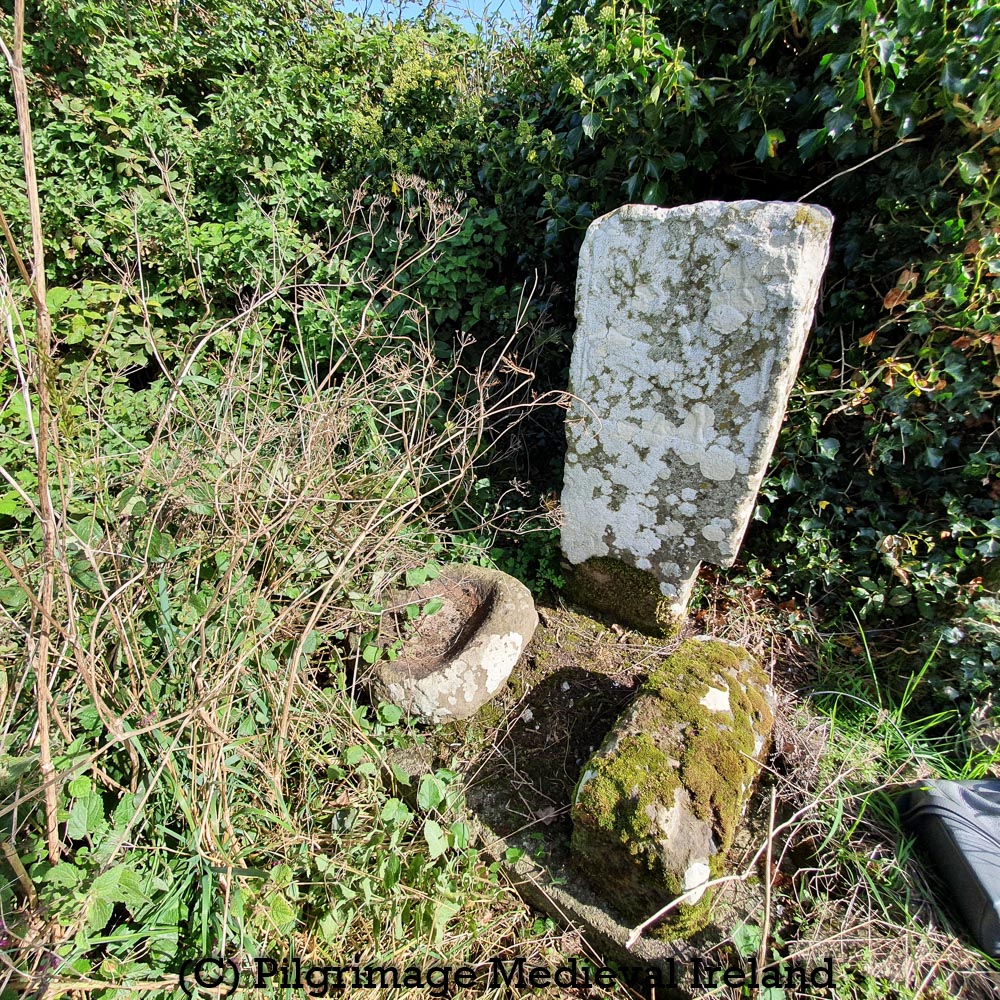
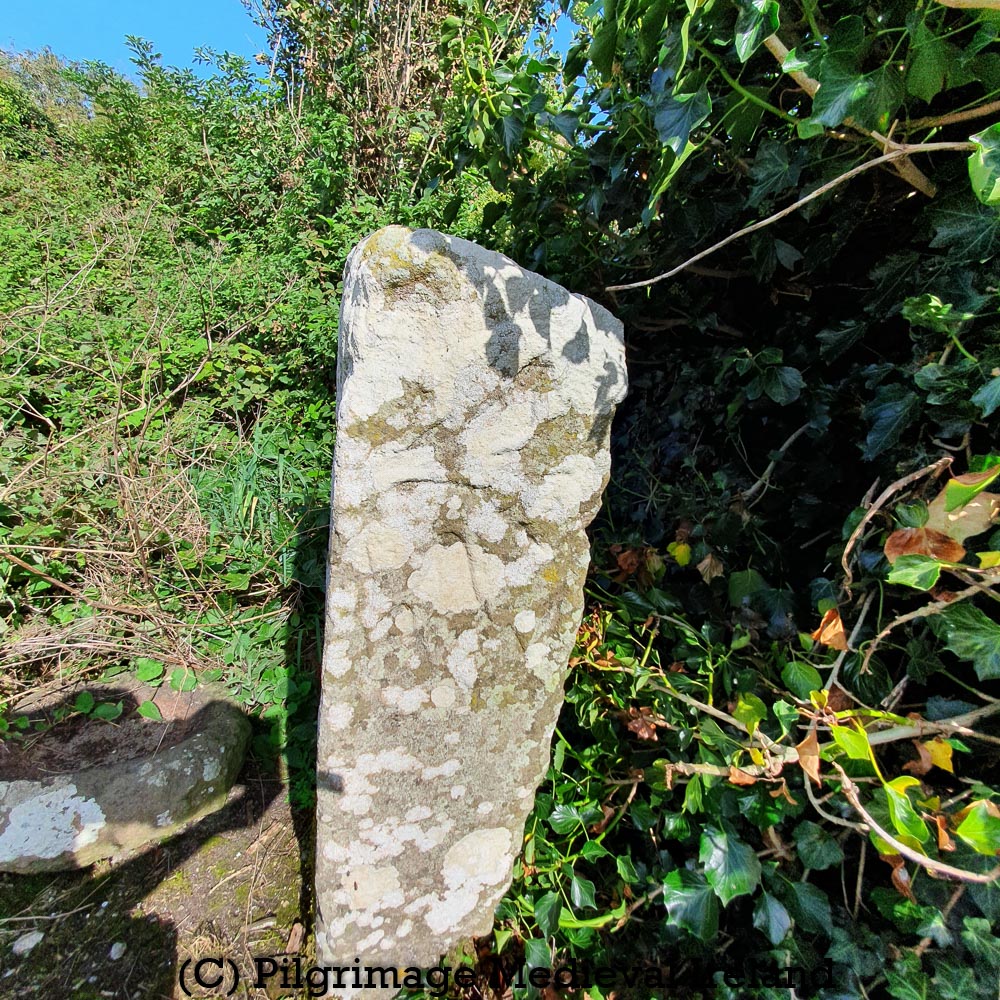
The Tybroughney pillar stone sits beside the church ruins, on a small patch of ground defined by low curbing. This area also contains a plain undercoated stone with an oval shaped hollow and seems to be font. There is also a rectangular stone covered in moss.
Carved pillar and font at Tybroughney medieval church
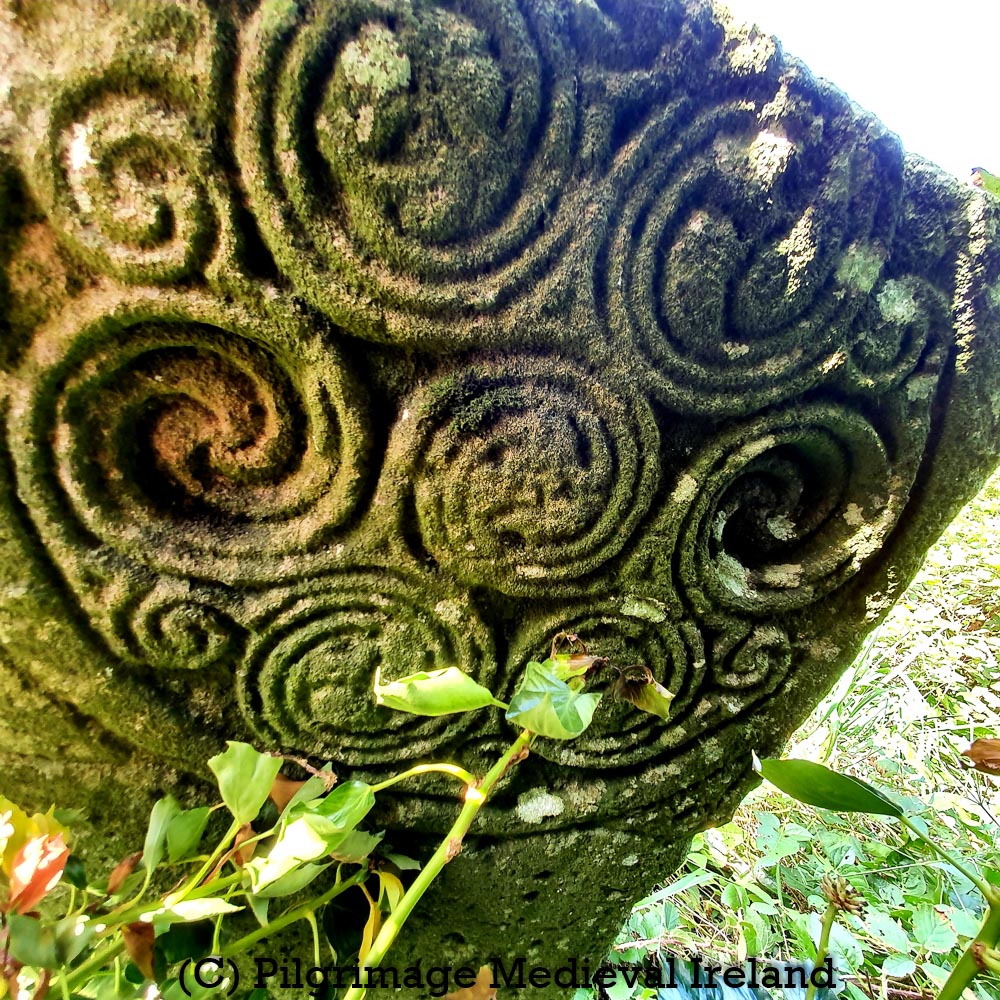
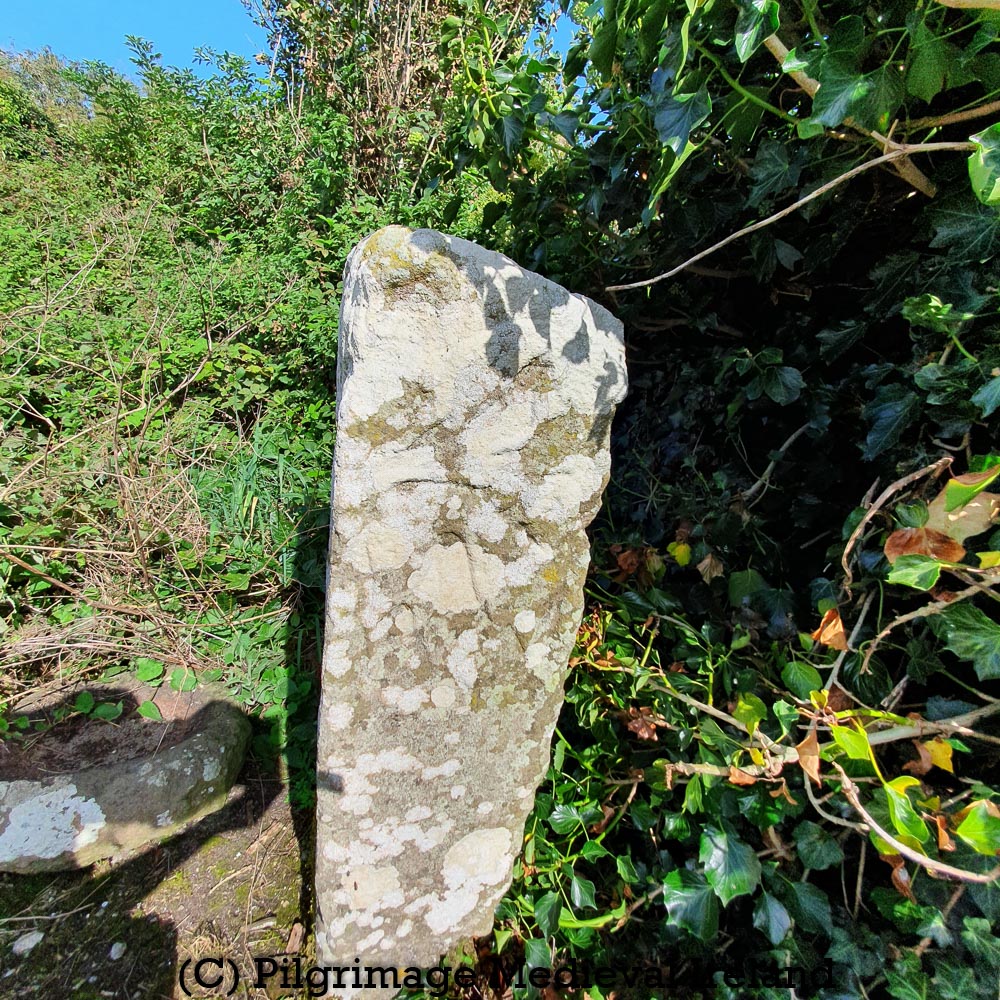
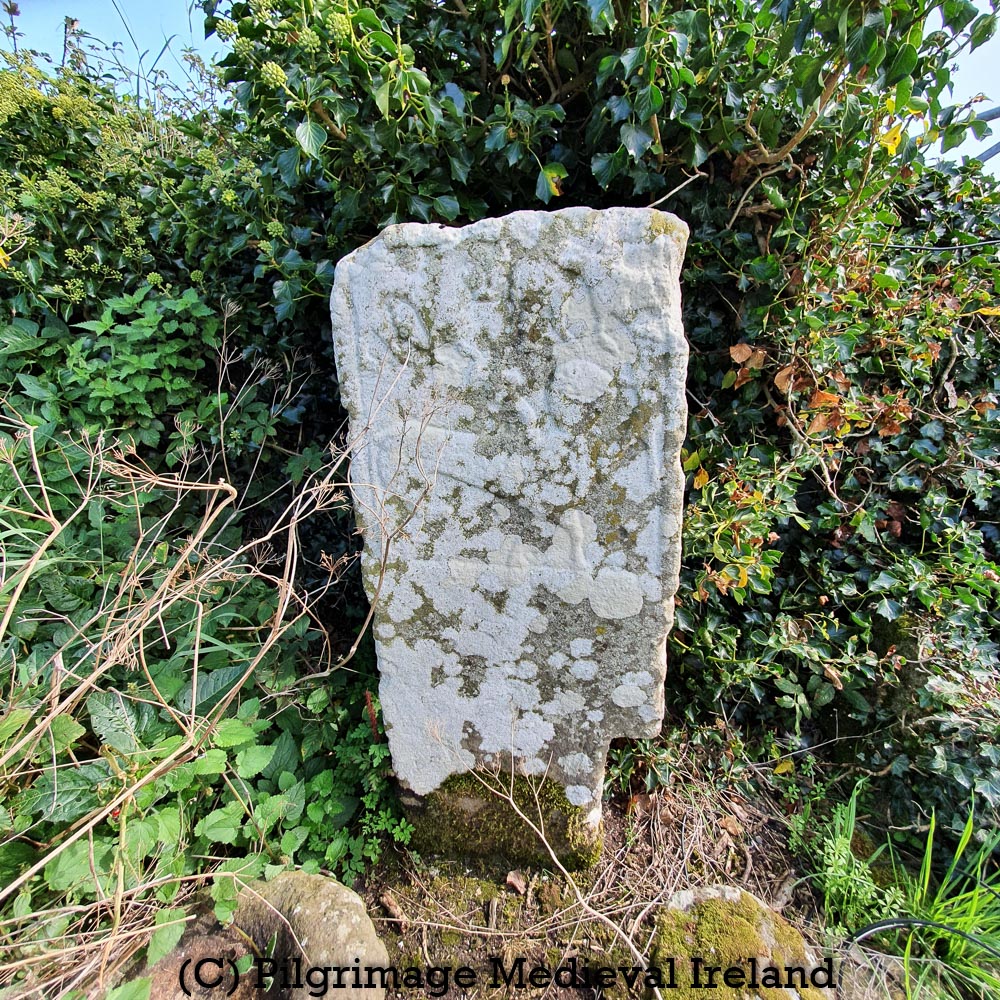
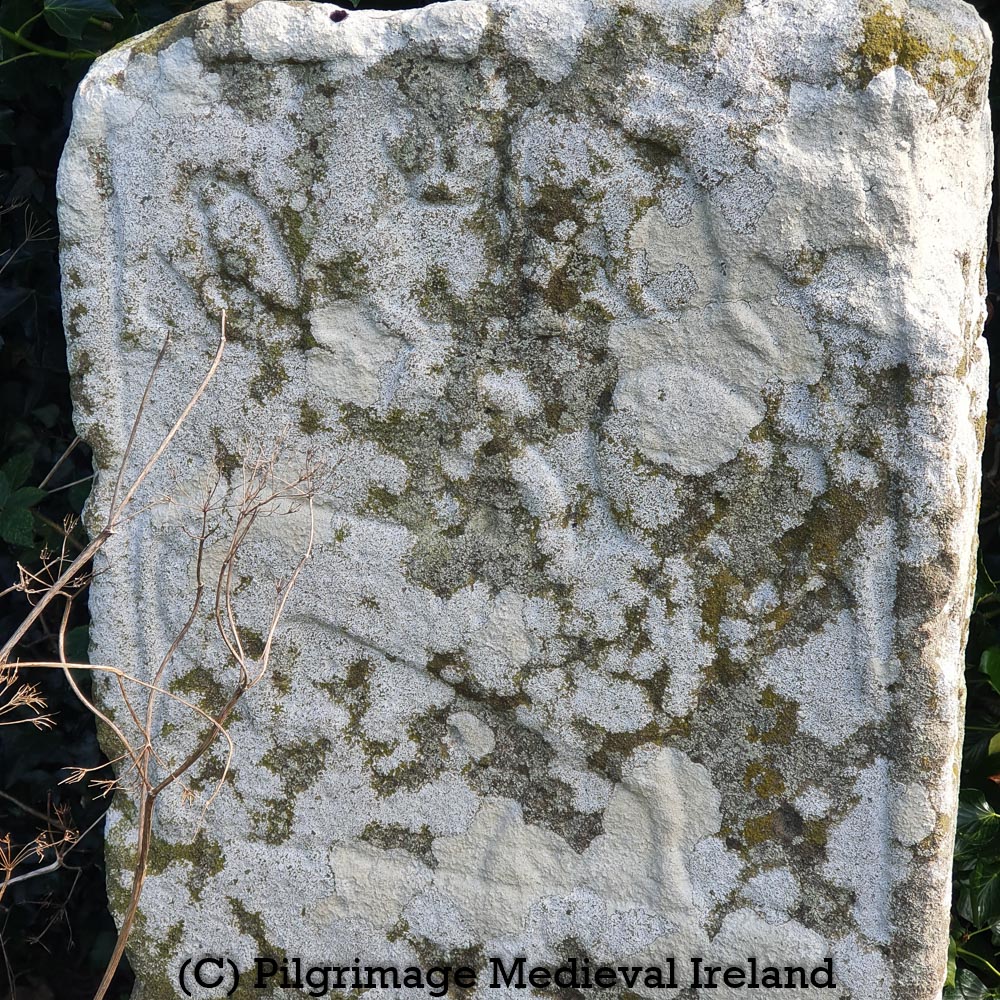
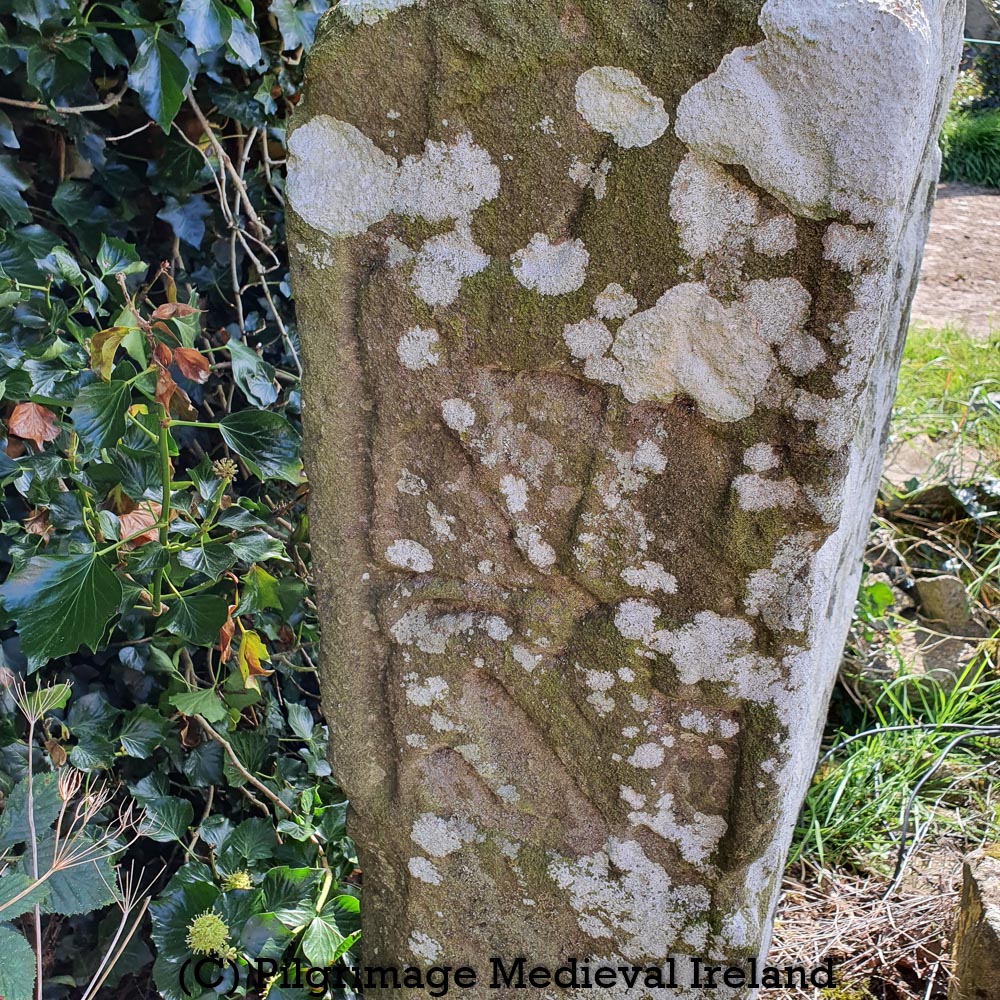
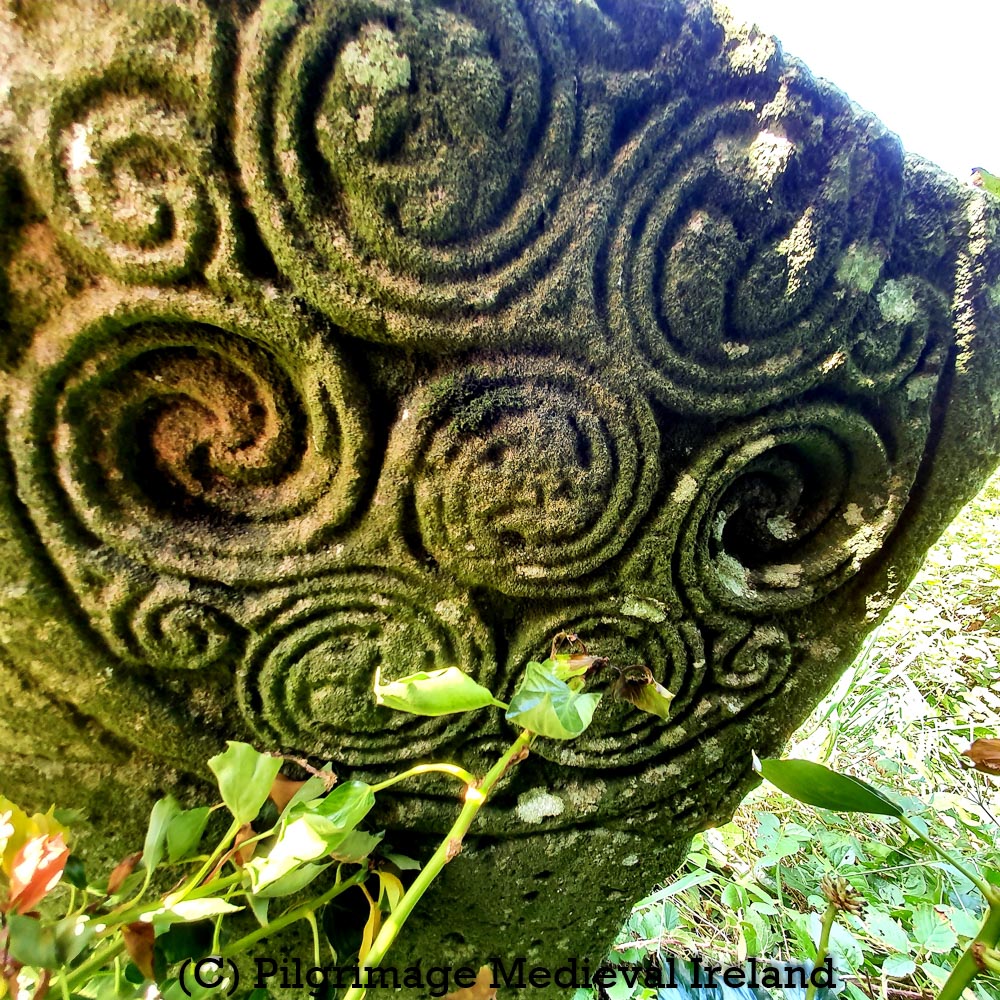
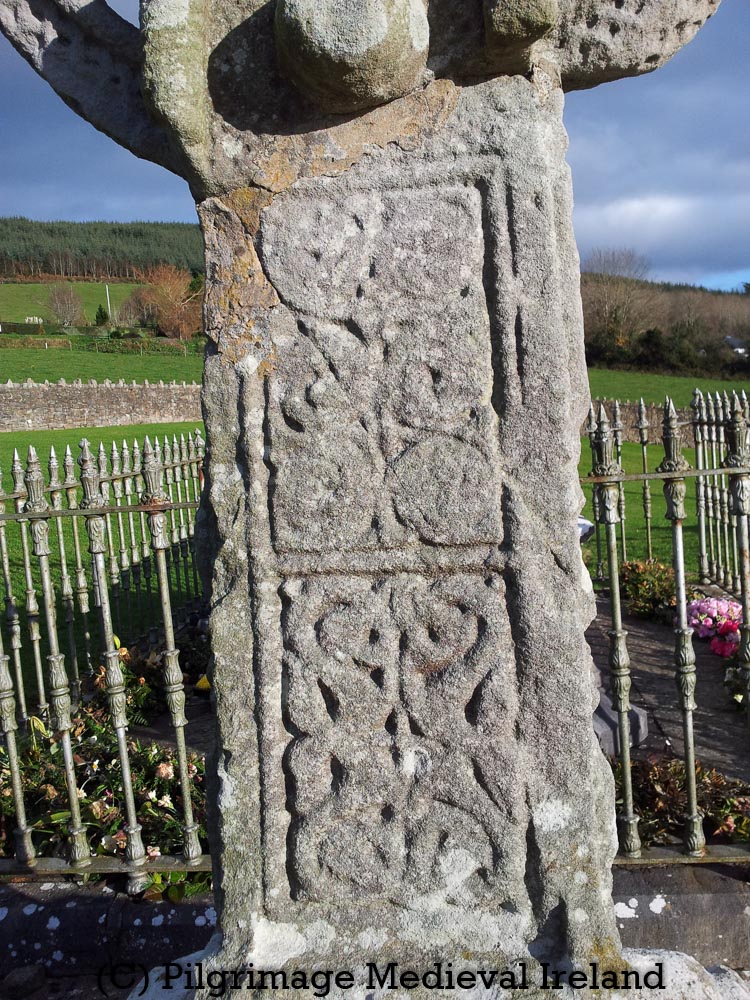
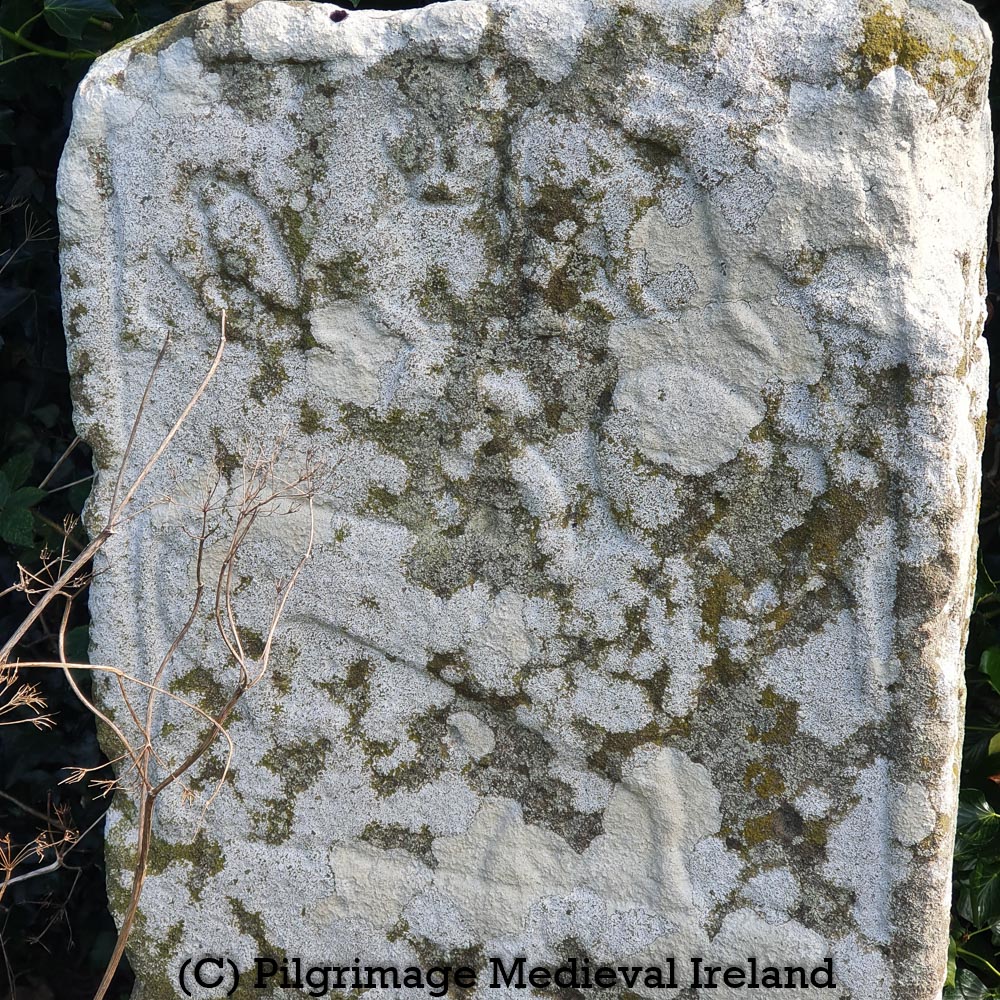
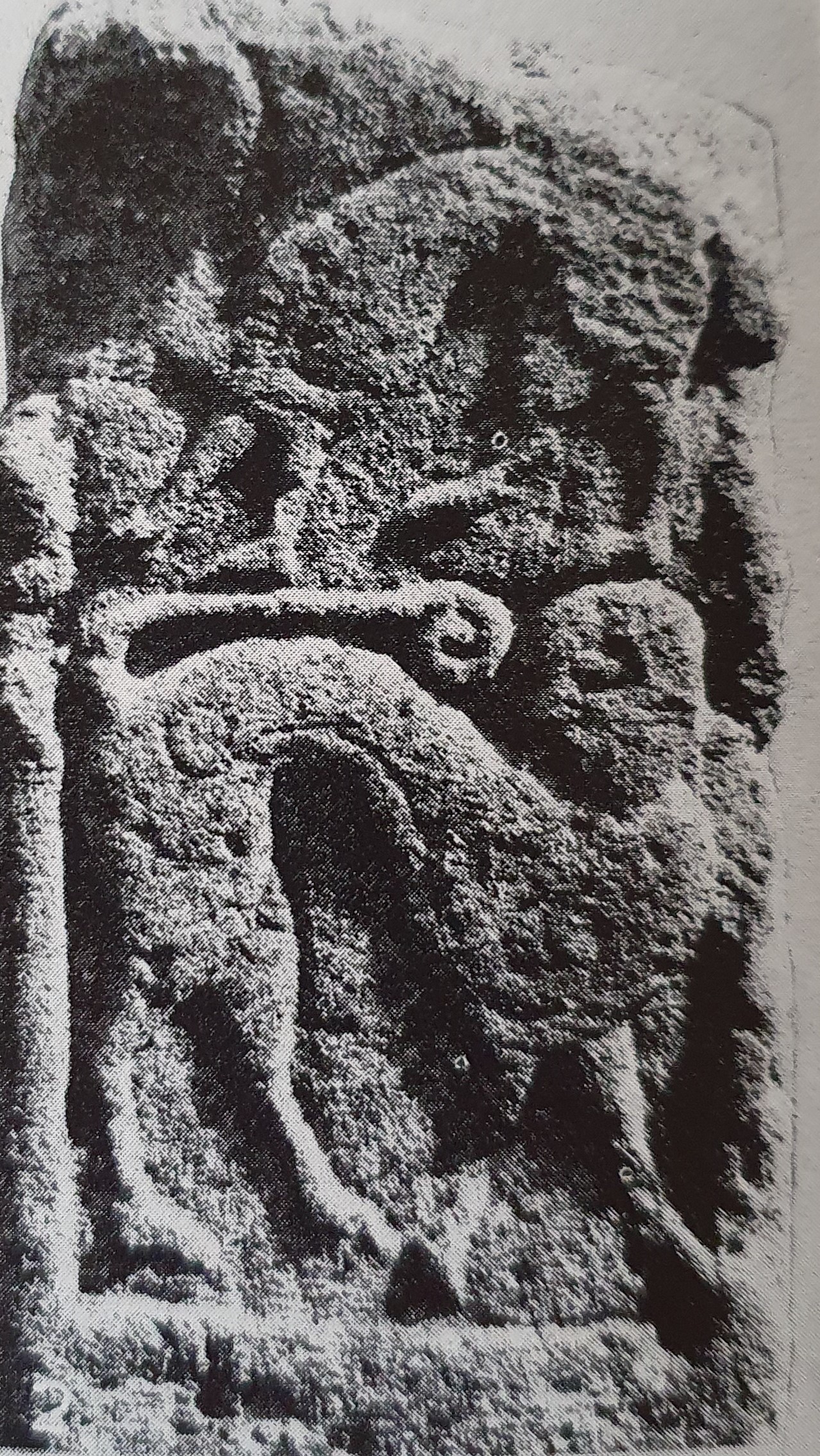
The pillar stone is decorated on all four sides with very elaborate and unusual carvings. The top of the stone appear to have been damaged in antiquity. Unfortunately my photos don’t do justice to the carving on the pillars but at different times of the day the light does brings out many of its details.
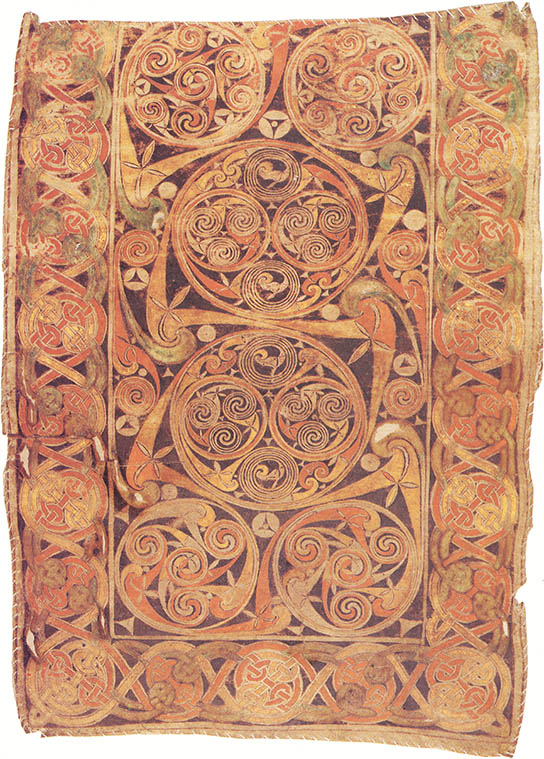
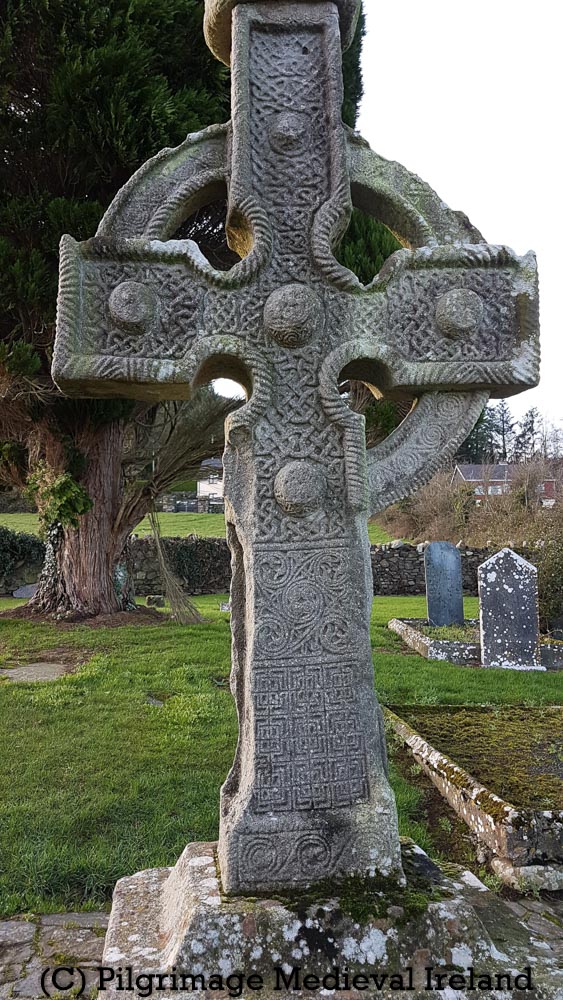
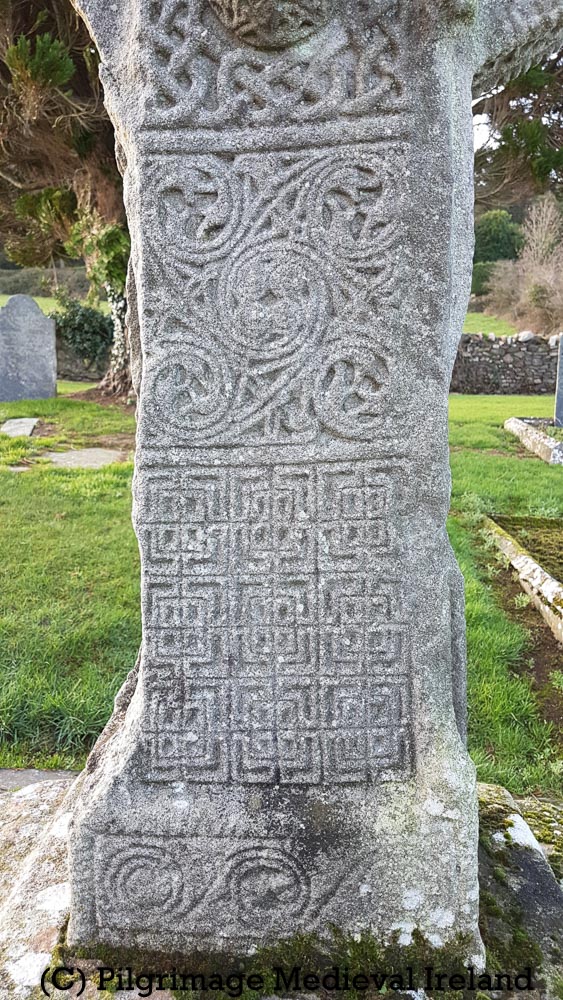
The east face face of the pillar decorated with an elaborate pattern of spirals. The pattern brings to mind spiral designs on one of the carpet pages in the beautiful Book of Durrow.
Similar spiral patterns also appear on the nearby early medieval high crosses at Ahenny Co Tipperary and Kilkieran Co Kilkenny.
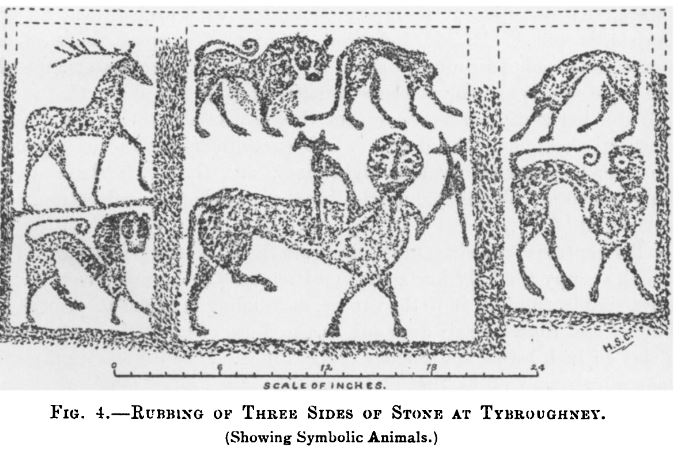
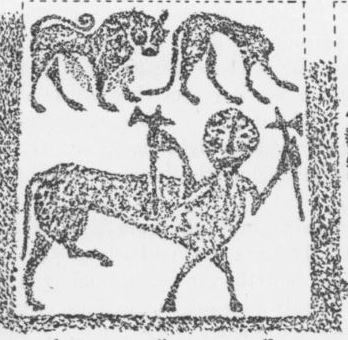
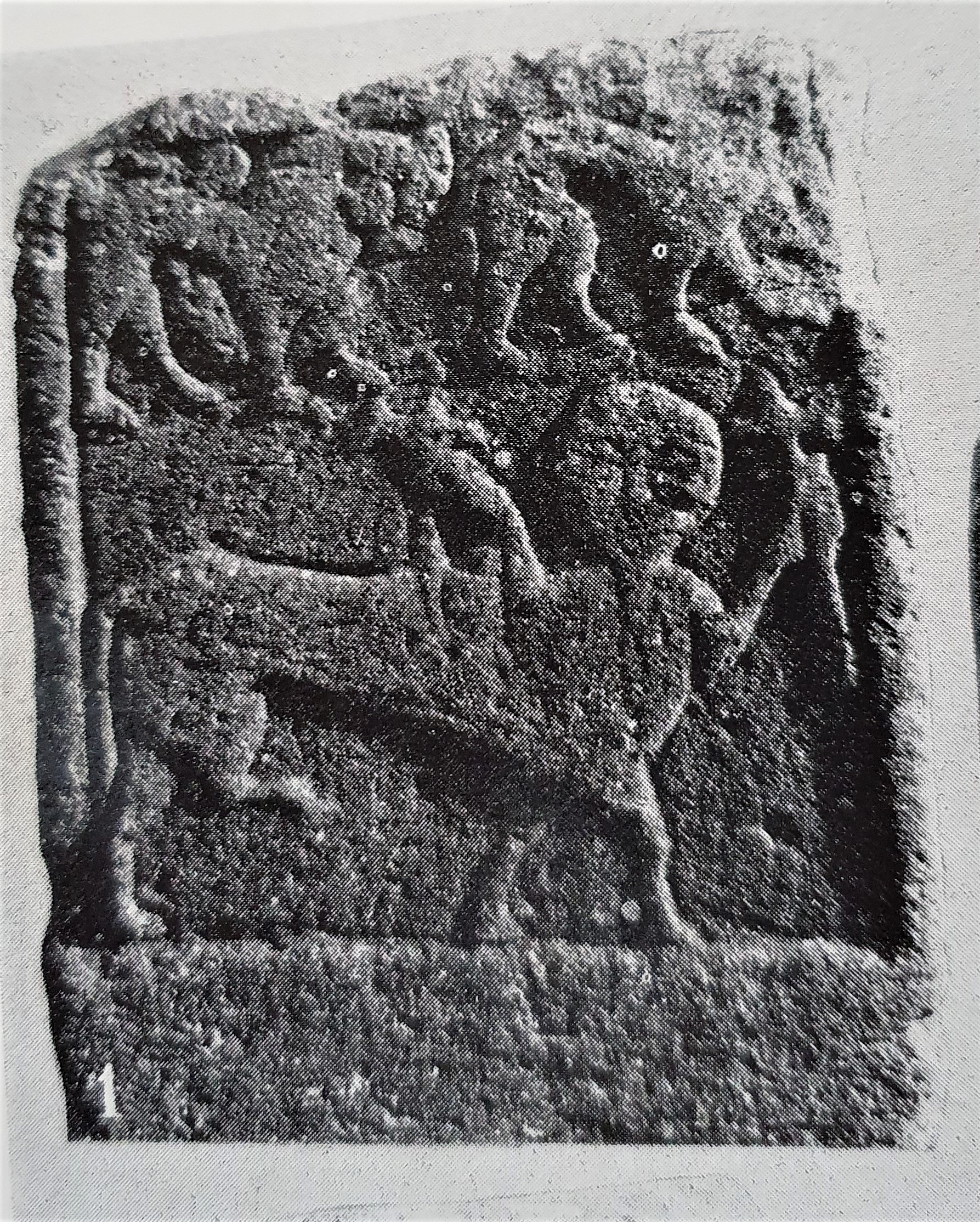
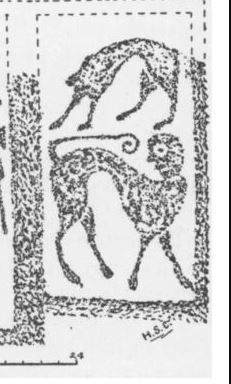
The pillar was drawn in 1908 by Henry Crawford for his article ‘Description of a Carved Stone at Tybroughney, Co. Kilkenny.’ The pillar was also photographed by Helen Role for the book The High Crosses of Western Ossory.
The west face of the Tybroughney pillar has a large creature possible a centaur – a half man and half horse- holding an axe in both its hands. A centaur ‘ by his dual nature was held to symbolise the conflict between Good and Evil’ ( Roe 1962, 33).
Two smaller creatures stand above the main figure, one is a lion and the other is whippet like creature.
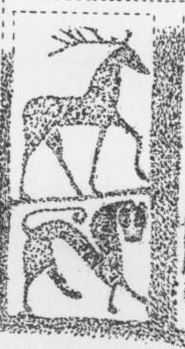
The southern side of the pillar closest to the railway tracks, his two mythical creatures. The lower figure is a manticora – the body of a lion and the head of a man- above the manticore is a ‘whippet-like creature’ ( Roe 1962, 33).
This may possibly be the Hyaena of the Bestiary, which scavenges in burial places and consequently was taken as a symbol of the Devil who battens the flesh of sinners.
(Roe 1962, 33)
The north face of the pillar has two figures, a stag and a lion. The stag ‘has various association, chief of which is as a symbol of Christ and his victory over Satan’ (Roe 1962, 33).
I really think this pillar would be a great candidate for photogrammetry. I hope to pay another visit here again soon to see the holy well so will keep you posted.
Bibliography
Crawford, H. (1908). Description of a Carved Stone at Tybroughney, Co. Kilkenny. The Journal of the Royal Society of Antiquaries of Ireland,38(3), fifth series, 270-277.
Manning, Conleth. “Kilferagh, Co. Kilkenny: a Medieval Parish and Its Church.” The Journal of Irish Archaeology, vol. 21, 2012, pp. 139–156. JSTOR, http://www.jstor.org/stable/jirisarch.21.139. Accessed 10 May 2021.
O’Kelly, O. 1985. The Place-Names of County Kilkenny- The Kilkenny Archaeological Society Rothe House Kilkenny.
Roe, H. M. 1962. High Crosses of Western Ossory. Kilkenny: Kilkenny Archaeology Society,
Over the last few years, I’ve visited alot of holy wells all over around Ireland. St Ailbe’s holy well in the village of Emly Co Tipperary is one of the most interesting.
The village of Emly can trace its origins back to a monastery founded by the Pre-Patrican saint known as Ailbe. The saint’s death is recorded for the year 528 in the Irish annals.
Repose of Ailbe of Imlech Ibuir
The Annals of Ulster 528
His monastery known as Imleach Iubhair ‘the lakeside at a yew tree’ went on to become one of the most important ecclesiastical sites in Munster and in later centuries Emly became a Diocesan centre.
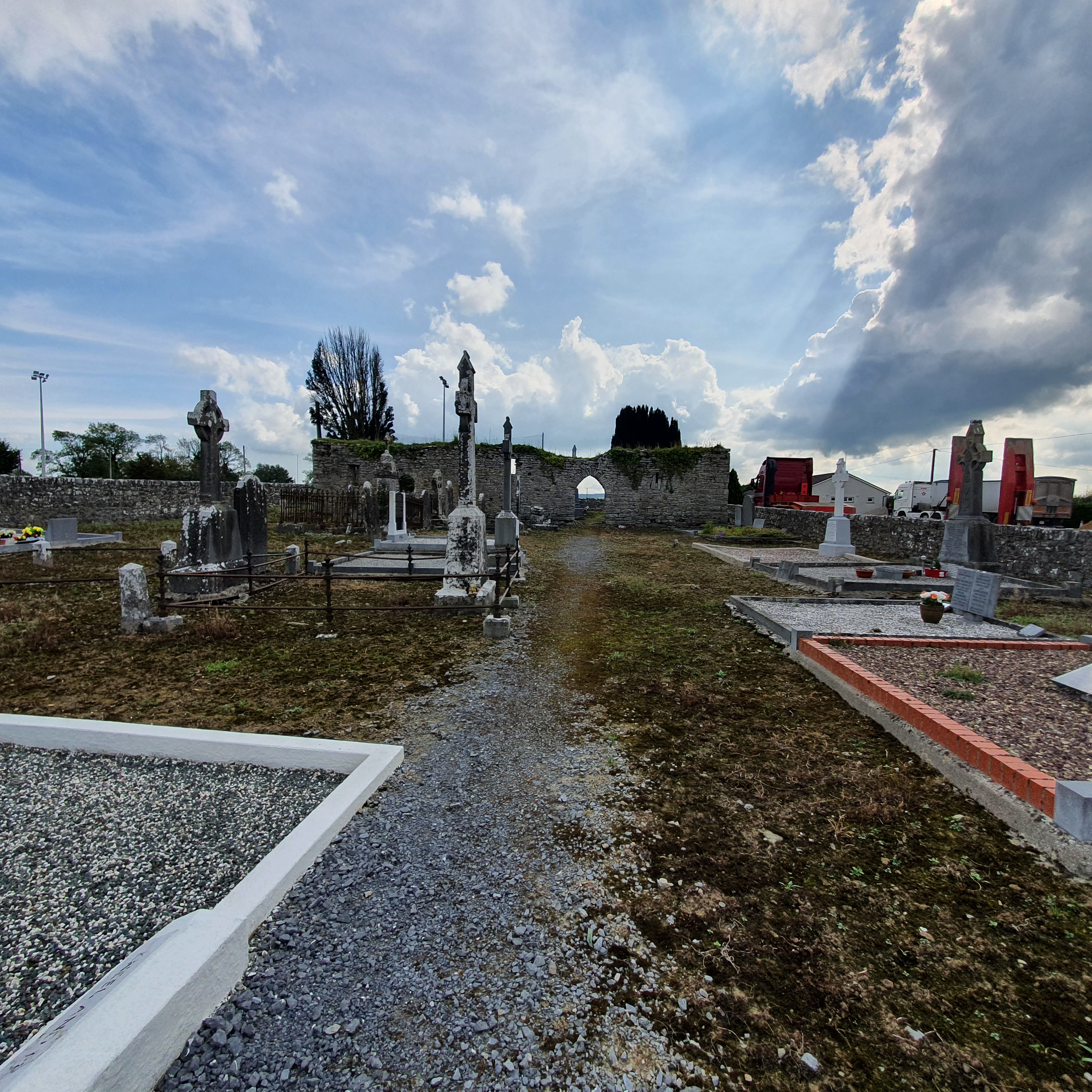
The ecclesiastical site was located at the modern Catholic church and graveyard. Unfortunately little of the early or medieval ecclesiastical remains have survived.
St Ailbe’s Catholic Church Emly
The annals provide some insight into what Emly would have looked like. In 1058 the great stone church (daimhliag) and the round tower (cloictheach) were burnt.
Imleach-Ibhair was totally burned, both Daimhliag and Cloictheach.
Annals of the Four Masters 1058
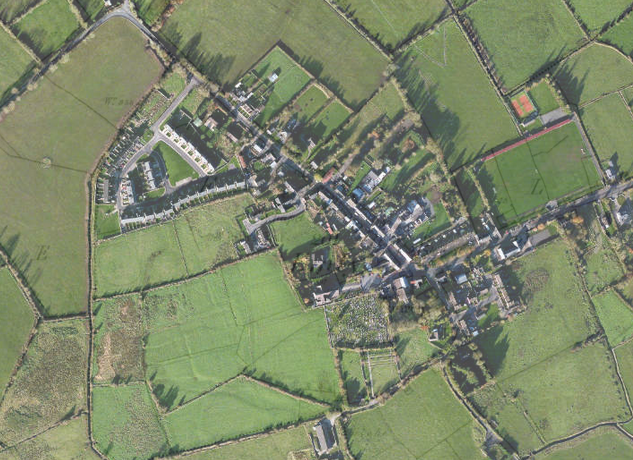
A circular enclosure surrounded the main ecclesiastical buildings. The outline of the enclosure is still preserved in the modern road and field pattern surrounding the catholic church (Farrelly 2014).
Aerial view of the village of Emly Bing Maps
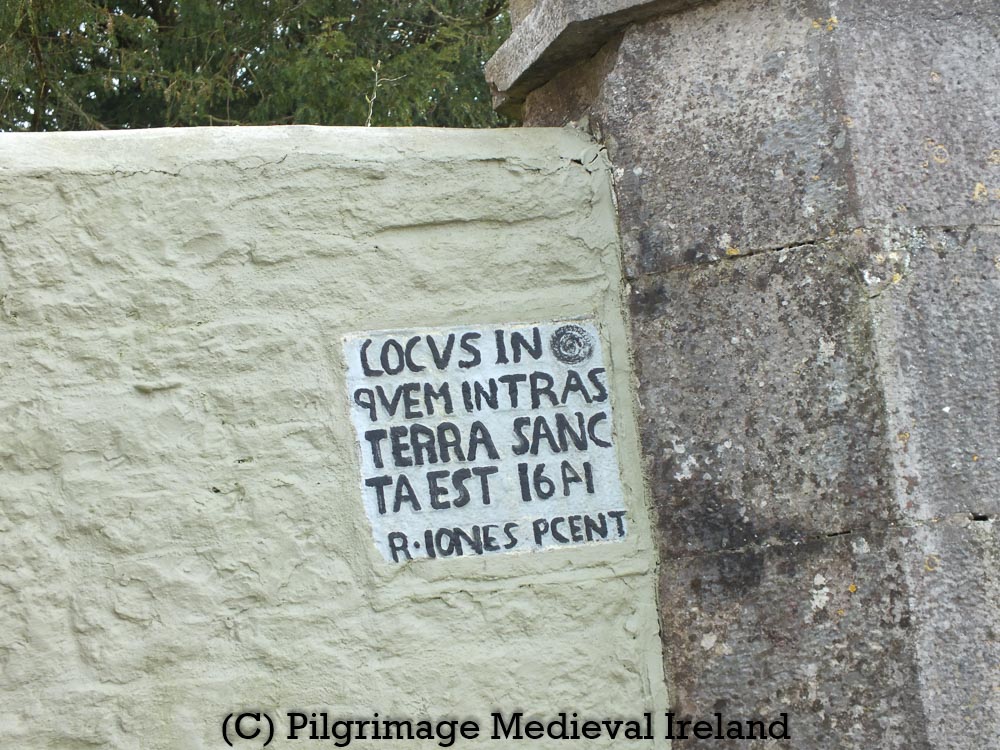
Further traces of the medieval past survive in architectural fragments incorporated into the modern graveyard wall. A stone plaque close to the main entrance to the graveyard and church which bears the inscription
LOCVS IN QVEM INTRAS TERRA SANCTA EST 1641 R. IONES PCENT
The inscription roughly translates as ‘The place wherein you enter is holy ground’ (Farrelly 2014 after pers. comm. Gerard Crotty).
Plaque with inscription LOCVS IN QVEM INTRAS TERRA SANCTA EST 1641 R. IONES PCENT’ located close to the entrance to Emly church and graveyard.
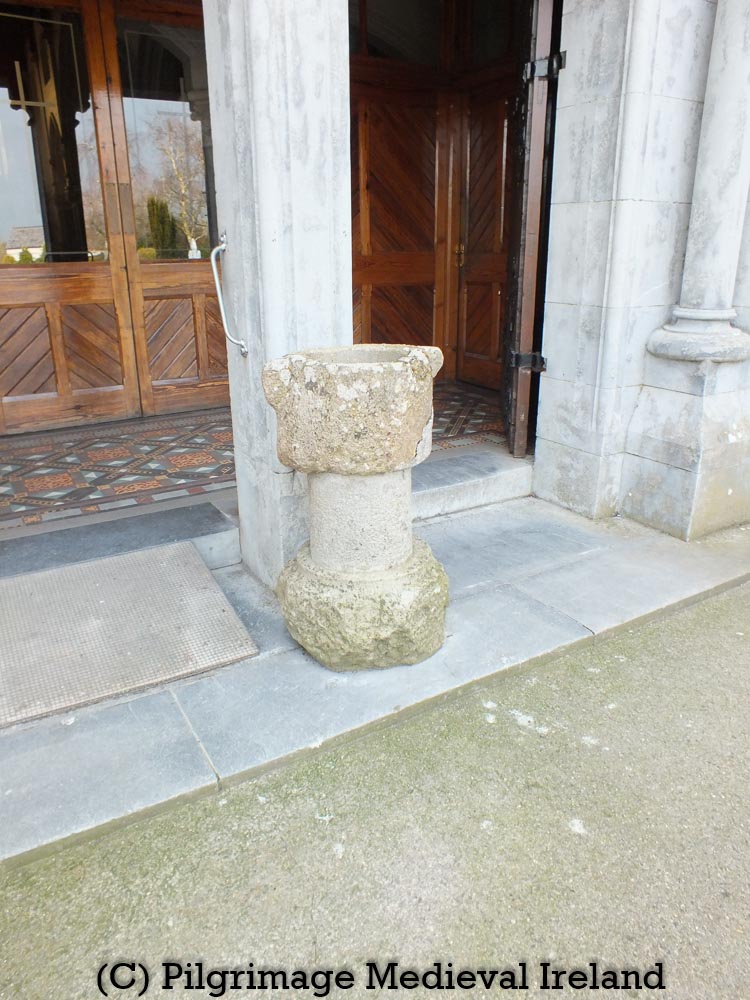
A medieval stoup, ‘consisting of bowl, shaft and base, composed of a conglomeration of sandstone, granite and quartz’ sits at the east door to the modern church (Farrelly 2014).
Medieval Stoup at eastern doorway at St Ailbe’s church Emly
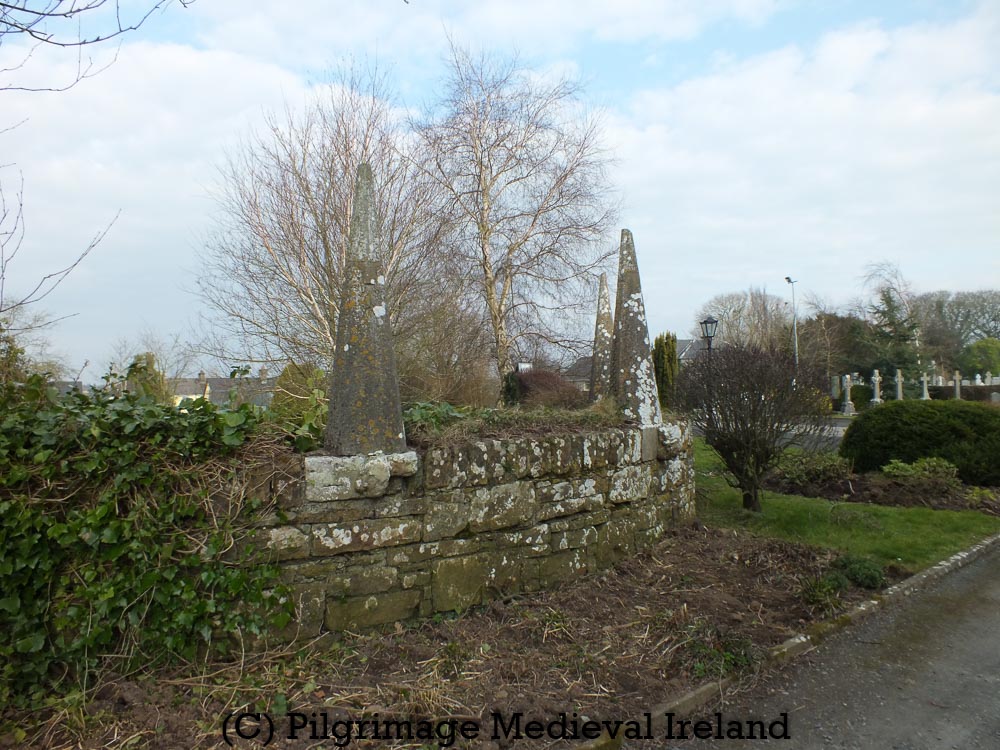
The wall to the right of the entrance to the east end of the church incorporates two carved heads from the former medieval cathedral, along with the base of a medieval graveslab. All date to the 13th/14th-century (Farrelly 2014).
Medieval carved stone heads and graveslab in the wall opposite east door of the modern church.
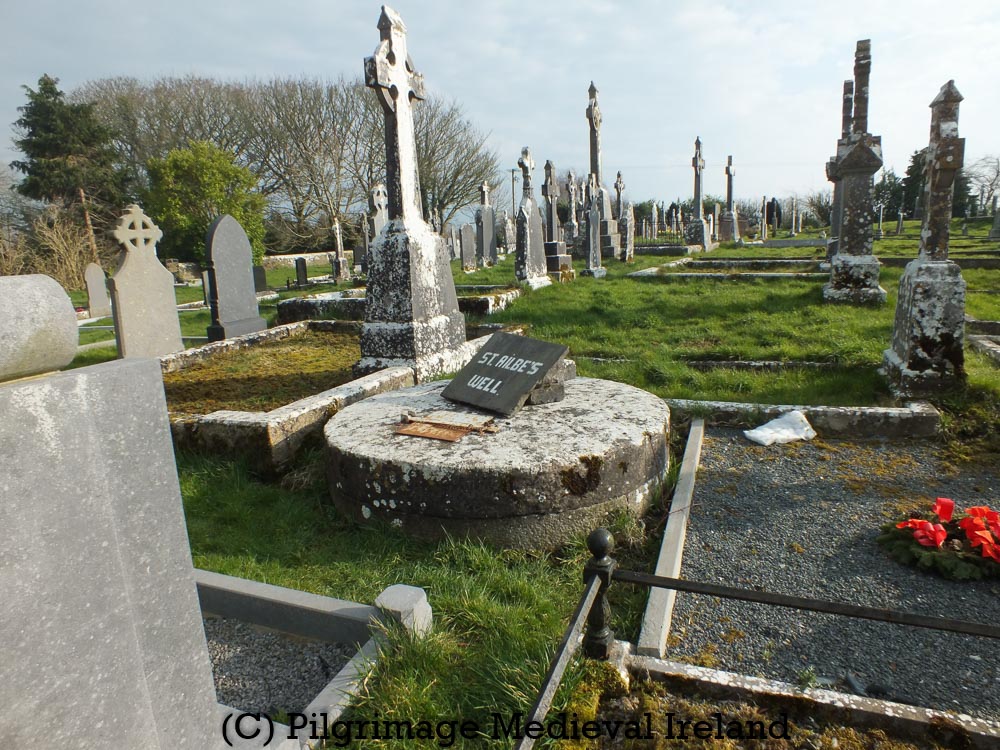
St Ailbe’s holy well can be found in the north-eastern corner of the graveyard. It was probably used as a water source for the religious community. In 1898 the well supplied the surrounding village with water.
Image of St Ailbe’s holy well 1898 from Journal of the Cork Historical and Archaeological Society, 1898, Vol. 4, No. 39 page 174.
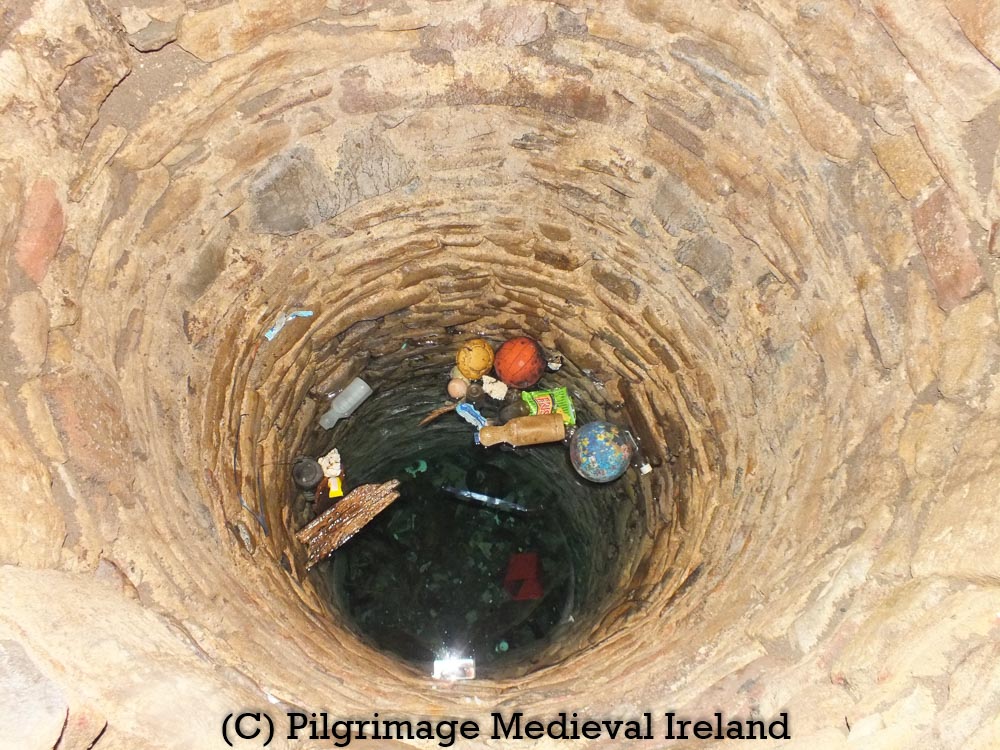
St Ailbe’s well is a very deep spring found at the base of 5m deep circular dry-stone lined shaft (internal diameter of 1.2m). The Ordnance Survey Letter for County Tipperary written in the 1840’s suggests the well was 7m deep. The upper section of the shaft was replaced in the nineteenth century by a cut limestone surround. Accounts from the late 1890s recall that a railing surrounded the well.
St Ailbe’s holy well Emly
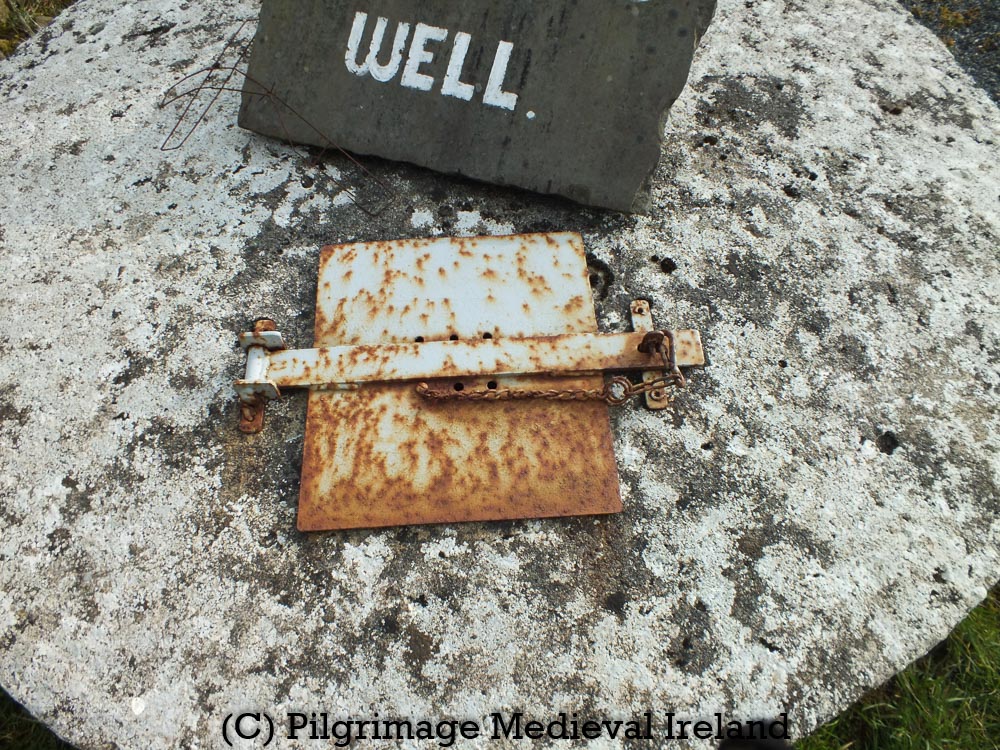
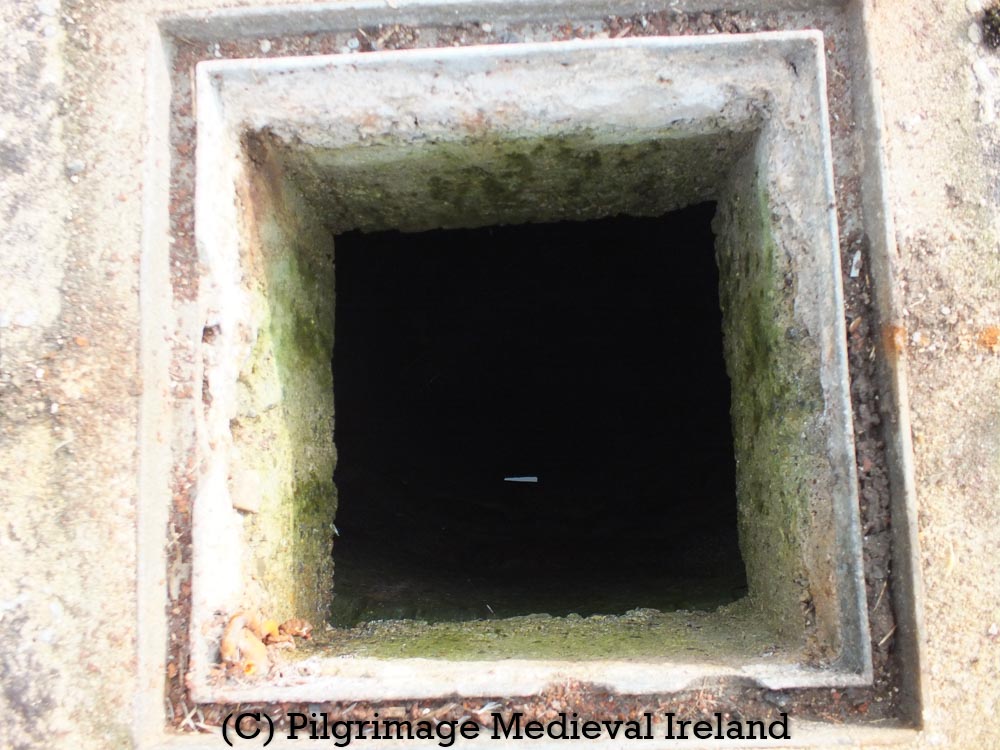
During the twentieth century the top of the well was covered by low concrete capping, incorporating a metal door/hatch. Today hatch provides a view into the interior of the well.
St Ailbe’s holy well
Due to the depth of the well a torch is required to see the interior in any detail . At the base of the well you can still see the water.
View into St Ailbe’s holy well
According to folklore the well was formed when
St. Ailbe jumped from the top of the hill of Knockcarron to where the well stands now and that is what caused the well to be there.
Archival Reference The Schools’ Collection, Volume 0580, Page 013
The well is still visited by local people throughout the year but rounds are no longer performed.
View of interior of St Ailbe’s holy well with flash
I have not come across any medieval references to pilgrimage at the well. Rounds were performed by pilgrims up to the middle of the twentieth century. Local folk memory recalls that a pattern day was held at the well on the 12th of September, the feast of St Ailbe.
Local memory and historical sources suggest that in the past the pilgrimage rituals were focused on the holy well and an early medieval cross, known as St Ailbe’s Cross. The cross is located a short distance from the well.
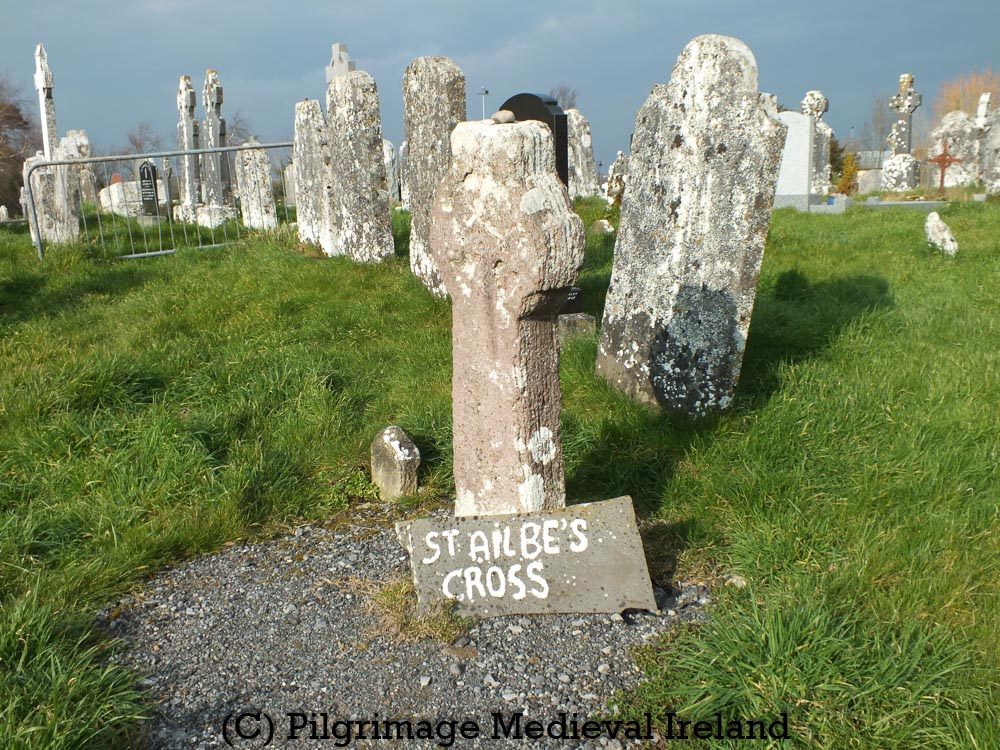
St Ailbe’s Cross Emly
Tradition held that the cross marked the saints grave (The Schools’ Collection, Volume 0580, Page 011). The cross is made of sandstone and has an imperforate ringed cross. A small stone sits on top of the cross.
In the past pilgrims traditionally visited the holy well on the feast day of St Ailbe or within the Octave of his feast day.
In the 1930’s, pilgrims began their prayers by saying five Our Fathers and Hail Marys at the holy well. They then recited three rosaries while walking around the graveyard. If the pilgrim visited on a day other than the feast they carried out the same prayers at the holy well but recited nine rosaries while walking clockwise around the graveyard. Other accounts recall pilgrims walking around the well nine times and every three times they circle the well they say the rosary. They then made five rounds around the graveyard reciting the rosary on each round.
Pilgrims also visited St Ailbe’s cross. Its was tradition for all who passed the cross to make Sign of the Cross.
The Sign of the Cross is made by the people on it with three stones which are laid on top of it. Long ago the people used swear by the Holy Stone of Emly. Every time people respect it as they pass it by carving a cross on it with stones.
The Schools’ Collection, Volume 0580, Page 016
The cross was also said to cure back pain when the back was pressed against the cross and a prayer to the saint uttered. People without back pain performed the same ritual to strengthen their backs.
When a person has a pain in his back he would get it cured by putting his back against the stone and praying to St Ailbe. When a person has no pain in his back and to do the same it would strengthen his back.
The Schools’ Collection, Volume 0580, Page 016
The waters of the well are said to be a cure for rheumatism and also to repeal birds from damaging crops.
People take the water from the well to drink. When St Ailbe was young he was sent into a garden to keep birds off of it and since that people go to the well, and take water from it and sprinkle it on the corn to keep the birds away.
The Schools’ Collection, Volume 0580, Page 013
Although there are no records relating to pilgrimage during medieval times, Emly would surely have possessed relics of the saint and attracted pilgrims. Perhaps the tradition of devotion to the holy well and cross may be much older then the nineteenth century.
Long, R. H. 1998. ‘Cashel and Emly Diocese. With a pedigree of Cellachan, king of Cashel, and an account of some other kings of Munster’ Journal of the Cork Historical and Archaeological Society, 1898, Vol. 4, No. 39, 170-185.
O’Dwyer, M. and O’Dwyer, L. 1987. The parish of Emly: its history and heritage.
O’Flanagan, Rev. M. (Compiler) 1930 Letters containing information relative to the antiquities of the county of Tipperary collected during the progress of the Ordnance Survey in 1840. Bray.
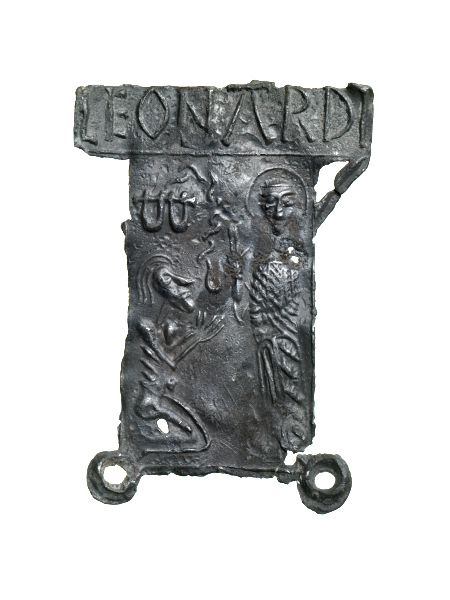
St Leonard (St Léonard-de-Noblat) was a sixth century Frankish hermit. He went on to become a very popular medieval saint. The saint’s primary shrine was found at Noblat in France. Over the centuries vast numbers of people from all over Europe made pilgrimage here. Devotion to the saint was enhanced by his shrine’s location on the Via Vézelay – a well trodden pilgrimage route- to the St James in Santiago de Compostela in Spain.
St Leonard was the patron saint of imprisoned people and women in labour. Medieval descriptions of his shrine recall that it was adorned with offerings of iron chains and shackles left by pilgrims who believed they were released them from their captivity due to the saint’s intercession (Gerson et al 1998, 47).
St Leonards cult also came to Ireland but never achieve a widespread popularity. A holy well dedicated to St Leonard can be still be found in the village of Dunnamaggin Co Kilkenny.
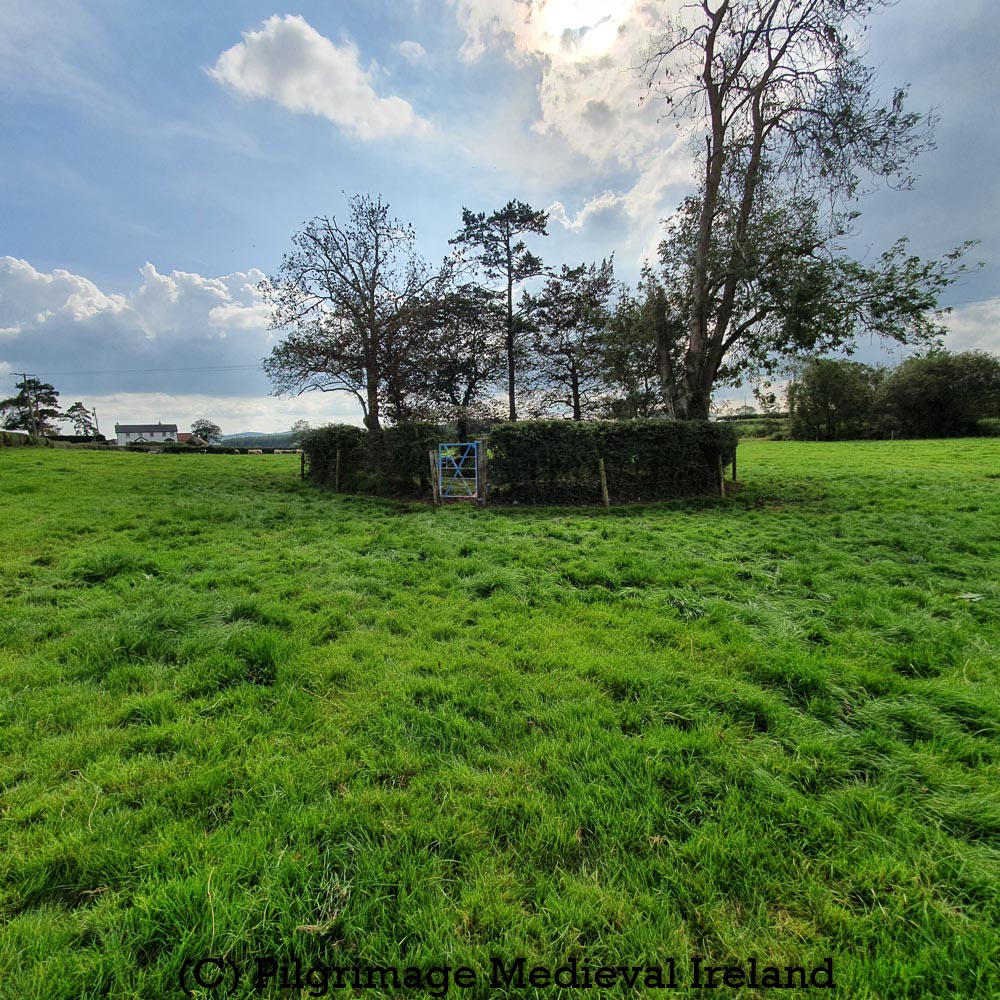
St Leonard’s Holy well Dunnamaggin Co Kilkenny surrounded by a circular hedge
I have come across only two other dedications to the saint. The first, St. Leonard’s Priory, a monastery of Fratres Cruciferi or Crutched Friars, was established in the medieval town of Dundalk in the twelfth century. The priory was, founded by Bertram or Nicholas de Verdun and was situated in the grounds of the present county library. The second dedication was located in the medieval town of Waterford where a chapel dedicated to St Leonard was located in the Benedictine priory. The saint’s feast day was also recorded in The Book of Obits and Martyrology of Christ Church Cathedral, Dublin where the last entry for November 6th reads
Et sancti Leonardi abbatis et confesson
Crosswaith 1844, 71
St Leonard’s cult probably arrived in Dunnamaggin area with the Anglo-Normans. The holy well is located a short distance from the ruins of the medieval parish church of Dunnamaggin, also dedicated to St Leonard.
Medieval parish church of Dunnamaggin
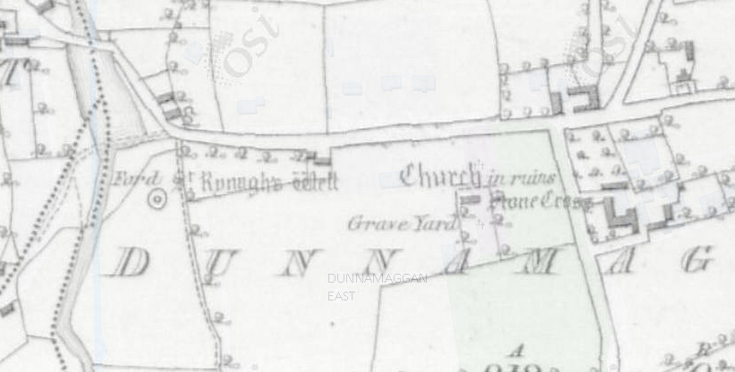
The 1st edition ordnance survey 6 inch map for the area tentatively point to another cult associated with the well. The well is clearly marked as St Rynagh’s well on the map.
1st edition 6inch maps showing St Leonard’s holy well marked as St Rynagh holy well OSI map.
Rynagh is the anglicisation of Ríoghnach. The saint may be the early medieval female saint, Rioghnach of Kilrainy in Co Kildare. Interestingly the contemporary Ordnance Survey Letters of Kilkenny written in 1839 only associated the well with St Leonard and makes no mention of St Rioghnach at all. She is not mentioned in Carrigan’s The history and antiquities of the diocese of Ossory either or in any local folklore sources.
The well is located in a field beside the main road through Dunnamaggin village. The field can be easily accessed through a style in the boundary wall.
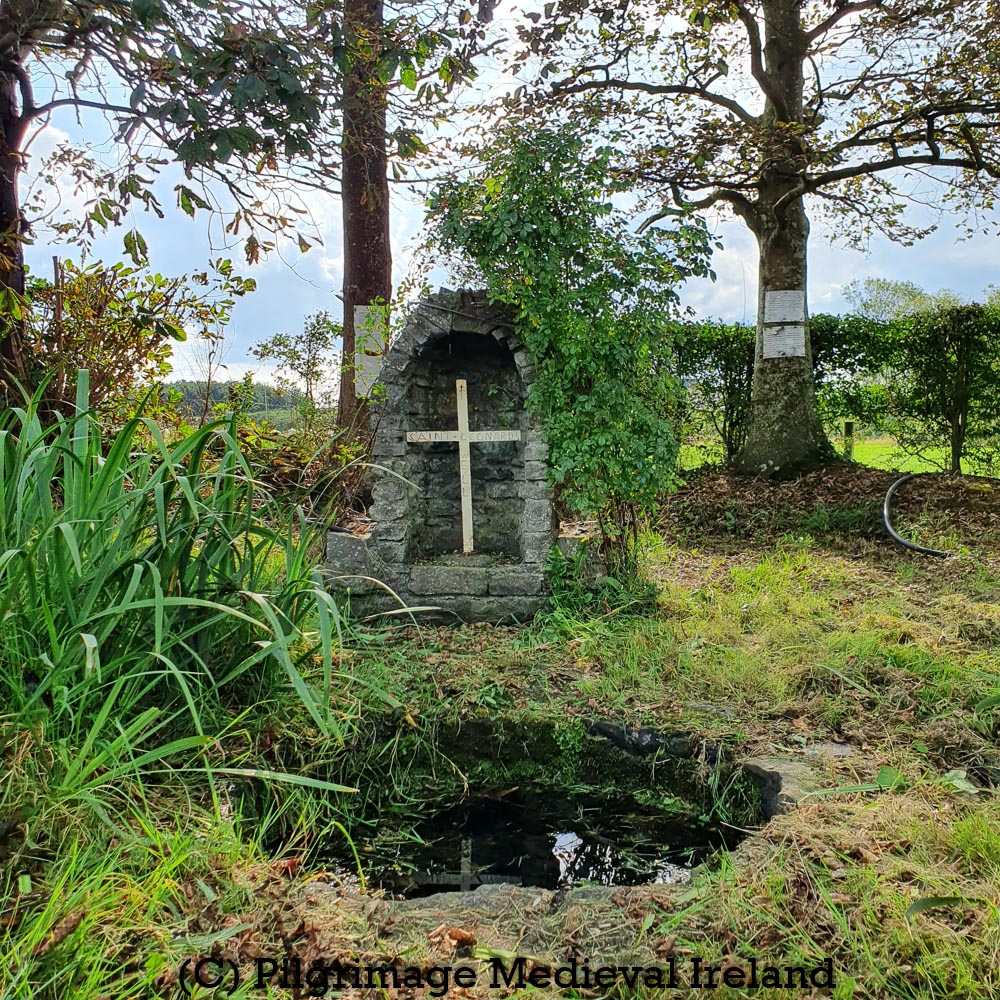
St Leonard’s Holy well Dunnamaggin Co Kilkenny is surrounded by circular hedge
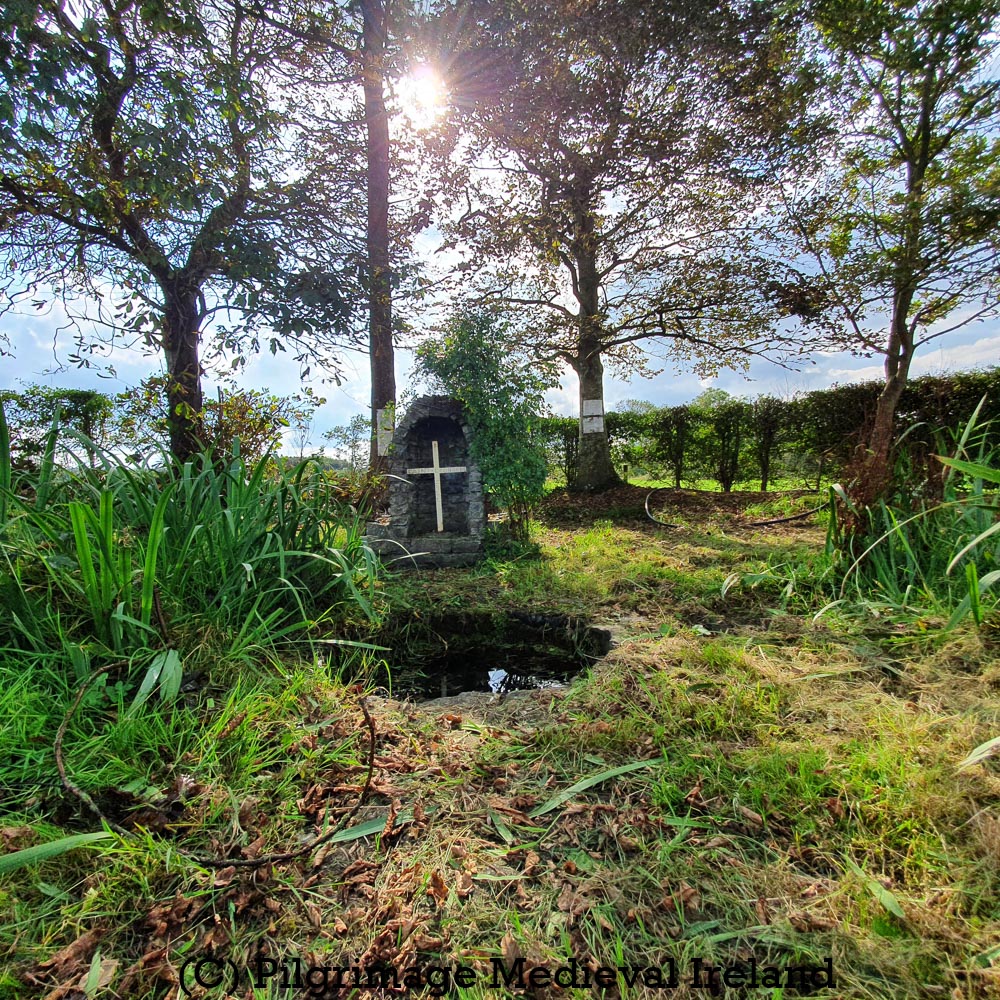
The well is enclosed by a circular hedge and a small metal gate provides access to the interior. The hedge respects the line of an earlier circular enclosure, which was ‘ almost levelled’ by the 1900’s (Carrigan 1905, 38).
The holy well is a natural spring. Its waters fill a circular stone lined hollow set flush to the ground. On one side there is a over flow which takes the water into a stone drain.
ISt Leonard’s holy well Dunnamaggin
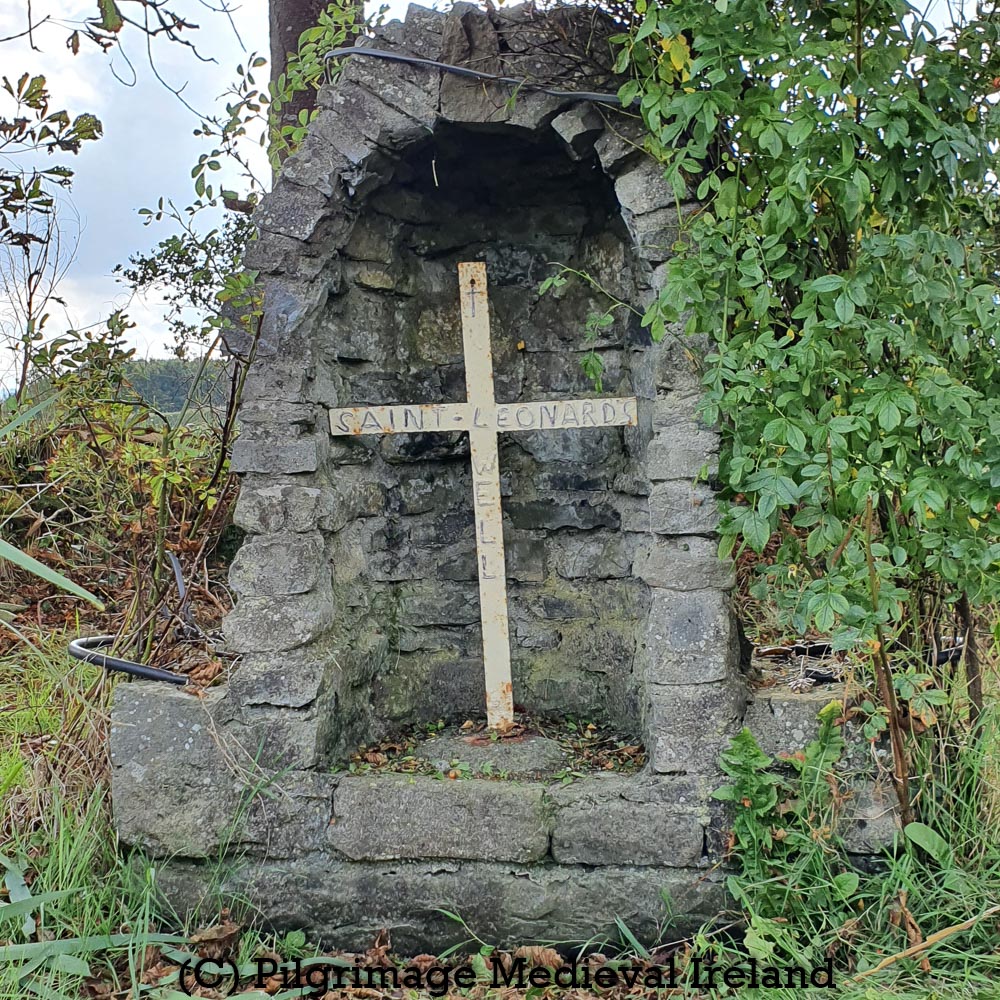
The well is over looked by a modern statue niche now filled by a metal cross bearing the saint’s name and a number of mature trees.
Statue niche at St Leonard’s holy well.
Some years ago the well was restored by the current land owner and a local committee. It is very clear that the well and surrounding area are maintained on a regularly basis, the day I visited the grass had been recently cut.
St Leonard’s holy well
The schools collections, local folklore and antiquarian sources record a number of traditions associated with the well. Like many other Irish wells it was said the water would never boil.
Another tradition held that St Leonard provided protection to local people from lightening.
St. Leonard prayed that no one within three mile of Dunnamaggin would be struck by lightning. His prayer was granted.
The Schools’ Collection, Volume 0853, Page 069
The well was once the focus of great devotion but was in decline by the mid-19th century. According the Ordnance Survey Letters 1839
There was a patron held here formerly, on Saint Leonard’s day, but what day that was nobody now remembers.
Ordnance Survey Letters [92-93]
It is not entirely true that the saints feast day was forgotten the schools collection for Dunamaggin school from the 1930s mention that
until recent years a pattern used be held there annually on the 6th November.
The Schools’ Collection, Volume 0853, Page 068
The 6th of November is the feast day of the saint. The schools essays for Newtown, Kells also note
The well was visited by people on the second or third Sunday in November and there are prayers said there by the people who visit it.
The Schools’ Collection, Volume 0858B, Page 02
Pilgrimages were also made in the summer months
Kilmaggany people visited it (St Leonard’s Well) during the month of July and took a drink of the water & washed their feet in the stream which flows from the well. It was believed to cure pains in the limbs.
The Schools’ Collection, Volume 0852, Page 294
Other cures are associated with the well’s waters include a cure for sore eyes.
The water would cure sore eyes when washed three times on different days. There is a big flag-stone at the side of the well.
The Schools’ Collection, Volume 0852, Page 295
The pilgrim landscape extends beyond the well and includes a tree called St. Leonard’s Tree. I didn’t have time on my visit to find the tree. In times gone by pilgrims visited the tree as part of their pilgrimage rounds. Carrigan noted that mass used to be celebrated beneath it. Like a number of other holy trees it was believed to have protective properties
Until recent years natives of the place would never think of emigrating without bearing away with them a sprig or chip cut from Crownsanleeanarth [name for the tree], as a preservative against shipwreck on their voyage to foreign lands.
Carrigan 1905, 38
During the cholera epidemic of 1832
people carried about with them little scraps from the bush to save themselves from the prevailing epidemic.
Carrigan 1905, 38
In the past people often turned to holy wells in times of crisis and outbreaks of disease. The well house at Abbeys well, in the parish of Kilshannig in North Cork was built in the 1870’s to give thanks for the saint expelling disease from the parish. Over the door is a stone plaque that reads “St, Abigal Expelling The Plague A.D. 1872,”
Carrigan in 1905 notes the order of the former rounds undertaken by pilgrims.
The pilgrimage used to begin within the enclosure, at the well ; was continued thence to the road ; and then along the road, to the present chapel, where it ended.
Carrigan 1905, 38
This is confirmed by the schools collections.
Rounds were made there long ago – people used go from the Well to the Church.
The Schools’ Collection, Volume 0852, Page 293
An alabaster statue of the saint was discovered at well in the 1800s and was then given to the care of St. Kieran’s College but is now in possession of the current owner of well.
In 1800, Brennans found a stone statue, which they kept in Dunnamaggan, in the well. It is about one foot high & represents a bishop dressed in sacred vestments & holding a staff in his left hand. The head was broken off & lost. The statue is the same as that on the foot of the Dunamaggan Cross. In 1875, Mr James Brennan handed it over to St Kieran’s College Museum where it is still to be seen
The Schools’ Collection, Volume 0852, Page 293
Carrigan noted that after the statues discovered before it was given to St Kierans College it was used to swear upon. There are many medieval references to medieval statues and relics being used in oath taking.
… in cases of dispute among the neighbours, the contending parties were accustomed to make declarations with hand placed upon this statue, believing that testimony thus given had all the binding force of an oath.
Carrigan 1905, 38
The radio station KCLR has a made a lovely radio documentary about the well which is worth taking a listen to.
Carrigan, W. 1905. The history and antiquities of the diocese of Ossory. Dublin : Sealy, Bryers & Walker.
Crosswaite, J. 1844. The Book of Obits and Martyrology of the Cathedral Church of the Holy Trinity: Commonly Called Christ Church. Dublin. For the Irish Archaeology Society.
Curran, A. 1971.“The Priory of St. Leonard, Dundalk.” Journal of the County Louth Archaeological and Historical Society, vol. 17, no. 3, 131–140.
Gearson, P., Krochalis, J., Shaver-Crandell, A. and Stones, A. 1998. The Pilgrim’s Guide to Santiago de Compostela: A Critical Edition. London: Harvey Miller.
Hennig, J. 1944. “St. Leonard in Ireland.” Journal of the County Louth Archaeological Society, vol. 10, no. 4, 297–301.
Herity, M. (ed) 2003, Ordnance Survey Letters Kilkenny. Dublin: Four Masters Press.
St David’s holy well -Tobar Chinnín Dháithí – is one of my favourite holy wells in the whole country. This isnt a statement I make likely.
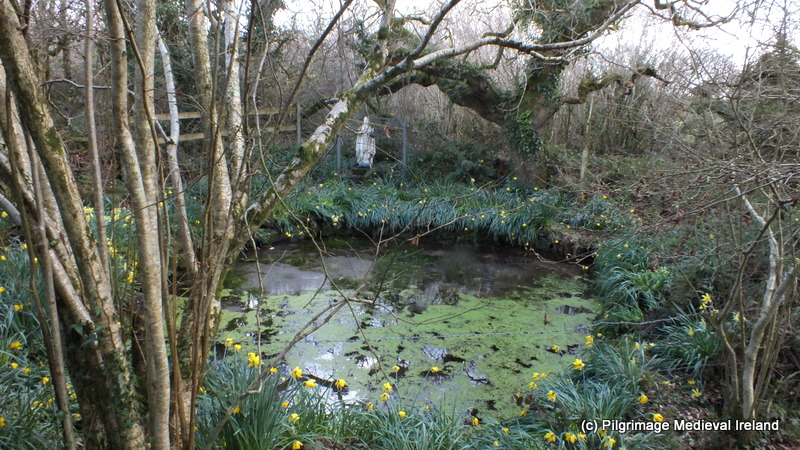
The main thing I love about the well is that it is very fortunate to have escaped the over use of cement that many Irish holy wells experienced in the 1950’s or some of the bad “restoration” work of the 1980’s-2000’s – the holy well at Brulee, Co Limerick immediately springs to mind. The charm of St David’s holy well is its simplicity. When you stand at the waters edge there is a real connection with the past and you can imagine your experience is very similar to pilgrims 100 or 200 years ago. The trees, flowers and bush that surround the well also help to connect the visitor to the natural world of which holy well are very much rooted.
Grove of trees surrounding St David’s Holy Well at Woodhouse
St David’s well is situated in an out of the way grove of trees on private land. In appearance it is very like the holy well at St Berriherts Kyle but more compact.
St David’s Holy Well in early March 2016
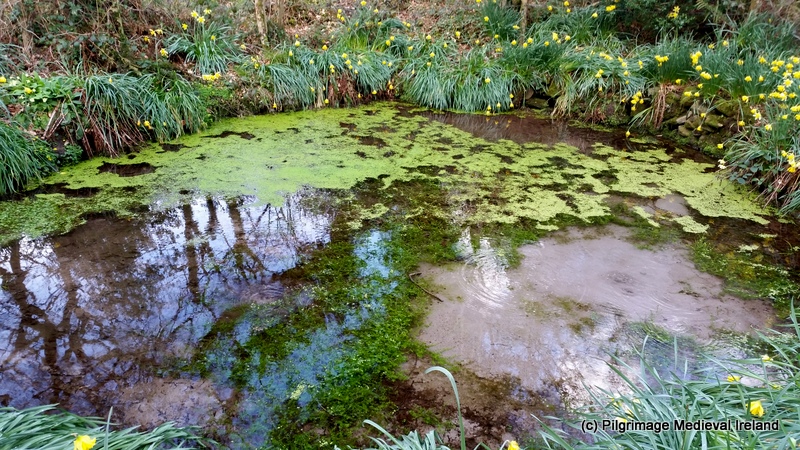
The well itself is a large spring that fills a circular pool defined by a low stone wall, set flush with the ground. The water bubbles up through white sands on the base, before escaping into an over flow channel that takes it the water from the pool into a nearby stream.
It is said “The well never dried even in the warmest summer” (The Schools’ Collection, Volume 0643, Page 155).
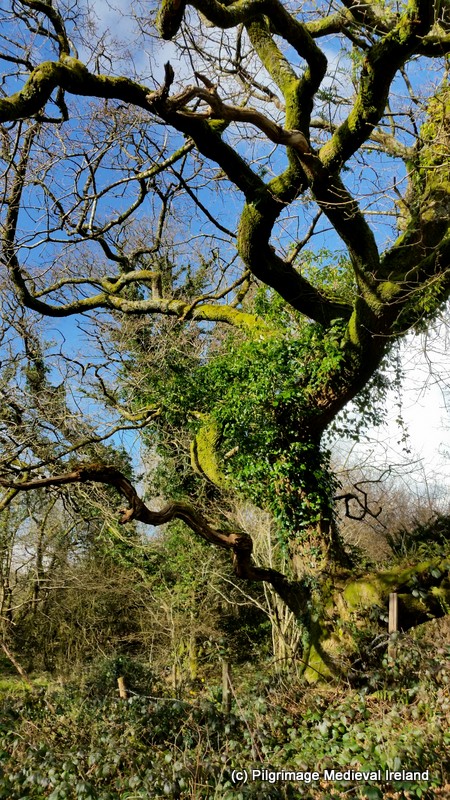
The bubbling waters are magical and I have sat for long stretches of time here just watching the water and listening to the rustle of leaves and chatter of birds. The wells beauty is enhanced by a large oak tree that cast shadows over the water. When I last visited here in March 2016, it was surrounded by a thick carpet of yellow daffodils.
It is a round well and there are trees growing all around it. The people hang the tokens on the trees. The statue of St David is erected there. There is a lovely sand bubbling up out of the well. It is so clear you would imagine it was silver.
The Schools’ Collection, Volume 0643, Page 167
Large oak tree growing beside St David’s holy well at Woodhouse
Unusually the well is dedicated to St David the patron saint of Wales whose feast day is the 1st of March. The south-east of Ireland has long established connections with Wales. St David and his monastery (at St Davids in Wales) are mentioned in several Lives of Irish saints. St Finbarr of Cork is said to have visited St David on his return from Rome, while SS Aidan of Ferns, Finnian of Clonard, along with Scothin and Senanus, are all said to have studied at the monastic school at St David’s.
St David’s holy well at Woodhouse is located in the Diocese of Waterford and Lismore. The patron of the diocese is St Declan of Ardmore who also spent time in Wales in the company of St David.
On one of these occasions Declan paid a visit to the holy bishop of the Britons whose name was David at the church which is called Killmuine where the bishop dwelt beside the shore of the sea which divides Ireland from Britain. The bishop received Declan with honour and he remained there forty days, in affection and joy, and they sang Mass each day and they entered into a bond of charity which continued between themselves and their successors for ever afterwards. On the expiration of the forty days Declan took leave of David giving him a kiss in token of peace and set out himself and his followers to the shore of the sea to take ship for Ireland.
Power, Rev. P. 1914. Life of St. Declan of Ardmore, 25
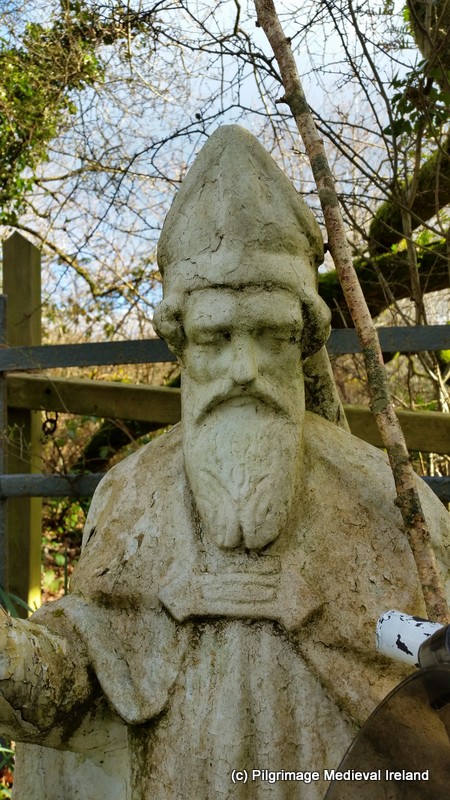
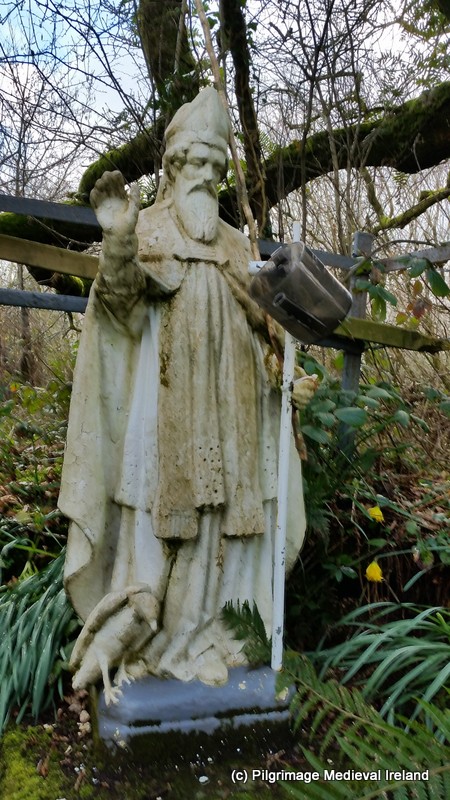
A large statue of a very serious St David, dressed as a bishop, sits a plinth of concrete overlooking the holy well. The date 1923 is carved into the base.
Statue of St David at St David’s Holy Well Woodhouse
This statue was a gift, donated by Br Benigus Tracy in this year having experieneced a cure (NFSC, An Eaglais, Ceapach Chuinn (roll number 1395).
The wells waters are said to have healing properties. The waters are especially beneficial to those suffering from headaches or migraines. The connection with healing of complaints the head is reflected in the Irish name for the well, “Tobar Chinnín Dháithí” translates roughly as the ‘Well of David’s Little Head’.
St David’s Holy Well Woodhouse
According to the Schools essays to obtain relief from sickness pilgrims had to walked three times around the well saying whatever prayer they wished (An Eaglais, Ceapach Chuinn (roll number 1395). Other accounts tell us that the pilgrim were to drink water from the well and rub it to their forehead to obtain the cure.
three sups of the water is taken. People leave a medal or a bead or string, there as a token of getting cured.
Mount Stewart, Ceapach Chuinn (roll number 0643)
In the past the well was visited throughout the year but a special pilgrimage was made on the 1st of March the feast day of St David. Pilgrims in the 19th century were said to ‘hang tokens on the trees’ around the well ( Mount Stewart, Ceapach Chuinn (roll number 0643). The tradition of leaving offerings has died out some local people still visit the well on the 1st of March.
Like many other Irish holy wells, folklore relating to St David’s well suggests it is now in a secondary location.
People say that the well was further up the field. One day Major Fitzgeralds washed his face in the well, and from that second onwards it started, to dry until it was dry as the field. Then it sprang up in the field further down, and it is there to this day.
An Eaglais, Ceapach Chuinn (roll number 1395)
Statue of St David at Woodhouse
Oak Tree beside St David’s holy well at Woodhouse
This is not the only holy well dedicated to St David in the south-east. Another more well known well one can be found at St David’s holy well at Olygate in Wexford. These two wells are reminders of the long established l links between the south-east of Ireland and Wales and the spread of the cult of medieval saints.
Thanks to Dr Ann Buckley for translating Irish language material in Schools Folklore Essays relating to the well.
Moore M. 1999. Archaeological Inventory of County Waterford. Dublin: Stationery Office, 203. ITA. (Irish Tourist Authority Survey )[1941-45] Topographical and General Survey, 122. Power, Rev P. 1907. ‘Place-Names of the Decies’, JWSEIAS Vol. 10, 193. Power, Rev P. 1914. Life of St. Declan of Ardmore, and Life of St. Mochuda of Lismore, (edited from ms. in Library of Royal Irish Academy). London : Irish Texts Society.
Pilgrimage in honour of St Declan at Ardmore, Co Waterford, can be traced back to the early medieval period. During the nineteenth and early twentieth century, Ardmore was one of the most important pilgrim sites in the southeast of Ireland, attracting 1000’s of pilgrims for the annual pattern day celebrations.
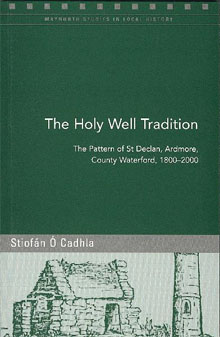
Pilgrim rituals during this period have been extensively discussed by Dr Stiofán Ó Cadhla’s in his excellent book The Holy Well Tradition. The Pattern of St Declan, Ardmore County Waterford, 1800-2000.
Although the numbers of pilgrims have fallen over the years, the saint and the celebration of his feast day (24th of July) are still a very important part of village life in Ardmore.
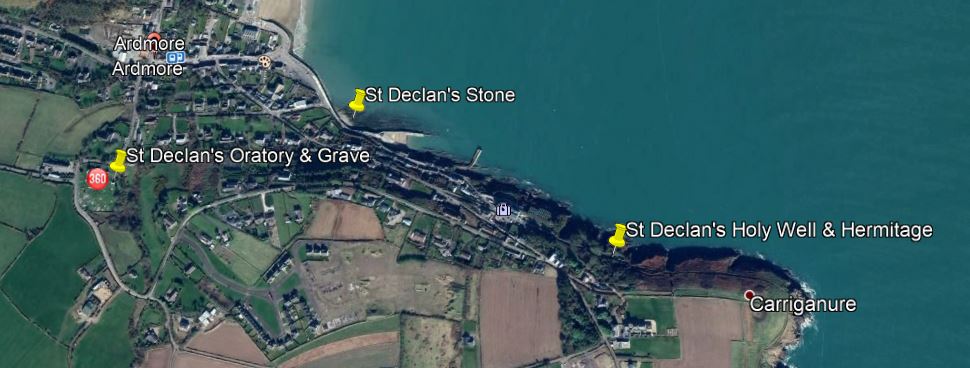
The nineteenth century pilgrim landscape was quiet extensive and included St Declan’s grave (at the eary medieval monastery), St Declan’s stone and St Declan’s holy well (see map on below).
Image taken Google Earth showing location of the St Declan’s grave, St Declan’s stone and St Declan’s Holy Well, nodal points in pilgrim landscape at Ardmore.
Today modern devotions are almost exclusively focused on St Declan’s holy well. They include a prayer vigil on St Declan’s eve at the well, along with the traditional rounds on the feast day.
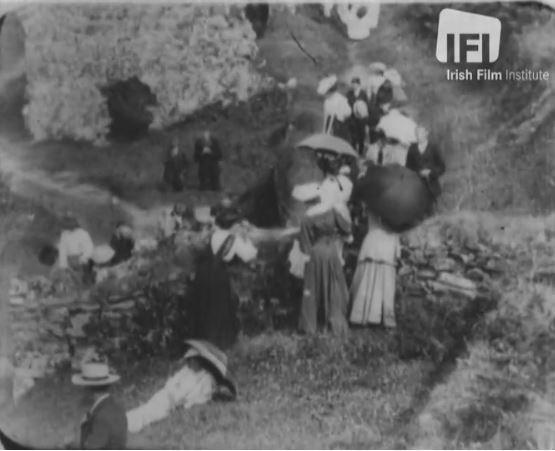
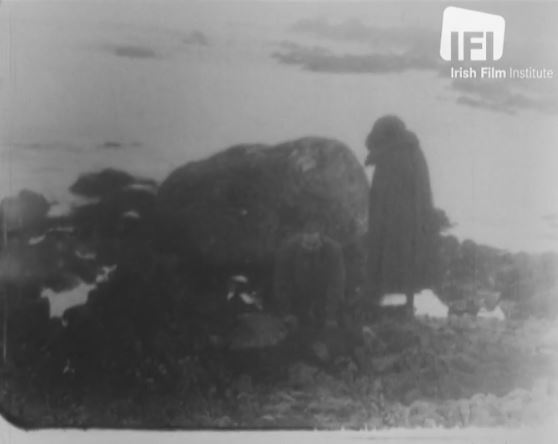
During the course of my research I came across a wonderful film on the Ardmore pattern day, which I want to share with you. This short film was created by Horgan Brothers’ films in 1910. The Horgan’s began their careers as photographers and later worked with film, opening a cinema in their home town of Youghal, Co. Cork. It was here they screened their newsreel style short films, which they named the Youghal Gazette many of which can be seen on the Irish Film Institute Website.
It is most unusual for an Irish pilgrimage of this period to have been filmed, let alone available to a wide audience today (through the Irish Film Institute). I am very grateful to the Horgan Brothers for their efforts as their work provides a wonderful window into devotional activity in Waterford in the 1900’s.
The film opens at St Declan’s holy well the last station in the early modern pilgrimage. There are many accounts which allow us to reconstruct the early modern pilgrimage at Ardmore but to see real pilgrims moving through the landscape is truly fascinating.
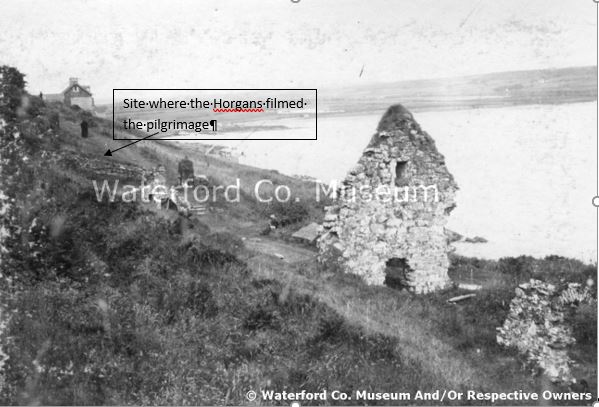
The photo below shows the location where the Hogan brothers set up their camera. They choose a position that over looked the well and church and also the approach route from the village.
As the film opens, directly in front of cameras are a group of six people, engaged, in what can only be described as people watching. Closest to the camera is gentleman in straw boater hat. He watches as people walk along the path to the well and is caught in the embarrassing act of picking his nose. Next to the man, is a lady dressed in a light coloured dress with a parasol. It seems to have been a warm sunny day as many of the ladies present have parasols. The young woman relaxes on the grass after fixing her parasol behind her head to provide some shade. Again her position allows her to comfortably view all who approach and leave. The remaining people in the vicinity of the camera are four ladies standing beside a wall adjacent to the entrance. They are watching the pilgrims complete their rounds and prayers with great interest.
At the time pilgrims began their prayers in front of the well. They then walked clockwise around the church and well while reciting three decades of the rosary. They would then knee before the well, finishing the rosary before moving to the well to say more prayers and take the water.
The film shows people in different stages of their pilgrimage. A cluster of people are in front of St Declan’s Holy Well, they must have completed their rounds, while the stream of men and women, make a clockwise circuit of the holy well and its adjacent church saying the rosary are only half way through theirs. It’s interesting to note the majority of men have removed their hats during the pilgrimage as a sign of respect for the place and the saint.
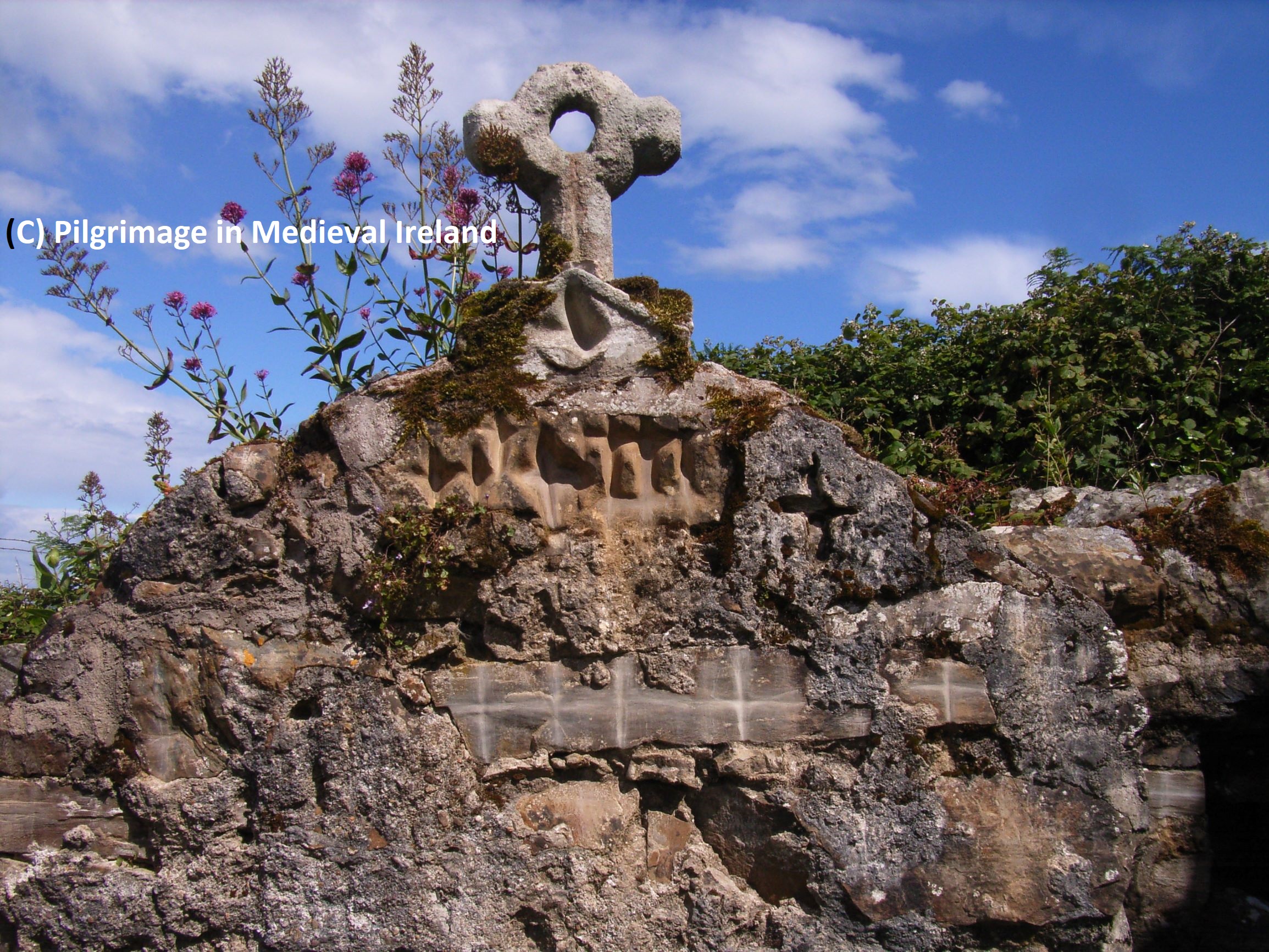
The landscape of the well has changed little since 1910. Below is a contemporary photo of the front of St Declan’s holy well which is obscured from view in the film. The structure of well has changed little over the years with the exception of the theft of the smallest of three medieval carved crucifix (on the left side of the photo) incorporated into the top of well superstructure.
Photo of three women at St Declan’s Holy Well taken 1910 from Waterford Co Museum Photographic Archive
Part of the pilgrim rituals at the holy well involved pilgrims carving crosses into the wall of the church and parts of the well superstructure. These actions are also caught by the camera. This practice is not unique to Ardmore but here as at the other sites, it is unlikely to have begun earlier then the nineteenth century.
Crosses carved by pilgrims into the walls of the church at St Declan’s Holy Well
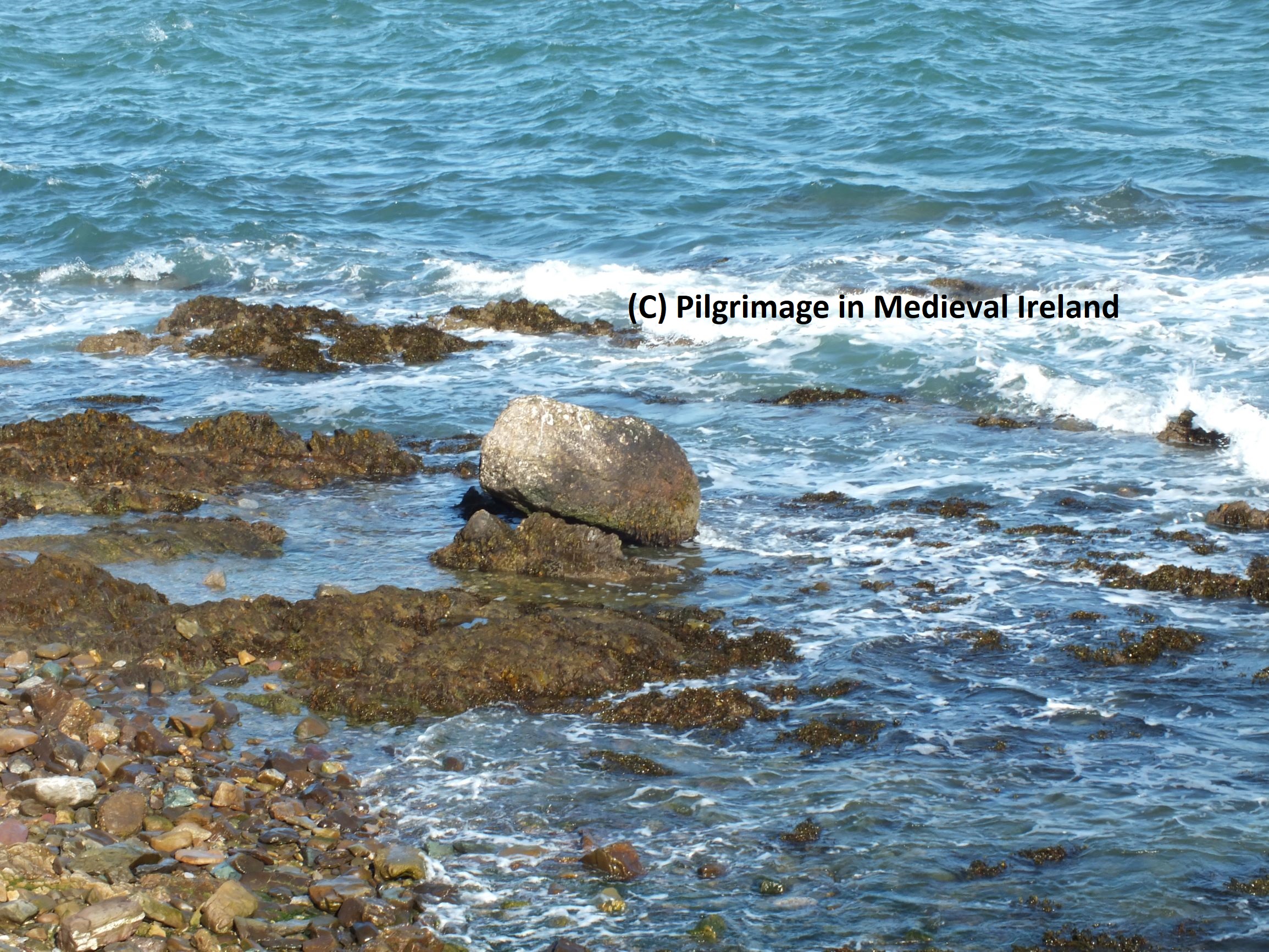
From the well the film then cuts to St Declans’ Stone, an erratic boulder located at the southern end of the strand some 500m to the east of the holy well. According to tradition the stone carried St Declan’s bell and vestments, floating across the sea from Wales to Ardmore. The stone was used as a penitential station by past pilgrims.
View of St Declan’s Stone as the tide comes in
In the film we see a woman wearing a Kinsale clock, a traditional garment worn up until the early twentieth century, standing beside the stone. A man wearing a long trench coat can be seem crawling out from under the stone. Traditional devotions at the stone involved the pilgrim saying set prayers before crawling under the rock. Given its located on the shore devotions could only take place when the tide was out. Outside of the pattern day the stone was also visited for healing and was thought to be particularly beneficial for those with backache or rheumatism. The stone was a central part of the pattern day devotions until the mid-twentieth century but pilgrimage has now ceased here.
The film then ends abruptly as the woman kneels in prayer and we do not get to see her crawled under the stone but she surely did.
I plan to write a more detailed post about the post medieval and medieval pilgrimage rituals at Ardmore in the new year. I will also be discussing the site at an upcoming lecture for the Waterford Historical and Archaeological Society in February of 2019 so please come along if you want to find out more.
If you find this film interesting you may also want to check out some of the other films by the Horgan Brother that are on the Irish Film Institute website at https://ifiplayer.ie/category/horgan/
This post is a shortened version of an article that I wrote, ‘Barrigone Holy Well and the Crimean War: An unlikely Connection’, published back in 2016 in the North Munster Antiquarian Journal .
The article details a little known the story of the mother of a young man from West Limerick. who went to fight in the Crimean war and the rituals she carried out at Barrigone Holy Well, in the townland of Craggs, to petition God for his protection.
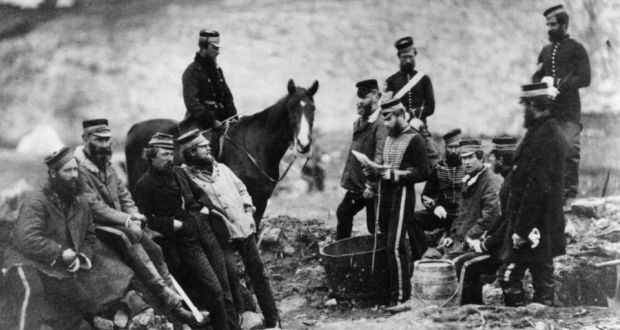
The 8th Hussars, the ‘King’s Royal Irish’, circa 1855, during the Crimean War. Photograph: Hulton Archive/Getty Images
The Crimean war took place between 1854-6 and was fought on the Crimean peninsula. It was fought between Russia and an alliance of Britain, France and the Ottoman Turkish empire. Irish soldiers made up around 30–35 per cent of the British army in 1854, and it is estimated that over 30,000 Irish soldiers served in the Crimea War. Approximately 7,000 Irish men died during the war. David Murphy has a very readable and interesting book called Ireland and the Crimean War which details the war and Irish involvement.
In 1855, at the height the Crimean war, a letter entitled ‘The Way to Save Lives in the Crimea’ was sent to The Catholic Layman Magazine. The letter was written by one Humphrey O’Leary who recounts his interaction with the mother of the soldier fighting in Crimea mentioned above. The woman, who was illiterate, wished Leary to write down her words in a letter to her son. She also wanted to provide instruction for the use of a small number of stones taken from the holy well at Barrigone, that were to be sent with the letter. Unfortunately the names of the mother or son are not mentioned and this was most likely deliberately done as Leary is sharing their stories in a very public venue. Its clear from his writing that Leary was a middle class Catholic and had advantages not available to the soldier woman including an education who is of a lower social standing. Apart from detailing the story of the woman and her son, the letter also provides an insight in life in nineteenth century Ireland, changing attitudes to pilgrimage within the Catholic population and the poor levels of literary.
Leary tells us the woman’s son was ‘fighting with the Rooshins in Sebastable [Sevastapol]’. He was part of the British forces who, along with their allies, laid siege to the main Russian naval base in the Black Sea at Sebastopol. Its clear the man’s mother was concerned for his safety and anxious to keep him safe.
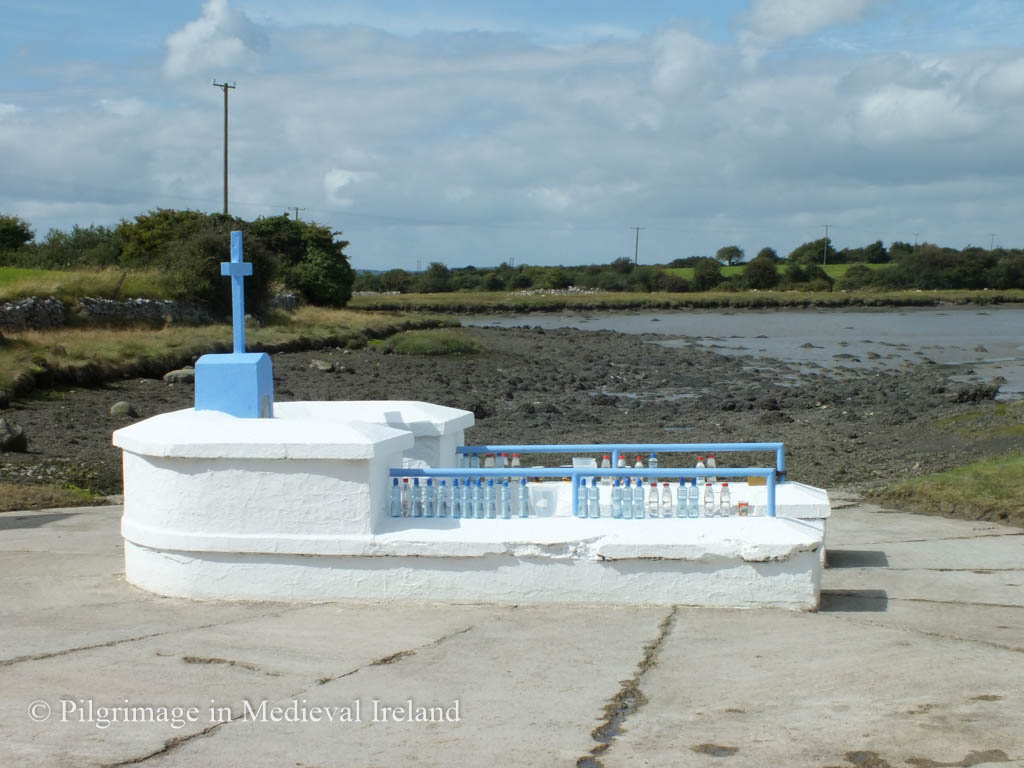
Barrigone Holy Well
Leary agreeded to help the woman and he writes that he wanted to write the letter ‘as well as ever I could; for I thought it would look mighty disgraceful entirely to send a bad letter as far way’. When he had filled the first page he told the woman ‘I am going to put your name to it now’: To which she replied ‘Oh Humphrey, avourneen for the love of all the saints keep a little corner of it empty a while, for I am sending him something, and I want you to explain it to him.’
The woman then asked Leary to fill a second piece of paper containing instructions ‘for I want to send him a thing that will save his life.’ To Leary’s surprise the woman pulled out a small red silk purse ‘that was for all the world as big as a tailors thimble’ filled with some tiny stones. The woman went on to say:
I am sending him the blessed stones of Barrigowen [Barrigone] well inside this purse, and tell him, that if he’ll receive them, and wear them in this purse round his neck with the same faith that his own mother is sending him, please God; that he will come home safe and sound again; for any one that ever wore them blessed stones about his neck could not be harmed.
Leary was not too impressed by the woman’s plan and thought it ‘very quare entirely that a small little bit like that could save one’s life.’ He pressed her on the matter, asking ‘is it in earnest you are, or do you think them stones will save him?’ The woman was staunch in her beliefs as she replied ‘Oh I am sure if they overtake him alive that there will be no fear of him’. To persuade the woman to abandon what he thought was a superstitious act, Leary answered ‘I’ll bet my life, Father Mick won’t let you send the stones, nor go to the well at all at all’ to which the woman replied ‘deed then, Father Mick knows that I gave rounds at the well for him, and I sent him the lining of the well in a letter, and he did not say “ill you did it” to me when I told him’. Determined to make the woman see the folly of this task Leary persisted:
I am thinking it might be better for you to pray to God to spare your son to you than to go sending these little stones; and perhaps, you or your son may lose your life by provoking him against you.
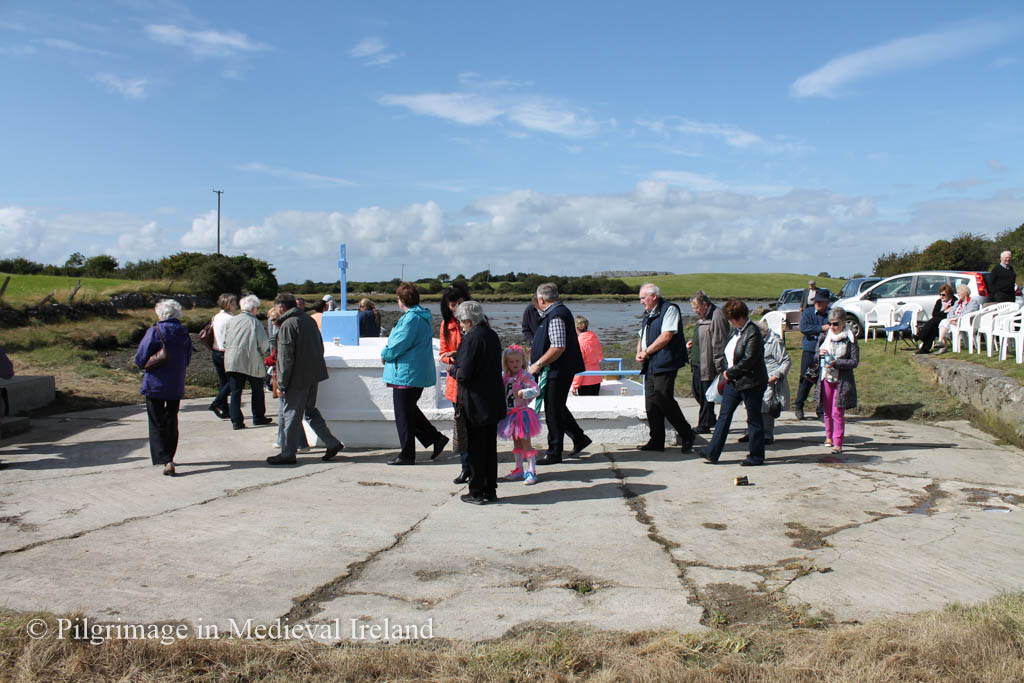
Modern pilgrims at Barrigone Holy Well West Limerick
Leary response is typical of a move away from, and change of attitude within, the Catholic Church from favouring devotion at holy wells to it becoming perceived as backward and superstitious. The soldier’s mother was certainly not of this opinion and according to Leary became cross and replied ‘I will send the stones at any rate, for I am sure they will do him good’. Leary, realising his arguments fell on deaf ears, and accepting her sincere conviction they would save her son ‘from Rosshen [Russian] bullets’, continued transcribing the woman’s instructions about the stones. Leary ends his letter to the Catholic Layman by noting that after sending the letter with the stones the woman also had a Mass said for her son. He seems to have more faith in the benefits of the latter. We don’t know if this poor woman ever saw her son again but I like to think these stone at least provided some comfort for him.
This account provides a unique insight into folk tradition, beliefs and devotional practice in the mid-nineteenth century Ireland. It also highlights the changing attitudes of the middle classes who following the famine and renewed efforts to implementation of Tridentine values in the church, came to see holy wells and their ritual practices as superstitious. The full article which includes a discussion of the wells history and similar practices of taking stone can be found in the North Munster Antiquarian Journal
Nugent, L. 2016. ‘Barrigone Holy Well and the Crimean War: An unlikely Connection’, North Munster Antiquarian Journal Vol. 56,














 Pilgrimage In Medieval Ireland