The Labyrinth Stone

Some thoughts on the Hollywood or  Labyrinth stone

The Hollywood or Labyrinth stone is one of the most interesting relics of medieval pilgrimage that survives today  in  Ireland. The stone as it name suggest is a large boulder  with an incised labyrinth motif on its face.
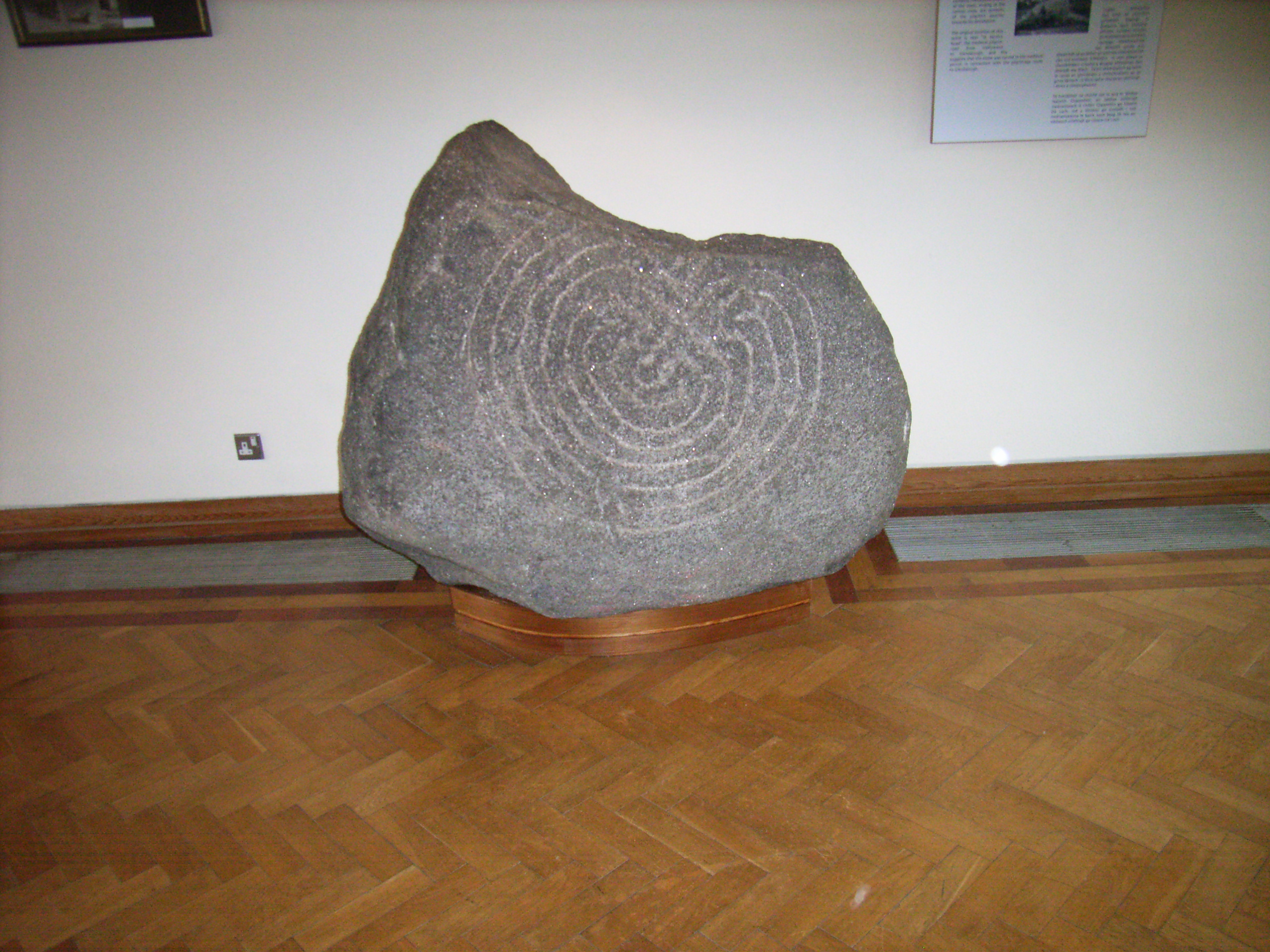
The Hollywood stone

The stone was  originally located in the townland of Lockstown in the west Wicklow mountains some 4.8 Km from the ecclesiastical site of Templeteenaun and 3.2km from the village of Hollywood.  Shortly after 1908   the stone  was moved to the National museum. The stone is on display at the Glendalough visitor centre and is well worth a visit.

Another boulder with a small incised latin cross was found close by but this stone has since disappear.

The cross incribed on a boulder beside the Hollywood stone (after Bremer, 1926, 52, Fig.2).

Labyrinth motifs can be traced back to prehistoric times in ancient Egypt and Greece (Harbison 1998, 107). Prehistoric labyrinths are generally composed of seven outer circuits and the highest density of stones incised with this motif are found in northern Europe, in Denmark, Norway, Sweden and Finland.

In  medieval times  the labyrinth  underwent a revival and became primarily a symbol of pilgrimage, and in particular pilgrimage to the holy shrine of Jerusalem ( Coleman & Elsner 1995, 112). Shortly after the loss of Jerusalem to the Muslims in the twelfth century, large labyrinths of mosaic or paving stones were incorporated into the western nave bays of a number of European cathedrals in the twelfth and thirteenth centuries (Connolly 2005, 286). Examples include Chartres near Paris, St Quentins, Amiens, St Omer and Rheims in France, San Vitale in Ravenna, San Savino Piacenza in Turin and Lucca Cathedral in Italy (Westbury 2001, 47-49, 104-105). Lucca was an important pilgrimage shrine as well as a stopping point for pilgrims travelling along the pilgrim route Via Francigena to Rome. One of the best preserved, largest and most famous and largest of medieval labyrinths (c.13m in diameter) is found at the cathedral of Chartres, France. It is believed that the Chartres labyrinth, like many others, was designed in response to the loss of Jerusalem and presented the medieval audience (Connolly 2005, 287).

By walking, or in some cases crawling on their knees, along the labyrinth, pilgrims could perform an imagined pilgrimage to Jerusalem (Westbury 2001, 51-52). Apart from its associations with Jerusalem, the motif also became symbolic of the individual’s journey through life and salvation in the next (Coleman & Elsner 1995, 112).

How old is the  Hollywood Stone?

At present it is not possible to definitively date the Hollywood stone. Price (1940, 260-261), and Harbison (1991, 142) all favour an early medieval date but given that the majority of medieval labyrinths date to the twelfth-thirteenth century or later, it may be worth considering a high medieval date for the stone. It was also during this period that the pilgrim movement across Europe reached a peak and the labyrinth as a symbol of pilgrimage came to be in vogue.

Function and Meaning of the Hollywood/Labyrinth stone
The  proximity of the Labyrinth stone to St. Kevin’s road and the ecclesiastical sites of Hollywood and Templeteenaun, along with the symbolism of the labyrinth motif, suggests that this stone was, connected to pilgrimage in the Kings River valley (Harbison 1991, 122, 142; Orpen 1923 Nugent 2009 Vol. I, 223-225 ).  It is possible that the stone functioned as a wayside station for pilgrims entering the western end of the Kings River valley en-route to Glendalough, and provided a place to pray and reflect before continuing onwards.

St Kevin’s Road

Only two other medieval labyrinths, incised stones are known in Ireland one located at the late medieval parish church of Rathmore, Co. Meath the other a carving found on the base of the twelfth century high cross at Cashel but neither appear to be associated with pilgrimage (Harbison 1998; Leask 1933).

© Louise Nugent 2012

Bibliography
Bremer, W. 1926. ‘Notes on The Hollywood Stone’, JRSAI Vol. 56. Conc. Series,
50-54.
Coleman, S. & Elsner, J. 1995. Pilgrimage: past and present: sacred travel and
sacred space in the world religions. London: British Museum Press.
Harbison, P. 1994. ‘Early Irish Pilgrim Archaeology in the Dingle Peninsula’, World
Archaeology, Vol. 26, No. 1, 90-103.
Harbison, P. 1998. ‘A labyrinth on the twelfth-century High Cross base on the Rock
of Cashel, Co. Tipperary’, JRSAI Vol. 128, 107-111.
Leask, H. G. 1933. ‘Rathmore Church, Co. Meath’, JRSAI Vol. 63, 153-166.
Nugent, L. 2009. Pilgrimage in Medieval Ireland, AD 600-1600. Vol. I-III. Unpublished PhD  Thesis, University College Dublin
Orpen, G.H. 1911. ‘Carved stone near Hollywood, Co. Wicklow’, JRSAI Vol. 41,
183-185.
Orpen, G. H. 1923. ‘The Hollywood Stone and he Labyrinth of Knossos’, JRSAI
Vol. 53. Cons Series, 180-189.
Orpen, G.H. 1929. ‘The Hollywood Stone’, JRSAI Vol. 59, 176-179.
Price, L. 1940. ‘Glendalough: St. Kevin’s Road’, In Ryan, J. (ed.) FéilSgríbhinn
Éoin Mhic Néil. Dublin: Four Courts Press, 244-71.
Westbury, V. 2001. Labyrinths. Ancient Paths of Wisdom and Peace. Singapore: De
Capo Press.

Miracles and Violence: St Augustine’s well in the 17th century

St Augustine’s Holy Well sits on water’s edge of Lough Atalia or Loch an tSáile, on the eastern edge of Galway city.

Originally this well was one of a group of three, but the northern and southern wells no longer survive. The Galway Archaeological Inventory states all three wells were dedicated originally to St Augustine but Máire MacNeill (2007) refers to the northern and southern wells as being dedicated to the  Blessed Virgin and John the Baptist.

The surviving well has been very tastefully restored by the Galway Civic Trust in 2000. Today it consists of a concrete hexagonal trough surrounded by a low wall. The well is tidal and when I visited the tide was in, but it was still possible to get close to the well. The trough was filled with small coins .

Trough at St Augustine’s Holy Well

At the turn of the last century the main days for devotion at the well were the last Sunday in July or the first Sunday in August and MacNeill raises the possibility the wells may have been associated  with Lughnasa.

Low wall defining the holy well.

During the 1600’s two very significant events happened here the first was an attack on a group of pilgrims by government forces and the second was a miraculous cure.

In the 1660’s the Cambrensis Eversus tells us that ‘a great multitude of persons, men, women and children, assembled to bathe’ at St Augustine’s well ‘expecting to benefit their health by the salubrity which the waters have from nature or the prayers of St Augustine’. The Governor of Galway ordered his troops to open fire into the unsuspecting crowd without warning. Many were severely wounded and the others were stripped of their clothes and valuables and thrown into prison.

This terrible event doesn’t appear to have dampened feelings of devotion of the local people towards the well and in 1673 it was the site of a miracle. O’Flaherty in West or H-Iar Connaught states that on the Feast of St Barnabie a fourteen year old boy Patrick Lynch son of Galway Merchant Patrick Lynch Fitz-Maurice and Redise Lynch was brought to the well. The boy was very ill with ‘a most grivous, desperate, and dangerous disease, and given over by all doctors to be incurable’. The text states the boy’s family had given up hope of recovery with ‘ all things were prepared for his death’.

St Barnabie or St Barnabas on whose feast day the boy was brought to the well ( the 11th of June) was not a saint associated with healing being the patron against hailstorms, and patron of Cyprus and Antioch so it is unlikely that date was chosen to ask for his intercession.

Having arrived at the well the boy was immersed in its waters and ‘having no fileing (feeling) thereof, and was brought upp was wrapped by Mary Burke into a wollin plaide’. The boy slept for a quarter of an hour before being woken by his mother who he promptly told off for having interrupted a vision he was having of ‘Our Lord Jesus Christ and his blessed mother and a multitude of brave winged brides’. The boy requested a cup of water from the well. He drank ‘three draughts in the name of the father and of the Sonne and the Holly Gost’. The boy then got up and walked about the well. He told his mother that in the vision, he had been advised to visit the well for nine days and to drink the water three times at each visit. The boy appears to have remained hail and hearty after the event and was cured of ‘the womiting disease, and dough eath and drinke ever since with a great apetit’.

The miracle was investigated by a board of the clergy and laity of the town (Matthew Lynch, Warden of Gallway, Fr. William Bourke, Prior Ord. Pred., Fr. James Blake S. Theol. Lector, ord. S. Fran., Fr. Dominicke Lynch, Fr.  Dominicke Martin, Prior of S. Augustine, Fr. Edward Bourke, Fr. Martinus French, Patricke Martine, Anth. French, Richard Martine, & finally Marcus Lynch). Sworn depositions were taken from the boy, his parents and Mary Burke. The family and Mary Burke were steadfast in their belief that a miracle had occurred, the board were not so certain and believed the cure may have been ‘attributed to hydropathy, i.e. cure by cold water’.

Bibliography

Gosling, P. 1993. Archaeological Inventory of County Galway, Vol. 1 West Galway. Stationary Office, Dublin.

Hardiman, J. (ed) 1846. A Chorographical Description of West Or H-Iar Connaught: Written A.D. 1684  By Roderic O’Flaherty, Trinity College (Dublin, Ireland). Library, Irish Archaeological Society, Dublin ( Google eBook).

Kelly, Rev. M. (ed) 1845. Cambrensis eversus, seu potius historica fides in rebus hibernicis Giraldo Cambrensi abrogata: in quo plerasque iusti hiistorici dotes desiderari, plerosque naevos inesse, ostendit Gartianus Lucius, Hibernus, qui etiam aliquot res memorabiles Hibernicas veteris et novae memoriae passim e re nata huic operi inseruit : impress. An. MDCLXII, Volume 1 (Google eBook)

MacNeill, M. 2007. The festival of Lughnasa: a study of the survival of the Celtic festival of the beginning of harvest. Dublin: Folklore of Ireland Council.

© Louise Nugent 2012

Hello!

So it begins,  the plan is to  share information on medieval pilgrimage  especially related to Ireland . I am also planning to document some patron days during the summer. More to follow in the next week or so.

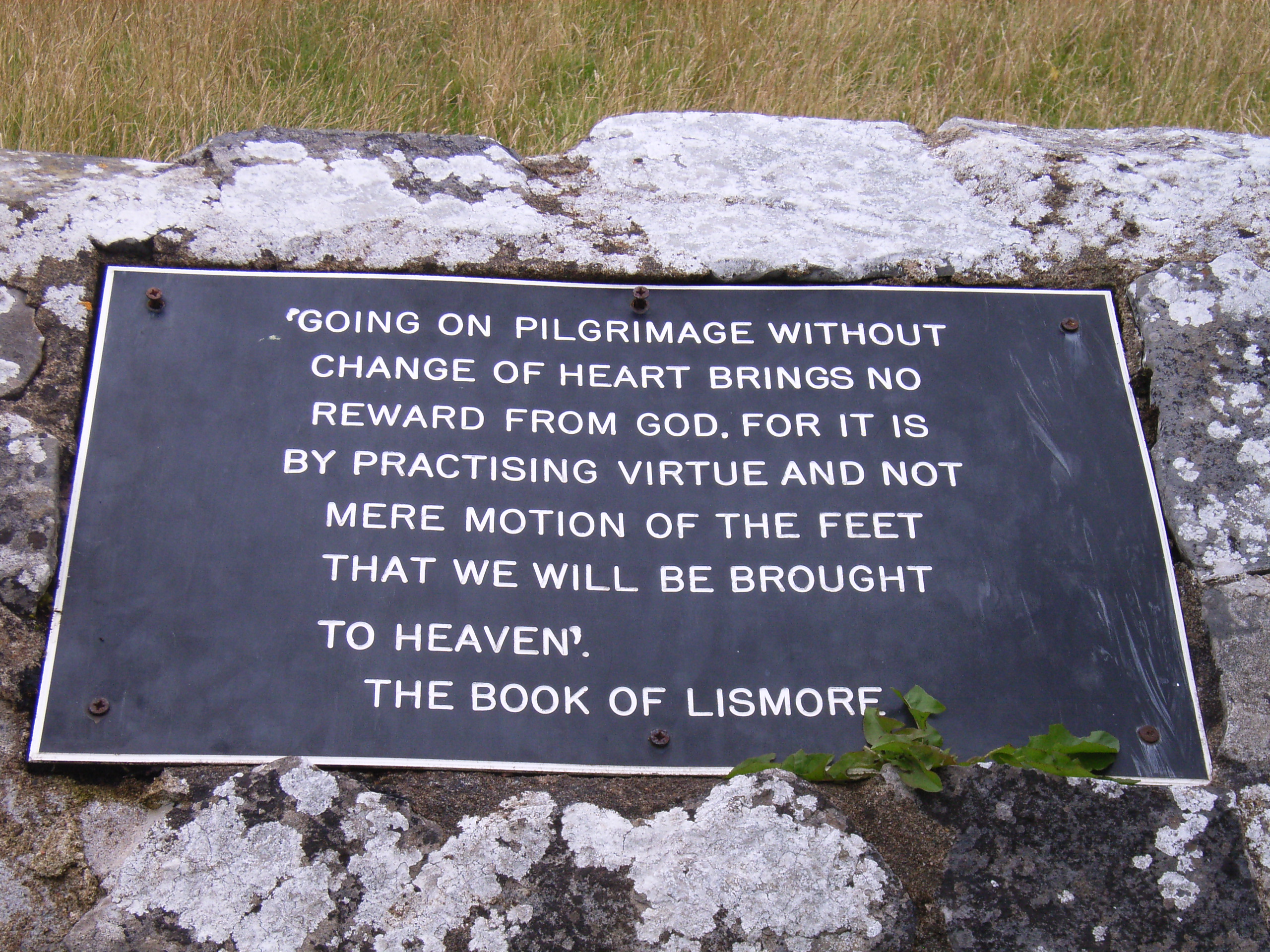
Advice for the medieval pilgrim from the Book of Lismore