Fancy a virtual walk along the Saint’s road to Clonmacnosie, Co Offaly ? Then follow route of the road on my new Storymap for the Saint’s road .

Story map for the Saint’s road Co Offaly
Fancy a virtual walk along the Saint’s road to Clonmacnosie, Co Offaly ? Then follow route of the road on my new Storymap for the Saint’s road .
Story map for the Saint’s road Co Offaly
I normally write a post related to pilgrimage and Christmas this time of year. This year has been a very busy one keeping up with the blog, facebook page , work and everyday life so I decided instead of researching a new topic to share some of my favourite images of the Nativity as depicted in medieval and modern glass and stone sculpture from Ireland and the Continent.
This small ivory panel was carved around AD 1000-1050 in Germany and probably came from the area around Liège or Cologne. The upper section of the plaque depicts the Annunciation and the lower the Nativity. I really like the little details that the artist has carved in the Nativity scene such as Mary’s shoes sitting beside her on a stool (1).

11th century Ivory plaque depicting the Nativity in the Victoria & Albert Museum
Another great image of the Nativity is found carved on a column at the Soria Monastery of San Juan de Duero, Spain dating to the 12th -13th century. It seem the stable was very compact (2).
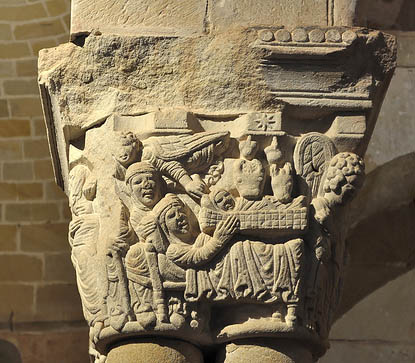
Nativity scene from Soria Monastery San Juan de Duero.
This is a more modern depiction and is one of my favourite stained glass windows. Created by Harry Clarke in 1918 for the St Barrahane’s Church of Ireland church at Castletownshend, Co Cork it depicts the Nativity and Adoration. My photo does not do justice to the fantastic colours of the glass (3).
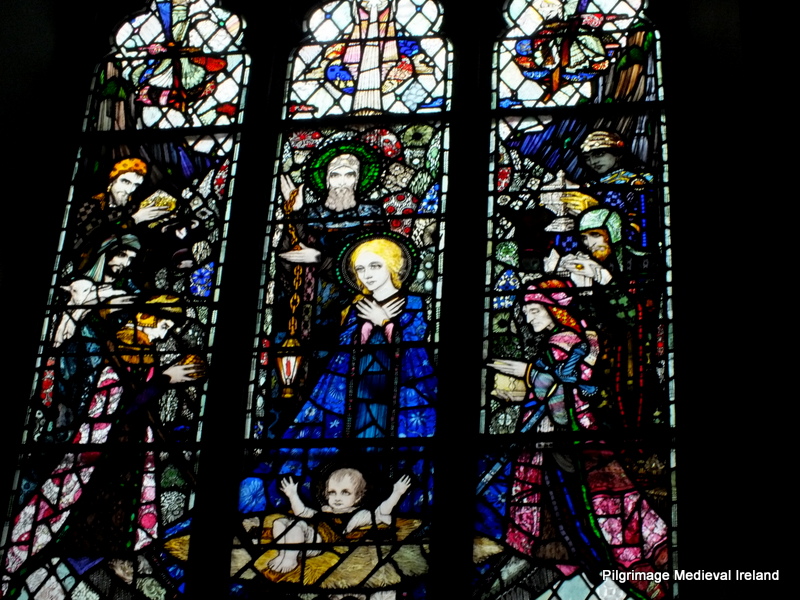
Harry Clarke stain glass window depicting the nativity at Castletownshend
Following the birth of Christ the three Magi follow the star to Bethlehem, brining with them gifts for the Christ child.
This scene from one of the columns at the Cathedral of St. Lazare, built between 1120 and 1146, depicts an angel coming to wake up the three magi so they can follow the star to Bethlehem (4) . This carving along with many others from St Lazare were carved by a man called Gislebertus who was one the greatest sculptor of his time.

An angel appearing in a dream to the three magi at St Lazare Cathedral (image found on thewinedarksea.com)
The Adoration of the Magi was also recorded on a number of early medieval Irish High Crosses. Below is an image that depicts the Adoration of the Magi on the east face of Muiredach’s High Cross at Monasterboise Co Louth, carved in the 9th/10th century.
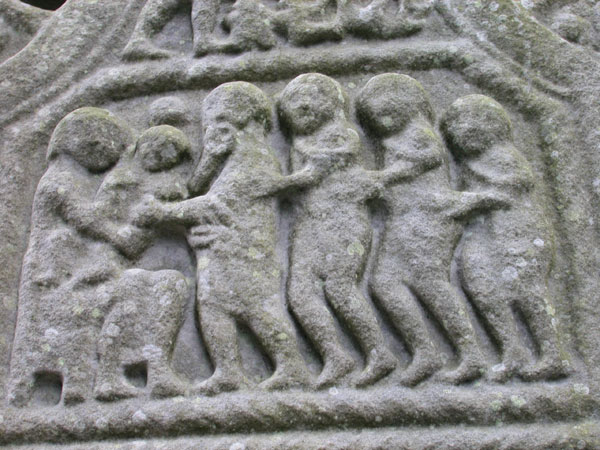
The Adoration of the Magi on the east face of Muiredach’s High Cross (image taken http://ireland.wlu.edu/cross/Muiredach/east/5.htm)
The Magi are also depicted coming with gifts in a carving in the west gable of the 12th century cathedral church at Ardmore Co Waterford. The three Magi are the lower figures under the scene depicting the Judgement of Solomon.

The Adoration of the Magi at Ardmore Co Waterford
Following the epiphany the next big event in the life of Christ was the “Flight into Egypt”.
I love this image of the Flight into Egypt also carved by Gislebertu, Mary is depicted with a ball in her hand which the Christ child is also touching maybe its a toy ? Poor Joseph looks like he is about to fall over. The carving is found in the Cathedral of St Lazare, Autun, France at the top of a capital in the nave and dates to circa. 1125 (5).

The flight into Egypt from St Lazare Cathedral Autun, France (http://www.oberlin.edu/images/Art335g.html.
I also love this very different depiction of the Flight into Egypt found on the Moone High Cross. The cross which was made around the 9th century, it was carved from granite, a very difficult stone to work. Whoever carved this possessed great skill as a stone mason and his simple design has a unique charm.
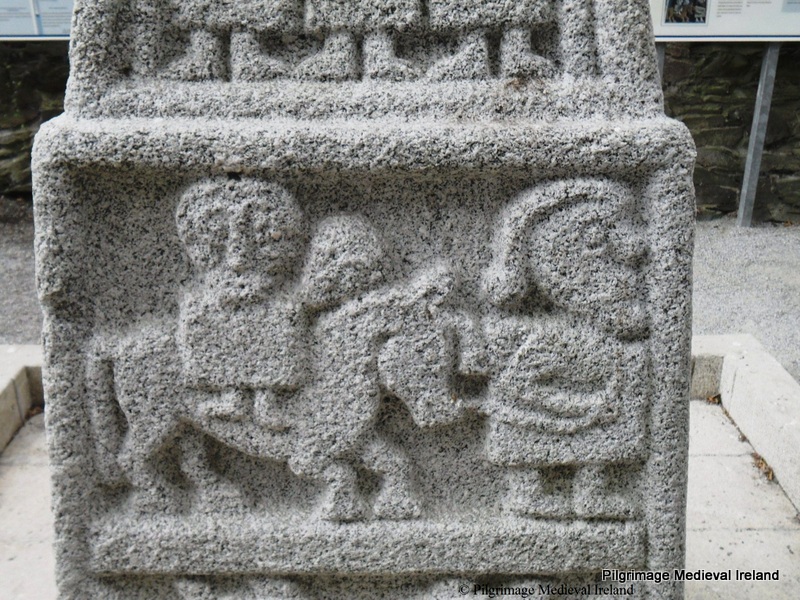
Flight into Egypt on the Moone High Cross Co Kildare.
There are many more images I could share but I think these are some of the nicest. So a very Happy Christmas to everyone and thank you all for your support for this blog.
References
1. http://collections.vam.ac.uk/item/O130040/the-annunciation-and-the-nativity-panel-unknown/
3. Many thanks to Finola and Richard of the Roaring Water Journal for taking me to see this amazing window in November.
4. http://kenney-mencher.blogspot.ie/2014/09/the-last-judgment-theme-in-romanesque.html
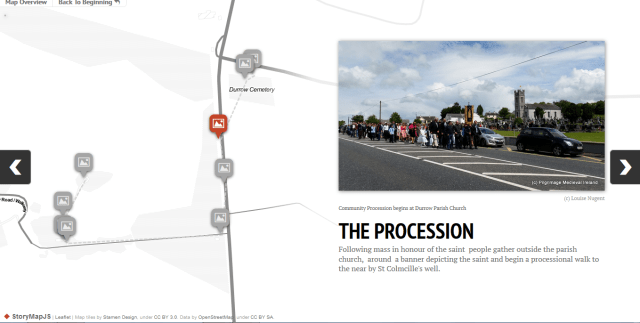
In June I attended the pattern day at Durrow Co Offaly and I wrote a post about it. I have been trying out some new social media platforms and here is the story of the pattern day at Durrow adapted and re told through photos and maps using StoryMap
Durrow Pattern day.
Recently I was in Carrick-on-Shannon and stumbled across the most amazing little building. The building in question is a small memorial chapel located at the top of Bridge Street sandwiched between two shop fronts.

Costello Chapel: Ireland’s smallest chapel Carrick-on-Shannon.
The chapel, a single room building is tiny, measuring circa 4.8m x 3.6m. The chapel, built on the site of a former Methodist chapel, was commissioned in 1877 by a Carrick-on Shannon merchant called Edward Costello as a memorial to his wife Mary Josephine. The building was completed in 1879.
The chapel was built of cut limestone with a steep pitched stone roof with two Celtic cross finials at each gable. On the left hand side of the door is a carved stone depicting the Costello coat of arms and Latin motto ‘Ne te quaesiveris extra‘ which means ‘Seek not thyself outside thyself’.

Costello coat of arms and Latin motto ‘Ne te quaesiveris extra’ Seek not thyself outside thyself
The chapel is entered through two doors of simple design, made of wrought galvanised iron.

The chapel’s doors are made of wrought galvanised iron.
Within the church is a small marble altar and tabernacle. Mass was celebrated here from the time of Mary’s interment in 1879, on the first Friday of every month until Edwards death in 1891.

Marble altar within chapel.
Mary Costello had died in 1877 and her remains were embalmed. When the chapel was completed she was buried within the chapel on the right hand side of the building in a rectangular sunken grave. Following Edward’s death he was also buried in the chapel and placed on the left hand side of the chapel. Both graves were sealed by a thick clear glass and when you enter the chapel today the coffins are visible. The floor of the chapel was tiled with tiles depicting symbols of the crucifixion.

Decorated floor within Costello chapel
Another lovely feature of the chapel is beautiful stain glass window which the information plaque at the site notes was designed by Mayer of Munich.

Stain glass window within Costello chapel.
The chapel is a beautiful structure and testament to Edward’s devotion to his wife. If you are passing through Carrick-on-Shannon do seek it out and see for yourself.
References
Notice board at the site.
http://www.carrickheritage.com/costello-memorial-chapel.html
http://www.buildingsofireland.ie/niah/search.jsp?type=record&county=LE®no=30813020
http://www.askaboutireland.ie/learning-zone/primary-students/looking-at-places/leitrim/people-and-places-in-leit/carrick-on-shannon/costello-chapel/
The names and stories of the vast majority of medieval pilgrims have gone unrecorded in the Irish historical sources but thankfully there are some exceptions to this rule. During the 15th century, two pilgrimages of a Waterford man called James Rice to the shrine of St James at Santiago de Compostella were recorded in contemporary sources.
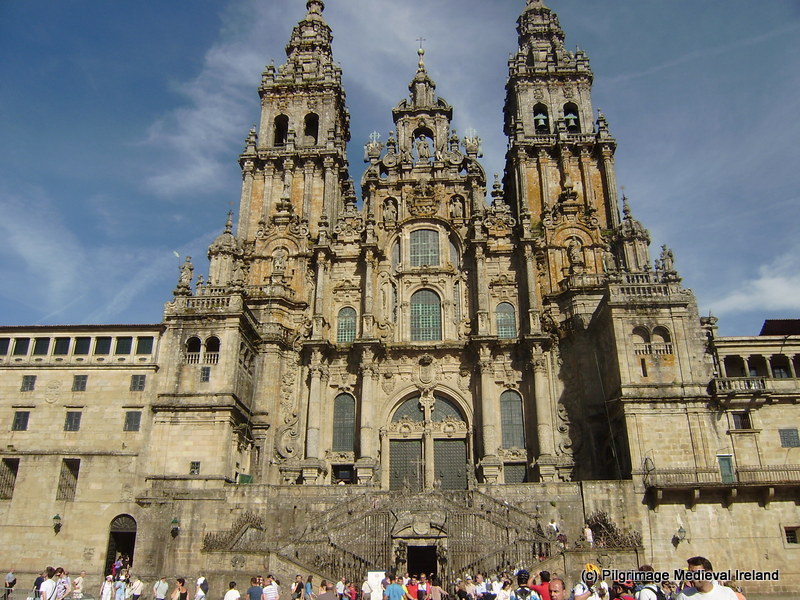
St James Cathedral Santiago de Compostella
Who was James Rice?
James Rice was born into a wealthy Anglo-Irish merchant family in the port town of Waterford in 15th century. The exact date of his birth is known but the name chosen by his parents suggests they had a devotion to St James whose cult from the 12th century onwards enjoyed great popularity across Europe.
We know also that James’s father Peter Rice held the office of Mayor of Waterford on two occasions the first in 1426-27 and the second in 1427. Following in the footsteps of his father, James also became a politician and held the office of Mayor of Waterford a staggering eleven times.
Like the majority of people living in medieval Ireland, James would have performed many pilgrimages throughout his lifetime. He would have visited local and regional pilgrim sites perhaps heading to Ardmore, Co Waterford or to Lady’s Island in Co Wexford. Unfortunately local and regional pilgrimages tend not to be recorded in contemporary sources as they were seen as everyday occurrences.
Long distance pilgrimages were very expensive and would have been beyond the finances of most ordinary of people. Therefore to embark on a long distance pilgrimage was a rare and significant occurrence and when undertaken successful brought prestige to the pilgrim. Being a man of means James Rice was able to go on at least two long distance pilgrimages that we know of to the shrine of St James at Santiago do Compostella in Spain. To give you some idea of the expense of such a journey, Irish pilgrims making the return journey from Spain to Ireland on-board the ill-fated ship the La Mary London in the 15th century paid seven shillings and six pence per head just for the return leg of the journey (1400 miles sea voyage). This was the equivalent of several weeks wages for an average working man.
So why go all the way to Santiago when there were many pilgrim sites closer to home? At a basic level James Rice probably had a great devotion to his namesake St James who was one of the most popular saints in Ireland. Santiago was also a high status pilgrim site, one of the most popular pilgrim destinations in the medieval world, attracting vast numbers of pilgrims from across Europe. It was also associated with miracles and it was a place where indulgences could be obtained.
Pilgrimages to Santiago
In 1473 James made his first pilgrimage to Santiago. At the time he held the position of Mayor of Waterford. His pilgrimage was recorded as he was vacating his office for the duration of the pilgrimage and protocol required that he applied for permission to parliament to appoint a deputy mayor in his absence. His request was granted and he embarked on pilgrimage.
As Waterford was a port town with trade links with France and Spain its likely James travelled by boat to the port of Corunna and then headed on foot to Santiago. Having arrived at his destination he would have found somewhere to stay. Most pilgrims spent the night in a vigil within the cathedral in front of the high altar. The next day pilgrims attended mass and during the ceremony they presented their offerings. Pilgrims would also have made confession and obtained certificates of pilgrimage in the Capilla del Rey de Francia. There are no records detailing James experiences but he must have visited the relics of the saint and perhaps even purchased some souvenirs. From the 12th century scallop shells were sold to pilgrims in the cathedral square and a small number have been found in Irish medieval burials.
Ten years later Rice decided to go on a second pilgrimage to Santiago in the year 1483. 1483 was the Jubilee year at Santiago. In 1181 Pope Alexander III granted jubilee years to the shrine, whenever the feast of St James fell on a Sunday. Pilgrims who came at this time received a plenary indulgence (a remission from all sin) once they made their confession, attended Mass, gave a donation for the upkeep of the shrine, and undertook to perform good works.
Rice was again in public office as the Mayor of Waterford. The Statue Rolls of the Irish Parliament record that prior to his departure on pilgrimage, Rice’s made a formal requested to take up the pilgrim staff. Permission was granted to embark on his second pilgrimage under the proviso that the mayor and the two bailiffs who accompanied him were to appoint replacement deputies acceptable to Waterford city council for the duration of their absence ). The names of his bailiffs were Patrick Mulligan and Philip Bryan.
Prior to departure on this second pilgrimage Rice commissioned a chapel dedicated to St James and St Catherine connected to Christ Church Cathedral in Waterford. The chapel was consecrated in 1482 (Bradley & Halpin 1992, 119). Following the completion of his pilgrimage James returned to Waterford where he lived out the rest of his days. He was eventually laid to rest with the chapel in an elaborate tomb. The chapel was later taken to extend the cathedral yard and moved into the nave of the Cathedral church.

Tomb of James Rice
The tomb consist of a chest with images of saints carved on all sides. The apostles are found on the north side; James the minor, Thomas, John, James the Major, Andrew and Peter and on the south side: Matthias Jude, Simeon, Matthew, Bartholomew and Philip.
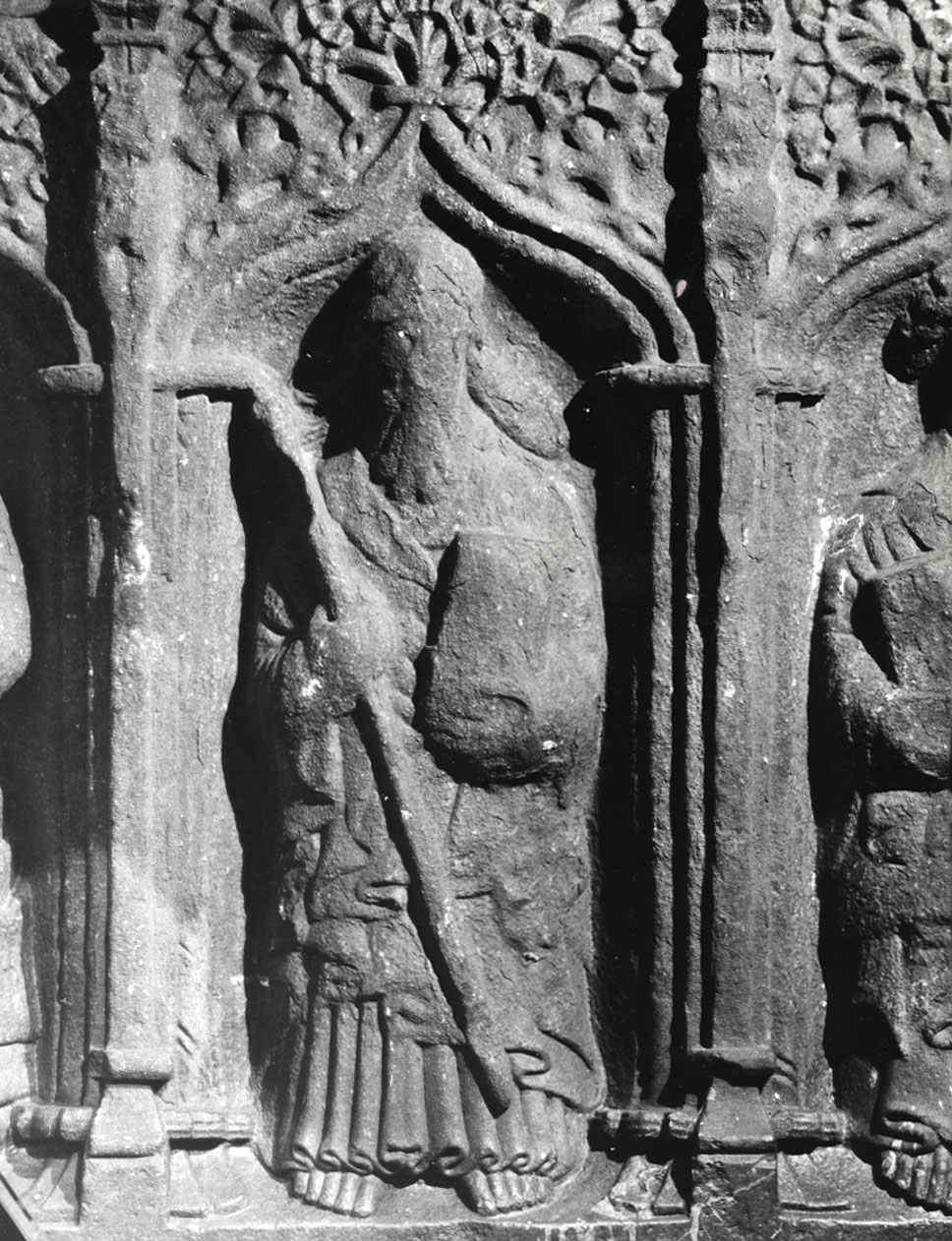
St. James Major (N. side, 3rd from W. end of the Rice tomb taken from the Edwin Rae Collection TRIARC http://hdl.handle.net/2262/56205
The west end of the tomb bears the images of St Margaret of Antioch, the Virgin and Child and St Catherine of Alexandria. The east end depicts St Edmund the Confessor, the Holy Trinity and St Patrick. An elaborately carved cadaver lies on top the tomb. It is wrapped in a shroud knotted at the head and feet which has fallen open.

Image of Cadaver from the Edwin Rea Collection TRIARC http://hdl.handle.net/2262/56072
Frogs and toads are emerging from the body which is surrounded by a Latin inscription that translates as
Here lies ‘James Rice,one time citizen of this city,founder of this chapel,and Catherine Broun, his wife.
Whoever you may be, passerby, Stop, weep as you read. I am what you are going to be, and I was what you are.
I beg of you, pray for me ! It is our lot to pass through the jaws of death.
Lord Christ, we beg of thee, we implore thee, be merciful to us!
Thou who has come to redeem the lost condemn not the redeemed.
James Rice is just one of many Irish people who went on pilgrimage to Santiago its likely if he had not been in office at the time of his pilgrimages they would have gone unrecorded.
References
Connolly, P. (ed.) 2002. Statue Rolls of the Irish Parliament, Richard III-Henry VIII. Dublin: Four Courts Press.
McEneaney, E. 1995. A History of Waterford and its Mayors, from the 12th century to the 20th century. Waterford: Waterford Corporation.
Cahir Castle in Co Tipperary is one of my favourite historic sites. The castle which dates to the 13th century is built on a rock outcrop in the River Suir and was once the stronghold of the Butlers of Ormond. The castle was rebuilt in the 15th and 16th century and there was also a lot of restoration work carried out in the 19th and 20th century.

View of Cahir castle from the outer ward (courtyard).
The castle has a very rich and interesting history and I highly recommend a visit and guided tour of the Castle. Abarta Heritage also have an excellent audio guide for Cahir Castle.
There are many interesting features within the castle but my favourite is a piece of medieval graffiti located on the east gable of the 13th century gatehouse, which later became the castle keep. The carving is located just inside the gateway with the portcullis (a latticed/grilled gate). If you have any difficulty finding the graffiti just ask any of the guides who work here they are so helpful.

Portcullis gateway close to the reception area in the middle ward of the castle.
As you pass through the gateway keep your eye out for a triangular-shaped stone with some cement surrounding it at the top of the batter of the east gable of the gate house wall. If you are coming from the middle ward (courtyard) it will be on your left hand side.
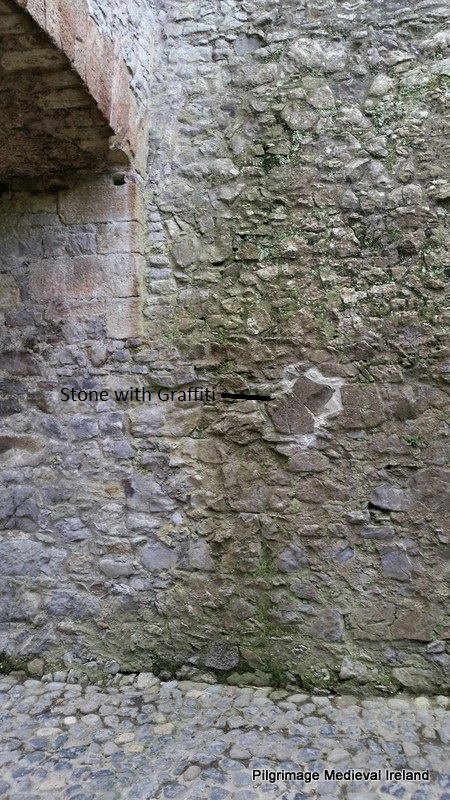
Stone with medieval graffiti on the east gable of the gatehouse at Cahir Castle.
The graffiti consists of a design of three figures which have been designed to fit the natural shape of a stone. The central figure consists of a triangular-shaped head with a rounded crown sitting on top of a thin neck and torso. Traces of ribs are visible in the torso.
‘The lower part of the body is damaged making it impossible to say where or how it terminated. The figure has a thin left arm and possibly a right arm, bent at the elbow, which many be indicated by a loop on the side (Holland 1988, 15).

Stone with graffiti showing the three faces.
On either side of the central figure are two inverted faces with eyes, eyebrows and nose. Both are of a similar shape to the central figure, with ears placed high on their heads. All three are contemporary and there appears to have been some thought about the design to make use of the shape of the stone.

The photo above inverted to show the two side faces more clearly.
Given that the stone is in situ its likely the graffiti was carved some time after the gatehouse was built-in the 13th century. But who carved it and why ? Was someone bored ? Or was it placed here for a specific purpose ? Most of these question may never be answered but its fun to try and come up with some answers. I havent come across anything like this graffiti at any other Irish medieval site I have visited which makes it all the more special. For a more in-depth discussion of the Cahir castle graffiti there is a very interesting article ‘A Carving in Cahir Castle, Co Tipperary’ by Patrick Holland (full references below).
References
http://www.heritageireland.ie/en/south-east/cahircastle/
Holland, P. 1988. ‘A Carving in Cahir Castle, Co Tipperary’, North Munster Antiquarian Journal , Vol. 30, 14-18.
Last Sunday I paid a flying visit to the medieval Cathedral at Clonfert Co Galway.
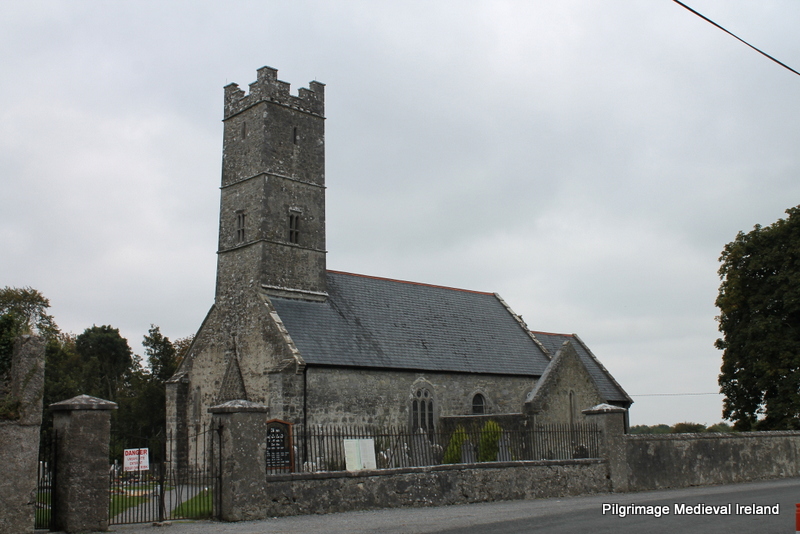
Medieval church at Clonfert
Clonfert Cathedral was built on the site of an early medieval monastery founded by St Brendan the Navigator circa 557 AD. The history of Clonfert and its architecture is really interesting and I will come back to it again but for this post I want to focus on a lesser known feature at the site known as St Brendan’s rag tree.
The tree, a horse-chestnut, is located in a grove of trees beside the medieval church along the nuns walk. This is one of the most impressive rag trees that I have come across. It is covered in votive offerings.
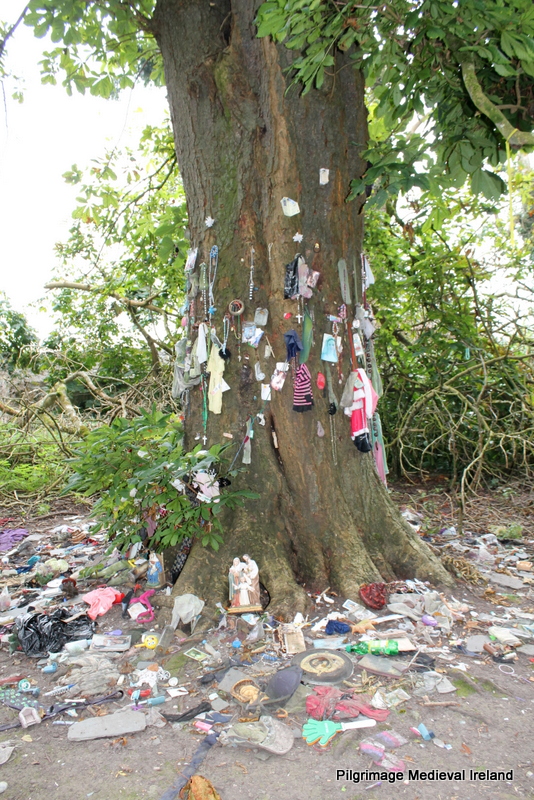
St Brendan’s rag tree at Clonfert.
The following text was written by Christy Cunniffe for the South East Archaeological and Historical Society Newsletter for Spring 2012 and provides an excellent discussion of the tree and its history and folklore.
Devotion at holy wells and sacred trees is still quite common
throughout rural Ireland. This example in the woodland near the
cathedral at Clonfert consists of a holy well dedicated to St Brendan.
It manifests itself in the form of a horse chestnut tree with a small
opening in its northern side. In its original form St Brendan’s Well
consisted of an actual well in the ground located in the corner of a
field some three hundred metres south east of here. According to
tradition the well was desecrated when a dog drowned in it. It then
dried up as is usual for wells that are interfered with in some way .It moved to a new location in the bough of a large ash tree growing on
the ‘hill of the abbey about a hundred metres away. The folklore
attached to this latter well relates that two young boys climbed the
tree and that one of them ‘peed’ into the waters of the well causing it
to fall in a subsequent storm . So once again because the well was
desecrated it went dry and was forced to move. The well that people
now recognise as St Brendan’s Well was only discovered in the
earlier part of the twentieth century and was recognised as such due
to it resembling the shape of the nearby Romanesque doorway of St
Brendan’s Cathedral. Pilgrims and people seeking cures for illness
visit here and leave votive offerings and requests for cures. In earlier
times it was used only for the cure of warts, but in more recent times
is used as a place to seek cures for sick children, thus explaining the
particular array of votive offerings left by believers. To effect a cure
it is commonly believed that one must make three visits and leave
something (Cunniffe 2012, 2).
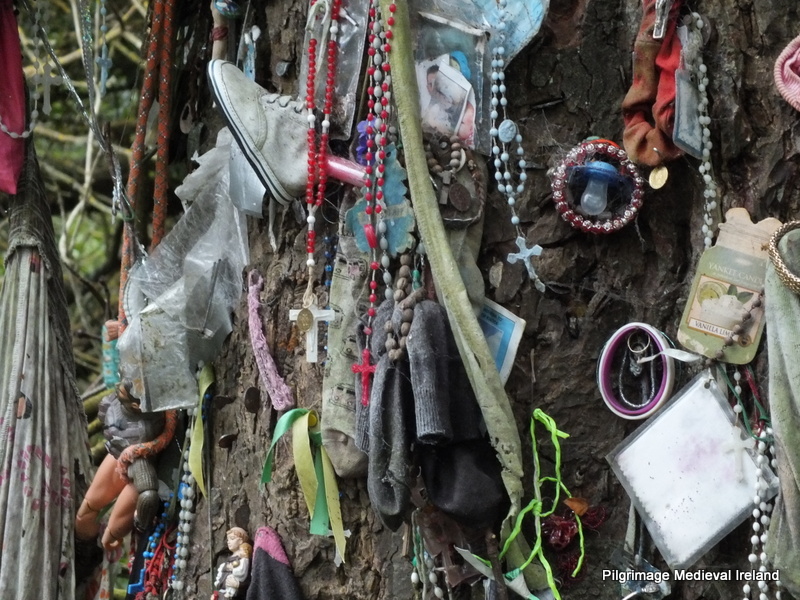
Offerings pinned to St Brendan’s rag tree at Clonfert.
The offerings pinned to the tree are varied. They range from rosary beads, hair bobbins, sockets, babies dummies, religious statues and children’s toys and brown scapular.
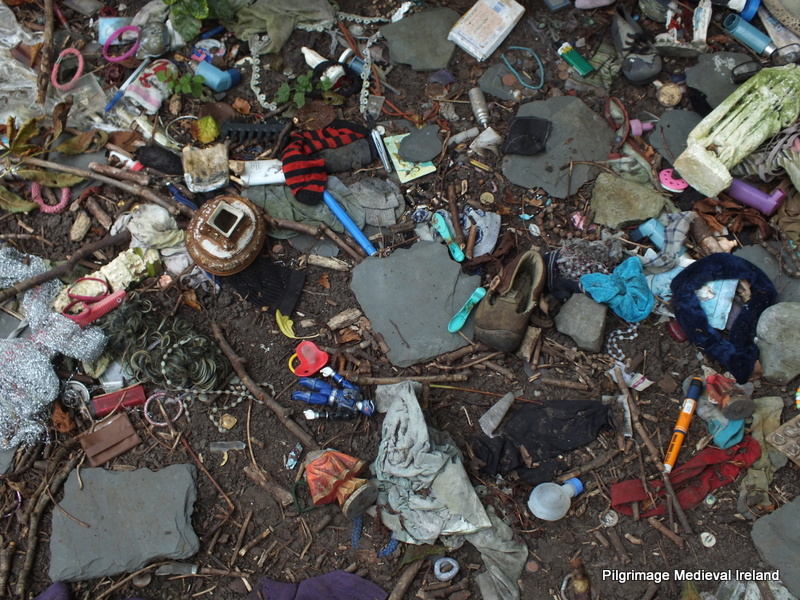
Votive offerings surrounding St Brendan’s rag tree at Clonfert.
The base of the tree is surrounded with a circle of offering some may have fallen from the tree but others are likely placed here on the ground. These offering are similar to those pinned to the tree although I notices more items of clothing, religious statues, inhalers, containers for tablets and holy water bottles. The volume of objects is astonishing and shows that there is still a great devotion to the tree.
References
Cunniffe, C. 2012 ‘St Brendan’s Tree, Clonfert’, South East Archaeological and Historical Society Newsletter, No 9, Spring, 2012, 2.
I am delighted to be nominated for The Blog Awards Ireland 2014 in the Best Arts and Culture Blog section. The Long List in this category includes many of my favourite blogs so best of luck to everyone.
My niece is almost two. My parents often recite little poems and rhymes to her that they told to my sister and I when we were small. Many of the poems they learned as children making some at least three generations old.
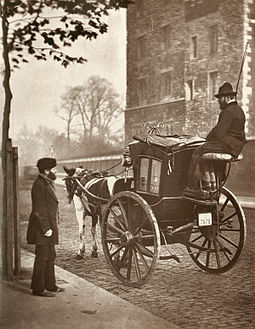
One of my nieces favourite poems is How many miles to Dublin? which is always recited while being bounced on one knee. It goes a follows
Hupp, hupp my little horse, hupp, hupp again sir.
How many miles to Dublin? Three score and ten sir,
Will we be there by candle light? Yes sir and back sir.Photograph of a hansom cab, From ‘Street Life in London’, 1877, by John Thompson and Adolphe Smith (http://en.wikipedia.org/wiki/Hansom_cab#mediaviewer/File:London_Cabmen.jpg)
A
This is not an Irish poem. According to the book A history of nursery rhymes, during the 19th century the poem was commonly recited to children in Britain as well as Ireland, where the word Dublin was substituted for London or other English towns.
Around the Mount Leinster area of Co Carlow the poem went
Hupp hupp little horse
How many miles from this to RossThree score and tenCan you be there by candle lightYes sir and back againHere Ross is substituted for Dublin and likely refers to the town of New Ross.This book suggests that this poem may date back even further to Tudor times. Its really interesting to see how simple family traditions can be preserved through the generations.
References
Green, P. 1899. A history of Nursery Rhymes. London: Greening & Co. Ltd.
This year I joined with thousands of pilgrims in the annual pilgrimage to Croagh Patrick. For those of you who might not know, Croagh Patrick is a holy mountain located on the western coast of May on of the southern shores of Clew Bay associated with St Patrick. The mountain is 764m (2510 ft) in height. Pilgrimage can place throughout the year but the main focus for pilgrims takes place the last weekend of August. The Friday of this weekend is generally the day local people climb the mountain and the Sunday often called Reek Sunday is the main day for pilgrims from a wider geographical hinterland. Each year on this weekend thousands of people make pilgrimage and ascend the mountain to pray at its summit. There is a long history of pilgrimage at this site which I have discussed in a previous post.

Croagh Patrick in Co Mayo
Pilgrimage to Croagh Patrick 2014
On the morning of the 27th of July I joined with circa twenty thousands pilgrims in the annual pilgrimage to the summit of Croagh Patrick. There are a number of approach route the summit. The majority of pilgrim climb from the townland of Murrisk following a track worn by centuries of feet known as the Cásan Phádraig (the Path of Patrick).
I arrived by car to the base of the mountain about 10.00am. An early start for a Sunday but not at Croagh Patrick, where pilgrims had begun climbing in the early hours of the morning to arrive at 6 am on the summit. I parked my car in one of the fields converted into temporary car parks to cope with the influx of traffic and paid a 5 Euro fee for the day. As I pulled on my walking boots and pack my rucksack with food and water, I noticed many of the people in my car park were having picnics out of their cars , tea and sandwiches, a reward for a pilgrimage completed or perhaps fuel for the climb ahead. To begin my climb I a short distance to a small laneway located beside the car park of the Croagh Patrick visitor centre.

Pilgrims begin their climb at the car park at the base of the mountain.
I have climbed this mountain many times over the years in various weather condition while doing research for my PhD thesis but this was my first climb with actual pilgrims. I was slightly apprehensive. I am not a fan of very large crowds and knowing how difficult the terrain of the mountain is I worried crowds the would make the climb uncomfortable however once I began my fears were soon allayed but I was conscious throughout the climb of what was going on about me.
On the main pilgrimage day Mountain Rescue groups and the Order of Malta have a very visible presence and they do really excellent work to help pilgrims get up and down the mountain safely. Croagh Patrick can be a dangerous mountain. Much of the route and in particular the conical top of the mountain is covered by loose shale which moves under foot and can be very slippery in wet weather. The terrain is difficult especially in the final stages. The weather conditions on the summit can be very changeable and temperatures at the top of the mountain can be up to 10 degrees colder than at sea level. It is very important to be prepared for the climb and to have good footware, appropriate clothing water and a stick. As I walked to the summit I noticed blood on some of the stones on the path and I witnessed at least 3 people fall and many more stumble but retain their balance because of their sticks.
The following day I read that there had been 17 casualties on this years pilgrimage with four people taken off the mountain via stretcher, and two helicopter evacuations. On my way up I saw one person being carried by stretcher from the cone of the mountain and one person being air lifted from the mountain during my decent.
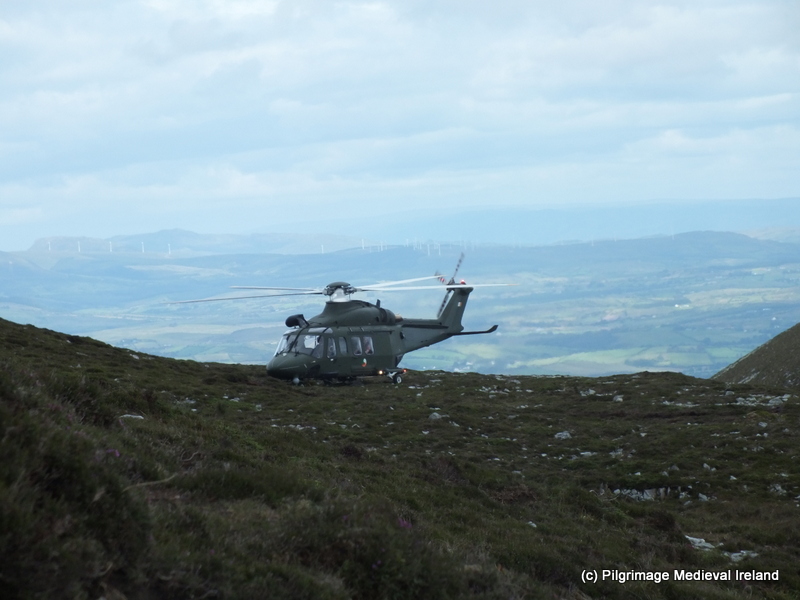
Helicopter getting ready to take an injured person off the mountain
The Cásan Phádriag
The pilgrim climb in Murrisk begins at the base of the mountain at a small laneway on the east side of the carpark of the visitor centre. This path takes you passed numerous stalls such as the legion of Mary as well as vendors selling religious items.

Vendor selling religious items.
At the top of the lane you come face to face with a large statue of St Patrick and get a great view of the mountain looming behind. The weather conditions were pretty good it was a warm day with a slight refreshing breeze. During my climb summit of the mountain was covered with low-lying cloud, that cleared intermittently to reveal the top. I could see people on the summit who from a distance looked like tiny colourful ants.
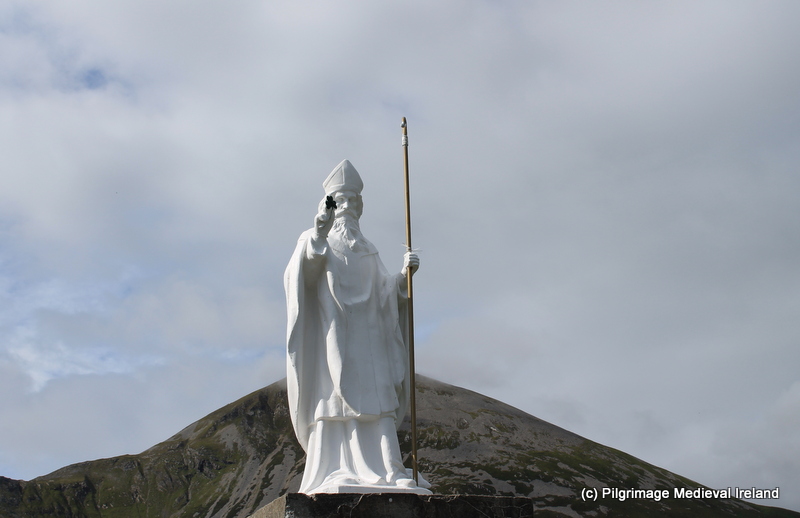
Statue of St Patrick at the base of Croagh Patrick.
On the way up the path was very busy with a constant stream of people coming up and down the mountain passing each other by. The pilgrims were made up of all age groups from as young as 7/8 to people in their 80’s. Some people walk alone while others walk in small groups of friends or family.

Pilgrims climbing the lower sections of the Cásan Phádraig.
People climb and participate in Reek Sunday for many reasons some for religious and spiritual reasons, others to carry on family traditions and other to experience this unique occasion and to enjoy the amazing scenery. As I walked along I saw a wide range of human emotions; a father and his small child quarrelling about the climb, a woman sitting down and spontaneously crying, children racing along like mountain goats and a woman helping bandage the hand of a stranger who had fallen and cut his fingers. There was a great sense of comradery among pilgrims. I noticed people would often stop and help people who slipped or ask others who stopped for their breath, if they were ok. In the final stages of climbing the cone those coming down the mountain would offer words of encouragement “your nearly there now” “Nearly at the top now”. I also noted a handful of people climbing the mountain in their bare feet as part of their penitential pilgrimage.

Pilgrims walking the lower section of the Cásan Phádraig
Climbing the Croagh Patrick on such a busy day means that you must pay extra attention to where you walk. One often needs to manoeuvre and avoid walking in the path of those coming down the mountain as well as those walking ahead at a slower pace or those who stop suddenly in front of you. You also need to be aware of where to put your feet and to try and choose the best path ahead.
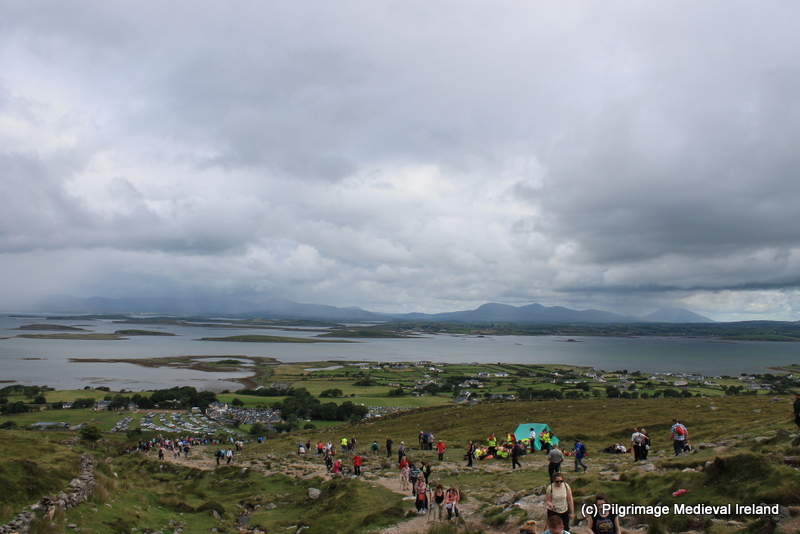
Views of Clew bay from the lower section of Croagh Patrick
Depending on your level of fitness and weather conditions it can take anywhere between 1.5 to 2/3 to reach the summit. It took me ages as I was constantly stopping to take photos.
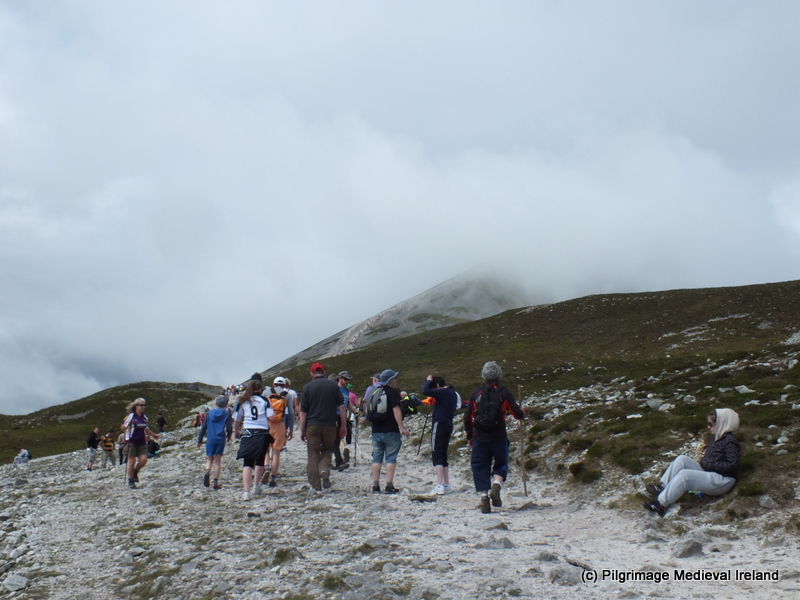
Cásan Phádraig as it levels out before reaching the cone.
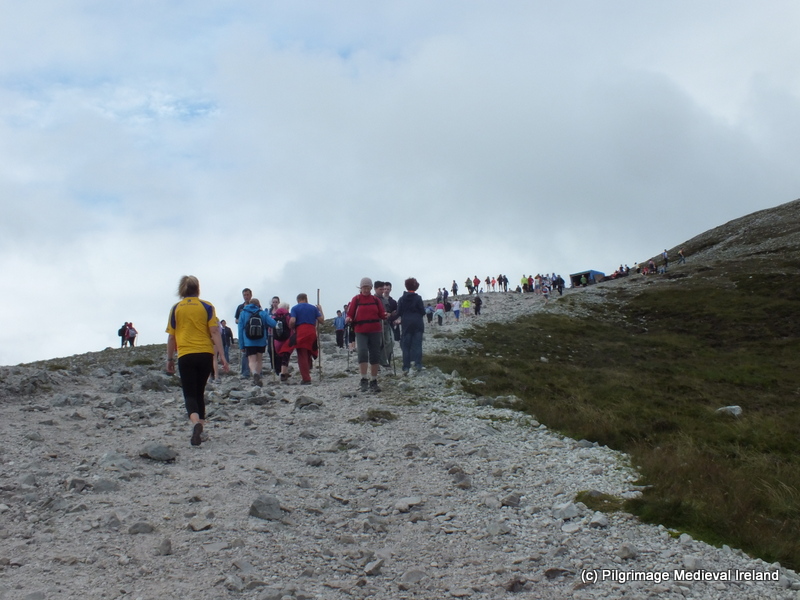
Pilgrims approaching the cone of Croagh Patrick
At the base of the cone of the mountain pilgrims encounter the pilgrim station known as Leacht Mionnáin/Benan. This is a large cairn of stones probably of 19th century date.
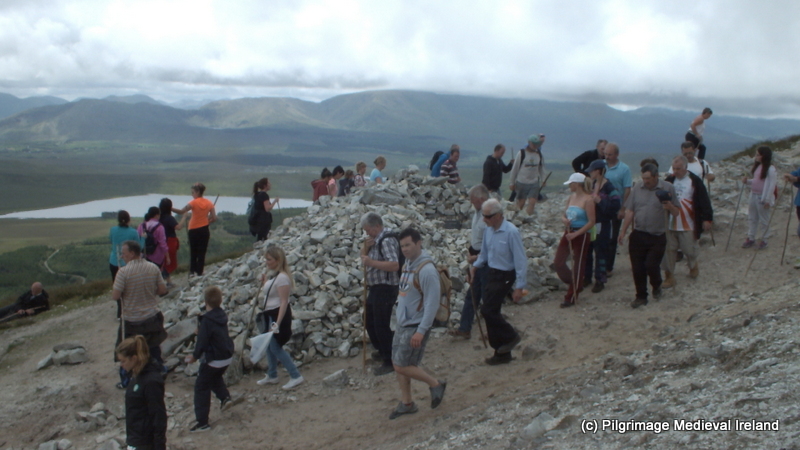
Pilgrims walking in prayer around Leacht Benan a the base of the cone.
Pilgrims preforming the rounds (traditional prayer focused on a number of holy foci ) walk in a clockwise direction around the cairn reciting the following prayers; 7 Our Fathers, 7 Hail Mary’s and the Creed. Having finished they embark on the final climb to the summit. The steepness of this section of the route and the movable terrain underfoot make this the most difficult section of the climb.
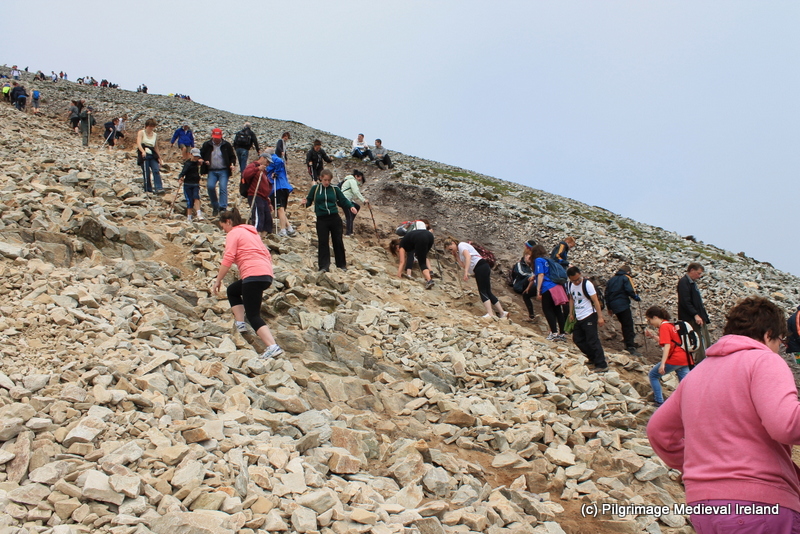
Pilgrims starting to climb the cone of the mountain the final stages of the ascent.
As I climbed upward the summit was hidden from by the clouds. The final stage of the climb is very steep and lots of concentration is needed to keep your balance but almost without realising it the ground suddenly becomes flat and you realise you have made it in one piece to the summit.

Some pilgrims perform their pilgrimage barefoot
The first thing I did was to sit down and catch my breath. I was sitting on the left hand side of the church lots of pilgrims were sitting down in this area too. It wasn’t long before I noticed the cold air and I was very glad of the fleece top I had packed at the bottom of my rucksack. The summit is a large flat area enclosed by a dry stone wall in poor condition on the top are toilets, a small church and a number of pilgrim stations.
The pilgrimage rituals on the summit include visiting the remaining stations or foci of devotion, as well as attending mass and confession. The first station is an unnamed cairn of stones.

The pilgrim kneels at the cairn and recites 7 Hail Marys, 7 Our Fathers, and 1 creed. Next the pilgrim prays near the modern chapel for the Pope’s intentions and walks 15 times round the oratory reciting 15 Our Fathers, 15 Hail Marys and 1 Creed.

The back the oratory on the summit of Croagh Patrick
Finally, the pilgrim proceeds to the station known as Leabha Phádraig/Patrick’s bed. This is a small hollow defined by a metal railing. The pilgrim walks clockwise around reciting 7 Our Fathers, 7 Hail Marys and 1 Creed.

The small chapel on the summit provided the sacrament of confessions begin on the summit at 7:30am and continuing until 2:00pm. The first Mass on the summit began at 8:00am and every half hour thereafter until the last Mass which at 2:00pm.

Pilgrims attending mass on the summit.
Traditionally the final pilgrim station of the pilgrimage was a visit to large possible Bronze age enclosure called Roiling Mhuire (Virgin’s Cemetery) on the western side of the mountain. Three cairns of stones are found within the enclosure and the pilgrim walked 7 times round each cairn, saying 7 Our Fathers, 7 Hail Mary’s and 1 Creed and finally go round the whole enclosure seven times praying. The majority of modern pilgrims skip this final stage and finish their pilgrimage on the summit.
While the pilgrims pray and perform their rounds other pilgrims take the opportunity to relax after their arduous climb many take the opportunity to sit and eat the food they have brought with them or purchased at the food stall that sells tea and sandwiches.

Stall selling food and hot drinks on the summit.
The summit was covered in cloud but intermittently the cloud would clear to reveal the stunning scenery and let the sun warm the weary pilgrims.

Views of Clew Bay from the summit.
I also notice people taking selfies on their mobile photos in front of the church or Leabha Phádraig while others posed beside a signs placed here in 2013 which says Croagh Patrick Ireland’s Holy Mountain. I am not sure sure why you need a sign to tell you your are on the summit but those who were photographed beside it seem to like it.

Sign on top of Croagh Patrick.
The final part of the pilgrimage is the decent. Climbing back down is as difficult if not more so then the ascent. This is also when most accidents take place. It was here that I found my trusty stick most useful.
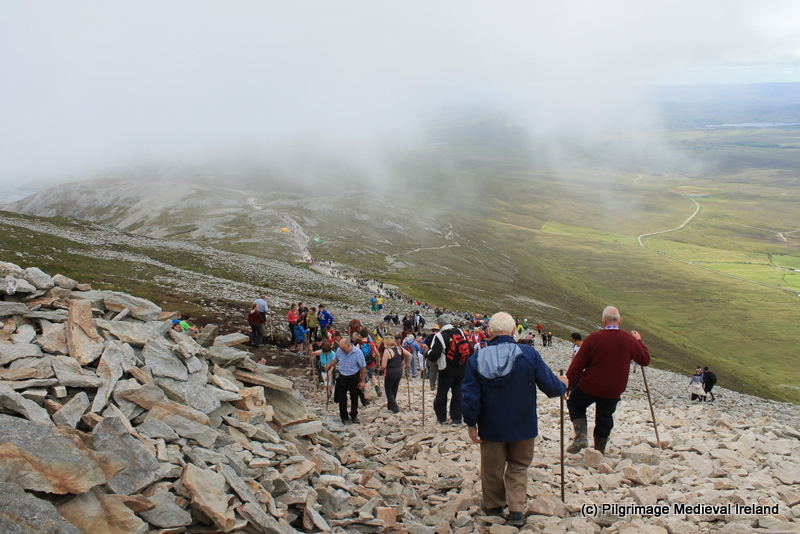
Climbing down Craogh Patrick.
Taking part in this pilgrimage was a wonderful experience and I hope I will be lucky enough to take part again in the future. Pilgrims who climb here should also be aware that the constant foot fall of pilgrims and tourists whose numbers can be up to 100, 000 during the year is causing sever erosion of the mountain. To find out more about this check out Mountaineering Ireland website.
Having returned safely down the mountain I ended my pilgrimage here by visiting the nearby sites of Glaspatrick and Kilgeever- posts to follow.
Further reading on this years pilgrimage.
http://www.irishmirror.ie/news/irish-news/croagh-patrick-pilgrimage-17-people-3922909
http://www.rte.ie/news/2014/0727/633338-croagh-patrick/
http://www.mountaineering.ie/aboutus/news/2013/default.aspx?iid=305
http://liminalentwinings.com/path-croagh-patrick/
 Pilgrimage In Medieval Ireland
