The Hidden World of the Irish Medieval Park

I am  delighted to present a guest post by  Fiona Beglane who is the author of a wonderful book on  deerparks in Medieval Ireland.  Hunting and the keeping of deer was such and important part of medieval life in Ireland but to date it has received little attention in academic or popular books.  This is a topic  I know little about so I was delighted when Fiona agreed to write a guest post  to share her knowledge and her research on the topic.

cover1

Anglo-Norman Parks in Medieval Ireland


The Hidden World of the Irish medieval park

Over the last couple of decades there has been increasing interest in both medieval archaeology and in landscape studies. Until recently very little work has been done on medieval parks in Ireland although these were an important part of the manorial landscape particularly for large, important manors that had castles at their centres. This blogpost will look at what the parks were used for, where they are and what we know about them.

The castle and park at Dunamase, Co. Laois

View of the castle and park at the Rock of Dunamase Co Laois

My research has shown that some of the recorded medieval parks can still be identified in the modern landscape. Medieval parks where I have carried out detailed surveys include those at Loughrea, Maynooth, Nenagh, Dunamase, Glencree and Carrick, Co. Wexford, while parks at places like Oakpark, Co. Carlow and Kilkenny are now under more recent demesne landscapes.

Medieval parks were enclosed areas of land surrounded by a wall, hedge, ditch or palings (a wooden fence) or by a combination of these, and in fact the word park means ‘enclosure’. In Ireland the recorded high medieval examples range between four acres and 913 acres, with the majority having a land area of between twenty and two hundred acres. In an ideal world, the lord owning of one of the largest parks would have kept a herd of fallow fallow deer which would have provided venison for the table, but this was out of reach for the vast majority of park owners who had more humble enclosures. Parks were important for growing large trees to provide timber for construction, and by enclosing these the trees were protected from being take for firewood, charcoal burning or general carpentry. Smaller pieces of wood such as coppiced poles and firewood could also be deliberately produced within parks and were important resources within the manors, both for the lord’s use and for his tenants. The vast majority of parks in Ireland also seem to have been used for pasturing cattle and other animals, which were protected from theft while they were enclosed. These could belong to the lord or to his tenants and could even include animals impounded by the court, for example on non-payment of fines.

The ditch forming the southern park boundary at Carrick   Co. Wexford

The ditch forming the southern park boundary at Carrick Co. Wexford


I have found documentary evidence of at least forty-six parks in Ireland up to c.1400, all of which are from areas of the country held by the Anglo-Normans. They are mostly in the east of the country, with a few examples in Anglo-Norman areas of the west and south. They appear in a variety of documents including Inquisitions post-mortem, court records, patent rolls, church and manorial records. The most detailed of these can include descriptions of land areas, the layout of a manor, livestock within the park and the value of grazing lands, and as such they can provide a valuable resource for understanding medieval land use and mind-set.

Many of the parks are difficult to physically find in the modern landscape. In some cases the site of a recorded medieval park has been lost under urban sprawl, although sometimes the pattern of the road system has fossilised the park boundaries. Other parks fell out of use fairly shortly after being created and so there is little evidence of their location. Place names can sometimes be helpful, however it is important to be cautious. The very common place name ‘Deerpark’, is post-medieval and would not have been used for a medieval park, while townlands or areas of land called ‘Park’ can be of high medieval or of later origin. Using maps and detailed fieldwork it has been possible for me to identify the location and boundaries of some of the Irish medieval parks. These include u-shaped, sub-rectangular and oval shapes and they can be bounded by lakes, rivers or roads on one or more sides.


The River Slaney formed the northern park boundary at   Carrick, Co. Wexford

The River Slaney formed the northern park boundary at Carrick, Co. Wexford

Before the Anglo-Normans arrived in Ireland the country was divided into a large number of túatha or petty kingdoms. There is evidence that many of the parks were constructed on land that was woodland in this earlier period, which would make practical sense. In some cases, there were also prehistoric or early medieval monuments within them, and there was place name evidence to show that the Anglo-Norman lords deliberately enclosed symbolically-important land. By doing this, the new owners aimed to control access to memories and monuments of the past and to demonstrate their control over the local population.
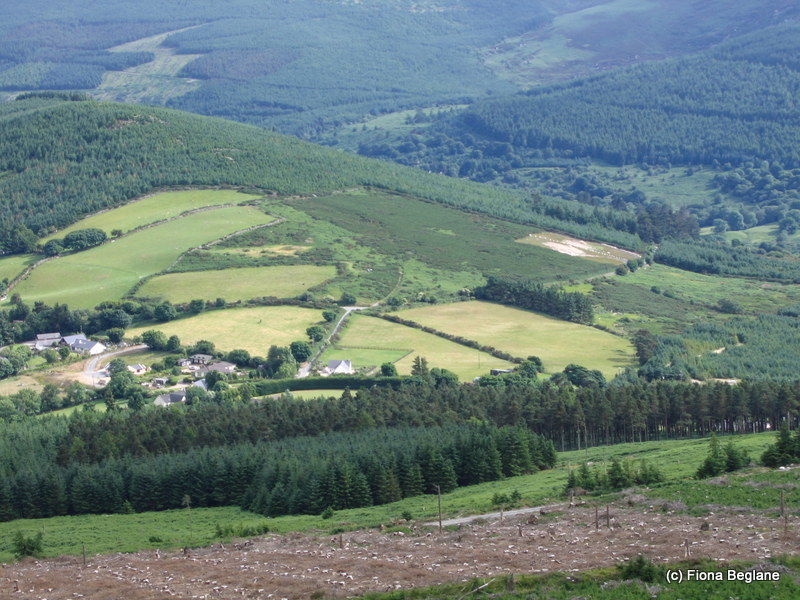
Glencree, Co. Wicklow

Glencree, Co. Wicklow

Parks were key features within the medieval landscape and have long been ignored. It is now possible to find these in the modern landscape and they can help us to understand how and why people in the past used the land in the way that they did. Parks had both practical and symbolic purposes ranging from enclosing deer and cattle though timber production to being used as a symbol of status and authority. If you would like to know more, then check out my recent book  Anglo-Norman parks in Medieval Ireland.

References
Beglane, Fiona. 2015. Anglo-Norman parks in medieval Ireland: 1169-c.1350. Four Courts Press, Dublin.
Beglane, Fiona. 2015. ‘The social significance of game in the diet of later medieval Ireland’. Proceedings of the Royal Irish Academy. 115C: 1-30.
Beglane, Fiona. 2014. ‘Theatre of power: the Anglo-Norman park at Earlspark, Co Galway, Ireland’ Medieval Archaeology. 58: 307-17
Murphy, Margaret & Kieran O’Conor. 2006. ‘Castles and Deer Parks in Anglo-Norman Ireland’, Eolas: Journal of the American Society of Irish Medieval Studies, 1: 51-70

Mini-bio
Dr Fiona Beglane is a lecturer of archaeology at IT Sligo. Her research interests focus on zooarchaeology, hunting, medieval archaeology, medieval landscape and settlement and the use of scientific techniques in archaeology. She has a particular interest in integrating scientific and social/cultural interpretations of archaeology and in examining the interaction of humans and animals. She can be contacted at beglane.fiona@itsligo.ie

Pattern Day at Old Leighlin 2015

Each year on the 18th of April, the feast day of St Laserian (also spelt Lazerian), sunshine or rain, the people of the village of Old Leighlin and the surrounding areas come together to take part in a pilgrimage whose roots date back to medieval times, in honour of their patron saint.  I had the honour of attending the pilgrimage in 2013 when the pilgrimage was held in the evening time.  This year  Laserian’s feast fell on a Saturday and the pilgrimage was held in the afternoon.

DSCF0892

St Laserian as depicted in the east window of Old Leighlin Cathedral created by renowned Irish stain glass artist Catherine O’Brien.

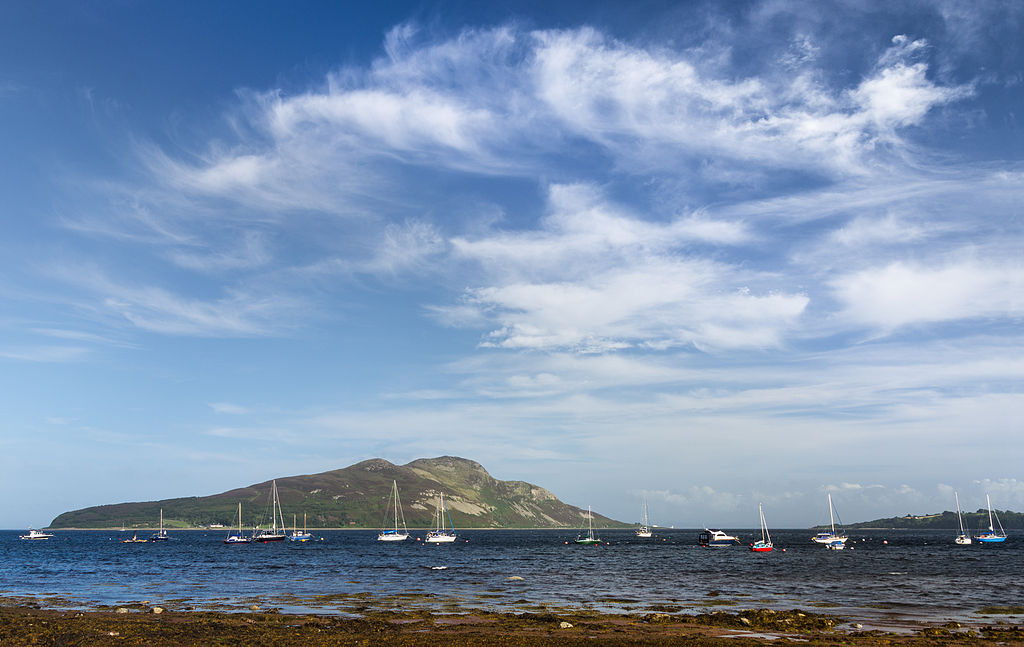
Laserian, also known as Molaise is the patron saint of Old Leighlin and his name means flame of fire.  According to The Dictionary of Irish Saints complied by Pádraig Ó’Riain, Laserian was born circa 566 AD, into an aristocratic family in Ulster. His father Corieall Curaidh was part of the ruling dynasty known as the Ulaidh, while his mother was daughter of Aodhán son of Gabhrán, King of Scotland. A medieval account of the saints Life, suggests Laserian spent the first seven years of his life in Scotland before returning to Ireland to be educate by St Munna of Taghmon in Co Wexford. As a young man he turned his back on his privileged background to devote his life to God. Laserian following in the footsteps of many other Irish saints, left Ireland to live as a hermit on a small island, off the coast of the Isle of Arran in Scotland. This Island is now known as Holy Island and the site of the saint’s cave in which he lived is still to be found.

221024px-Holy_Isle_from_Lamlash

Holy Island (© User:Colin / Wikimedia Commons, via Wikimedia Commons; http://commons.wikimedia.org/wiki/File%3AHoly_Isle_from_Lamlash.jpg)

Some years later Laserian left Scotland and travelled to Rome where he was ordained as a priest by Pope Gregory the Great. While in Rome he was inspired to return to Ireland to preach and work as a missionary. Directed by an angel the saint travelled through Leinster searching for a suitable site for a monastery. He stopped briefly at Lorum near Bagnalstown but continued on his journey until he reached Old Leighlin. Upon arrival he found a monastery already established by St Gobban. St Gobban sensed it was God’s will for Laserian to stay at Old Leighlin and relinquish control of the monastery to him. He then set out with a small group of monks and founded a new monastery at Kilamery in Co Kilkenny.

One early 20th century folklore tale from the area tells that as Laserian arrived at Old Leighlin a spring well, now the focus of modern pilgrimage burst forth from the ground. Laserian is credited with performing many other miracles at Old Leighlin and also with resolving the Easter controversy in the southern half of Ireland, at a synod held at Old Leighlin in 630 AD. Tradition holds that Laserian departed this world on the 18th of April in 639 AD.

Despite the passage of time devotion, memory and connection to the saint is very much alive at Old Leighlin and each year the local community comes together to celebrate the saint’s feast day. The celebration takes the form of an ecumenical service presided over by the Anglican Bishop of the United Diocese of Cashel , Ferns, Leighlin, Lismore, Ossory and Waterford and the Catholic Bishop of the Diocese Kildare and Leighlin, highlighting the importance of St Laserian within both diocese.
This years’ service began at 4pm on a sunny Saturday afternoon at the Cathedral church, built on the site of Laserian’s monastery. Following opening prayers and hymns, a procession from the Cathedral to the holy well was led by Bishop Denis Nulty of the Diocese of Kildare and Leighlin and Rev. Robin Bantry White representing the Right Reverend Michael Burrows, Bishop of the Diocese of Cashel, Waterford, Lismore, Ferns, Ossory and Leighlin, who was unable to attend this year’s celebration. They were joined by Rev George Cliffe, representing Rev Tom Gordon of Old Leighlin, George Kidd (Lay Reader at Old Leighlin), Fr Tom Lalor PP of Leighlinbridge and Deacon Patrick Roche of Leighlinbridge and in turn by pilgrims from both churches.

DSCF0549

Procession to St Laserian’s holy well

The procession left the Cathedral grounds, heading up the road, through the village to St Laserian’s holy well. Old Leighlin is one of only a handful of modern Irish pilgrimages which still incorporates a procession and is a wonderful sight to behold.
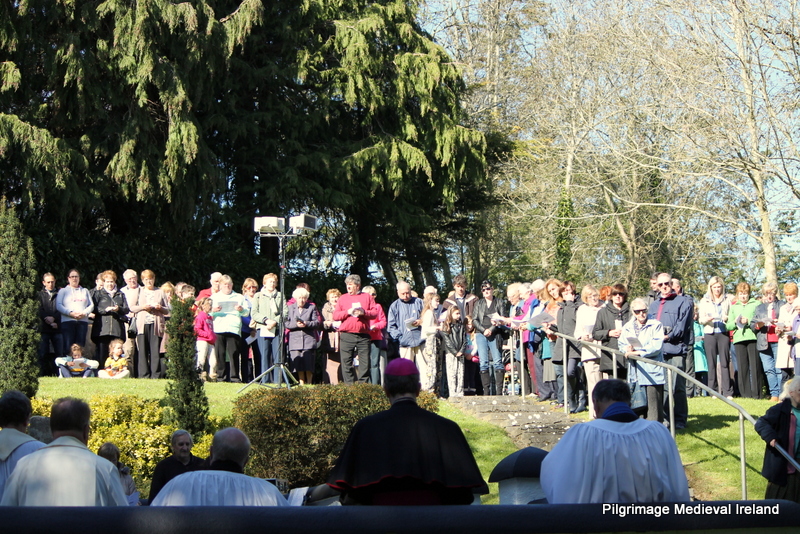
As the procession approached the well, the pilgrims were greeted by the music of a local brass band. Once the pilgrims had settled around the well, the ceremony continued with a reading from the gospel, poems, hymns and prayers in honour of the saint.

DSCF0582

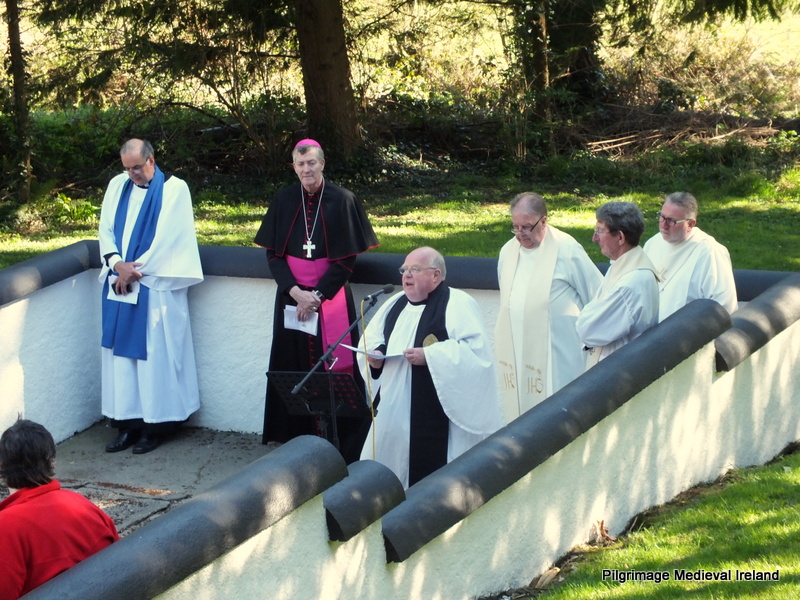
Bishop Denis Nulty, Rev. Robin Bantry White, Rev George Cliffe, George Kidd (Lay Reader at Old Leighlin), Fr Tom Lalor PP of Leighlinbridge and Deacon Patrick Roche of Leighlinbridge.


The service ended with the blessing of the waters of the well and the signing of the hymn O Great St Laserian.

IMG_7676

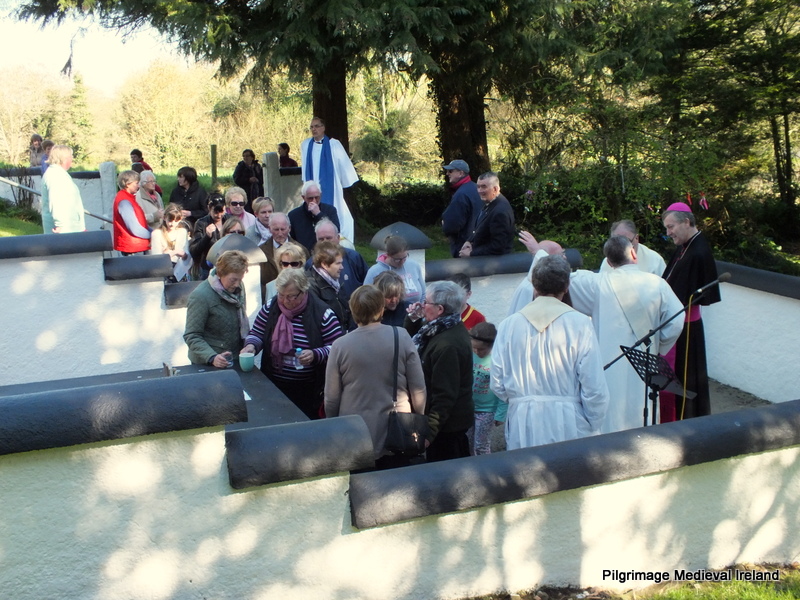
Many of those present went to the well to take the holy water either to drink or to carry home in plastic bottles. The pilgrimage finally ended with the traditional gathering in the local community hall for a very welcome cup of tea and a chat.

DSCF0603

Pilgrims taking water from St Laserian’s holy well

The Old Leighlin pilgrimage has its roots in medieval if not early medieval times and while aspects of the pilgrimage have changed through the centuries, a strong connection to the saint and places associated with him such as St Laserian’s holy well and the Cathedral church, remain constant. In modern times Laserian’s feast day continues to have a relevance to local people. On this day by coming together people renew their links to their saint, their locality and cements bonds and friendships within the wider community and long may it continue.

References

Ó Riain, P. 2012. A Dictionary of Irish Saints. Dublin: Four Courts Press.

Modern Pilgrimage to the Medieval Statue of Our Lady of Clonfert

The 1st of May  signals the beginning of a month-long pilgrimage to the holy statue of Our Lady of Clonfert, located at Clonfert  village in the parish of Eyrecourt, Meelick & Clonfert, in East County  Galway.

This is no ordinary statue and is one of only a handful of medieval statues to  have survive the destruction of the  Reformation in Ireland.  Housed  in the  Church of Our Lady of Clonfert, the statue is the focus of great devotion  especially during the month of May, when hundreds of pilgrims, some traveling long distances come here to pray.

035

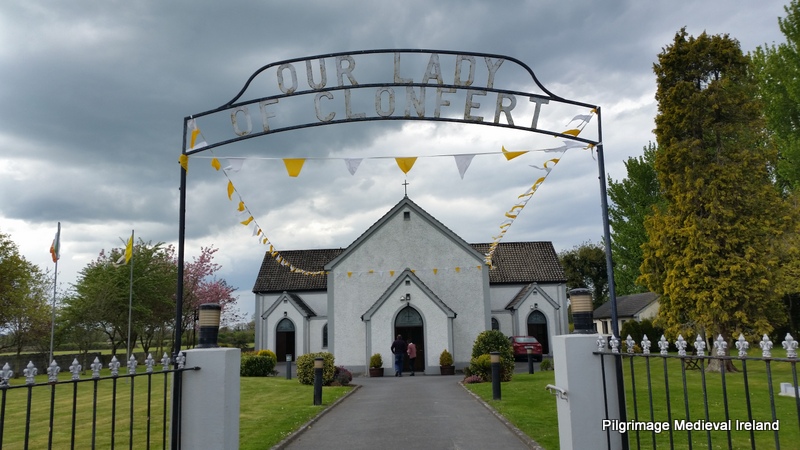
The Church of Our Lady of Clonfert.

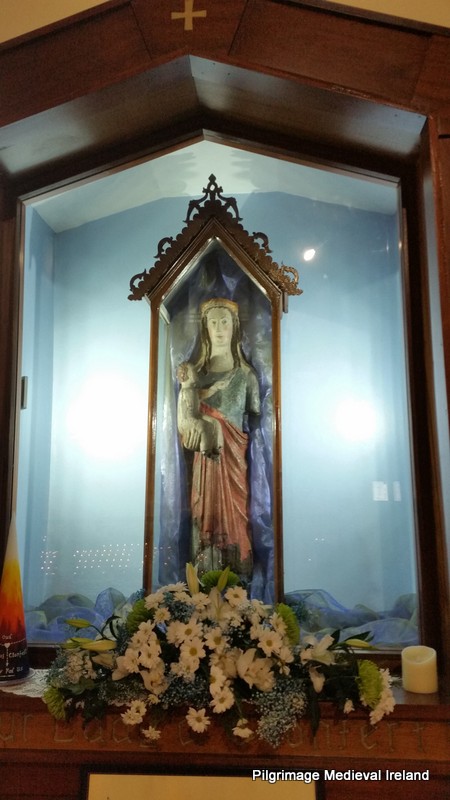
The focus of their devotion is a beautiful medieval statue of the Madonna and Child.

029

The statue of Our Lady of Clonfert

History and Origin Legend of the statue

According to MacLeod ( 1947, 180-181) the statue dates to the late 13th/early 14th century.  Statues like this would have been found in all medieval churches and monastic sites around Ireland and some such as the  statue Our Lady of Trim and Navan were the focus of  popular pilgrimages.

Some say the statue may have came from the old medieval Cathedral of Clonfert  (MacLeod 1947, 179) but it is also possible it may have come from the  abbey of St Mary de Portu Puro located a short distance to the southeast of the Cathedral (pers comm Christ Cunliff).  The statue thankfully survived the reformation and  appears to have remained within the parish. For the last 150  years or more it has resided within the Church of Our Lady of Clonfert.

030

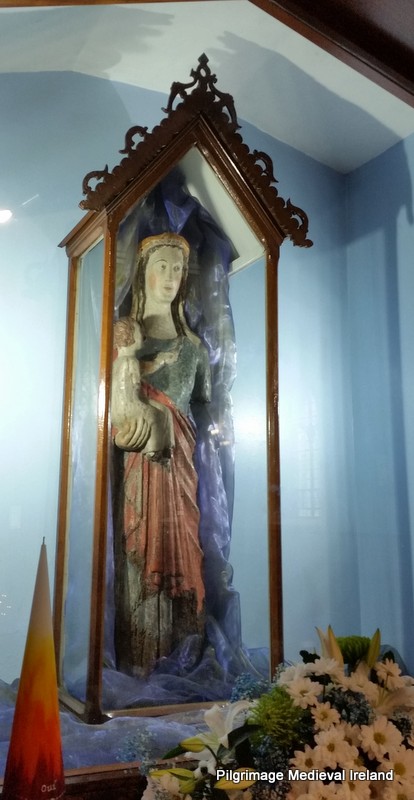
Statue of Our Lady of Clonfert

The statue is about 4 feet tall and carved from oak. The back of the statue is hollowed out.  For the most part the statue is in good condition and the original paint work was revealed under layers of modern paint during restoration.  Over the centuries the statue has incurred some damage, the head of the Christ child has been damage over the years and at some point in the past the top of the head was restored with plaster. While his right arm is broken off and the  feet worn away ( MacLeod 1947, 180-1).  Additionally the arm of the Madonna has been sawn off (ibid., 181).  Despite all this the statue is still very beautiful and engaging.

Local folklore records that early in the nineteen century,  a woodcutter was cutting down an old oak tree and the tree began to bleed.  When he examined the tree further he found the statue within a hollow in the oak tree but had by this stage accidentally cut off the arm of the statue.  It was said the statue was hidden in the tree during the Cromwellian period.

037

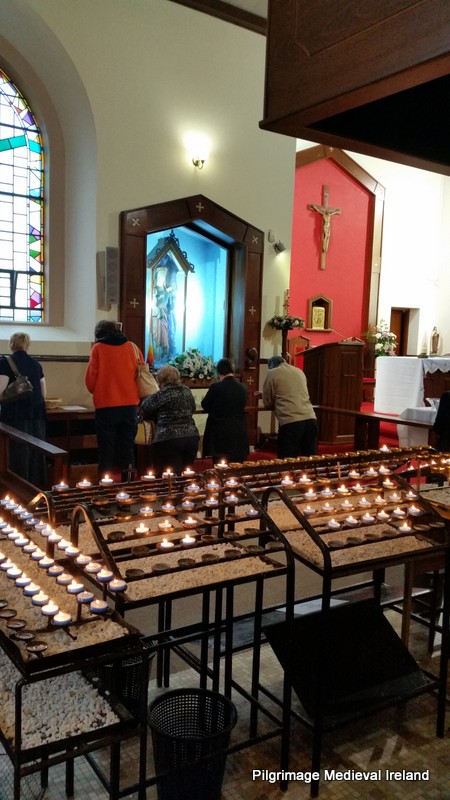
Pilgrims praying before the statue of Our Lady of Clonfert

Modern Pilgrimage at Clonfert

During the month of May the statue receives many visitor from within and outside the parish.  Most pilgrims will make three  visits to the statue during the month of May.  They come  individually at all times throughout the day to pray in front of the statue and to light candles for their prayers and intentions.   In recent years larger gatherings occur in the evenings  at specially organised masses held  throughout the month.

If anyone is interested in attended this years pilgrimage details can be found on  the Parish Website  of Facebook page https://www.facebook.com/eyrecourtmeelickclonfert.

Throughout the month, on Sundays (except May 31st) there will be Benediction and the Rosary and a sermon at 7:00 p.m., and on all other days there will be Holy Mass and a homily or sermon at 8:00 p.m.

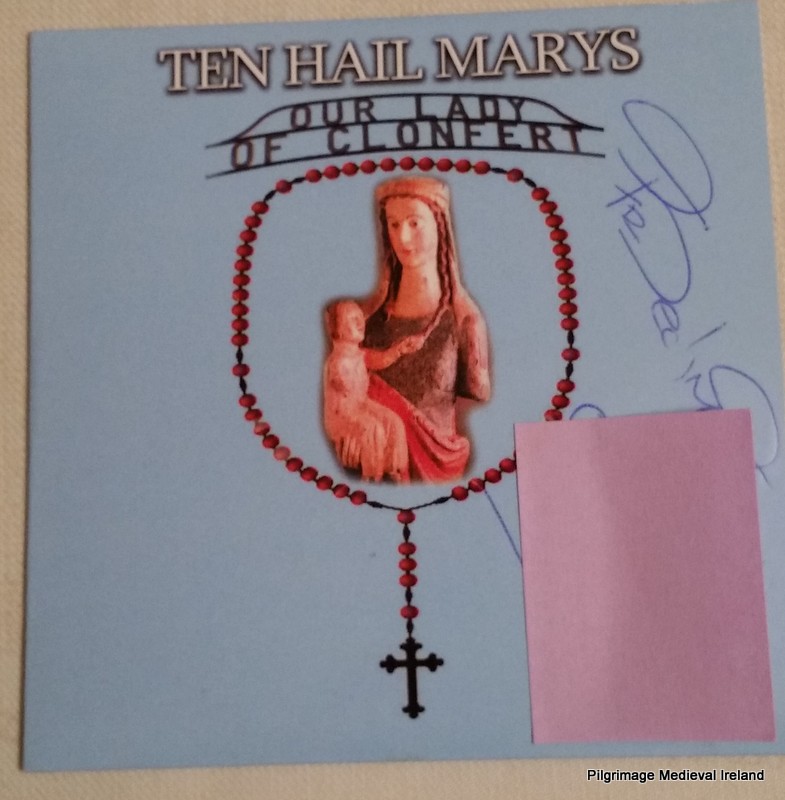
This year  the parish is launching a new CD  in our Lady of Clonfert Church on Wednesday 6th of May at 8pm Mass.  The CD  consists of a  number of hymns sung by soloists Rachel Goode and David Kennedy. The CD includes a new hymn to our Lady of Clonfert  put to music by Michael McCullagh and taken from our Lady of Clonfert Prayer.

043

CD Our Lady of Clonfert

All proceeds from the CD will go towards the large costs of maintaining , conserving and protecting this precious statue which is such an important part of Irish Heritage. The CDs will be available for purchase before and after Mass on the 6th but for anyone who would like  a copy but is  unable to attend  please contact the parish at (090) 967 5113 or email stbrenseyrecourt@eircom.net

References

MacLeod. 1947. Some Late Medieval Wood Sculptures in Ireland. JRSAI Vol. 77, No. 1, 53-63.

Parish Website http://www.clonfertdiocese.ie/html/eyrecourt.asp


Some masons marks at the Rock of Cashel

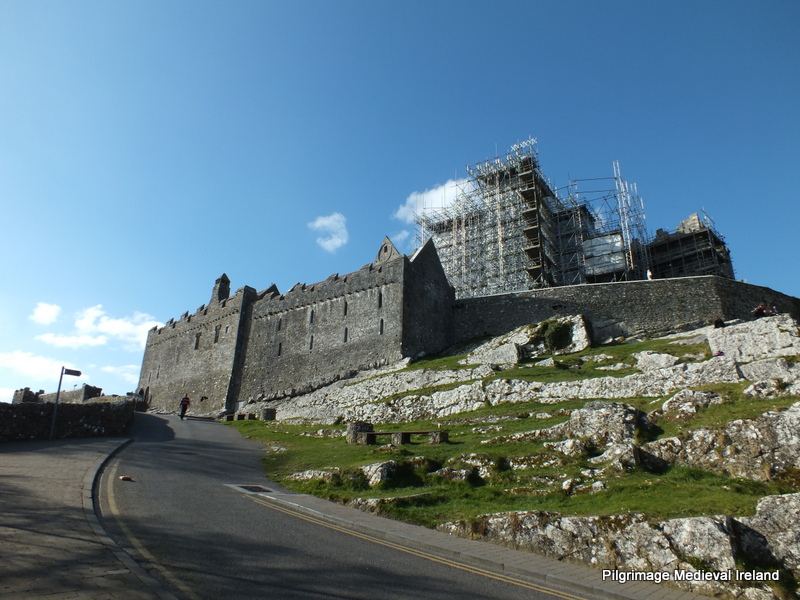
I ended up at The Rock of Cashel  in Co Tipperary a few weeks ago.  The Rock, one of Ireland’s most famous tourist attractions, is  chock-a-block with interesting architectural and archaeological remains.

In my opinion large sites like the Rock deserve several visits. From my own experience each time  I return I see something new that I missed on previous visits.  This visit was no exception as I discovered some tiny  mason’s marks I had never noticed before.

DSCF9315

View of the Rock of Cashel

A recently  conversation about masons marks found at medieval sites in South Tipperary was on my mind during my visit.   I asked  one of the tour guides  if there were any at the site and she directed me to  a number within the main Cathedral church and a building known as The Hall of Vicars Choral.

The Cathedral Nave

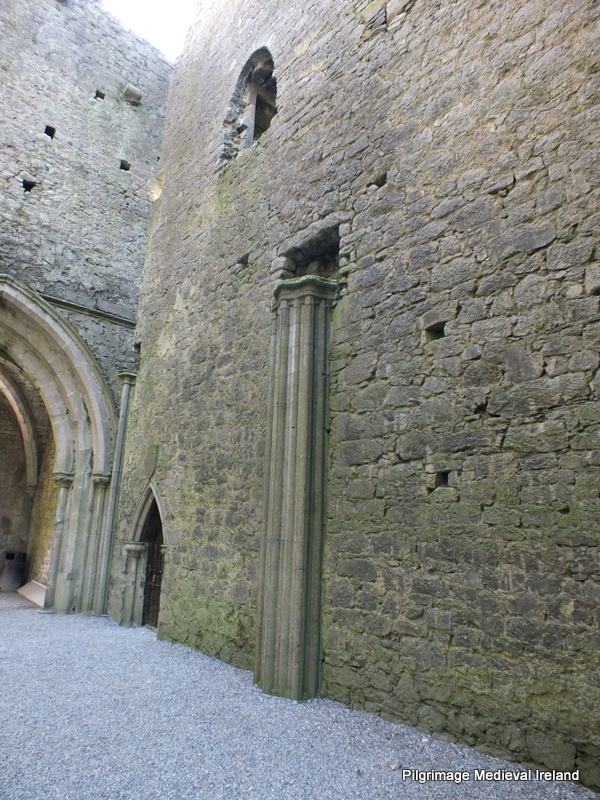
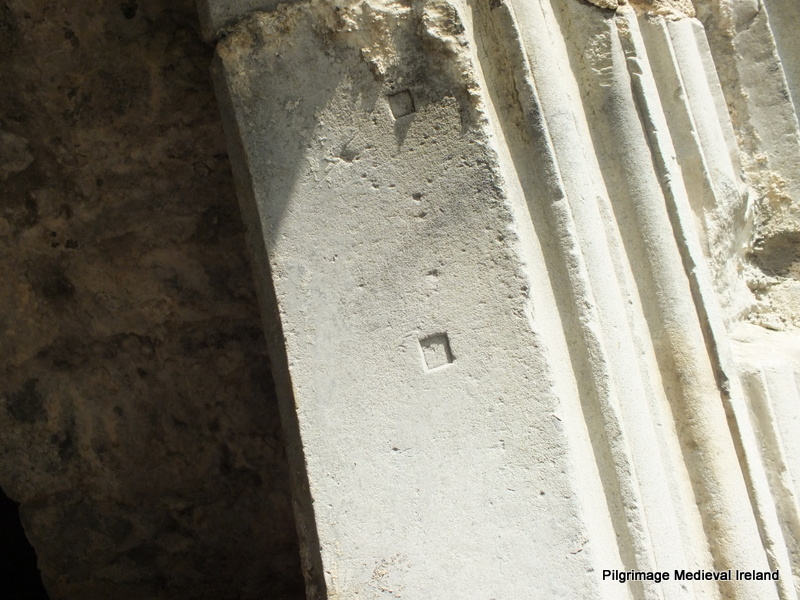
A group of at least three masons marks are located on a large column against the West wall of the nave of the  Cathedral church. The church is a Gothic church without aisles built-in the 13th century. A residential tower of  15th century date was inserted into West end of the nave.  The column  is built against the exterior  wall of this tower within the nave.

DSCF9369

Column built against the west wall of the nave of the church and the residential tower.

There are at least three tiny masons marks on the column. It takes patience to find them, if you are in a hurry  ask a tour guide to point them out.

DSCF9397

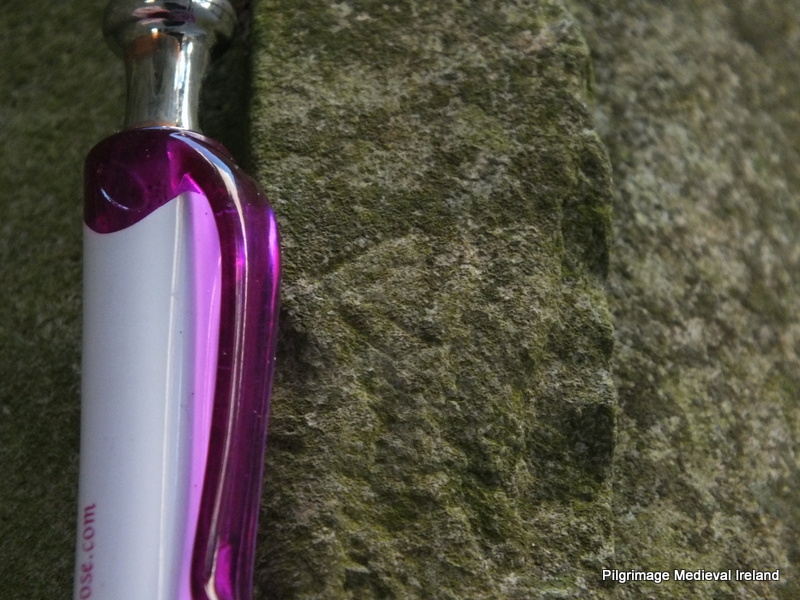
Linear masons mark

The marks are so tiny, I  used my pen for scale for the ones I could reach.  They are hard to make out and there  may very well be more  that  I missed.

DSCF9396

Masons Mark at Cathedral at the Rock of Cashel

DSCF9390

Masons Mark at Cathedral on the Rock of Cashel

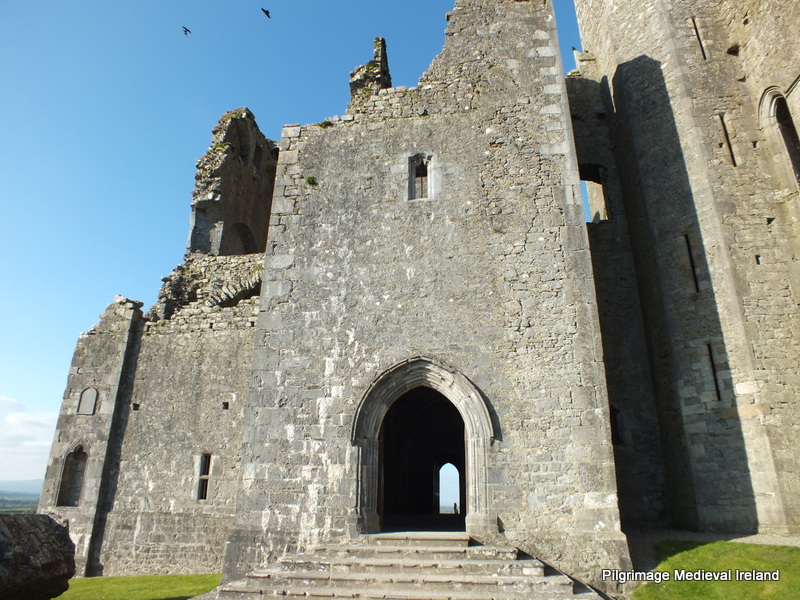
As I was leaving the Cathedral  I noted two more square masons mark in the outer doorway of the porch, which projects from the S wall of the nave and was the main entrance to the cathedral.

DSCF9461

View of main entrance, porch in the South wall of the Cathedral on the Rock of Cashel.

DSCF9458

Masons marks on the door of the porch leading into Cathedral Church at The Rock of Cashel.

The Hall of Vicars Choral

Additional masons marks are found in The Hall of Vicars Choral a two storey building  of 15th century date that  forms part of the enclosure of the site.

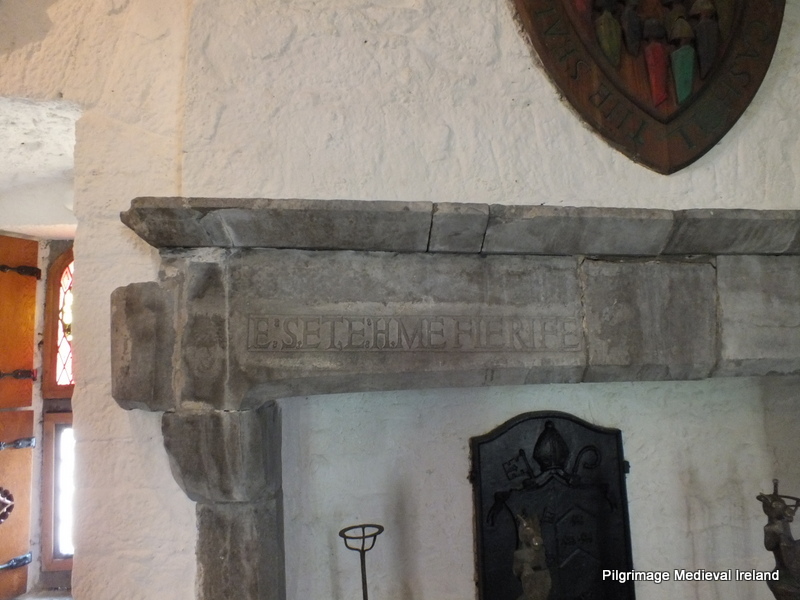
The upper level of the building  comprises of a hall for the Vicars, within is a large fireplace  found in the south wall with the inscription

E.S. ET E.H. ME FIERI FE[CERunt]’

DSCF9505

Fireplace with inscription in The Hall of Vicars Choral.

Within the inscription are  tiny figure of eight and diamond shape with a   circle attached. I thought these might be masons marks  but archaeologist Eamonn Cotter told me these are full stops and it was common to have stop marks between letters or groups of letters on fireplace inscriptions ( as at Barryscourt Castle Co Cork).

DSCF9507

Possible masons marks within the inscription of Fireplace of The Hall of Vicars Choral.

DSCF9508

Possible masons marks within the inscription of Fireplace in The Hall of Vicars Choral.

In the next room from the hall  (an  area restored as  a kitchen),  I noticed  another masons mark on the west wall on the south side of  another fire-place.

DSCF9509-001

Masons mark found in The Hall of Vicars Choral.

For details on opening times  and admission cost see http://www.heritageireland.ie/en/south-east/rockofcashel/

I look forward to visiting the Rock again. I am sure that I will find something  new that I have not noticed before.

A Late Medieval statue of the Pietà from Kilcormac Co Offaly

Kilcormac is a small village in Co Offaly, situated on the N52 approximately 13 miles south-west of Tullamore and 10 miles north-east of Birr.

Located within the  Catholic church, The Church of the Blessed Virgin Mary,  built-in 1867, just off the main street, is a late medieval statue of the Pietà.

images

16th century Statue of the Pietà at Kilcormac church Co Offaly. Image taken https://www.offalyhistory.com/reading-resources/history/history-by-place/kilcormacs-hidden-treasure

The statue is carved from a block of solid oak and measuring five feet by three.  It was created by very a skilled craftsmen. Today the statue is covered in layers of modern paint which obscure some of the intricacies of the carving but

In the anatomy of the Christ every muscle and vein are deftly shown; while the rich broken-edged folds of the Virgin’s drapery express and exuberance suggesting that the statue dates  no earlier then the late 16th century (MacLeod 1947, 62).

Local tradition holds the Pietà came from Italy through a member of the Magawley family of Tremona, in Kilcormac.  It originally stood in the old parish church administered by the Carmelites.  A Carmelite priory had been founded at Kilcormac in the late 1430s by the O’Molloy family, it was later dissolved during the Reformation and reverted to the role of parish church.  The date of the statute suggests it was likely donated after the dissolution of the priory after St Mary’s became the parish church.

Following  a  period of persecution during  the penal times the  statue was taken from the church by a group of local men and hidden in  Derrydolney Bog about a mile from the medieval  chapel of Kilcormac, to protect it from iconoclasts.   At the time Emancipation  the last surviving member of the group now a very old man was carried into  to the bog  on his deathbed where he pointed out the hiding place. The statue was  then dug up and returned to the local community and was  at a later date placed in the modern church at Kilcormac.   According to the Irish Own

It almost left the parish some years after that when a priest, who was moving to Borrisokane, took it with him! However the parishioners brought it back and it has remained in the parish church of Kilcormac to this day.

Today it is housed in the modern church (MacLeod 1947, 62) and  there is great devotion to the statue in the area.  The statue is well worth  a visit if you are in the area and give a glimpse of the  type of objects the one adorned our late medieval churches.

References

MacLeod. 1947. Some Late Medieval Wood Sculptures in Ireland. JRSAI Vol. 77, No. 1, 53-63.

Ireland’s Own Summer Annual 1988  article on the statue reprinted by the Offaly Historical and Archaeological Society . https://www.offalyhistory.com/reading-resources/history/history-by-place/kilcormacs-hidden-treasure


A Selection of Irish Sculpture depicting the Crucifixion from Early and Late Medieval Ireland

To mark Easter  I have decided to share some photos of the carvings of the Crucifixion & Resurrection of Christ found on Irish Sculpture  dating to the Early and Late Medieval period.   This imagery was popular in medieval times, for Christian believers, ‘Christ’s suffering and death brought the promise of redemption a theme emphasised by the crucifixion’ (Stalley 1996, 16).

Cross Slabs

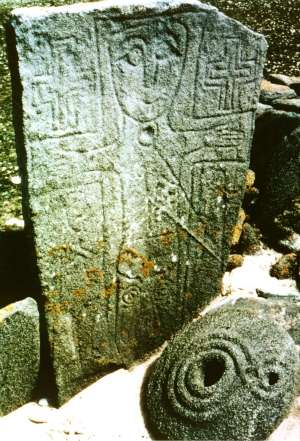
One of the earliest representations of the Crucifixion is found on a  9th/10th century cross slab on the island of Inishkea North, off the coast of County Mayo. The slab depicts  the figure of  a triumphant Christ nailed to the cross, with a wide smiling on his face.

inishkea3

Inishkea North, county Mayo: crucifixion slab (Image taken http://www.irishmegaliths.org.uk/crosspillars3.htm)

High Crosses

Many early medieval High Crosses   incorporate scenes of the  Crucifixion,  usually located at the centre of the cross as at the  Durrow High Cross in Co Offaly. The majority depict two soldiers,  Stephaton and Longinus, on either side of the Christ figure, one offering vinegar to the dying Christ, the other piercing his side with a lance.

DSCF8446

Crucifixion scene on the Durrow High Cross.

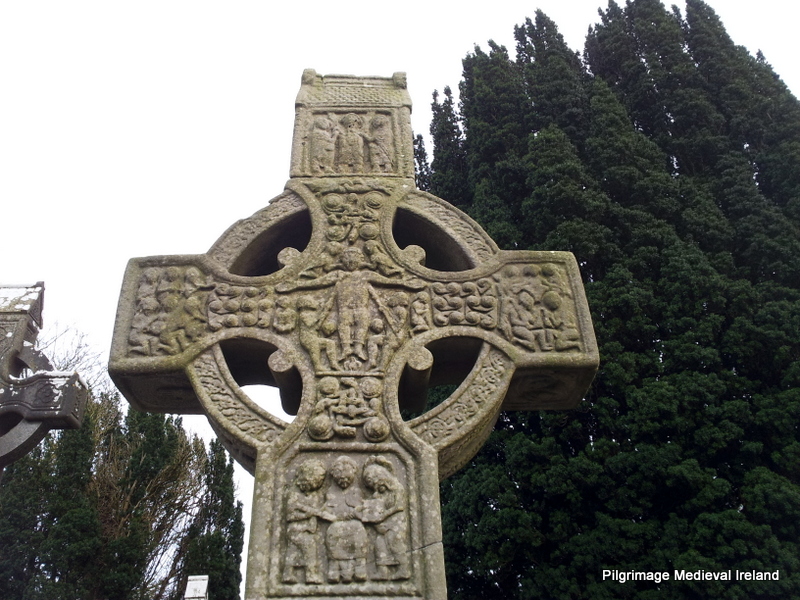
Or Muiredach’s High Cross  Monasterboise, Co Louth, created in the 9th/10th century.  On both crosses the lance-bearer and sponge-bearer are placed  on either side of Christ.

20130203_153526

The crucifixion scene on the Monasterboise High Cross, Co Louth.

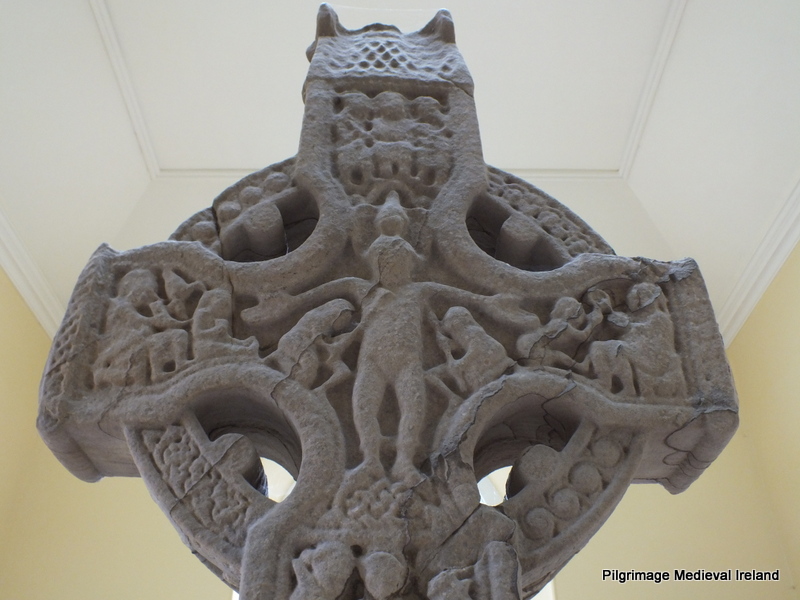
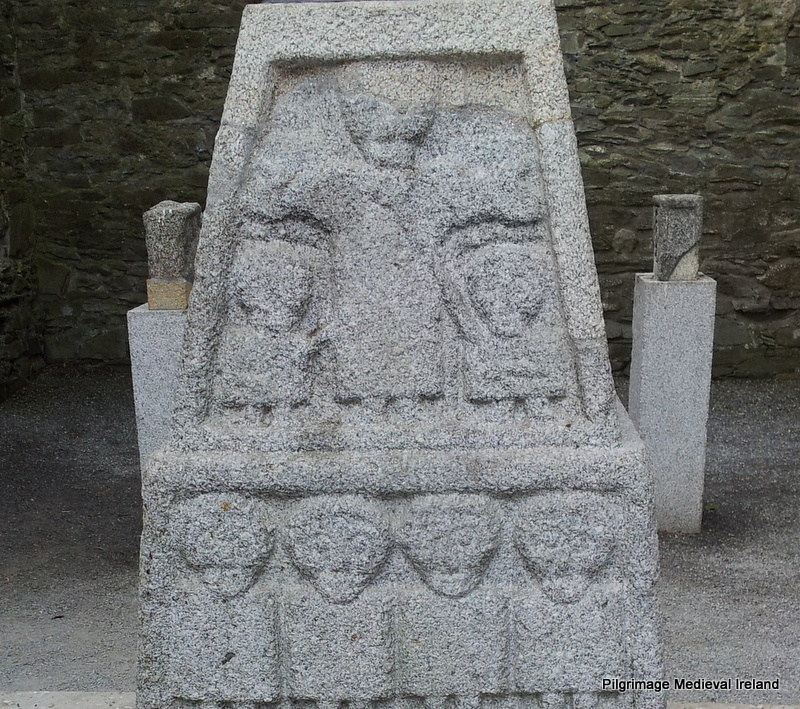
The Crucifixion is also  found on the shaft of the 8th century Moone High Cross, Co Kildare.  The Christ figure is dressed in a long robe.

20120920_105028

Crucifixion scene on the Moone High Cross Co Kildare.

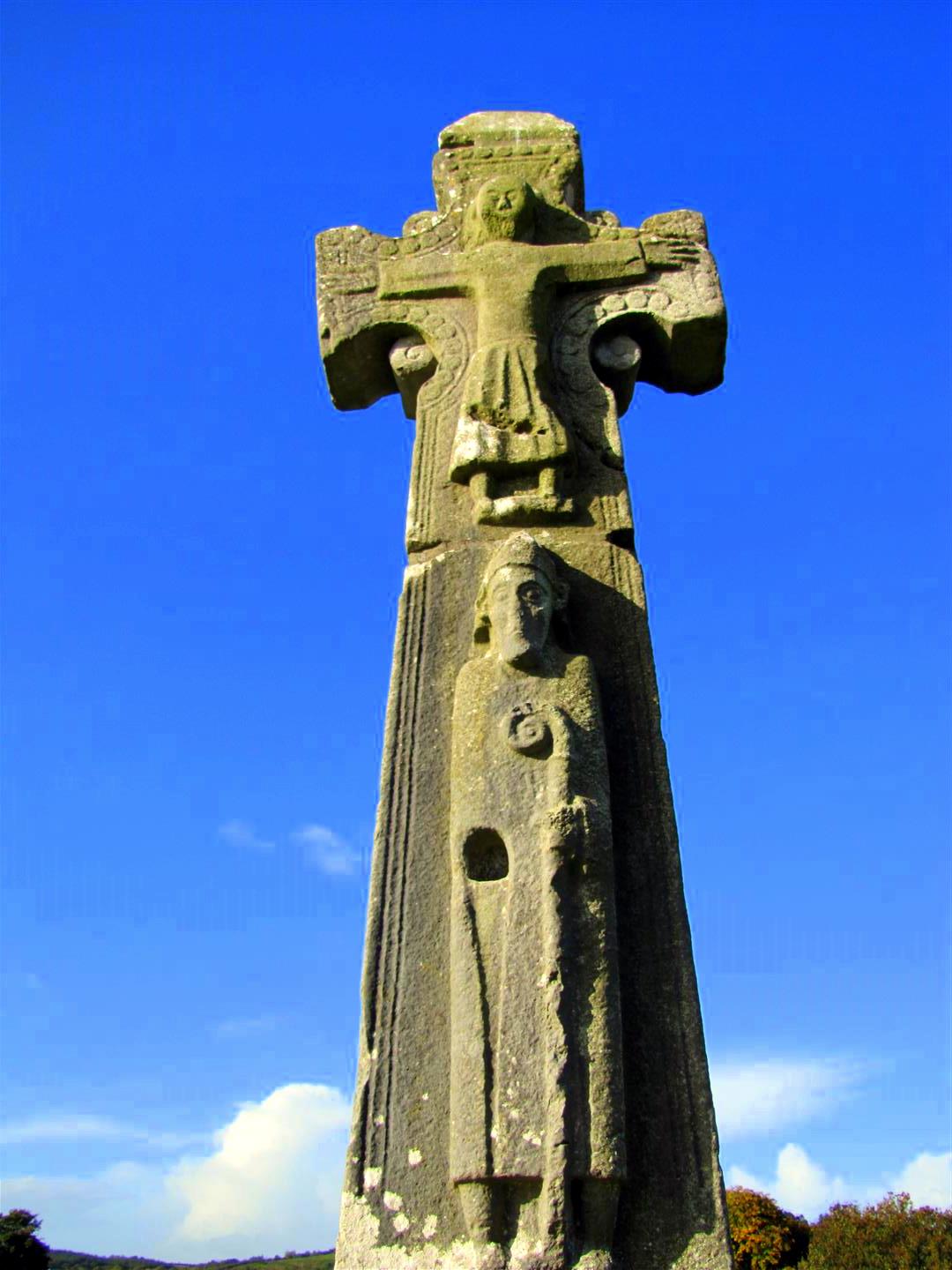
Below is the Dysert O’Dea High Cross  from Co Clare.   It dates to the twelfth century and belongs to the later Romanesque series of crosses dominated by high relief figures of the crucifixion and bishops or patrons. Christ is depicted  in a robe with a pleated skirt with his hands out stretched.

Late Medieval Cross at holy wells

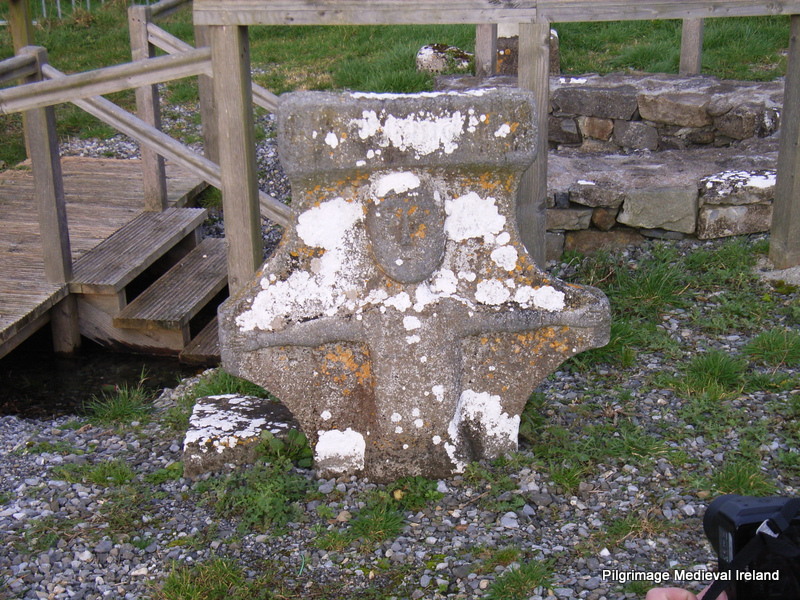
One of my favourite crosses dates  to the  late medieval period  and is found at St Ciaran’s holy well at Clonmacnoise Co Offaly.  It has a simple figure of Christ and  the inscription over head reading ‘Repent and do penance’.  It is part of the modern pilgrim stations at the holy well.

RIMG1722-001

Late Medieval Tombs

In late medieval  Ireland the Crucifixion often appears on  funerary monuments such as chest tombs.

A fine example is found as part of  the Creagh Tomb at  Ennis Friary.  The  Creagh Tomb was  built in 1843 but it  incorporates parts of earlier medieval tombs from the Friary. The Office of Public Works are carrying out conservation work on the Creagh Tomb and part of the Friary. The panels are currently on display at Ennis Friary which is open to the public. I highly recommend a visit to the Friary which is full of  many interesting features. 

The Creagh Tomb Image taken Ennis Friary Facebook page

 The bottom of the monument incorporates the ‘passion panels’ from the McMahon tomb and  depictions of Christ and twelve apostles taken from another royal tomb. 

The Betrayal of Christ- the panel depicts the figure of an archbishop alongside a scene depicting the betrayal of Christ.   Judas can be seen in the centre of the panel betraying Christ with a kiss.  Peter stands on the left sheathing sword.  Malchus, a Roman soldier, is on the ground below him holding his left ear with his right hand.  According to the Gospels Peter attempted to prevent Christ’s arrest by attacking one of the soldiers and cutting off his ear with a sword. Christ miraculously restored the soldiers ear and condemned the action saying: “All who take the sword will perish by the sword”.

betryal christ

Figure of an archbishop from MacMahon tomb and scene of the betrayal of Christ ( from http://hdl.handle.net/2262/11455)

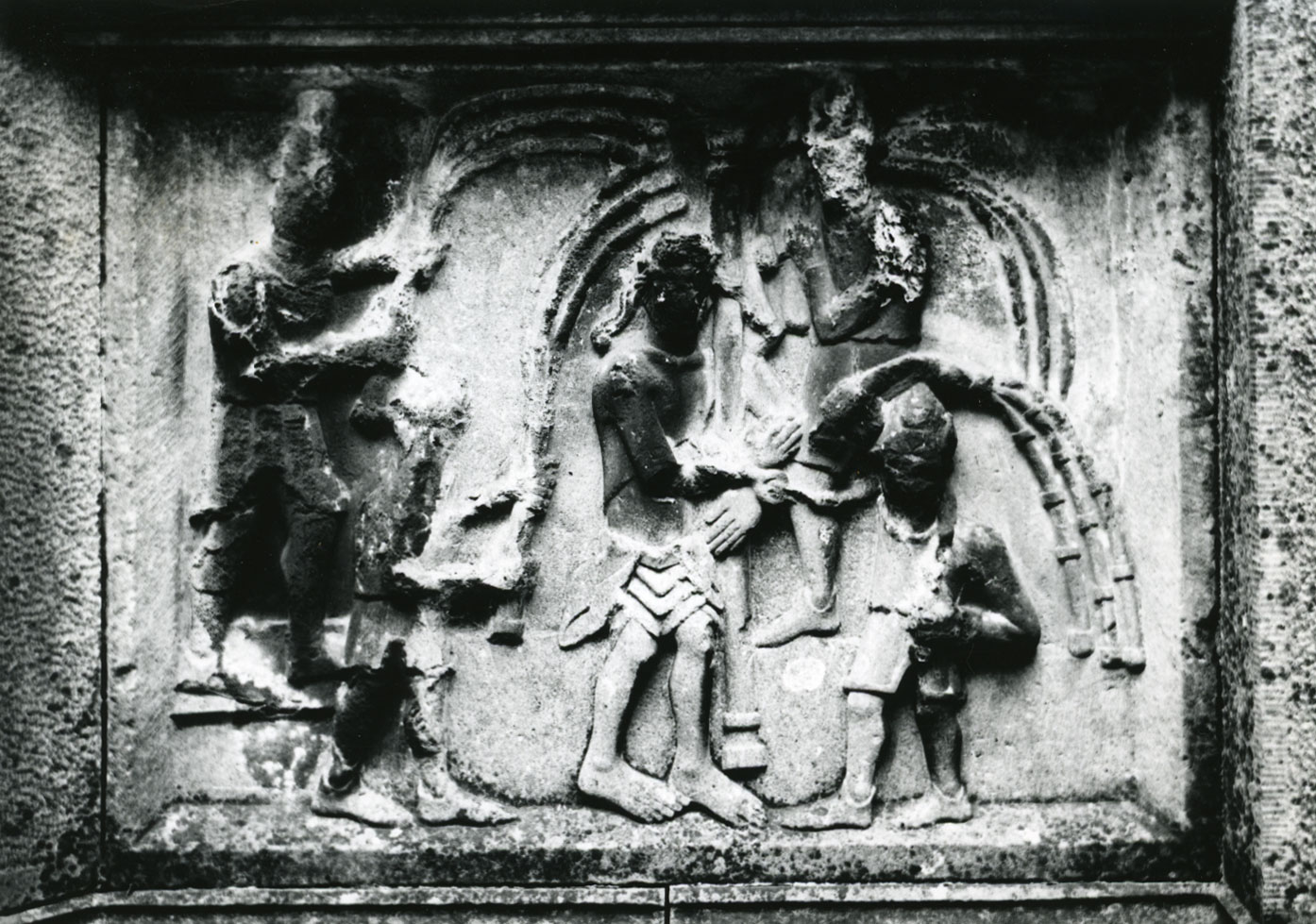
The Flagellation of Christ  – Pontius Pilate, the Roman governor of Judea, ordered  scourging of Christ before crucifixion. In this depiction, Christ embraces a column with his hands bound.  There are four executioners, two on either side of the central figure. Each hold scourges of three knotted lashes.

flagellation

The flagellation of Christ on the Creagh Tomb (taken http://hdl.handle.net/2262/11461)

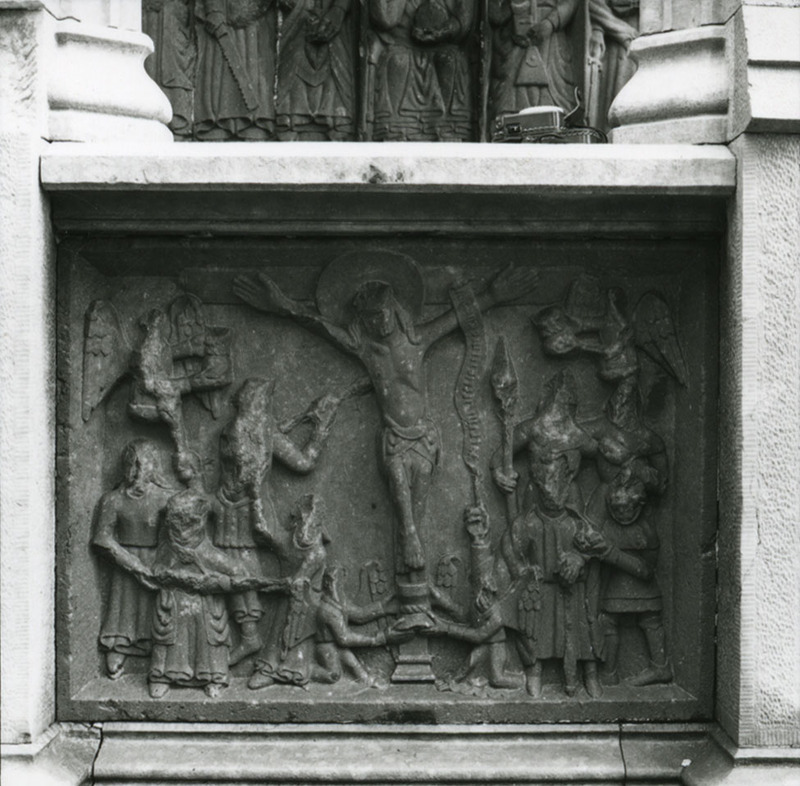
The Crucifixion the panel shows Christ in the center on a cross surrounded on either side and at the foot of the cross by a host of angels. Roman soldiers appear to the left and right of the panel. The soldier Longinus on the left is piercing Christs side with a spear. At the base of the cross four figures the Blessed Virgin, St John, Mary Magdalene and another male figure. Two angels  hold chalices under the hands of Christ and two more kneel at the base of the cross.

abc0ac7e73b4f7cfa0a28f6603fb23d8

Scene of the crucifixion from The Creagh Tomb. TARA (Trinity’s Access to Research Archive) URI http://hdl.handle.net/2262/11475

The Entombment of Christ – on the evening of the Crucifixion, Joseph of Arimathea asked Pilate for Christ’s body wrapped it in a linen cloth and laid it in a tomb.  Some Christian traditions hold that Joseph was Jesus’ uncle – but the gospel of Mark, states that Joseph was not a follower of Jesus, but a pious Jew who wished to ensure that the body was buried in accordance with Jewish law, according to which bodies could not be left exposed overnight. The figure on the left overseeing the entombment is thought to represent Joseph of Aramathea and the tiny figure kneeling holding Christs hand is thought to represent Mary Magdelene.

Franciscan Friary, Ennis, County Clare – Creagh Tomb, Entombment of Christ, (Taken from Gothic Past, http://www.gothicpast.com/items/show/3391)

The Resurrection of Christ – Christ is depicted  emerging from the tomb  stepping on a sleeping solider.  His right hand is held aloft in blessing and in his left hand he holds a cross which has a banner affixed.  The Roman soldiers are  dressed in medieval armor.

Resurrection of Christ  from -The Creagh Tomb at Ennis Friary

Another very interesting depiction of the  Resurrection of Christ is found on a 16th century tomb  at St. James Church, Athboy, County Meath. Christ is shown  stepping from the tomb on to a sleeping soldier.  Two soldiers stand within the tomb on either side of the Christ. The Christ figure  holds a cross in his left hand and his right hand is raised in blessing.

Resurrection relief on E. end of S. side of tombSt. James Church, Athboy, County Meath (image taken (http://hdl.handle.net/2262/39740

Resurrection relief on E. end of S. side of tombSt. James Church, Athboy, County Meath (image taken Gothic Past http://hdl.handle.net/2262/39740)

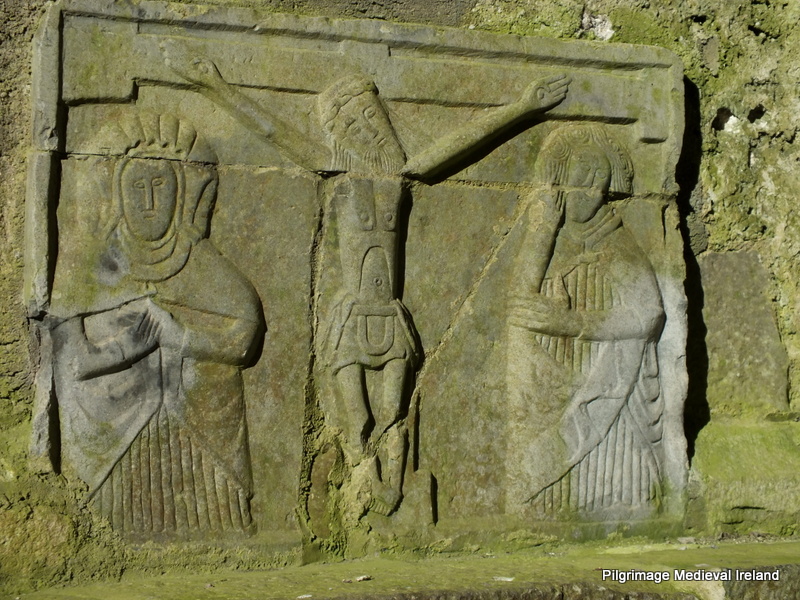
A 16th century example  of  the Crucifixion is found in the North wall of  South Chapel of the North Transept of the Cathedral Church at the Rock of Cashel Co Tipperary.  Christ with a sorrowful expression is shown nailed to the cross wearing a crown of thorn. Mary stands with clasped hands  on the left hand-side of the cross. She  is dressed in a pleated dress with an Irish style mantle known as a brat pulled up over her head. St John stands on the right hand side of the cross. He is also wearing  pleated garment and mantle, his right hand  is raised to his face in a gesture of sorrow.

DSCF9434

Crucifixion plaque found at the Rock of Cashel.

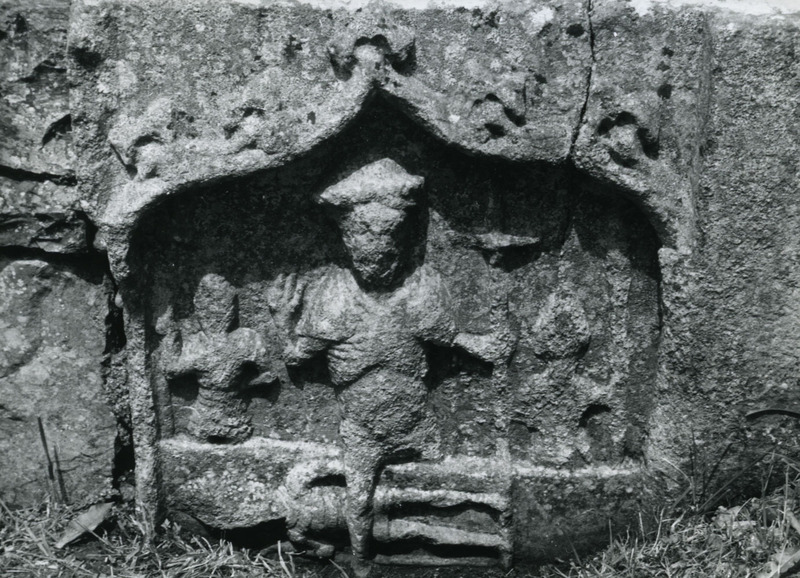
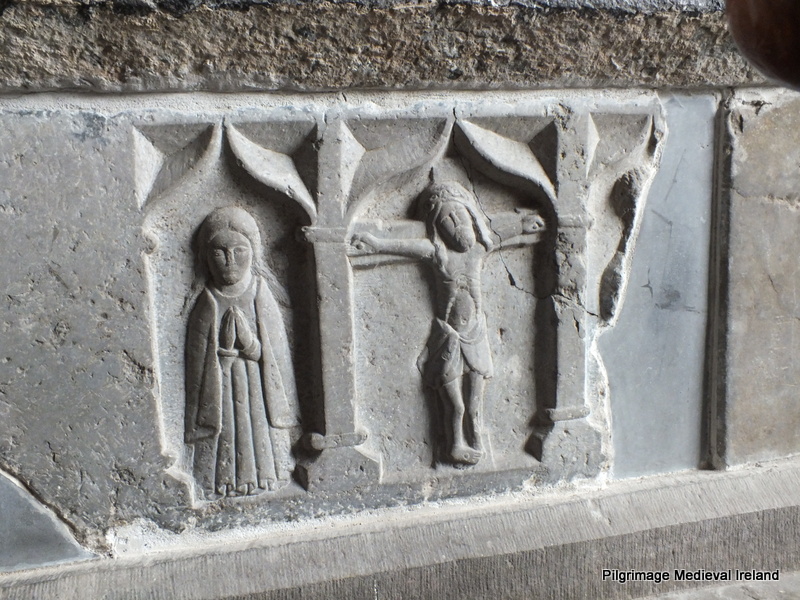
In the North side of the chancel of Holy Cross Abbey in Co Tipperary, an end slab of a chest tomb is built into the wall under the existing mensa.  The scene  depicts  Christ flanked on either side by St John and Mary within ogee-headed niches.  St John has been broken off the panel.  Mary stands with her hands joined in prayer  with her hair loose over her shoulders.

DSCF0321

Crucifixion on chest tomb at Holy Cross Abbey

Have a very Happy Easter everyone.

References

Hunt, J.  Irish Medieval Figure Sculpture. Vol.1. Dublin: Irish University Press.

Stalley, R. 1996. Irish High Crosses. Dublin: County House.

Ennis Friary Facebook page and information boards.

To find out more about Ennis Friary Check out their Facebook Pagehttps://www.facebook.com/ennisfriary?fref=photo

Save

St Patrick’s Cabbage

In County Longford  the watercress plant was  traditionally known as St Patrick’s Cabbage.


Watercress  is  peppery tasting plant and was traditionally  an important food in Ireland.  It was also held to have medicinal properties.

References

Mac, Coitir, N. 2006.  Irish Wild Plands, Myths, Legends and Folklore.  Cork: The Coillins Press.

Some traditional St Patrick’s Day customs: Part 1

Tomorrow is St Patrick’s day, the feast day of Ireland’s National Saint.  This post will briefly look at some traditions and customs  associated with this day, such as the wearing of  symbols of the saint. I have been reading  Irish Trees by Niall Mac Coitir, a wonderful book full of interesting folklore and mythology concerning Ireland’s native trees.   In the section on Sally or Willow trees , the author refers to an old custom from  Cill Rialaig Co Kerry that relates to St Patrick’s Day.  On St Patrick’s day  the people would wear  a ‘cros cipín dóite’ or ‘cross of charred pin’.   The ‘cross’  was made  of burnt sally twigs and worn on the right arm.

Throughout the rest of the country it was and still is, a common practice for people to wear a plant called shamrock upon their person.

The wearing of a symbols for St Patrick on his feast day appears to be quiet an old tradition  Thomas Dinely in 1681 noted

The 17th day of March yeerly is St Patrick’s, an immoveable feast when the Irish of all stations and condicions  wore crosses in their hats  some of pins, some of green ribbons, and the vulgar superstitiously  wear shamroges [shamrock], 3 -leaved grass…. (Danaher 1972, 58).

Dinely provides the earliest accounts of  the wearing of the shamrock. According to folk tradition  the shamrock was used by St Patrick as a metaphor for the Holy Trinity during his missionary work.  The shamrock is not referred to in any medieval accounts concerning Patrick and the earliest written record of this tradition dates to the 18th century (Mac Coiter 2006, 38).

St. Patrick depicted with shamrock in detail of stained glass window in St. Benin’s Church, Wicklow, Ireland (Andreas F. Borchert [CC BY-SA 3.0 de (http://creativecommons.org/licenses/by-sa/3.0/de/deed.en), CC BY-SA 4.0-3.0-2.5-2.0-1.0 (http://creativecommons.org/licenses/by-sa/4.0-3.0-2.5-2.0-1.0) or GFDL (http://www.gnu.org/copyleft/fdl.html)%5D, via Wikimedia Commons )

In  1726 botanist Rev Dr Threkeld who identified shamrock as white clover and noted

This plant is worn by the people in their hats on the seventeenth day of March (Mac Coitir 2006, 38).

DSCF1029
On St Patrick’s day the shamrock is normally pinned to a coat or jumper.

Dinely’s account also mentions the wearing of St Patrick’s day crosses. This is now an extinct tradition and refers to the wearing of homemade badge.  Mac Lir in 1890 gives an account of these  crosses  what they looked like and and how they were made

For a week or so preceding the National Festival, the grown members of the family are occupied in making “St Patrick’s Crosses” for the youngsters, boys and girls; because each sex have a radically different “Cross”. The  “St Patrick’s Cross” for boys, consists of a small sheet of white paper, about three inches square, on which is inscribed a circle which is divided by elliptical lines or radii, and the spaces thus formed are filled in with different hues, thus forming a circle of many colored compartments Another form of St Patrick’s Cross is obtained by drawing a still smaller circle, and then six other circles, which have points in the circumference of this circle, as their centre, and its centre as their circumferential point, are added; after which one large outer encompasses the whole, thus forming a simple and not inartistic attempt at imitating those circles or bosses of Our beautiful Celtic cross pattern. The many spaces, concave, convex or otherwise, thus formed are then shaded in; each a different hue and constitutes the “St Patrick’s Cross”….(Danaher 1972, 60)

He goes on to say that  little boys wore their crosses on their caps (Danaher 1972. 60).

For the girls Mac Lir notes the cross

is formed of two pieces of card-board or strong thick paper, about three inches long, which are places at right angles, forming a cross humette. These are wrapped or covered with silk or ribbon of different colors, and a bunch or rosette of green silk in the centre…. (Danaher 1972. 60).

The cross was then worn pinned to the chest or shoulder  of the girl (Danaher 1972. 60).  Examples of these crosses are to be found in  collections of the National Museum of Country Life.

Badge and St Patrick Gallery.jpg
An example of a badge on display in the National Museum of County Life http://ow.ly/i/92cPI

There are other  old customs associated with St Patrick’s Day and I hope to discuss them further in another post.

References

Danaher, P. 1972. The Year in Ireland.  Cork: The Mercier Press.

Mac, Coitir, N. 2003.  Irish Trees, Myths, Legends and Folklore.  Cork: The Coillins Press.

Mac, Coitir, N. 2006.  Irish Wild Plands, Myths, Legends and Folklore.  Cork: The Coillins Press.

Some traditional St Patrick’s Day customs: Part 2

Tobarnalt Co Sligo, images from the past and present

Tobernalt is a very popular holy well in St John’s Parish, in Carraroe townland, a short distance from Sligo town. The well is regard by many as being a place of healing and  is visited throughout the year.

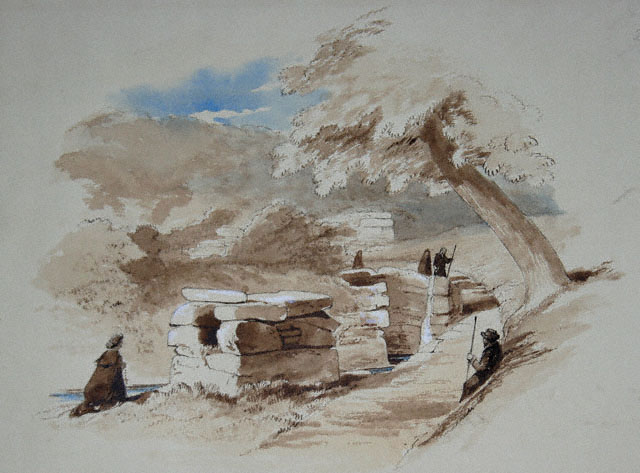
Below is a drawing of Tobernalt by William Wakeman in 1882.

Wakeman illustrated the Holy Well at Tobernalt on 23 July 1882 when it comprised of the mass rock and well. At the end of the 19th century another altar was added by the convent of the Sisters of Mercy, which was made from stones collected from the edge of Lough Gill (1).

holy-well-and-stations-at-tobernalt

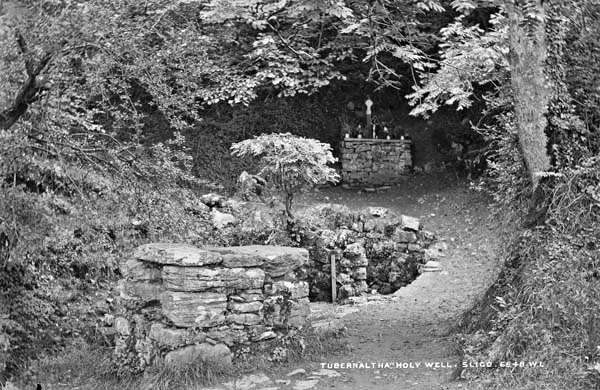
Below is a photo of the well  taken  in the early 20th century.  The image is part of the Lawrence Collection.  It was likely taken by Robert French  who was the chief photographer of the collection and  responsible for photographing three-quarters of the Lawrence Collection.

Tobernalt Co Sligo

Tobernalt Co Sligo from the Laurence Collection in National Museum of Ireland


Many alterations occurred in 1921 through the work of the locals and Fr Divine of Carraroe. The great storm ‘Debbie’ destroyed much of the site in 1961 when two large trees fell. Restorations, new shrines and the construction of the small bridge were made that year (2).

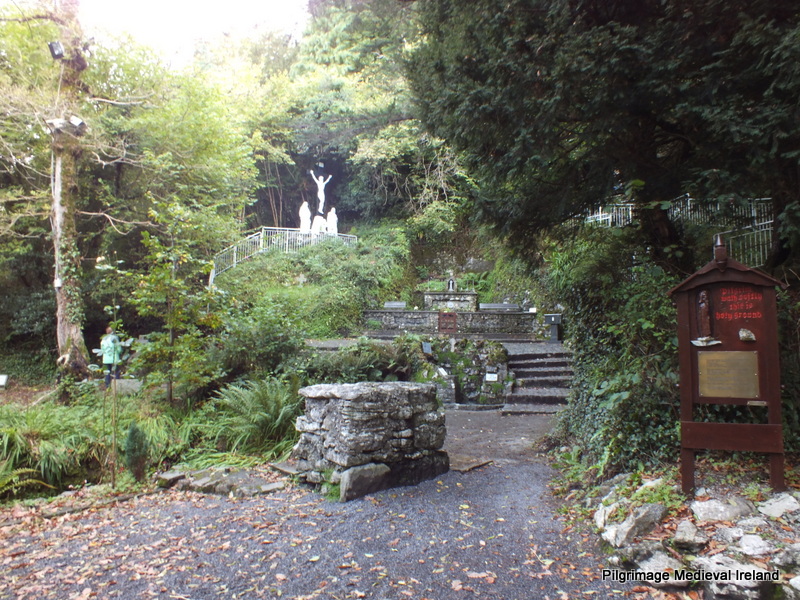
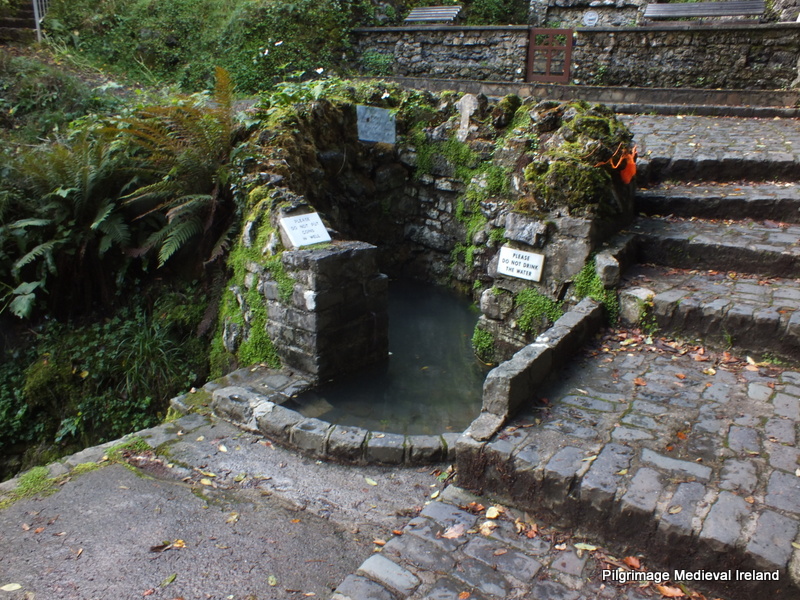
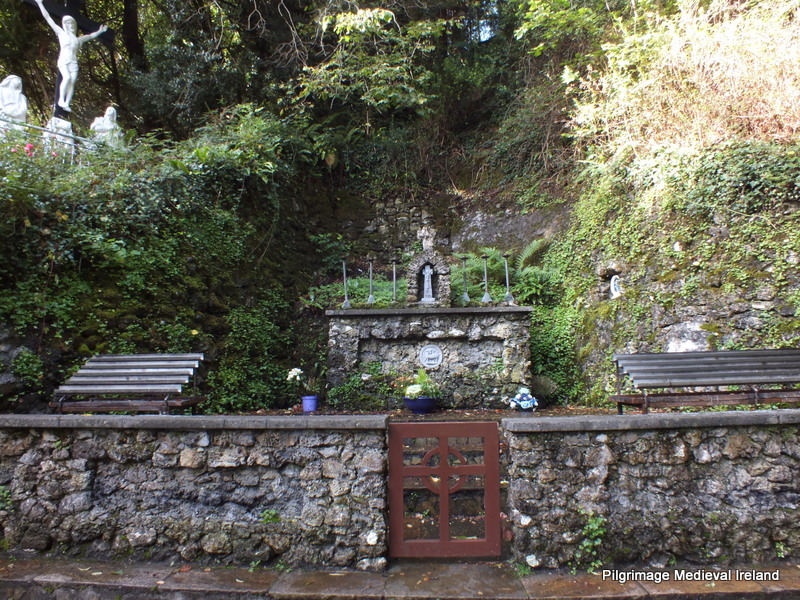
I visited the site in October 2014 . Below are some photos of the well  from my visit. As you can see the well itself is pretty much the same but  the area around the well has been landscaped over the years. With the inclusion of stone steps and paths and a large grotto behind the well.


Tobarnalt Co Sligo 2014

Tobarnalt Co Sligo 2014 Image taken in the same direction as the image from the Laurence Collection.

DSCF2956

Tobarnalt October 2014

DSCF2970

Grotto behind the holy well at Tobarnalt 2014

References

1. http://www.askaboutireland.ie/reading-room/environment-geography/physical-landscape/the-wakeman-drawings/tobernalt/)

2. http://www.askaboutireland.ie/reading-room/environment-geography/physical-landscape/the-wakeman-drawings/tobernalt/)


Shopping list from 1919

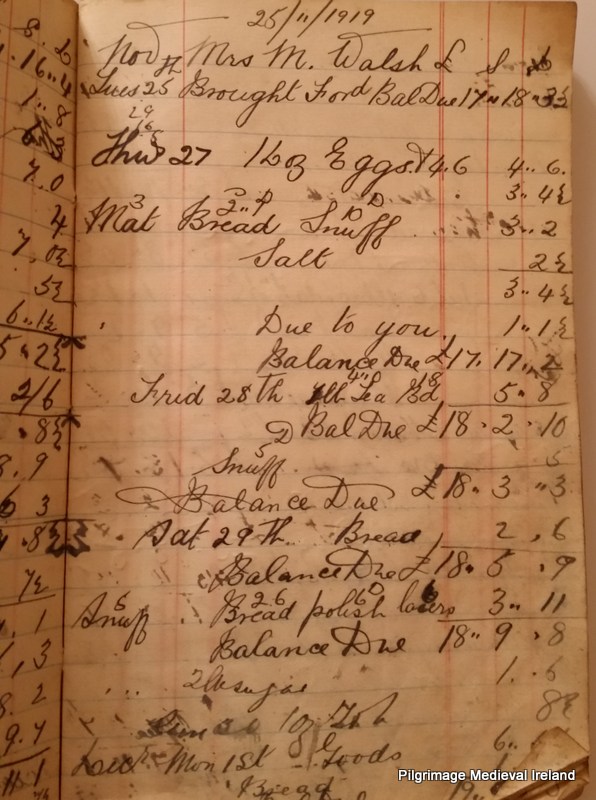
I recently came into the possession of a wonderful  little notebook.  The book was used by a shop in 1919 to record customer purchases  bought on credit.

052

Sample page from shop notebook recording credit purchases.

The notebook  which is an example of the wonderful penmanship, provides a list of the purchased and  cost of goods.  It also provides a glimpse into  rural life in 1919.

The main purchases were candles, matches, salt,  tea, bread, tobacco, cigarettes, snuff and pipes with occasional purchases of eggs, starch, pipes, and polish.

It’s easy to forget that people in rural Ireland  would not have had access to electricity  in 1919.  Although many  towns and parts of cities were supplied with electricity prior to Independence many people did not get electricity until the 1940s and some till the 1970’s  (Mac Philib 2011).  So its easy to see why candles were  on everyone’s shopping list.

In modern Ireland we all know the dangers of smoking tobacco, so I was surprised to see cigarettes , tobacco and snuff mentioned so often and purchased by approximately 99% of the customers.  Snuff a rarity today was especially popular and  turns up on almost every page of the notebook.  Some people purchased it along with cigarettes.  I wasnt sure exactly what snuff  was.  I remember an elderly neighbour who I used to visit as a child  taking snuff which she kept in a small tin in her apron pocket .  According to Wikipedia Snuff is a smokeless tobacco  made from ground  tobacco leaves. It is inhaled or “snuffed” into the nasal cavity and was very popular .

Reading this book also  made me realize how self-sufficient people were.  There is never a mention of  dairy products, vegetable or meat.  In rural Ireland  most people had access to milk and butter they produced themselves and they also would have grown their own vegetable.  No mention of  treats such as chocolate or coffee which I certainly couldnt live without.

References

Mac Philib, D. 2011. Rural Electrification. A changed Ireland. http://www.ouririshheritage.org/page_id__73.aspx