Medieval pilgrimage in honour of St Féichín and the ‘ Seven Wonders’ of Fore, Co Westmeath

Today is the feast day of  the  7th century St Féichín. What follows is a short account of the saints life and the history  for pilgirmage  to his shrine at Fore, Co Westmeath.

St Féichín was born in Billa in the townland of Collooney in Co Sligo and his cult is represented in the area by a number of places dedicated to him, such as  St Féichín’s well in the townland of Kilnamonagh and St Féichín’s Bed in Collonney .

Féichín  became a  student of St Nathí of Ardconry  and  went on to found  a number of churches   around Ireland such as  Fore Co. Westmeath,  Cong in Mayo, Omey & High Island in  Co Galway  and Termonfeckin Co Louth . His cult  also speard to  Scotland  and a monastery dedicated to him was founded at Arbroath (where he is known as St Vigean).   The annals tell us St Féichín died in AD 665  at Fore, having caught the  Yellow Plague, which was raging through Ireland at the time.  His Life notes that at the time of his death 300o monks resided at Fore.  It is very interesting that tradition held he was buried ar Ciarán’s church or Castlekeeran near Kells Co. Meath instead of Fore.

A Brief  Description of the Ecclesiastical Remains at Fore

This post will focus on the evidence for pilgrimage at Féichín’s  monastic site of Fore.

First edition Ordnance Survey map  of Fore

1st ed. Ordnance Survey map of Fore

Fore is located in a valley,   the archaeological  remains  consist of an early medieval church and cross located on the rocky slopes of the valley. On the valley  floor are the ruinous remains of  a  Benedictine monastery,   a Norman Motte,  fragments of a medieval town wall and  up to 14 wayside or boundary crosses scattered around the valley.

The original  early monastic site  was located  on a north facing terrace on the west side of the village.  Today all that remains are  a 10th century church  known locally as St Féíchin’s church. The church sits within a historic graveyard with a medieval cross.

Medieval cross within the graveyard at St Féichín's church

Medieval cross within the graveyard at St Féichín’s church

Close by are  the remains of  a mill  and  two holy wells  called  Tobernacogany and  Doaghfeighin.

On a terrace above the church  a 15th century tower with an  anchorite cell  that is attached to a 19th mausoleum for the Grenville-Nugent family.

View of the early monastic site at Fore

View of the early medieval  St Féichín’s church. The  19th century mausoleum is located on the terrace above St Féichín’s church.

During the 12th century the area fell into Anglo-Norman control and  a Benedictine abbey was founded on the valley floor by Hugh de Lacy. The abbey was dedicated to St Taurin and St Féichín and was a dependant of  St Taurine’s monastery at Evreux in Normandy.
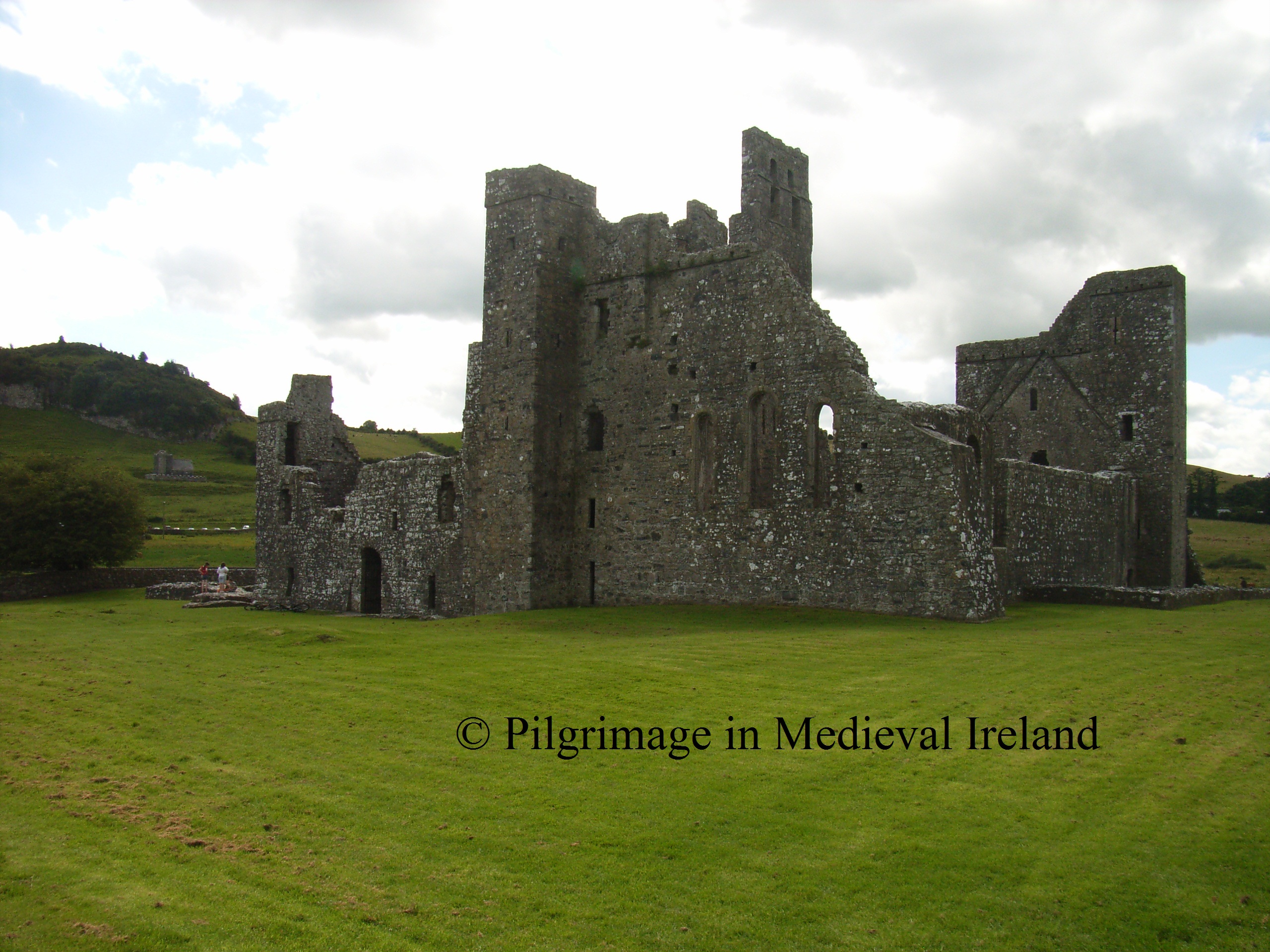
Benedictine Priory at Fore

Benedictine Priory at Fore

Pilgrimage at Fore

Details of the medieval pilgrimage at Fore are very  sketchy and uncovering the pilgrimage rituals are  difficult. The earliest written evidence of pilgrimage dates to AD 1607 when Fore is listed among the 12 Irish sites  granted a plenary indulgence to the faithful, by Pope Paul V.  The indulgence related to specific days Corpus Christi and the feast of the Annunciation.  Given the popularity of the cult of St Féichín  in early medieval times,  pilgrimage at Fore  is likely to be much much earlier. The Life of St Féichín records many miracles by the saint during his life time and pilgrims likely came here  in the years following the saints death.

There is a tradition associated with the Fore  known as   the  Seven Wonders of Fore;

1. The anchorite in a stone

2. The water that will not boil

3. The monastery built on a bog

4. The mill without a stream

5. The water which flows uphill

6. The tree which will not burn

7. The stone lintel raised by the saint’s prayers.

 ‘Wonder’ number 2 & 6  relate to the holy well called  Tobernacogany . In the 19th century pilgrims performed stations here on the 20th of January the feast of St Féichín, St John’s day, the 24th of June and on St Peter’s day the 29th of June. It was recorded that following devotions the pilgrims would drive a coin edgeways into the ash tree beside the well.

Rag tree at St Féichín's well / Tobernacogany

Rag tree at Tobernacogany

It was said that the wood from this tree wouldn’t burn and the water from the well would not boil. The well itself was known to cure headaches and toothaches.

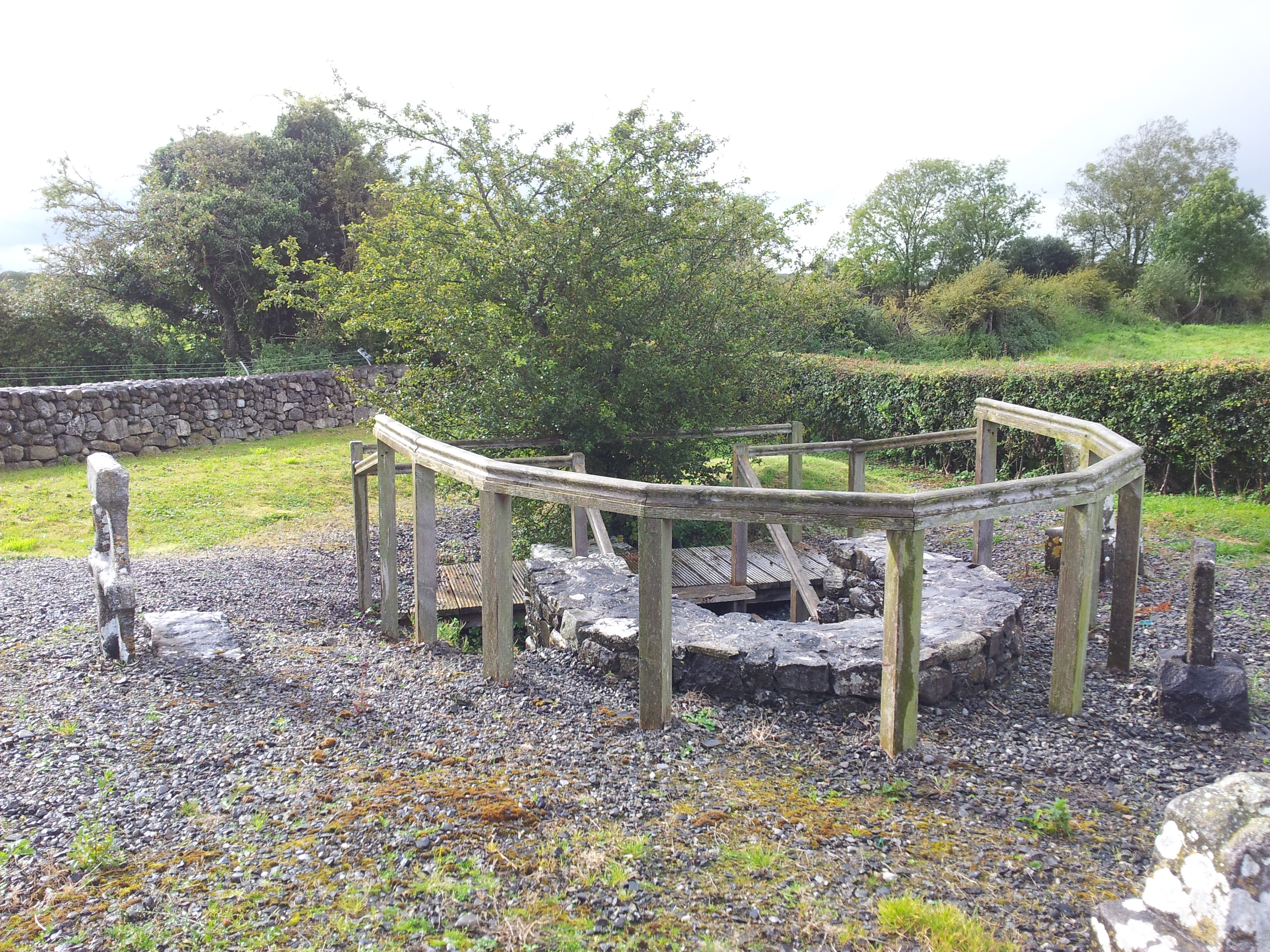
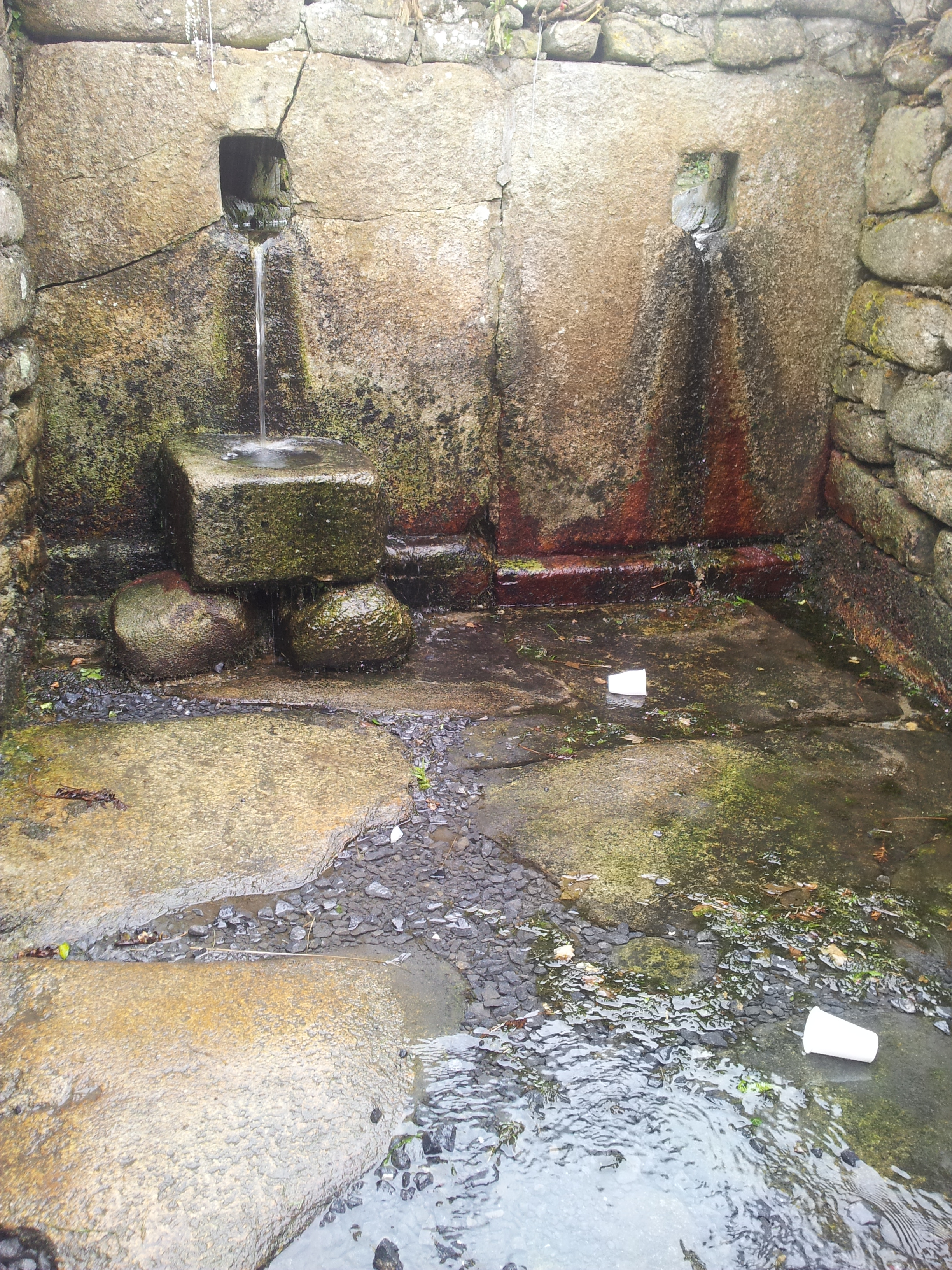
Another focus of 19th century devotion was Doaghfeighin or St Féichín’s Vat or Keen. This is a spring  which is defined by large stones arranged like a box. When I visited here the well was dry.
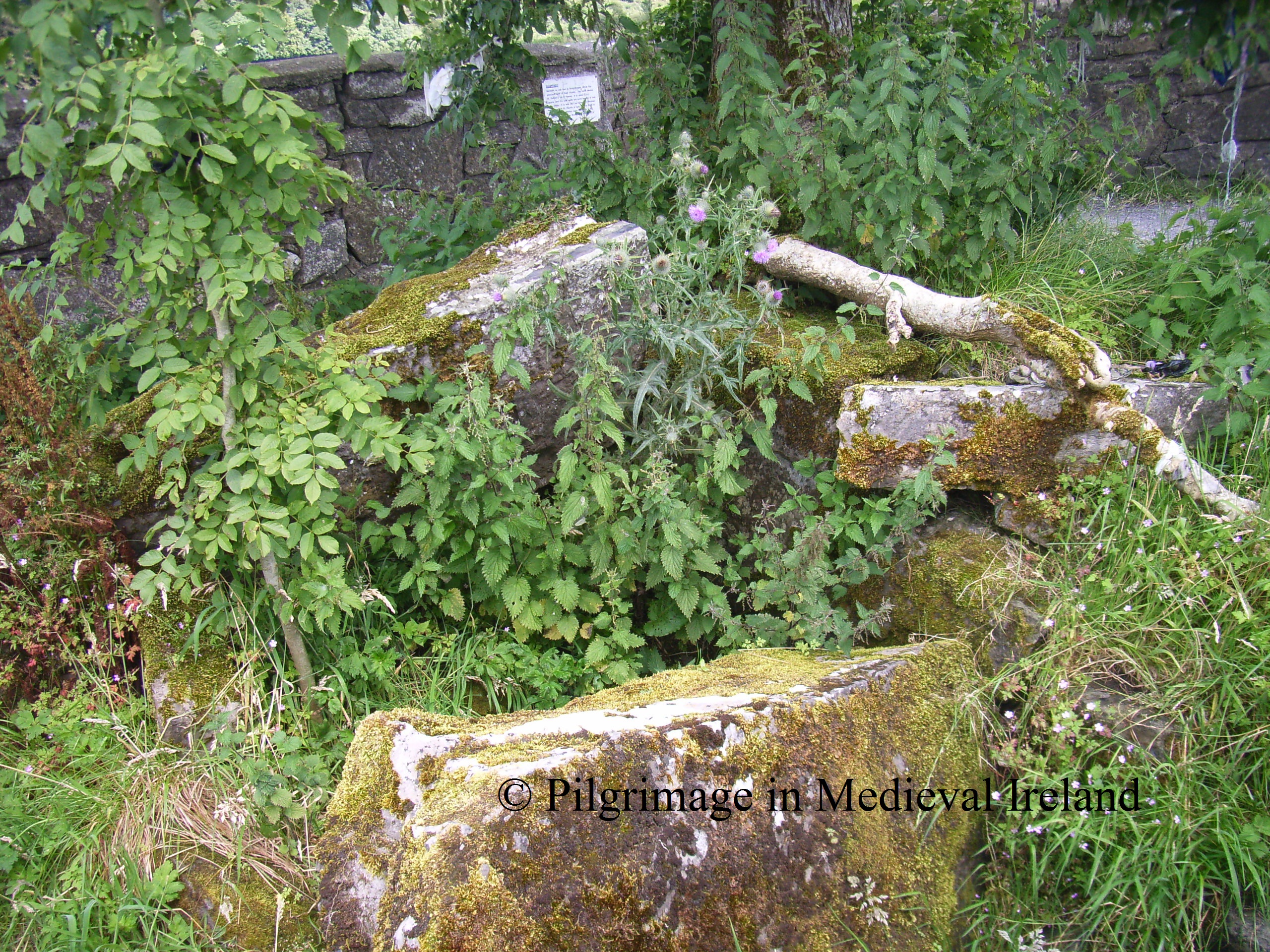
RIMG1405

Doaghfeighin (Feichin’s Vat)

Tradition holds that St Féichín would kneel and pray here. In the past  delicate and sick  children were immersed here in the water to obtain a cure through the  invocation of St Féichín.  A similar practice occurred at Glendalough during the 19th century when pilgrims would immerse sick children in a pool called St Kevin’s Keeve. Both wells are likely to have been a focus of   early  and later medieval devotion.

RIMG1403

Rag tree beside Doaghfeighin

The first ‘wonder’  the anchorite in a stone  likely refers to the anchorite cell attached to the 15th century tower. Within the mausoleum is  a stone which records the death of the last anchorite of Fore,  Patrick Beglan who died in 1616. This cell doesn’t appear to have been part of the  medieval or the 19th century pilgrimage stations.

Tower connected to ancohorite cell

Tower, Anchorite cell  &  Mausoleum

The third ‘wonder’ the monastery in a bog  refers not to the early monastic site which is located on the slops of the valley but the later Benedictine foundation location on the valley floor. Monasteries built on within bogs are not unusual in early medieval Ireland and Lemanaghan Co Offaly and Monaincha in North Co Tipperary are just two examples.  During the later medieval period the monastery would have been in possession of any relics associated with St Féichín.
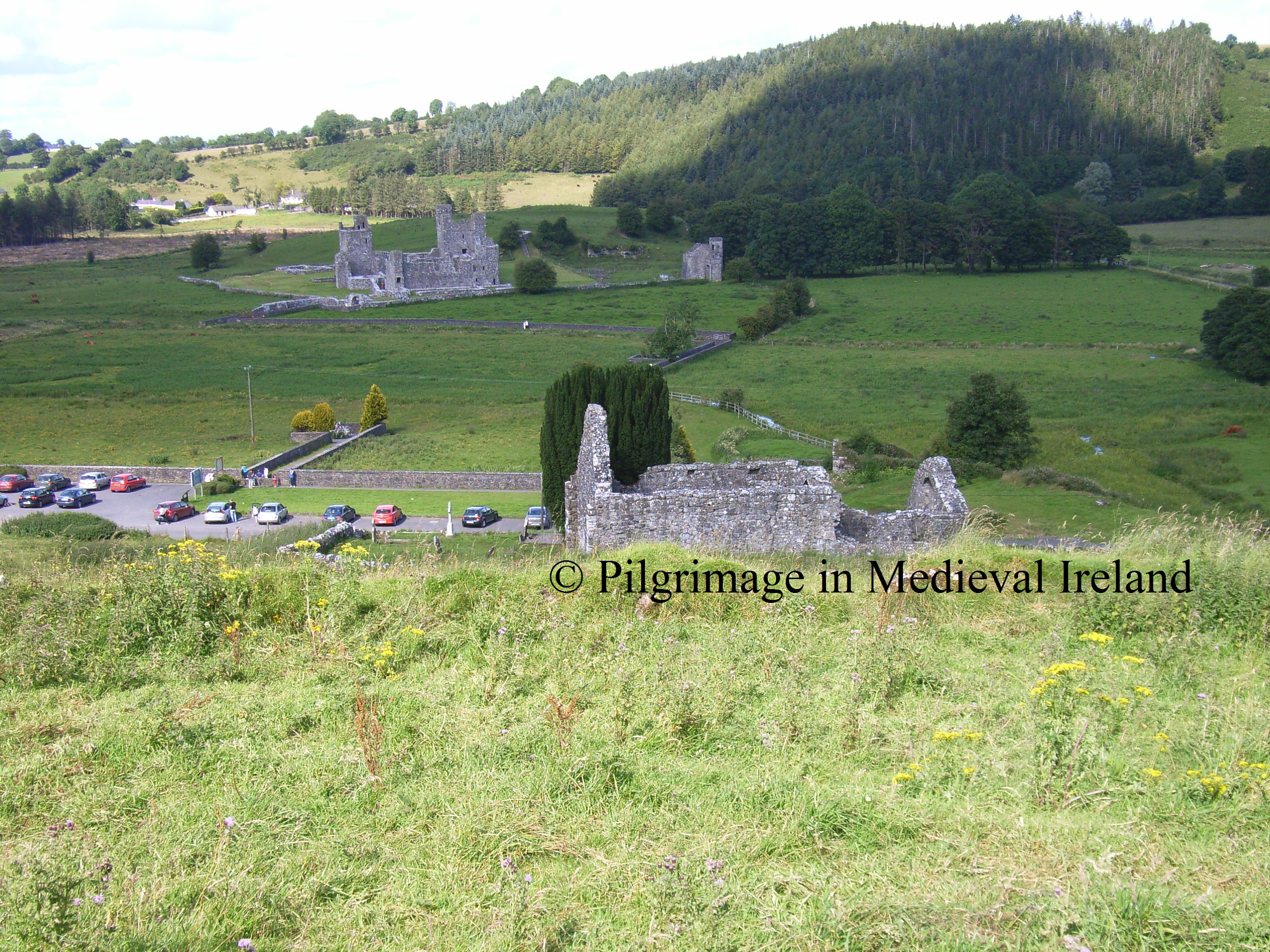
View of benedictine Priory in the valley floor

View of Benedictine Priory in the valley floor

The ‘Wonders’ number 4 and 5,  the mill without a stream and  the water which flows uphill all refer to the   monastic mill, the ruins of which are still visible. This building stands on the original mill built by the saint.  According to local tradition the mill   was in use until 1875 when it was replaced by another mill.

RIMG1400

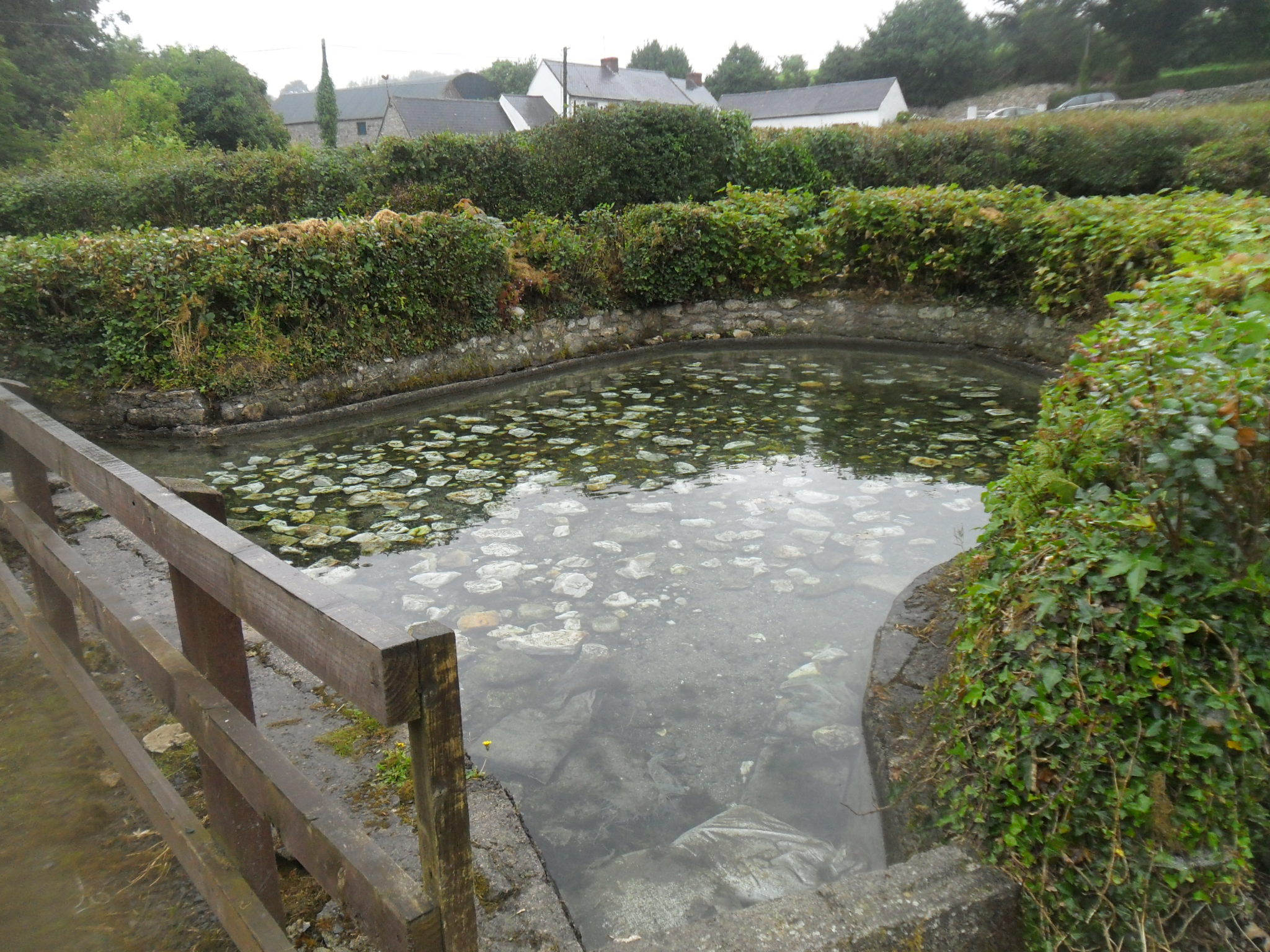
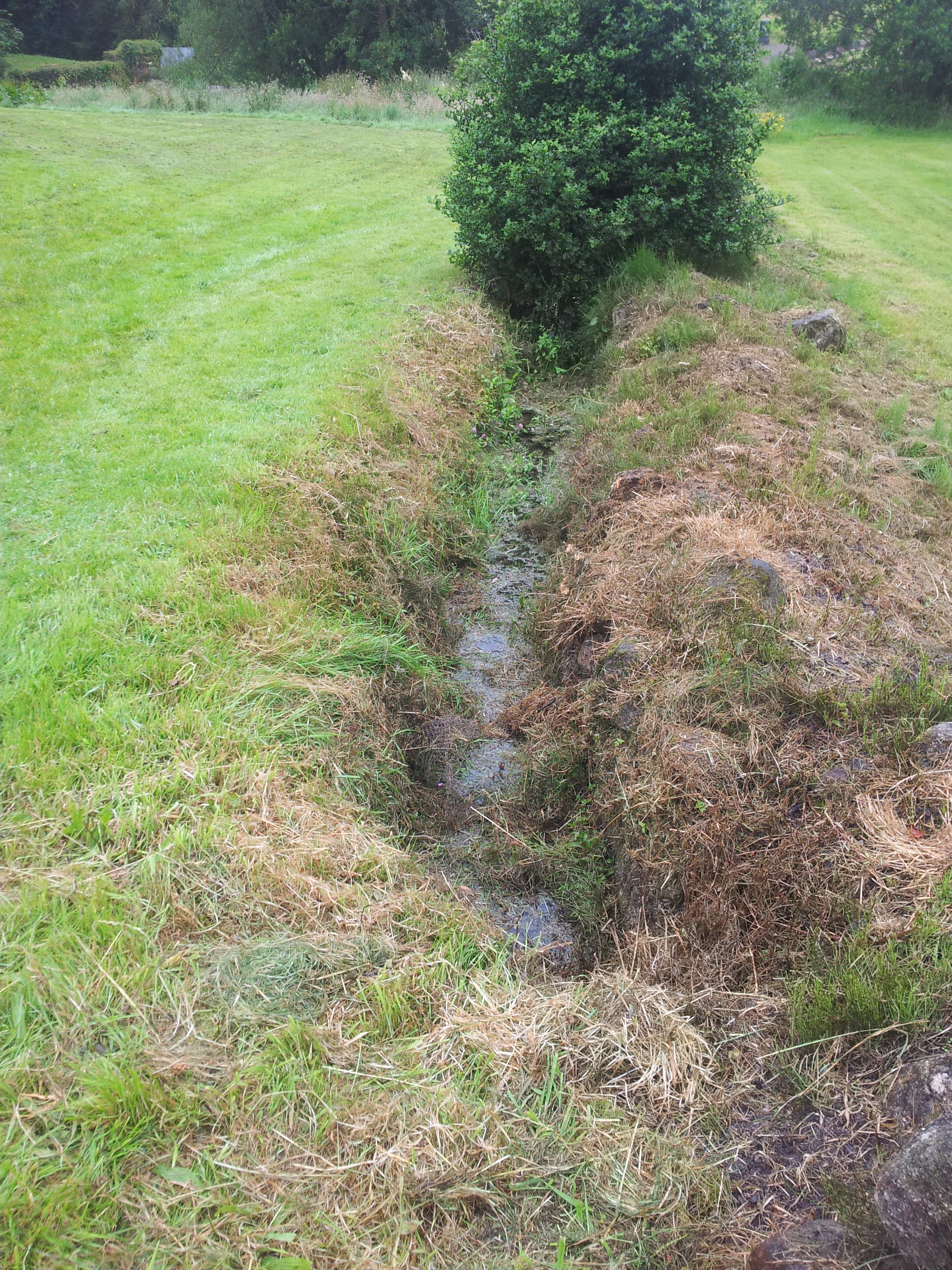
The mill  was  powered by an underground stream  which flows into a  now silted up triangular-shaped mill-pond.  The name Fore in Irish Fobhar means spring. The origin legend of the mill tells  that the saint decided to build a water-mill,  his carpenter scoffed at the idea of building the mill where there was no water. The saint

resorted to the lake, took his staff, flung it into the lake, which forthwith drove it against the side of the hill, which the staff at once pierced, cutting its way through the stone cliffs, drawing the waters of the lake after it, and coming out a mile distant at the exact point where the mill had been erected. And now came the punishment of the mill wright. He had gone to sleep in the mill when the saint departed to the lake. The wondrous staff, however, brought such a volume of water along with it that the mill was filled, and the sleeping millwright drowned, in punishment of his scoffing incredulity. St Fechin relaxed however, and when he had given him this severe lesson, miraculously restored him to life…

Geraldus  in his history of Ireland   written in the 12th century mentions the mill of St Féichín at Fore  and  notes  the prohibition against women entering either the churches or the mill.

RIMG1439

St Féichín’s church showing the large lintel over the doorway

‘Wonder’ number 7  refers to the enormous lintel over the door of St Féichín’s church .  Tradition records that this lintel was placed in position by the miraculous action of St Féichín himself.

According to legend when the church was being built the workmen had been labouring for hours striving to raise it, but to no avail. St. Féichín told them to go home to breakfast, and then began to  pray.  After some time spent in prayer, the saint took the stone in his arms, and without any difficulty placed it over the doorway.

With regards to  modern pilgrimage here. The rag trees beside the Tobernacogany and Doaghfeighin are covered in rags which suggests there is still a strong   local devotion to both  wells.

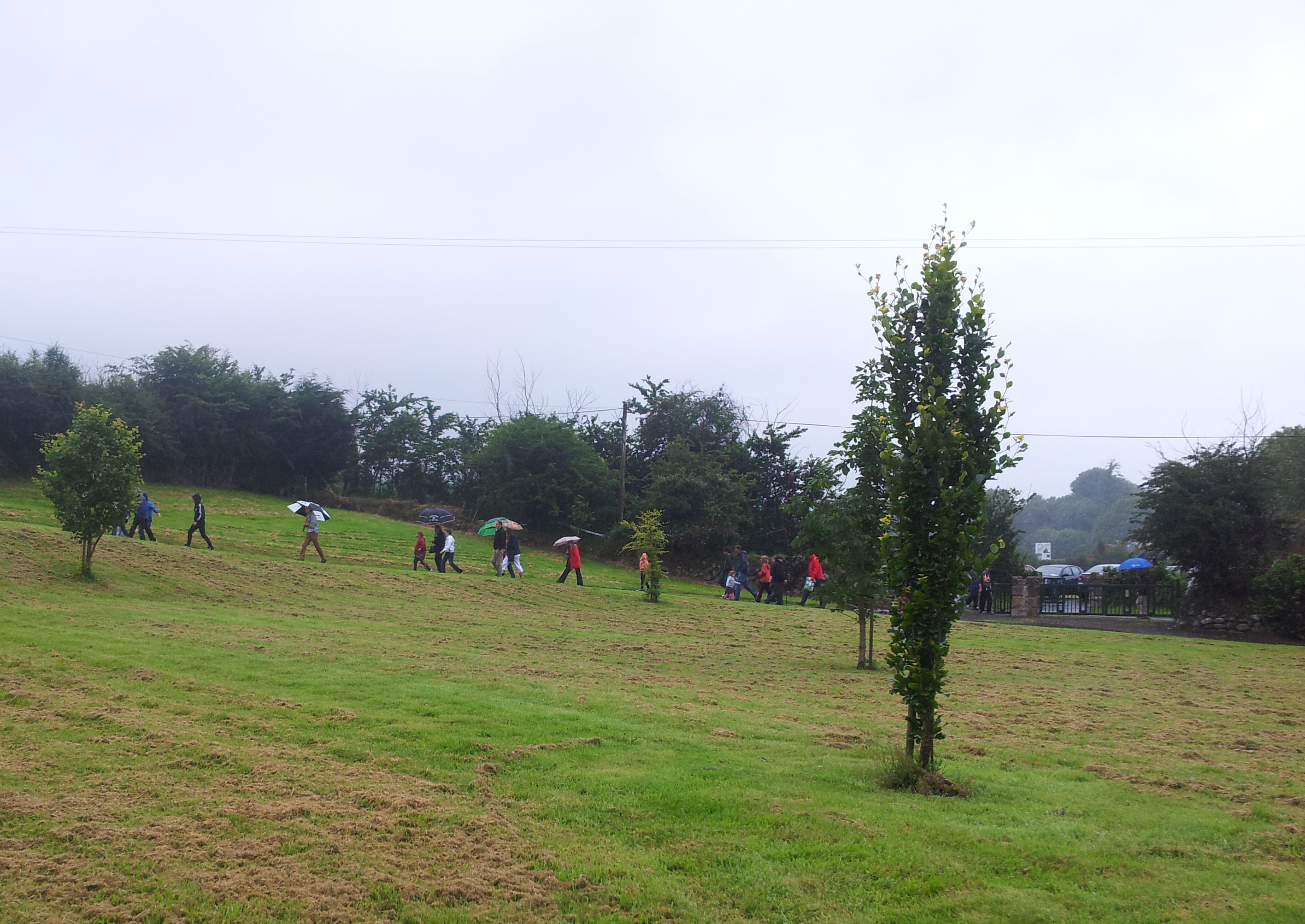
In 2010 a large-scale pilgrimage took place here. The Westmeath Examiner  for  2010 recorded  this  pilgrimage was to  commemorate  ‘the Jubilee Pilgrimage, and also to celebrate the year of the priesthood and as a preparation for the Eucharistic Congress in 2012′   Approximately 400 people from 9 parishes came here for this pilgrimage on May 23rd 2010.

The pilgrimage consisted of   the   Blessed Sacrament being brought in procession from Fore Church to the ruins of the Abbey,’ a trip which took over an hour’ . The   Blessed Sacrament was then carried along the walkway to the Abbey and around the Abbey. The nine parishes took turns carrying the Monstrance in procession with prayers read throughout and choirs from the nine parishes lead by Fore Choir.’ The paper also notes Local schools also prepared large banners which the children carried in the procession.

© Louise Nugent 2013

References

Ó Riain, P. 2011. A Dictionary of Irish Saints. Dublin: Four Courts Press.

Sharkey, O. 2004. Fore and Its  Ancient Buildings. Mullingar: Magpie Publications

Stokes, G. T.1892. ‘St Feichin of Fore and his monastery. JRSAI 12, 1-12.

http://www.westmeathexaminer.ie/news/roundup/articles/2010/05/27/3997364-big-turnout-for-fore-pilgrimage-of-hope-and-healing Accessed 15/01/2013.
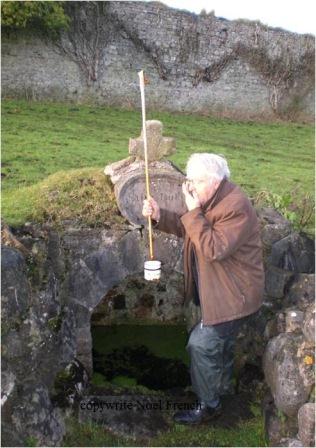
Holy wells of County Meath

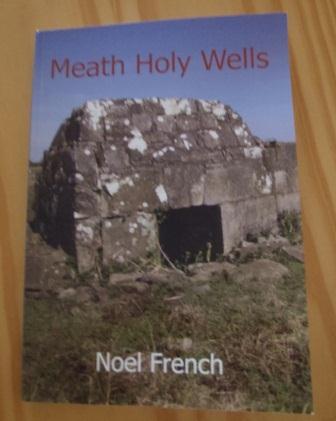
I had a lovely surprise this week,   I received a  gift  from my friend Muireann of a  newly published  book on holy wells called  Meath Holy Wells by Noel French. Holy wells have always interested me. They are really are  special and peaceful places. Given that there are approximately  3000 holy wells  in Ireland  they are many wells scattered around the country that  I am unaware of  and I must confess until now  I knew little of the wells in Meath.

Meath Holy Wells by Noel French

So what is a holy well? A holy well is a natural spring or natural  or man-made hollows ( bullaun stones)  in rock  which collect with water,  deemed to have a religious significance through association with the saint. The history of devotion at holy wells is  complicated,   the earliest references to the Christian use of holy wells  date to the seventh century but   many  are likely to have prehistoric origins and were apropreiated by the new christian church in the 5th and 6th centuries.  I think a small number were originally used for domestic use and developed into pilgrim features in the post medieval period. Without medieval documentation for a wells or excavation the dating of many of these monuments are very difficult, although a dedication to an early medieval saint suggests at least an early medieval date.

St. Lucy’s Well, Killua on the Meath – West Meath Border

Holy wells can occur in isolation but many are located close to ecclesiastical enclosures. There are found in both rural and urban  landscapes.  The majority of literary accounts of pilgrimage to holy wells date to the post medieval period, although a handful of holy wells are named in the medieval literature and its likely the tradition of pilgrimage to the well goes back to prehistoric times.  In many case  usually on the saints feast day there were special religious devotions at the well, people would gather and perform special prayers and rituals  ( rounding of the well ) on what was known as the pattern  day. The word pattern derived from ‘patron’  in reference to the patron saint, so pattern day refers to the patron saints day . There are many account of post medieval and modern pilgrims leaving votive offerings at  wells  such as pins, coins, buttons, holy medal and treads from shawls. Cruthes were left at Fr Moores well in Kildare. Even today at popular well pilgrims leave behind rosary bead,  candles, inhalers etc.

The book, Meath Holy Wells  records approximately 123 holy wells.  The Meath wells are dedicated to a wide range of Irish  saints  such as Patrick , Colmcille, Brigid, Kieran. Universal saints include the Blessed Virgin , Anne, Lucy and Nicholas.  Each well is described  and many accompanied by a  colour photo.  All the  traditions and folklore of the wells are recorded. Like elsewhere in the country many of the Meath wells are associated with healing, the waters of  St Seachnaill’s well,  Dunshauglan were said the cure swelling of any part of the body,  while the waters of St Ultan’s well Ardbraccan were a cure for sore eyes.

I discovered an astonishing  fact in the introduction,   that  the Meath archaeological Survey  ingnored these wells  and the County Development plan lists only 3 wells.  This is shocking when one considers the significance of these monuments.   Holy wells are of great cultural value and as  wells cease to attract pilgrims  they become ever vunerable to  being destroyed.  I was delighted to read that a significant number, such as St Johns well at Warrenstown are still the site of active pilgrimages.  This book  really showcases the value of the holy wells of county Meath and  it will hopefully make the people of Meath aware of their significance and go along way to help in their preservation for future generations.

Pilgrims at St Johns well , Warrenstown

This is really a lovely book and perfect for dipping in and out of . If anyone is  keen to  find out more about the holy wells of Meath, the book Meath Holy Wells – PRICE €15,   is available at Maguires, Hill of Tara, Newgrange, Antonia’s, Trim, Siopa an Caislean, Trim and Post Office, Trim. Also by post from Noel French, Castle Street, Trim  for €15 including postage.


Lady well or Tobar Mhuire in Modeligo, Co Waterford

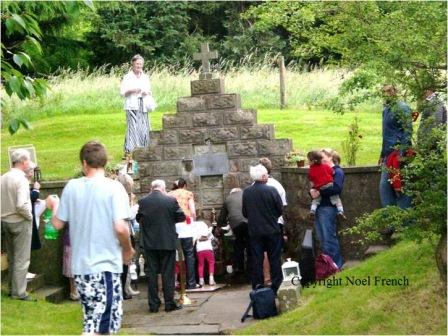
The village of Modeligo has one of the nicest holy wells,  it is  a real gem. The well like the parish church is dedicated to the Blessed Virgin and local people still gather here on the 15th of August the Feast of the Assumption, to say the rosary.

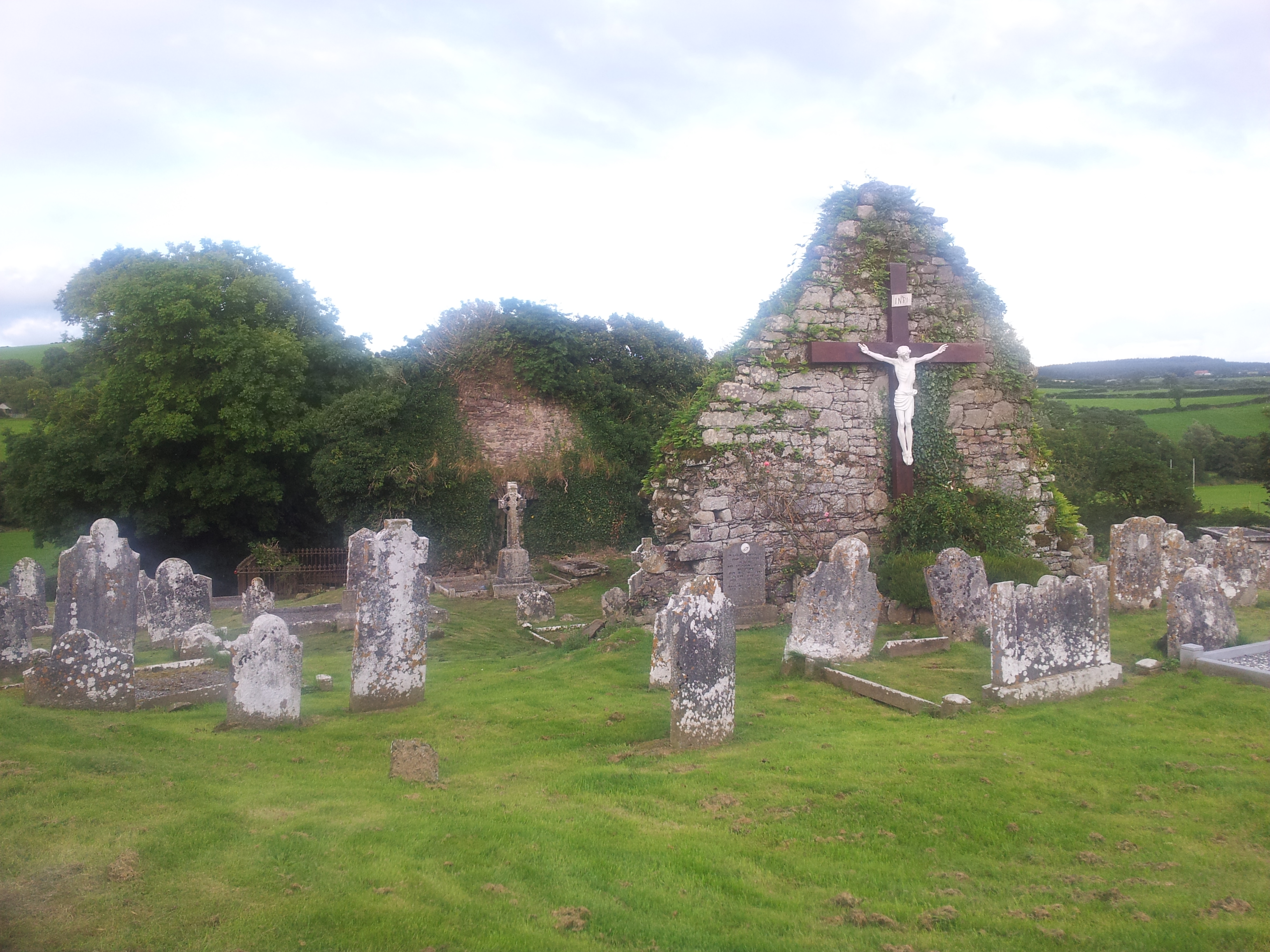
Medieval Parish church at Medeligo, Co. Waterford

The Ordnance Survey maps record the well as Lady well, while Forsayeth in 1911 says the well was known as Tobar Beannuighthe. Beary also writing in 1911 notes that local people referred to the well as Tobar Mhuire or Mary’s well. Today local people just call it the Holy well.

I first heard about this well from a friend Gillian McCarthy who happens to be from Modeligo and for the last two years I have been trying to visit. Finally in August 2012, I was able to visit and Gillian kindly gave my mum and I a guided tour of the village and the well, which is located in the townland of Knockgarraun a short distance from the local community centre, in farmland own by Gillian’s father Roger.

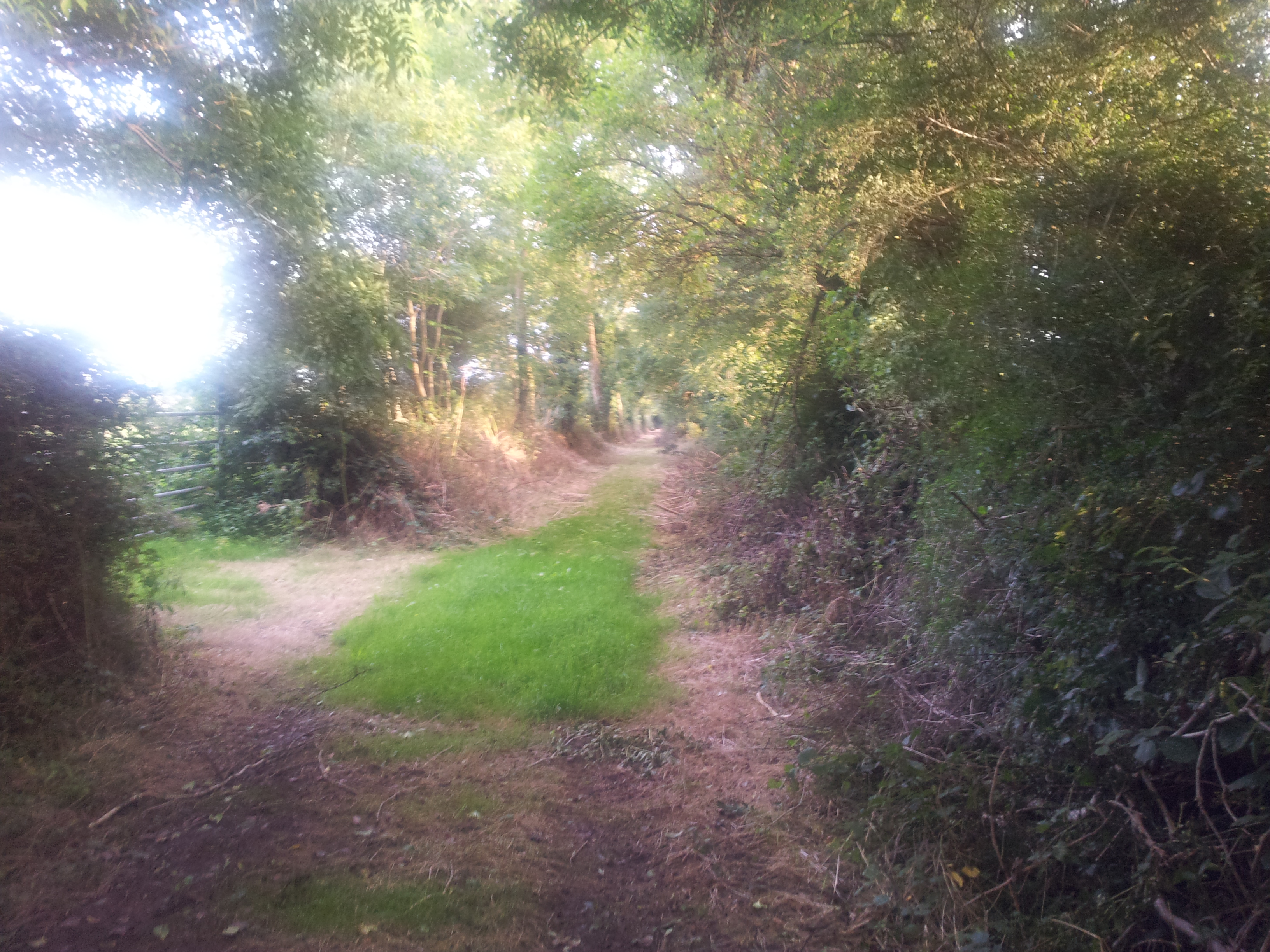
Lane way leading to Holy Well

The main focus of devotion at the well is the 15th of August and a pattern day is held in the village around this date but it is now a separate event to devotions at the well. The pattern appears to be a revival of an older tradition as in 1911 it was recorded that the pattern day;

‘used to take place here in olden times. People may still be seen to congregate on the aforesaid date, and they invariably hang mementoes, the shape of rags and other objects on the ancient hawthorn that grows beside the well’ (Fortheysth 1911, 187).

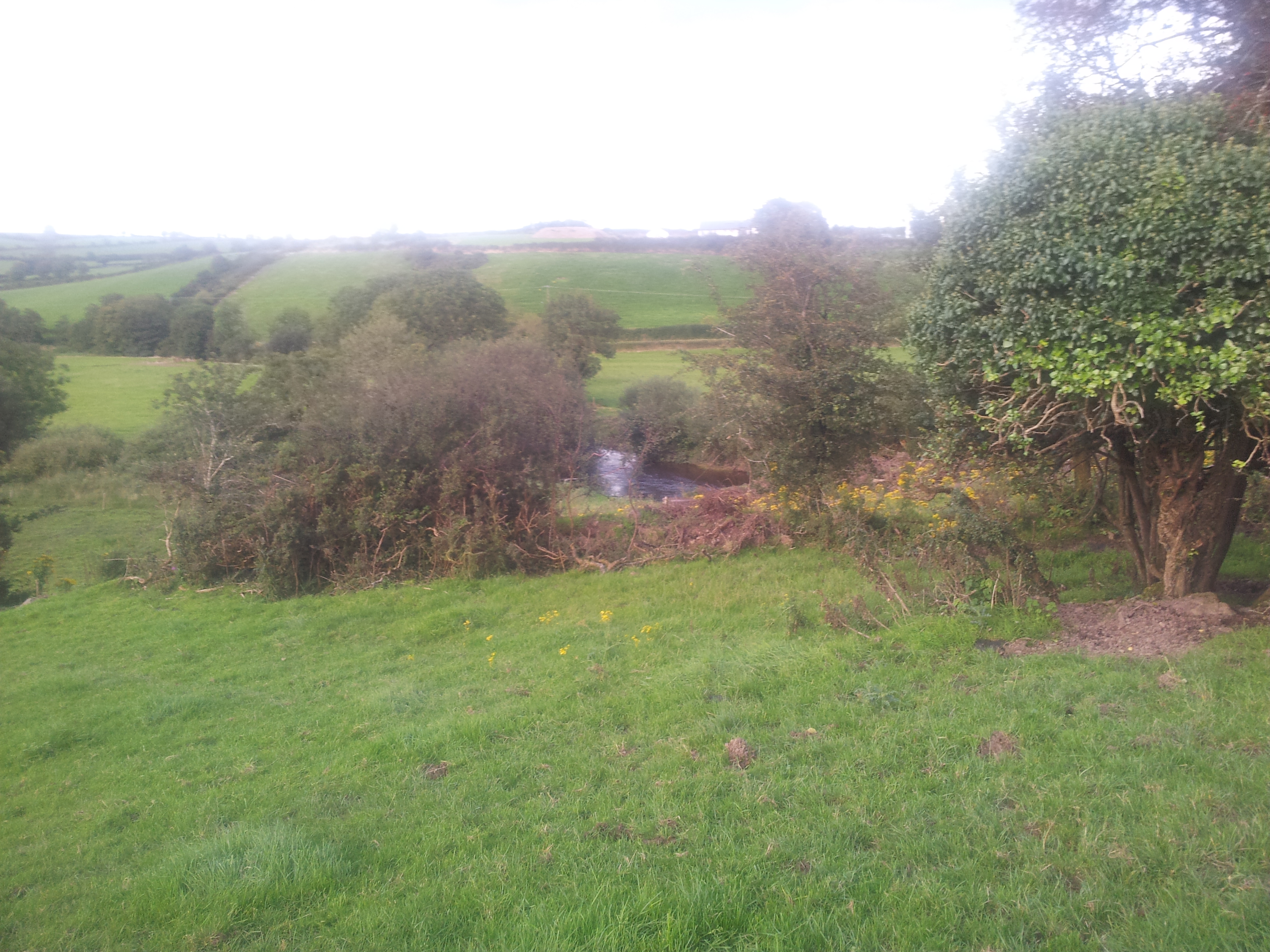
This year mass was to be said for the first time at the well but it was cancelled like many other events this summer due to the torrential rain and wind.  To get to the well you have to park at the community centre and walk down a long grassy boreen which leads into farmland. The well is located on steep slope on a rock outcrop that overlooks the Finisk River.

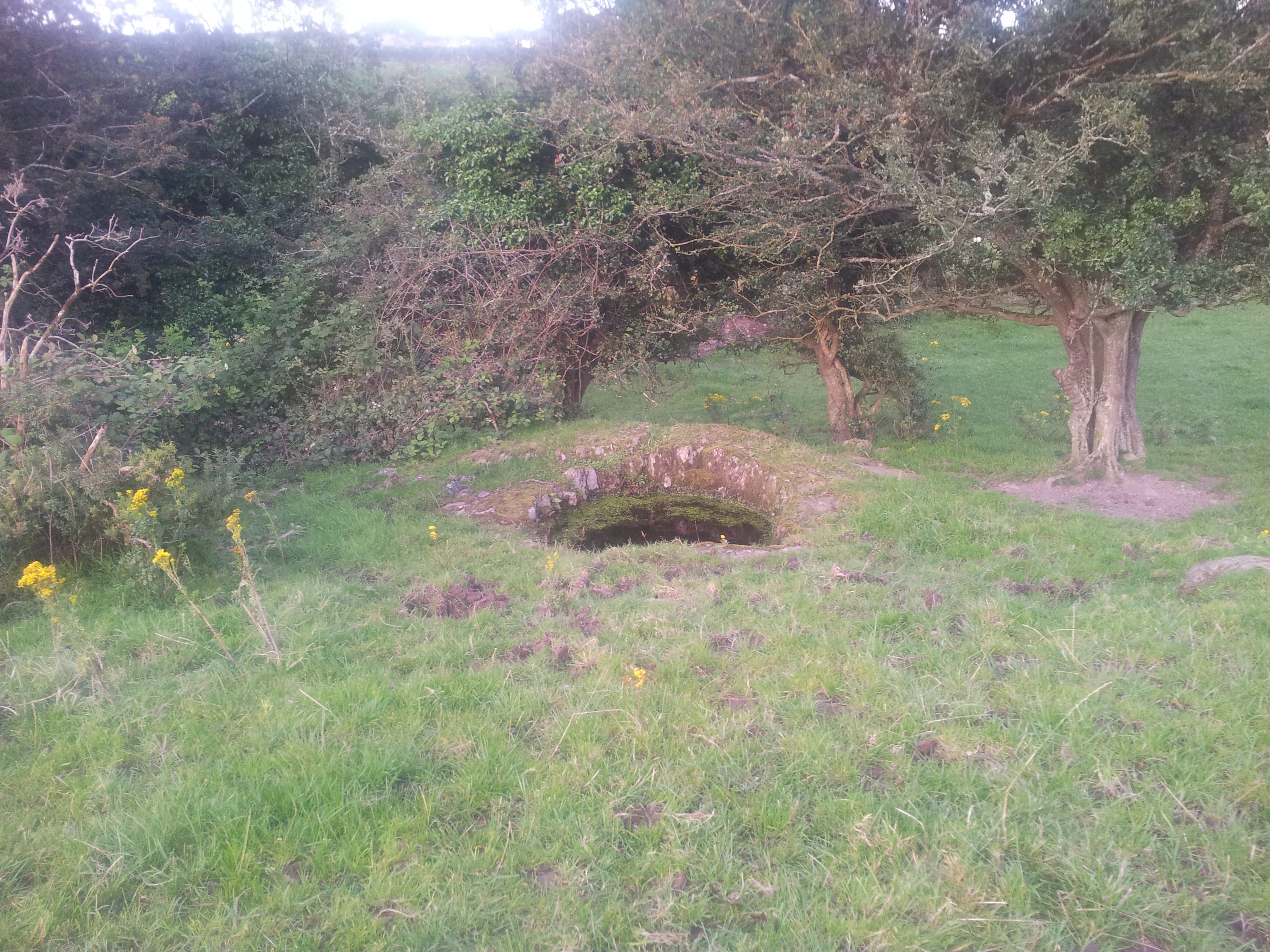
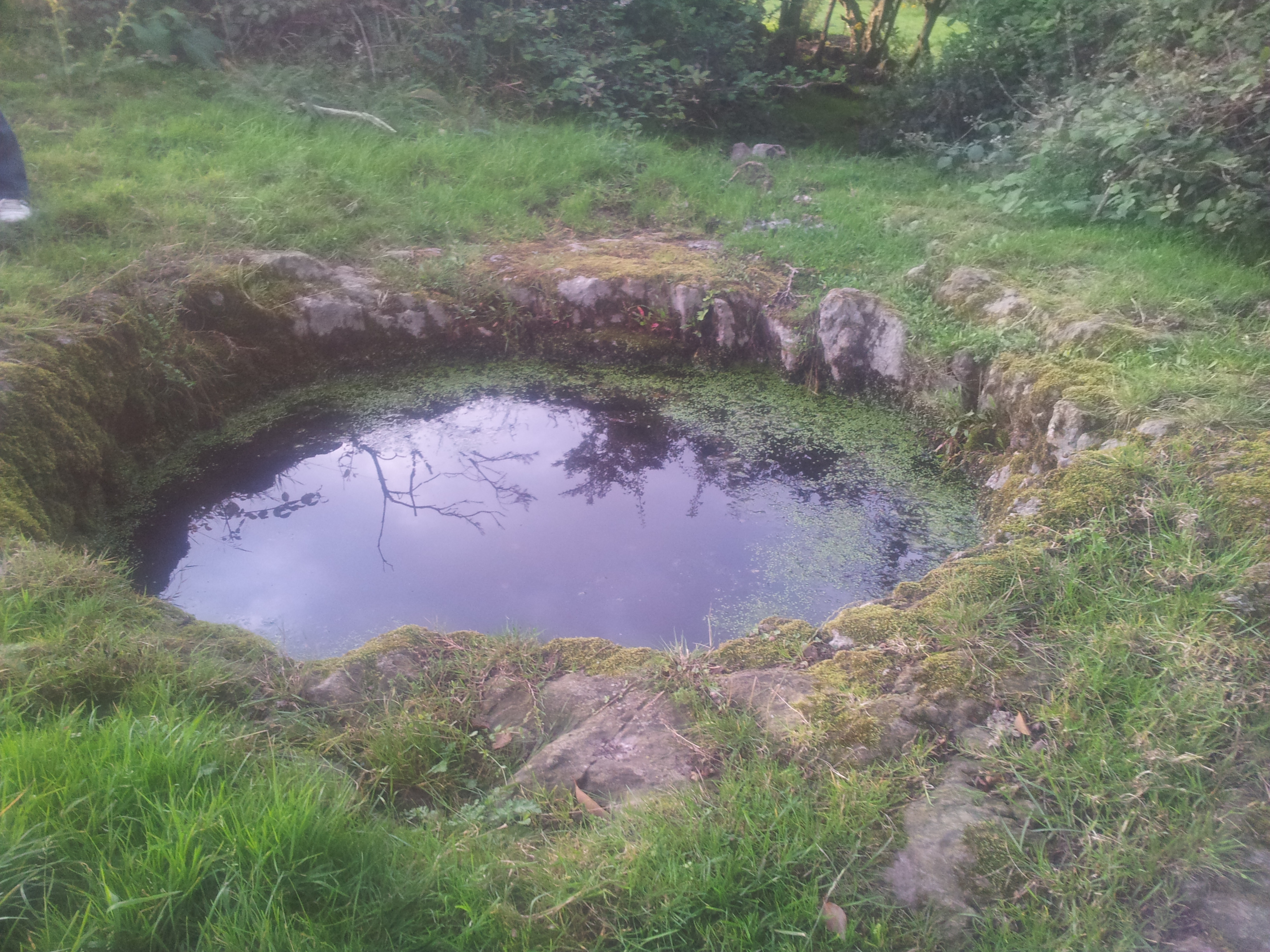
The well is a roughly circular hollow in the rock outcrop, the result of natural erosion by rainwater. The water within the well is a result of the hollow filling with rain water. Coming up to 15th of August a member of the McCarthy family will clean out the well getting rid of any algae growing in the water.

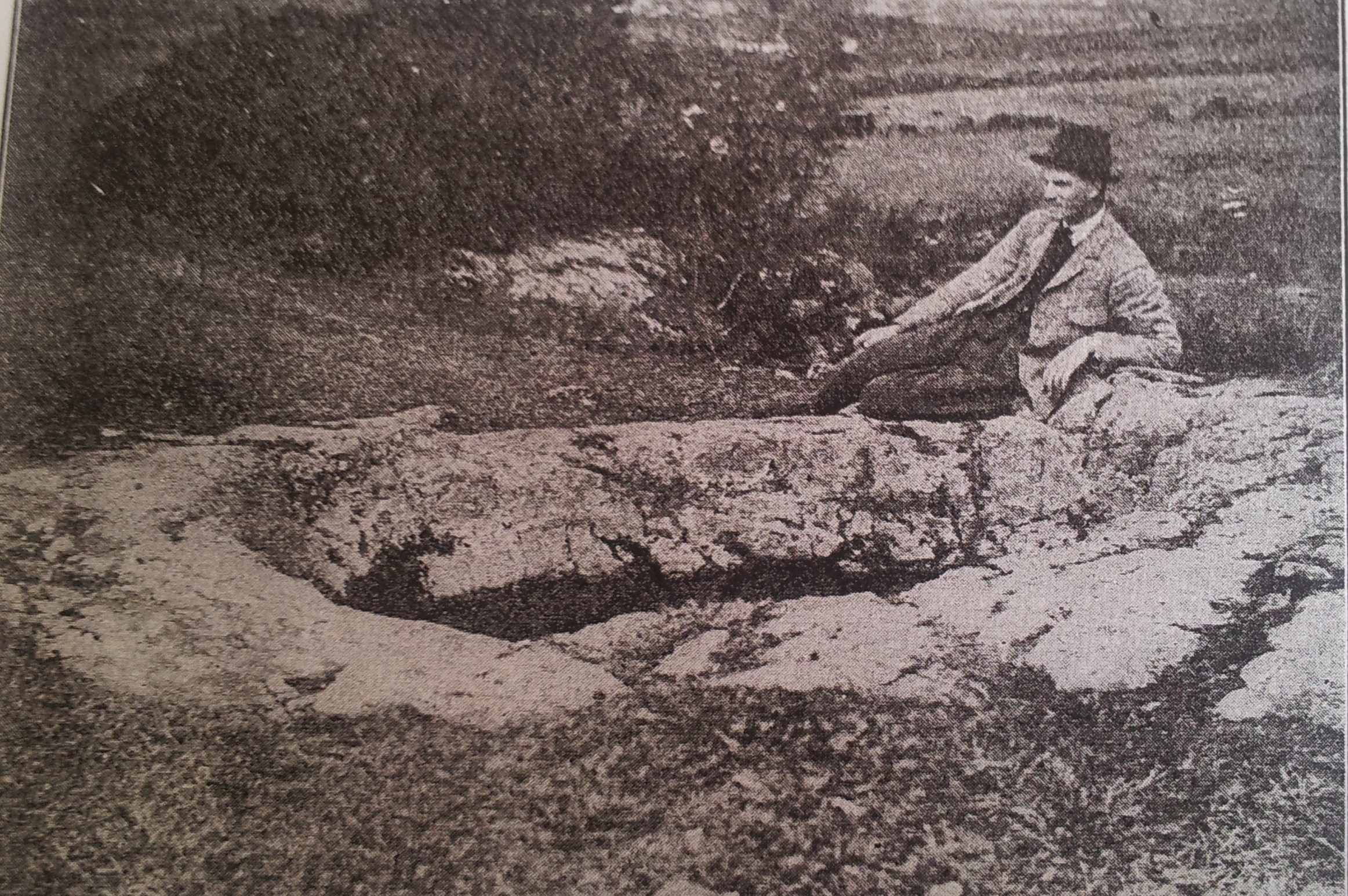
Forsayeth (1911, 186) noted that when the well was emptied a cross carved into the base was visible and Gillian confirms seeing this.

The hawthorn tree mentioned above still grows beside the well and Gillian’s father Roger, told me that rags and rosary beads were tied to the tree up to the 1960’s but the tradition has died out now.

Image of the Holy Well in 1911 ( Forsayeth 1911, 186).

Little is known about the well prior to the early twentieth century, Lewis writing in 1837 about the parish noted ‘There is a vitriolic spring in the parish the water of which is clear and sharp’.

Smith in his book the The Ancient and Present State of the County and City of Waterford in 1746 notes

‘On the south side of the parish lies the church; and near it, is a reputed holy well’

A local elderly lady called Mrs Cronin of Knocknageragh (a nearby townland) told Beary in 1911

‘ The rounds were made here. The water of this well may be used for any purpose, such as applying or pouring on the head, or rubbing on parts of the body, and some sup it out of the palm of the hand…. The rounds each time however, are finished  at the flowing spring well 60 yards below, on the flat Inch, and near the brink of the Finisc River. Here  three  sups or swallows are to be taken in honour of the Blessed Trinity’

The tradition of going to the Trinity well has died out in the area and I only came aware of the wells existence following my visit so I wasn’t able to seek it out.

View of the River Finisk from the Holy Well

Another very interesting fact about Lady well is that according to folklore from the 19th century this well  has moved its location in the past.

It was originally in the townland of Scart on the land of a Mr Healy and was resorted to for a cure for bad eyes and blindness.

‘….Mr. Healy used to hear all the people that was cured at this well talking about the well. So he told his steward to take a blind horse he had to the well. But the steward wouldn’t take the horse, so he had to take him himself to the well. So the horse got his sight back there and then, and Mr. Healy, who had  the impudence to take a dumb animal to the well, was struck blind himself, and the well disappeared. So there was no trace of the well to be found where it was. But after some days the well was found where it is at present, up a boreen under the chapel of Modelligo’  (Ussher 1914, 120).

There is another tradition which  states that it was a one Cromwell’s men who led his blind horse to the well in mockery and to test out the healing waters of the well, the horse was cured the solider stuck blind and the well up and moved to Modelligo (Forsayeth 1911, 187).

Bibliography

Beary, M, 1911. ‘Holy Well at Modeligo’JRSAI  Ser. 6, Vol. I, 393-394.

Forsayeth, G. 1911. ‘Holy well near Modeligo, Co. Waterford.’  JRSAI  Ser. 6, Vol. I,  186-187.

Lewis, S. A. 1837. A topographical dictionary of Ireland.

 Smith, C. 1746. The Ancient and Present State of the County and City of Waterford:

  Being a Natural, Civil, Ecclesiastical, Historical and Topographical Description

  Thereof. Dublin: Printed by A. Reilly.

Usher, E. 1914. ‘Waterford Folklore 1’, Vol. 25, No. 1 (Mar. 31, 1914),  109-121.

The Pattern Day at Clonmacnoise

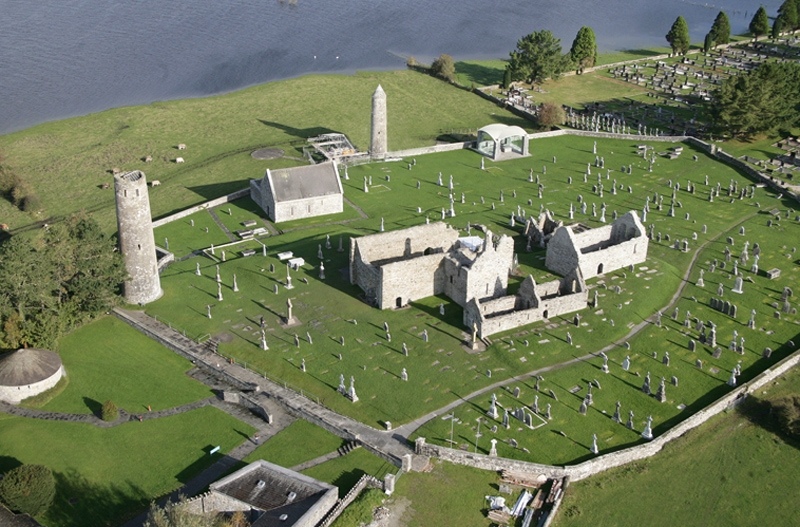
The ecclesiastical complex at Clonmacnoise is truly an amazing place. Founded by St Ciarán in 545, the site  developed into a vast ecclesiastical complex and became one of the great power houses of the medieval church in Ireland.

Aerial photo of Clonmacnoise (from http://www.athlonespringshotel.com/attractions.htm)

I have  visited Clonmacnoise on many occasions and each time I spend hours walking around , there really is so much to see here.

Plan of the ecclesiastical complex at Clonmacnoise

This visit coincided with the Pattern Day celebrations of St Ciarán’s feast day on the 9th of September. Clonmacnoise is one of the very few Irish ecclesiastical sites to have an unbroken tradition of pilgrimage that stretches from the 6th /7thcentury to modern times. The history of pilgrimage during the early to late medieval period and  the early modern period is very interesting and complex and is best discussed in more detail in another blog post.


According to the Clonmacnoise Heritage Centre there are two special days of devotion here at Clonmacnoise. The Church of Ireland hold an open air  service on the last Sunday in July which I hope to attend next year, while the annual St Ciarán’s Pattern Day  is held on the third Sunday in September, or if possible celebrated on the 9th of September (St Ciarán’s feast day) as it was yesterday.


Pilgrims beginning to arrive for the Pattern day


The Pattern celebrations began around 3pm. From around 2.30 pm people began to come into the main ecclesiastical complex in small groups and before  the main celebrations began there must have been well over a 100- 150 people present. A local man I spoke too said that even more people would normally be present but  the All Ireland final between Kilkenny and Galway had kept many away.

Unlike the pilgrimage I documented earlier this year at St Mullins, pilgrims were spread out around the site. A large group of people were seat on chairs in front of the open air oratory, which was  built for Pope John Paul II ‘s visit in 1979,

Pilgrims seated in front of the open air oratory

Pilgrims seated in front of the open air oratory

the rest of the pilgrims were scattered among the gravestones and the ruins of other churches at the site.


Pilgrims scattered around the ruins of the churches

Like the  Pattern at St Mullins, there is also a social element to this occasion,  this it is time for people to catch  up and chat, it is also a time for people to remember those who have died. Many of  people who attended the pattern also visit the graves of loved ones buried within the main complex and the modern graveyard beside it. Visiting of the graves takes place  before and after the Pattern Day mass.


During the nineteenth century and up to recent times   St Ciarán’s well, located a short distance away on the Shannonbridge road,  was a central part of the Pattern Day.  According to one lady that I spoke too,  mass and the stations here are now the main focus of pilgrims  but  some people still visit the well on the saints feast before or after the mass.

St Ciarán’s Holy Well


Clonmacnoise is part of the Catholic Diocese of Ardagh and Clonmacnoise.  St Ciarán is one of the patron saints of this diocese. The pilgrimage  is an import part of the Diocesan Calendar, so much so that  the Bishop of Colm O’Reilly officiated at the mass, aided by 11 priests.

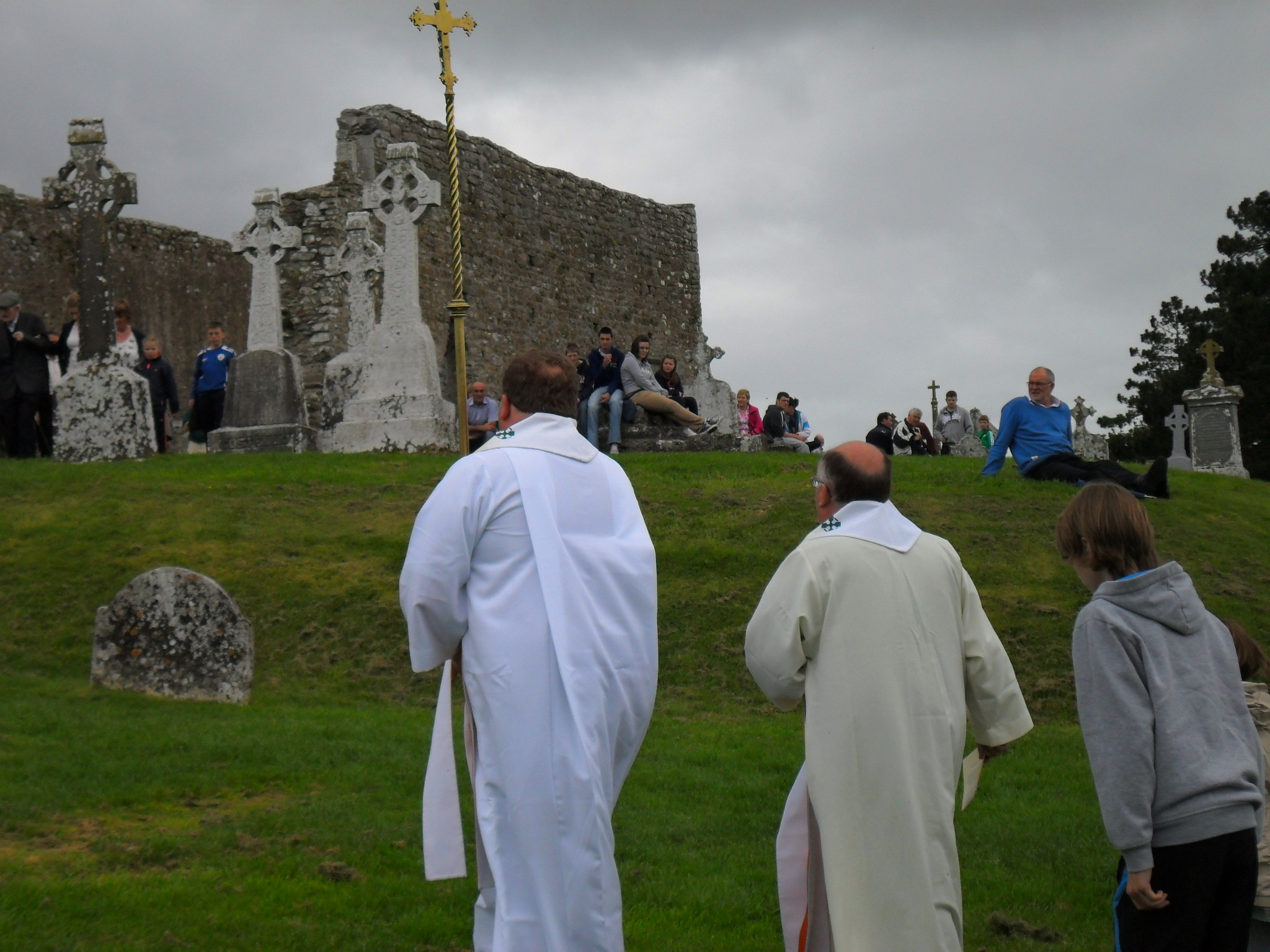
The pilgrimage began with the procession of the ‘Pilgrim Cross’ (a processional cross) around the  monastic complex while the rosary was recited.

Pilgrim Cross being carried in procession to the first station

Local people were invited to join in the procession but most preferred to pray where they were and only a small group of people joined in the procession. The first station began at the small oratory known as Temple Ciarán, the  traditional burial-place of St Ciarán.


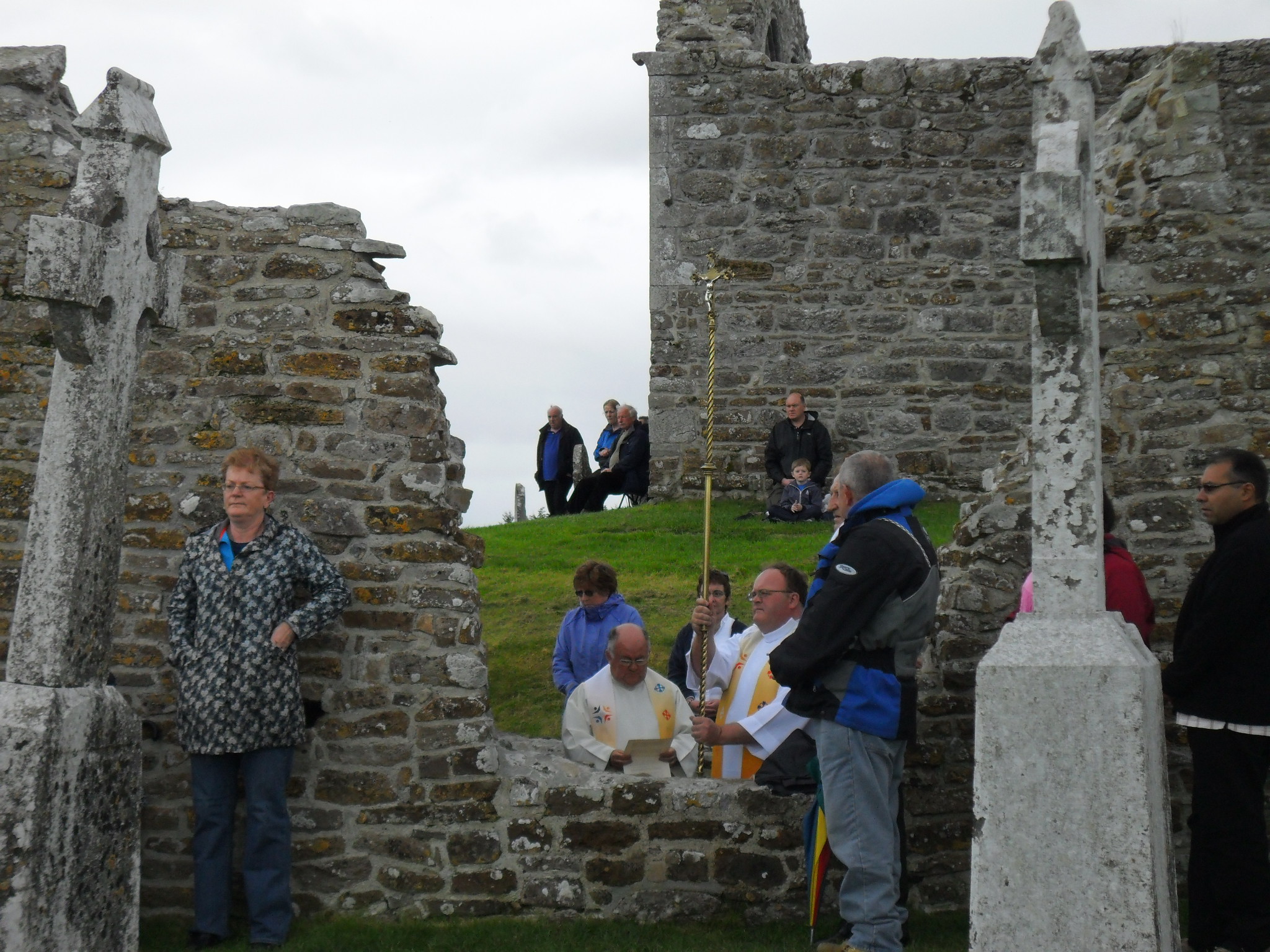
The first station at Tempel Ciarán

The Pilgrim Cross then  moved  to the second station at the top of the enclosure  among the gravestones.

The second station among the gravestones


The cross was then carried on to the third station at the Cross of the Scriptures opposite the Cathedral church.

The third station at the Cross of the Scriptures


The Pilgrim Cross then moved on to the fourth station was at the Round Tower.

The fourth station at the Round Tower


The Pilgrim Cross was then brought on procession down to Temple Connor the fifth station. This is the only church at Clonmacnoise which is still use, built in 1010 by Cathal O’Conor, it has been used as a place of worship by the Church of Ireland since the eighteenth century and services are still held here.

Procession past Temple Connor, the fifth station

The stations ended with the bishop reciting a litany of the saints of Ireland .  The mass began and  just as the sermon was being delivered by Fr Liam Hickey PP of St Ciaran’s parish Hartstown , Dublin, who was originally from this  area, the heavens opened and the Clonmacnoise became a very pretty sea of colourful umbrellas.

The umbrellas come out with the rain

As quickly as it began the rain cleared away. As the mass continued a few curious tourists looked on taking photos, perhaps wondering what was happening.

Bishop O’Reilly giving communion to the pilgrims


Looking around at the Clonmacnoise I really felt like the site was transformed from a museum into a living place belonging to the community. There was also a real sense of history and tradition, the pilgrims scattered around the site were following the same age-old traditions of their ancestors,  arriving here to celebrate St Ciarán just as their parents and grandparents had done before them and their parents before them and so on. As I will discuss in another post on Clonmacnoise the pilgrim rituals have changed through the centuries but the core act of pilgrimage, the community coming together in honour of their saint  on his feast day is unchanged and I feel really lucky to have been here to experience this.


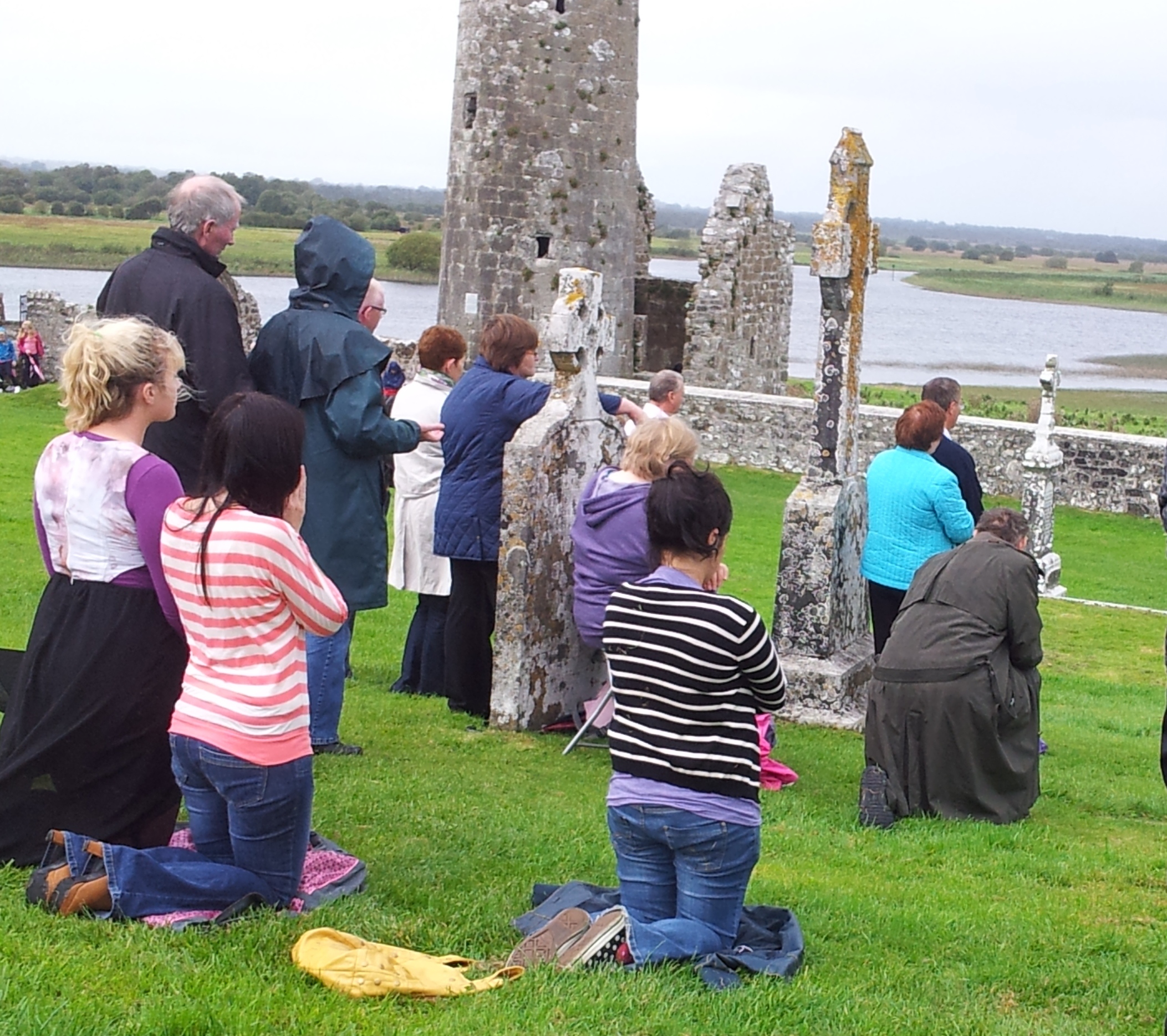
Pilgrims praying during mass at the Clonmacnoise Pattern Day


Pilgrimage at St Declan’s Well, Toor, Co. Waterford

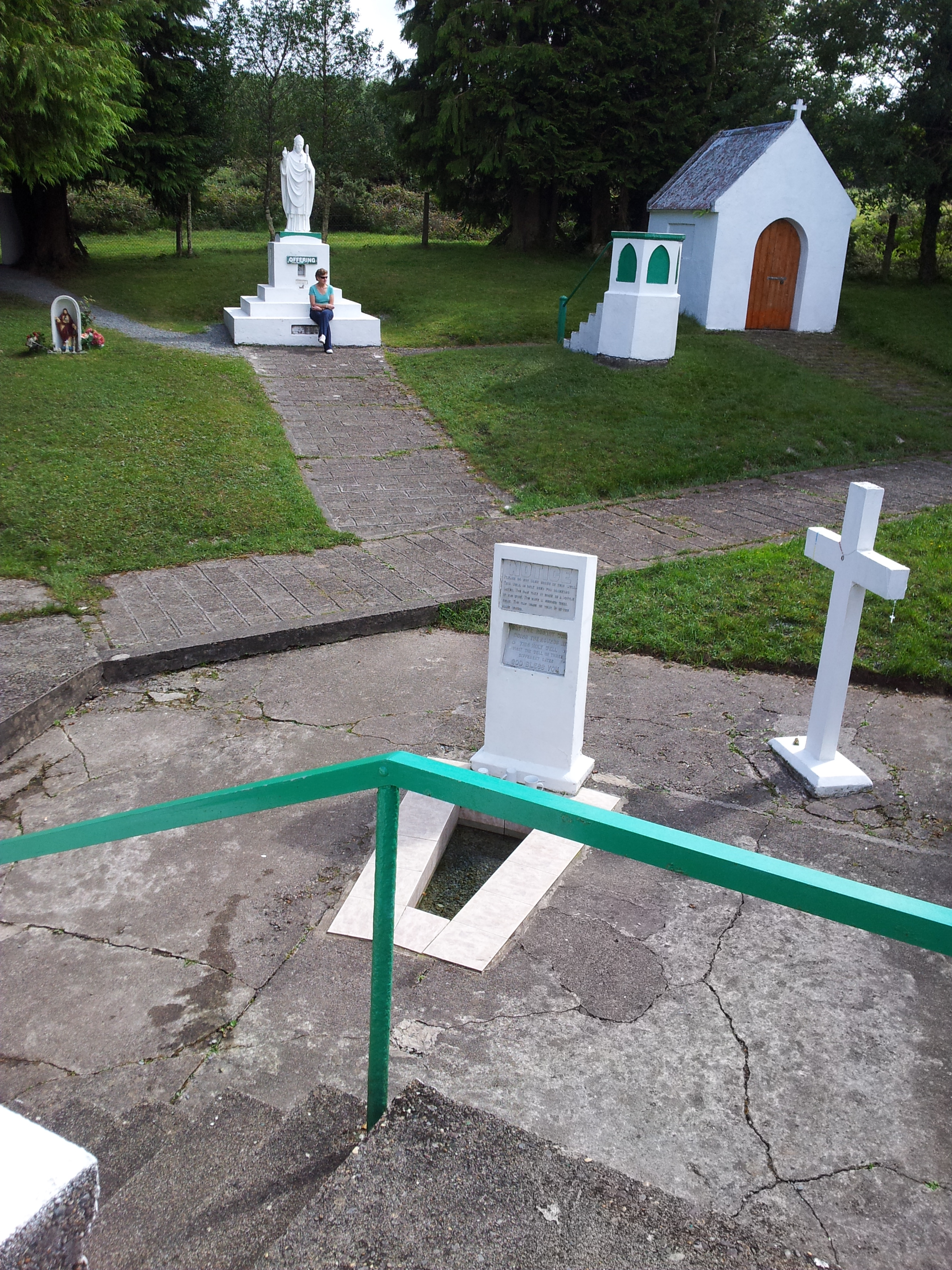
St Declan’s Well at Toor in Co. Waterford, has a special significance for me as my grandmother, who was originally from the area, visited the well throughout her life (even when living in another county).

St Declan’s Well

According to folklore St Declan  stopped here while en route to Cashel to quenched his thirst and it was this act that blessed the waters (Komen no date). I was unable to find any references to the well prior to the twentieth century, but the dedication to St Declan a pre-patrician saint suggests it is of some antiquity and  it may have originally attracted pilgrims only from the local area.

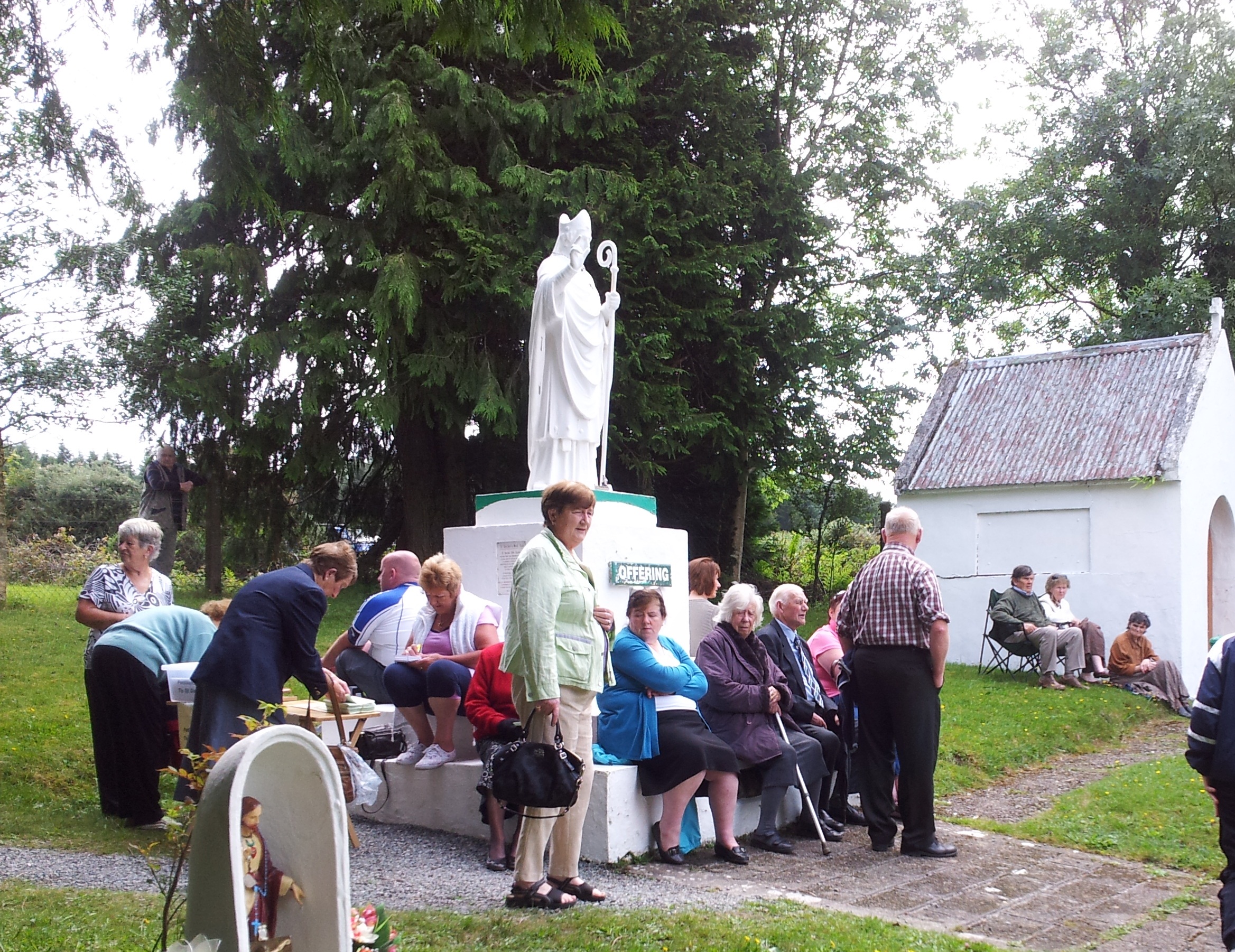
Statue of St Declan at Toor

Changing landscape of the Well

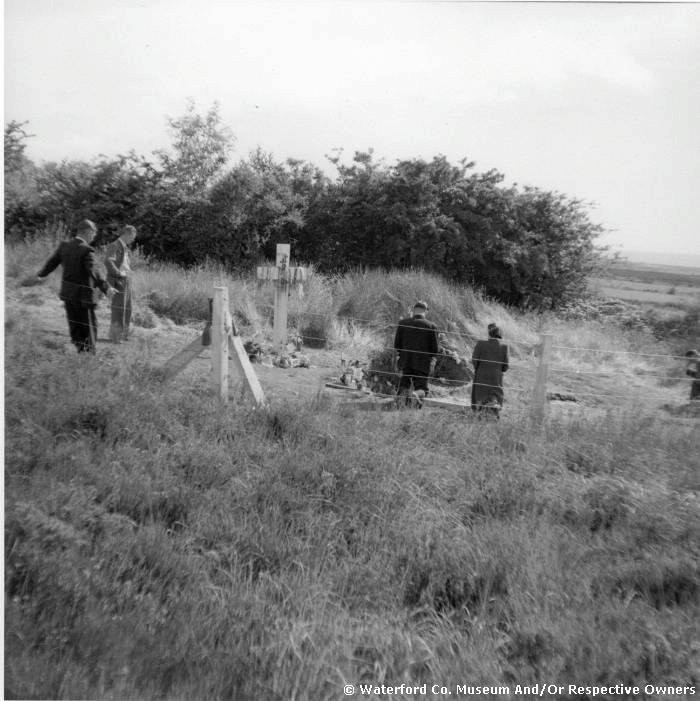
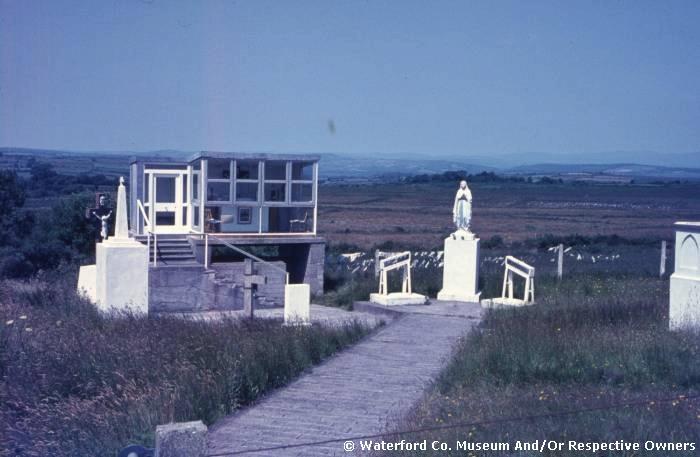
The modern landscape of the well is relatively recent. The statues, the structure where mass is said, the outdoor pulpit, are all additions dating to the 1950’s -1960’s. The coniferous plantation which surrounds the well is also modern. Thanks to the permission of Waterford County Museum I have included a number of photos of what the site was like in the 1950’s which show these changes.

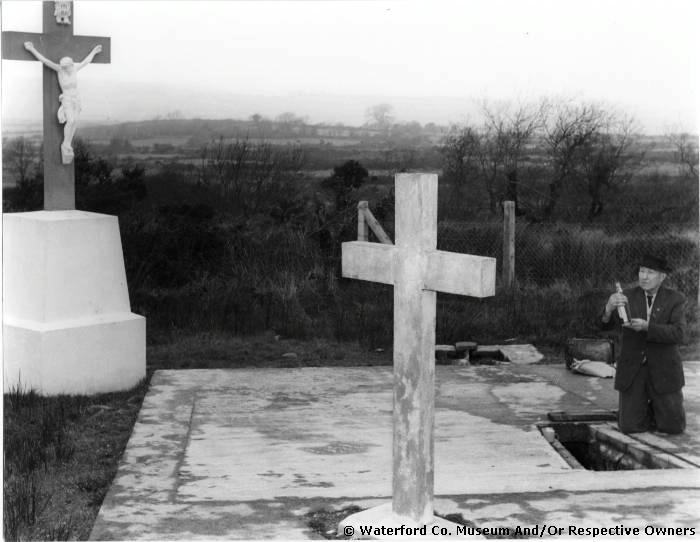
Pilgrims praying at St Declan’s Well in the 1950’s (Waterford County Museum Image Archives)

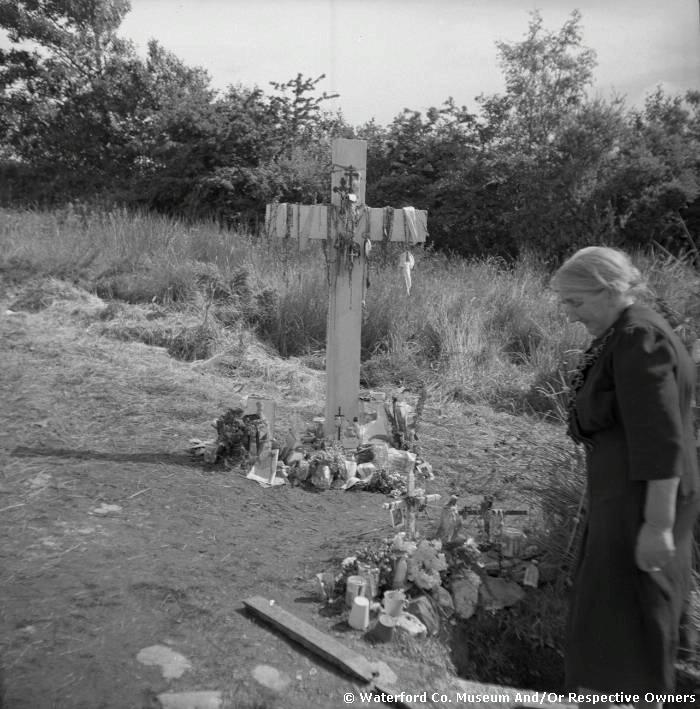
The photo below (Waterford County Museum Archive) shows the well as a deep  depression. The   large cross covered in rosary beads with flowers at the base is still present at the site.

Kate McGrath (nee_Corcoran), at St Declan’s well Toor in the 1950’s (Waterford County Museum Image Archive)

In the early 1950’s Josephine Fitzgerald the wife of Jerry Fitzgerald a cycle shop owner from Main Street, Dungarvan was cured at the well. In the subsequent years the couple were involved with others in the up keep and the addition of  the statues, new buildings  etc. at the site. There are two plaques dedicated to  their work at the site.

Jerry Fitzgerald, a cycle shop owner from Main Street, Dungarvan at Saint Declan’s Well in Toor. Mr. Fitzgerald was the caretaker of the well for many years.

By the 1960’s all the features that are visible at the site today were in place.

St Declan's well Toor 1966 ( Waterford County Museum Image Archive)

St Declan’s well, Toor in 1966, note the white rags tied to the fence ( Waterford County Museum Image Archive)

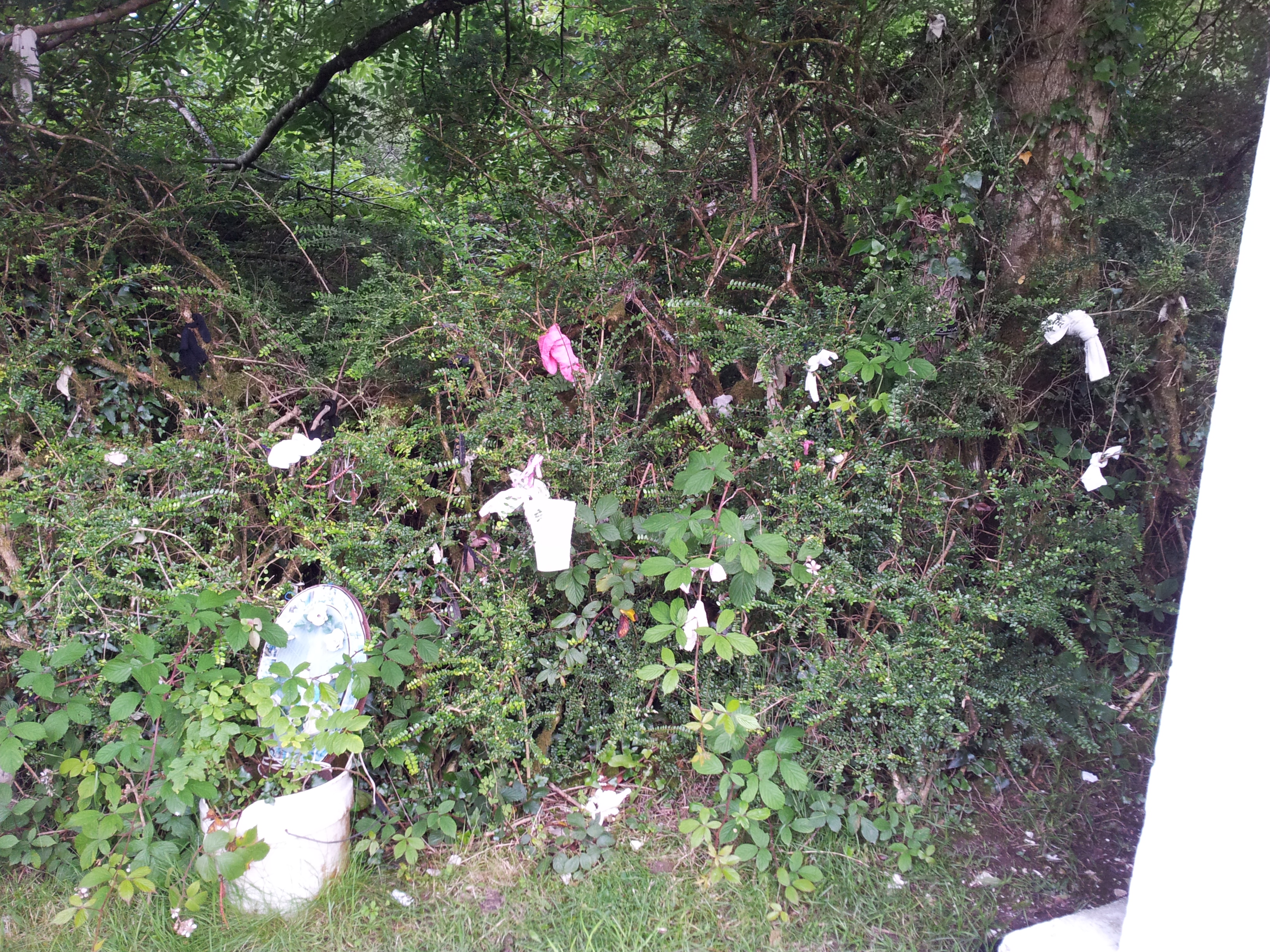
Today the site is enclosed but the older images suggest that prior to the planting of the modern forest, the site was open.  A really interesting feature at the site is the addition of a rag tree/bush following the enclosing.  Today  pilgrims tie cloths, kitchen towels and rosary beads to the hedge which surrounds the site.

Rags tied to hedge of enclosure around St Declan’s Well.

The Well and Healing

Like many other wells the water here is renowned for its healing powers. Its reputation is such that people travel here from all over Waterford and neighbouring counties such as Cork, Tipperary and Wexford to pray and to avail of the healing waters. The water is especially beneficial for diseases of the eyes and the skin.

St Declan's Well, Toor

St Declan’s Well, Toor

In 1945, The Irish Tourism Association  survey for Co Waterford recorded for the well that

 Cure for skin diseases, ringworm especially, is attributed to it. Seán Dower, an old man who lives near the well told me he saw many people come here and bath their lombs etc. which were afflicted with ringworm and exzema in the water, and he afterwards saw them quite cured. I got like information from other sources (I. T. A 1945, 122).

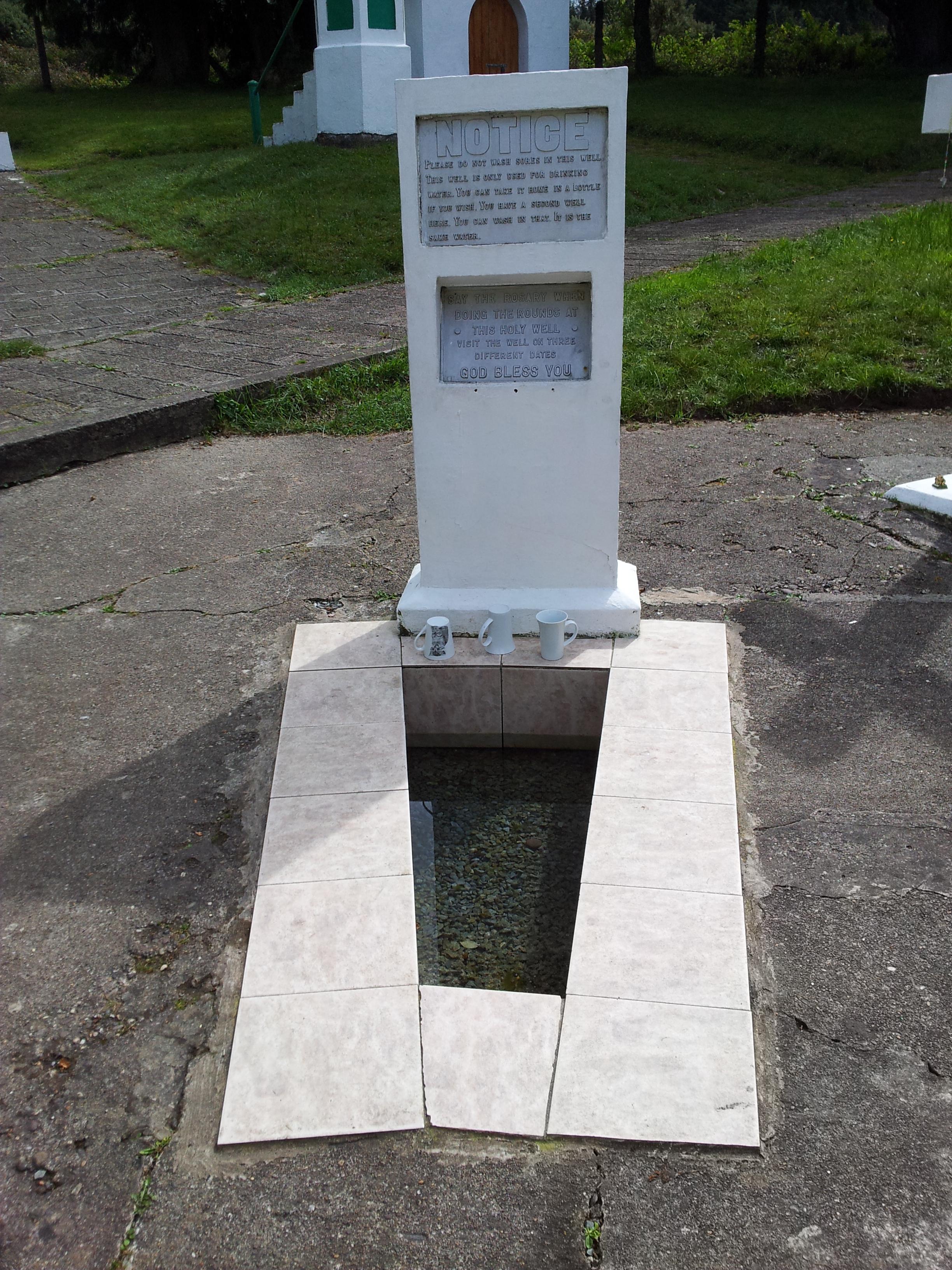
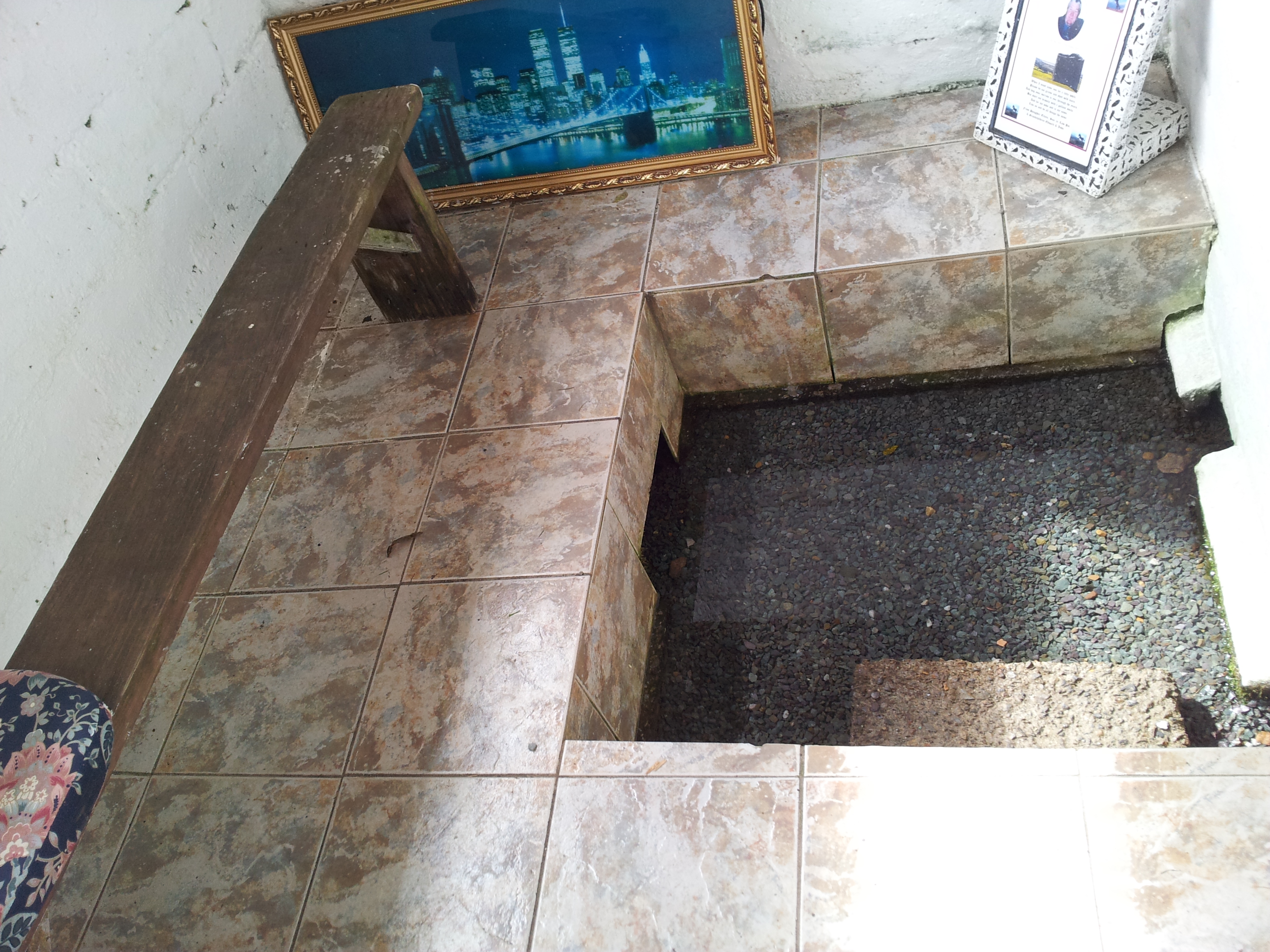
Pilgrimages take place here throughout the year. Individuals come to the well, drink the water, do the rounds while reciting the rosary. Many will then wash limbs in a small rectangular trough, located a short distance from the well.

Rectangular trough where pilgrims wash their limbs

For a cure or prayer to be successful it is a requirement to visit the well three times.

Annual Pilgrimage Mass

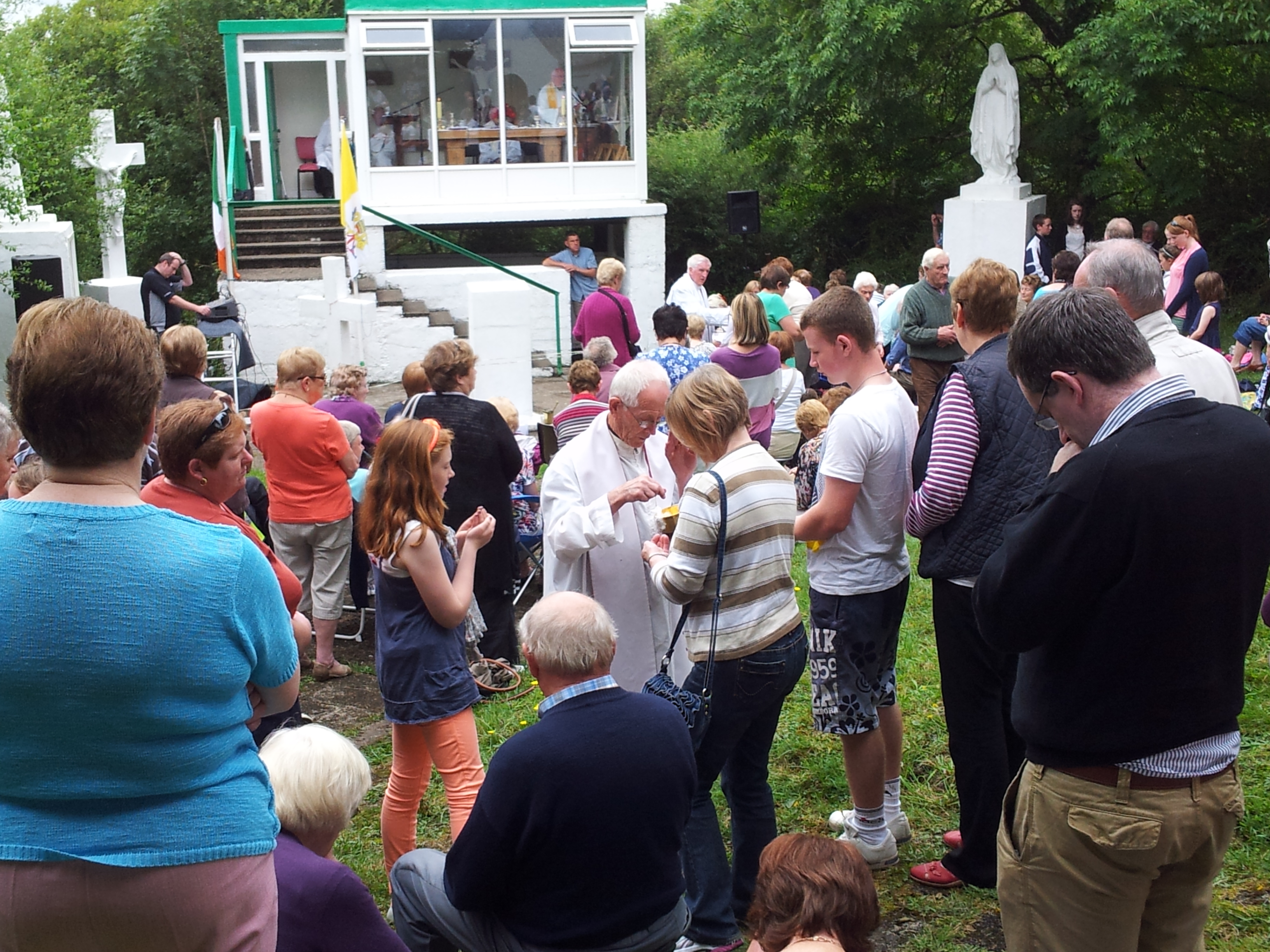
The well is also the site of two annual masses in July and on the 15th of August when, large number of people come to the well for the blessing of the waters and the celebration of mass and the feast of St Declan. This year I attended the July pilgrimage which is held here on the Thursday closest the feast day of St Declan on the 24th of July.

Mass at St Declan’s Well on the 26th of July

The tradition of mass is relatively new having begun in 1951. While attendance at other wells is in decline,  the pilgrimage here is very strong as evident from the large number of numbers of pilgrims young and old who arrived by car and bus. There was a very strong local presence with many people from the neighbouring parishes of Aglish and Clashmore attending. There  were many people who had travelled long distances to be here from Waterford City, Wexford and Clonmel.

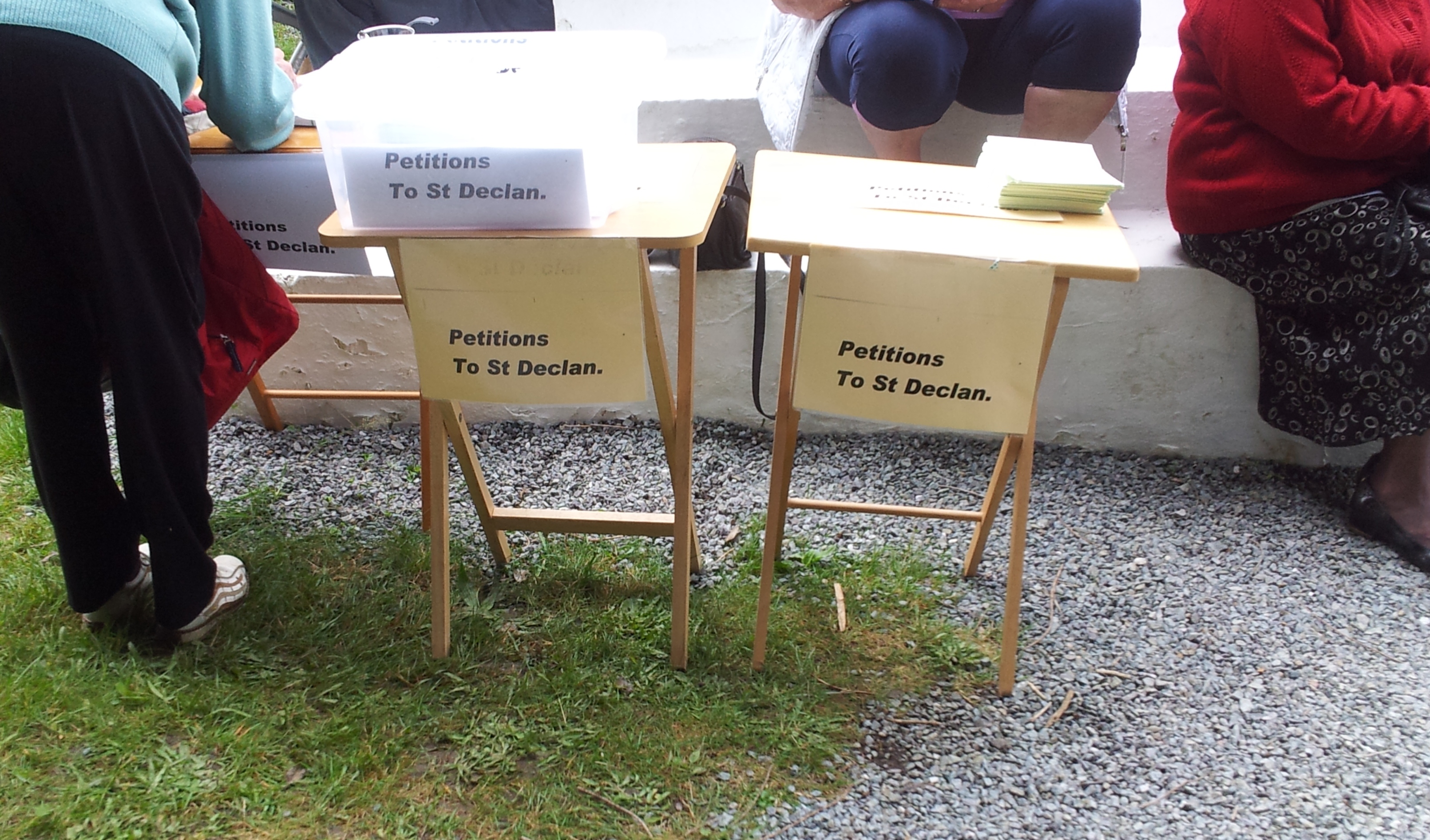
The mass is an important event and  11 priests assisted   Fr.  Gerry O’Connor  the parish priest of , who said the mass.  The ceremony began with blessing of the waters of the well and those present, next a box containing  petitions to the saint, from those in attendance was carried to the well.

Pilgrims writing petitions to St Declan

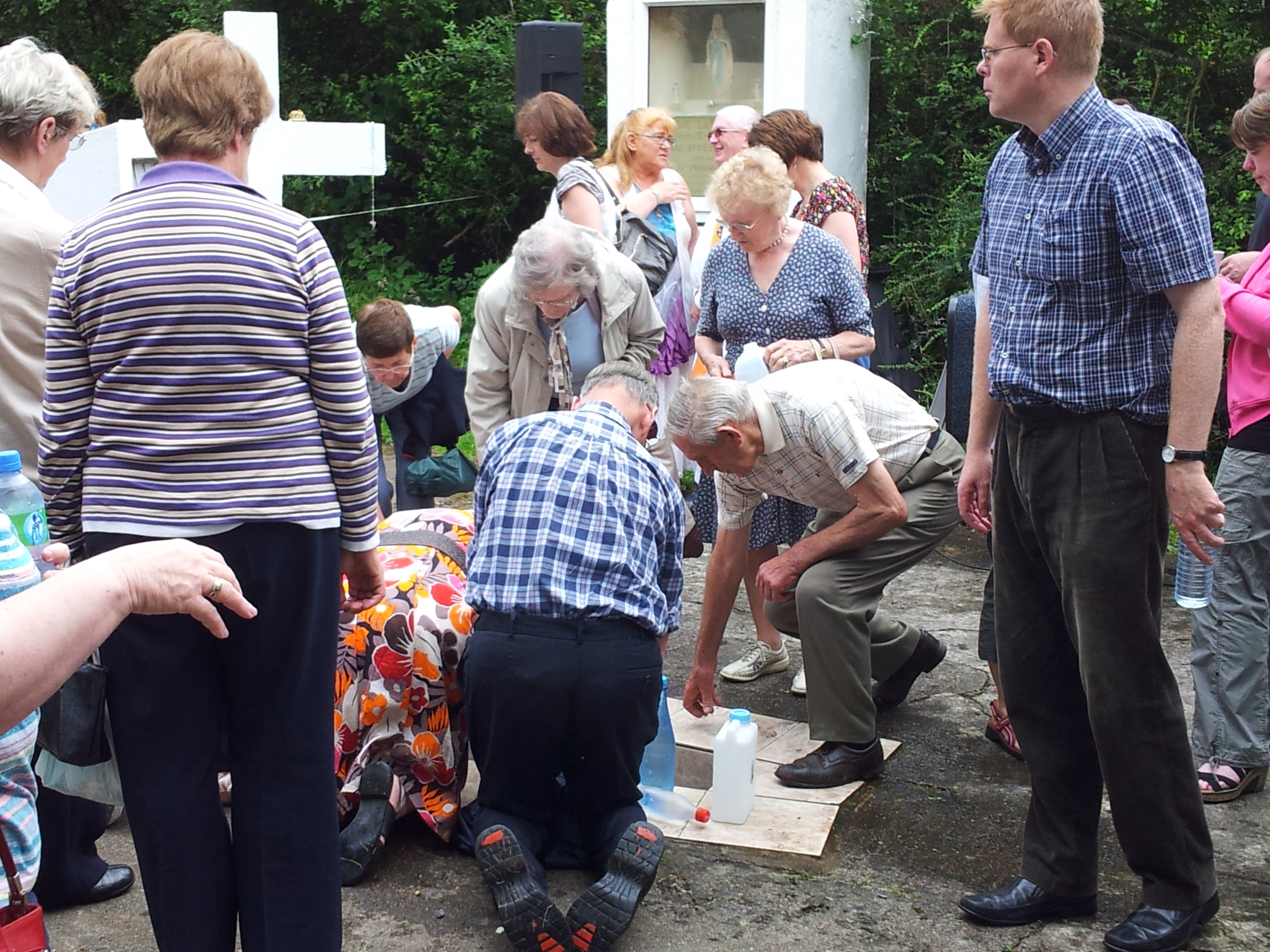
This is a new  addition to the ceremony at the request of  pilgrims the previous year. Following mass pilgrims went to the well to drink the water and some when to wash their feet at the trough underneath the structure where mass was said.

Pilgrims drinking the water of St Declan’s well after the annual mass

There is also a real social aspect to the occasion, it’s a chance for people to catch up and talk, afterwards  in the field generously provided by the local farmer for parking, many people had picnics out of the booth of their cars.

I would like to thank Fr Ger MacCarthy and Fr Pat Butler  for information on the well  and Waterford County Museum for permission to reproduce their photos.

References

I.T.A. Topographical and General Survey of County Waterford. Ireland, 1945. [on line] http://snap.waterfordcoco.ie/collections/efolders/155321/ita_survey.pdf [accessed 4/08/2012]

Komen, J. no date. ‘St. Declan’s Pattern.’ [on line] http://www.waterfordmuseum.ie/exhibit/web/Display/article/331/7/The_Ardmore_Journal_St_Declans_Pattern_.html [accessed 3/08/2012]

The Pattern day at St Mullins, Co. Carlow

St Mullins is one of my favourite places and on Sunday the  22nd of July I headed along to the annual pattern day.

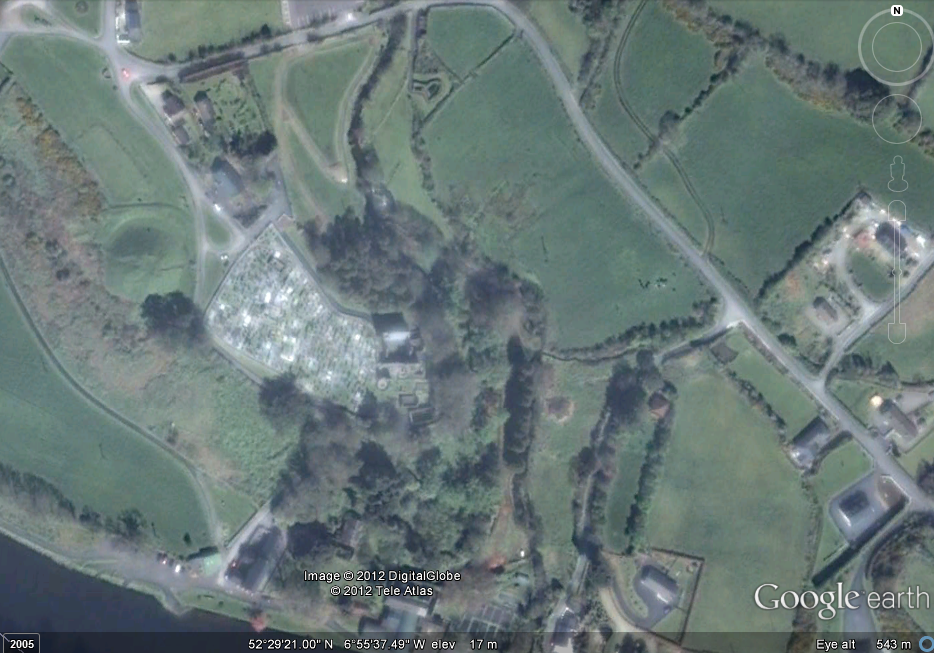
View of St Mullins graveyard and ecclesiastical settlement from Google Earth

A pattern day, is a day when people come together to perform pilgrimage at a holy well or saints grave, usually on the saints feast day. This  is a tradition that can be traced back to early medieval times.  Nineteenth century accounts suggest there were originally two main pilgrimage days  at St Mullins on the 17th of June the  feast day of St Moling and the 25th of July the feast of St James. Today the pattern  takes place on the last sunday before the 25th of July and prayers take place at the well and in the graveyard on the 25th of July.

St Moling founded a monastery here in the seventh century and he is reputed to be buried within the ruins of the monastic buildings found in the modern graveyard. Pilgrims having being coming to pray to St Moling  for centuries and St Mullins was one of the great pilgrimages in medieval Ireland.  A single blog post is not enough to discuss the history  and tradition of pilgrimage at the site,  I will just   focus on the  modern  pilgrimage.  I hope to write a second post about the  medieval and early modern pilgrimage in the  coming weeks.

On Sunday the pattern   began with the blessing of the water of the  holy well by the Parish Priest ,  the blessing was then followed by mass in the  nearby graveyard (attached to the ruins of the medieval monastic site).

Bless of the Well at St Mullins

View of the blessing of the waters at St Moling’s Well, St Mullins

Following the blessing  of the waters,  pilgrims  drink the water from the well and pray for their own intentions, before walking to the graveyard for mass. Some people  attended mass first and then went  to the well to drink its water.  The waters from the well are reputed to have great healing powers.

People walking from  St Moling's well to the graveyard

People walking from St Moling’s well to the graveyard

The well  which is dedicated to St Moling consists of a reservoir filled by nine springs  surrounded by a low wall.

Pool of water at St Molings Well

Pool of water at St Moling’s Well

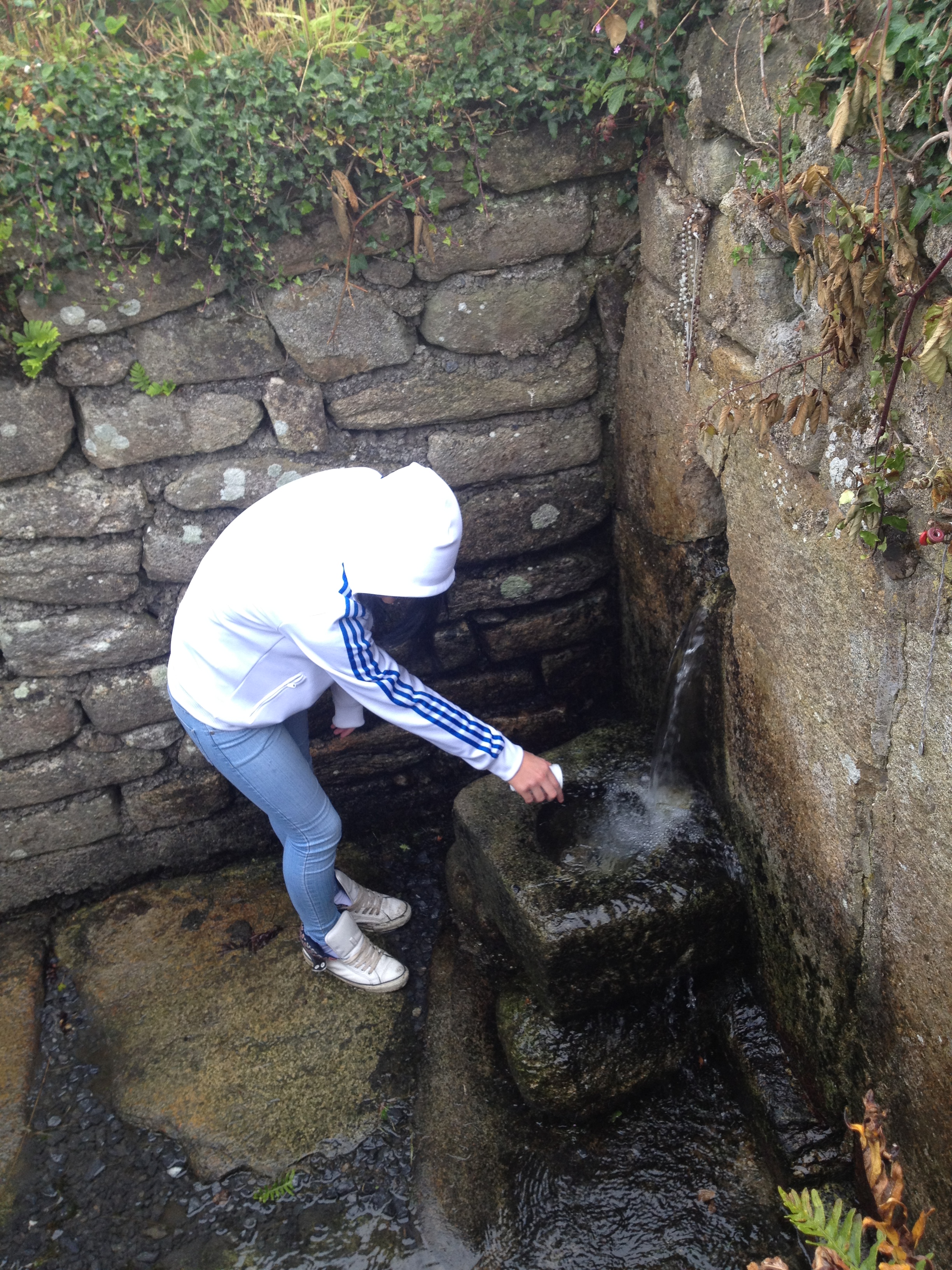
The water flows from this reservoir into a small roofless structure.  To get to the water one has to enter through a narrow door. The water flows from the pool through  two large  granite holed stones in the back wall .  A rectangular cut stone  with a circular basin/depression catches the water  as it flows out.

The Holy well at St Mullins

The back wall of the structure at St Moling’s well

The water then flows  over flag stones out the door and into the nearby mill-race known as the Turas (Pilgrim’s Way).

Mill race beside St Moling's well

Mill race beside St Moling’s well

When I visited the well on the pattern day in 2008,  I met a lovely lady Molly who looked after pilgrims  at the well and handed out water to them , she told me she did this every year for 50 years and her father before her  did the same . This year  she couldn’t make it as  she had recently been ill, so two   local student  stepped in to help out.  I  forgot to  ask their  names, too busy talking. So  they were  in charge of  filling cups with water and handing them to pilgrims who didn’t want to go inside for the water ( the flagged floor was very wet so not everyone wanted to get their feet wet).  I also had a chat with Mr Joe Mahony who was originally from Coolrainey and is now aged 92. He told me that when he was young as well as drinking the water people would stick their heads under flow of water as it came out of the wall. It was the belief that this would protect them from ailments of the head for the coming year. Joe  is a great character has been in his own words  ‘ coming to the pattern day since before he was born’.

girl collecting water at st mullins

One of the local student in charge of giving water to the pilgrims

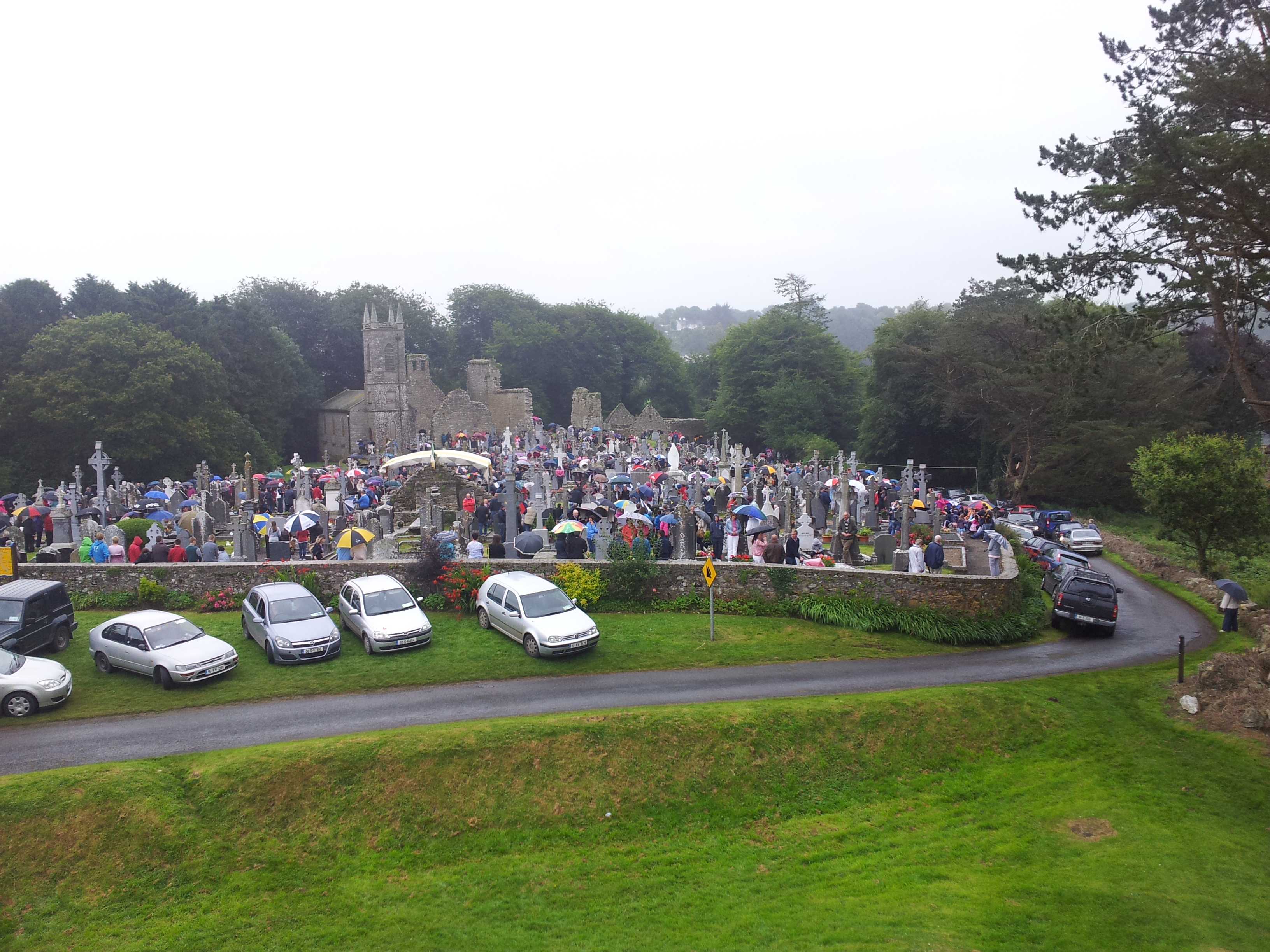
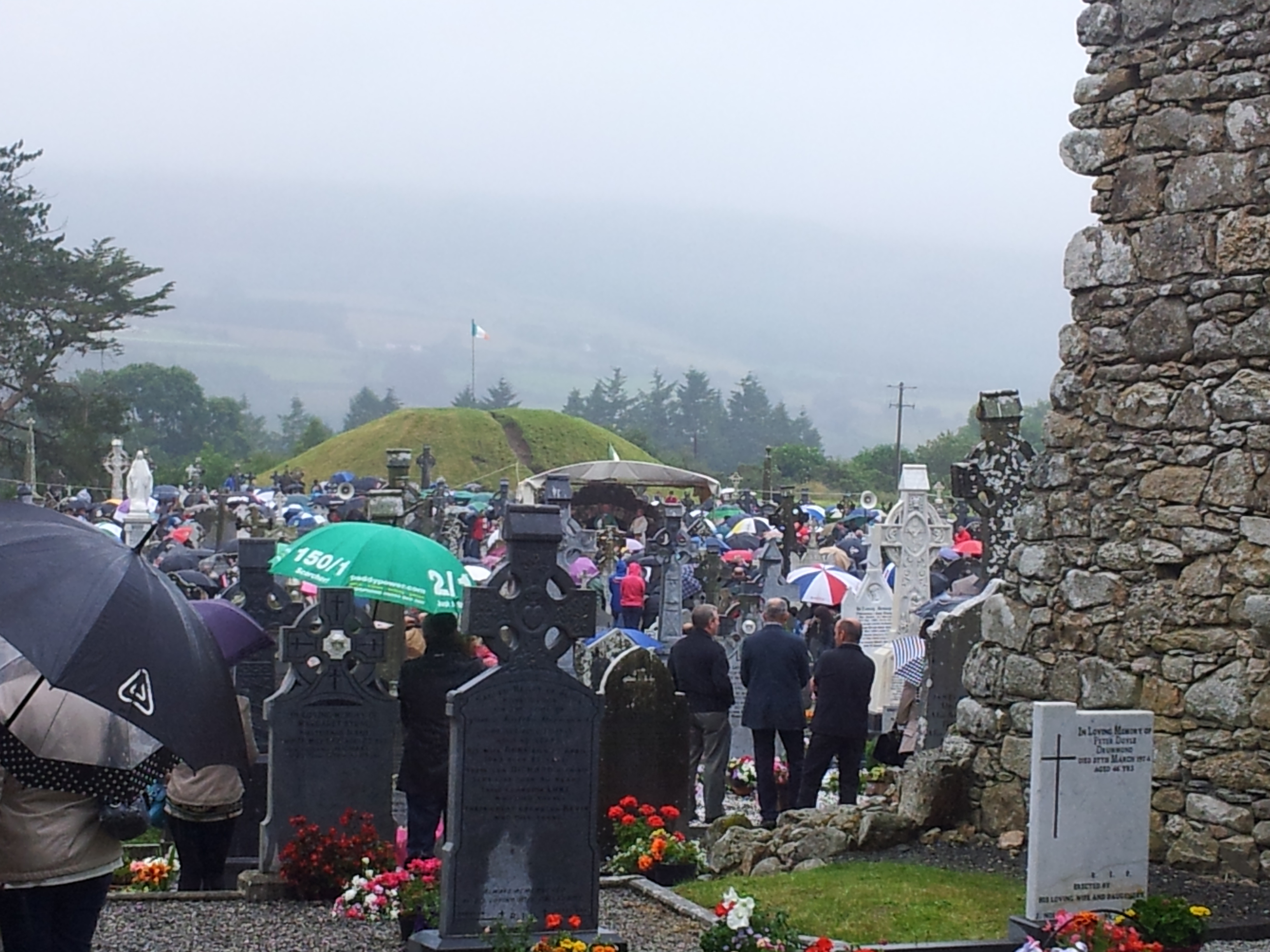
Mass  began in the graveyard at 3.  The weather was  wet and a constant light rain was down for the afternoon, but  despite the weather the graveyard was a see of coloured rain jackets and umbrellas.
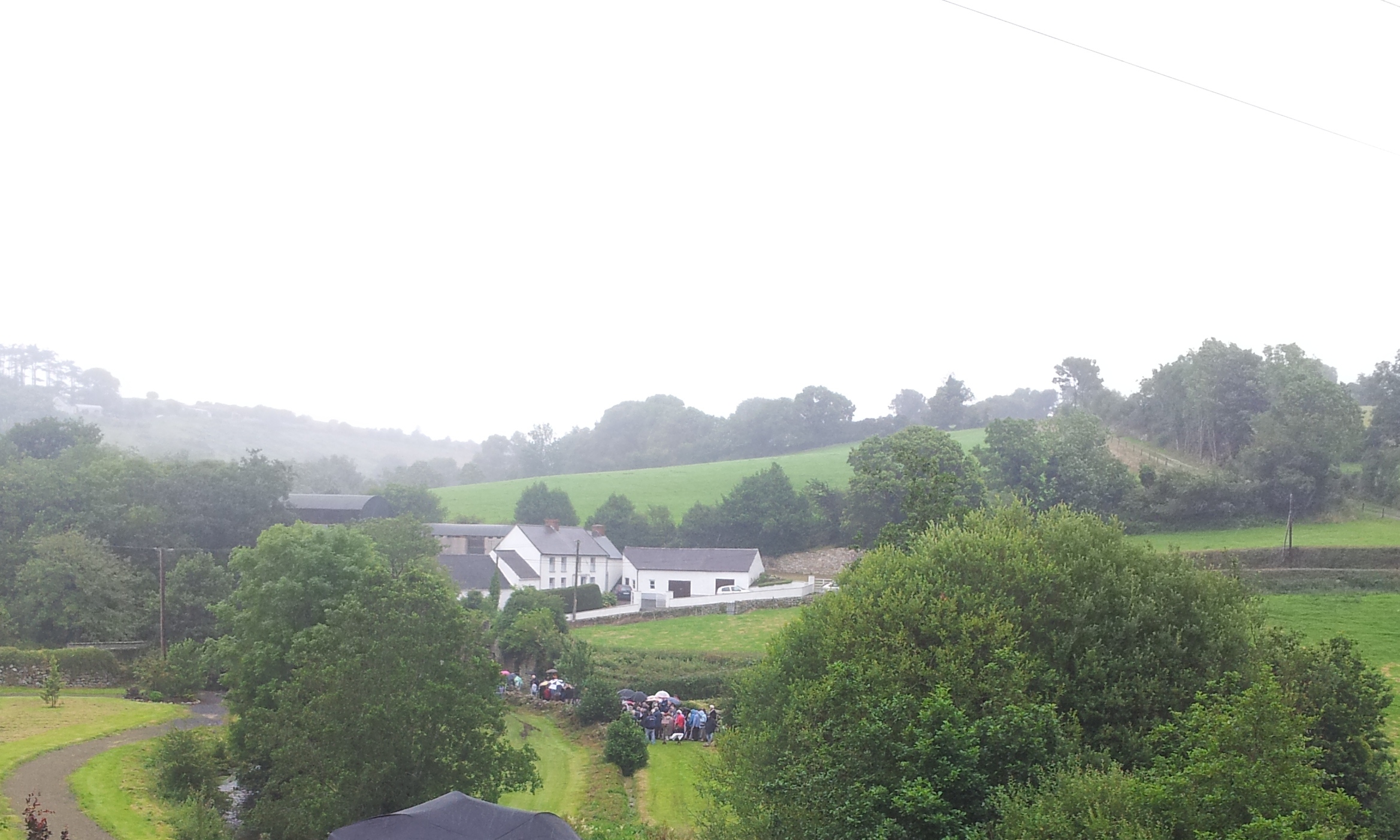
View of Patron Mass from Summit of nearby Motte

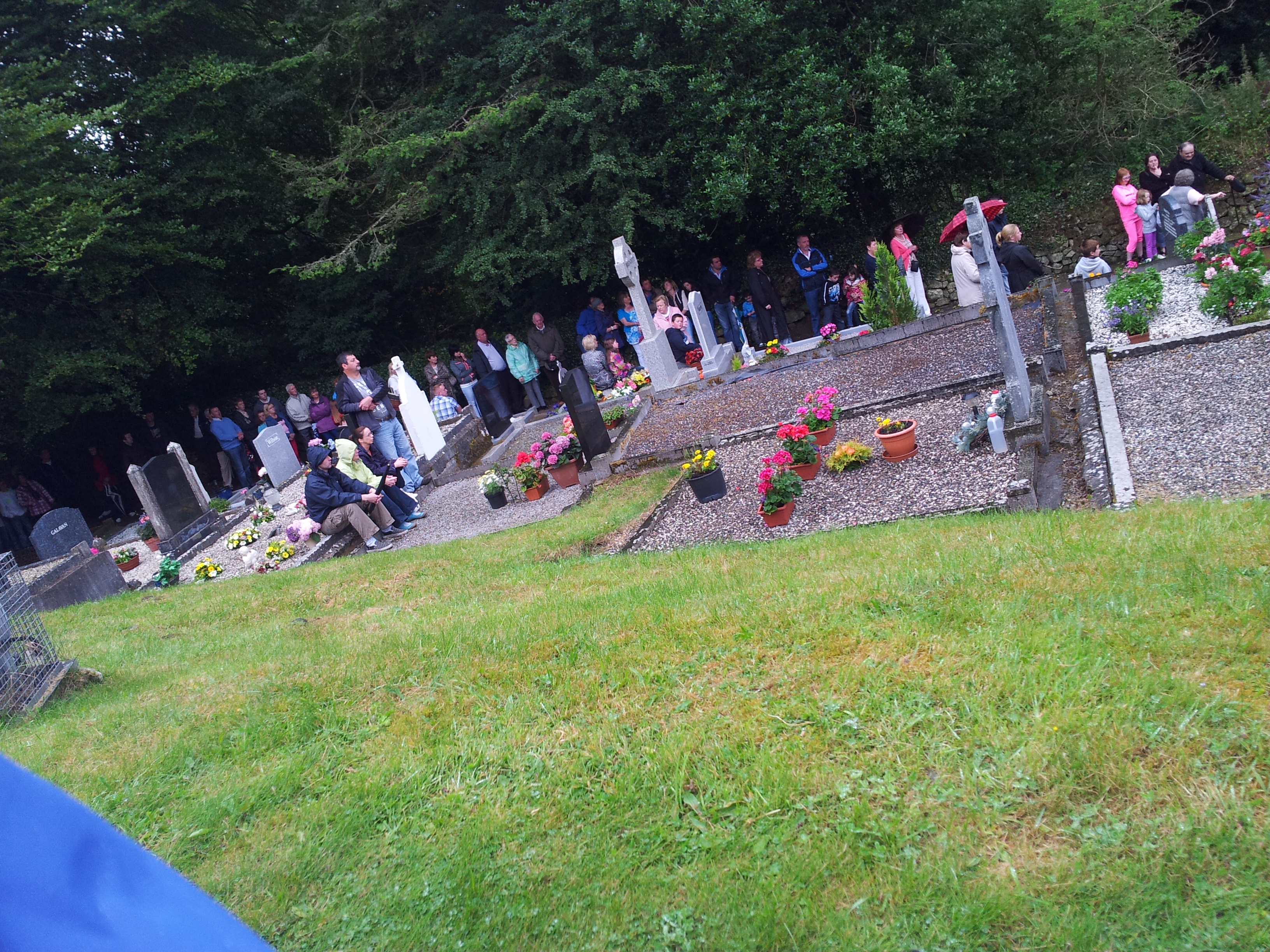
Some tried to take cover from the rain under the trees or in the ruins of the monastic buildings.

Pilgrims hiding from the rain under the trees during mass at St Mullins

People of all ages  attendance on Sunday from small babies to the very elderly. There is a real sence that this is a very important event for the local community. The mass performed by the priest in the middle  of  the graveyard, at  the site of  a penal altar.

Mass  being at penal alter

Mass being at penal altar

It is amazing to think that this pilgrimage has been taking place for centuries and there is a real sence of community and  history here.

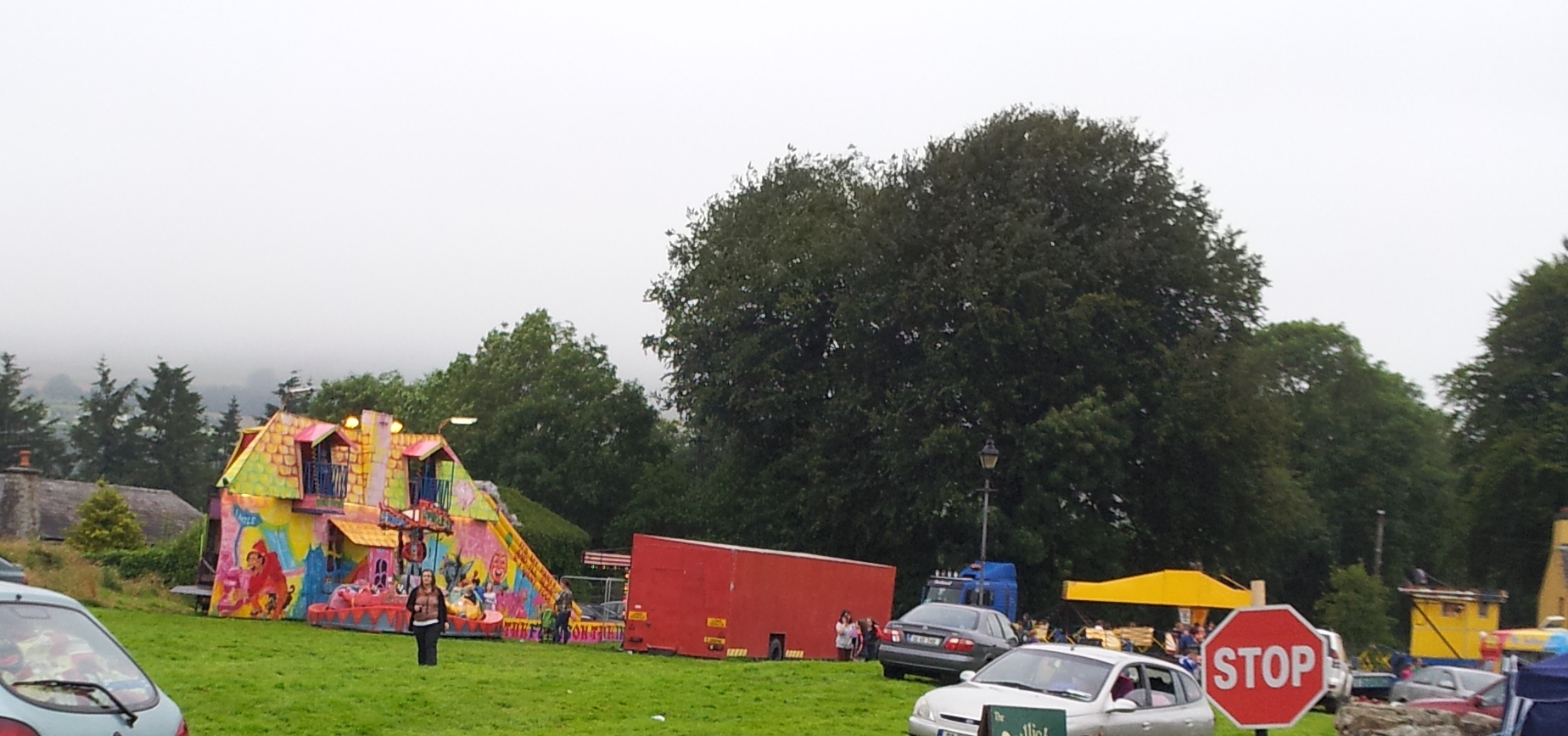
The Patron day is also a social event for local people,  in the green  beside the Norman Motte a short distance from the graveyard  there were amusements and stalls selling their wares, and chip vans .

Amusments  at St Mullins

Amusments at St Mullins

The pattern is a day for people to meet up with friends and have a chat.  Many local  people  who live in other parts of the county will come  back especially for the pattern.

Following the pattern, I headed to the  St Mullins Heritage Centre . The Heritage Centre is located in a former Church of Ireland church built in 1811 at the edge of the graveyard. It  is well worth a visit and has lots of information plaques of the history of the area, St Moling and the pilgrimage. The centre also deals with  genealogy queries .