Graveyard Recording at Shanrahan and medieval pilgrim rituals

At the moment there are some really exciting community archaeology projects taking place in Ireland. I want to tell you about one project  happening over the next two  weeks  in South Tipperary.  This project  involves the training of local communities  to record   historic gravestones at the old graveyards at Newcastle, Molough Abbey, Shanrahan and Tubbrid.  The  training and mentoring for the project  is being provided by Historic Graves.  As you can see from their  website   http://historicgraves.ie/  Historic Graves have  successfully completed similar project  all over the country.

Map showing the location of the four graveyards taken from google earth

Today I headed  over to  Shanrahan  graveyard, located  just outside of Clogheen, to see how the project works.
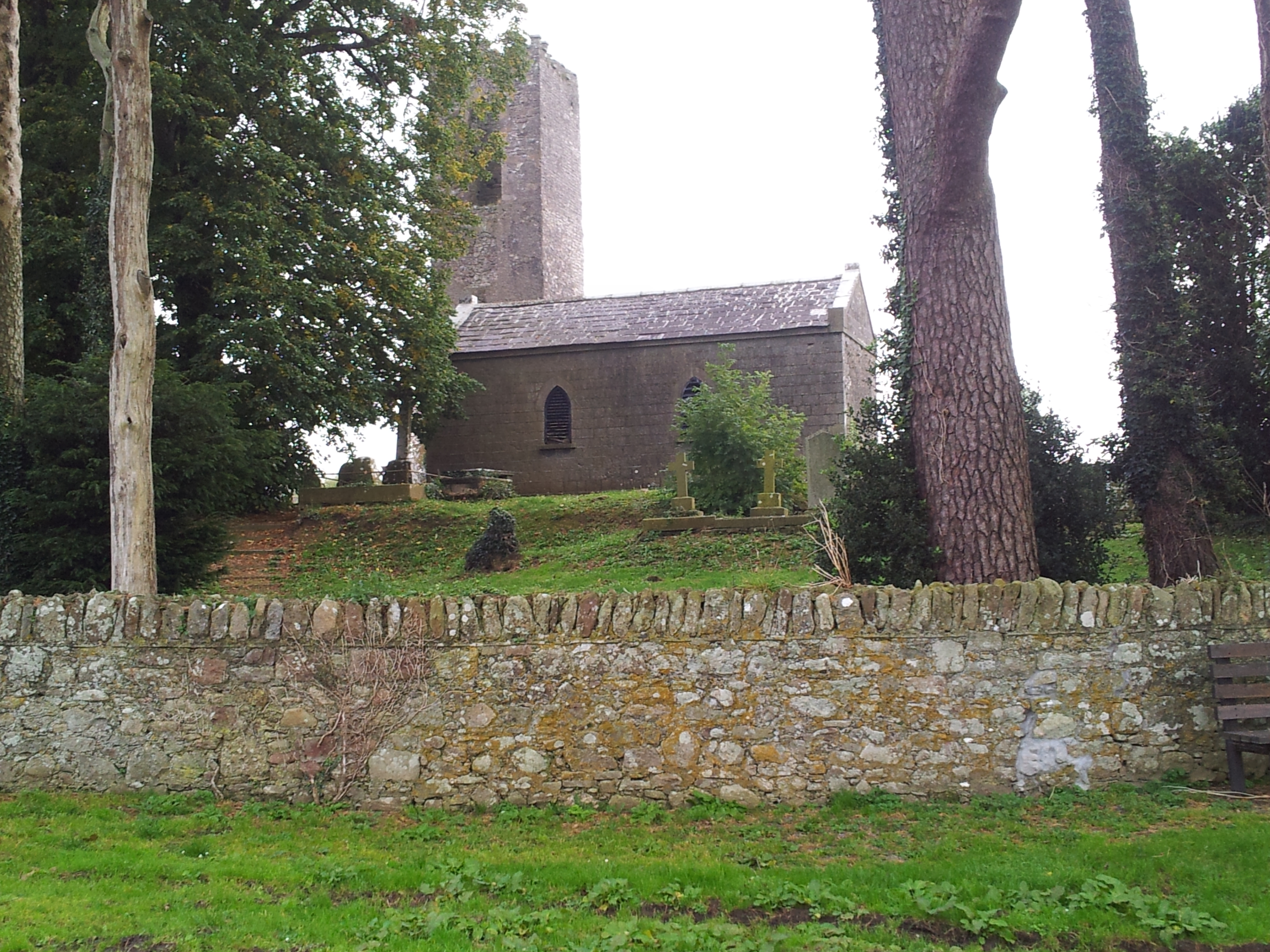
View of Shanrahan Church and Graveyard

Shanrahan is a really interesting place,  at the center of the graveyard are the ruins of a  medieval parish church. The church is unusual in that it has  two Sheela-na-gigs.   Sheelas  are  figurative carvings  of naked   women, usually bald and emaciated, with lug ears,  squatting and pulling apart their vulva.  These carvings are found on medieval church, sometimes castle sites in  Ireland and England.

There are lots of theories about  the purpose of these carvings,  some believe that were used to ward off evil,  others that they were symbols of fertility, others that they were used to warn against the dangers of lust  etc . If you want to find out more  about  these strange carvings check out the  bibliography below.
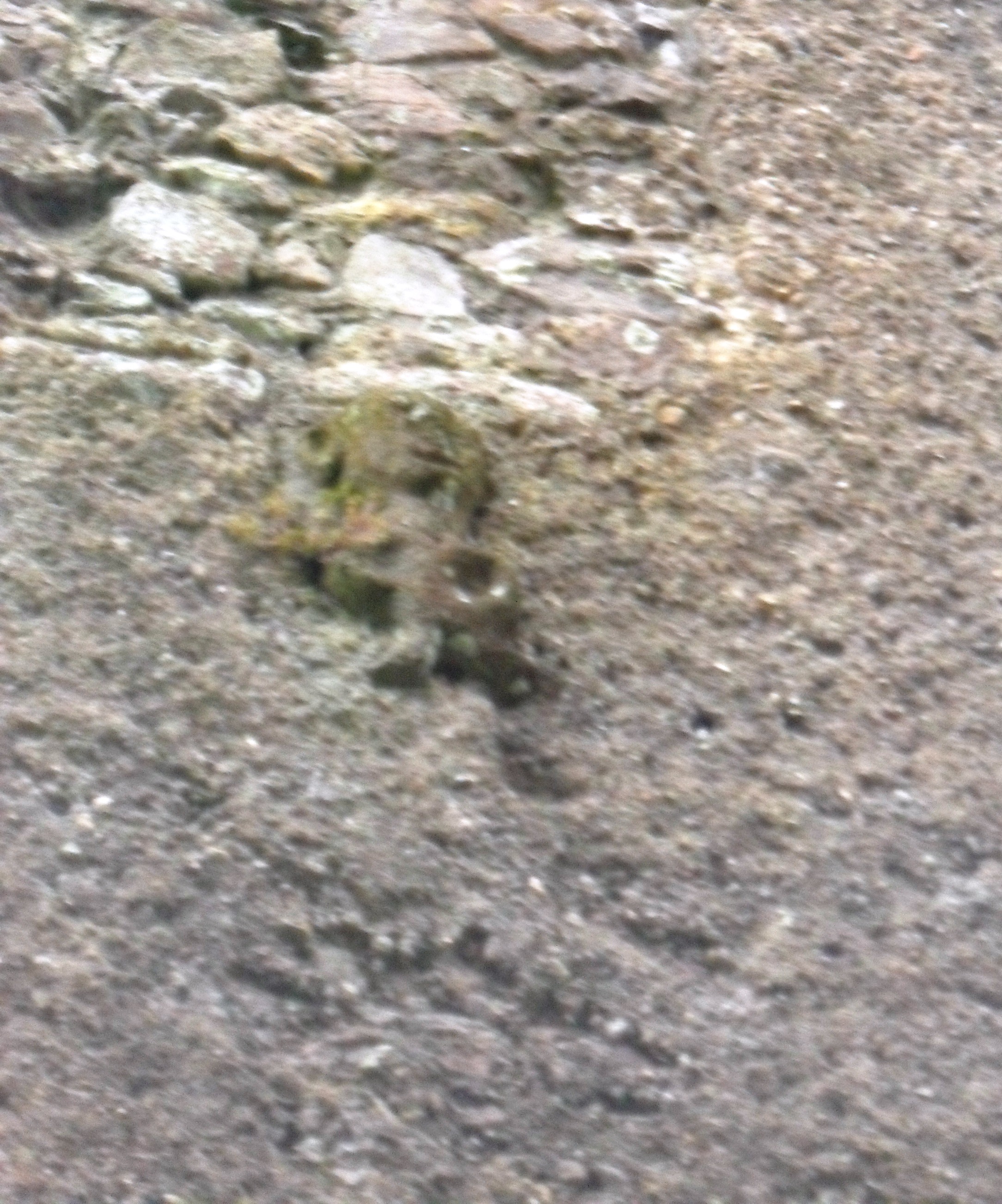
Sheela-na-gig on the church tower.

John Tierney of Historic Graves, kindly brought me on a guided tour and explained how  the recording is   done. I also got to meet the volunteers who were all having a great time  and doing an excellent  job recording the inscriptions.

Volunteers taking a brake for the recording

The project  also involves the  local primary schools.
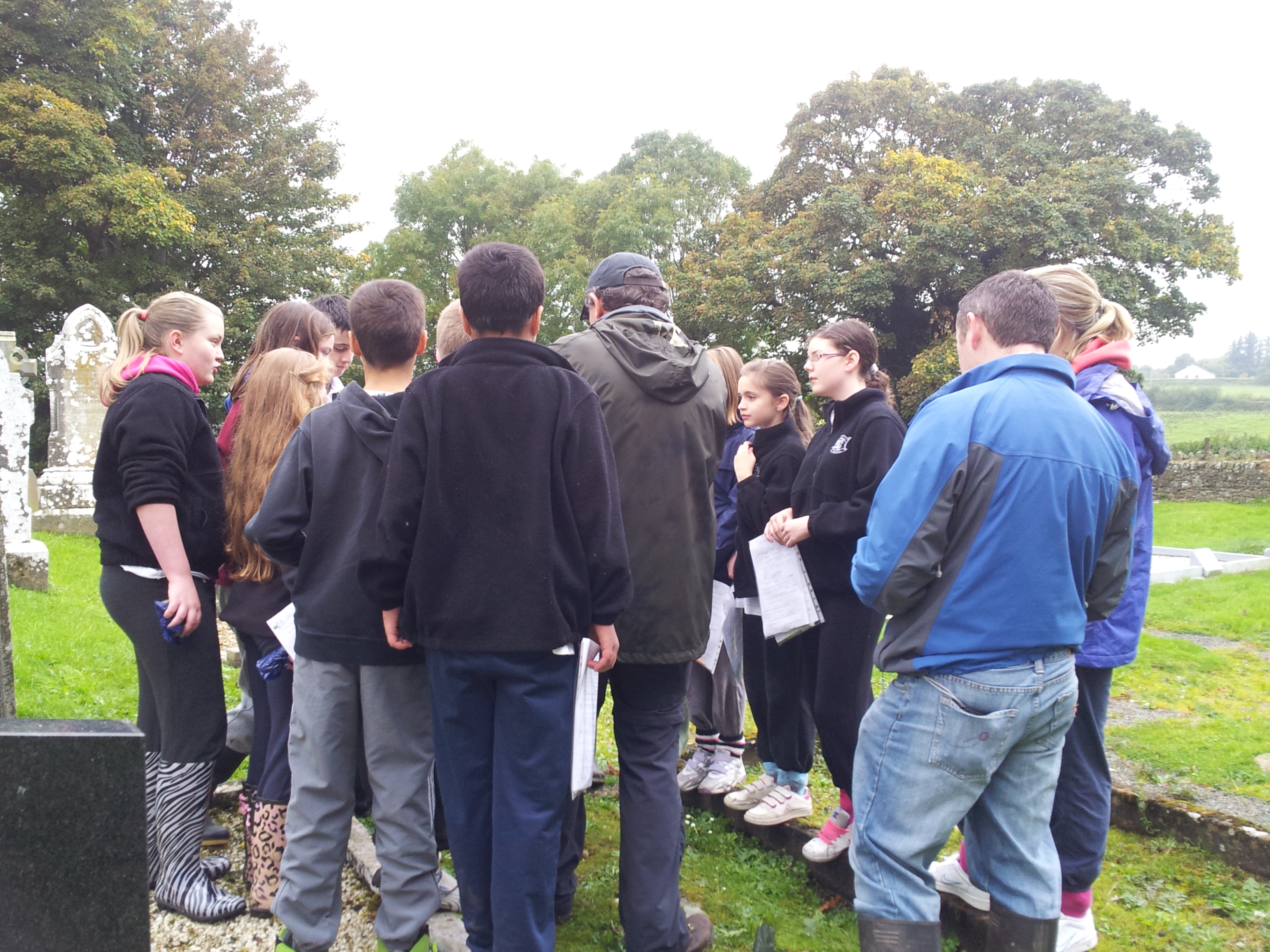
John explaining the recording to the local school kids

The gravestones are numbered, then photographed using a special camera which provides each photo which a geo tag.  This information can be used to produce a plan of the  graveyard.  Next the inscriptions on the stones are recorded.

Patsy McGrath, Michael Moroney, Michael Fennessey recording an 19th century headstone

Once the stones  have been photographed and  the inscriptions recorded ,  a rubbing is taken of  each gravestone .

Rubbing of 19th century gravestone

The local  kids  from Clogheen  primary school came along  for a visit and  to help out  with the recording.
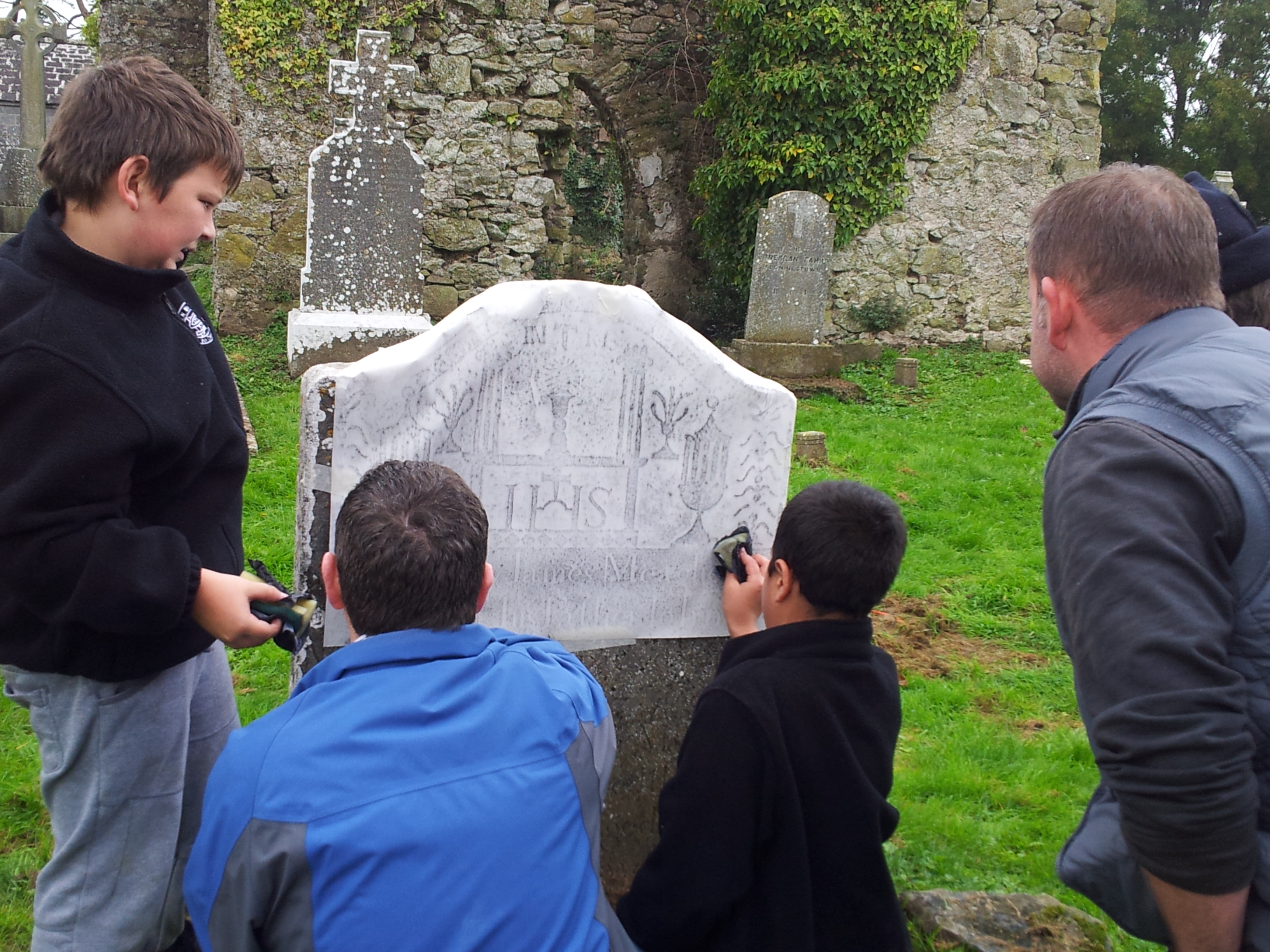
School kids taking a rubbing of gravestone

Projects like  this are really important. They help  local communities become aware  of the importance of  Irish graveyards. Each stone has its own story and can tell alot about the social  history of the time . The location of graves and style of headstone  can  tell us about class and religious differences .  They provide a record of people who lived in the area , as well as  a record  of  folk art for the 18th – early 19th century. They also provide imformation about the people who made the stones.  Additionally projects like this make people aware of good practice in maintaining and looking after graveyards. This in turn  means they are less likely to engage in bad practice like sandblasting  or cleaning stones with wire brushes which ultimately  damages the stones.


Close up of the angel Gabriel blowing a trumpet


Just  when I thought I was having a pilgrim free day  John brought me to see the grave of Fr. Nicholas Sheehy 1734—1766.  An  opponent to the penal laws, the preist was   hung , drawn and quartered  after he was falsely accused  of  murder.  The candles on the grave and the flowers immediately pointed to people coming to the grave.

The grave of Fr Sheedy


John then pointed out a small hatch or door in the side of his tomb and noted he had seen a similar hatch at priests grave in Cavan also dating to the penal times.

This opening allowed people to remove soil  from the grave within, the soil which was  seen to be holy and have healing powers,  was  take away  to be used for cures.

The soil within the tomb

Fr.  Sheehy’s tomb  immediately reminded me of medieval pilgrims who were known to take   dirt/earth from the saint’s grave, or  cloths touch against the saint’s shrines or oil from the lamps that burned at the shrine, home with them. The tradition of healing soil is recorded  in early Greek medicine, where certain soils were seen to have curative powers.   In the medieval world the healing  power of the earth came from the belief that the soil was a type of  relic. Pilgrims believed the earth or dirt from the saints graves had been scantified because of its proximity to the saints body . There are many  accounts of 19th century  and even modern pilgrims  taking  the holy earth from the grave of the saints home with them, to use for cures and protection.  At Ardmore  the soil from St Declans grave was sold to pilgrims in the 19th century, while at  Clonmacnoise the practice of taking earth from the grave of St Ciarán caused the walls of Temple Ciarán to become unstable and lean in. I think this could be a topic for another blog post.
 

References
McMahon, J. & Roberts, J. The Sheela-na-Gigs of Ireland and Britain: The Divine Hag of the Christian Celts – An Illustrated Guide Mercier Press Ltd. (2000).
Kelly, Éamonn Sheela Na Gigs. Origins And Function Country House (1996).
Freitag, Barbara Sheela-na-gigs: Unravelling an Enigna   (2004)

Medieval Pilgrimage at Hollywood Co. Wicklow

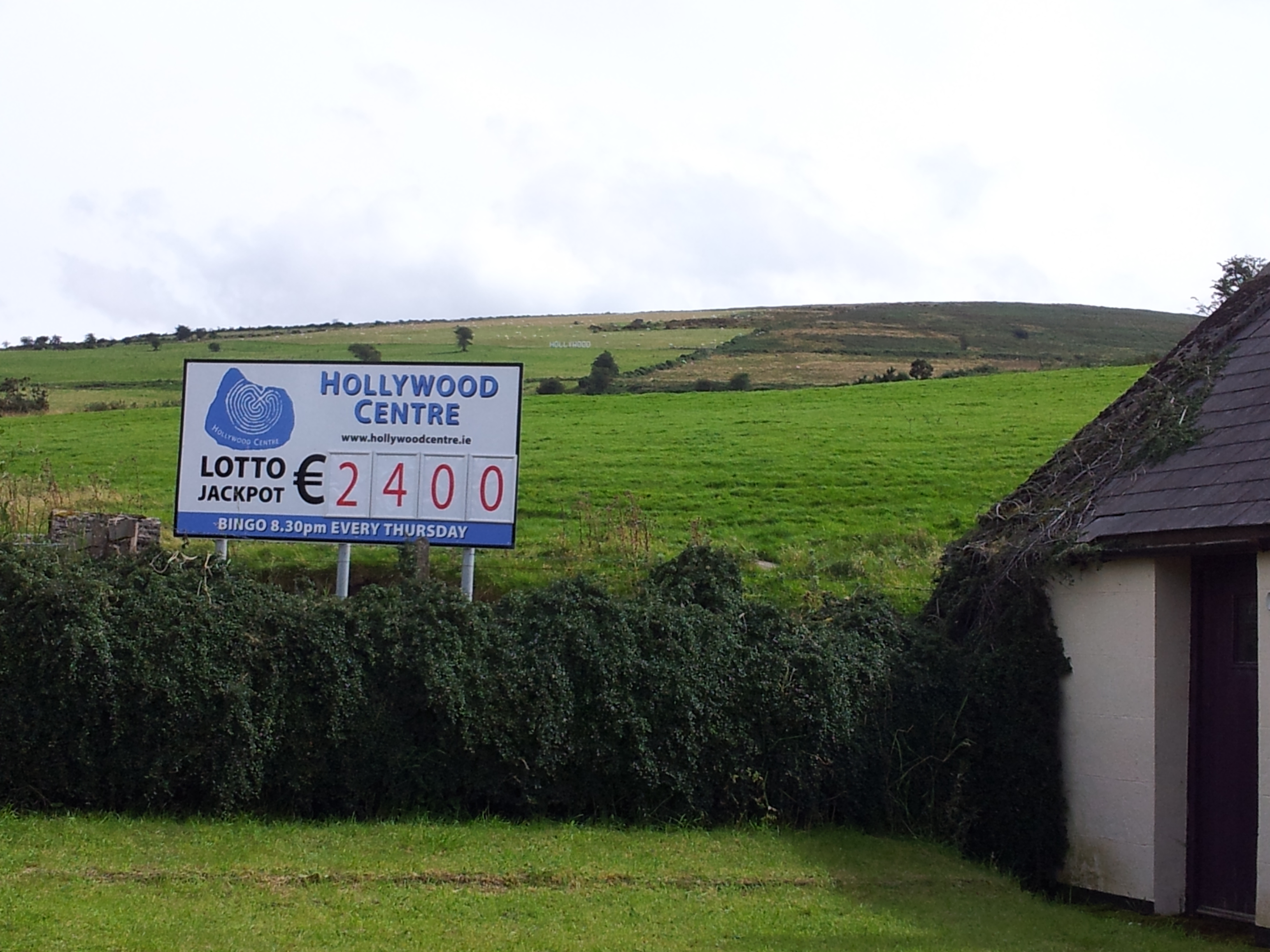
Hollywood,  Co Wicklow could not be further from its glitzy namesake in Los Angeles. This  quiet rural village is  a really interesting place and has its own unique charm. There is much about the history of pilgrimage at  Hollywood that we do not know, but I firmly believe that this little village played a very important role in the early and later medieval  pilgrimage  landscape of the King’s River Valley and was a stop  for pilgrims en-route to the shrine of St Kevin at Glendalough.

Hollywood Co. Wicklow.

Located at one of the main entry points into the King’s River Valley, the village is traditionally held to be the starting point of St Kevin’s road, a well known medieval pilgrim route .  The route of St Kevin’s road cuts through the Wicklow Mountains via the King’s River and the Glendassan Valleys. The road  linked Hollywood to the ecclesiastical site of Glendalough. Over the centuries countless pilgrims would have passed through Hollywood when travelling to Glendalough.

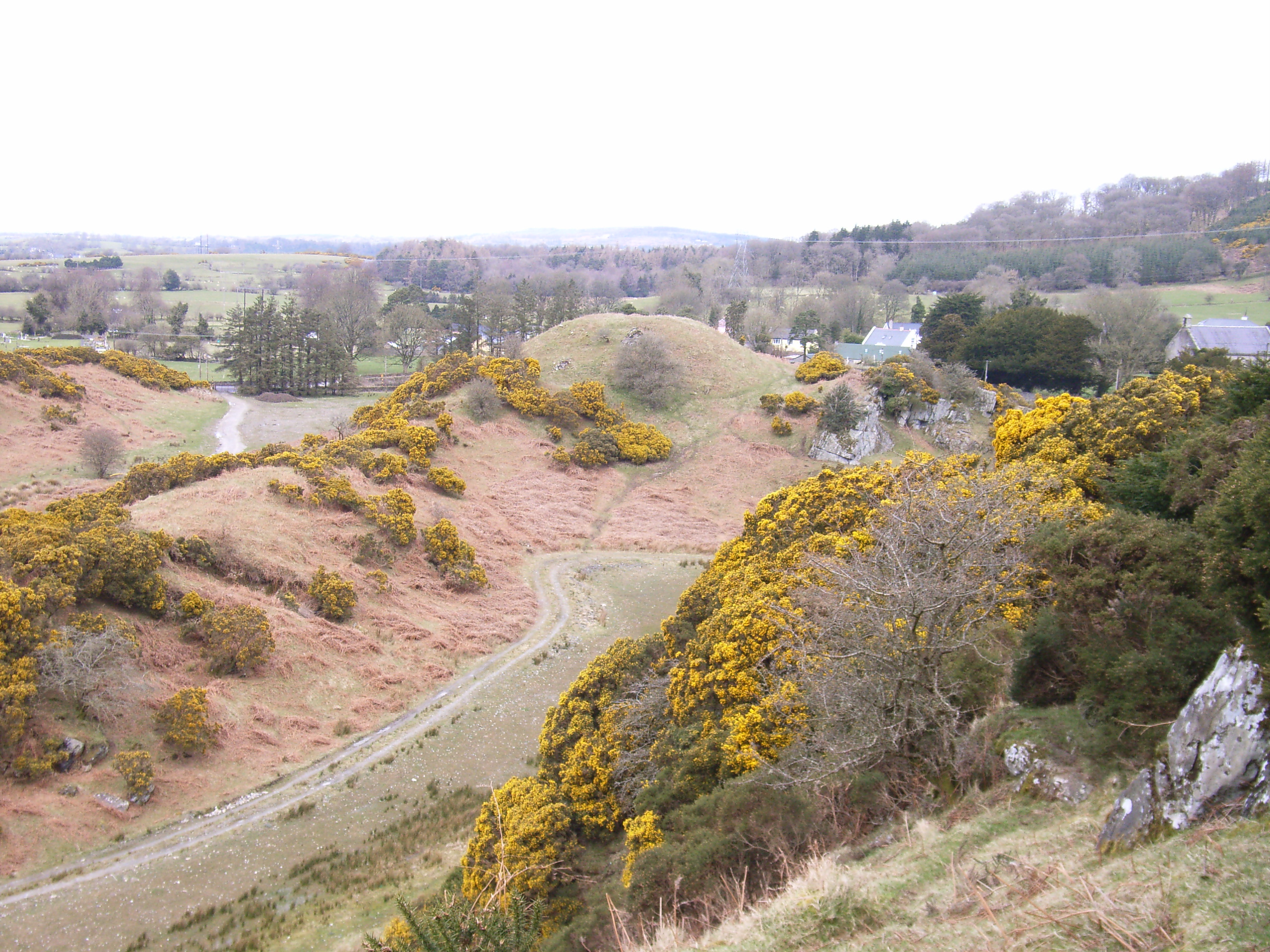
Unfortunately  there are few historical sources relating to Hollywood. The first mention of the area is in a charter granting land and the right to build a castle here, to the de Marisco family in 1192 (Price 1983, 207-08). All that remains of the castle is a large Medieval Motte located at the edge of the modern village.

View of Motte from St Kevin's Bed

View of Motte from St Kevin’s Bed

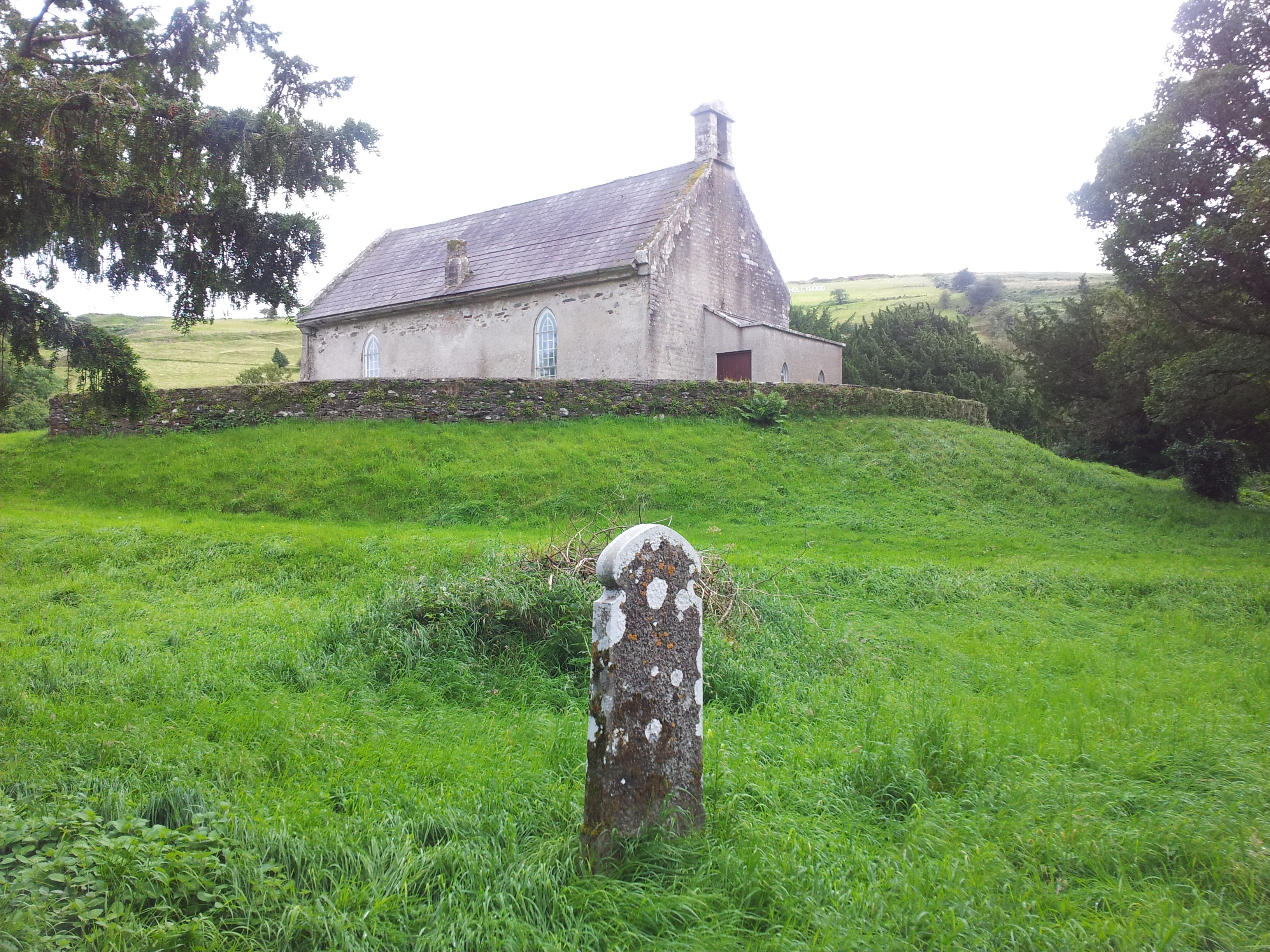
The charter and subsequent documents refer to Hollywood as Bosco Sancto or ‘holy wood’  interestingly a later sixteenth century source refers to the area as Cillín Chaoimhín or the little church of St Kevin. This late reference confirms links with St Kevin the founder of Glendalough and alludes to the existence of a church and cult associated with the saint. I believe that this association has a much earlier history. Folklore suggests that St Kevin spent time here in retreat before he headed across the Wicklow mountains and founded the ecclesiastical site of Glendalough. It is possible that a small church or hermitage may have existed at Hollywood  in the early medieval period. The earliest mention to a church at Hollywood is found in a thirteenth century charter but  no physical traces of the medieval church survive. Its location is likely to be the site of the seventeenth century Church of Ireland.

The seventeenth century church built on the site of the earlier medieval church at Hollywood.

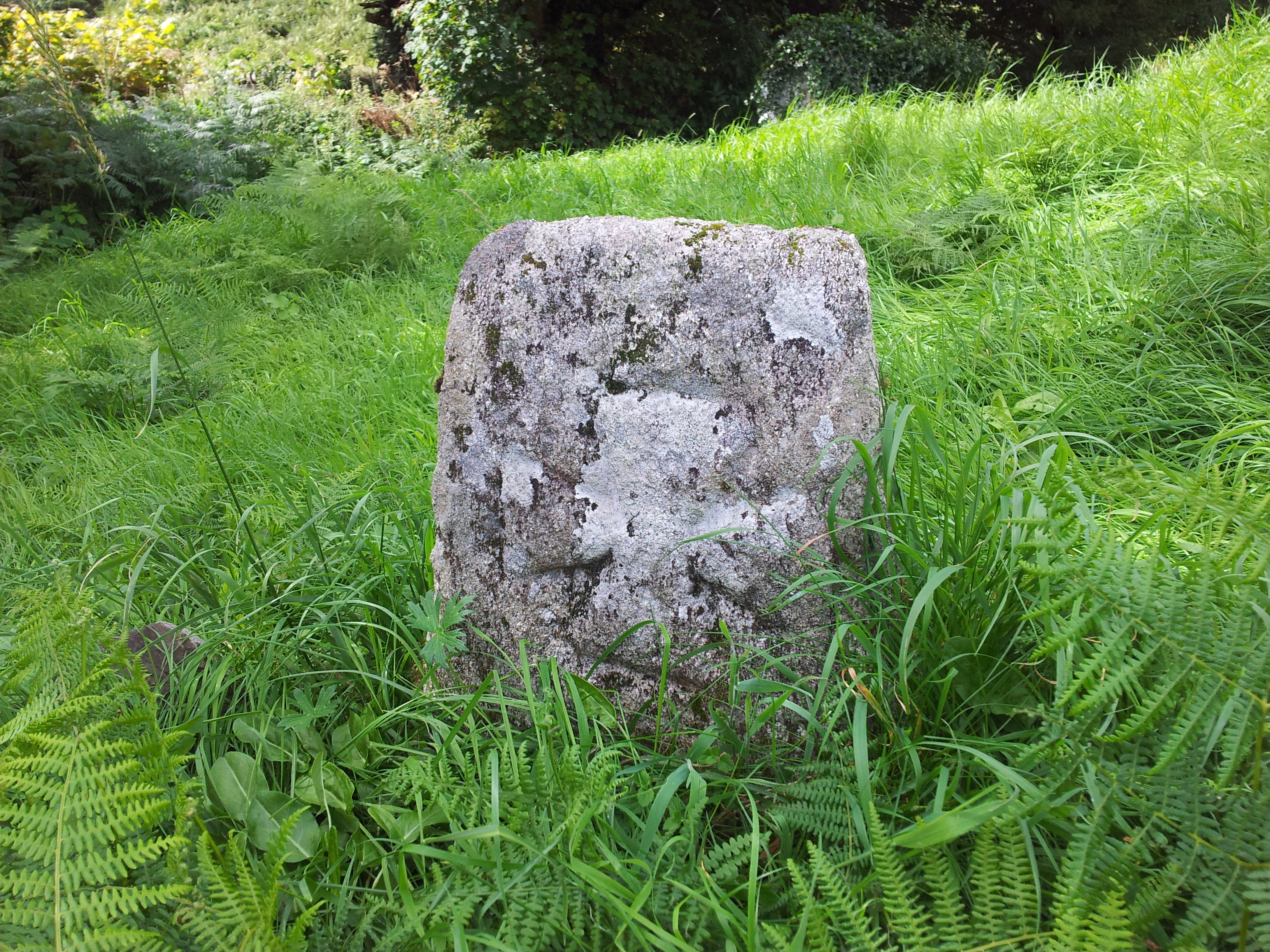
Five  medieval cross slabs dating to the thirteenth-early fourteenth century are to be found in its surrounding graveyard and they represent the only visible evidence of  medieval ecclesiastical activity  (Price 1983, 208; 216; Corlett 2003, 99-100; 105).

Medieval Cross Slab at Hollywood

Medieval Cross Slab at Hollywood.

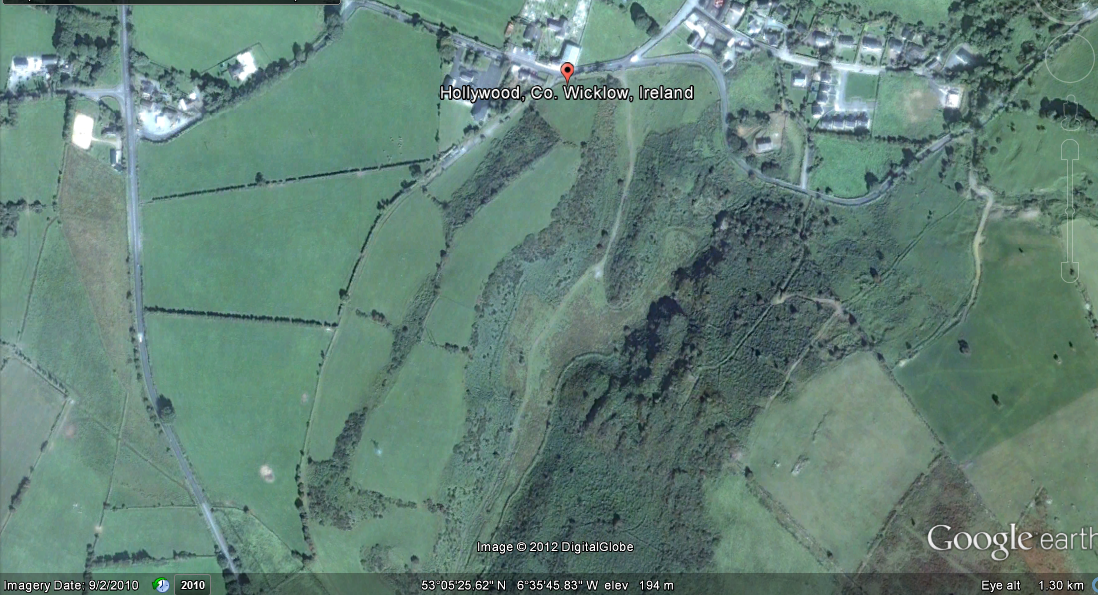
All traces of past pilgrimage are located a short distance from this church in an E-W running valley at the edge of the village.

The Village of Hollywood after google maps

The valley containing the pilgrim stations, is located below the village of Hollywood.

The  aforementioned Norman Motte (site of the de Marisco castle) is found at the entrance to the valley. The Motte overlook a mini pilgrim landscape of two natural caves and a boulder all linked to St Kevin. Although the earliest records of pilgrimage date to the nineteenth century the strong folklore tradition linking the area to St Kevin and its location on the route of St Kevin’s road  suggests that this place would have held significance for passing pilgrims during the early and later medieval period.

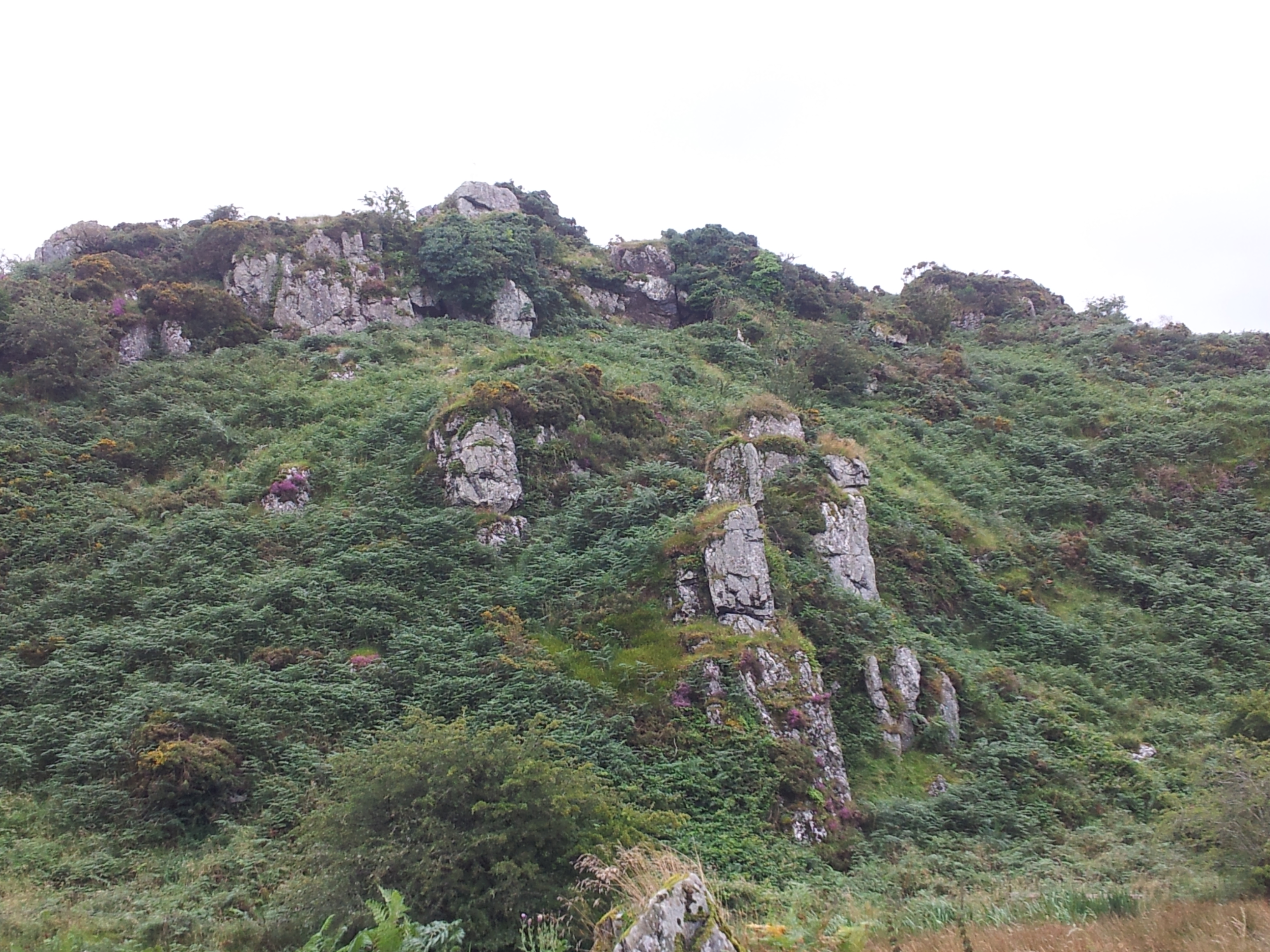
View of St Kevin's Cave and St Kevin's Bed from valley floor

View of St Kevin’s Cave and St Kevin’s Bed from valley floor

The two natural caves known as St Kevin’s Cave and St Kevin’s Bed  are sited on a steep east-facing cliff face. I have  visited the caves on a number of occasions, winter is definitely the easiest time to approach them as vegetation is low. The climb is steep and challenging.

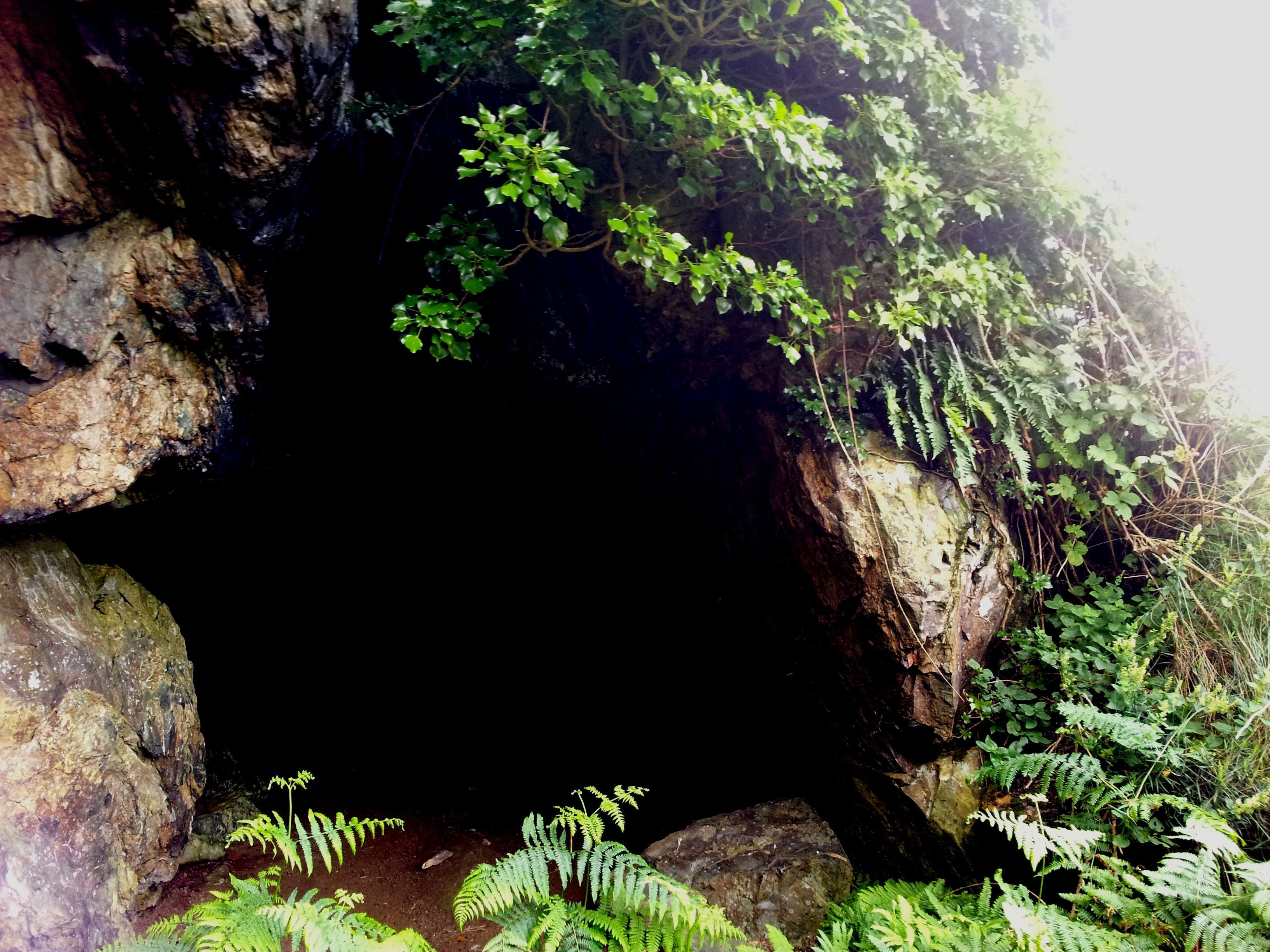
  St Kevin’s Cave  is the larger of the two caves.

St Kevin's Cave

St Kevin’s Cave

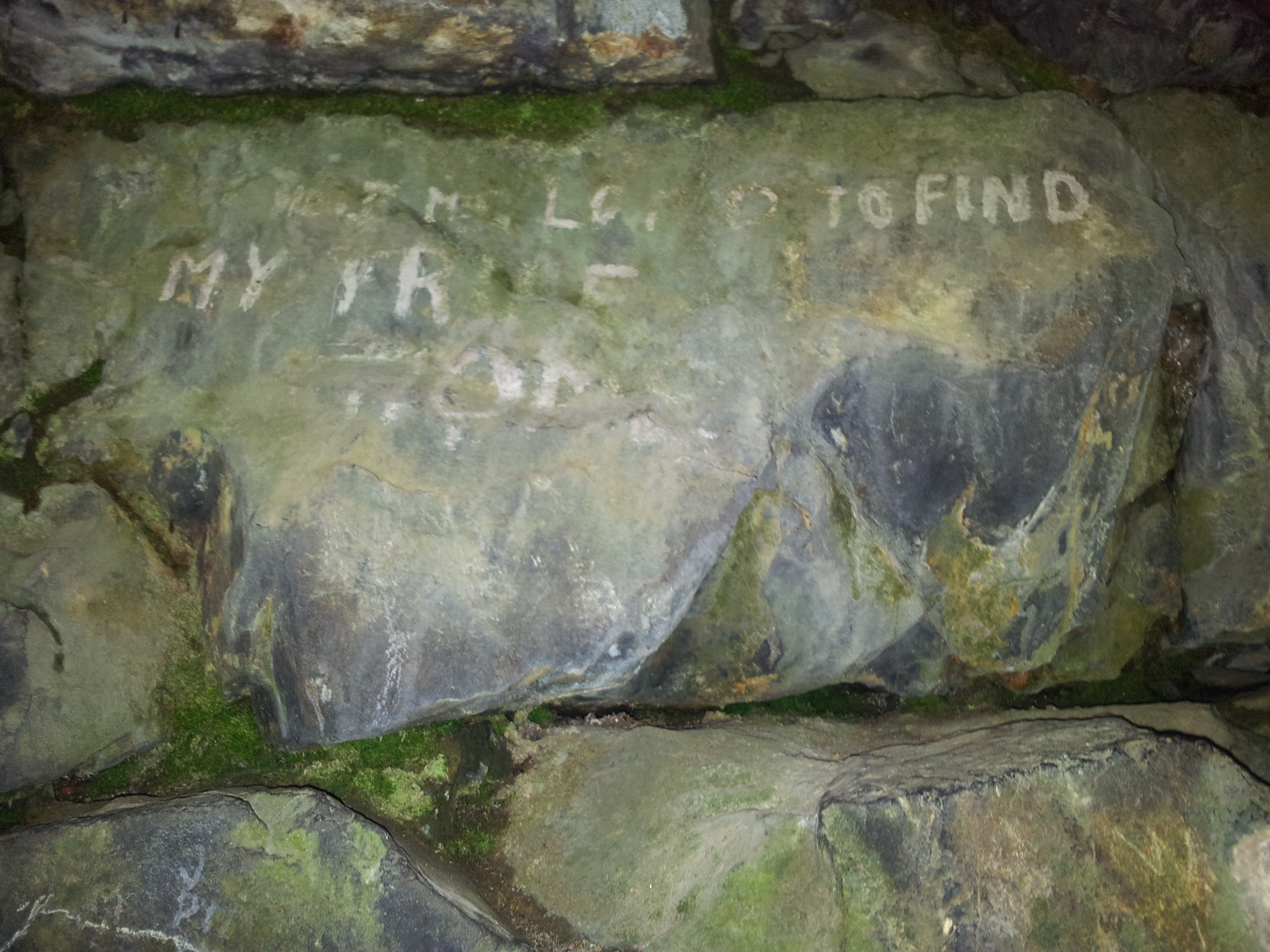
I found some  graffiti at the back of the cave in 2006 ‘Help me Lord to find my home’ a simple Latin cross was painted over this inscription,  when I visited  again this summer the inscription had  faded and the cross had disappeared.

Graffiti at back of St Kevin's Cave

Graffiti at back of St Kevin’s Cave (2012)

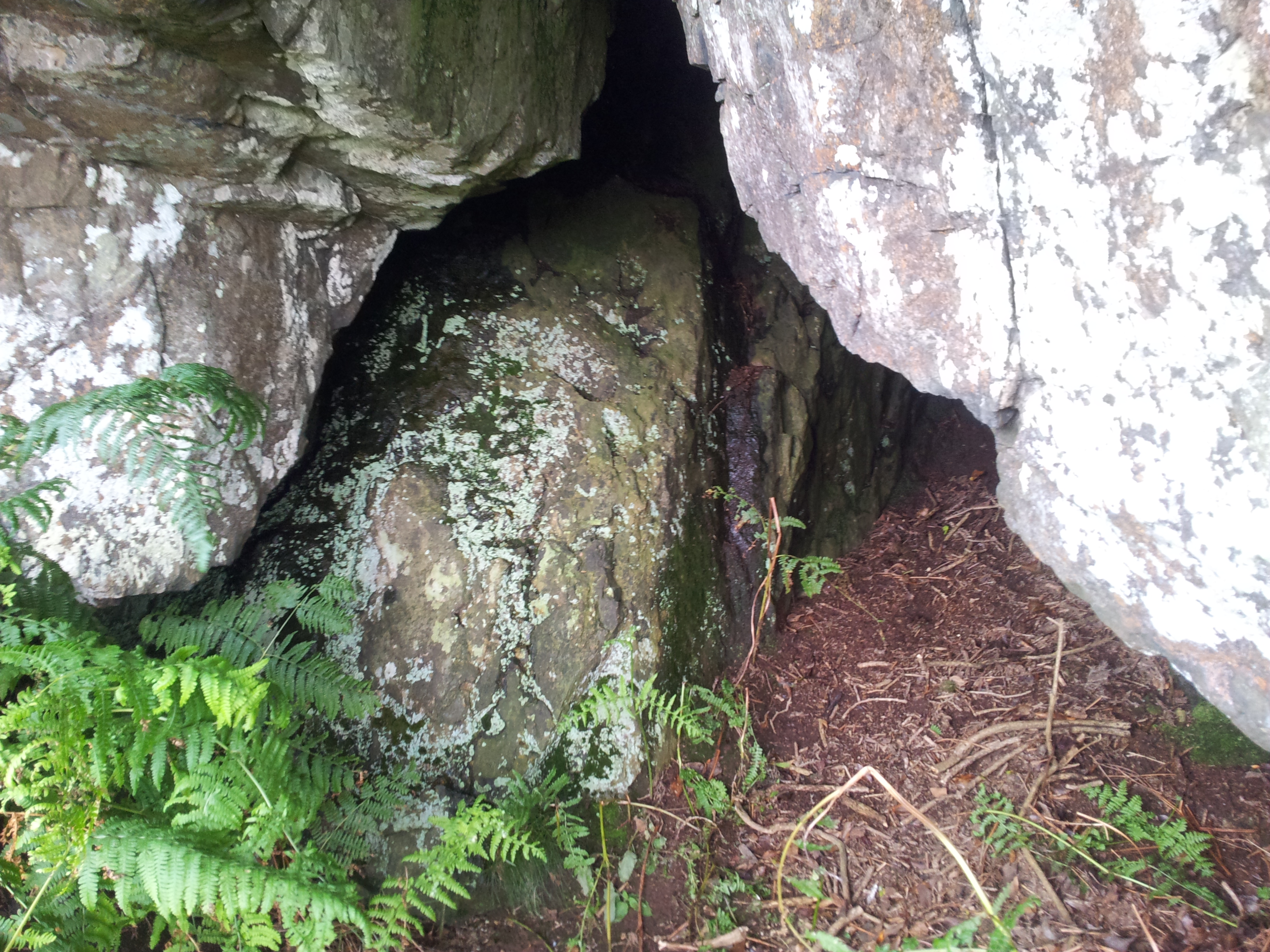
Close by is St Kevin’s Bed,  a narrow  vertical shaft   that leads  through the rock above .  St Kevin spent time in both caves and supposedly  used to sleep here.

The entrance to St Kevin’s Bed

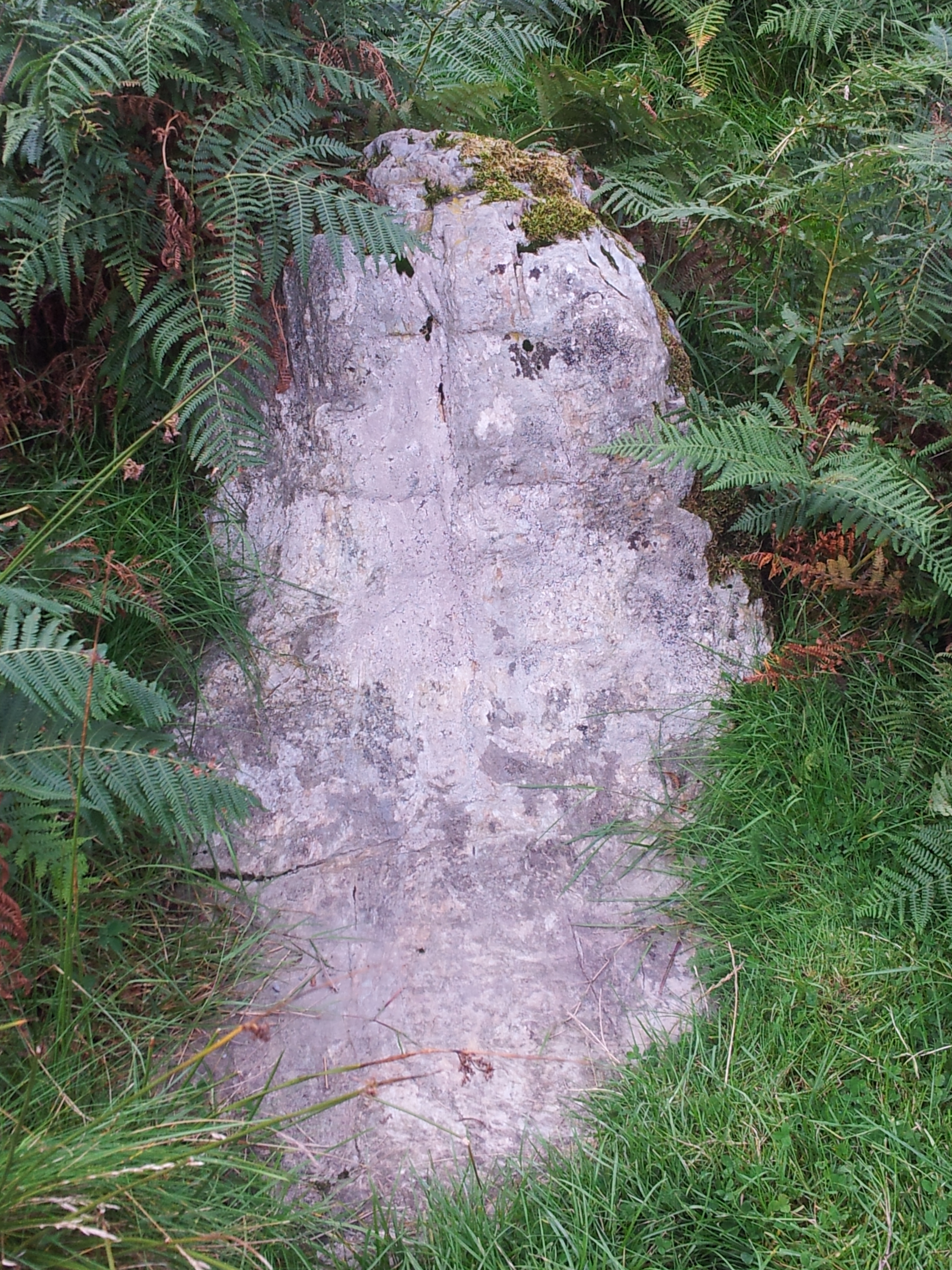
St Kevin’s chair is located on the floor the valley, directly opposite the caves . The boulder is hard to see despite its size, I always seem to walk past it.  According to  the Ordnance Survey Name Books (1840’s) St Kevin, in a fit of rage, threw the rock/chair from St Kevin’s Cave at a woman who annoyed him. Irish saints were not known for their patience.   Sitting on the “chair”  was supposed to  cure   backache.

The stone known as St Kevin’s Chair.

It should be noted that  the pilgrim rituals  at Glendalough included  visiting a cave known as St Kevin’s Bed and a piece of natural rock called St Kevin’s chair . I am hoping to dig a little deeper into the history and folklore of the area in the coming months and I would be delighted to hear from anyone who has any other information on the area and past pilgrimages here.

Bibliography

Corlett, C. 2003. ‘The Hollywood Slabs- some late medieval grave slabs from West Wicklow and neighbouring Counties’, JRSAI vol. 133, 86-110.

Nugent, L. 2009. Pilgrimage in Medieval Ireland, AD 600-1600. Unpublished PhD Thesis.

Price, L. 1940. ‘Glendalough: St. Kevin’s Road’, In Ryan, J. (ed.) FéilSgríbhinn

  Éoin Mhic Néil. Dublin: Four Courts Press, 244-71.

Price, L.  1983(reprint 1953). The Place-names of Co. Wicklow. Vol. IV-The Barony

  of Talbotstown Lower. Dublin: Dublin Institute For Advanced Studies.

Scattery Island. A place of prayer, battle and beauty!

I am delighted to introduce   my first guest post written by Maggie McNamara .  Maggie is an archaeologist based in Co Clare who has a great interest  in archaeology and history of  Scattery Island also known as Inis Cathaigh.

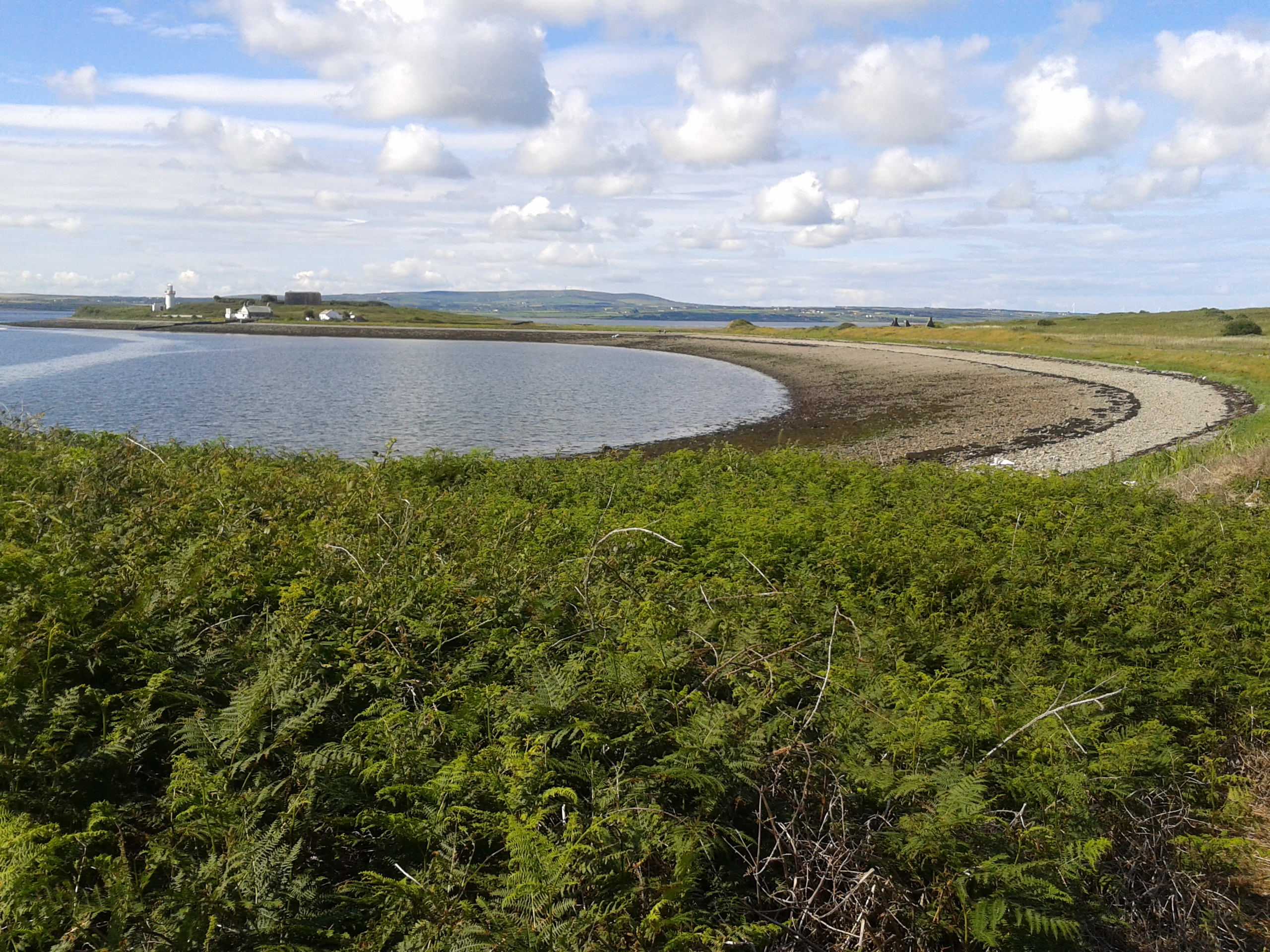
Scattery Island (Inis Cathaigh), a beautiful historic island located in the mouth of the Shannon estuary, off the coast of Kilrush Co. Clare, is home to a monastery founded by St. Senan in the early 6th century.

View of Scattery Island

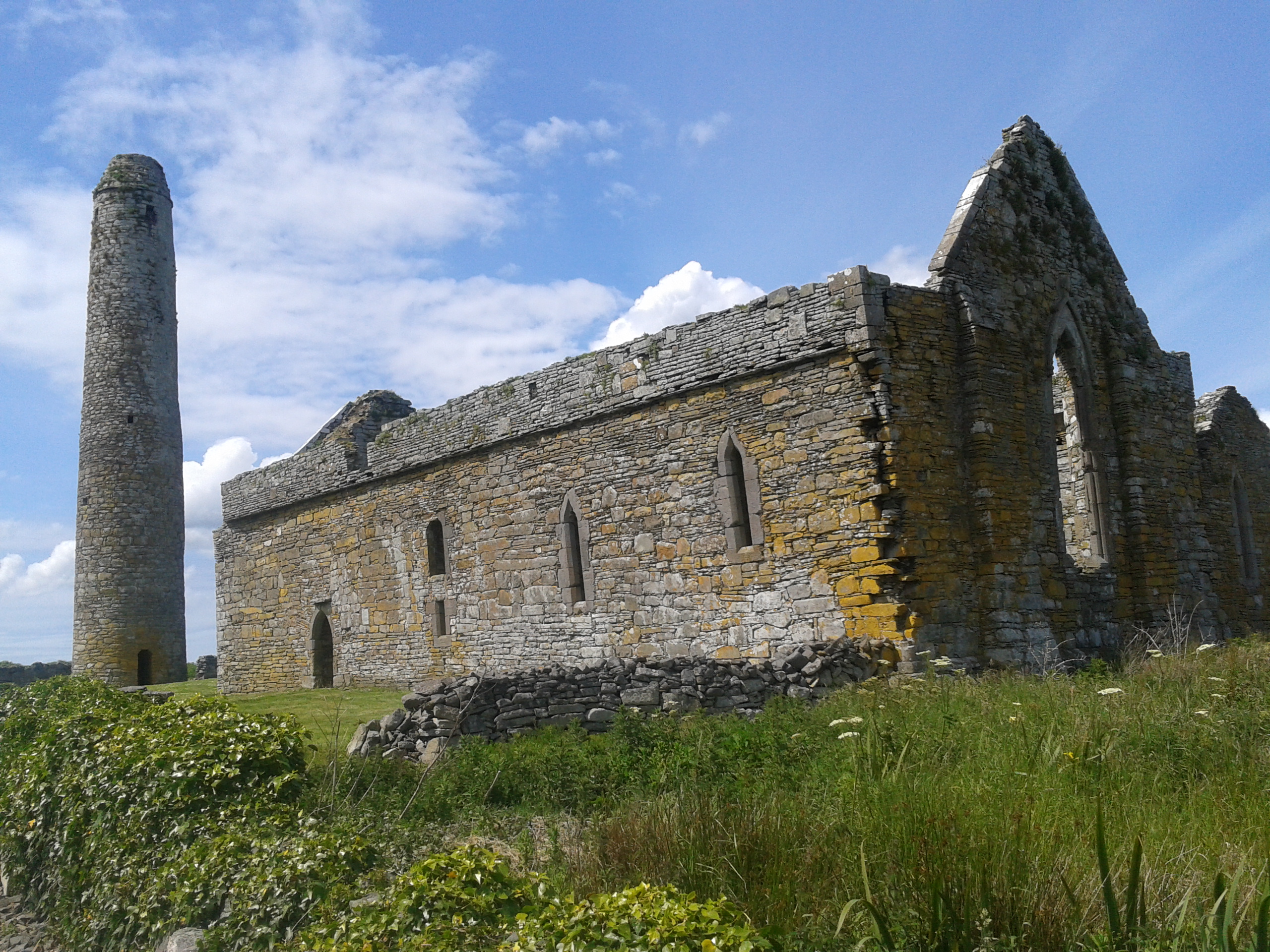
Legend tells us that Senan was placed on the island by an angel where he had to defeat a terrifying monster called Cathach hence the name Inis Cathaigh. The island contains evidence of intensive religious activity represented by the ruins of 6 churches, a round tower and holy well. It is said that there were 7 churches here at one stage if not more. An important religious settlement and place of learning in medieval times, administering to a diocese in the 12th century, associated with monastic possessions such as the Golden Bell (7th-8th century) and Bell Shrine (12th century) and a strong cult of Senan which survives to the present day. The saint is also said to have founded monastic cells in Brittany, Wales and Cornwall as well as at other Irish sites in Enniscorthy and Cork and on Mutton and Canon Islands in Co. Clare. Connections with other monastic foundations are known, most notably Clonmacnoise. The church ruins date to between the 7th and 15th centuries and display much fine stonework and a number of carved faces including representations of a bishop and kings. The round tower dates to the 10th century and is unusual in that it is one of only two in the country with its door at ground level.

Round Tower and St Senan’s church at Scattery Island

There is also a 10th century cross slab containing the inscription ‘A prayer for moinach, tutor of mogroin’ and an undated ogham stone.

St. Senan is said to have died  here in 544 on March 8th. In post medieval times pilgrimage took place here on Easter Monday and the 8th March, the saint’s feast day. Although there are no direct references to pilgrimage in medieval times, the modern pilgrimage is very likely to be a continuation of a medieval tradition.

The pilgrimage involved rounds of the island, starting on the shore and moving to the various churches and other points on the island, finishing at the holy well (located close to the round tower). The well is said to cure eye ailments and was an important focus for the islanders. The saint’s grave was also supposed to be the site of miraculous cures. The Life of St Senan states that the

Stones from St. Senan’s Bed were regarded as relics and a protection against diseases and especially drowning.

The Parliamentary Gazeteer of Ireland for 1845 noted

“A holy well in the island,” says Mr. Hely Dutton, “is resorted to by great numbers of devotees, who, as they term it, take their rounds about it annually on their bare knees; and it is a frequent practice for those who cannot conveniently perform this penance, to pay at this and other holy wells a trifling gratuity to some persons to perform this ceremony for them; I have known a woman to make a trade of this mummery. The common people have a great veneration for this island and its ruins; they carry pebbles taken from it as preservatives against shipwreck, and the boatmen will not navigate a boat that has not taken a round about Scattery in a course opposite the sun.”

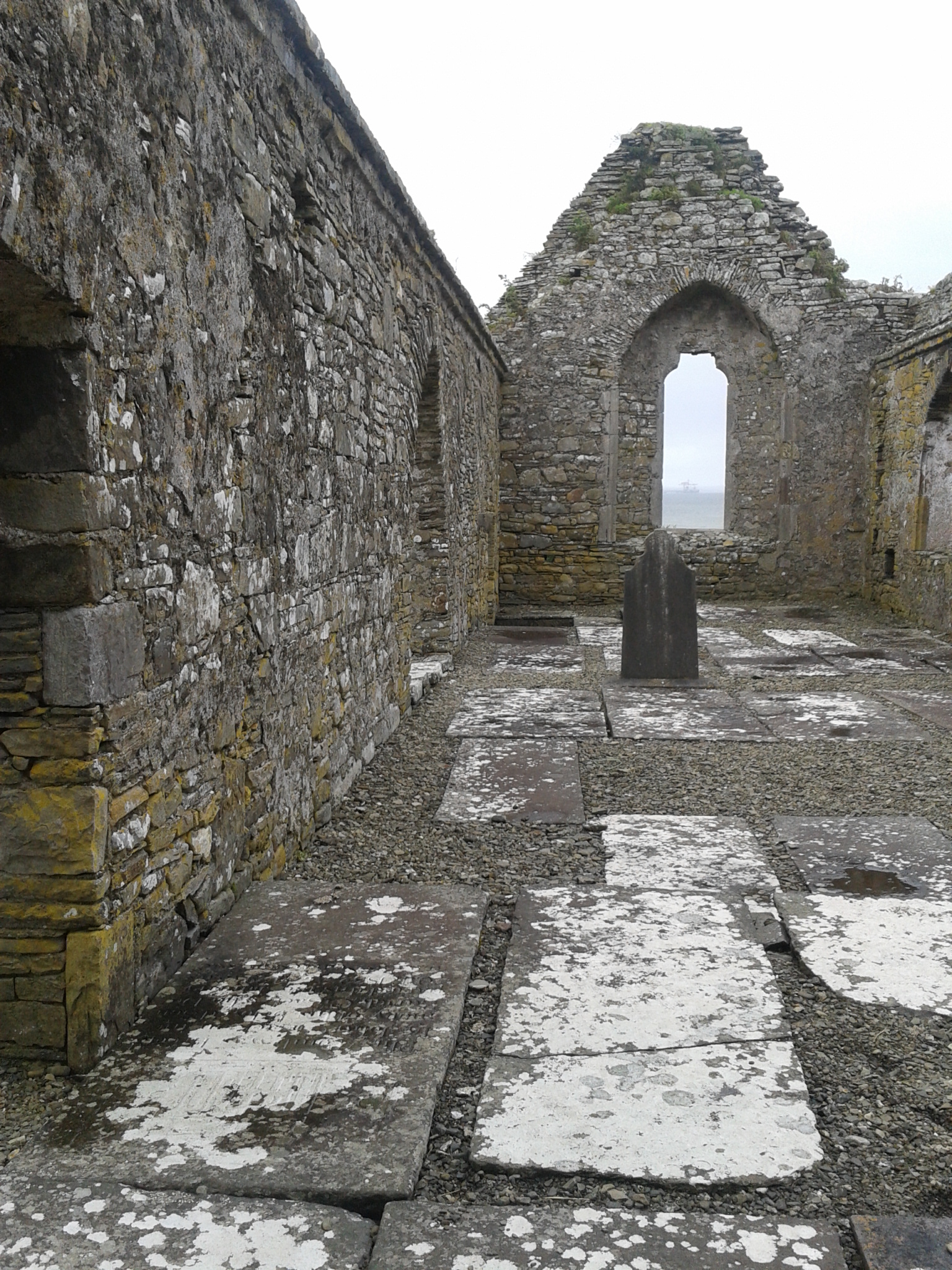
Interior of St Senan’s church

The island has seen much turmoil over the centuries having been raided numerous times by the Vikings, Irish and Anglo Normans. The Vikings had a stronghold here in the mid 10th century. Other features on the island include a late 16th century tower house, 19th century battery and lighthouse and a 19th-20th century village, home to river pilots and fisher-farmers up to the late 1970’s. A place of prayer, battle and beauty!

References

Anon. 1845 The Parliamentary Gazeteer of Ireland, 1845. [online] http://www.clarelibrary.ie/eolas/coclare/places/scattery_1845.htm [accessed 3/04/2012]

Local studies Project (no date) Scattery Island [on line] http://www.clarelibrary.ie/eolas/coclare/people/life_of_senan.htm

[accessed 4/08/2012].

Hedderman, Fr. S. Life of St Senan, Bishop, Patron Saint of West Clare [on line] http://www.clarelibrary.ie/eolas/coclare/people/chapter8.htm [accessed 4/08/2012].

Westropp, T. J. 1905. ‘Iniscatha (1188-1420)’ in Journal of the Royal Society of Antiquaries of Ireland, vol xxxv .

Westropp, T. J. 1897. ‘Descriptive sketch of places visited: Scattery Island and Canons’ Island, Co. Clare in Journal of the Royal Society of Antiquaries of Ireland, vol. xxvii .

Westropp, T. J. 1915, ‘Ancient remains on the west coast of Co. Clare: St Senan’s bell shrine’ in Journal of the North Munster Archaeological Society, vol.iii, no. 4 .

An overview of the history of pilgrimage to Croagh Patrick

Today is Reek Sunday the main pilgrimage day to Craogh Patrick. Croagh Patrick is located on the western coast of Mayo on the southern shores of Clew Bay. Its pyramid-shaped summit is known locally as the “The Reek”, and the  mountain has a long  association with St Patrick. Pilgrimage can be undertaken at any time during the year but the main pilgrim days are the last  Friday of July, last Sunday of July or Reek Sunday and the 15thof August. In the coming months I hope to expand on this post and explore the prehistoric,  medieval, early modern and modern pilgrimages in much more detail. What follows is really just an overview of the history of the pilgimage here.

Croagh Patrick

View of Croagh Patrick, taken by Helen Duffy

The mountain has been a focus of pilgrimage from medieval if not pre-historic times  and has an unbroken tradition for pilgrimage through the medieval period  to the present. Little is known about the early medieval history of Croagh Patrick. By the seventh century the mountain was associated with St Patrick. The earliest written record of this association is the Brevarium by  Tírechan which recalls that, during his mission in the west of Ireland, St Patrick  (Mons Aigli)  fasted there for forty days and nights on the summit of Croagh Patrick ( Bieler 2000, 153). Excavations carried out on the summit in 1994 revealed the presence of  a small oratory on the summit dating to between between AD 430 and 890 built in the style of Gallarus oratory Dingle, Co. Kerry (Hughes 2005).

The earliest and most interesting reference to  pilgrimage at the mountain comes from the annals for the year AD 1113 (AU). We are told

A ball of fire came on the night of the feast of Patrick 17 March on Cru chain Aighle, and destroyed thirty of those fasting (AU).

The pilgrims were fasting and performing a night vigil  when this  horrific event occured .  Jocelyn’s twelfth century Life of St Patrick also records pilgrims fasting and performing a vigil ‘That many are accustomed to spend the night awake and fasting on the mount’ (Hughes 1991, 16). In 1432 Pope Eugene IV issued an indulgence of two years and two quarantines  ‘of enjoined penance to penitents who visit and give alms for the repair of the below mentioned chapel’ on the summit of Croagh Patrick on the last Sunday of July (CPL). Croagh Patrick continued to attract pilgrims in the aftermath of the reformation and there are  detailed  ninteenth century accounts of the pilgrim rituals at the mountain. These rituals consisted of performing prayers known as stations, ritual prayers around devotional points in the landscape of the pilgrim site. The stations performed by modern pilgrims are very similar and the core traditions have not changed drastically, with the exception of the relaxing of some of the more penitential aspects of the prayer such as performing the entire pilgrimage barefoot or the stations on bare knees. Following the famine pilgrimage seems to have gone into decline but due to the efforts of the clergy it was revived, and a new church was built on the summit in 1905 (Hughes 2005, 15-22). The  popularity of the pilgrimage has continued to grow and today  pilgrim numbers on the main pilgrim day can reach  tens of thousands.

Modern Pilgrims climbing Croagh Patrick, image from The Guardian 2009
(http://www.guardian.co.uk/world/2009/jul/31/croagh-patrick-pilgrimage)

Bibliography

Bieler, L. 2000. (reprint 1979). The Patrician Texts In The Book Of Armagh.  Dublin: The Dublin Institute for Advanced Studies.

 CLP -Calendar of the Entries in the Papal Registers Relating to Great Britain and Ireland. Papal Letters. Vols. I to XIV, London, HMSO, 1893-1960; Vols. XV-XX, Dublin, Irish Manuscripts Commission, 1978-2005 and in progress.

Hughes, H. 1991. Croagh Patrick: (Cruach Phádraig-The Reek) An Ancient Mountain Pilgrimage. Westport: Berry’s of Westport.

Hughes, H. 2005. Croagh Patrick. Ireland’s Holy Mountain. Westport: The Croagh Patrick Archaeological Committee.

Mac Airt, S. & MacNiocaill, G. (eds.) 1983. The Annals of Ulster (to AD 1131). Dublin.

St James, Irish Pilgrims & Pirates

Today is the feast of St James  the apostle.  The saint’s shrine  at Santiago de Compostela in Spain attracted large numbers of pilgrims from all over the Christian world  during the medieval period. Medieval souvenirs purchased by pilgrims to Santiago have been recovered  across Europe including  Ireland.  St James enjoyed  great devotion  in medieval Ireland and  his image turns up on a number of Irish medieval  tombs.

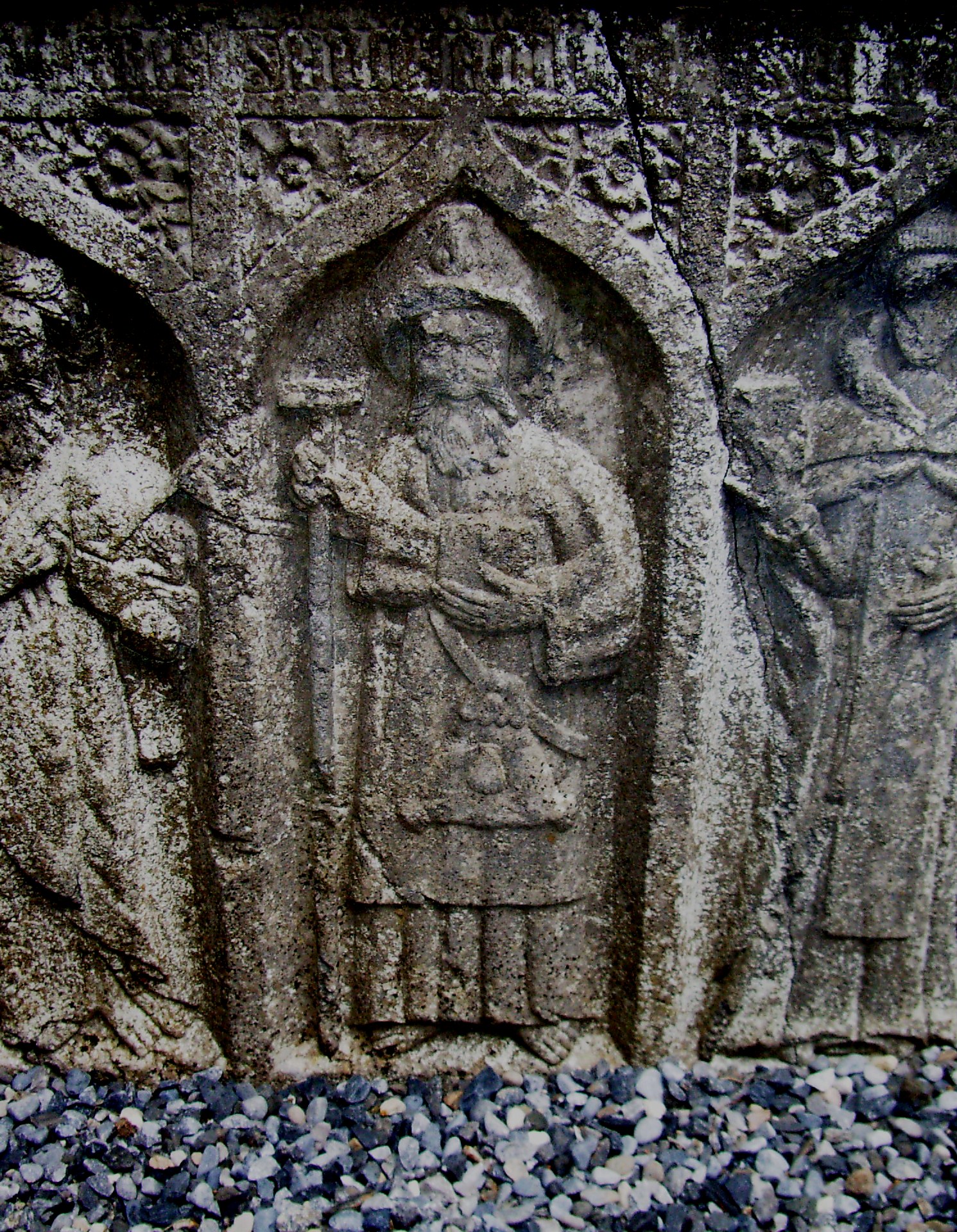
St James

Image of St James on a medieval tomb at the Franciscan Friary at Kilconnell, Co Galway

Given the long distance of the journey from Ireland to Santiago and the requirement to travel part of the journey by boat, a pilgrimage to Santiago from Ireland  was very expensive. Historical sources suggest that the majority of Irish pilgrims travelling to Santiago were  from the upper echelons of  Irish society. Pilgrims would have embarked from a variety of Irish ports such as Drogheda, Dublin, Wexford, New Ross, Waterford, Youghal, Cork, Kinsale, Dingle, Limerick and Galway (Stalley 1988, 398).

Roger Stalley gives an excellent discussion of the literary and archaeological evidence for Irish Pilgrimage to Santiago in his article ‘Sailing to Santiago: Medieval pilgrimage to Santiago de  Compostela and its artistic influences in Ireland’.

Travel by sea was shorter than by land but it was not without its own hazards. Pilgrims traveling by sea  were at risk from storms, disease and pirates. Bad weather was the biggest threat as storms had the potential of causing ship wrecks (Davies 1988, 47-48). There are many accounts of  pirates attacking ships  from Continental sources. Pirates  were known to  kill, kidnap and ransom or enslave pilgrims. A Lübeck chronicle dating to 1453 recorded the capture of some three hundred pilgrims returning from the Holy Land by hostile Saracens who killed all the men and enslaved the women (Ohler 1989, 48-49; Harpur 2002, 79). One of the most interesting reference to Irish Jacobean pilgrims dates to the year 1473.

The 1473 account concerns Irish pilgrims  traveling on ship called the La Mary London.  The  pilgrims appear to have been on their return journey from pilgrimage to Santiago when their boat was captured by pirates. It is not known  exactly how the events unfolded but the pilgrims were later released in the port of Youghal, Co. Cork, although the ship had originally been destined to dock at Waterford. It is likely that the pilgrims were ransomed by the pirates. They  had a lucky escape as they could have easily been, murdered or sold as slaves like the villagers of Baltimore in 1603  (Stalley 1988, 397 after Cal. Pat rolls. 1476-85, 78).

Bibliography

Harpur, J. 2002. Sacred Tracks. 2000 Years of Christian Pilgrimage. London: Frances Lincoln Ltd.

Ohler, N. 1989. The medieval traveller; translated by Caroline Hillier. Woodbridge: Boydell Press.

Stalley, R. 1988. ‘Sailing to Santiago: Medieval pilgrimage to Santiago de Compostela and its artistic influences in Ireland’, In Bradley, J. (ed.) Settlement and  Society in Medieval Ireland. Studies presented to F.X. Martin, o.s.a. Kilkenny:  Boethius Press, 397-420.