From Carlow to Jerusalem: The extraordinary story of a 19th century Irish Pilgrim

One of the most fascinating pilgrim stories that I have come  across  in the course of my research is the tale the Irish priest  Father Joseph Braughall.   The following account is based on an article written by Gerard MacRory  published in the Irish Monthly Journal of 1950. The article in turn appears to be based in the personal correspondence of the priest and Vatican archives.

In 1821, Fr Braughall then aged 41, was the parish priest of Graignamanagh, Co Carlow (not to be confused with Graignamanagh Co Kilkenny).  He became very ill and  to use the old term ‘took the bed’.  Fearing for his life, like many medieval pilgrims before him,  the priest vowed he would make a pilgrimage to the Holy Land if he recovered. Braughall made a recovery although he was to be plagued throughout his life with recurring ill-health. Shortly afterwards he began preparations for his pilgrimage.

The Bishop of Carlow Dr Doyle granted the priest  a leave of absence and he sold his belongings.  In the summer of 1822 he set sail to France with £5  in his pocket . Given the geographical location of Carlow its likely he set sail from Dublin or the port towns of New Ross or Waterford.  He arrived safely in France  and travelled on to Paris where he became ill again. Fearing that  his ill-health would prevent his pilgrimage to the Holy Land he wrote to the Bishop Doyle informing him that he planned to travel to Italy to join the Carthusian order instead. The Cartusian’s were founded by St Bruno in the late 11th century and their life style  combined  eremitical and cenobitic life.

When he was well enough he travelled to Rome. His health must have improved as he changed his mind about becoming a hermit and decided to continue with his  planned  pilgrimage.  Braughall  proceeded to the  Vatican where he received an audience with Pope Pius VII.

wmr_aph_n070493_624x544

Pope Pius VII

Pope Pius VII  blessed Braughall’s pilgrim habit and  presented him with documents of authentication necessary  for his journey to Jerusalem, Syria and Palestine.

Father Braughall left Rome and with great difficulty  managed to secure passage on a ship sailing to Cyprus in the Italian port of Livorna, (known in English  as Leghorn). He continued this journey from Cyprus  to Beirut in Lebanon on board a  felucca,  a wooden sailing boat with a distinctive sail used in the Mediterranean, the Red Sea and the Nile.
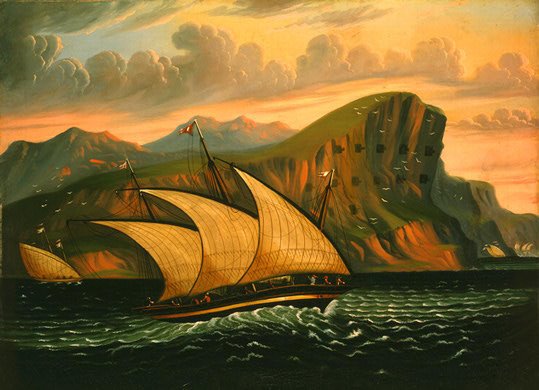
1850 - Felucca off Gibraltar

Painting by  Thomas Chambers (English-born American artist, 1808-1869) Felucca off Gibraltar.

From Lebanon Braughall managed to secure  passage with a trade caravan  travelling to Jerusalem.

Berber_Trade_with_Timbuktu_1300s

Image of a Trade Caravan to Tumbuktu in 1850 from Travels and Discoveries in Northern and Central Africa by Prof. Dr. Heinrich Barth, vol. iv, London 1858)

When he finally arrived in Jerusalem he was physically in a weakened state and his  finances were exhausted.

06733v

Jerusalem (El-Kouds). First view of Jerusalem from the south / American Colony, Jerusalem. (http://hdl.loc.gov/loc.pnp/matpc.06533)

At this time the Holy Land was part of the Ottoman Empire. Any  pilgrim wishing to enter any of the pilgrim sites such as the Holy Sepulchre could only do so at certain times and upon payment of a fee to the Governor of the city. Fr Braughall  requested  and was granted an audience with the Governor of the Provence.  The priest must have made a good impression on the  Governor  as he was granted a free  pass  to all the shrines in Jerusalem. Having completed his pilgrimage which included praying for 9 days and nights  within the Sepulchre church, while existing on bread and water, he  set off on his return journey.

We are told he travelled to Cairo in Egypt  but became ill with fever and dysentery. While in Cairo he stayed with a small religious community. The community appear to be Franciscan missionaries  and consisted of  four priests and two lay brothers. Within days of Braughall’s  arriving  the community had succumb to his illness and died and he was forced to bury them. Braughall may have felt some responsibility for their deaths as he  stayed on in Cairo and took over their duties until he was relived. MacRory states up to 40000 people died in the city during this outbrake.  Once his replacements arrived with the help of  the English Consul he received passage from Alexandria back to the port town of Livono in Italy.

We are not told what he did next  but his health  deteriorated yet again and for the next few years he seems to have drift through Portugal and Spain. In 1838 he returned to Carlow penniless  where he remained  for a short time as a guest at  St Patrick’s College in Carlow town. He had been away for 16 years.

carlowcollege

St Patrick’s College Carlow

The President of the college Dr Fitzgerald invited him to stay permanently but he refused deciding instead to return to Italy to live out his days as a hermit.

In 1839 Braughall set out again for Italy and travelled to Vesuvius where he tried  to enter one of the many hermitages dotted along the mountain slopes. The church authorities of Naples  in whose jurisdiction the hermitages were  became aware of his presence and were suspicious of his motives. They demanded to see his papers of identification which he could not produce. He was  then forced to write to the Sisters of the Presentation Convent at Carlow appealing to them to approach the bishop and to ask for a letter stating who he was and  of his former pilgrimage to the Holy Land. It is interesting that he did not write directly to the bishop.

Eventually a letter arrived from the bishop and was presented to the authorities but they  still remained suspicious and  demanded the letter be authenticated by the Holy See.  Once the  Vatican confirming his  story Fr Braughall left Naples and joined the  Benedictine monastery at Mount Cassino.
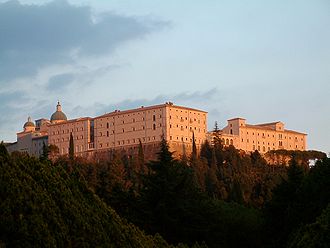
330px-Monte_Cassino_Opactwo_1

Monte Cassino Monastery

Fr Braughall became well-known and admired  for his piety. According to MacRory

It is recorded that when  the King of Naples and his family visited Mount Cassino they found Father Braughall  kneeling in adoration before the Tabernacle. The royal party, preceded by the King, reverently took up and kissed the hem of Father Braughall’s habit, while he, unconscious of their presence in the depth of his devotions, prayed on.

Fr Braughall made one final pilgrimage to the Holy Land following the vision of  what he believed was his Angle Guardian. He died in 1850 and was buried at Mount Cassino  along way from Carlow.

Reference
Gerard MacRory. 1950. ‘Pilgrim Priest’,The Irish Monthly Vol. 78, No. 925, 314-318

Pilgrimage in Medieval Waterford

This blog post is a brief review of the evidence for pilgrimage in the town of Waterford during the late medieval period. The information comes from a paper I am working on about  the archaeological evidence for pilgrimage in medieval Ireland.

Medieval Waterford

During the late 1980’s large areas of the medieval and Viking town of Waterford were excavated and the results published in the much sought-after book Late Viking age and medieval Waterford : excavations 1986-1992. These excavations were hugely important and have provided vast amounts of information, answering questions about how people lived and how the city grew and developed over time.  The majority of the artefacts from the excavations are on display in the Waterford Museum of Treasures. The  museum is a fantastic place and I would highly recommend a visit if you’re in the area. The many beautiful and rare artefacts on display show the domestic, military, trade and religious life of the medieval town of Waterford. Among the items on display are two tiny artefacts which provide evidence of personal devotion and pilgrimage.

4-charter-worked-up-alternative-with-quay-smaller

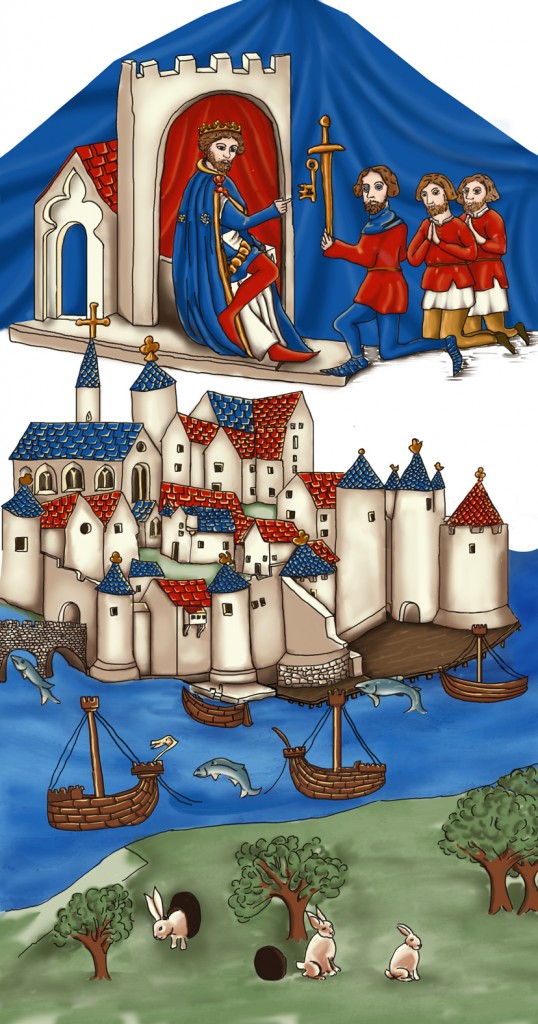
The medieval town of Waterford by Rubicon’s Sara Nylund.

The  artefacts in question are pilgrim badges purchased by medieval pilgrims who lived in Waterford.

Pilgrim Badges

From the beginning of Christian pilgrimage continuing to modern times, pilgrims  have been bringing home mementoes of their pilgrimage for example earth/dust from the saint’s tomb/grave, holy oil or water from the shrine but it was not until the 12th century that souvenirs were mass-produced and sold to pilgrims.

The badge  was  the most popular type of pilgrim souvenirs.  They were made of  made of lead or pewter making them cheap to manufacture and very affordable. Each badge was  decorated with  an image relating to the shrine it was sold at for example the  badges from the great shrine of Canterbury  depicted St Thomas á Beckett or scenes of the saint’s martyrdom.

To date there is no definitive evidence that  pilgrim souvenirs were produced at Irish shrines but the recovery of pilgrim souvenirs from urban and burial excavations across  Ireland tells us many Irish pilgrims were engaged in long distance pilgrimage abroad during the later medieval period and purchased souvenirs as mementoes of their pilgrimages.

Pilgrimage and Waterford

Waterford like other Irish  port towns  had strong links with pilgrimage. There would have  been  a constant flow of pilgrims embarking on and returning from foreign pilgrimage via the wine  and trade ships. Some of these pilgrims would have lived within the town walls, others came from the surrounding hinterland and some travelled long distances to reach the port. Most of the pilgrims who left Waterford are anonymous. We do not know who they were or where they went on pilgrimage.

One Waterford citizen whose pilgrimage was recorded was the  Mayor of Waterford James Rice (1467-1486).  Rice made two pilgrimages to the shrine of St James at Santiago de Compostela in northern Spain in the 15th century. The first pilgrimage was made for the Jubliee year of 1483.

Archaeological Evidence of Pilgrimage from Waterford

Analysis of the two badges found in Waterford suggest they were produced on the Continent.

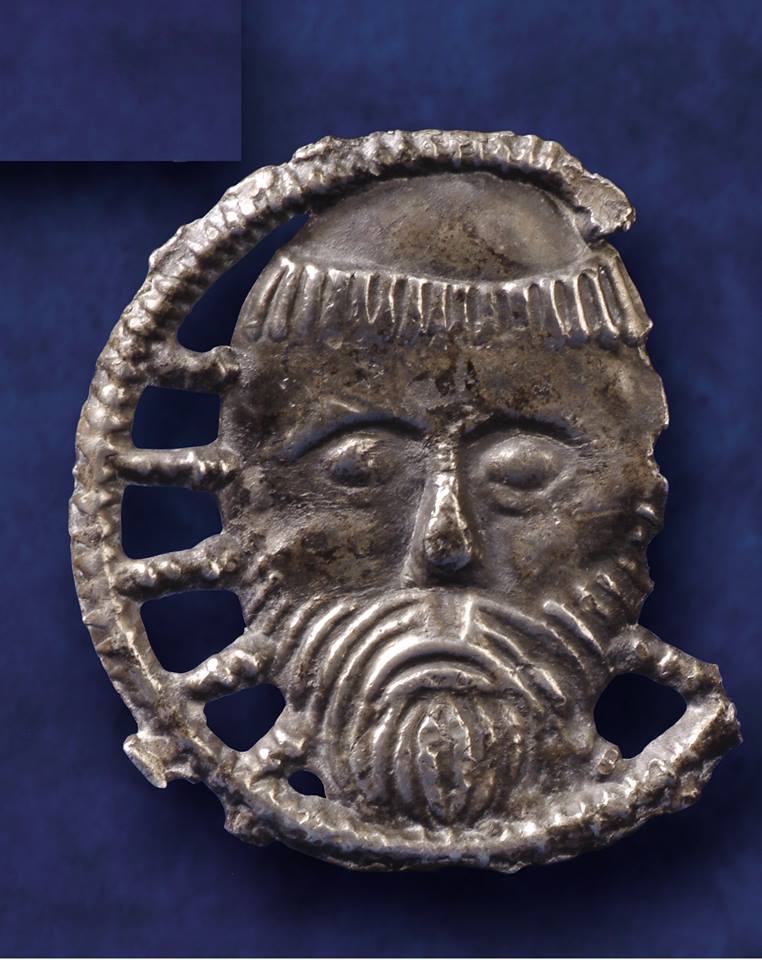
One of the badges is circular in shape. It was made of a tin-lead alloy and depicts the face of a bearded man, probably St John the Baptist. Similar style badges have been discovered at London and Canterbury. It is likely that the English and the Waterford badges represent the relic of the head of St John the Baptist, which was removed following the sack of Constantinople in 1204  to Amien Cathedral in France.  This relic was a major draw for pilgrims throughout the medieval period. Today it continues to draw pilgrims mostly from the Orthodox church but on a much smaller scale.

The badge was found in the backyard of a 13th century sill-beam house which may suggest someone who lived in the house had acquired the badge on pilgrimage and lost or  thrown it away at a later date.

970953_476576755750054_1283440569_n

Pilgrimage badge depicting the relic of St John the Baptist Head found during excavations of Medieval Waterford. Image (c) of Waterford Museum of Treasures.

The second badge  is extremely interesting.  It is unique with no other example of its type found elsewhere. It is  rectangular in shape and depicts the death of an unknown saint who is tied to a tree while a man with a hooked stick/bar  beats him. The badge bears the inscription  + SIGL/LVM: IONANNI/S: CRVCIFIX/I: A IVDEIS: P (the seal (or sign) of John, crucified by the Jews at P). The design and style of the badge suggests  that it was produced in France but  its exact origins are unknown. This badge  was also found in a 13th century context in association with a domestic setting.

???????????????????????????????????????????????????????????????

Pilgrim badge from unknown shrine on display at the Waterford Museum of Treasures.

Although countless Waterford pilgrims travelled within and outside of Ireland on pilgrimage the majority leave no trace of their journey. The discovery of these badges is very exciting. The badges provide additional destinations of  Irish pilgrims  not recorded in any of the historical records.  The badges also mark pious acts  carried out by  two of the citizens of Waterford. They are  personal items owned, touched and worn by the pilgrim who purchased them and provide information on the devotion to the saints. While it is generally accepted that  pilgrimage was an important part of medieval life, most pilgrimages go unrecorded and it is only through the discovery of artefacts such as pilgrim souvenirs that we can answer some of the many questions pertaining to pilgrimage in medieval Ireland.

 References

Hurley, M. F. 1997. Late viking age and medieval Waterford: excavations 1986-1992. Waterford: Waterford Corporation.

McEneaney, E. (ed.) 1995. A History of Waterford and its Mayors, from the 12th century to the 20th century. Waterford: Waterford Corporation.

Rubicon Heritage, 2012. Recreating the Earliest Image of an Irish City: The Waterford Charter Roll

Homepage


Molana Abbey, Co Waterford

Molana abbey has been on my list  of  places to  visit for a such a long time and I finally got my chance this week and boy was it worth the wait!!

The abbey is  located  on an island in the Blackwater estuary on the  Ballynatray estate just outside of Youghal. On private property the site is open to the public during the summer months on  Tuesday, Wednesday and Thursdays.

1-DSCF0264

View of Molana Abbey, hidden among the trees

History of the Molana

Molana was  founded in the 6th century by a little known Irish saint  called  Maol Anfide, a contemporary of St Mochuada of Lismore. The saint  built a monastic settlement here on a small island  called Dairninis  or the ‘island of  the oak’ . No architectural evidence remains of this early settlement and today the ruins on the island date to the late 12th and  13th century.

In 1806 Dairninis  Island was joined to the mainland by a causeway and bridge  by Grice Smyth the then owner of the Ballynatray estate.  I was delighted to see oak trees still growing on  the island and along the causeway continuing the tradition of the place-name origins for the site.

1-DSCF0263

Causeway leading to Molana Abbey

Turtle Bunbury’s excellent blog post Molana Abbey from the Stone Age to Dissolution tells of the sites early history

By the early 8th century, Molana was a major stronghold of the Céili Dé (Servants of God), a monastic order determined to reform the church. Its abbots subsequently played a key role in the subsequent introduction of Continental ideas to Ireland. Indeed, as Dr Dagmar Ó Riain-Raedel noted in her thesis on the island, the Abbey’s greatest hour came in about AD 720 when its Abbot, Ruben Mac Connadh of Dairinis, working with Cu-Chuimne from the island monastery of Iona, produced the Collectio Canonum Hibernensis. This was a profoundly valuable and important book for the church, written in Latin, effectively dictating the first rules of Canon Law. Its very title reflects its origin as a compilation of over two hundred years worth of canon law and synodal decrees. The text itself drew heavily upon previous ecclesiastical regulations and histories, all dating from the centuries prior to 725. It also included papal epistles, acts of synods, eccleiastical histories, a definition by Virgilius Maro Grammaticus, a compusticial tract by Pseudo-Theophilus, spurious ‘Acts’ of the council of Caesarea, the so-called dicta of Saint Patrick and several quotes from all but one of the works of Isidore of Seville.

Indeed, there is reason to believe that Molana Abbey may have been home to the first library in the south of Ireland. Unfortunately, none of these original manuscripts have survived but copies can be found in archives all over the Continent. Collectio Canonum Hibernensis was circulated throughout Western Europe for the next four hundred years

Despite this fascinating early history no physical remains of what was once an important and influential monastery are to be found.

1-molana 064

The ruins of Molana Abbey on Dairinis Island

By the 12th century Molana abbey was re-established as an Augustinian Priory  by Raymond le Gros FitzGerald, who tradition holds was buried here. References to the later history of Molana are sketchy. Interestingly in 1450 Molana was at the centre of a scandal.  Pope Nicholas V compiled a mandate for the investigation of claims that the Prior of Molana John McInery, was guilty of simony, prejury and immorality.

The abbey was granted an indulgence in 1462, by the then Pope Pius II , to all those who came here to pray and to give money to the maintenance of the abbey. Such an indulgence would have made the abbey a focus of pilgrimage for at least the duration of the offering of the indulgence.

The names of some of the later priors of Molana are also mentioned in historical sources.The abbey was suppressed in 1541 and fell into the hands of Sir Water Raleigh. By the 19th century the abbey was in possession of the Smyth family and was a focal point on their estate, with their stunning Georgian mansion looking across at the ruins.

1-DSCF0367

View of Ballynatray House from Molana Abbey

The Architectural Remains

Today the sites consists of a number of ruined buildings  that date to the late 12th /13th century. The buildings included a  church, monastic buildings and a cloister all  built of a red sandstone, which gives the site a lovely warm feeling . There are a number of cracks in the walls so some of these building do not appear to very stable.

The church is  large (17m x 7.6m)  with an undivided nave and chancel . The nave is the oldest part of the building and appears to incorporated part of an  earlier church. The chancel  was a later addition and dates to the 13th century. It has eleven large lanclet windows (tall, narrow windows with a pointed arch at its top) which must have looked quiet magnificent when the church was in use.

1-DSCF0340

Undivided church at Molana

The east wall of the church is in a poor state of repair but traces of a decorated  moulded window embrasure still remain.

1-DSCF0336

Decorated moulding of window in the east wall of church

Attached to the north wall of the chancel are the remains of  a two-story building which was probably used as the abbot’s or prior’s accommodation. It has a fine  pointed doorway of dressed sandstone and a spiral stairs.

1-DSCF0362

Building on the north side of chancel of church

At the centre of the ruins is a small cloister (19.65m N-S; c. 14.75m E-W). There is no evidence of an arcade but corbels in the outer walls of the surrounding  buildings suggest a roofed walkway.  Today the cloister is dominated by a  19th century statue which depicts the founding saint.

1-DSCF0280

Cloister of the Abbey

The statue was placed here in 1820 by Mrs Mary Broderick Smyth, the wife of Grice Smyth. A  plaque  on the statue plinth has the following inscription

This statue is erected to the memory of Saint Molanfidhe who founded this abbey for Canon Regular A.D. 501. He was the first Abbot and is here represented as habited according to the Order of Saint Augustine. This Cenotaph and Statue are erected by Mrs. Mary Broderick Smyth A.D. 1820

1-DSCF0290

Statue of St Mael Anfeid

The saint is dressed in a cloak and robe  with a very pretty floral pattern on the hem.

1-DSCF0375

Floral pattern on the hem of the statue

The building on the SW side of the cloister has traces of plaster and some  orange paint which may indicate traces of a wall painting. According to the Archaeological Inventory for Co Waterford  in 1908 traces of a wall painting were noted in the refectorum.

1-DSCF0389

Traces of possible wall painting in the building at the SE side of the cloister

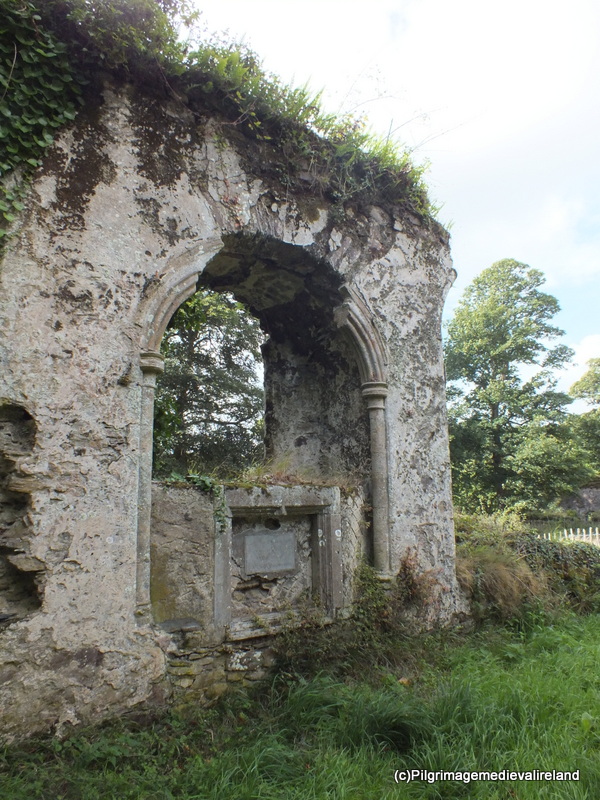
In the same room, a plaque is set into a window embrasure on the south wall. This plaque was also placed here by Mrs Smyth,  and has the  following inscription

Here lies the remains of Raymond le Gros, who died Anno Domini 1186

1-DSCF0396

Plaque dedicated to Raymond Le Gros set into a window embrasure

The fascinating  history, architectural remains combined with  the stunning setting all  make Molana a truly amazing, spiritual and peaceful place.

References

Bunbury, T.  Molana Abbey from Stone Age to Dissolution

Moore, M. 1999. Archaeological Inventory of County Waterford. Dublin: Stationery Office.

Power, Rev. P. 1898. ‘Ancient ruined churches of Co. Waterford’, WAJ 4, 83-95, 195-219.

Power, Rev. P. 1932. ‘The abbey of Molana, Co. Waterford’. JRSAI 62, 142-52.