Archaeologist Gary Dempsey is undertaking research into how archaeological objects are reported in Ireland.
You can help you Gary with his research by taking part in this online survey to gauge the public’s awareness on the reporting of archaeological objects. The survey just take a few minutes and you just need to follow this link https://www.surveymonkey.com/r/56TSF3S
I will let Gary explain to you about the project in his own words
I am undertaking research into how archaeological objects are reported in Ireland. Occasionally as heritage practitioners we encounter people who have in the past discovered an archaeological object, or know of one discovered by a family member which has not been reported to the National Museum. I am interested in finding out how prevalent this may be in Ireland and if people are aware of the laws and regulations surrounding the reporting of archaeological objects in Ireland.
Through my work with community groups I have encounter a number of people who were not aware of the acts relating to archaeological finds, and in their best intentions stored an object for safety or out of personal interest. I am interested in developing some education about this subject, separate to cases where objects are removed in malice, or for profit.
As no work has been carried out on this subject as of yet, I have put together a short survey in the hopes of understanding the basic level of knowledge in this area. The survey is for anyone who has an interest in heritage and archaeology in Ireland, and not just for for those working in the industry. I would be grateful if you could circulate this short survey to your Colleagues/Students/Social Media Contacts.
Over the last six months I have been writing a book with holy well expert and geographer Dr Richard Scriven of the blog Liminal Entwinings.
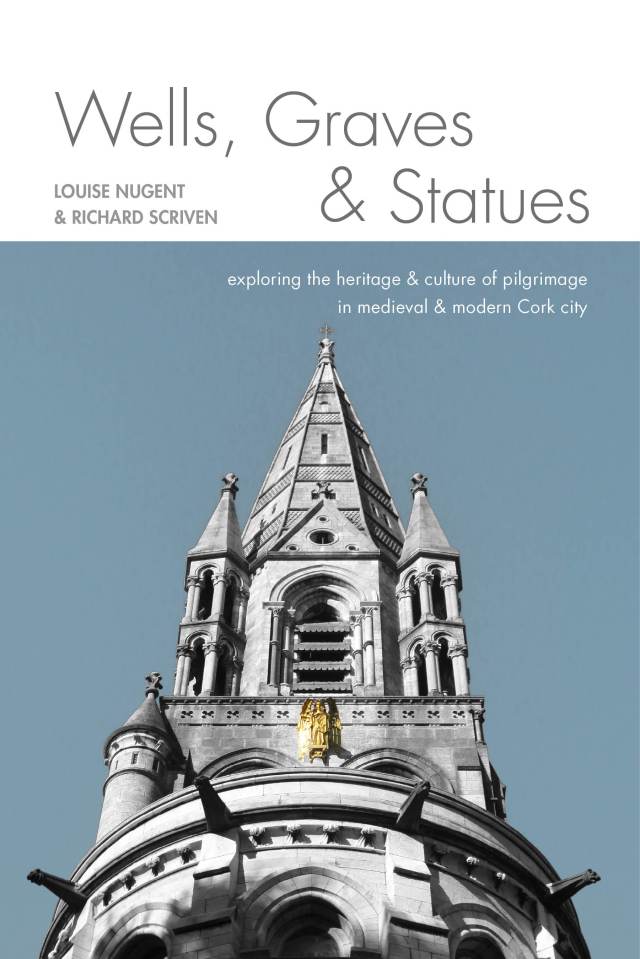
Our book Wells Graves & Statues, exploring the heritage & culture of pilgrimage in medieval & modern Cork City is just back from the printers.
The book tells the story of pilgrimage in Cork city, from medieval to modern times by exploring the places that the people Cork city went and still go on pilgrimage too. As the title suggest the book discusses the holy wells of Cork city such as Sunday’s well, the Franciscan well, along with St Fin Barre’s Cathedral, the great medieval centre of medieval Munster, medieval statues such as Our Lady of Graces in St Mary’s Pope’s Quay, and the graves of holy people like Father Mathew founder of the temperance movement, Nano Nagle the founder of the Presentation order and Little Nellie of the Holy God, Corks unofficial saint.
The aim of the book is to sheds light on the important role of pilgrimage in the social, cultural, and religious life of Cork and to bring the story of pilgrimage to a wider audience and to inspire people to explore Corks pilgrim landscape.
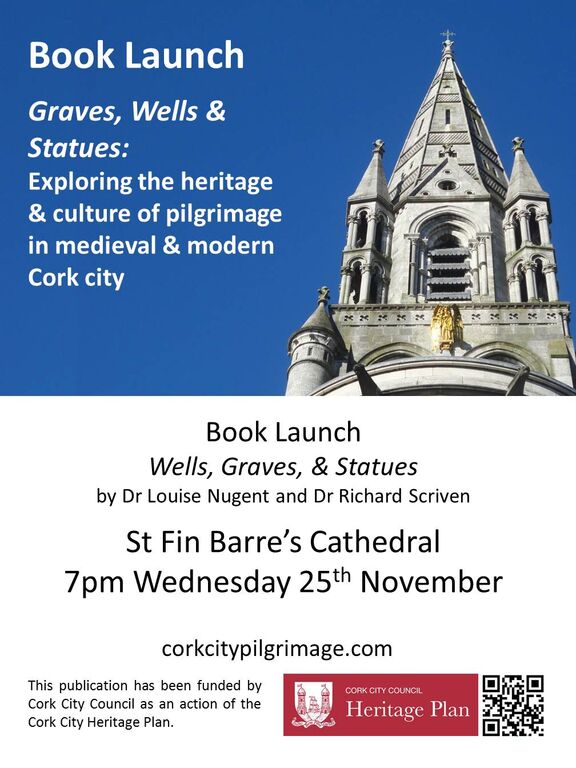
Wells Graves & Statues, exploring the heritage & culture of pilgrimage in medieval & modern Cork City will be launched on the 25th of November at 7pm in St Fin Barre Cathedral in Cork City and we would be delighted if you could join us.
This publication has been funded by Cork City Council’s Heritage Publication Grant Scheme 2015 and the project is an action of the Cork City Heritage Plan. We are very grateful to Cork City Council for all their help and support.
A few months ago I came across some wonderful images of pilgrims climbing Croagh Patrick. These images were taken some time in the first decade of the 20th century. The photographs were assembled by Fr. Angelus Healy OFM Cap. (1873-1953) a Capuchin friar known as the ‘Guardian of the Reek’, in honour of his long association with the pilgrimage. The images have recently been digitised from a collection of glass plate negatives held in the Irish Capuchin Provincial Archives, and the archives have kindly given me permission to reproduce the images for this blog post. I recommend a visit to the Irish Capuchin Archives Facebook page were you will find wonderful images and documents associated with early 20th century Irish history.
This slideshow requires JavaScript.
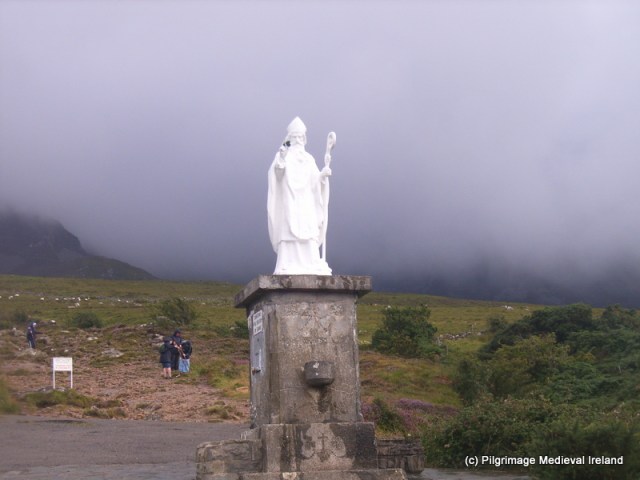
The photos reminded me of a contemporary account I had read some years ago of a pilgrimage to the summit of Croagh Patrick undertaken in 1910, on the main pilgrimage day to the mountain, the last Sunday of July often called Reek Sunday. The story of the pilgrimage was recounted in the article entitled ‘A Pilgrimage to Croagh Patrick’ and was written by a cleric who gives his name as E.O’L and was published in the Irish Monthly magazine. The article recounts the priests ascent of the mountain, the weather conditions and encounters with pilgrims. I have climbed Croagh Patrick a number of times most recently on Reek Sunday in 2014 and it struck me that the 1910 account has a number of parallels to the modern pilgrimage in particular the physicality of journey to the summit, the dangers faced by pilgrims and weather conditions.
I found it very interesting that the article advises against wearing poor footwear when climbing this holy mountain and over a hundred years later this advise is still sound. I have often seen pilgrims and tourist attempt to climb Croagh Patrick in flipflops or other inappropriate footwear or clothing. Mayo Mountain rescue advises those planning to climb Croagh Patrick and other mountains in the area to wear appropriate clothing and footwear and to be aware that temperatures at the top of the mountain can be up to 10 degrees colder than at sea level.
In 1910 the author of the article advise pilgrims to avoid poor footwear stating
Low, thin-soled shoes are not the thing where one frequently sinks above the ankles in wet, boggy turf loam, and ladies’ fashionable high-heeled boots are, to say the very least of them, quiet at a discount where loose, sharp rocks and stones, and heaps of them, covering long and steep stretches of the ” Pilgrim’s Path,” have to be got over somehow (E. O’L 1910, 539)
The article advises gentlemen in 1910 to wear
…good, thick-soled boots (not shoes), with a few spikes or nails to prevent slipping, leggings of some sort, a light, rainproof cape, and a good, long, reliable walking-stick or pilgrim’s staff (E. O’L 1910, 539).
For ladies
With regard to a suitable dress or outfit for ladies, we shall attempt to give only very little and very negative advice, namely, in the first place, not to wear light-soled, high-heeled shoes or boots; and, in the second place, not to wear over-long skirts, which cling about the feet, and, when the mountain is wet under foot or when there is rain and mist (which seems to be oftener the case than not), soon become very bedraggled and uncomfortable (E. O’L 1910, 539).
The author of the article undertook his pilgrimage on the last Sunday of July and tells us that
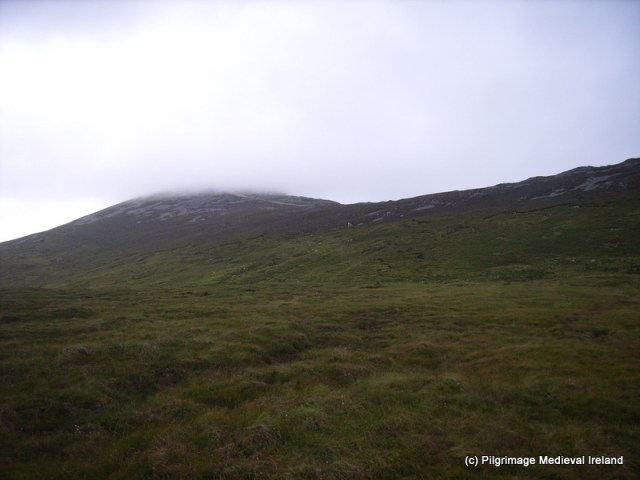
morning broke dull and grey, and heavy rain clouds and mist and fog enveloped and concealed the upper heights of the holy mountain almost all day long (E.O’L 1910, 587).
View of Croagh Patrick from base of the mountain covered in cloud and mist.
Traveling with companions, he left Westport by car and traveled on to Murrisk. En-route the group passed
group after group of young and old, boys and girls, men and women, on foot, all walking with zealous haste towards the holy mountain ; great numbers of cyclists also were to be seen, and a long line of brakes and cars of every description. Still everything was quiet and orderly, and the demeanour of the people was simply admirable (E.O’L 1910, 390).
Upon arrival at Murrisk the group immediately began their ascent of the mountain along the pilgrim path known as the Casán Phádraig/St Patrick’s path.
Pilgrims beginning their ascent of Croagh Patrick circa 1910. Image courtesy of the Irish Capuchin Provincial Archives.
Large numbers of pilgrims were already climbing the mountain and the scene described below is very similar to that of the modern pilgrimage on Reek Sunday.
Lifting up our eyes we saw before and above us an irregular and unbroken line of pilgrims winding, in long curves, up the mountain slopes, and higher up still, on an elevated ridge of the mountain leading to the cone proper, we could clearly see the unbroken line of pilgrims slowly advancing and silhouetted sharply against the sky-line; and higher and higher up still they could be seen, until they passed on into the heavy clouds, which hid them and all the upper reaches of the holy mountain from our sight (E. O’L 1910, 591).
Pilgrims climbing Croagh Patrick circa 1910. Note the ladies in their long skirts in the foreground. The image is courtesy of the Irish Capuchin Provincial Archives.
The modern pilgrimage as we know it derives from efforts made by the Archbishop of Tuam Dr. Healy in 1903 to revive the pilgrimage which was at the time in sharp decline. Dr Healy was also responsible for building the oratory on the summit of the mountain. The numbers of pilgrims have steadily increased in the last hundred years but in 1910 the pilgrimage was popular enough to attract pilgrims in their thousands.
Pilgrims taking a brake while climbing Croagh Patrick circa 1910. Image is courtesy of the Irish Capuchin Provincial Archives.
Until the 1970’s it the was the norm for a large portion of pilgrims on Reek Sunday to climb Croagh Patrick by torch-light the night before or in the hours before dawn.
An hour into the climb E. O’L and his companions
began to meet many of those who had already been to the summit and were now returning. Some of the older people had gone up the evening before, and had spent the night on the mountain side, or praying around the Oratory on the summit, and indeed they must have suffered greatly throughout that wet and dreary night, and no wonder they should look weary and faint and worn after having been ” buffeted at will by rain and storm ” all night long during their vigil on such a wild and shelterless mountain.
As they made their way up the mountain pilgrims descending greeted them with
Bravo ! you’re getting on grand, you have only a few hundred yards more to climb,” or, ” Take your time, alanna, and you’ll soon be at the top,” etc.
Modern pilgrims to Croagh Patrick on Reek Sunday will often give words of encouragement to those ascending the mountain.
Croagh Patrick can be a dangerous mountain much of the route, in particular the latter stages along the conical top of the mountain, is covered by loose shale which moves under foot and can be very slippery in wet weather. The terrain is difficult especially in the final stages. Each year people fall, sprain and brake limbs while ascending and descending the mountain. So it’s not surprising that in 1910 the group also met a man ‘with a handkerchief tied around his head and blood oozing from underneath it‘, who had slipped and fell among the rocks while descending the mountain. The video below shows the pilgrimage on Reek Sunday on a day with similar weather conditions to those described in 1910 and it highlights how dangerous the climb can be and the amazing work that Mayo Mountain Rescue and the Order of Malta do to help pilgrims on this day.
The author and his companion reached the summit
clothes drenched with rain, our feet wet, our boots and lower garments covered with clammy turf-mould.
Pilgrims descending Croagh Patrick is wet and overcast conditions, similar to those described in the article.
As is the case with Reek Sunday today mass in St Patrick’s Oratory and confession was a big part of the pilgrimage rituals in 1910.
The priests who said their Masses early heard a good many of the pilgrims’ confessions afterwards, and at the time we entered the little Oratory of Templepatrick, rows of pious pilgrims were receiving Holy Communion, and there were pilgrims for Communion at Masses until mid-day (E. O’L 1910, 593).
The evening before a rota was organised to ensure that masses were completed in an orderly fashion
the priests who wished to say Mass on the summit entered their names in a register kept at the presbytery, Westport, and both the hour and the altar at which each priest was to say Mass in the Oratory were appointed (E. O’L 1910, 585).
Pilgrims on the summit of Croagh Patrick circa 1910. Courtesy of the Irish Capuchin Provincial Archives.
After their masses the group enjoyed
some sandwiches and a warm cup of tea nicely prepared… by two or three young ladies from the Technical School, Westport (E.O’L 1910, 593).
On my pilgrimage in 2014 I noticed many pilgrims bought a packed lunch and others bought refreshments and tea from the stalls on the periphery of the summit.
Courtesy of the Irish Capuchin Provincial Archives.
Having enjoyed the refreshments and
listened to the excellent sermon of the Very Rev. Father M’Grath for the occasion, and having received the special Papal Benediction at its close, and after hearing the Acts devoutly read in Irish before the twelve o’clock Mass, we began our laborious descent, in fog and rain, over loose rough stones and through boggy turf-mould and slush, and our heads were moved with compassion especially for the poor weary pilgrims struggling up against us, and we consoled and cheered them as best we could…. (E. O’L 1910 594).
As they descended the cone
the clouds and mist all cleared away quite suddenly, or rather we had left them behind or above us. The sun shone out brilliantly, and land and sea and sky all seemed to rejoice with and for us on our happy and safe return from the Holy Summit. And looking down upon the pleasant land of promise that lay basking in the sunlight far below us, the hardships of the mountain and the wilderness were very soon forgotten (EO’L 1910 594).
View of the summit of Croagh Patrick covered in cloud and fog. Image taken from the Tóchar Phádraig pilgrim path in 2008.
I hope this post by combining early 20th century and modern images with an early account of pilgrimage gives you a sense of what it was like to be part of the pilgrimage to Croagh Patrick in 1910. It is also interesting to compare the dress of the pilgrims, the ladies in long skirts and fancy hats, the men dressed in suits some even wear top hats, it’s a far cry from waterproof jackets and hiking boots worn by the majority of modern pilgrims. We also see that then as now some pilgrims performed their pilgrimage barefoot. Yet we are also reminded while clothing has changed the modern pilgrim walks along the same path and endures the same physical hardships and weather conditions as those who have gone before.
Pilgrims on the summit of Croagh Patrick circa 1910. Image courtesy of the Irish Capuchin Provincial Archives.
Pilgrims on the summit of Croagh Patrick 2014
References
Images from the photographic collection of Fr. Angelus Healy OFM Cap. (1873-1953), now part of the Capuchin Archives collection. Reproduced in this blog courtesy of the Irish Capuchin Provincial Archives.
E. O’L. 1910. ‘A Pilgrimage to Croagh Patrick: July 31, 1910’, The Irish Monthly, Vol. 38, No. 448 (Oct., 1910), pp. 585-596.
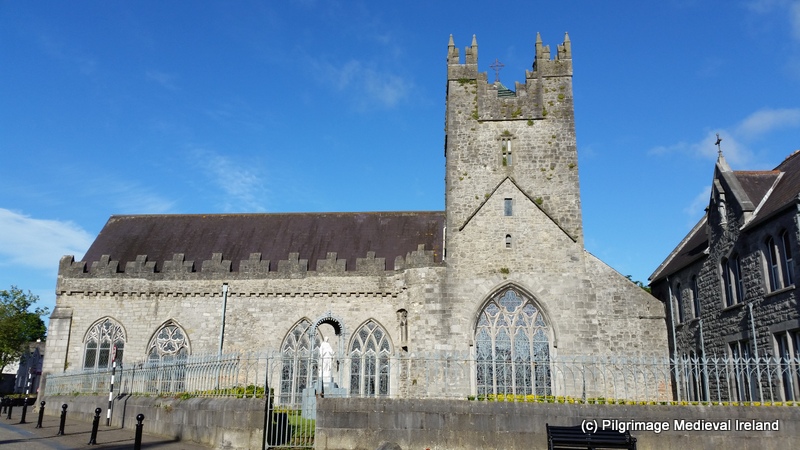
Black Abbey in Kilkenny city is a Dominican priory founded c.1225 by William Marshall. The church which still survives was dedicated to the Holy and Undivided Trinity. The abbey gets the name ‘Black Abbey’ from the black robes worn by the Dominicans, also known as the Blackfriars.
The Dominican priory of ‘Black Abbey’ in Kilkenny.
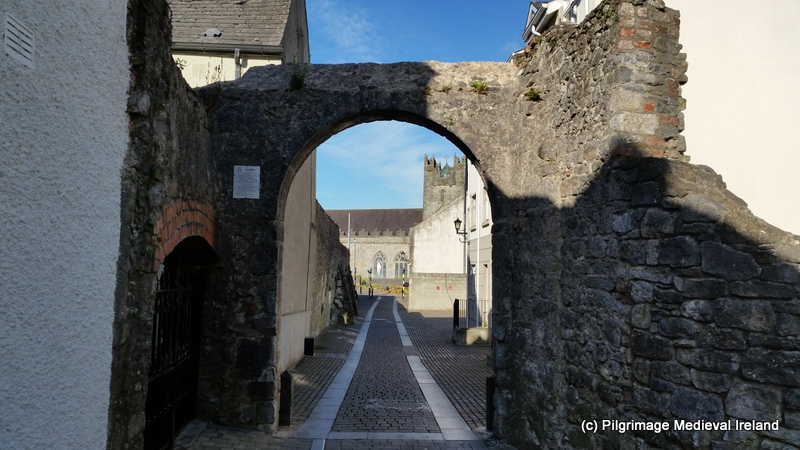
The priory was located outside the medieval walled town of Kilkenny, within its own walled precinct. The entrance from the town into the precinct was viaBlack Freren Gate. This is the only medieval gateway into the town to survive today (pers comm Cóilín Ó’Drisceoil).
Black Freren Gate, a medieval gate providing access to the medieval town of Kilkenny.
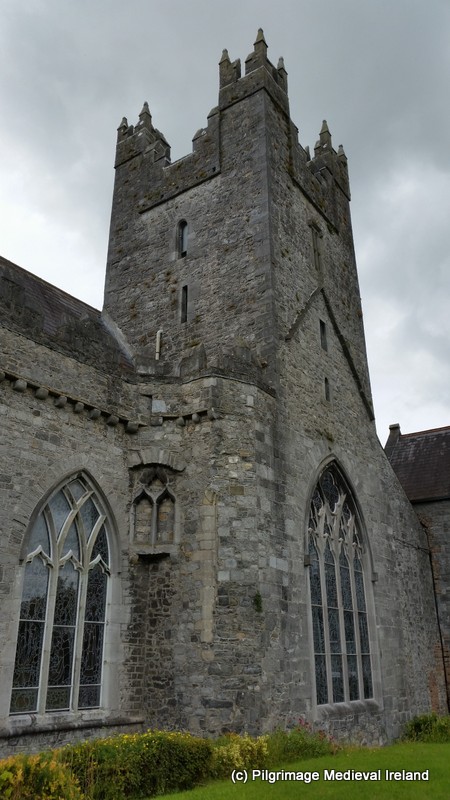
Much of the fabric of the medieval priory church survives and today the building is used as a parish church. This is a multi-period building, with a nave and south aisle of thirteenth century date, a number of the surviving windows date to the fourteenth century, while the crossing tower was erected in 1527.
The crossing tower at Black Abbey built in the year 1527.
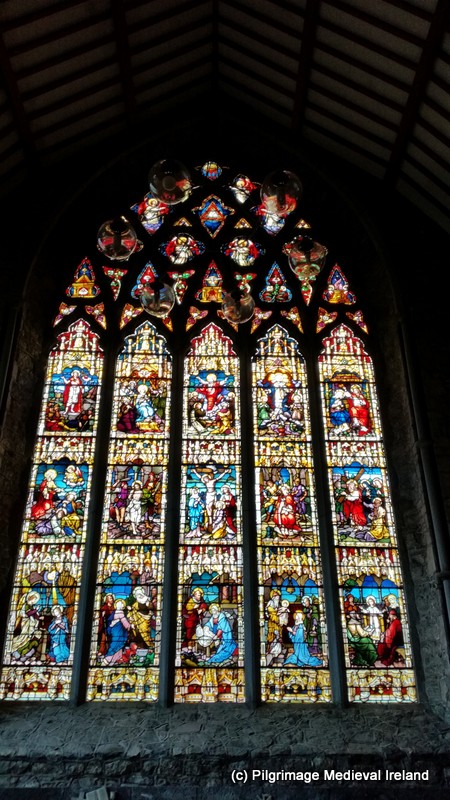
Alterations were carried out to the building in the eighteenth century, when the choir was demolished and in the nineteenth century.
Window in Black Abbey.
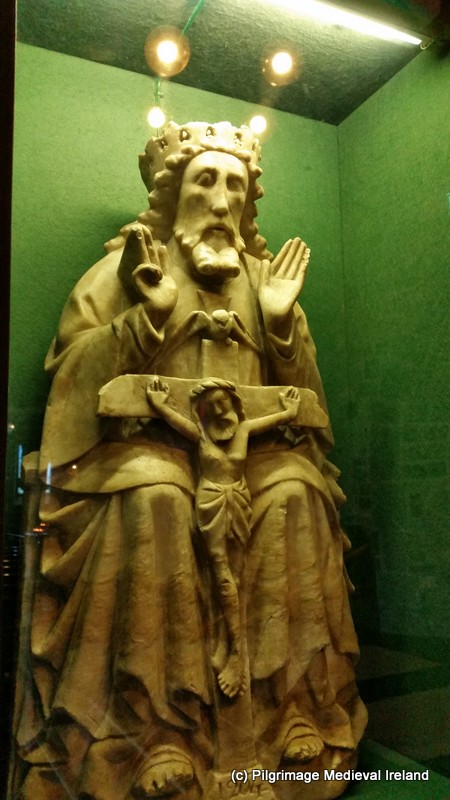
Within the church is the most amazing medieval statue that depicts the Trinity
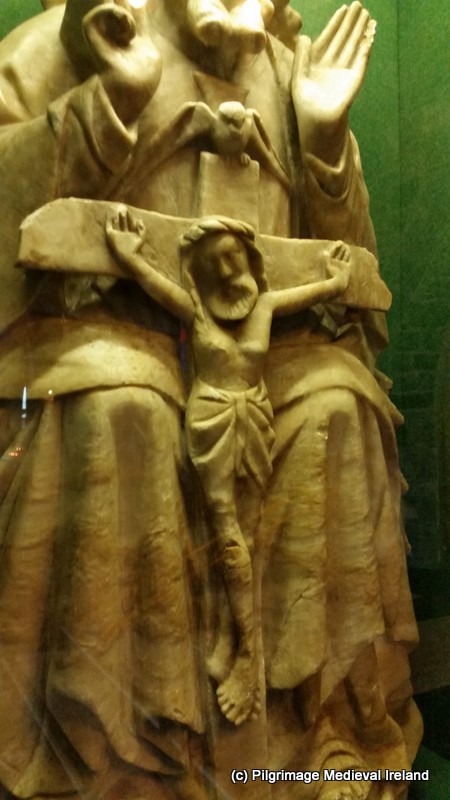
‘ representing God the Father, with God the Son on the cross between his knees, and the Holy Spirit above him, between the Father’s uplifted hands’ (Hunt & Harbison 1976, 318).
Medieval statue of the Trinity carved from alabaster.
The statue is made of finely carved alabaster and it is thought to date to the fifteenth century.
The Christ figure of Trinity statue at Black Abbey.
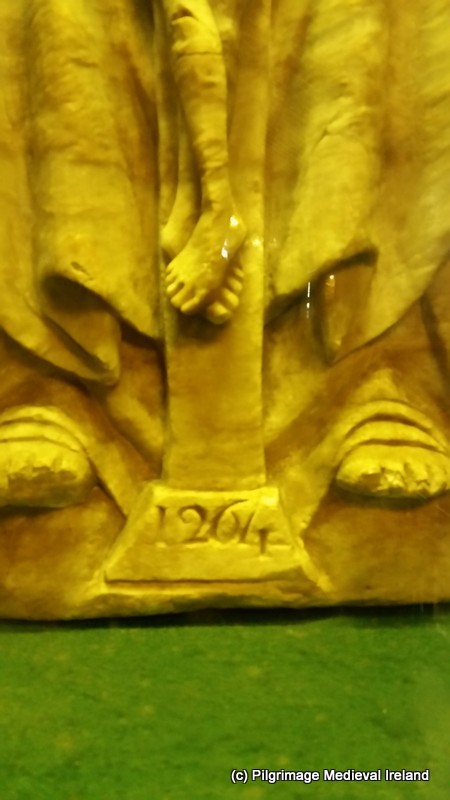
The date 1264 is carved at the base of the cross and Harbison and Hunt (1976, 318) suggest the date was inscribed on the base of the statue at a much later date probably sometime in the eighteenth century.
Date 1264 at the base of the medieval statue at Black Abbey
According to tradition the statue was found in a blocked-up niche in the south transept of the church and came to light during restoration work in the early nineteenth century. Today the statue is on display within the church and is just one of many interesting features within the church.
References
Hunt, J. & Harbison, P. 1976. ‘Medieval English Alabasters in Ireland’, An Irish Quarterly Review, Vol. 65, No. 260, 310-321.
Roe H. M. 1972. ‘A medieval alabaster figure, Black Abbey, Kilkenny’, Old Kilkenny Review, No. 24, 33-36.
This post is inspired by an article I am writing and it is the first in a of a series of posts highlighting some of the many colourful legends about animals, in particular cows, associated with the early Irish saints.
St Ciarán of Clonmacnoise and his Dun Cow
St Ciarán’s cow features prominently in folklore and hagiography associate with the saint. The cow was originally part of a herd of animals owned by the saints family. As a youngster the saint worked herding his families cows but as he became older he was drawn to the church and decided study and train under St Finnian at Clonard. The story goes as St Ciarán was leaving home he asked for permission to take one of the family’s cows with him. His mother refused his request. As he left he blessed one of the cows who then followed him with her calf to the monastery at Clonard.
The cow was a dun (a greyish brown) colour and was referred to as St Ciarán’s Dun cow. This was no ordinary cow , she was an excellent milker and had the ability to supply the entire monastery with milk (Ó h’Ogain 1991, 88).
Ciaran’s Dun was wont to feed,
three times fifty men in all;
Guests and sick folk in their need,
in a soller and in dining-hall.
She remained a companion of the saint for the rest of her life and when she died, her hide was kept as a relic at Clonmacnoise.
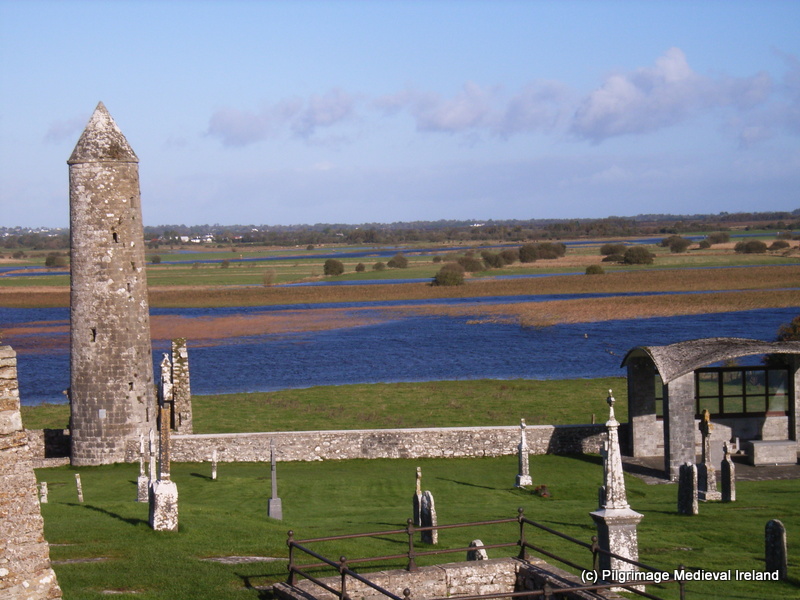
View of the River Shannon from ecclesiastical site of Clonmacnoise
The relic, known as “Odhar Chiaráin” or “hide of the dun cow ” was mentioned in the seventh century Martyrology of Óengus (1905, 205). It seems there existed a belief that whoever died on the hide went straight to heaven (Stokes 1890, 268; Lucas 1986, 9). In the year 900 the annals of Inishfallen recorded Tadgh King of Connacht dying on the hide
‘repose of Tadgh, son of Conchbar, king of Connacht after he had renounced the world on the hide of Ciaran’s Dun Cow.’
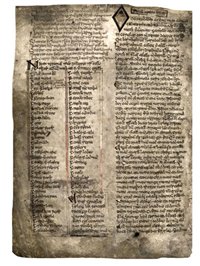
The cow was also commemorated by the name of manuscript written at Clonmacnoise called the Leabhar na hUidhre or the Book of the Dun Cow (Ó’Riain 2011, 170).
Leabhar na hUidhre
This book was compiled around 1100 at Clonmacnoise and it is the earliest surviving manuscript with literature written in Irish, and it contains the oldest version of the Táin Bó Cuailgne, the Voyage of Bran, the Feast of Bricriú, and other religious, mythical and historical material. By the thirteenth century the manuscript was in the possession of the O’Donnells of Donegal.
In 1359, when a number of the family were taken prisoner by Cathal Óg O’Connor, of the O’Connor family in Sligo, they were ransomed with Lebor na hUidre and Leabhar Gearr (now lost). Lebor na hUidre was recovered by Aedh Ruadh O’Donnell in 1470, and was in Donegal when the Annals of the Four Masters was completed in 1631. It then disappeared but was used by George Petrie in 1837 and turned up in the Hodges Smith Collection of 227 manuscripts which was purchased by the Academy for 1,200 guineas in 1844 (https://www.ria.ie/library/special-collections/manuscripts/leabhar-na-huidre.aspx).
The cow also features prominently in the local folklore associates with Clonmacnoise. One early twentieth century folk tale from the area tells of a group of thieves from Coosan near Athlone stealing the dun cow from the field she was grazing in at Clonmacnoise. Afraid of being caught they beat her with a stick to make her run and to escape quickly but in their hurry the cow fell on a flag and her two knees sunk into it leaving in it the impression of two circular shaped holes. The cow got up again and the thieve drove her on to Coosan. When St Ciarán arose in the morning he found his cow was missing but by divine inspiration he knew what happened. He followed her tracks to Coosan. The saint then entered a boiling house and there to his grief he saw the skin of his cow hanging behind the door. Her horns were left on the floor and he body boiling in a boiler. The saint flew into a rage taking the skin from the behind the door and lifting the horns from the floor he moved towards the boiler. He placed the skin around the half cooked body of his beloved cow and immediately she jumped from the boiler alive and as active as she every had been before. Ciarán then returned to Clonmacnoise with his newly resurrected cow. The theme of the theft of the saints cows is common in Irish folklore and associated with many Irish saints. I plan to return to and explore this topic in a later post.
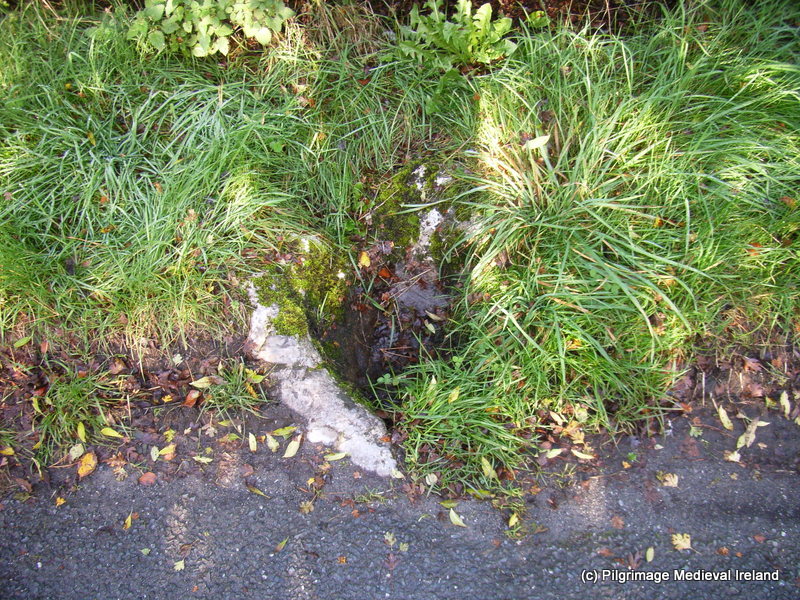
The legend of the dun cow has also left a physical imprint on the landscape of Clonmacnoise. A large bullaun stone located on the side of the Saint’s road that runs from Clonmacnoise past the Nun’s Church is associated with the cow.
The bullaun stone where the dun cow fell and broke her hip.
According to local tradition the stone marks the spot where St Ciarán’s cow fell braking her hip. The stone with its hollow is held to be the spot where the cow fell with the hollow created by the cow. During the nineteenth century this stone was used as a healing relic by pilgrims who would place their head in the cavities in the hope of healing. The stone was also part of the nineteenth century pilgrim stations.
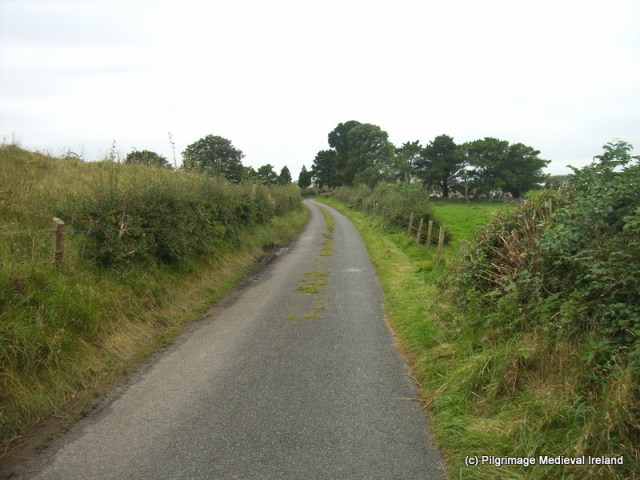
The Saint’s road Clonmacnoise.
Reference
Lucas, A. T. 1986. ‘The Social Role of Relics and Reliquaries in Ancient Ireland’, .JRSAI Vol. 116, 5-37.
Mac Airt, S. (ed.) 1944. The Annals of Inishfallen. Dublin
Ó hÓgáin, D. 1991. Myth, legend & romance an encyclopaedia of the Irish folk tradition
New York: Prentice Hall Press.
Ó hÓgáin, D. 2006. The lore of Ireland :an encyclopaedia of myth, legend and romance /
Doughcloyne, Cork : Collins Press.
O’Riain, P. 2011. The dictionary of Early Irish Saints. Dublin : Four Courts Press.
Stokes, W. (ed.) 1890. Lives of Saints from the Book of Lismore. Oxford: Clarendon
Press.
Stokes, W. 1905. The Martrology of Oengus the Culdee. London: Printed for the
Henry Bradshaw Society.
Yesterday Dungarvan historian John Donovan brought me to see a holy well in Dungarvan associated with the famine. The well is located just outside the walls of the old work house now Dungarvan Community hospital in the Springmount area of Dungarvan.
The old Work House in Dungarvan now the Community Hospital.
Tradition for the areas tells that during the famine when the dead were brought from the workhouse they were carried on a cart through a gate into the wall that surrounded the workhouse. The holy well was located opposite this gateway. It was said that a local priest called Fr Twomey would come to the well each day and bless the dead with its water as they left the workhouse on their final journey to the burial ground.
Gate from Work House opposite the holy well.
These actions had such an impact on local memory that the road the well is located on is known as Fr Twomey’s road.
Fr Twomey’s Road runs along side the wall of the old Work House in Dungarvan
Another account of origin of the well is found Schools’ Folklore Collection recorded in the 1930’s. This account recalls that the priest ‘Rev Fr Toomey of the order of St Augustine was resident in this town‘. He had a vision in which the Blessed Virgin appeared to him and asked him to clean up the well and build walls around it. The same account tells that the well was a focus of pilgrimage from the mid 19th century with devotion continuing into the 20th century.
Rounds are to be made for nine days and certain prayers recited. Some people sat five Our Fathers and five Hail Marys, others recite the Rosary during the rounds, and bathe the part of the body afflicted. This well is renowned for the cure of skin trouble.
The account goes on to say the priest died in 1879 and was buried in the Friary Church in Dungarvan.
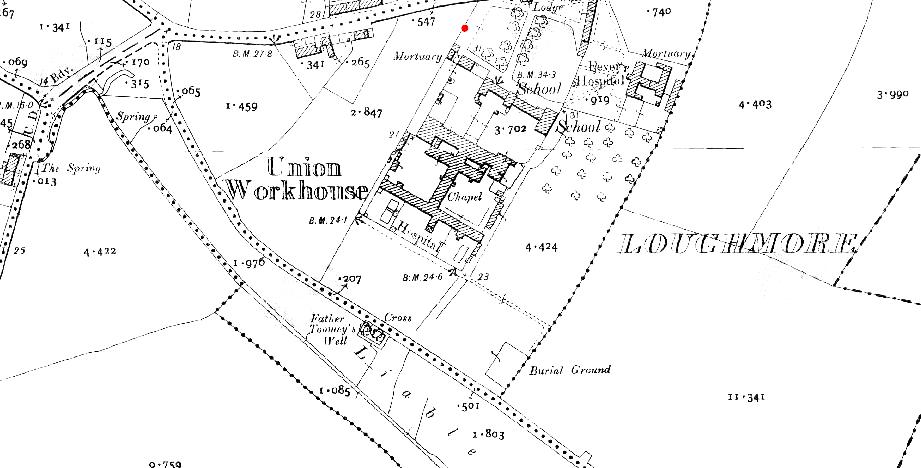
The well was not marked on the 1st ed. (1841) OS 6-inch map for the area. The wells absence from the map combined with the folklore evidence may suggest that the well came into existence around this date. The well was marked as a rectangular enclosed area along with a cross on the 2nd ed. (1905) OS 6-inch map and the 25-inch (1907) OS map and named as Father Twomey’s well.
Father Twomey’s well located outside the walls of the old Work House on the 25-inch (1907) OS map
Today the well is a sad sight, devotion has long ceased the cross marked on earlier maps no longer survives. The outer wall was destroyed by a truck some years back and the council later widening the road extending the road into part of the well. What survives is covered in concrete and has a rather ugly appearance. In its current position it is hard to imagine that this was once a pilgrimage site and I couldn’t help but wonder what it looked like in times past. I am going to see if I can find out any more about the well and will keep you posted.
References
The Schools Collection, Clochar na Trócaire, Dúngarbhán (roll number 11461) Volume 0645 pages 0055-59 (logainm.ie/en/49483)
Sliabh na Calliagh Passage Tomb complex is one of Ireland’s finest prehistoric archaeological sites. I am delighted to present a guest blog by the wonderful Lynda McCormack that explains the archaeological significance of the complex and its role in the autumnal equinox. Lynda is currently carrying out Doctoral Research at the Department of Archaeology at NUI Galway and Sliabh na Calliagh is one of her study areas.
The Autumnal Equinox and the Sliabh na Calliagh Passage Tomb Complex By Lynda McCormack
Introduction
The Sliabh na Callaigh Passage Tomb Complex often referred as the Lough Crew Complex is located in the north west of County Meath on a raised ridge of lower carboniferous limestone which erupts in four individual summits known as Carnbane West, Newtown hill, Carnbane East and Patrickstown Hill. The central and highest hill within this ridge is Carnbane East. At a height of 274m this is the highest point in County Meath and from this position in the landscape it is allegedly possible to view up to 18 counties on a clear day.
A map of the Sliabh na Callaigh Complex showing the distribution of monuments (McMann 1995).
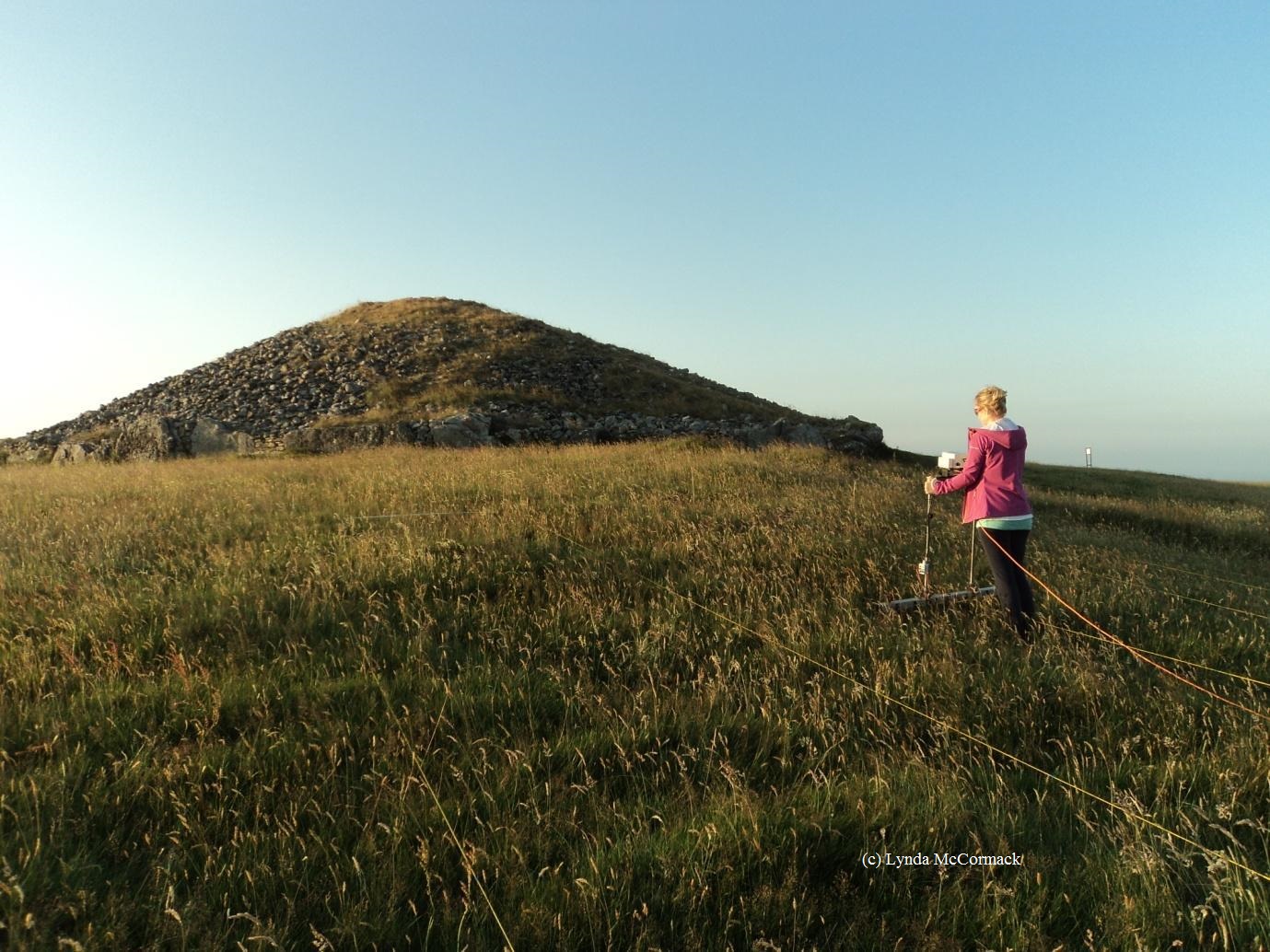
There are 31 archaeological monument found on the heights of summits and low valleys within this area. Antiquarian accounts of the area suggest there may have been many more monuments here with some dismantled in the past for the construction of walls in the 1800’s. Recent geophysical investigations which involve non invasive scanning of the ground to detect the signature of sub surface remains have clarified the pattern of monument distribution with the result that it is now possible to speculate that the arrangement of space within the Complex may have been quite different in the Neolithic (McCormack 2010, 2012, 2013, 2014).
Lynda carrying out geophysical survey on the southern extent of Carnbane East.
Folklore and Origin legends
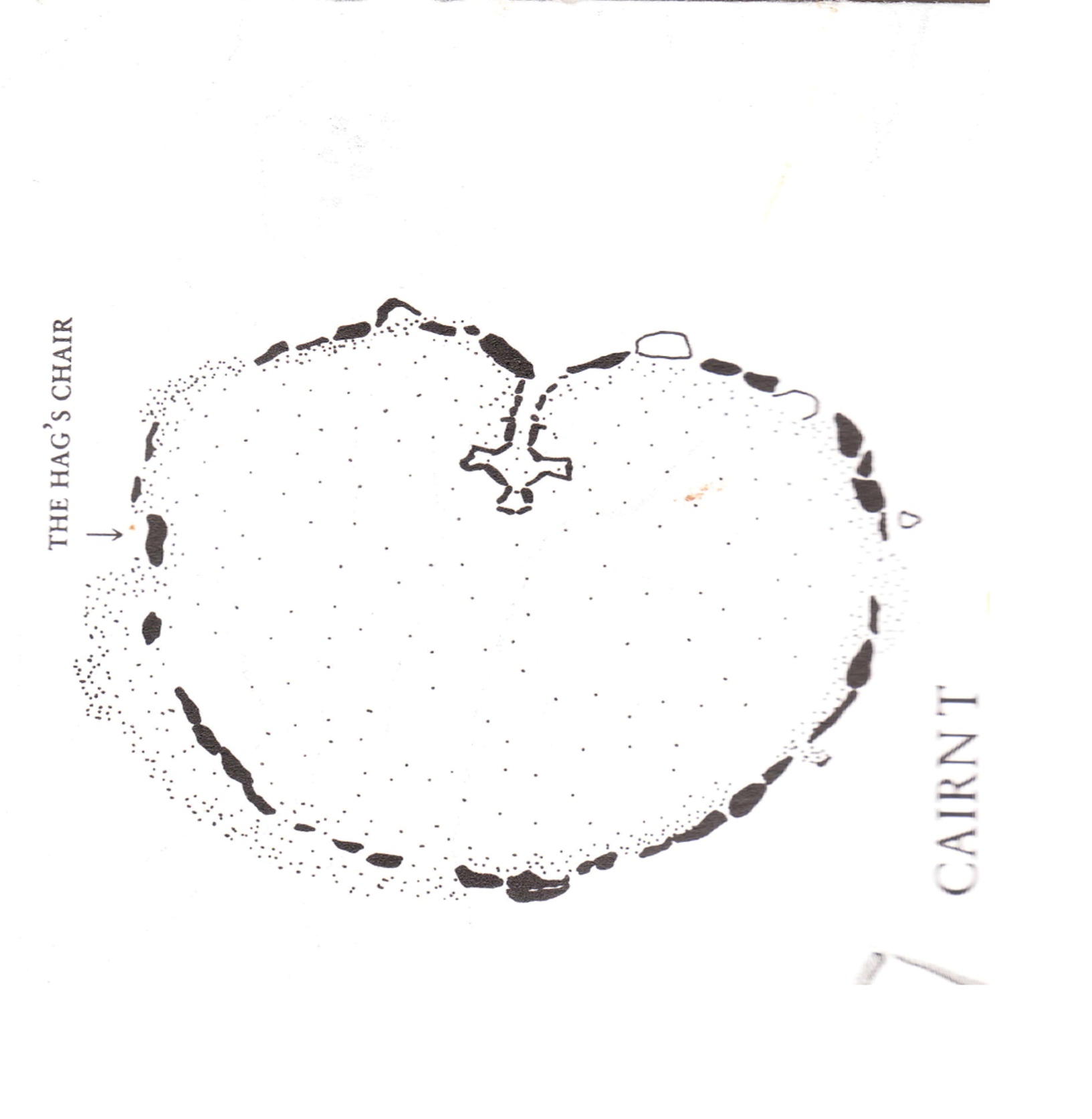
The name Sliabh na Calliagh translates as the hills of the Witch and references a local explanatory narrative which attributed these enigmatic stone heaps to a mythological Cailleacht/Witch who allegedly dropped these stones from her apron as she jumped from hill to hill in her quest to rule all of Ireland. She apparently fell to her death on the lower slopes of Patrickstown hill but not before dropping these stone cairns in her wake. The detail inherent in these stories suggests that the locals who perpetuated these narratives were familiar with the distribution of sites across the ridge. Not only is the site named after her, one of the distinctively shaped kerbstones on the northern face of one of the largest monuments Cairn T is named the Witches’ chair and it is thought that if she had succeeded in her quest then this particular stone could have functioned as her throne.
Cartoon of the caillech/withch dropping the stones from her apron after (Eibhlin Nu Sheinchin 1937).
Determined now her tomb to build, Her ample skirt with stones she filled,
And dropped a heap on Carnmore; Then stepped one thousand yards, to loar,
And dropped another goodly heap; And then with one prodigious leap
Gained Carnbeg: and on its height, Displayed the wonders of her might. (Jonathan Swift 1700).
Drawing of the hag’s chair from the Discovery of the Tomb of Ollamh Fodhla (Conwell 1973)
Passage Tomb Complexes and Passage Tombs
The Sliabh an Calliagh Passage Tomb Complex is one of our four major Irish Passage Tomb Complexes. There are over 236 of these monuments in Ireland, many of which appear within these four main concentrations. While many other Megalithic structures such as the Court Tomb, Portal Tomb and Wedge tomb most commonly appear in isolation. The Passage Tomb monument type is distinctive for its appearance in groups. These groups are commonly referred to as Cemeteries but are most accurately referred to as Complexes because a burial role can only have been one small part of their ritual usage. The most famous Irish Passage Tomb Complex is undoubtedly the Boyne Valley Complex where Newgrange and Knowth have been extensively excavated and reconstructed to facilitate tourist access via the Bru na Boinne visitor center in Donore Co. Meath. The two complexes in Co. Sligo are known as the Carrowkeel/Keashcorran Complex and Cuill Irra and both of these have been subjected to multiple research initiatives including excavation over the years. The Carrowmore distribution which is central to the Cuill Irra Complex is also accessible via an OPW visitor centre.
Plan of Cairn T plan showing the location of the hag’s chair (McMann 1995)
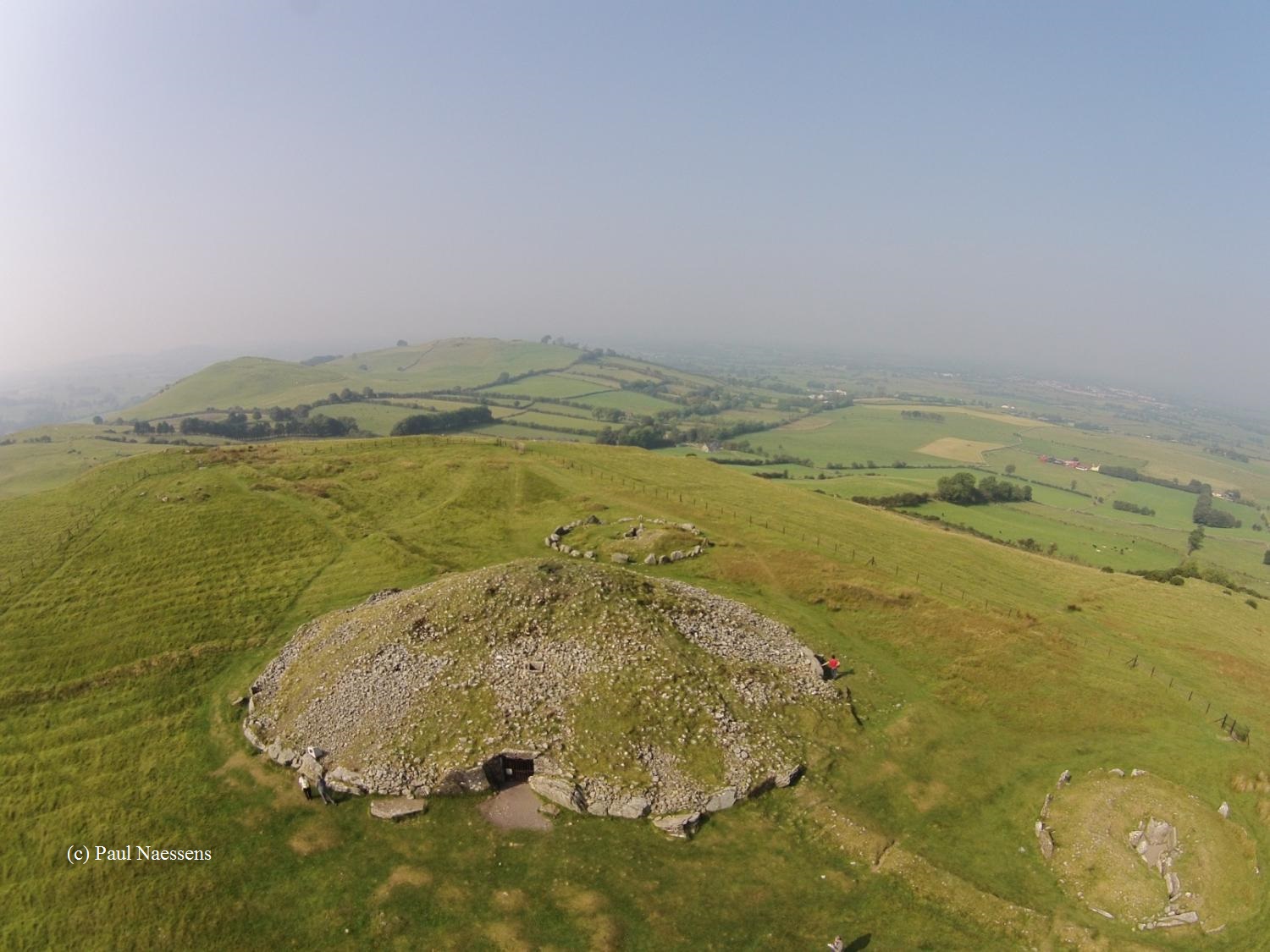
Passage Tomb monuments are named for the presence of a long passage which leads to a chamber which is concealed within a cairn of stones and retained by a kerb line of boulders. There is much variation in terms of size and while some monuments are small and compact and may never have facilitated human entry others are large and complex and appear to have been constructed to be as impressive as possible to a spectator.
Photograph by Paul Naessens Cairn T centrally placed on Carnbane East with Cairn U to the right and Cairn S in the background.
They date to the Neolithic period c. 3000BC and are complex ritual structures within which cremated human remains were carefully deposited. Although human bone is usually within these structures, they were not just built to contain to remains of the dead. These structures were built with ritual and used with ritual an in many instances excavation has revealed a series of foundation events which predate the structures suggesting that the very positions which they occupy within the landscape were of importance long before they came to be monumented in reflection of this in the Neolithic.
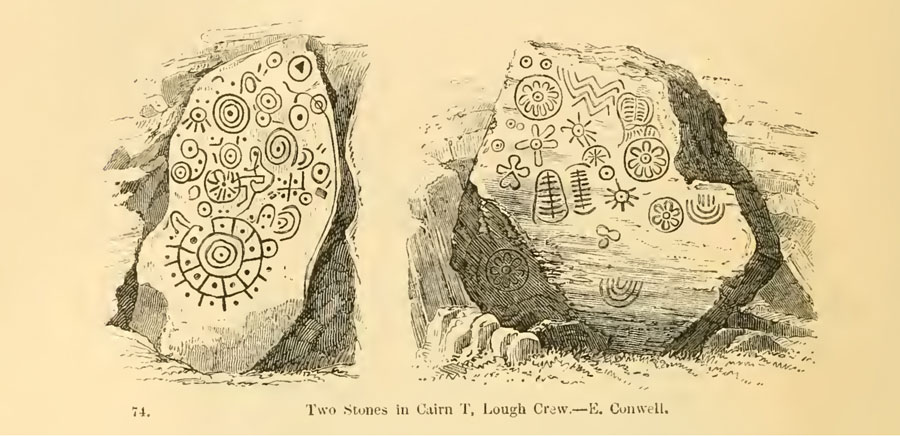
The Sliabh na Calliagh Passage Tomb monuments were brought to prominence by local school inspector Eugene Alfred Conwell in 1863 after a fortuitous visit to the summit of Carnbane East. It is most likely that the monuments were already well known to the locals and possibly also further afield but their significance was not understood or contextualised within the Irish Passage Tomb Tradition until Conwell began his investigations. He thoroughly searched the ridge and the surrounding hinterland and carefully documented each monument and implemented an identification scheme by which the individual monuments are still known today. Following his detailed field walking he undertook a series of investigations focused specifically on the recovery of human remains and the careful recording of each decorated surface. His records are of great value particularly because much of this art has been badly damaged and is no longer visible. Conwell also presented his findings to the Royal Irish Academy on numerous occasions and was responsible for the publication entitled The Discovery of the Tomb of Ollamh Fodhla. His research was conducted in the style of the time where different questions were asked of the data and so very little attention was paid to stratigraphy. Despite this however, Conwell was an industrious student and not only are his records detailed they are thoroughly engaging as he describes how he conducted his investigations under the watchful gaze of a number of ‘fine ladies’. Although the Sliabh na Callaigh Passage Tomb Complex is well known for its Neolithic Passage Tombs, it is a multi-period landscape which includes evidence for Mesolithic, Bronze Age and Iron Age activity extensively focused on the landscape to the north of the ridge.
Multiperiod Sliabh na Calliagh (McCormack 2010)
The Equinox at Cairn T Sliabh na Calliagh
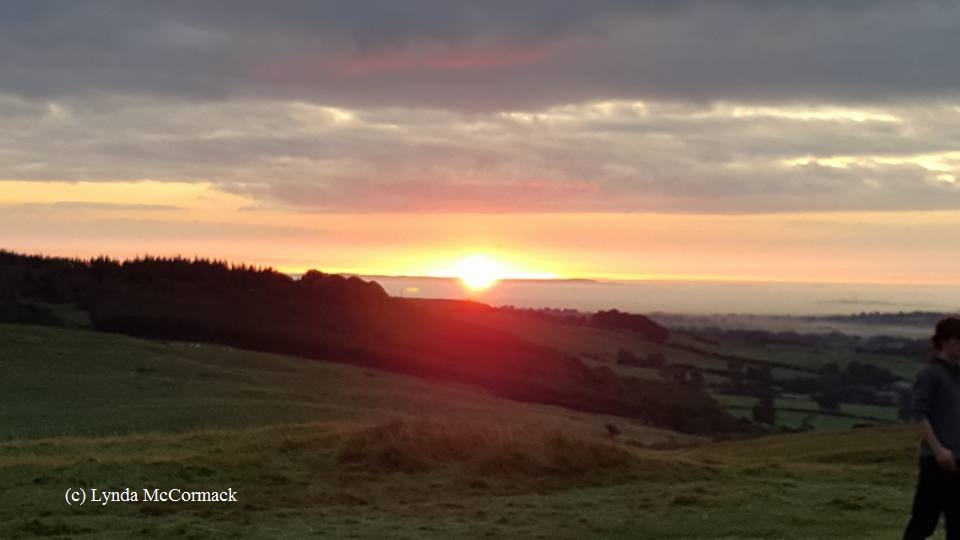
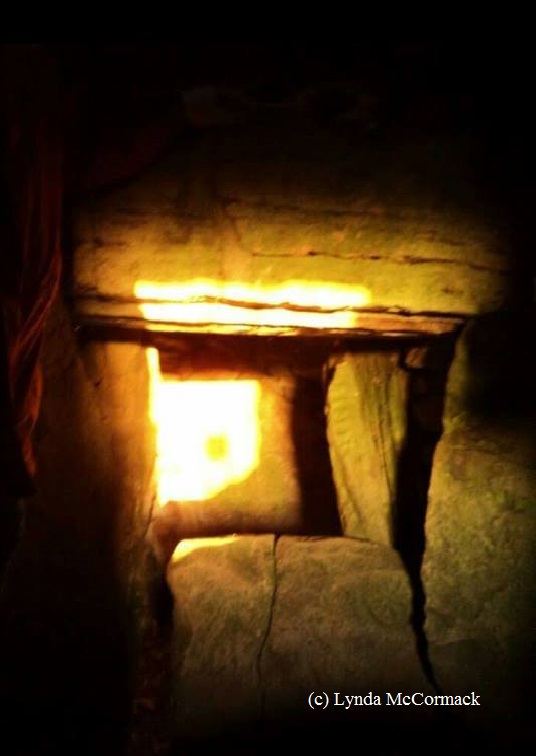
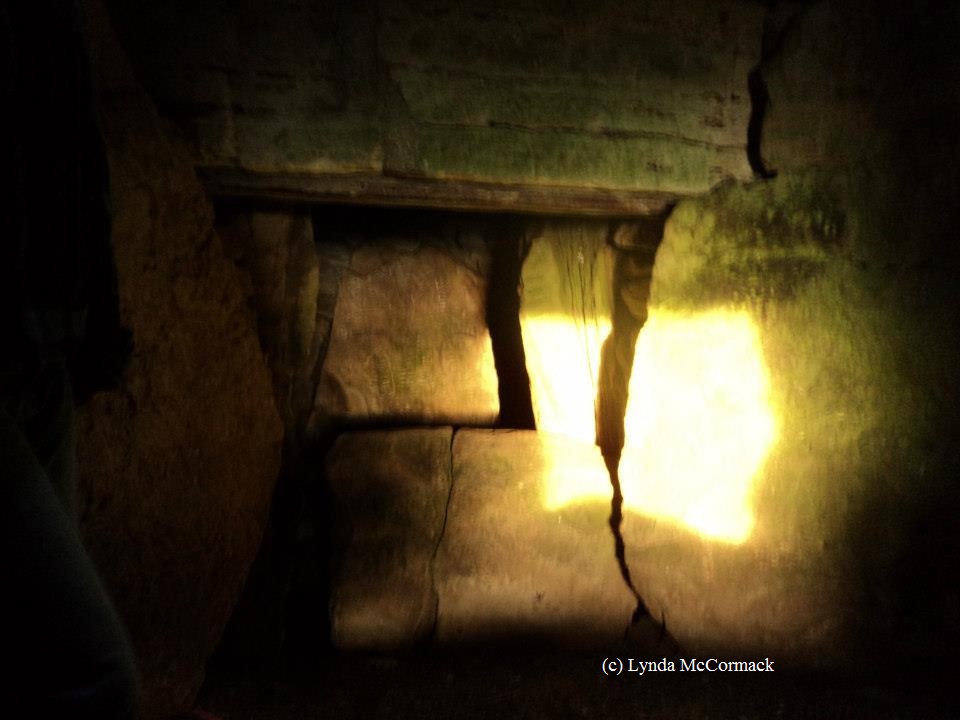
Many of the passage tombs on the height of the ridge are orientated towards the east and Cairn T in particular is carefully positioned with the effect that it captures the rays of the rising sun on the mornings of the Equinox in March and September. This alignment takes place over the course of five mornings and lasts for up to 30 minutes provided that the sun can penetrate the clouds.
Facing the rising sun on the 21st September 2015
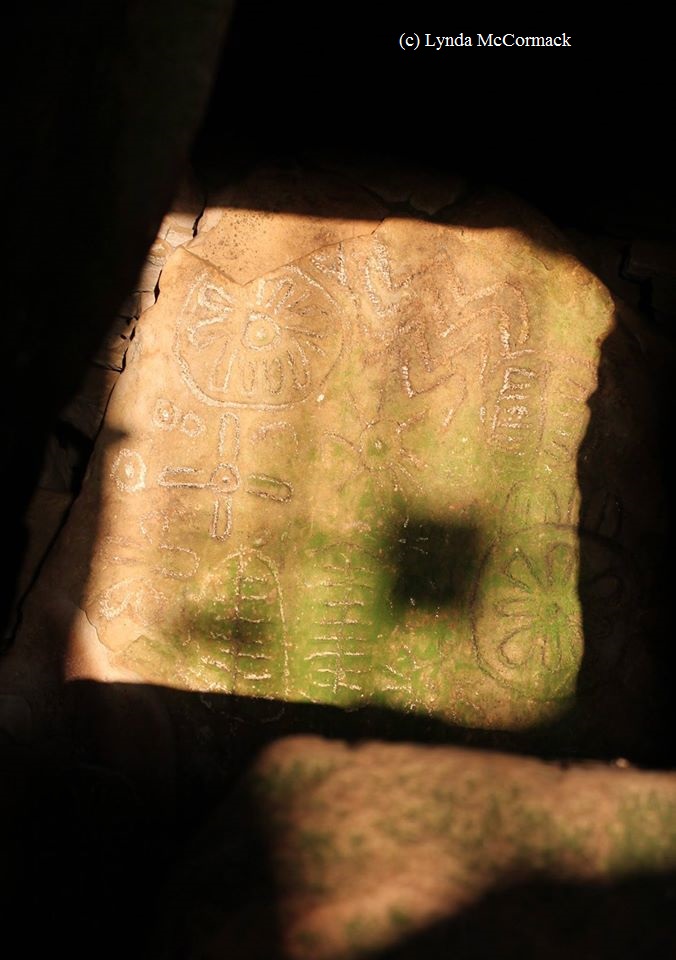
Having visited the Equinox for over 15 years myself, I can say that it is easier to see it in March around 6am in comparison to September around 7am when the weather can be a little more unpredictable. Each year on the mornings of the Equinox, hundreds of tourists climb Carnbane East in the dark to watch the sun rise and to access Cairn T where they can watch the light travel over the floor space of the passage until it eventually reaches the highly decorated backstone which is directly aligned with the entrance portal.
The illumination at 6.30AM
Illumination at 7.05AM
Those who enter the chamber of Cairn T on the mornings of the Equinox can watch the sunlight trace its decorated path across the surface of the stone, starting in the top left hand corner and moving right in front of their eyes until it comes to rest on the chamber orthostat to the right of the recess.
The illumination at 7.10AM
Interestingly, the quality of the light changes as it moves across this stone, as the sun rises. The colour of this light also changes from a deep red to a vibrant golden yellow.
The illumination at 7.30AM
The decorated backstone has been extensively studied and Shee Twohig (1981) notes that the ‘sunburst motif’ which is illuminated by the sunlight on the mornings of the Equinox is not found elsewhere within the Complex or within the Irish passage Tomb Tradition.
Illumination at 7.15AM, the light showing the decoration on the backstone.
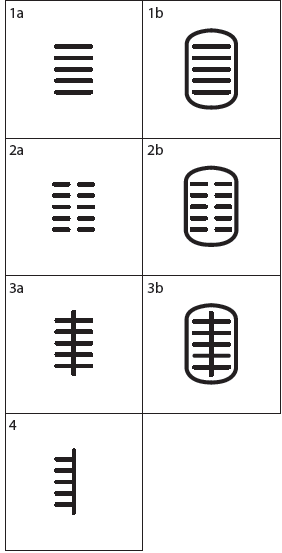
Within Cairn T in particular there are 19 decorated orthostats, 2 decorated sill stones, 8 decorated roof stones and one decorated kerbstone known as the Witches’ chair (Shee Twohig 1981, p. 214). Another interesting motif which is found on the surface of this stone is the offset motif which is also known as the scaliform motif (Robin 2008), Robin’s recent research into the structured placement of megalithic art within Passage Tomb monuments has shown that this particular motif is commonly found in association with entrances and sill stones and places of transition within the monument.
The Scaliform motif (Robin 2008) Decorated back stone Cairn T (Conwell 1873)
Antiquarian sketch of decoration back stone cairn T
Its appearance here on the backstone is potentially indication of a metaphorical transition seeing as it is not possible to physically move thorough this space. Perhaps the presence of this motif on this surface is also connected to the transition of the sunlight across the surface of the stone. Megalithic art is commonly referred to as abstract art. There are multiple interpretations of what the individual motifs might represent and each interpretation is a valid as the next but it is impossible to be sure of the true meanings affixed to the individual motifs. One thing is certain though, this art was undoubtedly integral to the ritual experience of the site and undoubtedly had a deep meaning for those who constructed and used these spaces in the Neolithic.
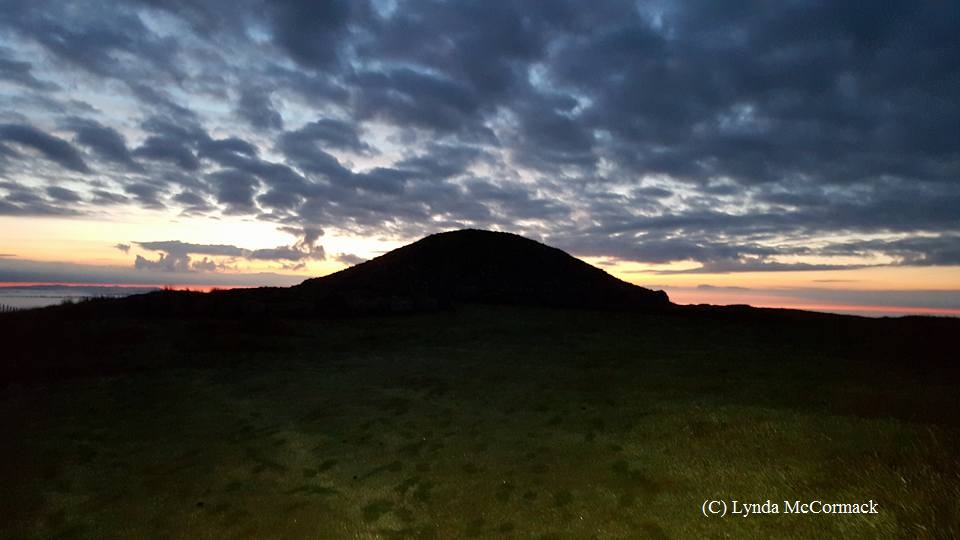
Cairn T photographed from the west on the morning of the Equinox 21st September 2015.
Visiting Sliabh na Calliagh
The central hill of the Sliabh na Calliagh Passage Tomb Complex known as Carnbane East is state owned and access can be gained free of charge to this site throughout the year. The key to Cairn T can be obtained from a local coffee shop and so access is facilitated to this monument even after the OPW have withdrawn their tour guiding presence which extends throughout the summer months .This Monday on the 21ST of September at 7AM hundreds of us made our twice yearly pilgrimage to the heights of Carnbane East in the dark hoping to experience the sun light trace its decorated path across the backstone of Cairn T. In doing so we were potentially re-tracing the footprints of our Ancestors who constructed these monuments 5000 years ago who may have climbed this hill with comparable anticipation. Those who made the trip this year were rewarded by the sight of a sunrise from the highest vantage point in County Meath, We were also rewarded by the sight of the sunbeams carefully captured within the monument for this short period of time.
We will gather again in March 2016 for the Vernal Equinox which marks the return of the light and the lengthening of the days but until then we are left with an evocative image of how these monuments may have been used to measure the passing of time in the Neolithic.
You can keep up todate with Lynda’s research on twitter at @LyndaMcCormack1 and on academia.edu
This slideshow requires JavaScript.
References
Conwell, E. 1873. Discovery of the tomb of Ollamh Fodhla. Dublin, McGlashan &Gill.
McCormack, L. 2010. A Comparative and Multiperiod Landscape Analysis of the Sliabh na Callaigh Hills. Unpublished MA Thesis. NUI Galway.
McCormack, L. 2012. A Geophysical Investigation of the Sliabh na Callaigh Passage Tomb Complex Phase 1. Unpublished report NUI Galway
McCormack, L. 2013. A Geophysical Investigation of the Sliabh na Callaigh Passage Tomb Complex Phase 2. Unpublished report NUI Galway.
McCormack, L. 2014. A Geophysical Investigation of the Sliabh na Callaigh Passage Tomb Complex Phase 3, Unpublished report NUI Galway.
McMann, J. 1995. Loughcrew the Cairns a Guide, Meath, After Hours Books.
Robin, G. 2008. Neolithic Passage Tomb Art around the Irish sea Iconography and Spatial Organisation. Unpublished Ph.D thesis, Nantes.
Shee Twohig, E. 1981. The Megalithic Art of Western Europe. Oxford, Clarendon Press.
I am delighted that Pilgrimage in Medieval Ireland has been short-listed in the best Arts and Culture category in the blog awards Ireland.
A big thank you to the people who nominated the blog I still cant believe I have gotten this far. Also thank you to everyone who supports and reads this blog.
Part of the judging process is a public vote so if you’d like to vote for the blog just click here. I have also added links to the voting areas in the blog’s sidebar.
Within the church is the Shrine of Our Lady of Dublin. The shrine contains a very fine medievalstatue of the Blessed Virgin and Christ Child. I had to use my phone to take the photos but below is they are a little blurry but I hope they give you a sense of the statue and inspire you to pay a visit.
Shrine of Our Lady of Dublin
The statue of 15th century date originally belonged to the Cistercian abbey of St. Mary’s located on the north bank of the Liffey in Dublin.
The statue is life-sized and carved of oak. It was originally brightly painted and traces of gold and bright blue polychrome were found in its crevices until the early part of the last century. It was whitewashed over at a later date.
During the Reformation, St. Mary’s was dissolved in 1539 and stripped of all its valuables and treasure. The statue survived but it was said that it was used as a pig trough in the yard of an inn beside the monastery. The statue was laid face down, and hollowed out back a common feature of medieval stature faced upward and formed the make shift trough.
Our Lady of Dublin
The statue was later mentioned in an account of the Catholic chapels of Dublin written in 1749 suggesting it was rescued from the yard and its new domestic role in the years that followed.
In Mary’s Lane is a parochial chapel whose jurisdiction extends from one side of Boot Lane to one side of Church Street. It is a large and irregular building. On the Epistle side of the altar stands a large image of the Blessed Virgin with Jesus in her arms, carved in wood; which statue at the dissolution belonged to St. Mary’s Abbey (MacLeod 1947, 56).
The Mary’s Lane chapel no longer survives and was located at St. Michan’s House. In 1816 a new church was built for St. Michan’s parish and the old chapel was converted for use as a school.
The statue seems to have made its way to a second-hand shop on Capel Street. Father Spratt of Whitefriars saw the statue in the shop in 1824 and purchased it. He had the statue placed on the Epistle side of the high altar in the new Whitefriars church. In 1915 the statue was sent for cleaning and all traced of white wash and medieval paint were removed. When the statue was returned it was placed in a new elaborate marble the shrine erected in the Carmelite church.
Prayer to Our Lady of Dublin
The statue is still visited today and the feast day of Our Lady of Dublin is celebrated on September 8.
References
MacLeod, C. 1947.’Some Late Mediaeval Wood Sculptures in Ireland’. JRSAI, Vol. 77, No.1, 53-62.
Pochin Mould, D. 1964. Whitefriar St. Church: A Short Guide, by Daphne.
Carmelite Publications. Dublin.
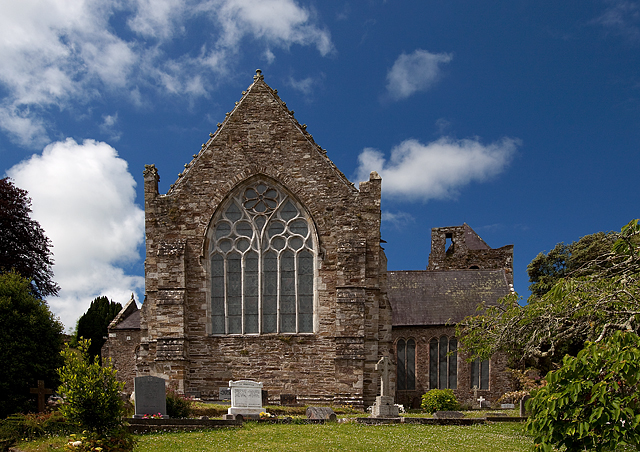
Last week I was lucky enough to go on a guided tour of the St Mary’s Collegiate Church in Youghal. The tour was led by archaeologist Dan Noonan. The church is an amazing building, filled with many interesting features and I highly recommend a visit.
St Mary’s Collegiate Church
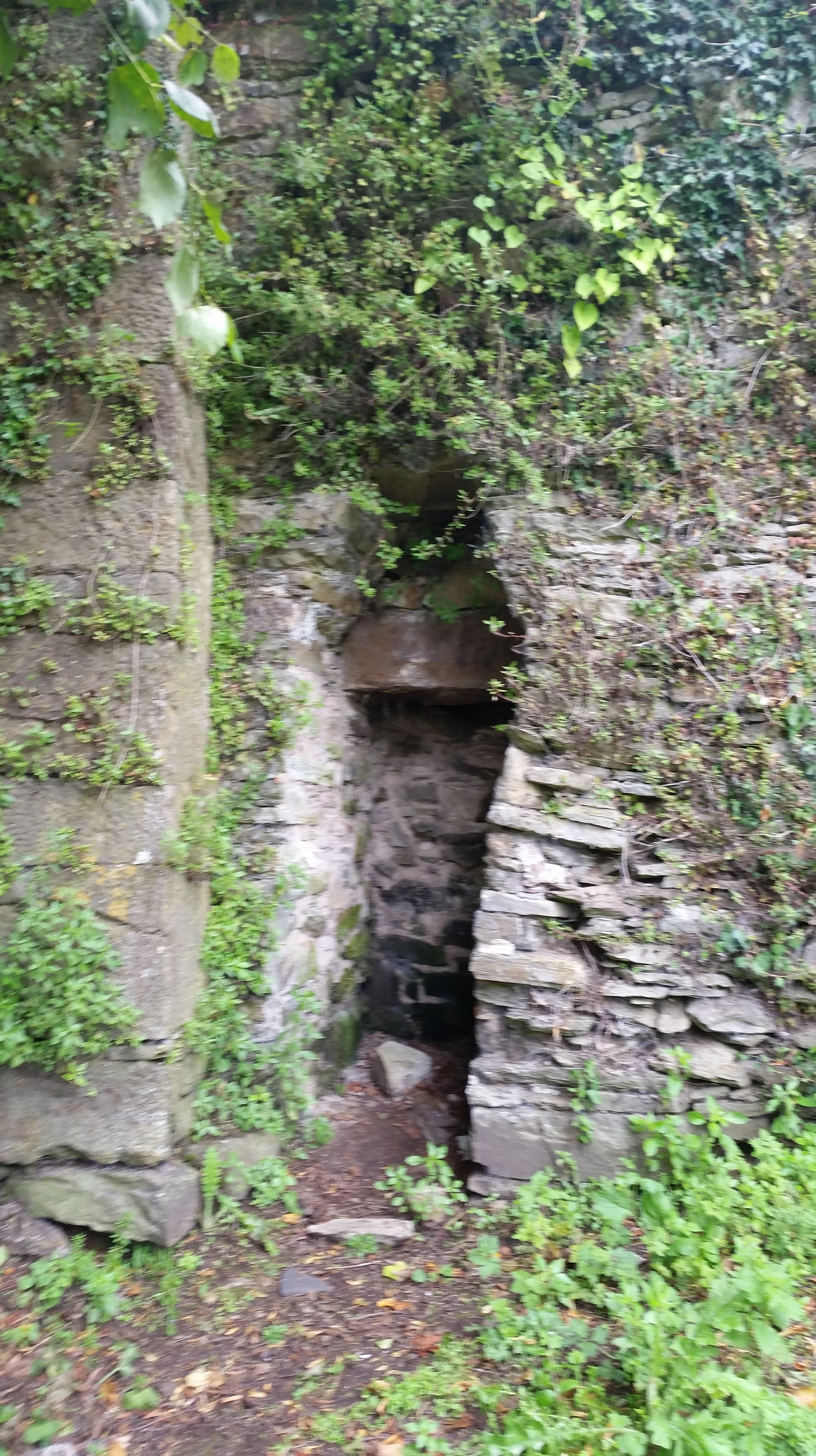
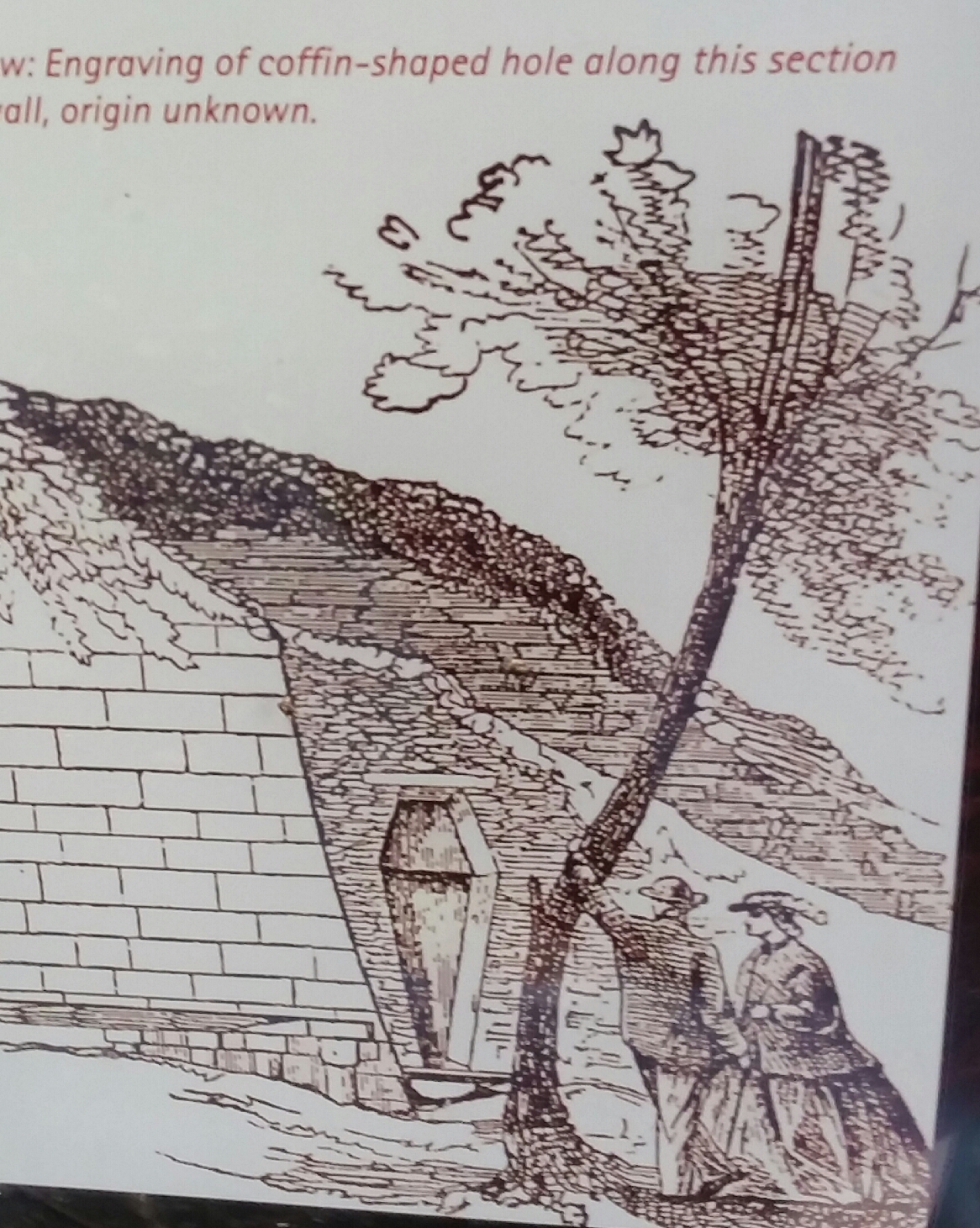
The church is surrounded by a really interesting historic graveyard located in the north-western corner of the town walls. The graveyard has a very unusual and interesting feature. This is a coffin-shaped recess built into the town walls. Tradition has it the recess was used to hold a coffin for pauper burials. Those who could not afford a coffin were place within this coffin temporarily during the burial process.
Recess for coffin in the graveyard wall of St Mary’s Collegiate church Youghal
The deceased was carried to their grave in this coffin and then they were removed and placed in the grave. The coffin was then returned to the wall to await the next burial.
Engraving of the coffin-shaped recess dating to the 19th century
Id be really interested to know if anyone has come across anything similar at other graveyards.
















 Pilgrimage In Medieval Ireland